Book review

Carpe Jugulum (Discworld 23) by Terry Pratchett, 1998

We have, it has to be admitted, been here before. Lancre, to be specific, the mountain home of Terry Pratchett’s wonderful witches, the awesome Granny Weatherwax, Nanny Ogg, Magrat Garlick, and Agnes Nitt. (And yes, that’s four witches, which is one too many, and a bit of a problem). Magrat, recently married to King Verence, has had a daughter, and people from far and wide have been invited to the christening. Unfortunately for all concerned, in an attempt to be progressive Verence has invited guests from Uberwald, a neighbouring kingdom inhabited by vampires. The vampires, once invited into the castle, begin to take over and snack on the locals. The witches are not standing for this of course, and battle begins.
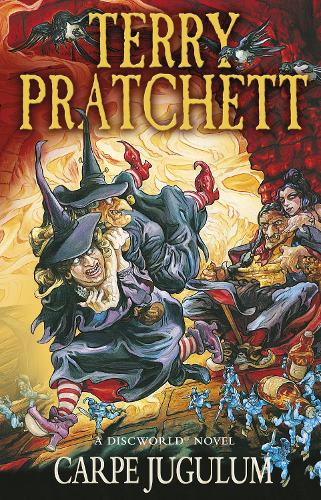
Carpe Jugulum - Discworld Novels (Paperback)

If you have been paying attention, and why would you, bells will start ringing at this point. Isn’t this pretty much exactly the plot of Lords and Ladies (Discworld 14) published some six years earlier? Superficially charming but sinister and other-worldly villains are accidentally invited into Lancre, take over, and battle with the witches? Pretty much.

The good news is that all this doesn’t matter in the slightest. Shakespeare recycled plots freely and unapologetically, so why couldn’t Sir Terry? Any time spent with the profound moral philosopher that is Granny Weatherwax, Pratchett’s finest creation, is time well spent, even if we have been here before. And this is a very brave book – not many fantasy writers would go to the dark places that Granny visits when she is called out to a difficult home birth, and is faced with the choice of saving the mother’s life or the child’s. When Mrs Patternoster, the local midwife, suggests the choice of who to save should have been offered to the husband/father, Granny replies:

You don’t like him? You think he’s a bad man? ,,,Then what’s he done to me, that I should hurt him so?”

Granny takes the pain of the decision, both literally and psychologically, on her own shoulders, so that others might not have to. This is such a shockingly brave and moving scene, showing how hard and sometimes lonely the lives of the witches are.

Another fresh feature to this story is the character of Mightily Oats. or more specifically the Quite Reverend Mightily-Praiseworthy-Are-Ye-Who-Exalteth-Om Oats, an Omnian missionary priest called in to officiate at Magrat and Verence’s daughter’s naming ceremony in the absence of the local priest who has been injured in a fall from a donkey. Oats is one of the ordinary-man characters Pratchett writes so well. He is devout in his faith in Om, but questions some of the teachings of his schismatic church. He is determined to do the right thing, even confronting vampires, when his every instinct is to run away. This is Mightily’s coming of age story. He starts the novel as a callow, frightened priest amongst the heathen folk of Lancre, particularly (and rightly) scared of the local witches. By the end of the novel he has earned their grudging respect, and slowly come to terms with his religion.

“Even when he was small there’d been a part of him that thought the temple was a silly boring place, and tried to make him laugh when he was supposed to be listening to sermons. It had grown up with him. It was the Oats that read avidly and always remembered those passages which cast doubt on the literal truth of the Book of Om—and nudged him and said, if this isn’t true, what can you believe?

And the other half of him would say: there must be other kinds of truth.

And he’d reply: other kinds than the kind that is actually true, you mean?

And he’d say: define actually!”

Carpe Jugulum also features the first appearance of the wonderful wee free men, the Nac Mac Feegle. The Feegles are a force of nature, and another fantastic addition to the Discworld universe, who of course were to go on and feature in their own series of novels. Scrivens!

Carpe Jugulum also features an Igor. I am not sure if this is the first appearance of Igor’s in Discworld (I think it might be) who is the servant of the invading vampires, and a part-time plastic surgeon of considerable skill. He is a traditionalist who spends his spare time breeding spiders, making sure the doors creak eerily, and generally trying to keep the old ways alive. Igor’s ancestral home is Dontgonearthe Castle, which tells you as much as you need to know about some of Pratchett’s jokes.

By now Discworld is a richly featured landscape full of much-loved characters with extensive backstories. This makes immersing yourself into a novel like Carpe Jugulum a wonderfully comforting and entertaining experience.
Standard
Book review

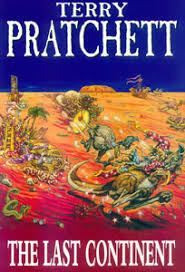
The Last Continent (Discworld 22) by Terry Pratchett, 1998

Discworld novels are often divided into a number of sub-categories – the Watch, Witches, Death, and so on. Of these by far the weakest group are those featuring Rincewind, the world’s worst wizzard, and within that group, I am sorry to say, The Last Continent is the least interesting and entertaining.

The novel can’t really be said to have a plot. It has two, and they are not very well integrated. In one, following shortly after the events of Interesting Times, Rincewind is magicked away to Xxxx, a thinly disguised Discworld version of Australia. He wanders around the outback for the rest of the novel encountering just about every representative feature of Australia you could mention – if it is a cliche about Oz, it’s there. There’s a certain relentlessness about Pratchett’s approach to this, almost as if he had to include every last possible thing he had ever read or heard about the continent. Weak lager, check, Skippy the Bush Kangaroo, check, Waltzing Matilda, Ned Kelly, peach melba and the Sydney Opera House, to name just a very few of the dozens of archetypes packed in. Rincewind is so heavily protected by plot-armour at this stage that the chances of anything interesting happening to him are non-existent – instead everything happens around him, and he passes serenely through unaffected.

The Last Continent - Wikipedia

The parallel plot features the wizards of Unseen University. Their search for someone who can help cure the Librarian, suffering from a form of morphic instability in which he keeps transforming into random objects, leads them to try and track down Rincewind, once the Librarian’s assistant. In the rooms of the Egregious Professor of Cruel and Unusual Geography they find a window in space leading to a tropical island. They pile through but of course get trapped when Mrs Whitlow, the University’s head of Housekeeping and the nearest thing the UU has to a sex-symbol, closes the window leading back to the university.

This is no typical tropical island. Cigarette plants, chocolate coconuts and spoon bushes pass unquestioned, but the arrival of a dinosaur that evolves into a chicken and a boat made from a plant lead even the usually phlegmatic wizards to wonder what is going on. The resident god of evolution turns up. and it gradually becomes apparent that not only have the wizards travelled a long way in space, they have also travelled far back in time, to when the world was being designed and assembled. Their suggestions – for example for sexual reproduction, are enthusiastically adopted by the god and lead to the Discworld as it becomes.

This is a thin foundation for a novel. The Australian cliches pile up irritatingly, and you end up waiting for the next one to turn up (Priscilla, Queen of the Desert, check, duck-billed platypus, check, the Dreaming, check). I felt Pratchett kept throwing new Xxxx items at the book to try and distract the reader from the underlying absence of anything approaching a plot. The fun with creation myths never really takes off – it’s mildly diverting, nothing more. Pratchett published two novels a year most years for almost twenty years, so a dud was always a possibility, but they are still a disappointment when they crop up, as they inevitably must. It’s not that I actively disliked The Last Continent, just that I didn’t love it. Some, perhaps much of that is down to Rincewind – he’s just not that entertaining a character, and he doesn’t have any relationship (except, I suppose, with the Luggage) to help carry the burden.

The Last Continent does however contain one of Pratchett’s greatest, if most cynical, quotes:

“We put all our politicians in prison as soon as they’re elected. Don’t you?”

“Why?”

“It saves time.”

Clown Town by Mick Herron, 2025

Clown Town by Mick Herron, 2025 Clown Town is the ninth novel in Mick Herron’s Slow Horses series, which you may be more familiar with as the television series featuring Gary Oldman. In addition to the nine sequential novels there are also seven other novels set in the Slow Horses ‘universe’ giving the background stories…

James, by Percival Everett, 2024

James by Percival Everett, 2024 It is a simple coincidence that I followed a reimagining of Hamlet (in Tom Stoppard’s Rosencrantz and Guildenstern are Dead) with Percival Everett’s 2024 novel, James, which reimagines Mark Twain’s Adventures of Huckleberry Finn from the perspective of the enslaved Jim. Before reading James I reread my review of Huck…

Rosencrantz and Guildenstern are Dead by Tom Stoppard, 1966

Rosencrantz and Guildenstern are Dead was the answer to a question on University Challenge last month – and that was enough of a reminder that I absolutely loved this play and that I ought to revisit it, especially as I had promised myself that I would read more plays this year. I warmed up by…

Standard
Book review

Part of the unwritten contract between authors and their readers is that we agree to suspend our scepticism for the duration of the novel. We know we are being told a story, that the events described didn’t ‘really’ happen and the characters never lived, but nevertheless we put our disbelief to the backs of our minds and go along with the idea that they did. In return the novelist will either take us somewhere we could never go in real life – to the Moon and Back, to the Centre of the Earth – or will portray a realistic scene that could, in theory, have happened. Realistic novels depend on a degree of authenticity. They don’t need to be hyper-real; we don’t really care if some of the fine detail of the recreation doesn’t stand up to academic scrutiny or for minor historical inaccuracies. The test is does it feel real. In A Room of One’s Own Virginia Woolf discusses this issue, using the term ‘integrity’ to describe this aspect of writing:

‘What one means by integrity, in the case of the novelist, is the conviction that he gives one that this is the truth. ..It is rather that Nature, in her most irrational mood, has traced in invisible ink on the walls of the mind a premonition, which these great artists confirm; a sketch which only needs to be held to the fire of genius to become visible.’

Readers will have their own standards and criteria for deciding which authors achieve this standard, who have the ability to reveal to us the truth. But the opening paragraph of Penelope Fitzgerald’s The Gate of Angels struck me as being particularly inauthentic, and I thought it might be useful to examine why. Inauthenticity in a realistic novel, when there is no suggestion that the author is deliberately breaking the literary equivalent of the fourth wall (for comic effect, for example, or to emphasise that this is, after all, just fiction) is for me a cardinal sin.

The Gate of Angels opens with this vivid, comedic description of a storm:

“How could the wind be so strong, so far inland, that cyclists coming into the town in the late afternoon looked more like sailors in peril? This was on the way into Cambridge, up Mill Road past the cemetery and the workhouse. On the open ground to the left the willow-trees had been blown, driven and cracked until their branches gave way and lay about the drenched grass, jerking convulsively and trailing cataracts of twigs. The cows had gone mad, tossing up the silvery weeping leaves which were suddenly, quite contrary to all their experience, everywhere within reach. Their horns were festooned with willow boughs. Not being able to see properly, they tripped and fell. Two or three of them were wallowing on their backs, idiotically, exhibiting vast pale bellies intended by nature to be always hidden. They were still munching. A scene of disorder, tree-tops on the earth, legs in the air, in a university city devoted to logic and reason.”

How, one might also ask, could an author get an opening paragraph so badly wrong, so profoundly inauthentic?

This paragraph is often quoted by reviewers, cited as either an example of Fitzgerald’s powers of descriptive writing, or her comedic genius, sometimes both. One online review describes it “as compressed as poetry—and funny, too”. But when I read it I was struck by its dishonesty, the obvious way that it has been constructed to make a fairly clumsy point.

In her biography of Fitzgerald, Hermione Lee claims that Fitzgerald’s inspiration for the opening of the novel came when she saw “through a Cambridge bus window some cows in ecstasy over willow branches that had been broken off by strong winds; she viewed this as an instance of reason giving way to imagination in ‘this orderly University city”. Ah yes, the good old struggle between reason and imagination. I have my doubts. There’s no question that the author is trying to contrast here the wild disordered weather with the serenity of the university, introducing the broader themes running through the novel of the opposition between reason and imagination, science and faith, and so on – strong, traditional themes no doubt, if laid on a bit thick. She is also trying to engage our attention, so we keep reading (not unreasonably) and entertain – the scene is deliberately comic and absurd. But the paragraph is so full of implausibilities and false similes that the point is completely undermined. Instead of contemplating how ridiculous academics can be when blown off course by the powers of imagination, I for one had a far less constructive reaction.

For a start, if the storm is sufficiently strong to blow branches off willow trees, the chances of any cyclists venturing out and about, let alone riding three abreast as they do in a paragraph or two, would be slim. Am I being too serious, too literal here? The simile comparing these distressed cyclists to sailors in peril is I would guess intended to conjure thoughts of the Tempest or Twelfth Night. But it doesn’t really work. Cyclists are not at all like sailors. Can you honestly say when you read that line you had a mental image of a storm-tossed ship? Using metaphor to describe something that is nothing like the thing being described can be effective – the evening in Eliot’s Prufrock is not literally “spread out against the sky, Like a patient etherized upon a table” but we know what he means. But Fitzgerald isn’t T S Eliot. and this comparison just invites the comment “Well they wouldn’t, would they?”.

And then there are these mysterious horned cows and their strange behaviour. Cows can have horns of course. But in a storm would horned cows really toss broken-off branches into the air? The author suggests it is because the leaves (not the branches?) are “everywhere within reach…quite contrary to all their experience”. Now I am not sure if the author ever spent a moment looking at a willow tree, but their predominant feature is their “aspect” whereby their branches brush the ground – often cited as the origin of the “weeping” adjective. But the author needs some explanation for the cows’ behaviour, and this will do as good as any.

But there’s more. Because these disorientated cows get the branches stuck in their horns (somehow). The branches then obstruct their view, and not being able to see properly they trip and fall. Of course they do. The fallen cows then lie there munching idiotically, unable to get up. This is surely a case of an image being asked to do too much work. I suspect what happened here is that the author thought she needed an image of futility and stupidity. Cows with their legs in the air, stilling munching away, will do the job? But how to get the cows on their back? I know, they have tripped over, because they have got branches in their horns which blinded them. Which requires a tree and fallen branches. So working backwards you arrive at the image, rather than the image inspiring the idea.

At which point the author had lost my trust. I had been shown behind the facade to see the author typing away, constructing a laboured image to make a point, all realism and authenticity, all integrity, left behind. The question I was left with was this – was this deliberate? Did the author consciously create an implausible scene of cows and willows to remind the reader that they are reading a novel, an artificial construct in which neither the cows nor the willows, or anything else actually exist? I don’t think so – setting the novel is a real street in a real city, with characters who meet and talk about real historical people suggests otherwise. The author goes to great length to place her narrative in a realistic setting with believable characters. So we are left with what – just clumsy writing? Or worse, dishonest, inauthentic writing? I’m still not sure.

Supplemental: Authenticity in literature with reference to Penelope Fitzgerald’s The Gate of Angels

Aside
Book review

Life of Pi is that rare beast, a post-modernist novel of ideas that is also a wonderful adventure story. In this 2002 Booker prize winning novel Mantel plays with ideas about narrative and the nature of the novel while at the same time keeping the reader fully engaged with an exciting tale of a young man trapped on a lifeboat with only a tiger for company, adrift on the Indian Ocean for over 200 days.Life Of Pi by Yann Martel – Canongate Books

I am guessing you knew that already – the central concept of the novel would once have been a surprising plot twist about a third of the way through, but now the cover illustration, the blurb on the back of the book, and of course the successful film of the novel all means that most readers will know this already. Post-modern might be a label that puts some readers off, but certainly here it shouldn’t. Mantel experiments with form and content within some quite traditional boundaries. This is a novel about an epic journey that stays firmly within the traditions of the genre, a quest for survival where the tension between two antagonists keeps the book in balance. In many ways the novel therefore owes a debt to survival novels going back as far as Robinson Crusoe.

Mantel uses a framing device to open the novel, in which ‘the author’ explains how he exiled himself in India to write a novel about Portugal just before the second world war, and is side-tracked by a meeting with the character who goes on to narrate much of Life of Pi, Piscine Molitor Patel, named after a French swimming pool of all things. Pi grew up quite reasonably resenting his unusual name, and adopts the abbreviated form to avoid the inevitable mockery. He is raised as a Hindu but as a teenager also becomes a Christian and a Muslim, seeing no contradiction in following all three faiths. He is brought up in the family-owned zoo in Pondicherry, once part of a small French territory in coastal India. Seeing political and social problems ahead in India, his father decides to sell the zoo and emigrate to Canada.

Pi is an endearing narrator who tells his story in a very straightforward and engaging way. The chapters in which Pi tells his account of his upbringing are interspersed by descriptions of the author’s interviews with the older Pi, giving glimpses of his settled life in Canada, a world apart from the drama of his youth. Hints are given of what is to follow after what is a fairly happy, prosperous and trauma-free childhood. This reference frame does of course tell the reader that Pi survives being ship-wrecked, which means our interest is engaged in wondering not whether but how he survives. Pi is brought up around the animals of his father’s zoo, and is a quick and resourceful learner, key knowledge and skills that help him survive when the time comes. 

The second section of the novel begins with the fateful journey to Canada on a freighter which is also carrying many of the animals from their zoo being sold to other zoos in north America. The ship sinks suddenly in a storm, and Pi escapes in a lifeboat along with some of the animals from their crates – a hyena, a zebra, and an orangutan. This is never going to end well, and inevitably the hyena kills the zebra and the orangutan. The hyena’s dominance doesn’t last long either, because from under the boat’s tarpaulin emerges another surprising survivor, ‘Richard Parker’, the zoo’s strangely named Bengal tiger. Richard Parker quickly dispatches the hyena, leaving him alone with Pi on the open and lonely seas. 

How is Pi going to survive sharing a small life-boat with a tiger? Surprisingly easily, all things considered. He builds a small raft using oars and life jackets and ties it to the bow of the boat. He sneaks back to the lifeboat periodically to raid its plentiful stores (echoes there of how Crusoe uses the stores and equipment on his shipwrecked ship) and fishes for food, sharing the majority of it with Richard Parker. He has water filtration devices and rain catchers, flares, tinned water and food – even a survival guide. But he quickly realises that keeping a distance from Richard Parker will not be enough – sooner or later he will get peckish and take the short leap to the raft. So he decides to train the tiger as if he was back in the zoo, teaching him to be submissive, using food as a reward, seasickness as punishment, and a whistle for dominance. This seems to work, and Pi and Richard Parker settle down into a unique and bizarre arrangement where the sole aim is survival. 

The novel maintains a strong sense of realism throughout these chapters. There is a focus on the messy practicalities of survival – some of the descriptions of butchering fish and turtles are hard to stomach. But the realism begins to ebb away at the end of this section of the novel. Pi encounters another blind castaway, who tries to kill him but doesn’t get past Richard Parker. Later, they find land, but it is a floating island inhabited by thousands of meerkats. This is a refuge of sorts, but any plans to remain on this island long term are abandoned when Pi discovers its secret – by night it becomes carnivorous, and the meerkats only survive by hiding in the trees. The end of the adventure comes suddenly and without fanfare. The lifeboat washes onto a Mexican beach and Richard Parker disappears into the jungle, leaving Pi to recover with the help of some bemused locals.

The third part of the novel is a form of epilogue. Officials from the Japanese Ministry of Transport interview Pi as part of their investigation into the shipwreck. They query the veracity of his story. so he offers them an alternative account in which he is the animals on the lifeboat are replaced with the ship’s cook, a sailor with a broken leg, and his mother. The suggestion is that the principal story has been an allegory for this ‘real’ version of events, which Pi has invented to protect himself from accusations or the psychological burden of cannibalism and murder. This ending, in which the story we have just been told is thrown into doubt by an alternative account, reminded me of the ending of Ian McEwan’s Atonement, where the central story turns out to be fictitious, as if any parts of the novel had a stronger claim on reality than any other. As a device this effectively reminds the reader this is ‘just’ a story, and we choose which to believe. Pi explicitly calls out this choice, and suggests the same principle applies to religion – “And so it goes with God.”

This makes it sound as if Life of Pi is a pious book, but that wasn’t my reading of it. Neither the bizarre carnivorous island nor the “was it all a lie?” ending spoiled the integrity of the central narrative, which was a sustained feat of imaginative story-telling. Pi is a really enjoyable novel which pulls off the challenge of making the long castaway voyage of a teenage boy and a tiger seem believable, while at the same time having something interesting to say about narrative and religion.  Recommended.


Life of Pi, by Yann Mantel, 2001

Aside
Book review

A Room of One’s Own is Virginia Woolf’s celebrated essay on the position of women in society. In this important landmark text in feminist writing, Woolf confronts the central challenges facing women in Britain in the 1920’s, barely a decade after they were first legally entitled to vote in general elections. While ostensibly about the problems of being a woman writer, the essay has much broader themes. Its central thesis (if it can be said to have one – it is quite discursive) is that “England is under the rule of a patriarchy.” The book’s title derives from Woolf’s argument that to address this oppression

“a woman must have money and a room of her own if she is to write fiction”.

Woolf adopts a number of personas to narrate the text, referring to herself in the third person as Mary Beton, Mary Seton, Mary Carmichael “or by any name you please“. These names are not adopted by chance of course – whether Woolf’s audience would have been aware of their historical significance is possibly irrelevant – the use of the forename Mary to represent an everywoman figure has its own resonance. The style of the narrative has been described as stream of consciousness. There are elements similar to this but it is not quite right. Although it has an informal format far from the traditional structure of a lecture or speech and it does wander to a degree, the narrative thread remains clear.

Categorising this book is not easy. I can’t think of any obvious equals to it in modern literature. It’s certainly a lot more than a lecture or an essay – the imaginative reconstruction of the narrator’s time spent preparing for the lecture reads almost like a novel (and the book is sometimes described as such) in the intensity of its descriptive writing:

I found my way back to my house by the river. Lamps were being lit and an indescribable change had come over London since the morning hour. It was as if the great machine after labouring all day had made with our help a few yards of something very exciting and beautiful – a fiery fabric flashing with red eyes, a tawny monster roaring with hot breath. Even the wind seemed flung like a flag as it lashed the houses and rattled the hoardings.

While the book’s title offers a simple solution to the question Woolf poses – that in order to be able to express themselves freely as authors (and by implication in all other fields) all women need is financial independence – the narrative recognises that the issue is more complex than this solution suggests. Woolf recognises for example that many of the great nineteenth century women novelists had neither rooms of their own nor financial independence. She pays tribute to these women who were able to write magnificent novels despite the constraints of society, who wrote without neither a room of their own nor £500 a year.

Woolf also recognises the importance of women being free in other ways, including to make their own choices in terms of their partners. Describing the work of a fictional woman author Woolf teasingly tells her readers/audience

“Then may I tell you that the very next words I read were these – ‘Chloe liked Olivia …’ Do not start. Do not blush. Let us admit in the privacy of our own society that these things sometimes happen. Sometimes women do like women.”

Here Woolf explicitly refers to  the recent obscenity trial of Radclyffe Hall’s The Well of Loneliness. Before she can discuss the ‘like’ Chloe has for Olivia she rhetorically checks whether Sir Chartres Biron, the magistrate in charge of Hall’s trial, is not listening. Such a check would be meaningless unless there is more to the ‘liking’ than just friendship.

The text’s most resonant chapter reflects on what might have been had Elizabethan women had the opportunity to write as freely as men. Woolf brings to life Judith, Shakespeare’s sister, who is denied an education, banned from the stage, and dies ignominiously without ever having the chance to write freely. What plays or poems are lost to the world by the absence of a room of her own where Judith could write? Sometimes it is just as important to ask the right questions as it is to offer answers, and here Woolf reminds us powerfully of all we have squandered by not allowing writers to write, musicians to play, artists to paint, whether because of their gender, class, disability or ethnicity. 

For this thought alone A Room is an important text. It doesn’t proffer any constructive solutions to the problems it raises: women are unable to express themselves freely because they do not have the independent space or funds to do so. Therefore we should….? We are not told. It sometimes feels as if the core text of the lecture has at a later point been padded to bring the book to a length suitable for publication. Woolf writes from a position of privilege, a position she freely acknowledges. My instinct is that the original lectures, stripped of a lot of the asides, anecdotes and off-the-point observations might have been more impactful that the longer, published text.


A Room of One’s Own, by Virginia Woolf, 1928

Aside
Book review

‘Give a man a fire and he’s warm for a day, but set fire to him and he’s warm for the rest of his life.’

Jingo combines two of Sir Terry’s favourite topics – social commentary, in this case on

Jingo: (Discworld Novel 21) (Discworld Novels): Amazon.co.uk ...

The Corgi paperback cover – note how the weathervane symbols point Hubwards, Rimwards, Turnwise and Widdershins

nationalism, and the men, women and other species of the Ankh-Morpork City Watch. It is silly to have favourites in these things, but if forced to choose I would probably have to opt for the Watch as my preferred set of books within the overall series.

Pratchett’s inspired idea here in order to explore the dangerous attraction of nationalism is that one day an island, Leshp, emerges from under the Circle Sea halfway between Ankh-Morpork and Klatch. Both countries see the island as a important strategical location, and lay claim to ownership of the territory. Chaos, almost inevitably, ensues. What complicates matters is that a Klatchian prince, Khufurah is visiting Ankh-Morpork to receive an honorary degree from the Unseen University. The timing is either an opportunity for some diplomatic discussions about the future of Leshp, or for mischief! Guess which is the more likely to occur? Someone – but this isn’t really a detective novel – tries to assassinate the Prince, and Sir Samuel Vimes, Commander of the City Watch, investigates. Is someone trying to provoke war between Ankh-Morpork and Klatch, or does the attempted assassination arise from an internal Klatchian power struggle?

Vimes, assisted by Captain Carrot and Corporal Angua, the Watch’s only werewolf, makes good progress, but relations between Ankh-Morpork and Klatch deteriorate even more quickly, and war is soon declared. Pratchett writes powerfully how petty nationalism (jingosim) can take hold and drive a country to war, and how poisonous an inflated sense of superiority can be. The ‘enemy’ is seen as weak and cowardly, likely to run away from the proud armies of Ankh-Morpork. Vetinari, Patrician of Ankh-Morpork, unexpectedly stands down, unable to prevent the rush to war but unprepared to sanction it, leaving the dangerous Lord Rust to take over. Rust mobilises the city’s nobility to create their own private regiments, an opportunity which Vimes, now dismissed as Watch Commander, decides to follow. 

From this point the novel divides into a series of parallel plot lines, all converging on the ominously inevitable battle in the deserts of Klatch. Vimes and his newly formed regiment pursue ’71-Hour Ahmed’, a suspect in the attempted assassination, back to Klatch, Nobby and Sergeant Colon travel with Vetinari and his mad-genius inventor, Leonard of Quirm, in Leonard’s “Going-Under-the-Water-Safely Device” to investigate Leshp, where they find out the island is only temporary, and will re-submerge in a matter of days. From here they push on to Klatch, assuming slightly farcical disguises in order to travel incognito. Will they be able to prevent war between the over-confident forces of Ankh-Morpork and the Klatchian desert tribes?

I have mentioned this novel revolves around a discussion of the dangers of nationalism. Please don’t assumes this means the novel is in any way worthy or preachy. The political points are made with a light touch, although there’s no ambiguity in Pratchett’s perspective. The seductive lure of nationalism is exposed, such as here where the Ankh-Morpork leaders discuss the rush to occupy Leshp:

‘Why are our people going out there?’ said Mr Boggis of the Thieves’ Guild.
‘Because they are showing a brisk pioneering spirit and seeking wealth and . . . additional wealth in a new land,’ said Lord Vetinari.
‘What’s in it for the Klatchians?’ said Lord Downey.
‘Oh, they’ve gone out there because they are a bunch of unprincipled opportunists always ready to grab something for nothing,’ said Lord Vetinari.

I am sure I have said this many times before, but I don’t think anyone reads Pratchett for the plots. The joy is in the language – at one point he describes “little crunchy brown bits” (in the context of Sybil’s cooking) as “the food group of the gods” which is just perfect, isn’t it? Elsewhere there is a touching demonstration of the ‘Trousers of Time’ theory first explained in Guards, Guards, where Vimes is able to hear how his life might have played out if he had made different decisions at a key point in the novel. STP’s genius shines through in many other ways, but one I don’t think I have mentioned before is his use of names. I love how he plays with the names of the various Watch stations in Ankh-Morpork for example – Pseudopolis Yard, Treacle Mine Road, Cable Street, and possibly my favourite, Dolly Sisters, each one just simply fun in their own right, irrespective of the wit and intelligence behind the names themselves.

If, 21 novels in, I haven’t won you round to the idea that your life would be richer with a little Discworld in it, I probably am not going to do so, but forgive me for not giving up. Jingo is possibly a shade too long and some of the jokes are laboured – Nobby dressing up as a profoundly unattractive Klatchian women was a bit ‘Carry-On’ at times – but every visit to Discworld is a pleasure, and this was no exception.


Jingo (Discworld 21) by Terry Pratchett, 1997

Aside
Book review

It was the river’s most elusive hour, when darkness lifts off darkness, and from one minute to another the shadows declare themselves as houses or as craft at anchor.

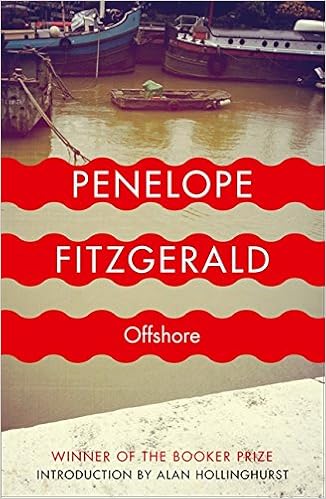
Well, it can’t be said that I haven’t given Penelope Fitzgerald’s fair crack of the whip. This, the third novel of hers I have now read, won the 1979 Booker PrizeOffshore: Amazon.co.uk: Penelope Fitzgerald: 9780007320967: Books. Three I think is more than enough.  When the Guardian’s reviewed the novel in 2009 the kindest thing the reviewer could find to say was that it “isn’t awful”, which is about right.

Offshore is set in early 1960’s London, described more than once as “swinging” although that seems a bit early to me. Post-war, depressed and crime-ridden would be nearer the mark. It focuses on a community of houseboat owners living on the Thames at Battersea Reach.

This was typical Fitzgerald – more a sketch than a novel, with few plot points, little structure, and an entirely open-ended conclusion. I actually don’t have a problem with ambiguous endings, where the details of what happens next is left to the reader to decide. But there is a difference between this and the approach Fitzgerald uses, which is to just simply stop writing once things have just started to get interesting.

I didn’t find her cast of characters that interesting either. Early 1960’s London was not brought to life – this is a marginal community living on the edges of the city and not prospering very well with it. Characters behave eccentrically with little if any explanation of their motives. Nenna, for example, a Canadian woman living with her two children in one of the run-down barges that are home for this group, is separated from her husband, who has returned from working abroad but made no attempt to contact her. She eventually goes to see him, but he rejects her telling her she is “not a woman”. No, I have no idea why.

Maurice, Nenna’s neighbour, is a male prostitute and allows his boat to be used to store stolen goods. There are other neighbours who appear briefly, but I didn’t find it easy to differentiate between them, even though they are given their own idiosyncrasies. Willis is a painter; Woodie is a retired businessman; Richard lives on a converted minesweeper. The only characters that really engage our attention are Nenna’s precocious children Martha, 12 and Tilda, 6. They skip school and go ‘mudlarking’ finding valuable tiles in a wreck which they sell in order to buy Cliff Richard records.

The novel is mainly pre-occupied with the boats in which the characters live and the river on which they float, and occasionally sink. There is, for me, far too much detail about life on the river, such as the various repairs the boats are constantly in need of. The autobiographical elements of the novel seem to be what interested Fitzgerald rather than her characters or anything resembling a plot.

One disturbing scene jumped out as being something that in 1979 an author might get away with, but today would surely not be published. Maurice’s boat is being used as a lock-up for stolen goods by Harry, a lightly sketched villain. While he is trying to fix the hatch to the boat to give “a mild electric shock to anyone who might try to get into it“, he is disturbed by six-year old Tilda:

“Tilda did not understand what he was doing, but she stared at him …until he became conscious of her and turned around. His eyes were curious….

“Want some sweeties?” ‘No’

‘Want me to show you a comic?’ ‘No’

‘Come on, you can’t read, can you?’ ‘I can’

You could get over here, couldn’t you? You can come and sit on my knee if you like, and I’ll show you a comic.’

(The exchange continues, then Harry says)

“You haven’t seen the things I’ve got to show you’

‘What are they like?’ ‘Something you’ve never seen before, love’.

He then chases after her, and while she escapes into a neighbouring barge, there is no doubt he intends her serious harm. This is a disturbing scene when read today, but I wonder how it would have been seen in the late 1970’s? Was it really intended as comic? The tone of the rest of the novel is whimsical and this scene jars alarmingly, irrespective of the author’s intention. The 1970’s were closer to the Second World War than they are to today, and social attitudes have shifted dramatically, but this isn’t funny, and I can’t believe it was thought humorous back then either.


Offshore, by Penelope Fitzgerald, 1979

Aside
Book review

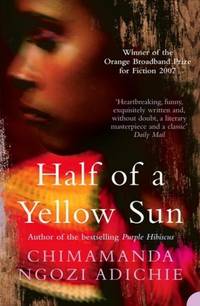
“Red was the blood of the siblings massacred in the North, black was for mourning them, green was for the prosperity Biafra would have, and, finally, the half of a yellow sun stood for thoe glorious future.”

Ngozi Adichie’s ftirst novel, Purple Hibiscus, took as its focus a very personal, i0ntimate look at a troubled Nigerian family. The wider political context of a country “coming to terms with its imperial past” (as it has been described) is there, but it’s in the background, and the precise period of the setting is no5#0*t critical. Half a Yellow Sun is a much more political novel. It is set in the 1960’s following Nigeria’s independence from the UK, and features the tribal and political conflicts that followed, culminating in the Biafran war of 1967-1970.

Half of a Yellow Sun by Chimamanda Ngozi Adichie - Paperback - 01/15/2007 - from Greener Books Ltd (SKU: mon0000034080)

I confess I knew little about this period before reading this novel – the name Biafra was familiar, but I doubt I would have been able to find it on a map. Britain’s role in this conflict derives initially from its construction of Nigeria from a patchwork of different tribal kingdoms and states as a calculated tactic to produce a divided country, to its shameful support for the Nigerian side during the Civil War, including providing arms to the besieging Nigerian Army. I suppose it is hardly surprising that this is not a war that is taught in British schools!

Half a Yellow Sun is not, however, just a history book. The war is the setting and the inspiration for the novel, but the conflict is shown as a personal as well as national tragedy. The complex web of narratives are woven together using three principal narrators: Ugwu, a ‘houseboy’ (servant) to a prosperous university lecturer, his master’s partner, Olanna, and Richard Churchill, an English ex-patriate, boyfriend to Olanna’s twin sister. Thus Adichie captures the perspectives of the Nigerian working-class, the more prosperous middle-class, and an English ‘outsider’ point of view.

Flag of Biafra

The novel uses a non-linear time structure. It starts in the early 1960’s, post-independence years. Teenage Ugwu starts work for Odenigbo, the lecturer boyfriend of Olanna. Ugwu is a naive village boy bewildered by the opulence of Odenigbo’s home and furnishings. But he is bright and Odenigbo is patient, and he quickly learns his duties. Odenigbo hosts intellectual dinner parties in which the post-colonial future of the country is debated. He is sceptical about the concept of Nigeria itself:

“the only authentic identity for the African is the tribe…I am Nigerian because a white man created Nigeria and gave me that identity. I am black because the white man constructed black to be as different as possible from his white. But I was Igbo before the white man came.”

Most of the characters in the novel are also from the Igbo tribe, and it is largely the perspective of this group that is shown throughout the novel. Odenigbo articulates a compelling analysis of imperialism, although it is principally an intellectual, theoretical rather than a practical position:

“The real tragedy of our postcolonial world is not that the majority of people had no say in whether or not they wanted this new world; rather, it is that the majority have not been given the tools to negotiate this new world.”

Through Odenigbo we meet his partner, Olanna Ozobia, daughter of a prosperous and influential Nigerian businessman. Olanna and her twin sister Kainene are strong young women who have to work hard to retain their independence from their parents. Kainene is in a relationship with Richard Churchill, the novel’s third narrator. Richard is an English writer who studies tribal African art and teaches at the local university. Richard is a distanced observer of the events of the novel, only briefly a participant.

Four years later, conflict between the Northern Hausa people and the Eastern Igbo tribe is sparked by a political coup in which Hausa leaders are murdered. A counter-coup leads to massacres of many Igbo people living in the North. The new republic, Biafra, seceedes from Nigeria, ostensibly to create a safe nation for the Igbo people. Olanna, Odenigbo, their infant daughter and Ugwu are forced to flee as refugees. These chapters of the novel contains many cryptic references to a parallel conflict between Olanna and Kainene which has led to a painful separation, references which are only finally explained in the next part of the novel, which jumps back in time to shortly after the first section.

Eventually the secret of this pain is revealed. Odenigbo betrayed Olanna: manipulated by his deeply unpleasant mother he slept with her servant, Amala, who went on to have his baby. Olanna takes revenge by sleeping with Richard, who has been nursing a long-standing crush on her. Odenigbo and Olanna decide to adopt the new-born baby girl, while Richard and Kainene decide to stay together and try to repair their relationship. In anger Olanna also destroys Odenigbo’s manuscript of the book he was working for – throughout the novel books are destroyed, burnt, buried, and frantically repaired and replaced. This emphasises the importance of the conflict being memorialised, and of writing itself.

The final section of the novel is the most compelling and traumatic. I found myself only being able to read a few pages at a time, as the war bears down on the lives of the characters who have become important to the reader. Even though they are relatively prosperous, and therefore protected from some of the more severe deprivations of the war (Olanna and Kainene’s parents fly out to England for the duration), their situation slowly deteriorates. There is finally no escape from the brutality of the war, no ending even after the ceasefire.

Ugwu’s story arc is in some ways the most compelling. He starts as an ‘uncivilised’ village boy who shows great loyalty and love towards his employers. He continues to study throughout the novel and his voice slowly becomes more articulate and educated. Several sections of the novel end in extracts from books about Biafra, and although at first it is implied these are written by Richard Churchill it becomes apparent that they are most likely written by Ugwu, and that he eventually becomes a writer. He is a kind soul, but even he is corrupted by the war, and when he is conscripted he takes part in the gang-rape of a young woman. Despite this complicity in a war crime Adichie still portrays Ugwu more as a victim of the war than a participant or criminal.

This is a wonderful ambitious novel. In addition to the central portraits it contains a wide range of minor characters, all sketched vividly, and while some are archetypes they still come to life, such as Harrison, Richard’s ‘houseboy’, who takes pride in his Englishness and his ability to cook traditional English dishes from local ingredients, and who maintains certain standards of etiquette even in the depths of famine and war. Another important sketch is of Mohammed, a former boyfriend of Olanna. Mohammed is a Muslim from the Hausa tribe, and is therefore technically an enemy of the central Igbo characters, but he rescues her from tribal violence and epitomises the civility of the Hausa aristocracy, providing nuance to the portrait of the conflict.

Although the Nigerian-Biafran War has been written about before Half a Yellow Sun, this novel has an immediacy and relevance. Starvation of civilian populations as an extension of warfare wasn’t invented in Biafra, but it was taken to a cruel and new level. I am sure the war is seen in a different light by Nigerians compared to how it is perceived in the West, and this is an important step in redressing that balance.

While the legacy of colonialism is an important theme in the novel, it is not didactic. The reader doesn’t feel beaten around the head with the politics of the conflict, while at the same time it is entirely clear on the war’s origins in the creation of the nation of Nigeria, and the ongoing complicity of the West. This is a hugely rewarding complex novel which was rightly lauded by critics and with prizes, including the Orange Prize for Fiction (now called Baileys Women’s Prize for Fiction) 2007. I am glad to have finally read it, having seen it on various reading lists many times in the last few years. It marks a dramatic progression from what looks now like an immature first novel in Purple Hibiscus, a graduation to the top level of modern writers.

Half a Yellow Sun, by Chimamanda Ngozi Adichie, 2006

Aside
Book review


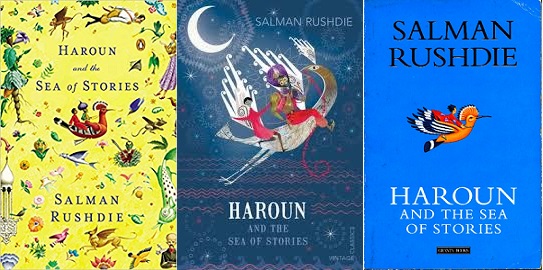
Book Review: Haroun and the Sea of Stories by Salman Rushdie ...

I didn’t realise when I picked Haroun and the Sea of Stories as my next read that it was a children’s book. Despite the publisher’s description of it as such, I’m still not convinced. Granta is not widely known as a publisher of children’s literature, and the front cover of the edition I read (the version on the right) is not particularly child-like. It doesn’t contain any illustrations and the font is a traditional size.

The concept of ‘children’s literature’ is one I often struggle with. When I find ‘children’s novels’ on a reading list I am torn – the completist in me wants to read the whole list, but is reading books specifically written for children a good use of my time? More to the point, the definition of children’s literature changes (quite rapidly actually) over time, and categorisations widely accepted in one generation look out-moded and ridiculous a few years later. There are books written with the intention to be read by children; books to be read to children; picture books; comics; books that were written for children but read by adults (for example the Harry Potter series) and books written for adults that are read by children (e.g Alice in Wonderland). That’s not to mention the whole arena of “young adult” fiction, a relatively recent concept, which bridges many of the gaps between books for children and those for adults. Other novels are re-categorised over time – originally intended for adult readers they eventually become perceived as children’s novels (Black Beauty for example).

Content is obviously what drives the categorisation of a novel as being suitable for children or otherwise; themes, language, and complexity are all factors. As society changes, what is considered acceptable in one generation would have caused apoplexy in an earlier age. Similarly language or attitudes in older novels make them challenging for modern readers (for example the extensive use of the n-word in Huckleberry Finn).

Where does Haroun and the Sea of Stories fit on this spectrum? There’s no doubt it was written for children, more specifically for a child, Rushdie’s son, from whom he was separated while in hiding due to the fatwa pronounced upon him by the Ayatollah Khomeini. Knowledge of this fact gives the story an added poignancy. Like all great children’s books, Haroun works on many levels. For younger children it is a fantastical adventure story. Young Haroun Khalifa looks up to his father Rashid, who is a famous storyteller. Rashid uses his narrative ability to campaign for various corrupt and untrustworthy politicians. One terrible day Haroun’s mother runs away from home with their neighbour, and Rashid is struck dumb, unable to tell his stories. You will probably have spotted by now the allegorical message regarding censorship underlying the narrative. Rashid and Haroun  travel to the ‘Valley of K’ to speak for ‘Snooty Buttoo’, a local politician. On the way Haroun  meets Iff, a Water Genie’, who has been sent to disconnect Rashid’s imagination. Thus begins a fantastical journey to the ‘Sea of Stories’ in the Kingdom of Gup. The Sea is slowly being poisoned by Khattum-Shud, a fairly sinister character, who very young readers might find scary. The conflict between the forces of good and bad is over quickly, and I don’t think it will spoil the book for you if I reveal it ends with a happy ever after. 

This is a charming and very readable little parable. The humour is mainly ‘dad” jokes, appropriately – there are ‘Plentimaw’ fish in the sea for example – and adults will find the articulate defence of freedom of speech and the importance of story-telling quite touching. Younger readers and the read-to will be entertained. Eventually whether this is a children’s novel or not probably doesn’t really matter, but I wonder whether in years to come it will be read mainly by adults for its commentary rather than by children for its whimsy.


Haroun and the Sea of Stories, by Salman Rushdie, 1990

Aside
Book review

There are a number of novels buried within Penelope Fitzgerald’s The Gate of Angels struggling for our attention. Juggling such a wide range of themes and structures would be difficult in a novel of conventional length, let alone one of barely 160 pages, and in the end I was not convinced that Fitzgerald pulled it off.

First there is a light academic comedy. The novel is set in 1912 at a fictional Cambridge college, St Angelicus,whereThe Gate of Angels - Wikipedia Fred Fairly, a Junior Fellow, cycles around the city, argues half-heartedly at ‘the Disobligers’, a typically pompous debating club, and falls in love. The locals are all a bit slow-witted, the police bumbling, and the academics fusty and crippled by tradition. The college has a rule that

“no female animals capable of reproduction were allowed on the premises, although the starlings couldn’t altogether be regulated”

The blind Master has such finely tuned hearing that he can detect kittens somewhere in the grounds, and wants them removed as soon as possible.

All in all very reminiscent of something by Tom Sharpe or perhaps early Kingsley Amis. I wouldn’t have minded reading this novel, but the focus swiftly moves on. 

The second element is the novel of ideas. In 1912 physics was in ferment, with Fred’s chosen specialist research field, quantum theory, challenging our ideas of matter, time and space. Not surprisingly St Angelicus is firmly in the traditionalist camp. A novel that looks at the developing ideas about the atom, the debates between scientists, the challenges to faith etc would have been interesting, and from what I can tell was Fitzgerald’s intended focus, but what we get here is only a brief discussion, passing mentions of Rutherford, Geiger and Mach, before we move on to the next component. 

Wikipedia describes The Gate of Angels as an historical novel, and there are certainly elements of this genre here as well. The first world war is imminent, and is going to tear apart everyone’s lives, reshaping the world as we knew it. Everything I have read about this period suggests that a global conflict was expected by just about everyone, and it was really only a question of when, but apart from a quick mention of “the cousins” (the Kaiser and George 5th) this component is passed over quickly enough. The struggle for women’s suffrage features, albeit largely in a comic fashion – the men in the novel are bemused by the concept.

In her biography of Fitzgerald Hermione Lee wrote that her interest in this time period derived from a perception that it was

a time of very great hope… of the coming of the 20th century, hopes of a New Life, a new world, the New Woman, a new relationship between the artist and the craftsman”

We certainly can find some of these themes here, together with the scientific debates I have mentioned, but surely this is an overly optimistic view of the period given the carnage that was to follow so swiftly?

This is also a romantic novel. Fred is involved in a collision between his bicycle and an unlit farmer’s cart. A young woman, Daisy Saunders, is also knocked unconscious in the accident, and they are taken in by a local householder and put into the same bed to recover. The intimacy of this experience causes Fred to immediately fall in love with the young woman. The novel switches to London for several chapters to tell Daisy’s unfortunate story; this is a change of pace which feels at times like a necessary diversion from the academic debates back in Cambridge. Fred’s dogged pursuit of Daisy is quiet sweet in a way, although it’s not exactly Heathcliff and Cathy. There’s also a ghost story thrown in for good measure, before the novel ends abruptly leaving the reader to fill in what we can presume is a happy ending should we choose to do so. 

So as you can see there is a lot going on here. The question I am struggling with is whether the whole is greater than the sum of its parts. The typical clichéd critical description of Fitzgerald’s novels is “polished gems”. I’m not convinced. The writing was uneven and much of the characterisation two-dimensional – a number of Fairly’s academic acquaintances are introduced, but none are developed beyond a quick sketch, and are all forgettable. This is only the second novel by Fitzgerald I have read, and reading my 2017 review of The Beginning of Spring I can see I had similar reservations. The 1990 Booker judges entirely understandably preferred A S Byatt’s much more complex and rewarding Possession. Definitely the right call.


The Gate of Angels, by Penelope Fitzgerald, 1990

Aside