Book review

There’s an immense power to DBC Pierre’s 2003 Booker Prize-winning Vernon God Little which with its troubled and intense fifteen year-old narrator has unavoidable echoes of Salinger’s The Catcher in the Rye. In style the novel owes an obvious debt to the energetic first-person participatory traditions of Gonzo journalism.Vernon God Little - Wikipedia
Any summary of the novel will smooth out the wrinkles in the plot and present it as a coherent narrative, one in which the reader knows what is happening at all points and in which the dots are joined up. People’s motivations are explained and secrets and lies are laid bare. Of course the reading experience is very different from that – Vernon is not interested in carefully explaining to us ‘what happened’. Instead he breathlessly tells us what ‘is happening’, as well as articulating his feelings about his experiences. This gives the novel an immediacy but also challenges the reader to construct a coherent whole out of what we are told. Sufficient information is provided to be able to piece things together, but we have to do a lot of the heavy lifting.

There has been a school shooting at Vernon’s school in Martirio, the ‘barbecue sauce capital of America’ in Central Texas. The killer is his friend Jesus, a Mexican student who was mercilessly bullied by the other students. Vernon was not involved in – in fact tried to prevent – the shooting, but he nevertheless is suspected by the local police. Vernon’s alibi – that he was running an errand for a teacher – is hard to prove as the teacher is in hospital, a victim of the attack. Things take a turn for the worse for Vernon when he meets Eulalio Ledesma, probably the most groteque monster of the many in the novel. Ledesma claims to be a reporter, and worms his way into the affections of Vernon’s single mother, promising to help Vernon tell his side of the story. But the chance of a sensational story is too good to miss, and Ledesma runs a story naming Vernon as a participant in the killings. Vernon is arrested and at his bail hearing the court orders a psychiatric assessment.

Vernon realises there is going to be no justice for him in Martirio, so he begins to make plans to abscond to Mexico, eventually rustling up sufficient funds to pay for the trip by blackmailing a local paedophile. This scene is essentially one of several bad taste jokes that have not aged well. Vernon’s journey to Mexico becomes a conventional road-trip across the South, which ends in disaster when he is tricked in a ‘honey-pot’ trap into confessing to involvement in the school shootings. He is dragged back to Texas for a show trial where he is convicted and sentenced to death. Ledesma’s influence has spread on the back of his coverage of Vernon’s story, and he is now able to organise televised executions as part of a reality show where people vote on which convict they want to see executed. Big Brother, just at that point taking off in the US, is referenced. Most of the novel to this point has been relatively realist, albeit with an absurdist element to many events, but this departure into dystopian satire might be perceived as unrealistic – but the pace of the novel at this point is such that for me Pierre gets away with it.

The climax to the novel is wonderfully contrived and enormously satisfying.

Pierre’s descriptive writing is intense, using imagery that only indirectly references its subject, as well as a lot of slang and a fair share of profanity. Combined the effect is often poetic and very effective:

Outside, a jungle of clouds has grown over the sun. They kindle the whiff of damp dog that always blows around here before a storm, burping lightning without a sound. 

The angst of being a teenage boy in America is captured brilliantly. Vernon is constantly both aroused and confused, particularly by his sense of smell:

When the rubbing of her thighs has faded, I crane my nostrils for any vague comfort; a whiff of warm toast, a spearmint breath. But all I whiff, over the sweat and the barbecue sauce, is school—the kind of pulse bullyboys give off when they spot a quiet one, a wordsmith, in a corner. The scent of lumber being cut for a fucken cross.

It is strange that a novel which revolves around a school shooting, sadly now such a commonplace event in the USA, can be so joyful. It helps that there are plenty of really good jokes. At one point Vernon is promised help by a reporter:

“We could turn your situation around three hundred and sixty degrees…”

His response is to the point:

“Learn some fucken math.”

Later when Vernon is on Death Row, his mother tries to commit suicide:

“Mom closed up the house one day, turned the oven on full, and sat by its open door. Apparently, it’s still a Cry For Help, even though our oven’s electric.”

The novel’s satirical intent consistently hits its target. Consumerism in American society is mercilessly mocked. The tragedy of the school shooting is a business opportunity grasped by many in the town of Martirio. The poisonous Ledesma builds a media business out of it. Several of the women in town want to use the media focus on the shootings and Vernon’s trial to launch their own media careers. Even local children sell t-shirts darkly joking about the tragedy:

The Lozano boys are out hawking T-shirts on the corner of Liberty Drive. One design has ‘I survived Martirio’ splattered across it in red. Another has holes ripped through it, and says: ‘I went to Martirio and all I got was this lousy exit wound.’ Preacher Gibbons tuts, and shakes his head.

The local vicar is shocked, not by their tastelessness, but by the prices they are asking:

‘Twenty dollars,’ he says. ‘Twenty dollars for a simple cotton T-shirt.’

Vernon God Little stands out as one of the more unlikely Booker winners of recent years, a brave choice in a year when Brick Lane, Notes on a Scandal and Oryx and Crake were all on the short-list. For once I think the Booker judges called it right.
 

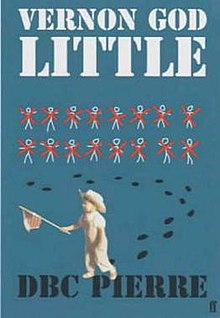
Vernon God Little by DBC Pierre, 2003

Aside
Book review

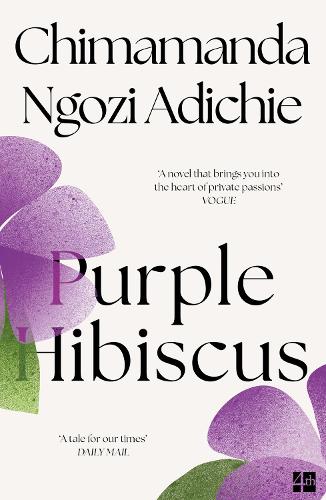
I honestly didn’t choose Purple Hibiscus deliberately as a companion piece to I Capture the Castle, (reviewed last week) but it works really well as such. It too is a coming of age novel, narrated by a teenage girl living in a ‘challenging’ family environment, and is often considered a young person’s novel. Over the course of the span of the novels both narrators falls in love and learn some difficult lessons about life.Purple Hibiscus by Chimamanda Ngozi Adichie | Waterstones

One can of course take these parallels too far. Purple Hibiscus was Chimamanda Ngozi Adichie’s first novel, published in 2003. It is set in Enugu in Nigeria where she was born and grew up and is a portrait of a young woman’s experiences in an extraordinarily strict Catholic family, dominated by a brutal father. At the same time it is also a wider commentary on the deterioration of civil society in Nigeria.

Kambili Achike is fifteen. She lives in terror of her father, who punishes any deviation from his rules with violence. Her mother is attacked so badly she twice miscarries. Her brother Jaja isn’t exempt from these attacks either, even though as the novel opens he is beginning to show signs of a preparedness to stand up to his father. Outwardly Mr Achike is a benevolent public figure and a devout Catholic, generous to his family and his community. But behind closed doors he is a monster. The scenes in which he tortures his family are distressing and explicit. 

A potential escape from this toxic and dangerous environment is offered by Kambili’s aunt Ifeoma, who offers to take her and her brother to a Catholic pilgrimage site, where a local girl claims to have witnessed visions of the Virgin Mary. Ifeoma appears aware of her brother’s brutality, but the novel implies that violent chastisement of one’s wife and children is an accepted or tolerated feature of Nigerian society. If so it is a symptom of a wider sickness in a society which is steadily breaking down – power supplies are interrupted, petrol is unobtainable, a newspaper editor employed by Kambili’s father is murdered by a postal bomb sent by state agents, and Ifeoma is sacked because she is insufficiently loyal to the incumbent regime.

Ifeoma’s household is very different from that Kambili and Jaja are used to. Her understanding and practise of Catholicism is more relaxed and less focused on sin and punishment. Her children, especially her teenagers, are encouraged to speak their minds and learn independence of thought. More generally Ifeoma’s parenting style is caring and supportive, a world away from  Kambili and Jaja’s home:

“It was what Aunty Ifeoma did to my cousins, I realized then, setting higher and higher jumps for them in the way she talked to them, in what she expected of them. She did it all the time believing they would scale the rod. And they did. It was different for Jaja and me. We did not scale the rod because we believed we could, we scaled it because we were terrified that we couldn’t.”

Kambili and Jaja begin to flourish in this environment. Later Kambili meets a young priest, Father Amadi, and becomes aware of a growing attraction for him. He seems to reciprocate her feelings, but neither of them act upon them.

Structurally the novel is a little weak. There are two extended spells where Kambili and her brother Jaja stay with their aunt – their tyrantical father would have been unlikely to agree to these visits, ceding his control over their every moment for a second occasion when the first included what he considered sinful behaviour. The ending felt a little rushed, with a series of incidents packed into a few pages when previously the pace had been relaxed, with everyday life with all its challenges being the main focus.

The novel also relies a lot on some slightly overworked symbolism, not least the purple hyacinth itself.

“Vibrant bushes of hibiscus reached out and touched one another as if they were exchanging their petals. The purple plants had started to push out sleepy buds, but most of  the flowers were still on the red ones. They seemed to bloom so fast, those red hibiscuses, considering how often Mama cut them to decorate the church altar and how often visitors plucked them as they walked past to their parked cars.”

The purple hibiscus are a special variety of the flower that will only prosper in Nigerian soil if cared for with love. The children in the novel are all equally delicate blooms that blossom if cared for.

These are minor reservations. The novel is a powerful, insightful portrait of life in post-colonial Nigeria, a society in flux and still coming to terms with its past. I think most readers will enjoy the novel principally because of its central character, Kambili. Because we hear her internal monologue for all of the novel it is easy to miss the fact that for much of the time she is virtually mute, terrified to say the wrong thing in front of her father, and lacking confidence to speak in front of school-friends or her cousins. She constantly monitors her thoughts to try and avoid anything considered sinful, and as a result she is more of an observer than a participant. Although she slowly finds her voice over the course of the narrative, her thoughts and reactions to even the most traumatic events are suppressed, leaving the reader to infer the full horror of her abuse. Because the only life she has lived is one of brutality she is unaware of the extreme nature of her father’s behaviour, which makes her mute acceptance of his violence all the more chilling.

I am interested to see how Adichie develops as a novelist. Half a Yellow Sun won awards and plaudits, as did the more recent Americanah, and I am looking forward to finding out the extent to which these were justified.


Purple Hibiscus, by Chimamanda Ngozi Adichie, 2003

Aside
Book review

“I know all about the facts of life, and I don’t think much of them.”

I think I originally read I Capture the Castle about ten years ago, and my impression at the time was that it was charmingly naive. A reread was therefore disappointing – what initially seemed sweet now grated. Much of this derives I suspect from how one reacts to the novel’s narrator, Cassandra (or Cassie, for short) Mortmain.

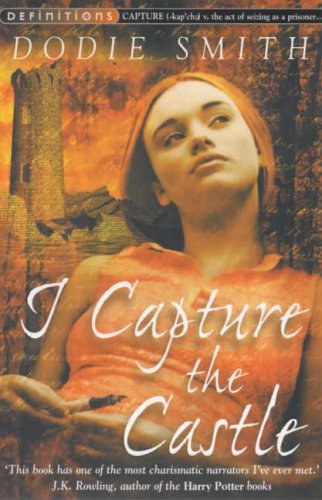
I Capture The Castle By Dodie Smith. 9780099845003

Dodie Smith’s I Capture the Castle

Cassie’s family is that uniquely English combination of being at once bone-grindingly poor but at the same time too posh to work for a living. They live in a castle for goodness sake, even if it is rapidly decaying into ruin. Cassandra is 17, has left school, and has little to do outside her daily chores. Her father is a writer who has only ever managed to produce one very well-received book, and since being widowed now spends all day avoiding writing – mainly reading trashy detective novels. His new wife, Topaz, is a former artist’s model, who wafts around the castle occasionally going for nude walks in the extensive grounds. Completing the family is Rose, Cassie’s older sister, Thomas, her down-to-earth younger brother, still at school, and Stephen, their lodger and unpaid servant. Stephen is naturally in love with Cassandra, but she is not interested – he is too much like a brother to her, despite his being an adonis. 

Authors from the time of Jane Austen on have had fun with immature narrators. The reader is shown just enough to confirm that the narrator’s interpretation of the events of the novel is incorrect. Piece by piece the reader is helped to work out what ‘really’ is going on – although at the same time enough is withheld to ensure there are a few surprises. Emma is a masterful example of this type of novel, and Austen is obviously a significant influence here in respect to the construction of I Capture. 

When the Cottons, a wealthy American family, become the Mortmain’s neighbours, it comes as very little surprise that there are two eligible sons, Simon and Neil, ideally suited for Cassandra and Rose. The author explicitly acknowledges the similarity between this scenario and Pride and Prejudice. (‘How I wish I lived in a Jane Austen novel!‘) The crucial difference here with anything by Austen is that however naive and innocent Cassie may be, she usually is not self-deluded. She reads people’s intentions and feelings correctly most of the time (not always, but consistently), and is often the only grow-up in the room, particularly given how infantile her father and step-mother can be. Only Thomas sees things more clearly and sensibly. Stephen appears only intermittently, but when he does he can usually also work out what is going on most of the time.

Rose decides to marry the older Cotton brother Simon, irrespective of any feelings she may have for him. Apparently there is nothing she will not do to escape the family’s poverty – nothing that is except get a job. Cassie is quick to discern that her sister is not really in love with Simon. These concerns grow all the stronger when she begins to develop feelings for him herself. The remainder of the novel charts the predictable route of the relationships between the sisters and the Cotton boys. It’s pleasant, amusing, often touching, but if you aren’t enchanted by Cassie by this point the novel is not going to work for you. She can certainly be irritating. She is gratingly positive about her situation. When upset she recommends

“Noble deeds and hot baths are the best cures for depression.”
and she faces up the family’s poverty with Pollyannaish positivity:
“I shouldn’t think even millionaires could eat anything nicer than new bread and real butter and honey for tea.”

There are scenes in the novel that invite comparisons with Cold Comfort Farm – the Mortmain home is ramshackle and with that complex layout and history that Gibbons has such fun with; middle class intellectuals are teased mercilessly; and all the castle’s characters have their own particular happy endings – Mr Mortmain starts writing again, Rose finds true love, and Stephen, like Seth before him, gets a job in the ‘talkies’. All that is of course for Cassie, whose feelings for Simon go unrequited.

When it was first published I Capture was marketed as a work for adults, but over time it has become more widely perceived as a young adult novel, dealing as it does with the coming of age experience. Cassie is a heroine young women will identify with, pouring her heart out to her diary and having innocent romantic adventures with handsome young men. This is a novel from the period when the phrase “making love” could be used by an author without any hint of sex. Published after the war but set in a period before it where there is no hint of what is to come, this works well as escapism and nostalgia, but has little else to say.


I Capture the Castle, by Dodie Smith, 1948

Aside
Book review
Possession (Byatt novel) - Wikipedia

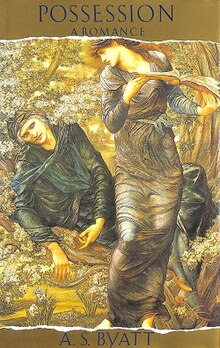
Possession was Byatt’s breakthrough novel, the first to attract significant levels of attention and sales, not least for winning the 1990 Booker Prize. I have a lovely hardback first edition of the novel with this gorgeous painting of the “Beguiling of Merlin” by Edward Burne-Jones used to illustrate the front and back covers.

Possession is a wonderfully rich, complex literary detective story and romance. That may sound an uncomfortable combination of genres, but Byatt makes it work. The novel is set partly in the pre-Internet 1980’s, where researchers haunt the Reading Room of the ‘London Library’ in search of insights into the greats of the nineteenth century. Roland Mitchell is a postdoctoral researcher into the life and works of Victorian poet and man of letters Randolph Henry Ash (widely understood to be based on Robert Browning, although no knowledge of the poet or his work is required to appreciate the novel). Mitchell accidentally finds some previously undiscovered draft letters hidden in the pages of a book that once belonged to Ash:

‘The book was thick and black and covered with dust. Its boards were bowed and creaking; it had been maltreated in its own time. Its spine was missing, or, rather, protruded from amongst the leaves like a bulky marker. It was bandaged about and about with dirty white tape, tied in a neat bow.”

This is a find to be treasured, the equivalent of a map with a large X on it, and is the jumping off point for a frantic search for the untold story of a great Victorian love affair.

Byatt carefully recreates the detail of this literary detection, including the pleasure to be derived from the excitement of the hunt. The letters Mitchell finds are written but unaddressed to an unknown woman, and suggest a relationship of some kind. He quickly identifies the mystery woman as Christabel LaMotte, a minor Victorian poet previously not known to have been acquainted with Ash. This is the moment in Mitchell’s otherwise disappointing life that he has been looking and waiting for, a stepping stone to a new world of romance, excitement and success – if he can ‘crack the case’. He impulsively steals the letters and travels to Lincoln to consult with the leading scholar on LaMotte, Dr Maud Bailey. (Byatt gives her primary modern characters Roland and Maud distinctly archaic and literary names to emphasise their connection with their subjects, Christabel and Randoph). Bailey is a feminist academic, and Byatt has some high-brow fun with the politics of late twentieth century academia.

Mitchell and Bailey are bound together into their clandestine investigation – Mitchell knows that if he were to report his discovery to his supervisor he would have the search taken out of his hands. They target a local country house owned by descendants of LaMotte as the most likely location of any surviving private papers. The discovery of a bundle of letters found in a doll’s cot is the breakthrough they have been looking for. The correspondence between the poets reveals a blossoming friendship and tantalising clues. For a while this parallel couple – Byatt spends quite some effort spelling out the many and varied similarities between the Victorian poets and their twentieth century counterparts – take centre stage, and the novel within the novel tells the touching story of their romance. Ash is trapped in an affectionate but celibate marriage, while LaMotte’s relationship with friend and possible lover Blanche Glover is no less troubled.

In an impressive feat of literary ventriloquism Byatt creates a huge volume of letters, poems, notebooks and diaries between and about the couple. She “quotes” whole extended poems by Ash and LaMotte. I confess these left me unmoved and my eye often slide down the page in that way the brain has of refusing to cooperate with the will. For me the novel works despite these creations rather than because of them. no matter how impressive they are as an authentic recreation of the past.

Mitchell and Bailey’s discovery is uncovered, and other academics begin to track down the story. The novel builds to a climax in that most stereotypical of Victorian settings, a graveyard on an dark and stormy night. Byatt cleverly uses the drama of the still recent real-life Great Storm of 1987 to provide a suitably tempestuous setting for the finale in which the secret at the heart of the investigation is revealed.

The literary mystery drives the narrative, but it’s mainly hokum – the box of papers buried with Ash which finally reveals the ‘truth’ about his relationship with LaMotte is known about from the beginning, and all the intervening steps of discovery are in both senses of the word academic. But the investigation allows the relationship between Maud and Roland to slowly mature and finally blossom, leading to a happy-ever-after of sorts for both the twentieth century couple and their nineteenth century counterparts.

Byatt teases the reader with a progression of uses of the term ‘possession’. Yes, it is the kind of novel where pleasure can be derived from games of this kind should you choose to do so. At first the term suggests obsession: in interviews Byatt has talked about seeing

“a well-known Coleridge scholar in the British Museum Library:. ”I thought, it’s almost like a case of demonic possession, and I wondered – has she eaten up his life or has he eaten up hers?”.

Certainly an obsession with Ash and LaMotte consumes not just crime-fighting duo Mitchell and Bailey, but also most of their colleagues. Sad Dr Nest has spent her life working on the diaries and notebooks of Ellen Ash, Randolph’s wife, even though she is really more interested in the works of Randolph himself; deep-pocketed American Cropper is the novel’s true villain, with his quasi-sexual interest in objects previously owned by Ash; Professor Leonora Stern, a brash sexually predatory American LaMotte scholar (Americans don’t come out well in this novel) unwittingly provides a clue to what happened to LaMotte after her romantic holiday with Ash; and Professor James Blackadder has been editing Ash’s Complete Works in ” for over 30 years (Incidentally, I checked, and the television series Blackadder predates this novel by seven years, so the choice of name is presumably deliberately comic?).

Later ‘possession’ comes to assume its meaning of ownership of property. I learnt more about the law of copyright than I expected in what is at its heart a romantic novel, as lawyers struggle over ownership of the key papers in the narrative. Finally, at the very end of the novel, the term possession is introduced in its sexual context:

“And very slowly and with infinite gentle delays and delicate diversions and variations of indirect assault Roland finally, to use an outdated phrase, entered and took possession of all her white coolness”.

There are other literary games to be played in Possession. The text is sprinkled with unattributed quotes, reference and allusions – I am sure I only spotted a few of the many lurking there, such as the reference to Marvell’s To His Coy Mistress, or the quote from Milton (“Thrones, Dominations, Princedoms”) used in Ash’s ‘Mesuline’. All of the characters in the novel are literary people who include references like this in their everyday speech as a matter of course, but it is fun spotting them, and will no doubt one day keep a researcher/PhD student fully occupied for a few months. There are many references to 19th Century authors, poets and other public figures – George Eliot is mentioned at least three times in the first 100 pages alone. Another source of interest is the way Byatt suffuses her text with motifs – fish in particular are everywhere (I spotted references to koi, octopi, sea creatures, flying fish, electric eels and mermaids, to mention a few). The novel is also vividly flooded with colour – there are mentions of every shade of the rainbow throughout the text.

I can remember being blown away by Possession when I first read it 30 years ago. It’s not the novel I read then, obviously, but it retains a similar impact. Jay Parini in the New York Times review described it as “a tour de force that opens every narrative device of English fiction to inspection without, for a moment, ceasing to delight“ which is a wonderful summary of the novel’s achievement. I can remember being a bit cross that this novel beat Beryl Bainbridge’s wonderful An Awfully Big Adventure to the 1990 Booker Prize but on more mature reflection I can recognise the decision was just. Byatt once said that she was aiming for “the kind of warmth of a Shakespearean comedy” and I think it is fair to say that this is a case of mission accomplished.

Possession, by A S Byatt, 1990

Aside
Book review

BloodyChamber.jpg

The first edition of The Bloody Chamber, published by Gollancz

Angela Carter’s The Bloody Chamber is her breakthrough 1979 collection of short stories in which several well-known fairytales are updated and given a modern twist. Several of the stories had previously been published elsewhere – only two were original to this collection. At the time of publication there was some debate about whether Carter had imposed a feminist interpretation on these stories; some forty years on that debate seems a bit irrelevant – the ten very varied stories can stand in their own right without the imposition of such limiting categorisation.

The first and longest of the tales is The Bloody Chamber, which is loosely based on the traditional story of Bluebeard. A teenage girl marries a wealthy French Marquis for his money. He seduces her with ostentatious gifts including

a choker of rubies, two inches wide, like an extraordinarily precious slit throat

and whisks her off to his mysterious castle. Left on her own she explores the library, quickly discovering his disturbing collection of pornography. This is a warning of what is to follow. After their first night together he is called away to business in New York, leaving her again alone in the castle. Before leaving he gives her the keys to the castle and tells her she can go anywhere except to one forbidden room, the bloody chamber of the book’s title. Guess what she does? She of course breaks her promise and promptly goes to his secret room, where she discovers the murdered bodies of his earlier wives, all gruesomely presented as trophies. But the latest wife, our narrator, is not going to go without a fight. Bluebeard has met his match. This story hints at the close relationship (for some) between violence and sex, without perhaps ever going the full Fifty Shades, observing

“There is a striking resemblance between the act of love and the ministrations of a torturer.”

The Courtship of Mr Lyon faithfully follows the traditional narrative of the Beauty and the Beast story. The only concession to modernity is that Beauty’s father seeks assistance at the Beast’s chateau after having car trouble rather than merely getting lost in the woods. But this conformity with the original story is presented as a contrast with the next iteration of the tale, The Tiger’s Bride. Here a woman is lost to the Beast (in the shape of a tiger) in the form of a gambling debt. In an ending to which Shrek owes a debt, instead of true love transforming the beast into a man, it is the heroine who transforms into a tiger.

The next story, Puss-in-Boots, is a comic interlude in the increasingly dark stories. Puss, a sardonic narrator of the story, helps his young dissolute companion seduce a young woman kept in a tower by a her miserly, older husband.

In The Erl-King a young woman is seduced by the sinister Erl-King, who plans to imprison her by turning her into a bird. She avoids this fate by strangling him with his own hair. If one were looking for feminist reworking of folklore outside the principal story this would be a good place to start – the Erl-King is a sexual predator and his intended victim a strong woman who sees past his sexuality and is happy to use violence to protect herself.

The Snow Child is the shortest and for me the most disturbing story in the collection. It is also the most heavily symbolic and allegorical. A Count and Countess ride out in deepest winter. The Count wishes for a child “as white as snow”. A young woman magically appears at the side of the road; she picks a rose, is pricked by a thorn and dies. Perhaps she is killed by the magic of the jealous countess?  

The Lady of the House of Love is a retelling of the vampire myth. A soldier, travelling by cycle through Romania, is lured to a mansion where a beautiful vampire tries to seduce him. His virginity somehow protects him from her, and he escapes only to have to face the greater horror of World War I.

The final three stories are variants on the Little Red Riding Hood story. In The Werewolf A girl is attacked by a wolf on the way to see her grandmother. She cuts its paw off, but when she reaches her grandmother’s house it is revealed that the grandmother was the werewolf. She is stoned to death by the villagers, who were are told are always quick to dispose of older women suspected of witchcraft in this manner. The Red character is here an unreliable narrator, and the suspicion lingers that she has attacked her grandmother in order to secure her cottage for herself. The next version of this story is The Company of Wolves which of course was turned into a feature film directed by Neil Jordan. This is a complex narrative with a number of stories within the story.  A witch turns a wedding congregation into wolves. A young couple are about to have sex on their wedding night, but the husband goes outside, never to return. She eventually remarries and has children, only for her first husband to finally reappear in wolf form. In the final story within the story yet another version of Red this time the wolf masquerades as the hunter before eating the grandmother. Red refuses to be scared by the wolf, and seduces him.

“See! Sweet and sound she sleeps in granny’s bed, between the paws of the tender wolf.”

In the collection’s final story, Wolf-Alice, Red is now a feral child raised by wolves. She lives with a vampiric Duke. When the duke is shot and wounded by the inevitable angry villagers, Alice saves him by tenderly licking the blood and dirt from his face.

In The Bloody Chamber Carter breaks multiple genre boundaries. On their own the stories are carefully crafted little gems, but the cumulative impact is unsettling and powerful.


The Bloody Chamber, by Angela Carter, 1979

Aside
Book review

The Castle of Otranto by Horace Walpole

Enter a caption

The Castle of Otranto is widely considered the first English gothic novel. It tells the story of Manfred, lord of Otranto and opens on the day of the wedding of his son Conrad to the princess Isabella. Shortly before the ceremony Conrad is crushed to death by an enormous helmet which falls on him. Yes, it does. This is the first of a series of absurd incidents that punctuate the novel, usually involving over-sized body parts for reasons I have yet to come to terms with.

There is a prophecy (of course there is) “that the castle and lordship of Otranto should pass from the present family, whenever the real owner should be grown too large to inhabit it”.

Just in case you are wondering, no, this doesn’t make any sense, at this point in the story nor subsequently. Lord Manfred decides to marry Isabella himself, which will necessitate divorcing his current wife, Hippolita, who has failed to successfully bear him an heir. Isabella is not keen on this idea, having just seen her fiance crushed by a giant helmet, so she flees to a neighbouring monastery with the aid of Theodore, a mysterious peasant and Jerome, an aged friar. Jerome, it turns out, is Theodore’s long lost father. Again, predictably.

This is just the start of a madcap rush of incidents in which long lost relatives and giant body parts are packed into the novel’s just over one hundred pages. There are ghosts, there are mysterious mute knights, plots and mistaken identity, duels and feasts. It’s all rather exhausting, like reading a plot summary for half a dozen Shakespearean comedies all mashed-up together, and all written in a florid, over-the-top style of which the following is a typical example:

“I come,” replied he, “to thee, Manfred, usurper of the principality of Otranto, from the renowned and invincible Knight, the Knight of the Gigantic Sabre: in the name of his Lord, Frederic, Marquis of Vicenza, he demands the Lady Isabella, daughter of that Prince, whom thou hast basely and traitorously got into thy power, by bribing her false guardians during his absence; and he requires thee to resign the principality of Otranto, which thou hast usurped from the said Lord Frederic, the nearest of blood to the last rightful Lord, Alfonso the Good. If thou dost not instantly comply with these just demands, he defies thee to single combat to the last extremity.”

See what I mean? The Knight of the Giant Sabre, who has recently mislaid his Giant Helmet. Is he trying to compensate for something?

It’s really dreadful. One Goodreads reviewer (who actually liked it!) described it memorably as the “kind of story a man hopped up on crack might shout to passersby from beneath a bridge“. It joins Sybil on my list of novels written by MPs, which is mercifully short. Walpole has a lot to answer for, not least a whole genre of similar nonsense. As always I look for redeeming features in particularly bad novels, and I recognise that judging an eighteenth century novel – which I think I can call experimental, in that no-one else had written anything like this before – by twenty-first century standards has its limitations. But I am struggling. The prose is over the top (see above), the characters two dimensional at best, the plot absurd: no, not a single redeeming feature. It was, I suppose, also mercifully short. 

The Castle of Otranto by Horace Walpole, 1764

Aside
Book review

“I don’t know what’s worse: to not know what you are and be happy, or to become what you’ve always wanted to be, and feel alone.”

Published in this edition by Orion books in their Science Fiction masterworks series, Flowers for Algernon is a much loved sci-fi classic. Flowers For Algernon (S.F. Masterworks), Daniel Keyes, Used Excellent Book

Charlie Gordon has an IQ of 68. He enjoys working at his menial job at a bakery. In the evenings he attends a college for “Retarded Adults”. Here he meets Professor Nemur who is looking for a a human guinea pig for his new surgical technique to increase intelligence. The surgery has already been performed successfully on a mouse named Algernon, who is now something of a super-mouse, able to solve maze puzzles with ease.

The novel takes the form of Charlie’s own ‘progress reports’ notes (i.e. his diary). Initially the diary entries are illiterate, full of phonetic spellings and without any punctuation. Following the operation they improve dramatically as Charlie begins to expand his understanding and knowledge. It is never really explained why the researchers try this procedure out on someone of below normal intelligence. Is it because if the surgery doesn’t work they won’t be sued? Or is it because the boost to intelligence will be so dramatic that in a normal human the impact would be too unpredictable?

As Charlie’s IQ soars he quickly leaves his old life behind. He struggles to cope with the dramatic changes to his abilities and understanding. This causes emotional turmoil, and is the basis of a lot of commentary about the apparent trade off between the benefits of intelligence and blissful ignorance. I was hoping that Keyes would have something to say about how a super-intelligent human might see the world differently. Sadly Charlie is more like a troubled teenager, trashing his room, refusing to do his homework and having rows with his family.  There is little else to show for his new abilities. He makes no scientific breakthroughs, discovers nothing.

Or not quite nothing. Charlie takes over the research into intelligence and discovers a flaw in the process meaning his boost in IQ is likely to be temporary. He faces this fate with a degree of resignation, even visiting the depressing institution where he is likely to end up. He tries to use the time left to him wisely, but all too quickly the old Charlie is back. Keyes reflects this degeneration poignantly through Charlie’s reversion to the fractured English used in his original notes.

Flowers for Algernon was originally a short story which Keyes later expanded into novel-form. I think the central concept – artificially enhanced intelligence – is a slight idea that probably fits better into the more straightforward format of the short story. Asking it to carry the weight of a full-length novel without any additional support is too much. Keyes doesn’t seem to know what to do with Charlie once he is super-intelligent, apart from showing him as a bit of a brat. As I mentioned in opening, this novel is much loved. People seems to have a nostalgic affection for Charlie and his mouse. So what are people seeing that I have missed? The novel has almost half a million ratings on Goodreads, scoring overall on average more than 4 (out of 5 – for comparison, Brighton Rock scores lower than 4). Reviews consistently talk about the novel being heartwarming and touching. My heart was neither touched nor warmed. I found the story profoundly predictable – there was never a moment’s doubt that Charlie’s boost in intelligence was going to be temporary. Super-intelligent Charlie is pretty unlikeable. He does nothing tangible with his enhanced powers – he learns languages, writes musical compositions, and so on, but there’s no substance to this, and the hoped-for insight into any of his areas of study never arrive. More to the point there’s no attempt to consider what super-intelligence actually means – is it just being cleverer than every one else, or is it a different level of consciousness? It was this kind of insight I was hoping for. Instead we are invited to feel sentimental for a dead mouse.

Writing in 1981, Philip K. Dick. 1981 defined sci-fi as:

“our world transformed into that which it is not or not yet. This world must differ from the given in at least one way, and this one way must be sufficient to give rise to events that could not occur in our society—or in any known society present or past. There must be a coherent idea involved in this dislocation; that is, the dislocation must be a conceptual one, not merely a trivial or bizarre one—this is the essence of science fiction, the conceptual dislocation within the society so that as a result a new society is generated in the author’s mind.”

This of course is one of many definitions of the genre, but it is one that commanded my attention as being a serious attempt to engage with the problem of genre rather than simply provide a template for is it/isn’t it decisions. Flowers for Algernon satisfies the criteria for science fiction in many of the more narrow definitions of the genre, but fails to make the cut here if Dick’s more comprehensive and compelling definition is used. Super-intelligence doesn’t ever once hint at generating a new type of society. The surgery which improves Charlie’s intelligence is given some credibility – there is talk of enzymes and amino acids – but the researchers could just as easily have given him a “make-you-clever” pill. Nothing else changes in the world – the changes are all within Charlie and his perceptions and abilities. Every other aspect of the society is recognisable, and we are not even given a hint of the way the world might change if the surgery had been successful. In other words, I am not convinced that Flowers is even science fiction, let alone a masterwork.


Flowers for Algernon, by Daniel Keyes, 1959

Aside
Book review

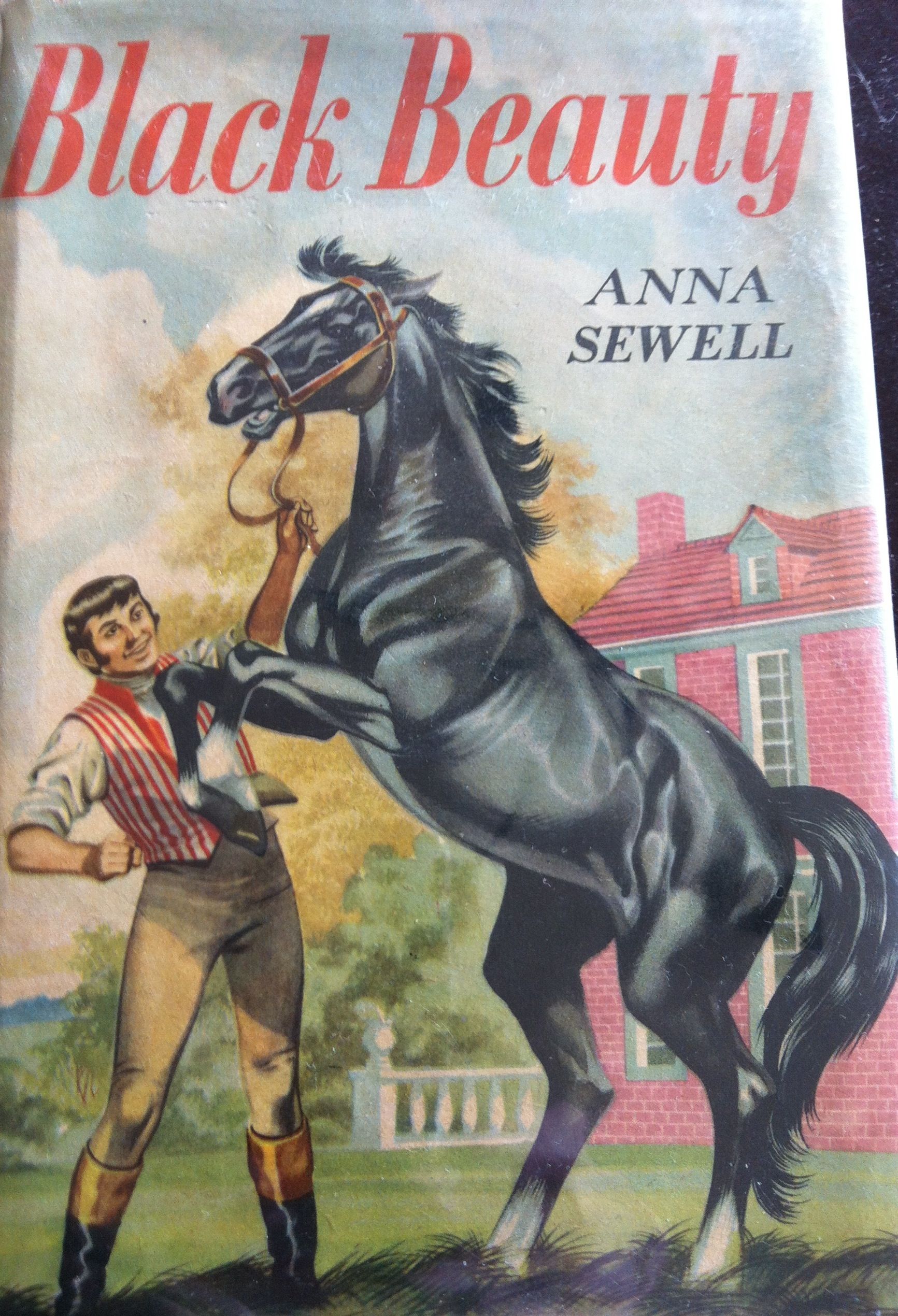
It is often an instructive experience to revisit ‘children’s’ stories occasionally. Rereading them as an adult can reveal layers of meaning not obvious to a younger reader. As a child I wasn’t initially aware of the Christian allegory in the Narnia stories, for example (until being beaten round the head with the idea in The Last Battle). Similarly, books like Alice in Wonderland and Gulliver’s Travels both work successfully as adventure stories for children and as more complex novels for adults.Black Beauty by Anna Sewell - First Edition - c. 1950s - from ...

Anna Sewell’s Black Beauty is another case in point. Written as a first person narrative by the title character, it was originally conceived as a plea for compassion in the treatment of working horses (in much the same way as The Water Babies was a campaigning tract about the treatment of child chimney sweeps). Sewell wanted to bring the plight of working horses to public awareness and in particular to end the practice of unnaturally raising carriage horses’ heads with the “bearing rein”. Stripped of its social and historical context it is now a straightforward story about the life of a horse.

But I was struck on reading the novel how clearly it also reads as an anti-slavery tract. Forget for a minute that this is a book about horses, and read these lines from early in chapter one:

Our master was a good, kind man. He gave us good food, good lodging, and kind words; he spoke as kindly to us as he did to his little children. We were all fond of him, and my mother loved him very much….I was a dull black, so he called me Darkie.”

As long as Black Beauty is well cared for he accepts his enslavement with resignation. He describes how he is broken into wearing reins and a bridle:

I had of course long been used to a halter and a headstall, and to be led about in the fields and lanes quietly, but now I was to have a bit and bridle; my master gave me some oats as usual, and after a good deal of coaxing he got the bit into my mouth, and the bridle fixed, but it was a nasty thing! Those who have never had a bit in their mouths cannot think how bad it feels; a great piece of cold hard steel as thick as a man’s finger to be pushed into one’s mouth, between one’s teeth, and over one’s tongue, with the ends coming out at the corner of your mouth, and held fast there by straps over your head, under your throat, round your nose, and under your chin; so that no way in the world can you get rid of the nasty hard thing; it is very bad! yes, very bad!

There’s no attempt to disguise the distress Beauty experiences during his “breaking in” (a phrase also used to describe the brutal treatment of slaves until they came to accept their captivity). But however accepting of his condition, Beauty is aware that he is still a possession, vulnerable to being sold to a new, less kind master at any time:

I was quite happy in my new place, and if there was one thing that I missed it must not be thought I was discontented; all who had to do with me were good and I had a light airy stable and the best of food. What more could I want? Why, liberty! …Straps here and straps there, a bit in my mouth, and blinkers over my eyes. Now, I am not complaining, for I know it must be so. I only mean to say that for a young horse full of strength and spirits, who has been used to some large field or plain where he can fling up his head and toss up his tail and gallop away at full speed, then round and back again with a snort to his companions—I say it is hard never to have a bit more liberty to do as you like.

He also knows that if he breaks down physically and becomes no longer useful or wanted he is likely to be disposed of, either sold on to ever more difficult work, or sent to “the dogs” – that is to say slaughtered and sold as dog food. When his friend Merrylegs the pony is sold to a neighbour it is seen as a kindness that

“it was on the condition that he should never be sold, and that when he was past work he should be shot and buried. “

(This line of argument, that Black Beauty is a form of slave narrative, is developed by the wonderfully named Bonnie Blossom in this article.)

I am not arguing that Black Beauty is an anti-slavery tract, not least because slavery had been abolished in the USA a decade before it was published, and much earlier in the UK – the moral argument had been won. But awareness of the brutality of slavery was still very much in the public imagination, and viewing our treatment of domestic animals as being analogous to the way slaves were once treated, adopting some of the traditional narratives and characteristics of slave stories, gives a powerful emphasis to Sewell’s argument for kinder treatment of horses. Putting it simply, we feel for the mistreated horses in the novel because they are treated like slaves.

This is a progressive novel in other ways. Sewell argues forcefully for the retention of the Sabbath as a day of rest. Beauty’s driver, Jerry, is tempted to work on Sunday’s for a reliable customer, but turns down the work as he wants to preserve his time with his family:

“If working  men don’t stick to their Sunday … they’ll soon have none left; it is every man’s right and every beast’s right. By God’s law we have a day of rest, and by the law of England we have a day of rest; and I say we ought to hold to the rights these laws give us and keep them for our children.”

This initial position of not working on the Sabbath for religious considerations is then generalised into a wider argument for the protection of working men’s conditions of employment, and their collective power through industrial action, specifically withholding their labour (a later chapter is called “A Strike for Liberty”):

“That may sound well enough, but it won’t do; every man must look after his own soul; you can’t lay it down at another man’s door like a foundling  and expect him to take care of it; and don’t you see, if you are always sitting on your box waiting for a fare, they will say, ‘If we don’t take him some one else will, and he does not look for any Sunday.’ Of course, they don’t go to the bottom of it, or they would see if they never came for a cab it would be no use your standing there; but people don’t always like to go to the bottom of things; it may not be convenient to do it; but if you Sunday drivers would all strike for a day of rest the thing would be done.”

Elsewhere Sewell argues from a moral standpoint that:

“With cruelty and oppression it is everybody’s  business to interfere when they see it”

This is typical of the muscular Christianity that informs much of the reforming literature of the Victorian era.

The novel also contains a striking portrait of the Charge of the Light Brigade in the Crimean War, told from the perspective of Captain, “An Old War Horse”. We are not told directly that his reminiscences are of this battle, but the descriptions are unmistakeable:

“I cannot tell all that happened on that day, but I will tell of the last charge that we made together; it was across a valley right in front of the enemy’s cannon. By this time we were well used to the roar of heavy guns, the rattle of musket fire, and the flying of shot near us; but never had I been under such a fire as we rode through on that day. From the right, from the left, and from the front, shot and shell poured in upon us. Many a brave man went down, many a horse fell, flinging his rider to the earth; many a horse without a rider ran wildly out of the ranks; then terrified at being alone, with no hand to guide him, came pressing in among his old companions, to gallop with them to the charge.

“Fearful as it was, no one stopped, no one turned back. Every moment the ranks were thinned, but as our comrades fell, we closed in to keep them together; and instead of being shaken or staggered in our pace our gallop became faster and faster as we neared the cannon…..

our gallant company was cruelly overpowered, and those who remained alive after the fierce fight for the guns came galloping back over the same ground. Some of the horses had been so badly wounded that they could scarcely move from the loss of blood; other noble creatures were trying on three legs to drag themselves along, and others were struggling to rise on their fore feet, when their hind legs had been shattered by shot. After the battle the wounded men were brought in and the dead were buried.”

I said, “I have heard people talk about war as if it was a very fine thing.”

“Ah!” said he, “I should think they never saw it. No doubt it is very fine when there is no enemy, when it is just exercise and parade and sham  fight. Yes, it is very fine then; but when thousands of good brave men and horses are killed or crippled for life, it has a very different look.”

The enemy must have been awfully wicked people, if it was right to go all that way over the sea on purpose to kill them.”

This vivid description of the battle makes an interesting contrast to the jingoism of Tennyson’s better known account. Sewell uses the apparent naivety of the horses to point out the simplicity of seeing war as ourselves versus “awfully wicked people”.

There is also a fascinating description of Beauty’s reaction to his first encounter with a steam train, which captures much of the Victorian shock at the force of this new technology.

I shall never forget the first train that ran by. I was feeding quietly near the pales which separated the meadow from the railway, when I heard a  strange sound at a distance, and before I knew whence it came—with a rush and a clatter, and a puffing out of smoke—a long black train of something flew by, and was gone almost before I could draw my breath. I turned and galloped to the further side of the meadow as fast as I could go, and there I stood snorting with astonishment and fear. In the course of the day many other trains went by, some more slowly; these drew up at the station close by, and sometimes made an awful shriek and groan before they stopped. I thought it very dreadful, but the cows went on eating very quietly, and hardly raised their heads as the black frightful thing came puffing and grinding past.

Reading the novel as a form of slave narrative, chapters on the Crimean War and the coming of the steam train – these are all points of interest. But the novel as a whole is repetitive. Beauty is sold to a new owner, he gets to know him and his new role, there is an encounter with another horse, and then an incident that leads to the next owner. Repeats over forty or more chapters. Events are described through the child-like innocent eyes of Beauty or his friends, with sufficient context for the reader to identify the wider commentary implicit and explicit in the narrative. All washed down with a gentle Christian sensibility (at one point a human watches a character leave and says to himself “Inasmuch as ye have done it to one of the least of these”, which as I am sure you know is from Matthew in the King James text of the Bible). There’s a banality to the repetition of the story arc over time which leaves the reader restless for the inevitable happy ever after. 

Footnote

A while back I wrote about the use of the word “gammon” as a term of disrespect. There is another instance here where it is used as a euphemism for “hypocrite”. Beauty’s driver takes a fare for an urgent job having previously refused one. Asked how much he earned he replies:

“A good deal more than I generally get…..what he gave me will keep me in little comforts for several days.”

“Gammon!” said one.

“He’s a humbug,” said another; “preaching to us and then doing the same himself.”

Black Beauty, by Anna Sewell, 1877

Aside
Book review

Harold Wilson, by Ben Pimlott, 1992

Harold Wilson was Prime Minister of the United Kingdom from 1964 to 1970, and again from 1974 until his retirement in 1976. In that time he won four general elections, making him the most successful ever leader of the Labour Party. His Governments were characterised by a series of progressive social reforms set against a background of Image result for harold wilson ben pimlottchallenging economic circumstances. Wilson was a pragmatic politician usually seen as coming from the left of the party when he first emerged from the diverse group of new MPs elected in 1945, although over time, as the political centre shifted, he became more associated with the traditional centre of Labour politics. He is now looked back on as a relatively slight figure, buffeted by external forces which he was never really able to control, rather than the dominant force in British politics that he was for so many decades.

Continue reading →

Standard
Book review

I am having a really poor run at the moment – this was the latest of a series of disappointing novels, in many ways the worst of the lot! It was Coetzee’s first Booker Prize winner, the other being Disgrace in 1999.

Life & Times of Michael K is set in a dystopian South Africa in which a civil war is being fought. The protagonist Michael K is born with a hare lip. He is also what was once thought of as “simple” and although not an orphan was effectively abandoned as a child and sent to live in an institution. A doctor who later treats him explains:

He is a simpleton, and not even an interesting simpleton. He is a poor helpThe Life and Times of Michael K, J. M. Coetzee, Good Bookless soul who has been permitted to wander out on the battlefield, if I may use that word, the battlefield of life, when he should have been shut away in an institution with high walls, stuffing cushions or watering the flower beds

In many ways this is a simple journey story. Michael works as a gardener and his mother is an ailing domestic servant. Law and order is breaking down in the coastal city where they live. Michael’s mother persuades him to help her escape the conflict and privations of the city and take her on a biblical exodus to her home town near the mountains. She dies during the journey, but Michael continues his pilgrimage alone, carrying her ashes with him. He settles in an abandoned farmstead, living off the land and making rudimentary attempts to grow food.

Michael’s time in the wilderness also has biblical overtones – his attempts to scratch a living from the surface of the earth is a hard, unremitting grind for the reader. The allegorical nature of Michael’s suffering is subtle but nevertheless unavoidable – this must be an allegory because otherwise it would be utterly meaningless.

Eventually he is captured as an undocumented citizen, suspected of working for the resistance, and sent to a prison camp. By now his fragile health has deteriorated further, and he appears to be starving. I haven’t been able to locate the original source of this claim, but I have read that Coetzee has said in interviews that the inspiration for this novel was a newspaper article about a captured panda that refused to eat the food it was fed in captivity. Once captured Michael K adopts the same approach, although there is no suggestion that this is a hunger strike or anything other than an illness. It is more an inability to eat than a refusal. He continues to lose weight, and the doctor who narrates the novel’s second section struggles unsuccessfully to understand his motivation for refusing food. I wasn’t comfortable with the portrayal of an illness as a philosophical protest or existential statement.

Michael eventually escapes from the camp, and in the last section returns to the city. He meets some vagrants who appear more attuned to life outside civilisation, and who effectively adopt him. At this point, with no suggestion that Michael has come to any resolution of his situation, the novel ends abruptly and inconclusively.

It is hard to care for Michael K. He is passive and has nothing of interested to say about his experiences. It is possible we are intended to see him as a Forrest Gump-like figure, with his simple lifestyle and even simpler thought processes giving us insights into the human condition. If that was the intention then I can’t say it worked. Towards the end of the novel Michael acquires a more analytical monologue which for some reviewers sits unconvincingly with his former passivity and incomprehension. His thoughts become positively philosophical:

How fortunate that I have no children, he thought: how fortunate that I have no desire to father. I would not know what to do with a child out here in the heart of the country, who would need milk and clothes and friends and schooling. I would fail in my duties, I would be the worst of fathers. Whereas it is not hard to live a life that consists merely of passing time. I am one of the fortunate ones who escape being called.

Michael is an innocent adrift in a world of sin and corruption, but my appetite for parables is a bit jaded at the moment – perhaps I need some escapism and an interesting story instead? The New York Times said in a review that Coetzee’s theme in this novel is “the wild and merciless power of inanity.” If you are looking for a novel about the inane then look no more, this is the one.


Life & Times of Michael K, by J M Coetzee, 1983

Aside