Book review

I Shall Wear Midnight (Discworld 38), by Sir Terry Pratchett, 2010

I Shall Wear Midnight is the fourth in the series of Discworld novels that focus on the earlier years of witch in training Tiffany Aching. The wonderfully poetic title of the novel is Tiffany’s defiant statement that she will be her own witch, not conforming to the convention that witches of all ages wear black (i.e. ‘midnight’) and is first referenced in Tiffany’s story at the end of A Hat Full of Sky, when she says “When I’m old I shall wear midnight”.
It is fair to say that each of Tiffany’s novels follow roughly the same pattern, albeit in each new book she is progressively a little older, a little more mature, and a more proficient witch. Here she is almost fully qualified (insofar as witches are ever qualified) and is working on her own as the Chalk’s witch, the Chalk being a sheep-farming area of Discworld somewhere between Lancre and Ankh-Morpork, which is admittedly a very large area. The novel opens at the Scouring Fair, a traditional Chalk celebration which includes maintenance of the massive hillside chalk carving which bears a striking resemblance to the Cerne Abbas giant. If you haven’t heard of the Cerne Abbas giant then a few minutes on Google will be instructive in terms of country folk’s attitudes to fertility and related issues…

But the celebration doesn’t last long because the second chapter opens with one of the most vivid and distressing scenes I can recall in the Discworld series. Thirteen year old Amber Petty has been beaten so badly by her drunken father that she has miscarried. Word has reached drinkers at the local pub, and a group of villagers is coming to exact ‘justice’ on Mr Petty. Here Pratchett references the rural tradition of “rough music” in which a community takes the law into its own hands.

“Rough Music…
o one controls the music, Mr. Pretty – you know that. It just turns up when people have had enough. No one knows where it starts. People look around, and catch on another’s eye, and give each other a little nod, and other people see that. Other people catch their eye and so, very slowly, the music starts and somebody picks up a spoon and bangs it on a plate, and then somebody else bangs a jug on the table and boots starts to stamp on the floor, louder and louder. It is the sound of anger, it is the sound of people who have had enough. Do you want to face the music?

Tiffany drags Mr Petty out of bed and tries to persuade him to run for his life and then takes Amber to be cared by Jeannie, the Kelda (queen) of the Nac Mac Feegles.

The fly-leaf of the hardback edition describes I Shall Wear Midnight as a Discworld book for “young readers”. It is not, not by any measure. It is not even a novel for younger readers, if I have understood the distinction correctly. I reject the meaningfulness of the classification, but any novel that deals so directly with domestic abuse in this honest and open way is not just for young readers. Young readers are perfectly capable of reading about these issues, of course they are, but there’s no sugar coating here, no turning away or euphemisms, unless you count Tiffany’s description of Amber being beaten so hard “that she bled from places where no-one should bleed”.

Shortly later, the local Baron, for whom Tiffany has been caring, dies after a long and painful unspecified illness. Tiff travels by broomstick (accompanied by her bodyguard of Feegles) to Ankh-Morpork to tells his son, Roland. Tiffany and Roland had previously been ‘walking out’ together, and everyone assumes that she is upset that he is now engaged to someone else, but she is actually taking the disappointment in her stride. On the way to the city she has her first encounter with the novel’s protagonist, the Cunning Man, a foul-smelling figure of nightmares who has holes for eyes. The Cunning Man is able to turn people’s minds against witches, which explains why Tiffany’s normally supportive community has started suspecting her of abducting Amber and killing the Baron and stealing from him.

The Feegles cause chaos in the city, but help her find Roland, to whom she breaks her sad news. With the help of Mrs Proust, a local witch who runs the Boffo Novelty and Joke shop, in Tenth Egg Street, ‘the spiritual home for all those who consider that fart powder is the last word in humour’, Tiffany looks for answers as to what the Cunning Man is, and how to defeat him. She meets Eskarina Smith, Discworld’s first and apparently only female wizard, not seen since the events of the third Discworld novel, Equal Rites, who tells her the Cunning Man’s origin story. After a walk-on appearance by some of the Watch’s regulars and an overnight stay in the police cells, Tiffany hurries back to the Chalk to confront the Cunning Man and restore some balance to her community. In doing so she meets two important new allies – Letitia, Roland’s fiancé, who is without realising it a powerful witch, and the charming Preston, one of the Baron’s guards. Back at the Chalk there is time for the Baron’s funeral and the new Baron’s wedding, guest appearances by Nanny Ogg and Granny Weatherwax (the highlight of any Discworld novel!) before the inevitable climatic showdown with the Cunning Man.

This is an important book. As with all Pratchett’s work it is suffused with good sense, compassion and kindness. Tiffany is a good person working tirelessly to make the world just a little bit better. She doesn’t do it for personal gain or glory, just because it needs doing. In a world where there are too many people doing the exact opposite, we could all be a bit more like Tiffany. But that’s not all Pratchett has to say. This is a novel about how people are prepared to believe bad things about outsiders, about ‘others’. The key quote (and it is rare that Discworld novels have just one key quote, but I think this one does) is “Poison goes where poison’s welcome.” In other words the lies told about Tiffany and other witches would not be believed unless people wanted to believe them. In a world in which outsiders and immigrants are demonised we need to realise that the poisonous words spread about them by newspapers, websites and politicians cannot harm us if we do not welcome them in. The people of the Chalk are Tiffany’s friends and relatives, normal hard-working folk, but they are not immune to the harsh words and thoughts spoken about witches or wise-women:

everybody knew, in some mysterious way, that witches ran away with babies and blighted crops, and all the other nonsense. And at the same time, they would come running to the witch when they needed help.”
Standard
Book review

Officers and Gentlemen, by Evelyn Waugh, 1955

Volume 2 in the Sword of Honour trilogy, and sequel to Men At Arms, Officers and Gentlemen sees our hero and Waugh avatar Guy Crouchback returning to London following the debacle at the end of the first novel. Despite the capital suffering from the worst weeks of the Blitz, aristocratic young men try their best to ignore the bombings and continue their social lives – dinner at the club, cocktails, etc – as normally as possible. Guy however is just passing through, on the search for a continuing role in which he can contribute to the war effort. He is also burdened by the responsibility of having to return the possessions of Apthorpe to a fellow officer, Trimmer McTavish.

Officers and Gentlemen (Penguin Modern Classics): Amazon.co.uk: Waugh,  Evelyn: 9780141184678: Books

Guy reports back to his battalion, but nobody expects him nor knows what to do with him. Eventually he is posted to an island in the north of Scotland to join a newly formed commando unit – more to get him out of the way it seems than find him something useful to do. On the Isle of Mugg he finally tracks down McTavish and with relief hands over Apthorpe’s burdensome possessions. Waugh peoples his narrative with absurd but believable caricatures such as the explosives obsessed Laird of Mugg and his Nazi-supporting niece. Trimmer is another example – we find out that he was once a hairdresser using the name ‘Gustave’ working on the Aquitainia where one of his regular customers was Virginia (formerly Guy’s wife).

More shambolic ‘training’ and preparation for combat follows, of a sort very similar to that endured in the first novel. Waugh captures the absurdity of this stage of the war – orders issued and then immediately countermanded, an obsession with who salutes who, petty deference to authority and where administration is more important than military fitness for duty – the unit is profoundly unprepared for combat:

They had no transport, they had no cooks, they had far too many officers and sergeants, they wore a variety of uniforms and followed a multitude of conflicting regimental customs, they bore strange arms, daggers and toggle-ropes and tommy-guns.

Eventually the unit, now dubbed Operation Hookforce, after many false starts sets off Egypt, Back in the UK a morale-boosting commando raid to the occupied Channel Islands surfaces in German-occupied France. The army can’t afford another fiasco so the operation is presented as a success and its senior officer, Trimmer, is feted as a patriotic hero.

This operation presages another more serious military disaster, the evacuation of Crete, Hookforce is sent to help with the campaign, but it is utterly chaotic and the troops are quickly overwhelmed. Guy manages to get out at the very last minute, and awakes in hospital, recovering from sunstroke and a serious case of PTSD. Despite having had a decade or more to reflect on the fact, Waugh is clearly still bemused by the fact that the Allies won the war, given their extraordinary levels of incompetence. It’s no coincidence that in both this novel and Men at Arms people blow themselves up accidentally. Senior officers are obsessive and slightly deranged – Ritchie-Hook decapitates a guard in the earlier novel and in this Major Fido Hound steals his own troops rations, and Ivor Claire deserts his post and is sent to India to avoid the disgrace of a court martial.

Several scenes from Officers and Gentlemen closely follow those of Waugh’s experiences in the Second World War, with a good mixture of creative and comedic licence thrown in: “I have been in a serious battle and have decided I abominate military life,” he wrote to his wife Laura from Egypt in June 1941, after the evacuation of Crete. “It was tedious and futile & fatiguing. I found I was not at all frightened; only very bored and very weary.” This may have been bravado – many men lost their lives in Crete, and many others were taken prisoner, and Waugh was fortunate to escape unscathed. But the novel does reflect the chaotic nature of Waugh’s training and combat experience, even if Guy is a pared-back version of Waugh, more respectful of authority, trying to do the right thing while others around him are panicking or looking after number one.

At times Waugh writes like an old man looking back with bitterness across the years to a long-forgotten, ignominious war. He was only in his early fifties when he published this novel, had experienced huge success with, amongst other works Brideshead Revisited (1945) and had what would generally be described as a ‘good war’. It’s hard to understand quite what made him so embittered. We do know that he was suffering from bromide poisoning when he was writing Officers and Gentlemen, apparently taking it as a cure-all for among other things insomnia. However I don’t think one would be able to diagnose this from the text alone. On reflection I probably should have built more of a break between the first two volumes of the trilogy because close-up they felt very similar in structure and style, and I am not sure I will be able to distinguish between them in a year or two. However I will push on and finish the trilogy with Unconditional Surrender when and if the bookshops finally reopen!

Standard
Book review

Men at Arms, by Evelyn Waugh, 1952

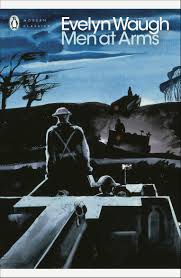
Men at Arms (not to be confused with the Terry Pratchett Discworld novel of the same name) is the first in Waugh’s Sword of Honour trilogy of novels about his experiences in

Men at Arms (Penguin Modern Classics): Amazon.co.uk: Waugh, Evelyn:  9780141185736: Books

the Second World War. His avatar for the purposes of this semi-autobiographical novel is the urbane Guy Crouchback. Guy is in his mid-thirties, has a failed marriage behind him, and his strict Catholicism means he cannot remarry. Hiding away in the family villa in Italy, Guy is moved to volunteer and join the army on the declaration of war in 1939. Being in his thirties he is considered rather old for active service and his extensive efforts to find a posting come to nothing. Nothing that is until a chance encounter leads to a role as an officer in eccentric and ancient Royal Corps of Halberdiers. In real life Waugh was in the Marines (initially at least) and it is clear that many of the experiences and challenges of army life are drawn from Waugh’s own life. Much of the novel focuses on his desultory training as an officer and the various random postings around the country, while the real events of the war take place off-stage, filtered back to the UK in a slowly descending spiral of bad news. Guy’s fellow officers are a series of fellow eccentrics and outcasts, particularly Apthorpe whose large and burdensome collection of personal possessions follows him around the country and becomes a running joke.

On leave in London during a short break in training Guy bumps into his ex-wife and her second husband Tommy Blackhouse, from whom she is also divorced. This is the kind of novel where characters are constantly bumping into friends and former lovers in unlikely circumstances, always responding in a low-key, fancy meeting you here old chap way. This motif is one of the few stylistic remnants from Waugh’s earlier comic novels where London and life was one big party for the rich and fabulous. As Guy is desperate to produce an heir to the Crouchback name, his brothers having pre-deceased him, he conceives an absurd plan to seduce and impregnate his ex-wife. Despite his efforts to get her drunk and into bed, his clumsy execution of his plan, not to mention the constant interruptions, frustrate him.

Back in training, a new officer, Brigadier Ritchie-Hook, takes command of the halberdiers, and threatens to bring some order to the chaos. While a sense of purpose is introduced the brigade seems no nearer to being combat-ready or to actually going into action, despite the steadily deteriorating position in Europe at the front. At this point in the novel there is an extended comic scene revolving round a chemical toilet, also known as a thunderbox. Quite why they need a chemical toilet when they are billeted in a school building is not explained and probably not relevant. This scene was well done and illustrated the ridiculousness of the modern army, with echoes of earlier, much more light-hearted Waugh. The feud between Apthorpe and Ritchie-Hook over ownership and exclusive access to the toilet culminates in it being sabotaged and destroyed in an explosion. Toilet humour may seem a bit out of place in this stiff-upper-lip novel of army life; the Halberdiers is an ancient brigade governed by a strict and sometimes apparently arbitrary set of rules, rituals, conventions and codes. But it is a welcome comic relief from army routine. These scenes reminded me of some chapters in Spike Milligan’s war memoirs such as Adolf Hitler, my part in his downfall, with which Men at Arms shares some dna – the extended and chaotic time spent preparing for conflict, pointless exercises, long journeys around the country ending up back in the same location, and moments of high farce.

Eventually the brigade sets sail for Dakar in Vichy French Senegal. Waugh was involved in a similar expedition to Senegal, which had a similar outcome. Having travelled all this way it comes as no surprise as the attack is called off. Nevertheless a frustrated Ritchie-Hook organises a clandestine raid on the coast, led by Guy, and returns with the severed head of an African soldier as a grisly trophy. For Ritchie-Hook this is all a gruesome game, another anecdote for when he is eventually decommissioned, but the consequences for Guy (for the unofficial raid, not for the decapitation of the guard) are serious, and he leave Senegal under a cloud. The brigade moves on to Sierra Leone where Apthorpe is hospitalised with an unspecified fever, his end hastened by a well-meaning gift of a bottle of whisky from Guy.

I’ve read quite a lot of Waugh in the past, and I am not sure how I haven’t got round to the Sword of Honour trilogy before. It is markedly different in tone from the dark comedy of his pre-war novels. Men at Arms is much closer to a straightforward memoir, with some exaggeration thrown in for comic effect. It is not a plot driven novel – the narrative meanders along at a relaxed pace. It’s also not really a war novel – the amount of combat involved in very limited and Waugh is in no way a triumphalist (the references to Churchill are pretty unflattering). Guy is something of an anti-hero, even of his own novel – he is determined to do the right thing when his country needs him and fully resigned to the discomforts and danger that military service will involve. But at the same time he tries to seduce his ex-wife, causes the death of a colleague, and the only action he sees is farcically unsuccessful. There is an honesty to this account of the early years of the war, when shambolic defeat follows defeat and only the Channel saves the country from invasion. I am pretty sure I’ll push on and read the other two novels in the trilogy to see how things pan out and try to decide whether I would recommend this to anyone other than Waugh completists or not.

Standard
Book review

Shuggie Bain, by Douglas Stuart, 2020

About a third of the way through Shuggie Bain I found myself once again questioning the wisdom of the Booker Prize panel, concerned that this 2020 winning novel was not much more than a standard misery memoir. Because it certainly starts that way. This openly autobiographical novel tells the story of the author’s distressingly difficult childhood in all its awful detail. All the traditional features of the misery memoir genre appear in quick succession. Young Shuggie Bain’s family is desperately poor (although arguably no poorer than the rest of his decimated working class Glaswegian community). His father is a philanderer and his mother is an alcoholic. Shuggie is gay, well spoken (mysteriously missing the broad Glaswegian accent of his family and neighbours) and artistic, and bullied relentlessly at school. The urban environment is empathetically grim:

“So Shuggie sat in stilted silence as the taxi rounded the corners of a brutal-looking council scheme. Each street was a scarred field of burnt-out off-licences dirty canals, and cars on bricks…Five or six tall high-rises pinned the heavy sky in place…the high-rises were ringed with low, boxy concrete houses… What was once built to be new and healthful now looked sick with a poverty of hope. There was no grass and no greenery; every flat surface was concreted over or covered in large, smooth round boulders.”

As is the weather:

“Rain was a natural state of Glasgow. It kept the grass green and the people pale and bronchial.”

Child, domestic and sexual abuse is so common it is not even recognised as such, or more precisely that there is not the language to describe it as such. Unemployment is almost universal, the mines and dockyards having been closed by the Thatcher Government. When the family moves to a grimy pit village outside of Glasgow in a futile attempt to escape, the community are hostile and unwelcoming. His father leaves home for another woman and his mother descends into even further alcoholic abuse. Catholic and Protestant sectarianism provides a final layer of nastiness to daily life. Shuggie’s sister leaves home as soon as she can, and his older brother can do little to help. He goes hungry most days and becomes his mother’s primary carer. It was a hard, depressing, unrelenting read, and I worried what else could go wrong for Shuggie, especially as the novel had opened with a chapter showing him living alone and having left school before his sixteenth birthday.

But then, amazingly, I found myself slowly coming to admire Shuggie’s extraordinary resilience. Despite the overwhelming challenges he faces everyday, he does his best to care for his alcoholic single-parent mother, goes to school when he can, keeps himself smart and ignores the bullies. Look most young carers he grows up quickly, learning to dress and undress his mother when she is in an alcoholic stupor:

“Shuggie gently lifted her foot, first unbuckling the tiny ankle clasp and slipping off each high heel and then carefully pulling the hard seam of her black tights out from between her toes. He rubbed the balls of her cold feet tenderly, and then he set each foot gently back on the floor. He talked to her quietly as he did…He set her high heels to the side of her chair and stood over her again. With skill he searched under the soft sag of her breasts until he found the centre of her chest, and through her thin jumper he undid the butterfly hook of her bra… Hooking his fingers he found each bra strap. He moved them on her shoulder line and freed her burdened flesh from the digging pressure of the nylon. Agnes stirred but did not wake. She coughed again, a deep damp cough that was the miners’ houses and mould, warm lager and now a cold night by the river.”

This scene jumped out at me, not just because of how it is resolved. Shuggie looks after his mother with such care – “gently, carefully, tenderly, with skill” – and has obviously done this many times before. More, it is written with an attention to detail that tells me the author has almost certainly had to do the same thing himself – sometimes scenes have an authenticity that is more than just a careful imagining of an event.

Agnes, his alcoholic mother, is in many ways the central tragic figure of this novel. She battles with her demons, and for one brief period seems to recover from her addiction, succumbing only to prove to her latest boyfriend that she is not the slave to alcohol she most obviously is. She is unable to give her children the care they need, but Shuggie’s love for her is indomitable. He is not perfect – he loses his temper and lies to her, but these are moments in years of devotion. And although Shuggie can’t in the end rescue his mother from her demons and comes to terms with the hopelessness of his task, the novel closes with scenes of him caring for another seemingly lost cause.

The New York Times described Shuggie as living in a “world of pain made bearable by love” which I think captures it right.

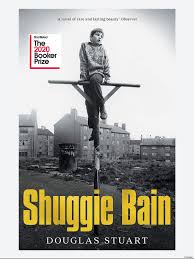
Finally, just a quick word about the novel’s cover images. The cover of the Picador hard back edition carries an extraordinary image (left) of a young boy perched on a cross-shaped post, a vivid crucifixion metaphor set against the backdrop of a desolate urban landscape. The first edition used this (right) tender picture of a young son cradling his mother’s head, locking eyes with her, both characters with a half-smile of recognition, his bare stick-thin arms showing his young age. It’s rare for an author to be so well served by such inspired and at the same time very different choices.

Douglas Stuart′s ″Shuggie Bain″ wins 2020 Booker Prize | Books | DW |  20.11.2020
Shuggie Bain (Douglas Stuart).png

Standard
Book review

The Underground Railroad, by Colson Whitehead, 2016

The Underground Railroad is a powerful exploration of the experiences of slaves in the USA in the first decades of the nineteenth century. It vividly brings to life the brutality of that period in images that will be hard for some readers to stomach.

The history of the real underground railroad has been extensively documented, so the challenge for any author is how to bring the lives of the slaves and those that assisted them to life. Whitehead’s ingenious idea is to conceive of the railroad as a literal, physical underground railroad, with engines and tracks running from the Southern states to the free North.

“The stairs led onto a small platform. The black mouths of the gigantic tunnel opened at either end. It must have been twenty feet tall, walls lined with dark and light colored stones in an alternating pattern. The sheer industry that had made such a project possible. Cora and Caesar noticed the rails. Two steel rails ran the visible length of the tunnel, pinned into the dirt by wooden cross-ties. The steel ran south and north presumably, springing from some inconceivable source and shooting toward a miraculous terminus.”

The story is told by the third-generation slave Cora, who has been born and brought up on a cotton plantation in deep South Georgia. There are one or two chapters narrated by other characters – Cora’s mother Mabel, and the slavecatcher Ridgeway, for example – but Cora’s is the predominant voice. Escape from the plantation is thought to be extremely improbable and dangerous – it is believed (wrongly, as it happens) to have been achieved only once before, and the punishments meted out to anyone who even tries to escape are barbaric in the extreme. Bounty hunters roam the land tracking down escaping slaves and recapturing them even years after their escape. But the advent of a new plantation owner, and the prospect of even more vicious abuse leads Cora to reconsider the escape plans of fellow slave Caesar. Caesar believes he knows how to make contact with a station manager on the fabled underground railroad.

Although their escape is beset with challenges, Cora and Caesar eventually make it to South Carolina, and begin life as free people for the first time in their lives. In this version of American history South Carolina is the site of an enormous and complex social experiment. Here the benevolent state government buys the freedom of slaves and then gives them jobs, medical treatment and social housing. While this seems utopian compared to the bloodthirsty existence on the plantation back in Georgia, there is a sinister element to this approach to the slavery question. Concerned that blacks are beginning to outnumber whites, the State government is sterilising black women and using black men to track the spread of syphilis. This is one of a number of theoretical approaches to slavery and the social problems it caused that are explored in the novel. How could a society dependent on black labour for the basis of its agrarian economy transition to a new model while preserving its prosperity? Although there were forced sterilization programmes across the USA in the twentieth century, evidence of this being an approach to slavery is hard to find. In fact quite the opposite happened – because slaves were so valuable, particularly after restrictions began to be applied to the transatlantic slave trade, female slaves were given fertility treatment to increase the number of children they had. Just to be clear, this is not a criticism of the novel’s exploration of this issue. It is in many ways best seen as an alternative history approach to considering the experience of slavery, even if many of the events described are drawn from real-life testimonies.

Throughout the novel Cora is relentlessly pursued by a bounty hunter named Ridgeway. Ridgeway failed to catch Cora’s mother, Mabel, and is determined to right this wrong by recapturing Cora, whatever the cost. He tracks her to South Carolina where she escapes at the last minute, leaving Caesar behind to be lynched by a mob. She ends up in North Carolina and is offered refuge by the son of a former railroad station operator. North Carolina has a different approach to slavery from its southern neighbour. Seeing the growing black population as a threat, North Carolina has launched what amounts to a holocaust against all black people, together with any who support or shelter them. Slaves have been replaced with mainly Irish indentured servants instead, just one step above slaves themselves. Any black people found in the State, irrespective of their legal status, are summarily executed, with a long series of bodies displayed across the State in a so-called Freedom Trail. (I had to look up whether this was a real thing or not – the brutality of slavery was such that it wouldn’t have surprised me if it was, although it is more an image drawn from Ancient Rome than the American South). Lynching black people has become a ritualised part of North Carolina’s society. Cora hides in the former station-master’s attic for several months, but is once again captured by Ridgeway when her presence is betrayed by the family servant. (The echoes between Cora’s time in the attic and the experiences of Anne Frank are clear, as are the wider points of reference between the slave-owners and the Nazis.)

Ridgeway tries to take Cora back to her owner in Georgia, but en-route she is rescued by some escaped slaves and taken to a free black farming community in Indiana. This is another, more positive alternative to life under slavery. Living on land once stolen from native Americans, freed and runaway slaves supported by abolitionists live in a community of equals.

“The land she tilled and worked had been Indian land. She knew the white men bragged about the efficiency of the massacres, where they killed women and babies, and strangled their futures in the crib. Stolen babies working stolen land. It was an engine that did not stop, its hungry boiler fed with blood.”

But it is clear this success cannot last, threatened from without by worried white neighbours, alarmed at the growing number of people living on the farm, and from within by nervous residents who disagree with the policy of offering sanctuary to runaways. This debate – whether progress in the fight for freedom for slaves can be achieved by radical challenges to the status quo or a gradualist, legal approach – was one of the many discussions in the novel that echoes the issues faced by modern African Americans .

This was a compelling read. The elements of magical realism in the novel, in particular the vision of the railway itself, and the discussions of some of the alternative responses to slavery, blending compellingly realistic descriptions with more fantastical concepts to make a gripping whole. In writing about this shameful period of American history a fine line has to be navigated between under-stating the barbaric nature of the treatment of slaves and exploiting those experiences for their shock value (in the way that, for example, Django Unchained does). Whitehead strikes that balance carefully – he doesn’t look away from some of the distressing scenes, but neither does he linger upon them. His characters are all well-rounded, believable individuals, even Ridgeway the remorseless Ahab-like bounty hunter.

Standard
Book review

The Thursday Murder Club, by Richard Osman, 2020

If you enjoy murder mysteries but aren’t a fan of the more gory, bloody thirsty variety of the genre, you will love Richard Osman’s intelligent but ever so slightly sedate ‘The Thursday Murder Club’. Set in a retirement village, four friends gather once a week (“It was Thursday because there was a two-hour slot free in the Jigsaw Room, between Art History and Conversational French”) to discuss unsolved murder cases. One of the club members, Penny, has recently fallen seriously ill and is no longer unable to attend, so the club has decided to recruit a new member. Joyce is the voice of naivete in the narrative, breathlessly excited about her new adventures. (“I’m afraid I don’t know WTF. I only discovered LOL last week”). The other, more experienced members all bring their own particular set of skills to this most unlikely A-team. They are Elizabeth, who was an intelligence agent before never really quite retiring, Ibrahim, a psychiatrist, and Ron, a trade union leader.

The Thursday Murder Club: The Record-Breaking Sunday Times Number One  Bestseller: Amazon.co.uk: Osman, Richard: 9780241425442: Books

The cynic in me suspects that Osman has had some excellent advice on how to sell books. Rule one must surely be “know your audience”. I haven’t taken the time to look it up, but I am believe the main buyers of murder mystery novels written by television celebrities are senior citizens, and it looks as if Osman has constructed his story with that market in mind. The heroes of his novel are the club members who defy all negative stereotypes about the aged. They are energetic, intelligent, and navigate the modern world with ease. The murder club amateur detectives are always one step ahead of the police and break rules (and laws!) with impunity. Jokes about the challenges of modern technology are kept to a minimum. This adds up to create an immensely likeable story despite some of the more conspicuous evidence of its construction. At 377 pages across 115 chapters the pages slip by quickly, and the contrasting narrative voices and cliff-hanging endings all give the story considerable pace. All these elements make this a very easy novel to read. Is it patronising to suggest that this is all intended to make the book more popular with older readers?

I’m not going to summarise the plot, for the obvious reason of avoiding spoilers, but also because it is quite byzantine. There are lots of red herrings, sub-plots and other diversions which add to the page count but at times felt like padding. The ending won’t come as a massive shock, but I don’t think it is mean to – after a while there are only so many suspects left standing!

Despite some of the media coverage of this novel it is anything but ground breaking in its treatment of the old. Miss Marple is an obvious template for the senior citizen amateur detective, using her age to ensure people under-estimate and overlook her while she doggedly pursues her investigations. Having said that, the setting is original (so far as my limited knowledge of murder mysteries can account for). Osman acknowledges that many people living in a retirement home will either have lost a life-partner, or be in the process of losing them, to dementia or other illnesses. Grief is shown as part of everyday life for this community.

It’s hard to avoid the fact that even the very best murder mysteries are written within a fairly rigid set of conventions. It follows that it is not a criticism of this author to say that his first novel seems to be consciously laying down a template for future novels in the series to follow. Why wouldn’t it? I understand he has already written the sequel to this novel, and I think I can hazard a couple of guesses about what will happen in The Thursday Mystery Club 2. The central structure of a suspicious death being investigated by the club members will of course be retained. I think we will learn a lot more about the back-story of Elizabeth and Ibrahim, two key members of the club who so far we only know little about. There’s a lot more to come there if the history of some of the other residents is anything to go by. I also think one of the club members will die – my money is on retired trade union leader Ron – allowing fresh blood to join the club and new characters to be introduced. I also suspect there will be more explicit romantic complications between the retirement village residents, and that PC Donna De Freitas and her boss, DCI Chris Hudson will return for the next set of murders.

Just as an aside, the attitude to death in this novel is interesting. Of course murder mysteries by their nature need to confront death, and one set in a retirement village probably all the more so. But here two characters take their own lives in quite a casual manner, as if for the old death is less of an issue that it would be for younger characters. That might be the case but it doesn’t really square with the zest for life shown elsewhere in the novel. Some old people might be blasé about death and check out willingly when the time comes, but I suspect many others will fight it to the last – certainly Ron, Elizabeth, Joyce and Ibrahim would.

It’s good to see one of the more thoughtful, intelligent television personalities have success as an author. I await the inevitable television adaptations of his novels with interest.

Standard
Book review

Milkman, by Anna Burns, 2018

I decided to end 2020 with a final Booker Prize winner, Anna Burns’ Milkman, which won the prize in 2018. It won from what seems a fairly weak long and shortlist, missing many of the big-hitters in English fiction in recent years, although I would freely admit to not having read any of the short-listed novels, nor indeed anything by any of the short-listed authors.

Set in Northern Ireland during the peak of what was euphemistically called “the Troubles” – that is to say the bitter sectarian violence that dominated daily life for much of the population of Northern Ireland in this period – Milkman is a first person narrative describing a few traumatic weeks in the life of the unnamed narrator.

Milkman: Amazon.co.uk: Burns, Anna: 9780571342730: Books

This narrator is an eighteen year old woman who lives in the heart of the Catholic community in a large town in Northern Ireland. It (along with everything else) is never named, but i think it is safe to assume it is based on Belfast. She is in a relationship of sorts with her “maybe boyfriend” although she tries to keep this relationship secret from her mother and siblings. She has a large family – as it seems do all her friends and neighbours – who are all referred to by their relationships rather than their names – third brother-in-law, oldest sister, etc. Friends and neighbours are also nameless and referred to by their occupation or some other defining feature. This is a world of euphemisms and coded references where proper nouns are forbidden – so the Protestant community is “the other side”, the Irish Republic is “the country down there” and Britain is “the country over the water”.

The Troubles form a backdrop to our protagonist’s daily life, but she does her best to navigate some form of normality despite the rigid code of conduct imposed by her community. This means that some types of rule-breaking are allowed – for example she sleeps over with her maybe-boyfriend without apparently attracting the censure of the community – but other activities such as going to hospital for medical treatment (it might allow the authorities an opportunity to force you into becoming an informer, or worse throw suspicion on you that you are an informer) even when seriously unwell are forbidden.

The narrator’s attempts to get on with her life are disrupted when she meets the Milkman. He does not deliver milk or any other dairy products, and the source of this soubriquet is unclear. He is much older than her and already married. Milkmen are usually perceived as a welcome presence, and a positive part of the daily life of a community. However this milkman however is anything but. He is a senior member of the Provisional IRA (again never mentioned directly) and as such he has certain privileges in this society, one of which appears to be the right to pick a consort of his choosing, irrespective of her wishes in the matter. The narrator is alarmed at being singled out in this way, and doesn’t know how to react. A robust rejection would be dangerous, for her maybe-boyfriend if no-one else, but she has no interest in this creepy figure. She doesn’t know who to turn to for help:

“At the time, age eighteen, having been brought up in a hair-trigger society where the ground rules were – if no physically violent touch was being laid upon you, and no outright verbal insults were being levelled at you, and no taunting looks in the vicinity either, then nothing was happening, so how could you be under attack from something that wasn’t there? At eighteen I had no proper understanding of the ways that constituted encroachment.”

She goes jogging with one of her many brothers-in-law, walks to her evening classes, socialises with maybe-boyfriend, but all the while is conscious of the menacing presence of the Milkman. Her relationship with maybe-boyfriend suffers under this strain, until she discovers his secret relationship with his friend, chef. Chef is bullied for his interest in cooking, which is widely perceived as indicating he is gay – although he is able to put his chef knives to use when the time comes.

The claustrophobic atmosphere of the city, where the authorities lurk behind every bush, snapping pictures of people going about their lives, is profoundly oppressive, and distorts all normal relationships. People accept punishment beatings and shootings as normal, and choose unhappy relationships to avoid the disappointment when happy relationships fail, as they surely must. The control of the terrorist groups and their supporters is however tenuous – freedom seems to be seeping out all over the place, from the children and their embrace of ballroom dancing (when written in this context I know that must appear implausible, but the author does a much better job of making it seem convincing) to romantic relationships being restored, including maybe-boyfriend and his long-standing romantic feelings for chef.

This wasn’t an easy novel to read – the refusal to use any proper nouns combined with the dense paragraphs and complex family relationships made it hard to push through at times. Conveying how language is breaking down with using fractured sentences is difficult, leaving the reader with paragraphs like this:

“Still,’ he said. ‘Ach,’ I said. ‘Ach nothing,’ he said. ‘Ach sure,’ I said. ‘Ach sure what?’ he said. ‘Ach sure, if that’s how you feel.’ ‘Ach sure, of course that’s how I feel.’ ‘Ach all right then.’ ‘Ach,’ he said. ‘Ach,’ I said. ‘Ach,’ he said. ‘Ach,’ I said. ‘Ach.’

But despite this Milkman made a strong impression on me. There are many surprising, almost charming elements, such as the narrator’s young sisters, who are exceedingly intelligent and curious, and blossom in the most difficult of circumstances. Love also finds a way – the narrator’s mother rekindles a childhood romance with the real milkman, her brother runs away with a former girlfriend, and chef and maybe-boyfriend edge towards declaring their feelings for one another. Initially the small-mindedness of the tight-knit community initially seems invincible – no dissent is allowed, and anyone who behaves unconventionally is considered “beyond the pale”, including the narrator. But this begrudging, limited tolerance of unconventional behaviour, such as the “issue women”, a feminist group, and the real milkman himself, who refuses to allow the IRA to bury weapons in his garden, are the seeds for a wider resistance. From such a grim premise Milkman turned out to be surprisingly optimistic.

Standard
Book review

A Study in Scarlet, by Sir Arthur Conan Doyle, 1887

ArthurConanDoyle AStudyInScarlet annual.jpg

Yep, that’s right – A Study in Scarlet, the first story to feature Sherlock Holmes and Dr Watson, was published in Beetons Christmas Annual, although you will struggle to find anything remotely Christmassy about it! This is the Holmes and Watson ‘origin story’, explaining how they meet (introduced by a common acquaintance), came to live together (they both needed somewhere slightly cheaper to live, and decide quite casually to share the rent with one another) and all about Dr Watson’s background (military doctor wounded in Afghanistan). Almost nothing on the other hand is revealed about Holmes’s background. He emerges fully formed – the meticulous, brilliant private detective with the ability, almost like magic, to use microscopic or incidental details to discern peoples’ lives, occupations and histories.

The short novel is divided into two very distinct narratives. Part I is entitled “The Reminiscences of Watson” and subtitled “Being a Reprint from the Reminiscences of John H. Watson, MD, Late of the Army Medical Department.” This gives the story the appearance of a biographical sketch, with the added authority of coming from an army doctor, so surely trusty-worthy. Perhaps this air of authenticity was part of the reason why people went on to conceive of Holmes are being a real life figure?

Watson, having returned to London from service in the Second Anglo-Afghan War, bumps into an old friend, Stamford. 

I had neither kith nor kin in England, and was therefore as free as air—or as free as an income of eleven shillings and sixpence a day will permit a man to be. Under such circumstances, I naturally gravitated to London, that great cesspool into which all the loungers and idlers of the Empire are irresistibly drained.

Watson explains he has been invalided out of the army and is looking for a more affordable place to live. Stamford mentions an acquaintance who is in a similar position, and might be interested in sharing. This is our first introduction to the great detective:

“…a fellow who is working at the chemical laboratory up at the hospital. He was bemoaning himself this morning because he could not get someone to go halves with him in some nice rooms which he had found, and which were too much for his purse.”

Stamford’ description of Holmes is ambivalent – his recommendation of him as a flat-mate is hardly glowing:

“Oh, I didn’t say there was anything against him. He is a little queer in his ideas—an enthusiast in some branches of science. As far as I know he is a decent fellow enough.”

He takes Watson to meet Holmes in a hospital laboratory, where Holmes (although he doesn’t work there, and seems to have set up shop spontaneously) has just developed a test to detect haemoglobin, for use in criminal investigations. Thus Holmes’s credentials as an eccentric, brilliant scientist are established. Without prompting Holmes greets Watson with the comment “You have been in Afghanistan, I perceive.” This is the first instance of Holmes’s deductive and observational powers, which were to become such a popular feature of the stories.

The two confirmed bachelors set up home together, and quickly become close friends. Holmes is unquestionably eccentric, but Watson is never judgmental, even when he suspects Holmes of drug-taking. It takes Watson some time to work out what Holmes does for a living – Holmes is as usual unnecessarily mysterious about the question. Of Watson himself we really learn little beyond the initial self-portrait – but his role is nevertheless established as the witness of Holmes’ brilliance and as the representative of the reader – always a few steps behind Holmes, struggling to keep up and work out what is apparently so obvious to the great one. Holmes remains enigmatic – there is no mention of any other friends or family, or his previous career.

Holmes is asked to help the Metropolitan Police with a murder investigation. He takes Watson along with him to the scene of the crime, for reasons that are never really established – perhaps he just thought it would be interesting, or an opportunity to get to know one another. Here we first see Holmes’s method in action – a meticulous observation of the house and garden, which appears to reveal much more to Holmes than is apparent to Watson. Another trope is thus established. Inspectors Gregson and Lestrade are introduced (unusual for the Met to allocate two inspectors to a murder; it is interesting to see how Lestrade went on to become a fixed part of the Baker Street universe, whereas Gregson faded into the background, until being spectacularly resurrected in Elementary). Gregson and Lestrade are competitive but largely there to underline even further how astonishingly clever Holmes is by comparison.

The corpse is identified as an American, Enoch Drebber. There is no wound on the body. Documents conveniently left at the scene confirm Drebber is visiting London with his secretary, Joseph Stangerson, an immediate suspect. One a wall, ominously written in blood – apparently not the victim’s – is the word “rache”. This it eventually turns out is the mother of all red herrings. Moving the body, a woman’s gold wedding ring is discovered.

Realising the murderer attempted to return to recover the ring, Holmes sets a trap, advertising its discovery in a newspaper. At the same time he sends telegrams to the US seeking confirmation of his theories about the crime and those involved. A little later Drebber’s secretary is found murdered at his boarding house, again with the word “rache” appearing at the scene. Lestrade also finds a small pillbox containing two pills. Holmes tests the pills on a disposable dog that conveniently just happens to have been in residence at Baker Street. (This is Conan Doyle not trying very hard. Yes, Holmes has to be shown that of the two pills in the box one is lethal, the other harmless. But to have a sick dog on hand just waiting to be put down is pushing the bounds of credibility). The first pill produces no evident effect, but the second kills the hound. Holmes is able to produce and capture the murderer moments later using his trademark ‘sudden reveal’ technique.

Part two of the novel, The County of the Saints, consists almost entirely of a flashback devoid of Holmes or anything Baker Street related. The narrator recounts the story of two people, John Ferrier and a little girl named Lucy, the only survivors of a party of settlers in early nineteenth USA. They are close to death from dehydration and hunger when they are discovered by a large party of Mormons on their way to Salt Lake City. (Warning – one can easily fall down an internet rabbit hole looking into the early history of the Mormons. They were viciously persecuted, which given the founding principles of the USA is a bit ironic). Ferrier and Lucy are rescued on the condition that they become Mormons, and with few choices open to them, they agree. Ferrier prospers, and adopts Lucy as his daughter. Years later Lucy falls in love with a man named Jefferson Hope. Hope is not a Mormon, and a relationship with him is not allowed by her community. Ferrier is given one month to change her mind or face what it is suggested are fatal consequences. Lucy must marry either Joseph Stangerson or Enoch Drebber, sons of members of the church’s Council of Four (and, you will have spotted, the men murdered in part one).

Lucy, Hope and Ferrier try to escape, but are hunted down. Ferrier is killed, and Lucy is dragged back to Salt Lake City and an enforced marriage, with only Jefferson escaping through sheer luck. Lucy pines away and dies, and Hope vows to seek revenge on her and her father’s killers. He hunts them for decades, chasing them across Europe until finally tracking them down in London, where he exacts his revenge by forcing Drebber to choose between a fatal pill and a harmless one. Stangerson is then despatched before the pill choice can be offered. Once captured Hope freely confesses all, knowing he has a conveniently weak heart and is close to death – indeed, he expires the next day, a smile on his face. Holmes then leisurely reveals how he had worked out the identity of the murderer and how he had used his Baker Street Irregulars, his “street Arabs,” to help with the case. Watson is outraged that Gregson and Lestrade are given credit in the newspapers for solving the case, and decides to document the investigation himself. Surprisingly, Holmes does not object.

To what extent does Holmes emerge in this novel fully formed? Almost completely is the short answer. All the features of a traditional Holmes story appear in the summary above. Admittedly, the portrait of Holmes’s weaknesses is over-done. Early in the novel Watson lists the subjects in which Holmes is an expert, and those in which he has little or no knowledge, including astronomy, and the astounding fact that he did not realise that the earth travels round the sun, a fact that is, according to Holmes, of no interest of value whatsoever.

His ignorance was as remarkable as his knowledge. Of contemporary literature, philosophy and politics he appeared to know next to nothing. Upon my quoting Thomas Carlyle, he inquired in the naivest way who he might be and what he had done. My surprise reached a climax, however, when I found incidentally that he was ignorant of the Copernican Theory and of the composition of the Solar System. That any civilized human being in this nineteenth century should not be aware that the earth travelled round the sun appeared to be to me such an extraordinary fact that I could hardly realize it….

You see,” he explained, “I consider that a man’s brain originally is like a little empty attic, and you have to stock it with such furniture as you choose. A fool takes in all the lumber of every sort that he comes across, so that the knowledge which might be useful to him gets crowded out, or at best is jumbled up with a lot of other things so that he has a difficulty in laying his hands upon it. Now the skilful workman is very careful indeed as to what he takes into his brain-attic. He will have nothing but the tools which may help him in doing his work, but of these he has a large assortment, and all in the most perfect order. It is a mistake to think that that little room has elastic walls and can distend to any extent. Depend upon it there comes a time when for every addition of knowledge you forget something that you knew before. It is of the highest importance, therefore, not to have useless facts elbowing out the useful ones.”

The idea that Holmes was ignorant of simple facts that a schoolchild would know, simply because he needs the space in his memory for more important facts, was quietly discarded by Conan Doyle, and rightly so. But the wider picture, of Holmes being an expert in a wide range of subjects, and having a vast brain ‘attic’ where facts can be stored and retrieved, is a core part of the character.

One other common feature of the Holmes stories is his frustrating refusal to tell Watson and any detectives involved in the case about his deductions until the case comes to fruition. Sometimes this is more a case of neglect that a conscious decision to be obtuse, but here the refusal to share is clearly deliberate:

I’m not going to tell you much more of the case, Doctor. You know a conjuror gets no credit when once he has explained his trick, and if I show you too much of my method of working, you will come to the conclusion that I am a very ordinary individual after all.

Watson is deferential as always:

I shall never do that,” I answered; “you have brought detection as near an exact science as it ever will be brought in this world.

Mrs Hudson has yet to be introduced – here the gentlemen are looked after by an anonymous servant – and of course Moriarty, Mycroft and Irene Adler were all to come, but the Study in Scarlet is otherwise the template which all future Holmes stories were to scrupulously follow.

Is it an enjoyable story, or just a curiosity piece? Certainly the second part of the novel, largely devoid as it is of anything Holmes related, comes in for a lot of criticism from readers (see Goodreads, for example). I actually found the scenes in America more interesting than those in London – the part one murders are pretty pedestrian, solved by Holmes with the minimum of effort. Origin stories are always interesting, offering insights into the way the novelist originally conceived of the characters, but here the interest is actually how incredibly consistent Conan Doyle was with his characterisation of Holmes and his detection techniques.

Standard
Book review

How to Stop Time, by Matt Haig, 2017

Time travel is an obvious source of plot material for authors, but it is also inherently problematic – making it plausible is always the challenge. Over the years authors have adopted a range of different approaches to making it believable. None have ever really cracked the central practical problems associated with the idea, but Matt Haig comes close in this novel, mainly by redefining what we mean by time travel. His central character, Tom Hazard, has a rare genetic condition which causes him to age extremely slowly.

I am old. That is the first thing to tell you. The thing you are least likely to believe. If you saw me you would probably think I was about forty, but you would be very wrong.

For every ten to fifteen years of his life his body ages approximately one year of everyone else’s. And this is his story. At the time we are introduced to him he is around 400 years old. Much of the novel is spent revisiting Tom’s memories of his earlier lives, from medieval England to 1920’s Paris. The gift of long-life has not been without its problems. His mother is drowned as a witch because of his eternal youthfulness, and he has to separate from his Elizabethan wife and daughter to prevent something similar happening to them. He is forced to change identity every eight years, can never put down roots, learn a profession, build a family, or settle down. And of course the things he can’t have become the things he wants.

In the present Tom works as a teacher, teaching history from first-hand experience. He becomes attracted to a colleague who comes close to working out his secret, but Tom knows that if he allows that to happen he would be putting her in danger. Because Tom has reluctantly joined a group of ‘albas’ – albatrosses, people with the same long-life gene as Tom – determined to protect their secret from big-tech or anyone who would want to analyse their genes for the secret of near eternal life. This group takes a unequivocal approach to secrecy – anyone who finds out about the albas is murdered.

The central concept of this novel is original and interesting. But the novel never really grabbed me. The main character, Tom, doesn’t realise what an amazing gift he has, and to be honest spends a lot of time complaining. His focus is relentlessly on how difficult long-life is amongst normal people, rather than “Wow, I met Shakespeare!”. The resolution of the plot in which he has to choose between enforcing the secrecy code of the albas or embracing the possibility of love is sentimental and unconvincing.

Sorry – I hate reviewing books that I feel underwhelmed by. I’d rather review a book I full-on hate rather than something that is not that bad. But this was just OK. The author can clearly write, and come up with great ideas, so I genuinely hope he finds the right combination one day.

Standard
Book review

Making Money (Discworld 36) by Sir Terry Pratchett, 2007

Making Money is the sequel to the transcendent Going Postal. It is the story of the further adventures of Moist von Lipwig as he takes on his next challenge – reforming the Ankh-Morpork banking system. For a choice of topic Pratchett couldn’t have been more prescient, coming as it did just a few months before the international banking crisis which precipitated a decade of economic misery.

Anyone who has read this blog before will know that I rate Pratchett as one of our finest writers, so it pains me to concede that Making Money doesn’t quite meet his usual high standards. Just to be completely clear I don’t think for one second this had anything to do with his diagnosis in the same year – his illness was a form of dementia that left him lucid to the end – this article he wrote about his condition explains it far better than I could. Perhaps it is more a case that Going Postal set such a high watermark that any attempt at a sequel would always struggle to compare.

Banks in Ankh-Morpork are failing, and who better to give them a shot in the arm than an admitted thief and smooth-talking showman? “The city bleeds, Mr Lipwig,” says Vetinari, “and you are the clot.” (It has taken me a very long to realise this, but there is a strong case for Vetinari being Pratchett’s greatest creation.) Lipwig is bored running the Post Office, which no longer needs his buccaneering approach to management. So he takes over the running of the city bank and mint. As you would expect there is a cast of comic characters involved. The bank’s chairman is a fussy little dog, the chief clerk, a mathematical savant, obviously harbours a dark secret, which sadly disappoints when it is finally revealed, and a sinister opponent has ambitions to replace Vetenari. In the basement of the bank (is it a bank, or a mint, or both – I was never really clear, so the powerful sense of place which dominates Going Postal, that extraordinarily evoked abandoned Post Office, stuffed to the rafters with undelivered post, is not recaptured) someone has built the Glooper, a model of the city’s economy that develops a life of its own.

There’s not enough of chain-smoking Adora Belle Dearheart in this novel. She is away finding more buried golems, who eventually appear in large numbers only to walk back off stage almost immediately, consenting to be buried in a most improbable fashion. Would Adora, who has dedicated her life to liberating golems, really be happy with this resolution of the ‘what to do with the golden golems conundrum?

Money is an elusive concept, so I am aware of the irony when I say that Pratchett never quite pins it down. It’s not intrinsically good or bad, so the novel is deprived of a cause (compared to say, its predecessor in which privatisation and modernisation are firmly skewered). Pratchett asks the right questions – of course – such as why we trust banks or what the “tacit understanding that we will honour our promise to exchange a dollar for a dollar’s worth of gold provided we are not, in point of fact, asked to” actually means, but never really gets to grips with the topic, skirting around it before moving on to other more tangible, plot-related issues.

My other disappointment with this novel, however slight, centres on Pratchett’s prose. usually his ability to craft a sentence is unparalleled, but here many of the lines fall flat.

“I wouldn’t trust you with a bucket of water if my knickers were on fire!”

“The only really sane person in there is Igor, and possibly the turnip. And I’m not sure about the turnip.”

“I’m an Igor, thur. We don’t athk quethtionth.”
“Really? Why not?”
“I don’t know, thur. I didn’t athk.”

That’s not always the case of course – I loved this image:

“It seemed to Igor that trouble hit Mr. Lipwig like a big wave hitting a flotilla of ducks. Afterward, there was no wave but there was still a lot of duck.”

Making Money is a fun story featuring many of the Discworld characters that by this stage in the series need to do little more than walk on, say their lines, and move on. Moist and Adora really deserved more than a light retread of Going Postal, but that’s essentially what they got.

Standard