
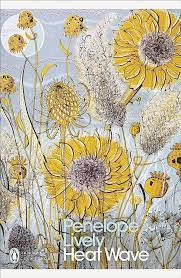
Heatwave, by Penelope Lively, 2009
Penelope Lively’s Heatwave is set during the course of a long hot summer in rural Oxfordshire. The narrator, Pauline rents one of a pair of cottages; the other is the home of her daughter Teresa, Teresa’s husband Maurice and their young son Luke. The pair of cottages are somewhat ominously called World’s End, not a reference to the Edgar Wright film but portentous nonetheless. Pauline is a proof-reader; Maurice an author, while Teresa cares for Luke. Maurice is writing what sounds like a very pretentious history of English tourism and as part of his working routine he regularly goes back to London for meetings. He is also visited from time to time by his publisher, James and James’s girlfriend, Carol. The other inhabitants of World’s End also travel up to London from time to time – while secluded it is obviously not that remote, and these are urban, middle class people comfortable with popping off to Paris for the weekend or Venice for a month.
It is obvious from early on that Maurice is a ‘bad un’. Think Martin, the sleazy brother-in-law from Fleabag. He (44) is quite a bit older than Teresa (29) who hero-worships him. Teresa’s archetype, the long suffering wife who accepts her lot without protest, is established early – on the very first page Pauline compares her to a Hardy heroine “betrayed no doubt”. Pauline, long divorced from her philandering husband Harry, recognises the signs of Maurice’s likely adultery well before Teresa does, although the reader is given even earlier clues of his wandering. Pauline is reluctant to tell her daughter of her suspicions, waiting for some concrete evidence. She recalls the details of her own marriage to a serially unfaithful husband, who now writes to her occasionally from America where he is a college professor. Other than the slow passage of the summer and occasional trips out to cheesy tourist attractions as ‘research’ for Maurice’s awful book, the action is slow. Pauline remains watchful towards Maurice but never confronts him, and time is marked by the changing agricultural landscape and the steadily warming weather. Slowly Teresa begins to develop her own suspicions, but is also reluctant to face the issue or even discuss it with her mother. We are offered other relationships for comparison – Pauline’s bookseller friend and his agoraphobic wife, and the author of the book Pauline is proof-reading, stranded in remote Wales. Happy relationships in Heatwave are rare.
The novel opens on a warm May day, with everyone apparently “poised for this agreeable summer of industry and companionship“. Or so they believed, the narrator silently suggests. As summer passes the stresses within Maurice and Teresa’s relationship are exposed and his infidelity becomes all the more obvious. Pauline spends much of her time reminiscing. Some reviewers – in fact most, I think – claim that the damage caused by Harry’s infidelity is inter-generational and is in some obscure way the cause of Maurice’s unfaithfulness, as if Teresa has sought out a father figure for a husband who will repeat his behaviour. I am not convinced we are fated to repeat our parents’ mistakes, but Heatwave certainly seems to suggest it is unavoidable unless a dramatic break with the past is made.
Heatwave reminded me of Howards End in its portrait of a rural idyll threatened by modernisation, the way the characters live halfway between town and country and the novels’ sudden melodramatic ending in which a brutal and arbitrary form of justice is meted out. Another novel I was reminded of was J L Carr’s A Month in the Country which follows a similar structure, but is much more gentle and perhaps even kind in its treatment of its equally flawed characters.
Often, finding a way to end these reviews can be the hardest part of writing them. You can’t just stop (as some novelists do, irritatingly) – you are always on the lookout for a way of summing things up neatly with an appropriate sign-off. Many bloggers end with an invitation to readers to comment and provide their own thoughts. But one option that is not open to us it the deus ex machina out of the blue approach to ending that Lively uses in Heatwave. It was such an abrupt conclusion that it left me feeling a little cheated if I am honest.



 Notorious for being described by one of the 1994 panel of Booker judges* as “crap”, How Late is Was, How Late is a stream of consciousness novel written in ‘Glaswegian demotic’. It spans a week in the life of Sammy, a shoplifter and ex-convict, who gets drunk, fights with the police, and is beaten by them so badly that he is blinded. The assault happens in the opening weekend leaving the bulk of the novel to relate his clumsy and sometimes tragi-comic attempts to come to terms with his condition, to navigate the streets of Glasgow, and make a half-hearted claim for disability benefit. He refuses almost all help despite desperately needing it, and slowly reveals a small amount about his past, including two long spells in prison.
 The Reading Bug