Book review

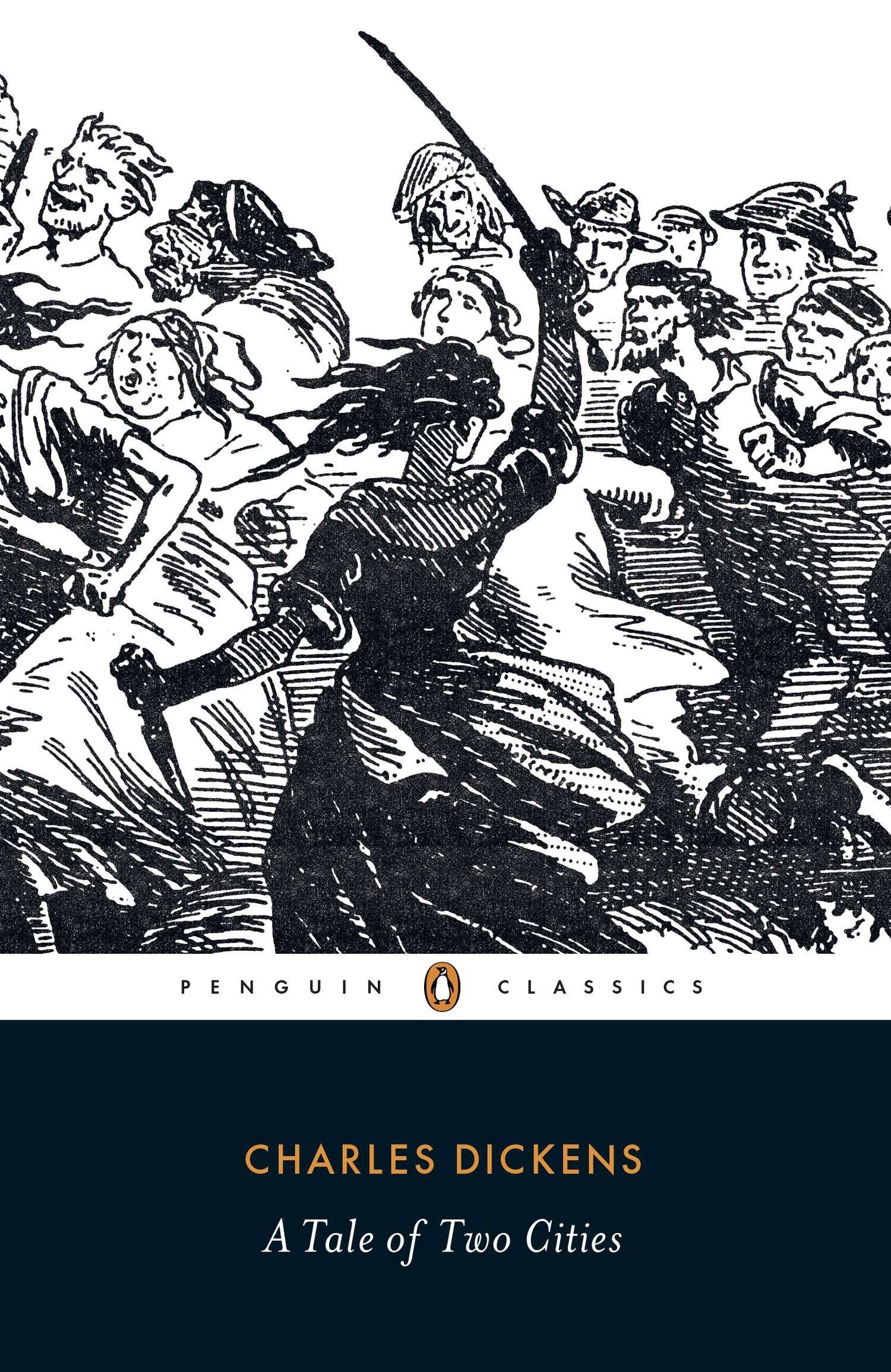
A Tale of Two Cities, by Charles Dickens, 1859

A while back I decided to copy Susan Hill‘s excellent idea of reading one Dickens novel a year. The volume of his work is such that it can be daunting knowing where to begin, (and thus never actually starting), whereas one novel a year is eminently achievable, and quickly builds up into a decent list. I read most of Dickens whilst at university, so I am making a point this time round of catching up with the ones I never got round to, of which the most prominent remaining is (or rather was) A Tale of Two Cities.Image result for tale of two cities images
It was the best of times, it was the worst of times, it was the age of wisdom, it was the age of foolishness, it was the epoch of belief, it was the epoch of incredulity, it was the season of Light, it was the season of Darkness, it was the spring of hope, it was the winter of despair, we had everything before us, we had nothing before us, we were all going direct to Heaven, we were all going direct the other way.

There are very few better openings lines to a novel than this. When I bought the copy of A Tale of Two Cities for this read, the shop assistant, (who was otherwise perfectly pleasant), took the opportunity to tell me how she ‘couldn’t stand’ Dickens. It’s not an uncommon reaction. Why do so many people feel this way? Dickens is often given to children as young as 10 or 11 to read. I can only imagine that this is done on the misguided basis that his works are considered accessible to the younger reader. But they clearly are not, on the basis of length and complexity alone. That might be one reason. The case against Dickens as a writer for adults is that his novels are slow-paced and overlong, his characters are two-dimensional, and his plots improbable. There is a lot in this. His novels are usually very long (possibly even too long, although how you could measure that I can’t imagine). The plots meander and take an age to develop. His characters are caricatures. Stupid characters are really stupid. Villains have not a single redeeming feature. Heroines are – well, you’ve got the picture. His plots, when they do finally reach a conclusion, depend massively on coincidence. His writing can be overblown and over the top. For all these reasons and more people struggle to appreciate Dickens. Which is a pity, because I think he is one of our greatest writers, and if evidence of this were required I give you the opening paragraph above. It is poetry in prose.

The case for the defence doesn’t just stand on this opening paragraph of course, but it is quoted in part as evidence of the strength of Dickens’ writing. While his characters may be two-dimensional, they are unquestionably memorable – Uriah Heep, Mr Micawber, Scrooge, the Artful Dodger and many others are known by people who would not come within a mile of one of his novels. They may be long, but reading isn’t a race. His plots wander, yes, but the wandering is the point, rather than the resolution. But all this would be as naught if he wasn’t a wonderful writer, and he is.

You will know the plot of A Tale even if you haven’t read a page of Dickens – and doesn’t that on its own tell you something about his abilities as a storyteller? Set in the time of the French Revolution, it follows the intertwined tales of an aristocrat refugee, Charles Evermonde (now known as Darnay), and the dissolute English lawyer, Sydney Carton. Dickens takes his time setting the scene, providing elements of the backstory that he will return to at the novel’s climax. In a vivid opening chapter the nightly mail-coach on route from London to Dover is flagged down by a messenger for Tellson’s Bank with the cryptic message “Recalled to Life.” We later learn that this refers to the release from the Bastille of a Dr Manette after 18 years inside. It is only at the end of the novel that we learn the reasons for his imprisonment. A reunion between the profoundly traumatised Dr Manette and his long lost daughter follows. The next chapters of the novel jump forward to 1780: Darnay is on trial for treason against the British Crown. Two spies claim that Darnay gave information about British troops in North America (where of course the American Revolutionary war was underway) to the French. Under cross-examination it is pointed out that fellow lawyer Sydney Carton bears a strong resemblance to Darnay. This coincidence is to play a key part in the novel’s resolution. Darnay is of course acquitted.

The novel’s focus then shifts to Paris, where Dickens shows the depravity of the aristocracy. The carriage of the evil Marquis St. Evrémonde runs over and kills a child. The Marquis casually tosses a coin to the parents as compensation. The Marquis is the uncle of Charles Darnay, who is also his heir, even though he has disavowed the family name. The die is thus cast – all the pieces are in place, and they fall domino-like, with the French Revolution leading swiftly to the reign of terror. At the height of the revolution Darnay suicidally travels to Paris where he is arrested as an emigrant and an aristocrat. In the novel’s least plausible development his wife, Lucie Manette, travels to try to secure his release. Bizarrely she takes an entourage with her – her father, Dr. Manette, her daughter, and two servants/travelling companions. Somehow they manage to live for over a year in the tumult of revolutionary Paris, a household of English people protected only by Dr Manette’s status as a former prisoner of the Bastille. I won’t spoil the novel’s ending for you, which you probably know anyway. I found it surprisingly moving, with that famous, resonant last line.

It is a far, far better thing that I do than I have ever done; it is a far, far better rest that I go to than I have ever known.

Dickens’ perspective on the revolution is crystal clear – the terror is a direct result of the appalling way the French working classes were treated by the aristocracy.

Along the Paris streets, the death-carts rumble, hollow and harsh. Six tumbrels carry the day’s wine to La Guillotine. All the devouring and insatiate Monsters imagined since imagination could record itself, are fused in one realization, Guillotine. And yet there is not in France, with its rich variety of soil and climate, a blade, a leaf, a root, a sprig, a peppercorn, which will grow to maturity under conditions more certain than those that have produced this horror. Crush humanity out of shape once more, under similar hammers, and it will twist itself into the same tortured forms. Sow the same seed of rapacious license and oppression over again, and it will surely yield the same fruit according to its kind.

This isn’t just a historical observation, but a pressing political point. The warning to the British ruling class is inescapable – abuse the working class and you will pay the price in blood. An academic analysis of the novel would talk at length about this being a work of opposites, a theme established clearly in that opening paragraph and indeed even in the novel’s title. I’m not going to dwell on that because it is so obvious. Instead I wonder what it would have been like reading this novel in those monthly installments in the 1850’s. In particular, would I have worked out what was going to happen, what was going to be the significance of the similarity between Darnay and Carton, and how the early promise of sacrifice by Carton was going to play out?

For you, and for any dear to you, I would do anything. If my career were of that better kind that there was any opportunity or capacity of sacrifice in it, I would embrace any sacrifice for you and for those dear to you.

The repetition of “dear to you” is in hindsight something of a clunking clue, but it comes fairly early on in the novel and would have been easy to forget. I’d like to think I would have worked it out sooner rather than later, but of course you can never be sure.

There are some weaknesses in the novel, admittedly. The heroine Lucie is a blank canvas, with nothing much in the way of personality. Not all Dickens’ female characters are so bland – Madame Defarge is a bloodthirsty monster, although even she, when her backstory is finally revealed, is not without some sympathy. The cast of secondary characters is less expansive that many Dickens novels, and they don’t play a significant role. The revolutionaries are all labelled Jacques One, Two etc – no need to differentiate the huddled masses there. Jerry Cruncher the part-time resurrection man, and Mrs Pross, Lucie’s maid, are wheeled on and off the stage at the plot’s convenience and left in storage off-stage when not required. Dickens may have hoped that the improbability of their extended stay in revolutionary Paris would not have been noticed given the focus on the main characters, but it seemed an unnecessary lack of realism to me.

These are minor quibbles. This is Dickens near his best, and is thoroughly recommended.

Standard
Book review

Feet of Clay (Discworld 19) by Terry Pratchett, 1996

This is Pratchett at the peak of his powers. Feet of Clay, often overlooked in any discussion of the best of Discworld, is sublime. it is a well constructed crime novel, but also a profound meditation on identity. It is also one of the City Watch series of the novels, and thus one of my favourites.

One of the less understood races of Ankh-Morpork are the golems. Usually treated as animate machines, they are awakened from their slumber and set off in search of the meaning of their existence. With the help of a priest and a baker they create a king golem, placing in his head instructions that go far beyond the simple mechanical phrases normally used. This experiment with creation goes badly wrong, which is how the Watch becomes involved. In a parallel plot sinister figures arrange for Lord Vetenari to be poisoned and replaced by a more malleable figure. Fortunately the Watch has a newly appointed forensics expert on the case, Constable Cheery Littlebottom.

Pratchett is often cited as a serious commentator on social issues (the Vimes Boots theory for instance) but in Feet of Clay he reaches Dickensian heights of commentary and analysis. On social housing for example he states:

“While it was regarded as pretty good evidence of criminality to be living in a slum, for some reason owning a whole street of them merely got you invited to the very best social occasions.

Sam Vimes is usually the calm centre of common sense in Discworld. Here he articulates openly republican ideas, and I can’t help but believe that this reflects Pratchett’s thinking as well:

“Royalty was like dandelions. No matter how many heads you chopped off, the roots were still there underground, waiting to spring up again. It seemed to be a chronic disease. It was as if even the most intelligent person had this little blank spot in their heads where someone had written: “Kings. What a good idea”. Whoever had created humanity had left in a major design flaw. It was its tendency to bend at the knees.”

I also like the sound of Vimes’s ancestor, kingkiller Stoneface Vimes, who tells us through the pages of his journal:

“In the Fyres of Struggle let us bake New Men, who will Notte heed the Old Lies”. 

We could do now with some New Men who can see through the old lies.

You would not expect to read a thoughtful discussion of what makes us human in the pages of a comic fantasy novel almost 20 books into a series, but that’s precisely what Pratchett offers here. There are no easy or glib answers, but some serious questions. The golems do the heavy lifting both literally and metaphorically, bearing the weight of these questions. They are treated as machines, but they can think and reason, and when they start to take their own lives in response to the wave of murders across the city we gain an insight into their developing sense of self-awareness. They are unable to live with the guilt of their shared responsibility for the deaths.

Sexuality is another area where Pratchett bravely is unafraid to tread. The sexual relationship between a human and a werewolf has already been accepted by the Watch, but an openly female dwarf seems at first a step too far. Cheery Littlebottom ground-breakingly confronts the sexual mores of her race and her profession but embracing her sexuality. Wearing lipstick and a skirt is a revolutionary step in dwarven culture. Is Pratchett here signalling support for the LGBTQ+ community, or is he having just a bit of fun with bearded ladies? Discworld preaches acceptance of difference and diversity, nowhere more so than in the Watch. Vimes even accepts a golem onto the payroll in a final and bold statement of understanding.

It would be a mistake if I gave the impression that this novel takes itself in any way seriously. It doesn’t, even while discussing serious issues with the respect they deserve. Like all great works of literature Feet of Clay works on many different levels – the discussion about identity and sexuality is there if you look for it, but so are the dad jokes about Nobby and Colon, the well-constructed murder mystery, the police procedural, and the character study. I would never choose a favourite Pratchett, but if I did, this would undoubtedly be on the shortlist. I suspect I have said that about most of the other 18 or more Pratchett novels I have reviewed thus far, and will say again more than once before The Shepherd’s Crown comes round again.

Standard
Book review

Mostly Harmless, by Douglas Adams, 1992

There’s an obvious, I might even say lazy, reading of Mostly Harmless that goes something like this:

It is well known that Adams struggled with writing these novels. His lack of interest in the process is apparent in the steady decline in quality across the series, ending with this novel in which the plot is confused, the multiverse theory is wheeled out several times to explain away any inconvenient plot holes, and the ending is the author slamming the door on any further possible sequels. (In fact this novel was published posthumously, so that wasn’t really an issue as it turned out!) The dark and frankly depressing tone of the novel is largely a feature of Adams’s melancholy mood during the time he wrote it.

And of course much of that is true. The question is not whether this is a fair summary of the novel but whether there is something more interesting to be said about it?

Mostly Harmless, the fifth book in the “increasingly inaccurately named Hitchhikers’ Trilogy” derives its title from a joke earlier in the series, when Arthur Dent discovers that the entry for Earth in The Hitchhiker’s Guide to the Galaxy representing 15 years’ worth of research by Ford Prefect, consists of the word “Harmless”, which is later updated toMostly harmless”.

Arthur Dent, the one constant throughout the series, loses the love of his life, his girlfriend Fenchurch, when she disappears into an alternative time stream during a hyperspace jump. An understandably depressed Arthur wanders the galaxy, eventually ending up stranded in yet another lonely planet, where he decides to become a sandwich maker, as one does. In a parallel storyline, Ford steals a new and as yet-unpublished version of the Hitchhiker’s Guide as an act of rebellion against the guide’s new owners. In a third strand Tricia MacMillan is tortured by the thought of what her life might have turned out to be if she had left with the alien she once met at a party who invited her to travel the galaxy with him. Finally a Trillian from a separate timeline conceives a child, Random Dent, using donated sperm from Arthur.

Now if you step back a minute there’s no doubt that this as a plot outline shows some promise. Admittedly there is a considerable amount of repetition from previous novels – being stranded on a lonely planet is pretty much where we started after all (with Ford on earth). The satire is a bit heavy-handed, and the multiverse idea isn’t exactly original. But it’s a good start nonetheless. Tricia/Trillian finally gets some serious page time being more than just arm-candy for Zaphod, and the idea of the unintended consequences of over-enthusiastic sperm-donation coming back to haunt the donor is worth pursuing. So I think what I am trying to argue is that there is a good novel here struggling to get out, but not quite making it. The re-imagining of the guide as a sinister force that can navigate through time and space, inhabiting all possible universes at the same time, takes the quite benign original concept of the guide – not much more than a book after all – and turns it into a destroyer of worlds. The ending, with Ford laughing wildly at the absurdity of the universe, and Arthur finally experiencing a “tremendous feeling of peace”, feels like an entirely fitting way of Adams’s saying goodbye to his characters. 


Mostly harmless is undeniably bleak at times. Its plotlines are often left dangling – I would really like to know what happened to Fenchurch, Zaphod and Trillian for example. But (and I am very conscious I have written this many times before, of other writers and possibly of Adams as well) a badly constructed, bleak, and confused novel by Douglas Adams is still a thing of great joy. With more time this might have been a fitting finale to the series.


Standard
Book review

So long, and thanks for all the fish, by Douglas Adams, 1984

It will not take most readers long to work out that So Long and Thanks for All the Fish, the fourth book in the Hitchhiker’s Guide to the Galaxy trilogy, is a very different type of novel from its predecessors. These were all (more or less) novelisations of other iterations of the story, mainly the radio series in which Hitchhiker first appeared. Fast paced and fizzing with ideas, these earlier novels can be consumed in one sitting. So long, on the other hand, is a much more reflexive novel. Adams tries to capture some of the spirit of Hitchhiker etc, but eventually settles down to a much more traditional, earth -bound romance. 

At the end of Book 3 in the series, Life, the Universe and Everything, Arthur Dent, Adams’s eternal everyman, and his alien friend Ford Prefect were stranded on earth millenia before the present day. Things have now obviously moved on, because Arthur and Ford are no longer together. This is really Arthur’s novel, and Ford fades into the background playing only a minor role towards the end.  Having hitchhiked across the galaxy, Arthur is dropped back on Earth, even though the planet was. as you will recall, destroyed by the Vogons to make way for a hyper-space bypass. Arthur is surprisingly calm about this, and continues to do what he knows best – hitchhike, restlessly trying to understand what has happened to restore the earth, and where all the dolphins have gone? He has a hunch the two things are connected.

On his travels he catches a lift with a man named Russell and his sister Fenchurch. Fenchurch is withdrawn and uncommunicative, and Russell hints that she is mentally unwell. It slowly becomes clear that Fenchurch’s condition is connected to the demolition of the Earth and its subsequent reappearance, which the rest of the population avoids thinking about by claiming it was mass hysteria. Arthur is fascinated by Fenchurch, partly because he is strongly attracted to her, but also because he suspects that she is one of very few people left on earth who might be able to understand what he has experienced.

As the novel unfolds their paths keep crossing and uncrossing. Arthur finds Fenchurch hitchhiking, gives her a lift, but on parting manages to lose her phone number. He then miraculously rediscovers her by searching for the cave he lived in on prehistoric Earth – her flat is on the same spot on this quasi-Earth. There is something strange about Fenchurch, and it is only when Arthur finally works it out that they are able to properly connect with one another. It transpires that Fenchurch was the woman mentioned in passing in the opening chapter of the previous novel who, moments before the earth’s demolition, had stumbled across the answer to life, the universe and everything. Someone who in the previous novel was just a throw-away gag becomes here a central character. The destruction of the earth had interrupted her epiphany, and Fenchurch is now left with a nagging sensation that a tantalising breakthrough is just out of reach – and the thought is making her ill.

Eventually, they are reunited with Ford Prefect, and they set off once again across the universe to visit the planet where God’s Final Message to His Creation is written, in the hope that it might give them some peace. On the way they encounter Marvin, the paranoid android, still as misanthropic as ever, but now some 37 times older than the known age of the universe and on his last circuits.

Neil Gaiman’s introduction reveals some of the pain Adams went through in composing So Long, but if you didn’t know it would probably still be apparent. At one point for example he retells in detail an urban legend (the one about the man sitting opposite you in a cafe who helps himself to your biscuits). It’s exquisitely told, but it’s padding nonetheless. (There was a point to this story, but it has temporarily escaped the chronicler’s mind.) Gaiman reveals that Adams’ editor moved in with him in a vain attempt to ensure that the book was completed to deadline. This might have led to some of the unevenness of tone of the novel, a feeling that every word was an effort and that the end comes as much to a relief as Adams as it did to Marvin. But a bad book by a genius can’t but help but be a work of genius, even if it is flawed. There are many moment to savour in So Long, not least the title which like many of Adams’s phrases has entered the general lexicon. This is not Adams at his best or his most inventive, and the jokes are a little dated (“There is a feeling which persists in England that making a sandwich interesting, attractive or in any way pleasant to eat is something sinful that only foreigners do.”) but it must still be treasured as part of the wider contribution he made to our culture.


Standard
Book review

Titus Groan, by Mervyn Peake, 1946

God I loved this book and its sequels. They enchanted me in a way that very few other books have done in my lifetime – possibly only teenagers can really feel this way about novels. Decades on I can look at them a bit more dispassionately and see their (very minor) flaws, but they remain high on my top ten list, and will always do so. It’s not going to be easy explaining this obsession. You either love these books (or at least the first two, the third is more complicated as I will explain in a bit) or you don’t – indifference is rare.

Peake was a writer of extraordinary flair and confidence. This is how he opens Titus Groan:

Gormenghast, that is, the main massing of the original stone, taken by itself would have displayed a certain ponderous architectural quality were it possible to have ignored the circumfusion of those mean dwellings that swarmed like an epidemic around its outer walls. They sprawled over the sloping arch, each one half way over its neighbour until, held back by the castle ramparts, the innermost of these hovels laid hold on the great walls, clamping themselves thereto like limpets to a rock. These dwellings, by ancient law, were granted this chill intimacy with the stronghold that loomed above them. Over their irregular roofs would fall throughout the seasons, the shadows of time-eaten buttresses, of broken and lofty turrets, and, most enormous of all, the shadow of the Tower of Flints. This tower, patched unevenly with black ivy, arose like a mutilated finger from among the fists of knuckled masonry and pointed blasphemously at heaven. At night the owls made of it an echoing throat; by day it stood voiceless and cast its long shadow.

I wonder at the assurance and skill of an author who can open with a parenthesis like that. This is our introduction to the huge castle of Gormenghast, a “vast landscape of crumbling towers and ivy-filled quadrangles” that has for centuries been the hereditary residence of the Groan family. I have only limited evidence for this but I am personally convinced that as Peake wrote the novels the castle grew in his imagination, starting from a modest, realistic setting and with it finally ending larger than a city. Titus Groan, the first of the series (not strictly a trilogy as it was not conceived as such, more a 3 book series) opens in an extraordinarily cinematic way – taking the reader from the outside of the castle where the Bright Carvers reside to the Hall of Bright Carvings, through corridors and passageways into the heart of the castle, focussing down to a small eye-hole in a painting through which we see the novel’s newly born hero, Titus, heir to the crumbling towers of Gormenghast.

Slowly Peake introduces the cast of his drama. Lord Sepulchrave, seventy-sixth Earl of Groan, a melancholy man, a prisoner of the rituals that govern life in the castle.

Sepulchrave, 76th Earl to the house of Gormenghast and lord of those tracts of country that stretch on every hand, in the North to the wastelands, in the south to the grey salt marshes, in the East to the quicksands and the tideless sea, and in the West to knuckles of endless rock.

His wife Countess Gertrude shuts herself away with her birds and her multitude of white cats. Their daughter is 15-year-old Fuchsia.

a girl of about fifteen with long, rather wild black hair. She was gauche in movement and in a sense, ugly of face, but with how small a twist might she not suddenly have become beautiful. Her sullen mouth was full and rich – her eyes smouldered.”

Fuchsia is a typical teenager, moody, self-absorbed and selfish. Sequestered in the south wing of the castle are Sepulchrave’s identical twin sisters Cora and Clarice:

dressed in purple, with gold buckles at their throats by way of brooches, and another gold buckle each at the end of hatpins which they wore through their grey hair in order apparently to match their brooches. Their faces, identical to the point of indecency, were quite expressionless, as though they were the preliminary lay-outs for faces and were waiting for sentience to be injected.

Both suffered from ill-defined fits in their youth which left them with limited mobility and even less intelligence. They crave power and blame Gertrude for robbing them of their rightful place in the castle’s heirarchy.

This is the ruling Groan family. Their lives are supported by numerous servants. These include Mr Flay, Lord Sepulchrave’s personal assistant, who is obsessively dedicated to his master. Swelter, the castle’s enormously fat chef, is Flay’s arch-nemesis:

Swelter, as soon as he saw who it was, stopped dead, and across his face little billows of flesh ran swiftly here and there until, as though they had determined to adhere to the same impulse, they swept up into both oceans of soft cheek, leaving between them a vacuum, a gaping segment like a slice cut from a melon. It was horrible. It was as though nature had lost control. As though the smile, as a concept, as a manifestation of pleasure, had been a mistake, for here on the face of Swelter the idea had been abused.”

Nanny Slagg is the down-trodden Groan family carer, looking after Fuchsia and now Titus. Doctor Prunesquallor is the castle’s physician. Rottcodd cares for the Bright Carvings. Sourdust is the Master of Ritual.

Into this arcane, decaying, isolated world, comes Steerpike, a young kitchen boy who could give Machiavelli a run for his money, Rescued by Flay from the kitchen, mainly to irritate Swelter, Steerpike immediately starts scheming his rise to power. This is as much his story as Titus’s. Steerpike is the worm in the apple of Gormenghast, who slowly comes to corrupt the whole body-politic of the castle.

In some ways the castle itself is almost a character in the novel. Peake is endlessly fascinated by its eccentric architectural detail:

Most of these buildings had about them the rough-hewn and oppressive weight of masonry that characterized the main volume of Gormenghast, although they varied considerably in every other way, one having at its summit an enormous stone carving of a lion’s head which held between its jaws the limp corpse of a man on whose body was chiseled the words: “he was an enemy of Groan’; alongside this structure was a rectangular area of some length entirely filled with pillars set so closely together that it was difficult for a man to squeeze between them.

Some readers have struggled to allocate Titus Groan and its sequel to a particular genre. While often described as fantasy, there are no witches, dragons or magical spells here, nothing supernatural or other-worldly at all. We perhaps cannot tell where or when Gormenghast is, but the people who live there obey strictly the internal rules of the narrative. It is best read as a gothic adventure story, a romance. Yes it is peopled by grotesques who you are unlikely to meet in everyday – but you might. There are stranger people out there. Not that long ago the Guardian carried an article comparing the novel to its near contemporary The Lord of the Rings, trying to understand why it was not as well known or loved as Tolkien’s trilogy. This was surely a category error – one work is a quest trilogy peopled by dragons, dwarves, wizards and elves; in Titus we remain rooted in Gormenghast, and the only menacing creatures hiding in the shadows are the men and women of the castle.

Readers may struggle with Peake’s florid language. Without question some passages are over-written. The novel also has probably the slowest start of any classic – it takes an age to reach Titus’s birth and Steerpike’s escape from the kitchen. All I can say is that once you get past this point the pace picks up and the narrative is gripping across the two main novels. Steerpike is a compelling character – while he is clearly monstrous, we cannot help but sympathise with him for at least some of his journey.

Titus Groan and its sequels are wonderful, life-changing, superb novels. Peake creates memorable characters you come to genuinely care about, and who will stay with you. There is a Shakespearean quality to the tragedy that unfolds in this novel and its sequel, a tragedy compounded in a remarkable way by the turn of events in Peake’s own life that are reflected in the third and final novel in the series. They may not be universally popular – some readers may find it hard to find a hero to identify with, and the language over-indulgent – but I love them.

Standard
Book review

The Handmaid’s Tale, by Margaret Atwood, 1985

The popularity of the television adaptation of The Handmaid’s Tale may have been what inspired Margaret Atwood to return to Gilead and the story of the eponymous handmaid Offred. (In the TV adaptation this character is called June, but so far as I can tell this name is not used in the book). It was certainly a factor in my decision to finally getting round to picking up this much-admired classic.

The Handmaid’s Tale is set the near future. A radical religious group, the “Sons of Jacob”, has captured power in the United States. The president has been assassinated, congress murdered, the constitution suspended, and the possession of jobs and separate bank accounts is forbidden to women. This is only the beginning of a dramatic overhaul of society in which all other religious groups are banned and a Talibanesque Old Testament-inspired model of society is imposed.

Declining birth rates caused by pollution and radiation mean that now only a few women are able to have children. These women are taken into slavery and forced to produce children for the ruling class of men, the “Commanders”. They are known as handmaids, a title derived from the story in Genesis of Rachel and her slave Bilhah. Women (and their children) are commonly treated as possessions in the Old Testament, and this inspires many of the new social structures and traditions in Gilead. All women have rigidly defined roles and and must follow a strict dress code: Commanders’ wives wear blue, handmaids red, and Marthas (servants) green.

The story is narrated by Offred, a 33 year old woman who records several months of her life as handmaid to a Commander and his embittered wife. As well as telling the reader about her imprisonment and the daily tortures she faces, she includes memories of her life before and during the revolution, which she describes as “The other time, the time before”. Life is brutal for almost everyone in Gilead, but the enslavement of women and the ritualised assaults for the purpose of breeding is particularly horrifying, even if Offred has slow begun to come to terms with her captivity. Her fond memories of times past provide some slight relief from the brutality of her new life.

Things improves marginally when the Commander begins to meet her secretly at night, not for sex, but to play Scrabble. This surprising development lightens the mood slightly and allows them to develop a less formal relationship. This is rule-breaking that could easily end badly for Offred, but she welcomes the hint of freedom it offers. She also agrees when the Commander’s wife, Serena, proposes that she tries to get pregnant by Nick, the family chauffeur, the implication being that the Commander may be sterile. At the same time Offred learns from her shopping partner, Ofglen, that there may be an underground resistance working to overthrow Gilead.

Offred’s narrative ends abruptly, leaving it unclear whether she has been taken into custody for her small acts of resistance, or whether she escapes Gilead. A mis-judged epilogue set in 2195 explains the events of the novel were recorded onto cassette tapes and are now considered an historic document charting the early years of the Republic of Gilead. While it appears a more equal society has now been restored, the lecturer is insensitive, treating the victims of the regime as a source for clumsy jokes. 

There are several disturbing aspects to this novel. It is utterly convincing in its demonstration how the injustices towards women in today’s society came to be the first step towards their enslavement in Gilead. Offred describes her life before the collapse of society as largely happy, but

“I never ran at night, and in the daytime only beside well-frequented roads. Women were not protected then. I remember the rules, rules that were never spelled out, but that every woman knew: don’t open your door to a stranger, even if he says he is the police. Make him slide his ID under the door. Don’t stop on the road to help a motorist pretending to be in trouble. Keep the locks on and keep going. If anyone whistles don’t turn to look. Don’t go into a laundromat, by yourself, or at night.”

In other words the seeds of Gilead and its oppression of women are inherent in today’s society. Another incident recounted in the novel emphasised this point. Offred describes a book-burning scene. But these are not nazis burning books about Marxism, but women burning hard core porn.

You see what things used to be like? That’s what they thought of women then!”

I think the author may be suggesting here that freedom of speech extends to even content we find offensive, and that once we start burning books or magazines because they are upsetting, we are on the path that lead to censorship. Atwood in other words is out to challenge the reader rather than present a scary story which we can walk away from knowing we are lucky not to live there.

There are some obvious parallels between The Handmaid’s Tale and George Orwell’s 1984. Both are set in a relatively near future in which people can remember and contrast life under the previous regime. Both envisage totalitarian control of society in which thought crime can be punished by death. Sex is strictly controlled by society and is used as an act of rebellion by the protagonists. War dominates daily life in both Gilead and Eurasia. The state spies on and tortures its opponents and punishes any deviation from the rules, and uses collective gathering, such as the daily hate or the Salvagings to keep the people in check. The novels even share the same feature of an epilogue or postscript looking back at the society from a more liberal future. The other characteristic the novels share is their approach to language. In 1984 language is under attack through the introduction of Newspeak, constantly being diminished to reduce the risk of thoughtcrime. In Gilead they take this further, so all writing and reading is forbidden to women (which is why seemingly mundane invitation to play Scrabble is so dangerous thrilling to Offred).

Doing a small amount of background reading I came across the shocking fact that this novel was short-listed but did not win the 1986 Booker prize, which was instead awarded to Kingsley Amis’s The Old Devils. Time has not been kind to that decision. I know hindsight is a wonderful thing but the judges of that award must look back with some shame. Instead of the Booker the Handmaid’s Tale won the inaugural Arthur C Clarke award in 1987, even though the novel is clearly not science fiction. My other brief attempt at research also threw up (choice of words intentional) this classic example of missing the point. Writing in the Spectator, the writer Allison Pearson claimed

“I only wish that Atwood would tell her fans that she is not writing, primarily at least, about the way that Trump’s America could go in the future, but about how things are right now for females in repressive Islamic societies. We are so blessed compared to them. To don a red dress and white bonnet, to pretend their suffering is ours, to talk of tyranny, is the most appalling moral vanity.”

Yes and no. Surely Atwood is writing about how women are treated in patriarchal society, not just one country or set of social conditions. She is unlikely to have been writing about Trump’s presidency in 1985 anyway! It’s easy to scan round the world, find a society you don’t like (the Spectator isn’t a fan of Islam) and identify ways in which women in that society are treated similar to those in Gilead. You can if you wish do the same for women in America denied the right to have an abortion. It’s not a competition – which society is the most repressive towards women – the problem is that they all are. And they all use the same reasons – that women are not safe when they are free. I think this slowly dawns on Pearson, because she ends on this peroration

Imagine a country where women have no jobs, no rights and are valued only for their reproductive success. Imagine a country where girls aren’t taught to read in case they get ideas. Imagine a country where boys eat lunch while girls have to wait. Imagine women having to cover themselves head to toe in case men get ideas. Sadly, we don’t have to imagine. There are millions of handmaids. The nightmare of Gilead is right here.

Her dislike of Islam overrides her need for consistency, because women wear head to toe clothing in many societies including the UK, women earn less than men, women face everyday sexism in the workplace, and the example of boys eating their lunch first is drawn for a reference earlier in the article to a school in the UK.

I am glad Atwood has returned to Gilead in The Testaments, which I look forward to reading. The Chaucerian echo in this novel’s title always suggested there were more tales to be told.


Standard
Book review

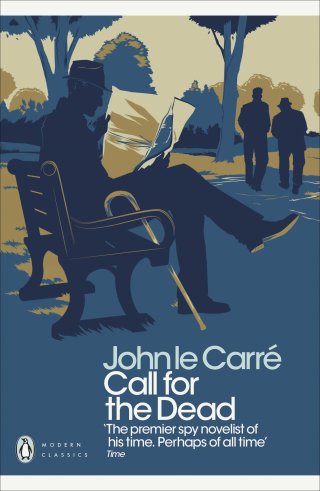
Call for the Dead by John le Carre, 1961

Call for the Dead is the first novel in which George Smiley appears, which of course is the right order in which to read a novel series, not jumping straight in with the last one as I carelessly did recently. Carre

The novel opens with the suicide of civil servant Samuel Fennan following a routine security check, which in turn had been prompted by an anonymous accusation that Fennan had been leaking secrets to/working for the Russians. This is the novel’s central puzzle – why would Fennan kill himself when the review was going to clear him? But kill himself he has, and it begins to look as if the investigating officer, one George Smiley, is going to be blamed for his death.

This is the first of the novel’s many improbabilities – despite it being obvious that there is at least a chance that Smiley is going to be implicated in the suicide, he is asked to investigate it. He interviews Fennan’s wife Elsa in her home. While there he answers the telephone, expecting the call to be for him, (oh for the days before mobiles!) but it is an alarm call from the telephone exchange which Fennan had booked the night before. Why would someone book a call and then kill themselves? Could it possibly be that this is not a suicide, but a murder staged to look like one? It could.

A local policeman Inspector Mendel, the classic copper only days from retirement, conducting the investigation into the Fennan case, begins to work with Smiley. Smiley’s boss (rather late in the day) orders him to drop the case, but a letter posted by Fennan the night before arrives, requesting an urgent meeting that day, confirming his suspicion this is murder! Smiley hands in his badge to pursue the case. Of course these may not have been such tired police procedural cliches in the 1960’s, but that is of limited consolation to a modern reader.

Can you guess what happens next? I suspect you can. Yes, before he can make much progress with the case, Smiley is hit on the back of the head in an alley by a mysterious assailant, and goes out like a light. He has just had time to find the lead that will crack the case, and expose the sinister East German agent who is behind it all.

Yes, there’s a twist, of sorts, but by now you will have got there already. So why does this novel seem so tired and predictable when Le Carre is widely seen as a master of his craft, writer of novels of byzantine complexity where you only find out what really happened on the last page? The Guardian ran an excellent parody of the novel a while back which does a good job of pointing out its combination of cliche, predictability, and improbability. As soon as the long holidays to Austria the Fennan’s took every year (in an era when even everyday civil servants were prohibited from travelling to Eastern Europe) it is obvious they are guilty as hell. There is no way Smiley or anyone would have cleared Fennan on the basis of the cursory chat that passes for an investigation into the allegations against him. As well as being the first Smiley novel this was also Le Carre’s first novel of any kind, and it went on to generate a series that is widely loved and respected, so I shouldn’t be too harsh. Smiley himself is an anti-hero, fat, balding, aging, but becomes over time a formidable spymaster, not that you would necessarily know that from this work alone. I may have ruined my enjoyment of the later books in the series by reading the last one first, but at least I can say I have given Le Carre a run for his (my) money!

Standard
Book review

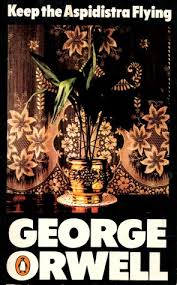
Keep the Aspidistra Flying, by George Orwell, 1936

Gordon Comstock, anti-hero of Keep the Aspidistra Flying, is a failed poet, struggling with a premature mid-life crisis, and what we would now characterise as depression. He expresses his feelings as resentment at demands placed upon him by family and friends, and rages against the need to work for a living. OrwellRejecting a well-paid job in advertising, which he feels is beneath him, he instead works in a bookshop, spending long sad weeks struggling to make sure he can afford the next cigarette or pint of beer. He obsesses over the cost of everything. At first this is slightly comic, but the intensity of this obsession soon becomes wearisome. He is a misanthropic, grumpy figure who doesn’t deserve the friendship and love of those around him who care for him and look out for him, even though he goes out of his way to reject their help.
He lives a mean life in a dingy bedsit in Hampstead, working in a bookshop and in his spare time picking away at his magnum opus ‘London Pleasures’. His fantasy of himself as a poet is fed by the earlier publication of a slim volume of poetry – ‘Mice’ – which sold only 153 copies despite positive reviews. His obsession with money poisons his relationship with his girlfriend Rosemary. They have nowhere to go to be together, and Gordon’s pride means he wont allow her to pay for even a cup of coffee. Rosemary suggest a day in the countryside , with a hint that this might be the long awaited opportunity to finally consummate their relationship (Orwell was to return to this idea – of a couple travelling out into the countryside to find somewhere private to have sex – in 1984).

The day doesn’t go well – in an attempt to impress Rosemary, he wastes most of his money on lunch at a fancy hotel. Later when they are about to have sex en plein air it doesn’t happen because Gordon has forgotten to bring any contraception. Like a spoilt child he is angry with her:

“Money again, you see! … You say you ‘can’t’ have a baby. … You mean you daren’t; because you’d lose your job and I’ve got no money and all of us would starve.”

When some money does finally come his way, in the form of payment for a poem sent speculatively to an American magazine, Gordon wastes it on a fancy dinner and ostentatious tips. He gets completely out-of-control drunk, leading to a night in the cells and the sack from his job the next morning. I am not sure if Orwell intended this episode to be comic, but it is quite the opposite, not least in the assault on Rosemary.

After “sponging” for a while off Ravelston, a more prosperous literary friend, Gordon secures a post in another book shop/lending library. Determined to sink to the lowest level of society but afraid of sleeping on the street, Gordon takes an even seedier bed-sit in Lambeth, (to have fallen so low!) and isolates himself from family and friends. There is no question at this point that Gordon is clinically depressed, and he is hugely lucky to be loved by some of the most patient people on the planet. In desperation Rosemary has sex with him, and while this doesn’t jolt him from his depression, the result of this and thereby the conclusion to the novel is predictable.

Keep the Aspidistra Flying has a strong, semi-biographical flavour. It was written in 1934 and 1935 when Orwell was living in London, and clearly draws on his experiences in this period. There are numerous points of comparison between the life of the novel’s protagonist and his own. Orwell had written for The Adelphi, a left-wing literary journal edited by Sir Richard Rees, an obvious model for Ravelston, Comstock’s upper-class publisher and friend. Orwell had also worked in a second-hand bookshop in Hampstead, lived in squalid bedsits and struggled to find female companionship while attempting to write.

The novel has not aged well. Many of the social attitudes here will be uncomfortable to a modern reader. Comstock is homophobic, referring to a customer as a “nancy”. Orwell gives this character an affected lisp, and used similar language in correspondence and articles, so it is a reasonable assumption that he is here reflecting the everyday prejudice against homosexuality that was common in the 1930’s. Comstock also has disrespectful attitudes towards women, seeming only interested in them for sex:

This woman business! What a bore it is! What a pity we can’t cut it right out, or at least be like the animals—minutes of ferocious lust and months of icy chastity. Take a cock pheasant, for example. He jumps up on the hen’s backs without so much as a with your leave or by your leave. And no sooner is it over than the whole subject is out of his mind. He hardly even notices his hens any longer; he ignores them, or simply pecks them if they come too near his food.

Equally there is a horrible disdain for the working class in this novel that only someone born in the middle-class (and having been to Eton) could display. Of course one needs to be careful to not ascribe the character’s views to the author too easily, but the disgust with which the working classes – not least their terrible smelliness – seems authentic, and is on a par with some of Orwell’s other work. Take this description of a pub for example:

“A foul yet coldish air enveloped them. It was a filthy, smoky room, low-ceilinged, with a sawdusted floor and plain deal tables ringed by generations of beer pots. In the corner were four monstrous women with breasts the size of melons.” 

Comstock explores the underworld of the very poor, as Orwell himself did when Down and Out in Paris and London, but is always an outsider looking in, with the safety net of the £4 a week job waiting for him whenever he wants it. There’s a cursory discussion of socialist ideas which could help Comstock escape the money he feels trapped by, but Orwell’s heart doesn’t seem in it. Gordon’s conversations with Ravelston never progress beyond the level of point facile scoring:

Every intelligent boy of sixteen is a Socialist. At that age one does not see the hook sticking out of the rather stodgy bait.

Whatever its aspirations this isn’t a novel of ideas. It is at best part of the tapestry of 20th century literature. The portrait of the profoundly grumpy, sexist poet with a flair for getting extremely drunk may have been an inspiration for Kingsley Amis’s Lucky Jim, although there equally are some clear signs of borrowing from Sinclair Lewis’s 1922 novel Babbitt about a another individual’s struggle against the pressures of capitalism. “Keep the aspidistra flying!” is also the final line of Henry Miller’s novel Nexus (1959), and last but least it provided the title (if little else by way of inspiration) for Nancy Mitford’s 1949 “Love in a Cold Climate“.

Orwell wrote Keep the Aspidistra as a source of relatively easy income, and it shows. In a 1946 letter to a friend he wrote that this novel was one of the two or three books of which he was ashamed, saying that it was “written simply as an exercise; I oughtn’t to have published it, but I was desperate for money [-] At that time I simply hadn’t a book in me, but I was half starved and had to turn out something to bring in £100 or so.” It wasn’t until towards the end of his life, after the second world war, that he was to find his authentic voice as an  author of novels. Much of his best writing is to be found elsewhere, in his journalism, his essays and book reviews. 

Post script 2026 – I just came across this American edition of KAF on the internet, and thought I would share it as it is so marvellous:

May be an image of text that says "KEEP THE "The most powerful 35c novel he (0rwell) ASPIDISTRA has produced" LOS ANGELES TIMES FLYING GEORGE ORWELL Complete and Unabridged AN EXCITING AND MEMORABLE NOVEL THE THEWORI WOR AMOUS AUTHOR OF "1984" AND "BURMESE DAYS"

Standard
Book review

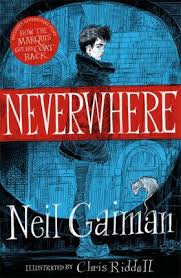
Neverwhere by Neil Gaiman, 1996

I don’t think you would be able to guess that Neverwhere is a novelisation of a television series – it has a dramatic range and scope ideally suited to the novel form, and must have been a challenge to film. It is rare for novelisations to be more than their original format, but here it is almost as if the novel was existing in concept all along, and it just took the development of the television series for it to come out.Neverwhere

In the introduction to this edition, which was published to coincide with the publication of American Gods, Gaiman describes editing the text to make it more accessible to American readers – explaining that Oxford Street is a main shopping thoroughfare for example. I suspect he was wasting his time, because this is a novel firmly rooted in place, written by a writer with considerable and obvious affection for the London landmarks that appear in the book: Blackfriars, Baron’s Court, the Angel Islington and Old Bailey, among many others.

Three years in London had not changed Richard, although it had changed the way he perceived the city. Richard had originally imagined London as a gray city, even a black city, from pictures he had seen, and he was surprised to find it filled with color. It was a city of red brick and white stone, red buses and large black taxis, bright red mailboxes and green grassy parks and cemeteries. It was a city in which the very old and the awkwardly new jostled each other, not uncomfortably, but without respect; a city of shops and offices and restaurants and homes, of parks and churches, of ignored monuments and remarkably unpalatial palaces; a city of hundreds of districts with strange names – Crouch End, Chalk Farm, Earl’s Court, Marble Arch – and oddly distinct identities; a noisy, dirty, cheerful, troubled city, which fed on tourists, needed them as it despised them, in which the average speed of transportation through the city had not increased in three hundred years, following five hundred years of fitful road-widening and unskillful compromises between the needs of traffic, whether horse-drawn, or, more recently, motorized, and the need of pedestrians; a city inhabited by and teeming with people of every color and manner and kind.” 

The novel’s springboard is the hidden issue of homelessness – how rough sleepers can live in cities such as London and be effectively invisible to the rest of the population. Gaiman takes this idea and has the homeless become residents of ‘London Under’ – a city existing in plain sight alongside London Above. I was reminded of China Meiville’s The City and the City  which is based on a very similar concept. But Gaiman’s hidden world is magical, peopled by fantastical characters and where the normal rules of time and space do not apply. In this it is closer to the Rivers of London series which I believe it directly inspired.

Neverwhere’s central character is the Arthur Dent-like everyman beloved of fantasy writers. Richard Mayhew is a young businessman, who one day helps a mysterious young girl, Door, who appears before him, bleeding and weak, on a London street. Gaiman makes Richard a Scotsman exiled in London – he already feels a sense of alienation from his environment, so when his contact with the people of the Underworld makes him effectively invisible to other Londoners the process is complete. Door, only surviving member of a family of underworlders with the power to open any door, sends Richard to find the Marquis de Carabas who in turn can help her escape her pursuers. They hire a bodyguard, the Amazonian Hunter, and set off to find out why Door’s family was slain by the infamous assassins Croup and Vandemar, who are now on their trail. They criss-cross London Under in their quest, meeting a series of fantastical characters in extraordinary places. This is an action-packed adventure full of twists and turns and incident – it’s a great story.

I was a little uncertain as to Gaiman’s target audience with this novel. There is a horrific element to the novel’s casual and brutal violence, particularly that of Mr Croup and Mr Vandemar, the former all refinement and elegance, the latter the complete opposite, usually to be found munching on the remains of a puppy or a pigeon. Some characters die and don’t come back, and the happy ever after ending is not guaranteed. But while the peril in the novel is serious it is resolved quickly, and the one main character who is killed is resurrected with minimum suspense that it is not going to happen.

There’s a lot to enjoy in Neverwhere. The dialogue is outstanding, if fizzes with ideas, the aesthetic as evoked in Gaiman’s prose is wonderful, and the central relationship between Door and Richard is sweet, understated, and touching. There is a darkness to much of the humour (“Do you like cat?” she said. “Yes,” said Richard. “I quite like cats.” Anaesthesia looked relieved. “Thigh?” she asked, “or breast?” ) that is entirely unsentimental. Gaiman has promised a sequel, which would be fantastic although this novel stands up well on its own. Highly recommended if you enjoy fantasy.

Standard
Book review

Smiley’s People by John le Carre 1979

Smiley’s People by John le Carre 1979

I’ve written previously about how I prefer not to read too much about a novel in advance of reading the novel itself – how it can prejudice the reader, shaping their expectations one way or another. But you can take that approach too far, and I think I did here. I knew Smiley’s People was one of le Carre’s series of novels about espionage during the Cold War, but it wasn’t until I glanced at the back cover after completing the novel that I found out it was the seventh in the Smiley series. Each of these novels are capable in theory of being read independently of one another, of course, but they accumulate a depth of background that over time makes the idea of them being stand-alone novels harder to sustain.

Smiley’s People, as well as being the seventh Smiley novel, is also the third and final novel in what is known as the Karla trilogy, the others being Tinker Tailor Soldier Spy and The Honourable SchoolboySmiley’s People presents itself as a novel of byzantine complexity, with plots within plots. But if you take a step back in some respects it is quite simple. Karla, Smiley’s Russian nemesis, has a daughter who needs psychiatric treatment not available inside the Soviet bloc. Through an admittedly complex route Smiley eventually discovers the identity of this daughter, and the rest is relatively simple –  Karla is blackmailed into defecting to the West, the alternative being the loss of both his and his daughter’s safety and security.

What I can’t be sure about is whether reading this novel out of order, as I did, would have made much difference to my appreciation and understanding of the complexities of the plot. I suspect it might have made things easier, although now I have committed this mistake I don’t think reading the earlier novels in the series would remedy the situation.

Is the novel any good? Did I enjoy reading it? Well Smiley is an enigmatic, closed down character – we really only get glimpses of his personality in, for example, his relationship with his ex-wife. He is not all-powerful – while he comes out on top in the struggle with Karla, there are avoidable losses along the way. Without giving too much away, there are deaths in the novel which are foreseeable and avoidable. If you enjoy complex novels where staying one step ahead of the protagonists is a challenge then this is one to definitely add to your TBR list. Stylistically I noticed little of the prose which made The Spy Who Came in from the Cold stand out. Here’s a scene setting from the later novel:

The café was the last in the street, if not in all Paris, to lack both a juke-box and neon lighting – and to remain open in August – though there were bagatelle tables that bumped and flashed from dawn till night. For the rest, there was the usual mid-morning hubbub, of grand politics, and horses, and whatever else Parisians talked; there was the usual trio of prostitutes murmuring among themselves, and a sullen young waiter in a soiled shirt who led them to a table in a corner that was reserved with a grimy Campari sign.

And this is from the earlier novel:

They walked to her flat through the rain and they might have been anywhere—Berlin, London, any town where paving stones turn to lakes of light in the evening rain, and the traffic shuffles despondently through wet streets.

For me there is no question as to which excerpt captures the atmosphere more effectively and concisely. I appreciate you could do the same with just about any two novels using selected quotes, but I think my point is that in the later novel le Carre gets bogged down with the procedural elements of the plot and overlooks the need to capture the moment.

To do le Carre justice I probably need to read more of his work, but one as always comes up against the conundrum of there being so many books, and so little time.

Standard