Book review

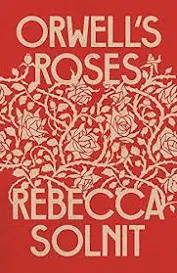
Orwell’s Roses, by Rebecca Solnit, 2021

There is a scene is Stella Gibbons’s near-perfect Cold Comfort Farm where the heroine, Flora, meets the appalling Mr Mybug in a tea shop. She tries to avoid him but he is unshakeable and tries to impress her by talking about his latest project. He is convinced Branwell Bronte wrote Wuthering Heights and in his research has found three letters from him to an aunt in Ireland. These letters are “little masterpieces of repressed passion.  They are full of tender little questions… he asks her how is her rheumatism…has her cat, Toby, ‘recovered from the fever?’ … what is the weather like at Derrydownderry…?’” This portrait, of a pseudo-intellectual taking an obscure fact from the life of an author and blowing it up into a profound insight into their life and work, cannot be bettered, but in Orwell’s Roses, Rebecca Solnit gives it a good go.

In the mid-1930’s Orwell rented a small cottage in Wallington, Hertfordshire. He ran the local shop from the front room of the cottage and tended the small garden, planting fruit trees, vegetables, and roses. Those roses may or may not be still flowering in the cottage garden, although this seems both improbable and unimportant. In the course of the many thousands of articles, reviews, essays and letters he wrote he inevitably also referenced roses from time to time. But the idea that this scant piece of information can tell us anything significant about Orwell, either as a man or as a writer, is ludicrous. Although sceptical I was genuinely prepared to be persuaded I was wrong. I expected Solnit to have dug up some long-forgotten essay or letter in which Orwell wrote about the significance of roses to his world view, perhaps using their connection to England’s heritage as a metaphor for, well, anything. But of course he didn’t write any such thing and this left the author struggling mightily to make any kind of case. Chapters are devoted to the commercial rose growing industry in Columbia for example, in which unsurprisingly workers rights are undermined and working conditions are tough (although it is hardly a dark satanic mill situation). The author draws clumsy parallels between these hot greenhouses full of roses with Orwell’s exploration of the British mining industry in the 1930’s, but almost any third-world factory or sweatshop would have delivered the same set of comparisons.
A few years ago, shortly after lockdown, I was browsing in my local bookshop with one of my sons. Knowing my admiration for all things Orwell, he pointed this book out. My initial reaction probably seemed a little churlish (I do hope not, but fear it might have been) – that this felt like the scraping of a barrel. All of Orwell’s primary influences – Empire, class, the BBC, literature, politics etc – have been documented and investigated at length, so here was someone writing about his love of gardening. Gardening might have made it into the top ten of a list of Orwell’s interests, perhaps, but did it tell us anything we didn’t already know about the author, his works and his politics? I hazarded that the answer was no, and decided not to invest the £20 or so that the hardback would have cost me. A second-hand bookshop bargain made the decision a lot easier more recently, but my initial judgment – that this was a really tenuous thesis that it would be hard to sustain – was vindicated. There’s no questioning that the author makes a strong effort in arguing that there was some significant connection between Orwell and floristry, but effort doesn’t equal success in this case. See here for example:

“He (Orwell) went on to classify flowers among hobbies, and hobbies among the characteristics of people who valued liberty and private life, but he had opened a door for a room he hadn’t gone into, or perhaps a door onto something much larger than a room. If you do go through this door marked aesthetics and Orwell, you wander toward the very center of his life’s pursuits. (188).

No you don’t. And even if you do, roses are entirely peripheral to that room/area of interest.

Solnit writes at length about the significance of flowers to our lives. There are times where she seems to forget that the book is supposed to be about Orwell, only dragging him back into the text unconvincingly in chapter-ending summaries. But when she does write about Orwell, particularly in the book’s final chapters looking at the extraordinary productivity at the end of his life, she writes well. It is rewarding to spend time revisiting this period of his life, when he took the bizarre decision to move to Jura with his very young son, shortly after his wife Eileen had died, but carried on writing ferociously. The text ends with a chapter on Orwell’s significance today and she rightly points out that the word Orwellian has a resonance in these times that even words like Shakespearean or Dickensian do not. I was expecting the text’s final peroration to see roses drawn back into the discussion, but I was really pleased to see that in the end this didn’t (and probably couldn’t) happen. Solnit writes so much more interestingly about Orwell when she isn’t struggling to tie his work to her poorly-conceived theme.
Orwell’s Roses, by Rebecca Solnit, 2021

Aside
Book review

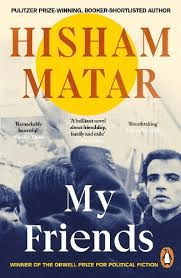
My Friends, by Hisham Matar, 2024

My Friends is a very personal narrative about the experiences of the narrator, Khaled, a Libyan student who in 1983 goes to study at the University of Edinburgh. There he meets fellow Libyan Mustafa, who becomes a life-long friend. Despite being aware of the risk to both themselves and their families they attend an anti-Gaddafi protest outside the Libyan embassy in London in 1984. This was the infamous occasion when Libyan secret police opened fire on the protest from within the embassy, killing Yvonne Fletcher, a Metropolitan police officer.

Khaled and Mustafa are wounded in the attack and spend weeks recovering in hospital under police guard. They realise that as soon as the Libyan authorities discover they were present at the demonstration that not only will they be at risk but so will their families. While the Gaddafi regime survives they can never go back to Libya. Their involvement in the demonstration is kept strictly secret, revealed only to the most trusted, closest friends. Their close-knit friendship is later joined by another Libyan ex-patriate, Hosam, a writer, one of whose anti-Gaddafi poems is read on the BBC Arabic World Service, thus putting a target on his back. This small group of friends share their longing to return to Libya and their families and a life-long fear of retribution by the Gaddafi regime.

For almost thirty years the friends keep in touch, on and off, while Khaled tries to settle in London, teaching and occasionally starting relationships, but never seriously committing to either a job or a partner. Finally, during the 2011 Arab Spring, the friends feel compelled to choose between staying in London or returning to Libya to fight. Mustafa chooses to return to fight – Hossam and Khaled stay in London.

As with all plot summaries, I have evened out the chronology – in the novel itself the chapters jump between time periods as Khaled looks back over his friendships with Hosam and Mustafa. It opens in the present with Khaled saying farewell to Hosam at St Pancras Station. Hosam is leaving for California, and Khaled recognises he is unlikely to see him again. As Khaled wanders through the London streets he reminisces about his friendships, and this walk forms the framework for the novel.

Exile is the central theme of the novel and this is the closest I am likely to ever get to experiencing this sense of loss, of one’s life being almost permanently on hold, never being able to commit to a relationship or a career. But equally the novel is about friendship, particularly the type of friendship forged in crisis and a shared experience of trauma than can endure for decades and through long periods of separation and distance.

Although My Friends won the Orwell Prize for Political Fiction in 2024, it is not an overtly political novel. Opposition to the Gaddafi regime forms a backdrop to the exiles’ lives, but it is taken as read, without the need for any overt criticism of the dictatorship. While the Arab Spring saw the end of that generation of political figureheads, a new generation has emerged. Political opposition and protests is as unsafe as it ever was, now in the West as much as elsewhere. This gives My Friends a renewed political relevance, urgency and resonance.

It’s great to see the Orwell Foundation expanding its scope and awarding prizes for a wider variety of writing. The results of this year’s prizes are announced later this month (June 2025) – well worth watching out for.


My Friends, by Hisham Matar, 2024

Aside
Book review

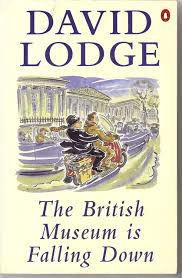
The British Museum is Falling Down by David Lodge 

This novella is a comic pastiche of James Joyce’s Ulysses. That makes it sound more substantial than it actually is. Lodge was flexing his literary muscles as a professor of English literature here, and he did so by inserting throughout the novel a series of literary references. Ten distinct sections of the novel are written in the style of a range of authors including Conrad, Woolf and Kafka. I would argue that these actually add little to the novel overall. In other words there’s an element of showing off here, where the reader might be vaguely aware that the novel’s style has shifted and that they should be getting the joke, (the Kafka and the Joyce sections are unmissable; the others less so) but uncomfortably aware that they are failing the test being set by the much cleverer than them author.

Strip away the contrived literary references and this is simply a straightforward mid-sixties comic novel on that most sixties of themes, sex. Adam Appleby, a father of three and a student of English literature spends a single day failing to do any work at the British Museum (not) researching his thesis “The Structure of Long Sentences in Three Modern English Novels”. Instead he gets into a series of what it is hard to avoid calling ‘scrapes’ familiar to anyone who watched British sitcoms (especially those, ironically, from the 1970s) – he accidentally calls the fire brigade out to a non-existent fire at the museum, he is the subject of an attempted seduction by a frustrated seventeen year-old virgin (a common experience for the male subjects of English post-war comic novels), he gets drunk at a cocktail party, and his scooter bursts into flames. The scene where he tries to buy some condoms but can’t do so because his priest enters the medical appliances shop at precisely the wrong moment is appallingly cliched. Throughout the novel Appleby, a thinly disguised avatar for the author, is haunted by the fear that his wife is pregnant with their fourth child, because being Roman Catholics and this being before the widespread availability of the pill, they are forbidden from using any but the most unreliable methods of contraception. This leaves Appleby permanently frustrated and at the same time petrified that their personal complicated game of Vatican Roulette has been lost once again.

As well as the explicit references to other authors, there are some strong echoes of Kingsley Amis here. The ‘seduction’ scenes is an obvious example. Appleby’s persistent worries about money and the way these are resolved by the intervention of a wealthy American at the end of the novel was strongly reminiscent of the way Amis concludes Lucky Jim. The getting inappropriately drunk at a party scene, the ‘seduction’ scene, and the many petty minor frustrations of academic life, all echo the earlier Amis novel. So yes, in a nutshell, this is heavily derivative, so much so that by the end their is no attempt to disguise Lodge’s borrowing, and it is simply chalked up as pastiche.

In many ways this is a very typical mid-Sixties comic novel, but what sets it apart are Lodge’s literary pretentions. And in case you were wondering, no, the title doesn’t make sense – Lodge explains in an afterword written for a 1980 reprinting that he had originally wanted to call the novel “The British Museum Had Lost Its Charm” but as this is a quote from a Gershwin song and he couldn’t get permission to use it, the alternative title had to be used. There is a clearly late addition to the text to explain the alternative title he ended up using, with its reference to London Bridge, which Lodge may have got away with if he hadn’t written about the original title in the afterword.

The British Museum is Falling Down, by David Lodge, 1965

Aside
Book review

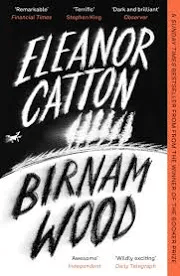
Birnam Wood by Eleanor Catton, 2023

I really enjoyed reading Birnam Wood, until the end, when I didn’t, which retrospectively spoiled the whole novel for me. Don’t you hate it when that happens?

First. just to get one thing out of the way, this novel has nothing to do with Macbeth. You could work hard at trying to find some parallels, but they won’t work. Which is just one of those minor disappointments that could have easily have been overlooked if the novel’s ending worked, which it didn’t, as I may have mentioned.

The author invites us to believe that a New Zealand community gardening project, with the mildly amusing name of Birnam Wood, is covertly a much more subversive, radical project threatening the status quo – or so some of its members believe (others just like gardening). For wildly complex and improbably reasons, this group gets involved with Robert Lemoine, an American billionaire, who decides to sponsor and support the group. He’s a psychopath, so the reasons he gives for sponsoring BW are nonsensical, but we are invited to accept them anyway because billionaires spend their money on whimsical projects as the fancy takes them. don’t they.

“I know how easy it was,’ said Lemoine. Mira didn’t follow. How easy what was?’ All of it,’ he said, shrugging. Getting rich. Staying rich. Winning. It was all so easy. I just took what I wanted, and it was mine. I said what I wanted, and people got it for me. I did what I wanted, and nobody stopped me. So simple. And if it was easy for me, then it could be easy for anybody, and that’s a very frightening thought. Apart from anything else, it would be untenable, Everyone can’t be on top, or it wouldn’t be the top any more, would it? That’s just a fact. And I’ve been in the citadels of power,’ he added. I’ve eaten at the high tables; I’ve seen behind the doors that never open. Everyone’s the same. You reach a certain level and it’s all exactly the same: it’s all just luck and loopholes and being in the right place at the right time, and compound growth taking care of the rest. That’s why we’re all building barricades. It’s in case the rest of you ever figure out how incredibly easy it was for us to get to where we are. 

Lemoine invites the group to start gardening in the grounds of an estate he is considering buying and of course they accept, the whole deal sweetened by the promise of much more money to come once the garden is established and he gets to know them better. No, that doesn’t make any sense, does it? Obviously I have summarised the ‘logic’ behind his investment unfairly, because I am irritated by the fact that a central plot point in the novel makes no sense, but it gets worse. Because secretly this one-dimensional evil genius is drilling for rare earth minerals in the national park around the home he is about to buy and having a group of hippies on site is just what any illegal covert mining operation needs.

Despite all of the above, I enjoyed at least three quarters of the novel. It was well-paced, the non-billionaire characters were well-sketched, and I was interested to find out what happened to everyone. As the remaining pages dwindled and the multitude of plot lines remained stubbornly unresolved, I wondered how the author was going to bring everything together. At one point I genuinely thought we were going to be set up for a sequel, there was so much left incomplete. Instead, Catton totally blows the ending. She uses a crude device to bring to a sudden halt some of the plot lines, and leaves a few dangling uncertainly. One central character, Shelley, seems to be forgotten entirely. The climax is rushed, unconvincing, and the reader is left to sketch in most of what happens themselves, with little to go on. Most of the dramatic events happen off-screen (as it were) with the reader left to join the dots from scattered clues. Imagine Hamlet from Fortinbras’s perspective and you get a rough idea of how the potential drama of the climax is thrown away.

Birnam Wood aspires to being a thoughtful novel of ideas, and there are prolonged sections in which characters discuss the decline of late stage capitalism, mostly in a millennial argot in which the word ‘like’ is sprinkled through the speeches every other sentence, in a redundant attempt at authenticity.

“Shelley said “I was just thinking about it. Like, no one ever actually knows that the right thing to do is. I mean, you can think that you know what’s right, and you can tell yourself that you know, but at the point that you make your choice, like, in the moment, you’re never really certain. Yu just hope. You just act and you hope for the best…But, like, the wrong thing to do, that’s often much clearer. Wrong is, like, easier to se than right, a lot of the time. It’s more definite – like, this is the line I know I will not cross. “

I get it that some people do speak like that and I understand that it is just the twenty-first century equivalent of um’s and er’s, but on the page it is wearisome. The ideas being discussed never really come into focus and are quickly forgotten when the action sequences in the novel kick in.

In a promotional interview the author said that she aspired to write a twenty-first century equivalent of Jane Austen’s Emma. I don’t think I have ever read a more absurd comparison in a very long time. It’s like Dan Brown comparing the Da Vinci Code to Middlemarch. Austen is the most precise, careful writer – Birnam Wood is ultimately a soggy mess. Which proves one thing – that thrillers are not as easy to write as you might think.

Birnam Wood by Eleanor Catton, 2023

Aside
Book review

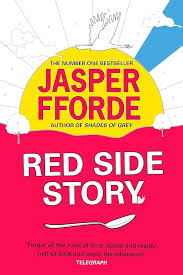
Red Side Story by Jasper Fforde, 2024

Red Side Story is the sequel to the wonderfully imaginative Shades of Grey (2009), which I should stress straightaway has absolutely no connection with the book with ’50’ in its name. Fifteen years is a long time to wait for a sequel (unless you are George R R Martin) and I was worried that the author had lost interest in the fascinating world of chromatacians (bear with me) that he had created, or couldn’t work out where to take the story. But all our patience has definitely been rewarded.

As we know from Shades of Grey, the story is set in a version of the UK (more specifically, Wales) where every aspect of your position in society depends on your ability to perceive parts of the colour spectrum. Colour vision is extremely limited in this society. Some people – ‘Greys’ – have no colour vision at all and are the equivalent of untouchables; others are divided into the colours they can see with more senior roles given to those with the better colour sensitivity. Society is governed by an extremely rigid set of rules set out in Munsell’s ‘Book of Harmony’. Technology is largely forbidden, with a few exceptions. It is a bizarre, but at the same time recognisable world. It is also quite brutal – people are killed (by being shown a shade of green which acts like a deadly poison) for any small infraction of the rules. There are signs of the civilisation that came before the Something that Happened’ five hundred years earlier, but very little understanding of that society.

The novel picks up where Shades of Grey left off. IN East Carmine on the fringes of Red Sector West, Eddie Russett and Jane Grey, having discovered that there is something profoundly wrong with their society, have determined to do something about it. But first they have to escape the trumped-up murder charges they are due to imminently face. Eddie has also recently found out that his perception of the colour red is very high, meaning he is highly valued in the marriage market. But once his seed has been sown any protection he derives from his colour perception will be gone. Slowly Eddie and Jane piece together clues that show them their society could possibly be a vast social engineering experiment, monitored by drones that they have been taught to think as swans. Everyone carries a bar code imprinted on their fingers, allowing the ‘swans’ to locate them at any time – hence the reason wearing gloves is not allowed.

The novel’s parables aren’t hard to unlock – they aren’t meant to be. Treating people as unequal simply because of their physical characteristics is bad. Dogmatic adherence to out of date rules of dubious authority is stupid. We should be able to love who we want to love, not have to trade our fertility like cattle. And so on. But the novel is at no point preachy – this is just Eddie and Jane’s world, and they are heroic in their struggles to find the truth, risking their lives over and over again. I don’t think there’s ever any doubt they will succeed.

Red Side Story can be read as a standalone novel, but I would recommend reading Shades of Grey first. Not because you really need it to work out what is going on in the later novel, but because it is a great story. Fforde is a unique author – comparisons to Pratchett (in the Independent’s review below) for example are wide of the mark. Possibly the nearest in terms of imaginativeness would be the wonderful Douglas Adams and there really is no higher praise. The inventiveness of Fforde’s stories is just the start – what is really impressive is the way he manages to sustain an idea and populate a believable universe without drawing on folk tales or mythologies as most fantasy authors do. This makes him instantly recognisable as an author. Add to this mix his consistently progressive narratives and some great jokes (and there I will accept a comparison with Pratchett, because some of the puns are a bit painful – for example the menacing Undertoad) and you have an author in superb control of his material and a wonderful, whimsical and at the same time brutal story.

The internet seems to think there will be a third novel in the series – I do hope so, and that we don’t have to wait 15 years!

What other reviews have said: a selection

‘Fforde is one of literature’s most enjoyable visionaries, and his long-awaited Shades of Grey sequel will be eagerly seized upon by his admirers… The jokes are excellent, the pacing breathless and the last line a classic’ Observer

‘Fforde’s books are more than an ingenious idea. They are written with buoyant zest and are tautly plotted . . . and are embellished with the rich details of a Dickens or Pratchett’ Independent

‘No summaries can do justice to the sheer inventiveness, wit, complexity, erudition, unexpectedness and originality’ ​The Times

Red Side Story by Jasper Fforde, 2024

Aside
Book review

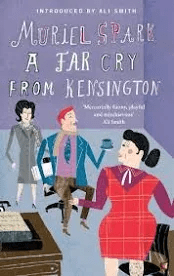
A Far Cry from Kensington by Muriel Spark, 1988

Muriel Spark is on my auto-buy list. When browsing in second hand bookshops I have a few authors I always buy if I can find them. As long as the book is reasonably priced, in decent condition, and I don’t already have it, I will always buy novels by, among a small number of other authors, Muriel Spark. Her novels are always interesting and worth reading, and A Far Cry from Kensington was no exception.

Set in 1955, A Far Cry is narrated by the no-nonsense Mrs Hawkins, a thinly disguised semi-autobiographical portrait of the author. It centres on a “rooming house” in (you guessed it) Kensington – a large house divided into separate one room apartments – where a diverse set residents live under the care and supervision of the landlady, Milly. It is a comfortable community of people in transit, typical of post-war London, settled by individuals and couples looking to establish themselves in London and in life.

Mrs Hawkins works in publishing. Some of her reminiscences (the narrative is told in flashback, some thirty years later) are based on Spark’s own time working in this field. Initially she works for the Ullswater and York Press, a chaotic publishing house that is heading for bankruptcy. I haven’t researched the novel sufficiently to say this for certain but I would put good money on the fact that Ullswater Press has a real-life equivalent that went bust in the mid-1950s, causing something of a scandal at the time as the proprietor was subsequently jailed for fraud.

The novel’s villain is Hector Bartlett, a bad writer who has influential friends who try to secure publication of his writing. Hector takes to accidentally-on-purpose bumping into Mrs Hawkins on her daily walks in the park near her office, attempting to leverage this casual relationship into an introduction to her boss. Hector the writer is described thus

“Hector Bartlett, it seemed to me, vomited literary matter, he vomited and sweated, he excreted it…His writings writhed and ached with twists and turns and tergiversations, inept words, fanciful repetitions, far-fetched verbosity and long, Latin-based words.”

Hector the man is if anything even more harshly described:

Red hair en brosse, brown corduroy trousers, tweed coat with leather patches on the sleeves, a yellow tie, and a green check shirt….with a pronounced stoop of the shoulders which made him seem older than he was… His face was round with a second fat chin”.

Mrs Hawkins describes him to his face as a ‘pisseur de copie” a urinator of journalistic prose, and never backs down from this undeniably confrontational phrase. Spark denied that Bartlett was a portrait of anyone specific in post-war literary London, which I suppose must be right given how libellous it would otherwise have been!

Bartlett uses his influence with Emma Loy, a successful novelist, to have Mrs Hawkins sacked from Ullswater Press and subsequently from another job in publishing when she continues to use this description of him and also refuses to rewrite his copy to make it acceptable for publication. This doesn’t have a significant impact on her career and even if it would have done she is not the kind of character to back down, even in the face of a direct plea from Ms Loy. She can’t stand him, and her instincts prove spot on when there are further revelations about his damaging behaviour towards other women in the novel.

A Far Cry isn’t just a series of anecdotes about the publishing world. While the residents of the boarding house all have their brief moments centre stage, Wanda, the Polish emigre seamstress, has a defining role when she receives a threatening letter, which leads to a downward spiral that, we eventually find out, was caused by the vengeful pisseur de copie.

Central to the novel is the bizarre practice of ‘radionics’.  Radionics is a form of quack therapy that survives to this day (There is a Radionics Association that awards three-year diplomas and sells crystal pendulums). It claims that diseases and other medical conditions can be diagnosed and treated by applying electromagnetic radiation such as radio waves to the body from an electrically powered device. It ‘works’ only through the placebo effect. Mrs Hawkins has no time for it and it is no surprise that Hector Bartlett is an enthusiast proponent of the concept, using it to manipulate other characters in the novel. People undoubtedly do fall prey to this sort of scam, and while radionics may have faded out somewhat, certainly in the UK, other forms of manipulation have of course taken its place. Initially I found this all a bit clumsy, but on reflection the fact that there are many modern forms of the same pseudo-science that people fall prey to every day made me reconsider and feel more charitable towards the idea as a plot device.

This is a complex and rewarding novel in which Mrs Hawkins’ narration, even with the benefit of thirty years of hindsight, reveals only glimpses of what is ‘really’ going on – for example the identity of the anonymous threatening letters to Wanda is only revealed in passing at the end of the novel, the revelation pivoting on the spelling of the word “organisers”. The reader sees the events of the novel through the eyes of 1955 Mrs Hawkins as she experiences them in real time, with only occasional reassuring interjections by the 1980’s narrator. I have enjoyed other Spark novels more, but I could admire the artistry of A Far Cry without being blown away by its sophistication.

A Far Cry from Kensington by Muriel Spark, 1988

Aside
Book review

We Solve Murders, by Richard Osman, 2024

I think it would have been a reasonable assumption that in moving away from The Thursday Murder Club, Richard Osman was going to try something a bit different. He strongly implies as much in the acknowledgements to the fourth book in the series. Yet while We Solve Murders superficially inhabits a totally different world from the TMC series, if you scratch the surface we are right back in Coopers Chase.

We Solve Murders introduces the reader to Amy Wheeler, a bodyguard to the rich and famous. Amy is seriously hard-core, totally unafraid of the dangerous life and death situations she regularly finds herself in. She has a long-distance relationship with her husband, who plays only a very minor role in the book, but seems much closer to her father-in-law, retired copper and widower Steve. Steve loves his quiet life – pub, crossword, and chatting to his late wife – and is very reluctant to be pulled away from this retirement when Amy calls for his help. Amy’s client, Rosie D’Antonio, the world’s second most successful novelist forms the unlikely third wheel of this team as they career around the world trying to do what the novel’s title promises they will – solve murders.

Because someone has been killing influencers – young naïve people with small social media followings who travel to exotic locations to promote brands that mysteriously don’t seem to actually exist. This isn’t really one of the novel’s puzzles – we are told by the novel’s criminal mastermind who narrates occasional chapters that these killings are a retaliation for when his money smuggling operation is called into question. While the use of gullible and well-meaning influencers to unwittingly move money around the world is an innovative idea, I am not sure that’s how money smuggling really works anymore, is it? Surely it’s moved around online nowadays? Not that I claim any expertise in this issue I hasten to add. Amy is set up as the fall guy for the murders, which is a really silly choice as she is not going to allow this to happen without putting up a ferocious fight.

While the novel is set in several exotic locations – a private island off the coast of South Carolina, St Lucia, Dubai, and Dublin (!) – there’s no real sense of place in any of them. They could have been anywhere. I had to wonder whether these locations were chosen more for the inevitable film adaptation than the narrative? There’s also no really sense of peril – Amy, Steve and Rosie are held at gun-point and shot at more than once, but I didn’t for a second think they were going to die. Neither did they if the way they respond is to be believed – plot armour is one thing, but characters behaving as if they know they have plot armour is another!

Rosie is a source of much of the novel’s slapstick comedy – she is an archetypical randy pensioner, and being incredibly rich she can conveniently summon up private jets and helicopters at a moment’s notice. She has a sense of adventure which means she can be extremely reckless, in counterpoint to Steve’s deeply conservative instincts. He always yearns to be back home with his cat, Trouble. The novel’s ending is both predictable and to be honest not that interesting – the exposure of the bad guy’s identity is very much a ‘so what?’ moment. But that’s missing the point, because this is cosy crime after all, however badly disguised as a thriller, and it’s the gentle humour that keeps the pages turning, not any sense of adventure. One of the novel’s climactic scenes happens at a pub quiz, which tells you all you really need to know.

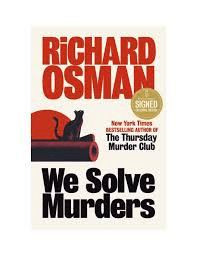
The hard-back edition of this novel has a strangely neutral design – it’s definitely moved away from the distinctive Thursday Murder Club ‘branding’ – but to where? The author’s name dominates the front cover, and the portrait of Trouble is the only real ornamentation on an otherwise stark black and red design. I think it reflects some uncertainty on the part of the publishers – whether to market the novel as ‘more of the same’ (the text “Best selling author of the Thursday Murder Club” appears above the title) or a new direction for the author. I can’t blame Osman for staying close to what has been a hugely successful and rewarding formula for him. It may not seem like it but I did enjoy reading We Solve Murders despite my reservations, but I wasn’t challenged by it in any way. Osman is by now such an accomplished novelist that as a reader you can leave yourself in his hands knowing he is going to safely guide you to the conclusion with everyone you care about in one piece, all ends neatly tucked away and the opening lines to the sequel already inked in. (In fact I fully expected the opening chapter of the sequel to appear at the end of this edition – it’s that kind of book – but it didn’t; instead we are neatly guided back towards TTMC).

In conclusion, you won’t be at all surprised to read that if you enjoy TTMC you will enjoy We Solve Murders. I do and I did.

We Solve Murders, by Richard Osman, 2024

Aside
Book review

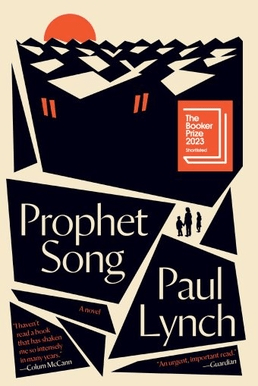
Prophet Song, by Paul Lynch, 2023

Wow. Prophet Song is the most impactful novel I have read in a very long time. Some critics have compared it to 1984 and The Handmaid’s Tale, and I think they are right. At one point I found reading it so traumatic (if you have read it you will know immediately what scene I am referring to) that I had to put the book down for 24 hours. It’s extraordinary.

The novel is set in Dublin shortly after the election of a far-right nationalist Government, the National Alliance Party. No specific timescale is given but everything else in the novel is set in the present. The Government introduces emergency powers that are in effect martial law. A new quasi-military police are given far-reaching powers to quash any dissent or opposition, a classic fascist strategy. Events are told through the Slack family. Larry, a teacher and trade unionist, is arrested and held without charge while attending a protest. He quickly becomes one of the disappeared, a non-person whose existence is denied by the state. Human rights lawyers trying to locate the disappeared are themselves threatened and arrested. Larry leaves behind Eilish, his wife; Mark, their sixteen-year old son son; their daughter, Molly; thirteen-year-old Bailey; and baby Ben. Amnesty International says that “Enforced disappearance is a crime under international law and an insidious practice that not only persists as a relic of past conflicts but also still looms large as a contemporary instrument of oppression used by the states across the world as a tool to silence dissent and instill fear.”

Lynch’s brilliance in setting Prophet Song in Ireland begins to pay off. This is not some distant South American banana republic where human rights have only ever tenuously existed – this is a modern European country. But people were disappeared in the states of the former Yugoslavia – Bosnia, Serbia and others – and there is evidence of this happening in the Ukraine as well. Being European is no guarantee of human rights, and if we think of flagrant breaches of human rights as being something that happens elsewhere, we are wrong. But the Irish setting has an even deeper impact that this, because in Northern Ireland people were ‘disappeared‘ in the 1970’s by masked armed men appearing at their doors in the night, taking them away to be shot in the head in some remote countryside, never to be seen again. (For the avoidance of any doubt, of course I understand that Northern Ireland and Ireland are not the same country – but the experience of the Troubles affected people from both sides of the border, and that shared trauma clearly forms a backdrop to Prophet Song). Lynch also seems to be drawing inspiration from the approach taken Margaret Attwood in The Handmaid’s Tale in which everything that happens in the novel has happened in real life elsewhere in the world.

As well as her family, Eilish cares for her father, Simon, who has dementia. Vulnerable people – the very young and the very old in particular, suffer disproportionately in times of unrest. Simon has occasional bouts of lucidity during which he encourages Eilish to take the rest of her family and leave the country, but she stubbornly refuses, despite being warned that “History is a silent record of people who could not leave“. It is not as simple as that – history is also “a record of those who did not have a choice, you cannot leave when you have nowhere to go and have not the means to go there, you cannot leave when your children cannot get a passport, cannot go when your feet are rooted in the earth and to leave means tearing off your feet.”

Mark is called up for military service shortly before he turns seventeen. He refuses to support a regime which has captured and possibly killed his father, and goes into hiding. Refusing his mother’s attempts to persuade him to leave the country he joins a rapidly growing force fighting to overturn the regime. At this point Mark fades from the narrative like his father before him. The rebel force make progress and capture parts of Dublin, providing a glimmer of hope, but the fighting intensifies in Eilish’s area, with bombs falling on the houses and streets. Daily life becomes more and more dangerous, with civilian casualties inevitable. The rebel forces are not portrayed as saviours but as equally vicious as the Government forces. Bailey is seriously wounded during a shelling attack. Eilish tries to take him to hospital but it is being bombed and evacuated. She finds another hospital but when she returns the next night to check on him he has also been ‘disappeared’, apparently taken as a suspect rebel soldier despite his age. Finally, in a desperately upsetting and gruesome scene Eilish finds his broken body in the morgue, showing signs of having been tortured before being killed. Initially my instinctive reaction to this traumatising scene was that Lynch had gone too far, that the Government forces would have no reason to torture a young teenager, but a moment’s thought made me realise that such scenes are happening right now across the world, that age is no protection for children in war zones, (the ongoing tragedy in Gaza was brought vividly to mind) they have no special status, and that the idea this could not happen in a Western Europe capital is simply wrong.

Somehow Eilish finds the strength to go on, and she flees with her two remaining children as refugees from the fighting, trying to cross the border into Northern Ireland. This becomes a story of ‘illegal’ immigrants, so stigmatised in the UK and across Europe at the moment. The refugees are exploited by people smugglers and corrupt border crossing guards. Seeing this experience through the eyes of already traumatised people (as of course refugees often are) humanised the refugees in the face of the often heartless headlines we read about ‘economic migrants’ and the rest.

Lynch’s point – that these things could so easily happen to us, as they are already happening to so many people, and we should reject any complacency that ‘it can’t happen here’ – is inescapable. If there were to be any doubt, towards the end of the novel he drives the point home:

“and the prophet sings not of the end of the world but of what has been done and what will be done and what is being done to some but not others, that the world is always ending over and over again in one place but not another and that the end of the world is always a local event, it comes to your country and visits your town and knocks on the door of your house and becomes to others but some distant warning, a brief report on the news, an echo of events that has passed into folklore”

Prophet Song is an extraordinary, challenging novel, and I can’t recommend it highly enough. It is undeniably a difficult read but an important one, and a very worthy winner of the 2023 Booker Prize.

Gaza

Prophet Song, by Paul Lynch, 2023

Aside
Book review

Summing Up 2024, and looking forward to 2025

I reviewed 35 books in 2024, which is about average for me in a typical year, but a little disappointing nonetheless. One book every ten days, read and reviewed, doesn’t sound too bad, and that does include Dombey and Son – but almost all the other books were either average length or shorter. Definitely a ‘must try harder’ year. Likes and views were slightly down on 2023, but still better than any other year. My five most popular posts were my reviews of Bob Mortimer’s underwhelming The Satsuma Complex, Richard Osman’s The Last Devil to Die, fourth in the Thursday Murder Club series, Ben Okri’s The Famished Road, and Graham Greene’s The Third Man. The other post in my top five is one in which I discuss Clothing in Jane Eyre, which was posted back in 2016 and which is by some considerable distance my most visited post of all time. I can just about understand why the Mortimer and Osman reviews are popular – these were both huge sellers from the end of 2023 – but the persistent popularity of the other posts are baffling. Not that I am complaining!

My reading in the first quarter of the year is as always going to be focussed on the outstanding selection of books received as presents, including new novels by the aforementioned Mortimer and Osman, as well as a book I am very much looking forward to, the latest Jasper Fforde novel. My 2025 Dickens is going to be his last completed novel, Our Mutual Friend. Beyond that I do not have any specific reading targets, but I would like to improve on this year’s total if possible. While I have abandoned my attempt to read all the Booker Prize winning novels – I was left with a small residue which I simply didn’t like the look of – I will be catching up on one or two of the more recent winners this year. Above all I will be trying to recapture the reading bug, that love of reading that is such a blessing and which gives this blog its corny name.

Summing up 2024, and looking forward to 2025

Aside
Book review

Invisible Man, by Ralph Ellison, 1952

Invisible Man appears on many lists of the best novels of the twentieth century. It is a powerful and often disturbing account which challenges many of the conventional ideas of the form and structure of the novel.

It opens with the narrator, an unnamed black man, living in an underground room lit by hundreds of electric lights powered by electricity stolen from the city’s grid. He tells his story in flashback, attempting to explain why he feels socially and sometimes literally invisible.

“I am an invisible man. No, I am not a spook like those who haunted Edgar Allan Poe; nor am I one of your Hollywood-movie ectoplasms. I am a man of substance, of flesh and bone, fiber and liquids — and I might even be said to possess a mind. I am invisible, understand, simply because people refuse to see me. Like the bodiless heads you see sometimes in circus sideshows, it is as though I have been surrounded by mirrors of hard, distorting glass. When they approach me they see only my surroundings, themselves, or figments of their imagination — indeed, everything and anything except me.”

Born in the American South, he lives in a highly segregated society, in which black people live in fear and subjugation. He intends to escape the poverty which defines black lives in this community and wins a scholarship to an all-black college. Integrated education in the South at this time was unheard of. He works to support himself by taking a chauffeuring job. One day, while chauffeuring Mr. Norton, a trustee of the college, he makes a series of disastrous decisions. Norton, a white man, is curious about the lives of local black people. The narrator takes him to the old slave-quarters near the college campus. The fact that there even are old slave quarters still standing shows that slavery is still part of people’s lives, despite it formally ending almost a century beforehand. Here Mr Norton meets Jim Trueblood, a notorious local figure who has got both his wife and his daughter pregnant ‘in his sleep’. This is an uncomfortable portrait of black poverty in which people live little better than slaves and ignore social conventions regarding incest. Norton is appalled and asks to be taken somewhere for a stiff drink. Inexplicably the narrator takes him to a local brothel, where a riot breaks out caused by a surreal day-outing of patients from a nearby mental hospital. (There is an echo of this scene in One Flew Over the Cuckoos Nest, where the patients are taken out for the day, with similarly disastrous consequences).

The narrator is summarily expelled from college. He sees it as an unfair punishment but his principal is appalled that he has exposed the dark side of black people’s lives behind the civilised facade of the campus. The narrator travels to New York and finds work in a paint factory. More chaos ensues – he is a magnet for trouble and has no control over his life. He unwittingly causes an explosion at the factory, is hospitalised and given electric shock treatment. He escapes the hospital and stumbles into the next, decisive phase of his life. Happening across the eviction of an elderly black couple he makes an impassioned speech in their support, accidentally inciting the crowd to attack the bailiffs and triggering yet another riot. His oratorical skills are recognised by a group known as “the Brotherhood” which appears to be a black nationalist movement. He signs up and quickly becomes one of the group’s keynote speakers. Internal politics eventually turns this sour, and he becomes disillusioned with the group. Its message of gradual change and co-operation with whites is challenged from the left by more radical voices, led by a figure known as Ras the Exhorter. The novel reaches its climax with the narrator getting caught up in a race riot in Harlem. He narrowly escapes being lynched by supporters of Ras the Exhorter who perceive him as a traitor to his race.

Invisible Man is vivid, impressionistic, and unconventional. Superficially it follows a traditional narrative structure but the narrator’s adventures and mishaps are chaotic and often appear random. It charts a very specific time in Black American history at the birth of the Civil Rights movement, when many of the debates about how best to combat segregation and oppression were at their fiercest. It’s not a comfortable read but it is an important, unique book.

Invisible Man, by Ralph Ellison, 1952

Aside