Book review

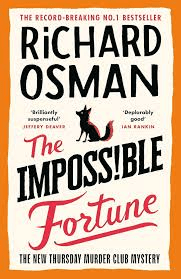
The Impossible Fortune – The Thursday Murder Club 5, by Richard Osman, 2025

The Impossible Fortune was the best selling novel in the UK in 2025. It is therefore proof from any criticism I can level at it. More to the point if you have read the previous four novels in the series you will have long ago decided if this is your cup of tea – if it is then again any criticism will be moot and if it isn’t then you will almost certainly be skipping this review. Nonetheless, I shall press on, because surely the novel deserves more than the unthinking adulation it seems to have received thus far? Equally the ‘read it, review it’ rule will continue to apply in 2026!
Osman has reached the point in the series where recaps of the cast and setting are not required – it is assumed that the reader will be familiar with the context. Also, very few readers will start the series on book 5 and were they to do so (it could happen – I started the Harry Potter series on book 4, Goblet of Fire) there are enough summaries available elsewhere to help them find their feet. We are back at Coopers Chase, the retirement home for active and prosperous pensioners, with Joyce, Elizabeth, Ibrahim and Ron, the founder members of the Thursday Murder Club, and a large and growing cast of secondary characters. A new investigation presents itself on cue, although it is not clear whether it actually is a case of murder or not. The gang don’t worry about this of course – the mystery is what matters. Some valuable crypto-currency is missing – or rather the codes to access it are – and the challenge is to find them before some of the other potential claimants do so.

Still grieving former spy Elizabeth is not at the top of her game and doesn’t provide the insights that usually comes to her so easily. Former trade unionist Ron is worried about his family but finds a way of combining his role in the investigation into the missing crypto with a means of protecting them all, including his precocious grandson, Kendrick. Joyce is a continuing delight and the main source of humour in the novel, especially her relationship with her daughter Joanna, who as the novel opens has just married new character lecturer Paul. Paul has two friends Holly Lewis and Nick Silver (Osman not over-exerting his name giving skills here) who together run a high security ‘cold storage’ business. This is presented as something innovative and shadowy, slightly mysterious, but to me it seemed remarkably similar to the safe deposit box services offered by many banks. Several years ago Holly and Nick were paid for their services in Bitcoin; this has increased in value exponentially over the years and they have now decided to cash it out. But as soon as they have decided to do this Nick finds a bomb attached to his car and very shortly thereafter Holly’s car is blown up, with her in it. Nick cannot be traced and mysterious text messages exchanges with Paul suggest he might have been killed.

This is a problem because to access the crypto-currency a 12 character code is required, half of which is held by Holly and half by Nick. So multiple puzzles present themselves – who tried to kill Nick, who actually killed Holly, where is Nick and how can the crypto-currency be saved?

In the event either of them dies, Holly and Nick have left their access codes with a solicitor, so the final problem in this list is fairly straightforward. Nevertheless the murder club devote most of their efforts to finding the codes which Holly and Nick have also hidden in plain sight. This is where the mystery element of the novel begins to break down somewhat – it is not clear why they have done this. Please note spoilers follow at this point. Just before she is killed by the car bomb, Holly dials a phone number, which eventually turns out to be a disguised form of her code. (Hiding personal number codes, PIN’s etc, in a fake phone number is quite common – so if I wanted to write down my PIN number 1234 in case I forgot it I would create a fake contact Bill’s Pizza and write it down as 07770 001234.) But there is no plausible reason why Holly would dial this number just before she dies; worse still there’s no reason why she would write it down at all as she has memorised it for so long, and no reason why she would dial the number rather than save it as a contact. In other words this is a very poorly constructed attempt to mislead the reader looking to ‘solve’ the mystery. Nick’s code is disclosed in an even clumsier manner, hiding it in text messages to Paul (so for example “I have written a hidden number in this sentences” disguises the number ten) that depend entirely on Paul sending the right replies in the thread. It also depends on Paul showing the messages to Elizabeth and her being able to decipher the code. Again it is totally unclear why he does this, other of course than to provide a simple puzzle for the reader looking to ‘solve’ the novel.

All of which it to miss the point – the mystery element of this series has always been secondary to Osman’s celebration of the liberation of old age. Unencumbered by jobs or responsibility, the Thursday Murder Club members are able to enjoy the later stages of their life by doing pretty much whatever they want. Rules are for other people. Osman also recognises they are so much more than just old people – they all have a lifetime of skills and experience to draw upon. This is a combination that is highly effective when deployed in the solving of murder. Recognising the value and worth of older people rather than seeing them as in god’s waiting room, decrepit or infirm (there’s even a reference to Coopers Chase residents getting frisky in the community hot tub) is at the heart of this series, and it is to be celebrated for that fact.

The Impossible Fortune has a number of sub-plots that are arguably more interesting than the central mystery. Ron’s daughter finally escapes an abusive relationship and in doing so exposes her whole family to a dangerous revenge plot. Connie, the drug dealer imprisoned earlier in the series has been released from prison but continues her unlikely relationship with former therapist Ibrahim, which in this novel finally solidifies into a friendship and even, potentially, a partnership. Joyce enjoys finally being a mother-in-law and her relationship with her daughter is drawn with skill and sensitivity. The novel has lots of good jokes – Joyce coming to terms with technology is a sub-section in its own right:

Joanna has recently introduced Joyce to Rightmove. It’s a website where you can see houses for sale. You click on them and they let you look inside! Thousands of strangers’ houses! Twenty, thirty, sometimes forty pictures. You can see their sofas, their kitchen cabinets, where they’ve put their wooden LIVE, LAUGH, LOVE signs, what they’ve done with their gardens and so on. And this site is free! Joyce doesn’t believe in all progress, self-service checkouts, for example, but she is certainly happy that somebody invented Rightmove.”

A visit from Prince Edward is mined for all it is worth; references to David Tennant and Pierce Brosnan jokingly call back to the 2025 film adaptation of The Thursday Murder Club (and its controversial casting decisions).

Osman knows his audience. The Impossible Fortune is printed double spaced with very large font – the largest I can ever recall seeing. Chapters are a few pages long at most. Nothing is too demanding or difficult. At times it seems he is falling into the trap the books warn against – under-estimating the old. The cosiness factor is kept in check, and the moments of genuine peril, particularly when Jason (Ron’s son) and Kendrick are being shot at are uncomfortably worrying. But we are quickly back to jigsaw puzzles, bourbons and sherry before you know it. The author continues to stubbornly refuse to kill off any of his main characters in defiance of my prediction that he would do so in book 2, but I refuse to back down and have faith that one day this prediction will come true. Osman is the king of cosy crime and you can’t help but feel happy for him. Let’s just hope that if they film the later books that they get the casting right this time round!
The Impossible Fortune – The Thursday Murder Club 5, by Richard Osman, 2025

Aside
Book review

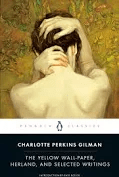
The Yellow Wallpaper and other selected writings by Charlotte Perkins Gilman

Even though you could read The Yellow Wallpaper in not much more time than it takes to drink a cup of coffee, it is widely perceived as both the author’s most significant work and a classic of its genre. The Penguin Classics edition of this story, published with Herland and other selected writings, has The Yellow Wallpaper as the lead text in its title.

The story is written as a collection of journal entries narrated by an unnamed woman whose physician husband has rented a mansion for the summer, to provide her with somewhere to recuperate. He forbids the narrator from working or writing and encourages her to rest. She is suffering from what he calls a “temporary nervous depression – a slight hysterical tendency”, a vague but common diagnosis in women at the time. As the journal entries continue the narrator slowly becomes obsessed with the yellow wallpaper in her room, convinced that it moves and that something is hiding behind it.

An important part of the context of the women’s physical and mental decline is that she has just given birth. We know little about her pregnancy other than it appears to have been the cause of her decline. Although she believes she is treated with care and consideration, the reader can infer that there is more to her confinement. She describes her room with its torn wallpaper, barred windows, metal rings in the walls, a floor “scratched and gouged and splintered”, a bed bolted to the floor – this is a cell in all but name. It will occur to most readers to wonder whether her husband has used his status and authority as a doctor to have her legally sectioned? I haven’t researched this issue thoroughly but it does appear as if women could be declared mentally ill and a danger to themselves and others simply on the word of their husband. If he happened to be a doctor as well then the chances of anyone questioning his decision were slim to non-existent. This is an interesting article on this topic from Time magazine https://time.com/6074783/psychiatry-history-women-mental-health/

The narrator’s morbid obsession with the wallpaper in the room comes to dominate the text and her thoughts. The wallpaper has a “sickly” color, a “yellow” smell, and a pattern like “an interminable string of toadstools, budding and sprouting in endless convolutions”. It leaves yellow smears on the skin and clothing of anyone who touches it. Her mental health rapidly declining, the narrator comes to believe that a woman is trapped behind the pattern in the wallpaper. To free the trapped woman she begins to strip the remaining paper off the wall. When her husband comes home, he finds the narrator rubbing herself against the wallpaper, saying “I’ve got out at last… in spite of you.”

The story is undoubtedly inspired in part by Gilman’s personal experience. When her daughter was born she suffered from postnatal depression. A doctor, considered the leading expert on women’s mental health, prescribed bed rest and forbade her from any form of work including reading, writing, or painting. She found this treatment made her condition worsen. The Yellow Wallpaper is a straightforward autobiographical account of this treatment with the addition of a supernatural component to the story, to provide a dramatic critique of these methods of male control of women’s bodies and lives.

The Yellow Wallpaper has become an important feminist text. The narrator’s attempts to control her environment, her health, and eventually her life by her interpretation of the wallpaper that surrounds her, act as a metaphor for the domestic environment, her body, her mind, and the many other lenses through which the story can be read. At the same time a simple interpretation of the text is elusive – the author scatters hints through the text, but a straightforward key – X = Y – is never provided.

Because of the significance of The Yellow Wallpaper in the canon of feminist literature, the rest of Gilman’s writing is often overlooked, or simply seen as ‘things that might be like, or provide additional information about,’ the primary text. Which is if course both wrong and a pity. Many of the short stories published in the Penguin Classics edition, together with a number available online, are intelligent thought-provoking pieces written from a progressive, feminist perspective. When I was a Witch is a fascinating account of someone being given the power to make wishes that come true, but being unable to use this power for the general improvement of the lives of women. If I were a Man must be the earliest ‘body swap’ story, in which a young woman wishes she were a man and finds herself in her husband’s body. She is fascinated by the different physical experience, and the different, secret attitudes men have towards women – some protective and loving, others base and sexual:

“In the minds of each (man) and all there seemed to be a two-story department, quite apart from the rest of their ideas, a separate place where they kept their thoughts and feelings about women. In the upper half were the tenderest emotions, the most exquisite ideals, the sweetest memories, all lovely sentiments as to ‘home’ and ‘mother,’ all delicate admiring adjectives, a sort of sanctuary, where a veiled statue, blindly adored, shared place with beloved yet commonplace experiences. In the lower half–here that buried consciousness woke to keen distress–they kept quite another assortment of ideas. Here, even in this clean-minded husband of hers, was the memory of stories told at men’s dinners, of worse ones overheard in street or car, of base traditions, coarse epithets, gross experiences–known, though not shared.”

The Giant Wistaria and The Rocking Chair are both conventional, sub-Jamesian ghost stories. While containing traditional gothic elements they are fairly predictable, although The Giant Wistaria still manages to include a feminist portrait of an early American settler woman choosing to commit suicide instead of submitting to an enforced marriage with a cousin. Bee Wise is an early working out of some of the ideas to find expression in Herland, describing a utopian and largely female community established on strongly egalitarian grounds. His Mother and The Vintage are fascinating treatments of social evils affecting the lives of women – the white slave trade and syphilis respectively. His Mother tells the story of a woman tracking down and handing over to the police her son, who has been a key figure in a gang procuring vulnerable young women for prostitution. The Vintage describes in distressing terms the impact untreated syphilis can have down the generations. These were topics that were not widely discussed in ‘polite society’ nor written about outside the pages of medical journals. I find it hard to imagine how brave it would have been for Gilman to have published these stories with their clear and unambiguous treatment of these issues.

Gilman’s personal story is in many ways as fascinating as her writings, and this https://www.neh.gov/article/charlotte-perkins-gilman-did-more-write-one-classic-short-story is a good starting point if you are interested. I agree with the article’s conclusion – Gilman is definitely worth reading beyond The Yellow Wallpaper, although that in itself is a great starting point.

The Yellow Wallpaper and other selected writings by Charlotte Perkins Gilman,

Aside
Book review

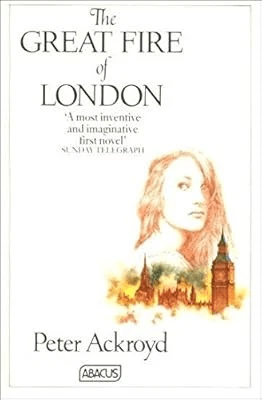
The Great Fire of London by Peter Ackroyd, 1982

I realised fairly early on that I had made a mistake in choosing to read this book, despite it having been on my shelves for (literally) several decades. The mistake lay in the fact that the novel is a retelling of Charles Dickens’s Little Dorrit, and Little Dorrit is one of the very few, possibly the only, Dickens novel that I haven’t read. To be fair, a novel called The Great Fire of London (1666) isn’t an obvious retelling of a novel set in Victorian England, but perhaps I am missing something? I was certainly going to miss all of the subtle references to the source material in Ackroyd’s novel, and was therefore faced with the decision – to push on regardless, or wait until I had read the original?

I pushed on. Little Dorrit is now top of my list of Dickens novels to be read and I will surely experience the slightly bizarre sensation of reading a source novel and spotting influences in reverse. I will let you know how it goes of course. But could The Great Fire of London stand on its own as a novel worth reading?

Yes and no. The novel tells the story of a film-maker producing Little Dorrit in the London streets of its original setting, with a varied cast of eccentric characters, many of which almost certainly have Dickensian originals. It is very short – less than 200 pages – which is very unDickensian – and mildly entertaining. The characters were largely unlikeable and didn’t come to life – I didn’t really care what happens to them. We don’t spend enough time with any of them to get to know them properly and they remained essentially caricatures. In any case what happens to them is usually telegraphed well in advance – an abusive affair ends badly, a gay romance fizzles out, the planned film is incomplete due to production problems, and so on – even the Great Fire we were promised in the novel’s title was as predictable as the iceberg in Titanic. And the novel’s title is misleading – this story has nothing to do with the Great Fire of London – and while the story ends of a conflagration of the film set, that simply acts as a convenient climax for the plot rather than anything more symbolic or meaningful.

So far I appreciate I haven’t found much positive to say about the novel. It seemed burdened by its source material rather than inspired by it. There are only glimpses of the author that Ackroyd was to develop into, and I am not surprised the novel is no longer in print. I occasionally pop over to Goodreads to see what other reviewers have thought of things, as a sense check as much as anything. This succinct review stood out: “A pretentious, miserable book about pretentious, miserable people.” Bizarrely the reader gave the novel two stars! Another reviewer claimed the novel is a “Fictionalised account of the great fire of London. Not too bad, but also not really all that good, or so I thought.” which suggests they really didn’t read it at all (or reviewed the wrong book!)

The Great Fire of London by Peter Ackroyd, 1982

Aside
Book review

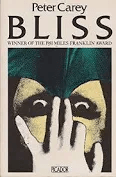
Bliss by Peter Carey, 1981

Initially I thought Bliss, Carey’s first novel, might be interesting in the way authors’ early work often is, giving an insight into the author they are going to become. Northanger Abbey for example is in some ways quite an unremarkable novel, but it does show glimpses of the writer who was going to go on and give us Pride and Prejudice. Would it still be in print if it was the only novel written by Austen? Possibly not (although comments in defence of NA are more than welcome!)

But Bliss is much more than just an early novel of an author showing promise. It is a mature, complex work – had I not know it was Carey’s first I would never have been able to tell. There are characteristics of his work in terms of complexity and also thematically, but few signs of immaturity or anything else to show this is a first novel.

All the reviews of Bliss I have been able to find on the internet agree on one thing – this is a darkly comic novel. While that’s a fair observation it is a lot more than that. The novel’s central character is Harry Joy, an Australian advertising executive. At the start of the novel, Harry suffers a near-fatal heart attack and for a few minutes he is technically dead. When revived he becomes convinced that he is still dead and is now in Hell. The world he once knew— his wife Bettina, his children, and his job in the advertising industry— now feels hellish and grotesque. He is convinced that his family and friends are devils acting as part of his torture. This delusion is aggravated when he simultaneously discovers his wife is having an affair with his business partner and his teenage children are having incestuous, exploitative sex. How can that world not be hell? Seen through this new lens Harry re-evaluates his life. He decides to walk away, seeking the ‘bliss’ of the novel’s title with Honey Barbara, a free-spirited hippie and environmentalist who lives in an off the grid community.

Bliss is a not particularly subtle satire of consumer society; at one point Harry agonises over whether to work with petroleum companies knowing their products are harmful – they eventually are revealed to have given his wife cancer. Harry only comes to life when he walks away and moves to the hippie commune. Bliss is both tragic and redemptive. Harry’s quest for spiritual rebirth brings him a form of peace but he loses his family in the process. Can genuine happiness – “bliss”— only be achieved by rejecting the trappings of modern life?

When Bliss was first published, it was hailed as a major breakthrough in Australian fiction. It won the Miles Franklin Award and was adapted into a film and even an opera. It is one of the strongest first novel’s I have read in quite some time and a clear indication of the author’s abilities, a promise fulfilled in novel’s such as the Booker Prize winning The True History of the Kelly Gang.

Bliss by Peter Carey, 1981

Aside
Book review

Conversations with Lord Byron on perversion 163 years after his Lordship’s death by Amanda Prantera, 1987

This novel is very much a curiosity. With only three Goodreads reviews and now out of print, you may struggle to get hold of a copy. The reference to perversion in the title is misleading – there are no discussions about any form of sexual deviancy, unless homosexuality was considered such in 1987, (which it wasn’t) and it feels as if it was included as a cynical effort to increase sales. But the main interest of the novel is its very early but also quite advanced discussion of what we now term Artificial Intelligence.

Lord Byron was an interesting figure. His in part self-created reputation as a legendary seducer of women caused him to be a scandalous figure in early nineteenth century English society. Inoculated to an extent from the full consequences of his actions by his aristocratic status, he nevertheless broke a lot of taboos, and eventually had to leave the country. His poetry was arguably less successful than his seduction technique and his readership nowadays is largely restricted to university syllabuses. But he is an excellent choice for the central character of a novel about AI. Prantera imagines a computer programme in which every known piece of information about Byron’s life and works is entered into a database to create a simulation of his Lordship’s consciousness. The research team set up to develop the program then go on to interrogate it, hoping it will connect its fragments of information in new ways, thereby providing answers to academic puzzles about Byron’s life – particularly his romantic life – such as whether he wrote his love poems “To Thyrza” to his Cambridge friend John Edleston.

Predictably the program develops a consciousness close to Byron’s own, Its interior monologue forms much of the second part of the novel, its voice imitating Byron’s memoirs and letters. His time at Cambridge is the focus of this ‘memory’, and a potential explanation of his enigmatic relationship with Edleston is developed. Edleston is initially presented to the reader as an angelic voiced young chorister, who falls in love with the older (but still young, only 17) more experienced Byron. Tempted, Byron resists any sexual contact with Edleston seemingly repulsed by the idea of homosexual sex. Finally he can resist no longer and it is at this point that the novel’s ‘big’ secret is revealed – like many attractive young men in fiction before him (for example virtually all of Shakespeare’s comedies) Edleston is a young woman disguised as a boy! As the novel hints at several points that Edleston has a secret which would relieve Byron of his homosexual hesitation, this comes as no surprise whatsoever. The opportunity to write about a trans or bisexual character is thrown away – this is simply a disguise used by a privileged aristocrat/minor royal in order to have fun at an all-male university, nothing to do with sexual identity. Byron had no reason to worry about his sexual orientation – he was only attracted to Edleston because (s)he was a girl all along, not because he was in any way sexually confused. This of course does a disservice to same-sex attracted people and in particular to the transgressive Byron himself.

What of the novel’s discussion of artificial intelligence? Surprisingly it was quite accurate in its fundamental concepts – load the computer with as much data as possible and then leave it to start making connections itself. The computer used in the research programme has an algorithm which learns through its interactions with the operators, finding patterns to simulate a characterisation of Byron’s intelligence and personality. The layering of different personality traits and characteristics for the programme is strongly reminiscent of the neural networks used today in AI in which layers of “neurons” are used for complex tasks such as image and speech recognition. It also has a Natural Language Processing facility which allows it to understand and generate human language, very much in the way that chatbots and voice assistants work today. The only dated aspect of this portrait of a very early AI is the fact that every output from the programme needs to be printed out and photocopied in order to be studied by the researchers. But apart from that this was a very interesting insight into how AI was seen in the 1980’s and how little, surprisingly, it has progressed since then, even if it has moved from the pages of fiction into the real world. When compared to the almost unfailing inaccuracy of the typical prediction of the development of technology from this period, which anticipated we would all be travelling in flying cars and eating our meals in pill form, it feels spot on.

Conversations with Lord Byron on perversion 163 years after his Lordship’s death by Amanda Prantera, 1987

Aside
Book review

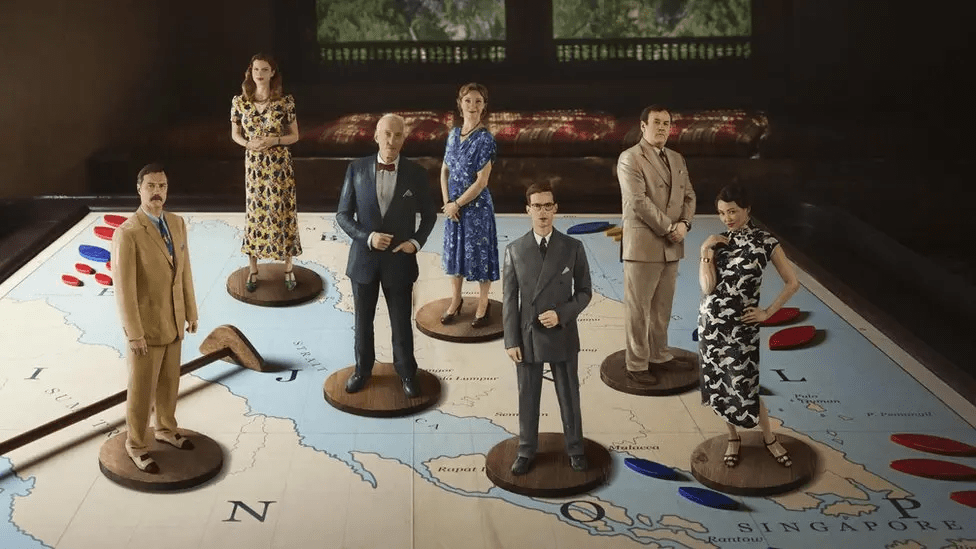
The Singapore Grip by J G Farrell, 1978

I finished J G Farrell’s The Singapore Grip with a sense of relief, which is not a good sign is it? At over 650 pages it was hard work. I had really enjoyed Farrell’s previous novel, Troubles, which was intelligent and entertaining. I had more mixed feelings about his Booker prize-winning The Siege of Krishnapur, which completely erased the voices of the local residents and portrayed every incident from the perspective of the English settlers. The Singapore Grip suffers from a very similar problem – the story is told almost exclusively from the perspective of the English people living in Singapore, and (with only a couple of exceptions) the Malayans and Chinese residents of the peninsula are there for comic effect.

The novel is set in (as you may have guessed) Singapore, and portrays the final days of British government of the island and the Japanese invasion of 1942. The complacent colonial elite, solely interested in exploiting the land for its natural resources, principally rubber, are represented by Walter Blackett, an imperiously dense rubber merchant, and his daughter Joan and son Monty. Often described as a satirical novel, colonialism is a soft target for a novel written in the 1970s. The Blackett’s privileged lifestyle rests upon their attempting to recreate middle class English society as closely as possible, with tea parties and drinks before dinner, even while the society is collapsing all around them as the Japanese come ever closer. The novel’s conscience is embodied by Matthew Webb, son of Walter Blackett’s late business partner, newly arrived to the island (leaving behind a Europe at war) who has previously worked for the League of Nations. Matthew expresses doubts about the society he finds and believes a better world is possible. He symbolically rejects the colonialists by refusing to marry Joan, an arranged marriage that would have secured the future of the company, and instead pursues a relationship with an Asian woman.

There are a number of reasons why this novel was such hard work. The plot meanders and never surprises – we always know the Japanese are going to invade and conquer the island. Whether certain characters escape before the invasion is not a key plot point, as a reader might expect – some of them have chances to leave and let them pass. Walter in particular is focussed on rebuilding his commercial empire after the war, rather than how to survive it. The large cast of characters is not interesting or attractive enough for us to care greatly what happens to them. The critique of colonialism is heavy handed and repetitive – the absurdity of manipulating the supply of rubber to ensure profit from the estates is maximised is explained more than once. Worst of all, on-English voices are silent, with a few exceptions. The Frenchman, François Dupigny, is thrown in for some contrast, but his character is never really developed. After rejecting Joan, Matthew starts a relationship with Vera Chiang, reputed to be the daughter of a Russian princess and a Cantonese tea merchant. Despite this character’s potential she is largely a one dimensional caricature of a mysterious Eastern seductress, and I don’t think we ever are given an insight into her interests or thoughts, only seeing her through Matthew’s eyes.

There is one chapter that stands out from the parade of mildly inconvenient but still privileged things happening to the Europeans. This chapter is written from the perspective of the members of the invading Japanese force and shows them as reckless and driven by a profound sense of honour and determination. Although this is again a cliche it is at least a new voice and perspective from that of the European voices that dominate the rest of the novel. When we read on the final pages that any local people suspected of collaborating with the conquered English were massacred by the Japanese it is almost said as an afterthought, with no real sense of horror at the scale or brutality of the killings.

The novel’s title is a salacious joke, a single entendre, a reference to a sexual practice said to have originated in Singapore. Matthew is regularly teased by people he meets because he doesn’t understand the phrase, not that it really matters. Attempts to interpret the phrase as a reference to the control exerted by the island or its occupiers on society are well-meaning but redundant.

When the novel was adapted into a television series in 2020 by the BBC, critics complained that “Asian characters are merely heavily accented ciphers, silent chauffeurs, exotic dancers, giggly prostitutes, monosyllabic grunts and half-naked Yogis …. Asian womanhood is represented as lurid temptation and subservient availability.” That seems to me a fair representation of the novel as well. I am glad I finished it as I have a pathological aversion to investing time in a novel and not getting to the end (I’d rather not start in the first place) and the excellent Troubles had given me every reason to try again with Farrell. This was his last novel before a premature death in an accident and a disappointing way to finish.

The Singapore Grip by J G Farrell, 1978

Aside
Book review

The Inheritors by William Golding, 1955

The Inheritors is a fascinating, challenging novel by the author of Lord of the Flies, with which it shares some points of similarity. It is set in prehistoric times and follows a community of stone-age people moving from their winter quarters to their summer base. The novel is prefaced by a quote from H G Wells’s Outline of History explaining how little is known about Neandethal man. Although this is presented as a key to interpreting the text that follows, it is somewhat misleading, as the reader comes to learn.

The Inheritors is told largely from the perspective of Lok, one of ‘the people’, a term they use to describe their small group. It is not clear if the people have had contact with other communities before. It is quickly clear however that they are a very primitive tribe. One way Golding illustrates this is that they struggle with most kinds of abstract or conceptual thought. We see this early in the novel, when Lok finds that the log the group has habitually used to cross a river has been removed:

“He shut his eyes and frowned at the picture of the log. It had lain in the water from this side to that, grey and rotting. When you trod the centre you could feel the water that washed beneath you, horrible water, as deep in places as a man’s shoulder. The water was not awake like the river or the fall but asleep, spreading there to the river and waking up, stretching on the right into wilderness of impassable swamp and thicket and bog. So sure was he of this log the people always used that e opened his eyes again, beginning to smile as if he were waking out a a dream; but the log was gone. “

You will note that the author uses the phrase ‘as deep in places as a man’s shoulder’. Elsewhere the term ‘old woman’ is used. So we are subtlety led to understand that these people are men and women, or consider themselves as such. But they have virtually no tools, no clothing, a very limited understanding of the world around them, and are almost completely unable to use abstract ideas (although they are able to control fire). Which prompts the reader to ask – just how primitive are they? – and critically, are they homo-sapiens, the species that went on to inherit the earth (in the terms of the novel’s title), or are they another species entirely? We are initially encouraged – by the novel’s title, the focus on the group, the first person narration and the use of the terms man and woman – to think they are the inheritors, our ancestors, but we come to realise that assumption might not be right. That doubt accelerates or is confirmed when the group comes into contact with the Others. This new group wear clothes, use tools including weapons and boats, and kill the people casually immediately on contact. The people are quickly reduced to two adults – Lok, Fa, a female, and two children, Liku and an unnamed baby. The newcomers kidnap the children and shoot arrows across the river at Lok, who doesn’t understand what is happening:

Suddenly Lok understood that the man was holding the stick out to him but neither he nor Lok could reach across the river. He would have laughed if it were not for the echo of the screaming in his head. The stick began to grow shorter at both ends. Then it shot out to full length again. The dead tree by Lok’s ear acquired a voice. “Clop!” His ears twitched and he turned to the tree. By his face there had grown a twig: a twig that smelt of other, and of goose, and of the bitter berries that Lok’s stomach told him he must not eat. This twig had a white bone at the end. There were hooks in the bone and sticky brown stuff hung in the crooks. His nose examined this stuff and did not like it.

Despite his understanding that the sticky brown stuff at the end of the arrow is unpleasant, (he has a highly advanced sense of smell) Lok is simply unable to conceive of the fact that he is being attacked. Later he again has arrows fired at him and crucially he has learnt nothing from his original encounters with the Others and reacts in a bemused way. The people are so isolated that they are unable to comprehend the danger that the Others represent – without this instinct for self-preservation they are doomed. Although wary of the Others once they have killed four of his group, Lok is also fascinated by them – running away doesn’t occur to him. Fa, more perceptive than Lok, tries to persuade him to flee, but he is focussed on rescuing the children. When Liku, the older child, is apparently killed and possibly eaten by the Others, Fa sensitively protects Lok from this fact. As we see the events of the novel from Lok’s perspective it is some time before we (and he) realise what has happened to Liku. More generally, his limited vocabulary and understanding of the world at times makes the novel hard to follow. The reader has to decode everything – the example given above of the arrow being fired at Lok is straightforward enough, but much of the time things are confused and unclear. This means that The Inheritors is a novel that demands to be read carefully.  Ben Okri’s introduction to the Faber and Faber edition puts it this way:

“It is the kind of novel in which the real reading starts with the second reading. Then the work becomes clearer with every sentence and yet not so clear. In the second half, much has to be pieced together in the highly suggestive writing. Readers have to discover for themselves what is meticulously described. This makes us inhabit the restricted comprehension of ‘the people’, sometimes understanding and sometimes not.”

The novel is redolent with symbolism and particularly Biblical imagery. The group are described as the people of the Fall. In one sense this is literal, as their summer camp is next to a waterfall, but the analogy with the Adam and Eve story, with the people embodying an innocence that has no concept of sin or violence, and the Others representing the violence of Cain. It is relevant that the people have a cultural taboo against killing animals, although they will eat the abandoned or stolen prey of wild animals. The Others have developed an alcoholic drink and the scene where Lok and Fa accidentally get drunk and are completely disorientated by the experience is analogous to Adam and Eve being tempted to eat the fruit of the tree of knowledge of good and evil. If this sounds a somewhat heavy-handed use of symbolism that is more down to my summary than Golding’s writing which is done with much more sensitivity and lightness of touch.

The novel ends, famously, with two sudden changes of perspective. From the moment Fa is swept away over the waterfall, the narrator steps back, and instead of showing us the world and its events from Lok’s perspective, looks at him dispassionately. He suddenly – mid-chapter – becomes “it” and “the red creature”. We have seen this description used once before, when in Chapter 11 we see Fa from Lok’s eyes and she is described as “red as a squirrel, running mostly on all fours“, but this is the first detailed description of the people’s appearance:

“It was a strange creature, smallish and bowed. The legs and thighs were bent and there was a whole thatch of curls on the outside of the legs and arms. The back was high and covered over the shoulders with curly hair. Its feet and hands were broad, and flat, the great toe projecting inwards to grip. The square hands swung down to the knee. “

The novel’s final chapter sees another switch in perspective, almost as shocking. It is written from the viewpoint of Tuami, one of the homo sapiens group that has brought such destruction into the simple lives of the people. This group are scared – terrified – of the people and are running away from them. Tuami is plotting to kill the group’s leader and replace him. But for now they are fleeing from the strange and dangerous people who they think of as devils. They have with them the Neanderthal baby, adopted as a pet. The Others have been scarred and damaged by their encounter with the people and will carry traces of this meeting for a long time, choosing to avoid the forest where they think they live. These are the real inheritors – and they are us. As he does in Lord of the Flies, Golding exposes man’s true nature. I wouldn’t want to reduce this complex narrative to a simple parable – ‘we are the real monsters’ – but there’s no doubt that is a significant part of the overall theme of the novel.

As Golding’s second novel this is a powerful follow up to Lord of the Flies and a novel that is perhaps not read as widely as it should be. That might in part be because of its perceived difficulty and partly because (slightly surprisingly) it has never been filmed. It is thoughtful and thought-provoking. Highly recommended.

The Inheritors by William Golding, 1955

Aside
Book review

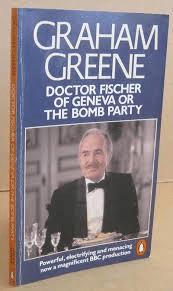
Dr Fischer of Geneva, or The Bomb Party, by Graham Greene, 1980

Graham Greene was arguably the senior British novelist of the post-war period. He was nominated for the Nobel Prize for Literature and probably would have won it if not for the objections of a couple of key Swedish judges. But since his death in April 1991 his reputation has faded and faded quite quickly. According to an essay in Prospect magazine this is because ” the world has moved on to another century and other fashions”. Adaptations of his work, such as Neil Jordan’s film of The End of the Affair (1999) and Phillip Noyce’s The Quiet American (2002) only served to emphasis the outdated nature and period settings of his novels rather than keep him in the public eye. I’d struggle to find any concrete evidence for this fading popularity, but my feeling is that his work is read very little nowadays. He certainly is conspicuously missing from many of the ‘100 best novels written in the 20th Century’ lists that pop up from time to time.

So, as always, the question has to be asked, why did I read Dr Fischer of Geneva? The BBC made a television movie of the book in 1984, with Alan Bates, James Mason (in his final screen performance) and Greta Scacchi in the leading roles and with Barry Humphries rather hilariously miscast as the alcoholic womanising film star Richard Deane. The edition I read had a still from this adaptation on the front cover and the impression was inescapably that I was looking at a late version of one of Roald Dahl’s corny ‘Tales of the Unexpected’. (For people of my generation that reference will immediately summon up a lot of memories and meaning – for others please refer to the internet!) Perhaps it was that association, combined with the promising brevity of the novella, that encouraged me to read this text to while away the time on a short journey.

The novella is narrated by Alfred Jones, a translator for a Swiss chocolate company. A note of inauthenticity is immediately introduced – did even the largest chocolate companies have their own in-house translators? It does seem something of a luxury. Jones lost his left hand while working as a fireman during the Blitz and is a widower in his fifties. In Geneva Jones meets the much younger Anna-Luise Fischer, the estranged daughter of the eponymous Dr Fischer and quickly experiences a mutual if unlikely attraction. Her father, Dr Fischer, has become rich after inventing a perfumed toothpaste. He is now known for his notorious dinner parties which attract the rich and famous. Alfred and Anna-Luise are married after a very short courtship and the problem of how to tell her father is one they eventually have to confront.

Jones finally plucks up the courage to go and see Fischer to tell him about the marriage, but Fischer is indifferent to the news. However, he later invites Jones to one of his slightly sinister and infamous dinner parties. Anna-Luise begs him not to go – the suggestion is that the parties will in some way corrupt him – but she relents, and out of curiosity Jones goes to one of the parties. At the party, Fischer sets out the ‘rules’: if a dinner guest does as she or he is instructed they will receives a valuable present at the end of the meal. This is simply a way for Fischer to humiliate his guests. Desperate for their reward they go only with the rules, pretending to find the experience amusing. Jones of course refuses to take part.

This would have been the last of their relationship with Dr Fischer and his ludicrous parties, but Anna-Luise is tragically killed in a skiing accident. Jones is devastated and considers suicide. He tells Fischer about his daughter’s death, but he needs unconcerned. When unexpectedly another party invitation arrives from Dr Fischer he decides to attend to vent his anger at his father-in-law’s indifference to his wife’s death by attending the dinner party and telling him precisely what he thinks of him and his ‘friends’.

This is of course the “Bomb Party” of the novel’s alternative title. Dr. Fischer explains the rules – he has hidden cheques for two million francs apiece within five crackers. Inside the sixth is a small bomb likely to kill whoever opens it. The guests are expected to chose a cracker and open it. A form of Russian roulette in other words. Most of the guests accept the challenge, partly suspecting that Dr Fischer would not really kill one of his guests. Jones, still feeling suicidally reckless, opens several of the crackers. I won’t spoil the ending for you but it was neither surprising nor satisfying.

Greene is quite clumsily discoursing on wealth and morality, but I am not convinced he had anything particularly interesting to say. Fischer is a monster who uses his wealth to abuse his ‘friends’, and they are sufficiently avaricious to allow him to treat them like that. Rich people aren’t very kind to one another. Who would have known? By contrast the romance at the heart of the novel is sweet albeit brief. Jones’s first person narration warns the reader early on that it is not going to last, so Anna-Luise’s death does not come as a shock. But we lose the more interesting character – Jones never really emerges as a convincing persona: having lost his hand in the war he has no expectation of a romance in later life, let alone with someone as exuberant as Anna-Luise. After her death he reverts to existing rather than living.

This was a late Greene novella, not much more than an extended short story. It passed away a short journey, but I doubt it will linger long in the memory, nor encourage me to continue trying with Greene.

Dr Fischer of Geneva, or The Bomb Party, by Graham Greene, 1980

Aside
Book review

Jack Maggs, by Peter Carey, 1997

I can’t tell you precisely how long Peter Carey’s Jack Maggs has sat on my bookshelves waiting to be read, but it is a long time – I was seriously considering abandoning any intent of reading it and regifting it to the charity shop from whence it came. I am so glad that I did not and instead on a whim started this original and entertaining novel.

When I first started it I wasn’t aware that Jacks Maggs was based on Dickens’ Great Expectations and was feeling rather smug when I identified the character Tobias Oates as being a portrait of the young Dickens. Oates is 24 and has had one successful novel published (Captain Crumley, a version of the Pickwick Papers). Oates is married but is already getting bored with his wife and is having a passionate affair with his eighteen-year old sister-in-law. There are close parallels with Dickens’ life here and he doesn’t come out of the novel well at all. Dickens did eventually separate from his wife after she had borne his many children and his relationships with his sisters-in-law don’t stand up to too much scrutiny. This speculative portrait of the early years of his marriage suggest that his affections for his wife were waning even at this stage.

The novel opens with the titular character returning from a life-sentence of transportation to Australia. Whilst imprisoned as a convict his life in Australia was brutally hard, but eventually he was freed and went on to earn a comfortable living and a place in respectable society by becoming a brickmaker. He uses some of this money to trace his young son, abandoned back in England, and provide him with a good education. This of course is essentially the storyline of Great Expectations, but seen from Magwitch/Maggs’s point of view. On returning to England to find his son, leaving a young family back in Australia, Maggs risks the death penalty which faced all those who left Australia after a life sentence. He finds his son’s house empty – he has fled to his club after being forewarned of his father’s intention to come calling – and takes a job as a footman in the household of Mr Percy Buckle, the next door neighbour. His predecessor in the role has recently died by suicide and one of the novel’s mysteries and sub-plots is the background to this death. Maggs is a brutal man, vividly realised by the author, and quite unsuited to the subservient role of footman. In this role he encounters Oates, a dinner guest in the Buckle household, who is intrigued by the rough character who is attending table. Oates offers to hypnotise Maggs to help him with a painful tic that has developed in his face, a result of his being brutally whipped. Oates real intention is to discover Maggs’ backstory, which he quickly does, much to Maggs’s anger when he finds out his identity has been revealed. Maggs only agrees to be hypnotised if Oates will tell him how to find a notorious thief-taker who he believes will help him track down his son.

The novel slightly stalls at this point. The Great Expectations storyline has been left some way behind, and the characters and events repeat themselves while waiting for the deadline by which Oates has agreed to reveal the identity of the thief taker to come around. Maggs discovers his identity has been revealed, and reacts with anger, effectively taking Buckle’s household and Oates along with it hostage. Maggs doesn’t follow a plan or behave in any way strategically – he just uses cunning and the threat of violence to get his way. A trip to Gloucester to find the thief-taker is a wild-goose-chase which doesn’t seem to serve any particular purpose in the narrative (unless it was following a story-line in GE that I have managed to forget!) and puts off the climax in which all the characters come together in a dangerous and potentially violent end to the novel. Dickens was always careful to give his villains an ending that Victorian civic society would approve of, however charismatic they might be, but Carey is less anxious to comply with Victorian morality and (spoiler alert) allows Maggs a happy ending that for much of the novel appears deeply unlikely. Oates on the other hand suffers a painful loss that runs parallel with a similar loss in Dickens’ life, showing that not all immoral behaviour escapes judgment, even if the judgment is delivered on a young woman rather than Dickens/Oates himself.

I thought it would be an interesting to compare this novel with a more recent reimagining of Dickens, Barbara Kingsolver’s Demon Copperhead. Google’s AI tells me that the latter novel is the more radical reinterpretation of the two, set as it is in the Appalachians in modern times, and focussing on the opoid epidemic. But it was also in other ways a traditional and fairly close retelling of the Dickens novel, albeit updated, whereas I thought Carey’s novel, while retaining the original setting, was a more imaginative narrative. It uses the Dickens text as a jumping off point but also blends the events of Great Expectations with episodes from Dickens’ life itself. It also uses what I think of as the ‘Rosencrantz and Guildenstern’ technique of showing the events of the novel from an entirely new perspective, revealing depths to the original that were previously unexplored. I think on balance I found the Carey text the more impressive of the two (compared that is with the Kingsolver novel, not the Dickens!) although in terms of critical and popular reaction Demon Copperhead has been far more successful. It is interesting that two very well established authors chose to turn to Dickens for inspiration (of course there are many others doing the same thing) rather than crafting entirely new narratives.

Jack Maggs, by Peter Carey, 1997

Aside
Book review

Aiding and Abetting, by Muriel Spark, 2000

Aiding and Abetting was Muriel Spark’s penultimate novel. It is a retelling of the notorious case of ‘Lucky’ Lucan, a British aristocrat who in the 1970’s murdered his children’s nanny, battered his wife almost to death (she having been his original target) and then went on the run, never to face justice. He is the recurring subject of tabloid stories, being ‘discovered’ living in the Australian outback or South Africa every few years.

Spark tells this story through the unusual lens of Dr Hildegard Wolf, a fake-psychiatrist ‘practising’ in Paris, who is consulted by two men, both of whom claim to be Lucan. They have discovered that she, like them, has a secret – in a previous incarnation she was Beate Pappenheim, a ‘fake stigmatic’ – someone who claimed to experience the wounds Christ suffered on the cross, wounds which mysteriously heal and reappear periodically. Using this story Beate/Hildegard took charitable donations from the faithful and the gullible, and when her fraud (she used period blood to simulate her wounds) was uncovered, fled the country. assuming a new identity.

It’s never clear whether the Lucan claimants are intending to blackmail Wolf – they need the money, their supporters who have kept them secure from the law for decades finally beginning to run out – or whether they enjoy the experience of being able to tell their story free from any risk of exposure. Wolf quickly works out that the men are working together, one being the real Lucan and the other a decoy, helping collect donations of support while leading the police and others astray. But this is all largely a framework within to tell or retell the notorious story of Lucan’s murder of Sandra Rivett, the Lucans’ nanny, and attempted murder of his wife. Lucan sees this as a Shakespearean tragedy instigated by his wife’s legal battle for custody of their children (they were divorcing), made worse by his constant gambling losses. He is the victim in his version of the story. The protection he is offered by friends in escaping justice is his god-given right.

When reading Aiding and Abetting I was left with the impression that it was poorly written, with a lot of repetition and sub-plots that peter out. Poorly written by Spark’s standards that is – she is normally a very intelligent writer with intricate plots, well developed characters and deft control of her material, none of which could be found here. I went back to the text several times to try and find evidence for this impression, but came up empty-handed. Perhaps I was looking for something that wasn’t there? As a reader you have to both trust and challenge your instincts – trust them as first impressions, but nevertheless check them just in case they are prejudices bobbing to the surface. Always give the author the benefit of the doubt (OK- not always; there are some authors who just don’t deserve the benefit of the doubt. E L James comes to mind, as do Jeffrey Archer and Dan Brown. But that’s just about it). If you are left with an impression, try and work out why. Well, for a start in Aiding and Abetting Spark doesn’t really have anything new or interesting to say about the Lucan case. She uses it as the structure for her story, but ends up leaning against it lazily. Spark claimed the novel’s theme was ‘blood’ and while there is plenty of blood in the novel, multiple references don’t add up to a theme. None of the novel’s characters are engaging – some are pretty forgettable – and the story doesn’t do justice to the real victim, the children’s nanny, who remains a largely one-dimensional and voiceless figure. (As part of my background reading for this review I was pleased to note that more recently, in 2019, Jill Dawson wrote The Language of Birds which tells the events of the Lucan murder from the point of view of the victim). If I felt ambivalent about the novel, the appallingly predictable and unfunny ending, a tribute of sorts to Evelyn Waugh but with none of the wit and about seventy years too late, left me in no doubt that this was a bit of a dud.

I really hesitate to suggest that Spark, in her early 80’s when this was written, was running out of steam, but I can’t find any other reason why an author usually so careful in her construction and characterisation would not live up to those standards. Perhaps I should read her final novel, The Finishing School, to see if that hypothesis stands up?

Aiding and Abetting, by Muriel Spark, 2000

Aside