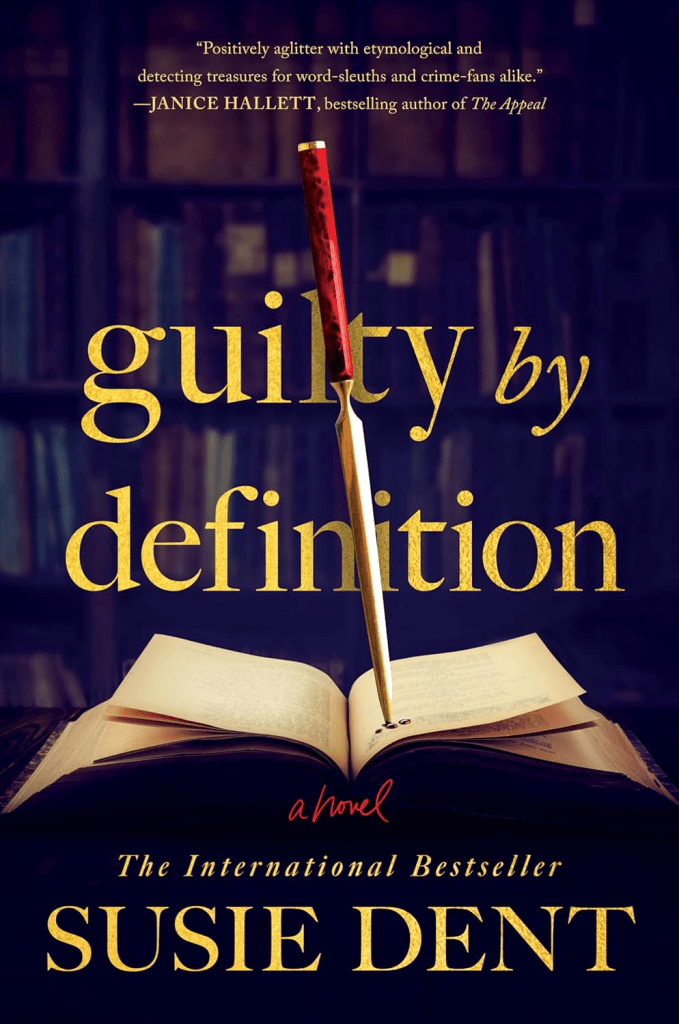
If you had to guess what a novel by tv’s lexicographer Susie Dent would be about I think most people would assume that it would be a) in the cosy crime genre, b) feature a main character who is a lexicographer, or a related profession, and c) involve word puzzles and clues that lead to the resolution of the mystery. And the author obviously hates to disappoint her audience, because that is exactly what she has produced. I was expecting the novel to be a lazy, genre-driven cash-in on the author’s public persona (of which there are many out there at the moment) but I am delighted to say it was so much better than that. There are still some predictable elements, of course, including the loving descriptions of academic Oxford, the word puzzles, and the short chapters that keep the pages turning. But these are more than compensated for by the high quality writing and the well constructed plot.
Set in Oxford and featuring a team of lexicographers working for the Clarendon English Dictionary, the setting and structure of Guilty by Definition also provides the author with plenty of opportunities to weave into the text anecdotes about the origins of words and phrases, keeping the fans of Countdown and Dictionary Corner satisfied. These word-related anecdotes are sometimes rather obviously shoe-horned into the narrative (often something about a word or phrase will just occur to the narrator and have to be explained) but I think Dent just about keeps on the right side of this not being irritating or distracting.
The plot follows Martha Thornhill, senior editor of the Clarendon English Dictionary. She and her team seems to have gloriously relaxed jobs tracing the origins of words and phrases. Also working for the CED but not part of Martha’s team is Jonathan Overton, a Shakespeare expert who has published widely on the bard’s coinages and who is a minor media celebrity. One day they receive a letter from an anonymous correspondent who signs themself ‘Chorus’. This letter contains a word puzzle, which when solves leads to the answer 2010, which is the year that Martha’s sister, Charlie, went missing. Thus begins a reopening of the investigation into Charlie’s disappearance. This moves along at a fair pace, with new developments and discoveries about Charlie’s past every few pages. Further letters and puzzles from Chorus move the action along every time the investigation begins to lose focus. It is revealed that Charlie was on the trail of a literary discovery, which as well as being hugely valuable would rewrite much of what we know about Shakespeare’s invention of new words. In lexicography terms this could be up there with the Rosetta Stone or the double helix structure of DNA.
Guilty by Definition is well plotted and well written. The final reveal of what happened to Charlie and what she had discovered hits exactly the right balance between not being too obvious but at the same time not too obscure. I was able to work out ‘whodunnit’ fairly early on, the list of possible suspects being quite small, but this didn’t spoilt the read for me in any way. The novel has lots of independent women characters who are not defined by their appearance or sexuality and who are not traditional stereotypes, which was a refreshing change from much genre fiction. The three main lexicographers, Safi, Martha and Alex form a strong team that would translate very well onto the television screen (with Oxford as a photogenic background) and I would be astonished if they do not reappear in further word-based mystery sequels. I look forward to them.
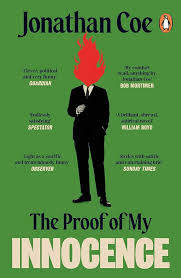
In his summary of The Proof of My Innocence, Jonathan Coe tells us that ” I felt like writing something contemporary, ironic and harder-edged. I wanted to return, if possible, to the tone of What a Carve Up!, with some kind of metatextual crime story which would also reflect on the current political situation.” If we judge the novel by these criteria, then I think that while certainly the metatextual crime story box can definitely be ticked, I would struggle to describe this as ironic or harder-edged. I will try to explain why in this review, but the good news is that the lack of a hard-edge is not a serious problem nor does it detract from the overall enjoyability of the novel.
Coe’s well-established method is to use contemporary real-life political events as a backdrop to his stories. The Proof of My Innocence follows this pattern by being set in the tumultuous period of Liz Truss’s premiership in the autumn of 2022. It opens with her election and ends with her resignation just seven weeks later, the shortest term of office of a British Prime Minister by some considerable distance.
The novel opens with a woman detective following a suspect on a train. Just as she is about to arrest him she is interrupted by a See It Say It Sorted announcement. Being infuriated by these announcements and then making a plot point out of them, is the kind of thing an observational stand-up comedian might ‘notice’, and pretend to get worked up about, when they really aren’t that obtrusive. This scene is then swiftly followed by an apparently unrelated story-line in which Phyl, who has recently graduated from university, works in a minimum wage job at a sushi bar at Heathrow Airport. She lives with her parents and misses the freedom of university life. Phyl watches old episodes of Friends as a means of reducing the anxiety caused by the lack of direction in her post-graduate life. The friction between millennials and their Boomer parents is one of the sources of humour in the novel. Coe is unquestionably one of the latter and I am not sure his portrait of the younger generation is entirely accurate, but the Friends obsession (or insert comedy programme of your choice – another favourite is the US version of The Office) seemed spot on.
The arrival of a guest disrupts the family dynamic. Christopher Swann, a friend from her parents’ time at Cambridge University in the 80’s, writes a blog on contemporary political issues. He is planning on attending TruCon, a conference organised by a dubious right-wing group pressure group. The conference is being held at a nearby stately home, Wetherby Hall. Chris is joined by his adopted daughter, Rashida, who quickly bonds with Phyl over a shared frustrating experience with the lifts at terminal 5. Phyl is toying with the idea of writing a novel, and in discussion with Rashida about this idea she jots down three possible genres for her work: cosy crime, dark academia (such the The Secret History) and auto-fiction. The bulk of the remainder of the novel is written in the form of these three genres. The reader can’t immediately tell whether these are fictions written by Phyl or by Coe, although this is eventually revealed.
The cosy crime third of the story is set at Wetherby Hall, the venue for the TruCon conference, which opens on the day Liz Truss becomes prime minister. This section opens with a parody of this genre which is somewhat over the top:
“Christopher Swann carefully steered his car between the yellowing drystone walls of the quaint old bridge that carried the road over the brook….Just a few hundred yards after crossing the brook he entered the village of \Wetherby Pond itself. At the sound of his engine (even though he was driving a quiet, hybrid model) the ducks on the eponymous body of water took flight with a volley of complaining quacks. Christopher followed the road around the edge of the pond, his eyes taking in every unlikely detail of the old post office, the red telephone box standing outside the village shop, the row of trimly thatched cottages and an elderly resident reading a copy of the Times while sitting on a weathered oak bench.”
I genuinely can’t tell if this is deliberately bad genre writing or not, but I will give Coe the benefit of the doubt and assume it is part of the parody. I particularly liked the description of his Swann’s ‘eyes’ taking in every detail as if any other body part could have fulfilled the same function! Swann is treated as an outsider by most conference delegates, which of course he very much is. Rather than keeping a low profile he goes out of his way to antagonise the various right-wingers present, all of whom feel jubilant at Truss’s appointment, feeling this is their moment. The conference is interrupted by the news of Queen Elizabeth 2nd’s death, quickly followed by Christopher’s brutal murder. Coe is treading a fine line here – he is incorporating all the cosy crime tropes he can think of – the rural setting, a locked room mystery, secret passages, a cryptic note from the victim, etc etc – and at the same time telling the underlying story of Swann’s forty-year pursuit of the far right in the UK and their plans for the day they finally take power, which seems to have arrived.
The next section of the story is told as an example of the ‘dark academia’ genre and is based around a manuscript memoir of one of Swann’s friends at university in the 1980’s. This section continues the delicate balancing act between parody – the author’s memories of his days at Cambridge in the 80’s include love affairs, glamorous young women, hidden identities, secret societies and a sinister conspiracy to support the Thatcher Government – and advancing the narrative, leaving clues about the present-day mystery. The final section written as auto-fiction completes the murder mystery element of the novel but leaves some loose ends dangling. These are picked up in what is in effect the novel’s postscript, which reveals that much of the preceding story has been a fiction within the fiction – hence the sound of the metatextual box being ticked.
The Proof of My Innocence is full of things that the reader is encouraged to notice for themselves, the novelists equivalent of Easter eggs. Clues to the identify of the murder form part of these things we are encouraged to notice, but there’s much more – references to contemporary culture, running jokes (the laboured joke about whether an Cambridge don had a harpsichord or a clavichord in his rooms is repeated about a dozen times) wordplay, and so on. Each time we spot one of these we get a small hit of dopamine – ‘clever me!’ – that keeps us reading. And The Proof of My Innocence was eminently readable – I got through it in just over two days. By way of example, the murder mystery element of the story has the victim surviving his attack just long enough to write a few cryptic symbols before expiring (this trope goes back to at least A Study in Scarlet. The message is “r 8 / 2.” Is this a reference to someone staying in room 8 (2)? Or something happening on 8th February? Or possibly even something happening on 2nd August (those pesky Americans with their different conventions for writing dates). Or something else entirely? (Clue, it’s something else entirely). Earlier a pub Swann visits is called theFresh Lettuce, a wry reference to the tabloid joke that haunted (haunts?) Truss as to whether her premiership would last longer than a lettuce (it didn’t). I was patting myself on the back when I spotted the fact that a plot point would revolve around a novel within the novel called My Innocence and changes made to the proof copy (hence, the Proof of My Innocence, a clever play on words). Is the enjoyment of these ‘noticeables’ a feature of the genres Coe parodies, or of his writing more generally?
Sadly, the novel slightly fizzles out. The big conspiracy Swann is planning to expose, the far-right’s plan to privatise the NHS, never sees the light of day. A memory stick with details of the plan is stolen and back up copies are quietly forgotten after his death. An alternative right-wing plan revealed within the 1980’s memoir, to defeat a strike by the NUM, is also forgotten (this was hardly a secret plan, more a statement of the obvious). Coe’s portrait of the far-right of British politics, and the extent to which it is influenced by the American right, is usually spot on, but the absence of any reference to Farage or Reform was puzzling. Wagstaff, a Tory politician who plays the role of villain in the novel, is the nearest we come to a portrait of Farage, but he is a Cambridge graduate and a life-long Tory, so not anywhere near an equivalent. Reform need the Jonathan Coe treatment. Once the meta-fictions end and the novel switches to the principal storyline we find out that the murder-mystery narratives were Phyl’s attempts at making sense of Swann’s death in a car crash before he even reached the conference. Not a particularly sensitive way of processing someone’s death I would have thought.
Coe is an author I have been meaning to read for some time. He is quite prolific having published 15 novels, roughly one every three years. His writing style is engaging and accessible. So I will definitely be reading more of his work in future. I enjoyed TheProof of My Innocence and look forward to reading Coe’s thoughts on Starmer’s Labour.
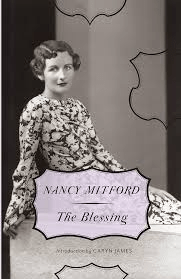
England, 1939. Grace Allingham, a young, affluent Englishwoman is engaged to be married to Hughie. But when she meets Charles-Edouard de Valhubert, a French Air Force officer, she is swept off her feet, Hughie is dumped unceremoniously and Grace and Charles-Edouard quickly marry. After a brief honeymoon he returns to the war, leaving Grace pregnant but content to wait out the months and years of war for his return. Seven years pass, and when he finally returns to England it is to collect his wife, son and the family nanny and take them back to France, to finally begin married life.
Life in France is not without its challenges. The principal characters of the novel, with the exception of the nannies who look after the children before they are sent off to boarding school, are all upper class if not aristocratic, independently wealthy, who don’t have to work, have multiple houses, staff and spend their summers in Italy. But their relationships are a mess. The comedy of the novel derives largely from stereotypes about English and French aristocrats and their very different lifestyles. The main difference between the countries is their attitude towards infidelity. The French have a ‘laissez-faire’ approach, where affairs are seen as a private matter rather than a moral failure, and even accepted as part of long-term relationships. Charles-Edouard’s problem is that he is a enthusiastic adulterer who seems untroubled by being caught in the act. Eventually Grace realises he is never going to change. She returns to England and divorces him. He is remarkably untroubled by this, continuing with his long-term affairs, confident that his wife will sooner or later see sense and return to him.
As Charles-Edouard is a man-child driven by his libido above all else, it is hardly surprising that his son, Sigi, easily outwits him. Sigi likes his parents being separated – it means that all the potential new husbands and wives in their lives have to seek his approval, and approval means treats. He is spoilt rotten and frustrates Charles-Edouard’s lacklustre attempts to woo his wife into returning to France by simply not delivering his messages. Potential suitors for his mother’s newly available hand are equally easily disposed of given Sigi’s veto over their selection. Balls are attended, afternoon tea is drunk, French properties left unlooted by the Nazis are toured, and of course assignations are conducted more or less in the open. The comedy is dated, and I suspect it felt so even in the early 1950’s when the novel was first published, being more suited to the carefree times of the 20’s and 30’s. I even wonder whether this might have been a returned-to manuscript from the 30’s, updated with scant details of the slightly longer second world war?
The only indication we are in post-war Europe is a short discussion on homosexuality. Dexter, an obnoxious American, (it is almost a given that Americans in novels of this kind are obnoxious) is ranting about the link between homosexuality, which he calls ‘perversion’, and communism. Hughie, who by this point in the novel has overcome his break-up with Grace and is courting Albertine, who is one of Charles-Edouard’s mistresses. replies “But, old thing, they’re not sick. They just happen to like boys better than girls. You can’t blame them for that, it’s awfully inconvenient, and they’d give anything to be different if they could…I probably know more about them than you, having been at Eton and Oxford“. The revelation towards the end of the novel, that Dexter was a Russian spy and life-long communist, further undermines his credibility as a judge of public morality. Other than this brief defence of ‘perversion’ the social attitudes prevalent throughout the novel are those of earlier decades, when the Mitford’s had some relevance beyond historians of English class identities.
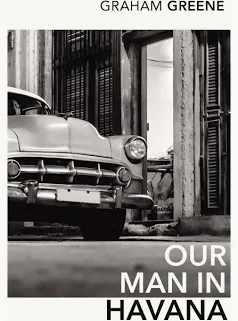
The central plot point of Graham Greene’s 1958 novel Our Man in Havana involves an unlikely spy, James Wormold, a middle-aged English vacuum salesman, making up details of secret military installations he claims are being built in the mountains outside Havana. Absurdly he sends his handlers in London detailed drawings of the rocket base using the schematics of the vacuum cleaners he sell, presciently named the Atomic Pile Suction Cleaner. What is strange is that I knew this detail before I opened the book, and it was one of the very few things I know about Greene’s work. But I found it frustrating that I can’t for the life of me remember how I knew that fact! There is a wider point here about how novels work their way into the cultural subconscious (so that, for example, Kate Bush could write a song about Wuthering Heights without ever having read the novel). I suspect the main reason this detail stuck in my head for so long (however it got there) is because of the way the novel strangely anticipated the 1962 Cuban Missile Crisis which brought the world to the brink of nuclear war.
The novel draws its humour from the gullibility of MI6. The central character, Wormold, is a vacuum cleaner salesman, selling only one company’s product (he seems to have only two different models of vacuum available). It shouldn’t matter, I know, but the idea of an Englishman selling vacuums in 1950’s Cuba just struck me as profoundly improbable. Who is buying these things? Greene himself had worked for British Intelligence during the war, and came to realise how easy it was for spies to file fictitious reports – who could check them for accuracy? This idea seems to have originated with the notorious case of Garbo, a Spanish double agent who pretended to have up to 27 agents working for him all over England, and who came to play an important role in misleading the Germans about the location of the 1944 landings. Greene wrote a first draft of the story in 1946 but it was the outbreak of the Cold War that gave the novel a new, more absurd, dimension.
The novel opens with our rather pathetic anti-hero struggling to keep his head above water, financially, mainly due to the demands of his spoilt teenage daughter. His wife has long since left him, leaving him to bring up his strictly Catholic daughter on his own. When he is clumsily approached by Hawthorne, an English spymaster, he becomes a spy himself almost accidentally. His initial doubts about the job are quickly overcome when he realises that this could be a lucrative profession if he recruits enough fictitious agents and claims enough expenses. His masterstroke comes when he concocts the idea of a secret mountain missile base using drawing of vacuum cleaner parts. Although British Intelligence is presented in this novel as incompetent and overly-trusting, it is very hard to see how else they could have dealt with the situation Wormold presents them with. They take his reports seriously – to do otherwise would have been reckless – and insist on him providing proof, suggesting different ways he can do so. They also send other agents out to Cuba to help him. That all seems fairly reasonable to me. Of course their main mistake is there inability to notice drawings of a vacuum clear when presented with them.
Up to the point at which Wormold starts his campaign of deception, the novel has been lightly comic, with Wormold being an accident-prone loser who is making things up as he goes along. He seems destined to be exposed as a fantasist at any point. But he reveals an inner strength when his improvised plans start to fall apart. Back in London, nobody knows he sells vacuum cleaners and has no reason to suspect his worrying reports. A secretary, Beatrice, and a radio assistant are sent out to join him and scale up his operation. As his lies become more outrageous Beatrice comes to suspect his elaborate fictions. She asks to speak to one of his agents, a pilot named Raúl. When a real-life pilot named Raul is killed in a ‘car accident’, but which is almost certainly an assassination, Wormold begins to panic. It is almost as if his lies are becoming reality and he sets out to save his fictional contacts, exposing himself to real danger while doing so. The reader is able to infer that his reports to London have been intercepted and decoded and his ‘operation’ is now under attack. Things get real very quickly and in the novel’s climax Wormold only narrowly escapes an attack on his own life.
An accidental spy who finds himself in the thick of an adventure, surviving encounters with assassins through dumb luck, sounds like a summary of a James Bond parody such as Johnny English or Austin Powers. Our Man in Havana was published only a few months after Dr No, the sixth in the James Bond series which started with Casino Royale in 1953 and seems to have been influenced by many of the tropes Fleming uses. I think it is best seen in this light – as a response to the portrayal of English spies as suave, sophisticated and almost unstoppable. But both Bond and Wormold get the girl in the end, and both beat the bad guys when it matters. Wormold discovers a surprising inner core when he and his family are threatened.
As I have mentioned several times before, I am not a massive fan of trigger/content warnings, but it comes as a shock when Greene uses the n-word in the novel’s opening sentence. The word is used casually by a character rather than the narrator and emphasises his background (he is a refugee from Germany). Other than the general contempt that British people casually treat all ‘foreigners’ in books from this period, the racism shown here does not reappear regularly, so if you can get past this instance you should be able to stick with the rest of the book. This is not Greene’s most sophisticated or complex novel and it is hard to warm to the principal characters, especially Wormold, but it has moments of light comedic touch, and is an interesting portrait of pre-revolutionary Cuba. Never has vacuum sales been more interesting.
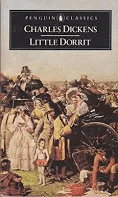
I have finally finished this year’s Dickens, Little Dorrit, with what I am embarrassed to admit was a sense of relief! It took me around two months to complete it. As will be obvious, at no point in the nine hundred pages did the novel ever really engage me. There were some characters who were more interesting, but their stories frequently fizzled out and were incomplete. I found the main plot line mechanical and dull, and most of the peripheral characters were two-dimensional. There were one or two elements of the novel that were unexpected, which I will expand upon below, but despite this I found it flawed and disappointing. As is probably too often the case, I am going to devote the bulk of this review to working out why I found it so.
Taking a step back for a moment, why do we read Dickens? It can’t really be for his plots – they are drawn out, driven by the demands of publication by instalment. They usually include hackneyed and repetitive plot devices: profoundly unlikely coincidences, long lost relatives reappearing after decades, lost wills, hidden identities and sudden reversal of fortunes. Little Dorrit has all these tropes and more, assembled in a slightly random order. When the myriad plot lines are resolved at the end of the novel the explanation given is baffling complex and improbable – the reader could never in a million years have worked out what was really going on behind all the subterfuge. Nor, frankly, would they have cared. The events of Little Dorrit pivot (we eventually find out) on a codicil to a will that passes through many hands before ending in those of a blackmailer, but by the time the intentions of the deceased are revealed it has long since ceased to matter.
Or do we read Dickens for his characters? Here the case is stronger – many of his creations live on in popular culture: Fagin, the Artful Dodger, Sam Weller, Mr Micawber and so on. But I would struggle to make this claim for any of the characters in Little Dorrit. The heroine, Amy Dorrit, is a kind and loving daughter, but her relationship with Arthur Clennam, the novel’s hero, if he can be called such, is one of Dickens many rather creepy much older man/young woman relationships which are so problematic in the light of the author’s personal life. Throughout the novel Clennam refers to Amy as ‘my child’, ‘my daughter’, or variations on this idea, and even though their eventual marriage is one of the least surprising events of the novel, it still feels uncomfortable. Of the novel’s other principal characters, the villain, Rigaud, is an appalling caricature, with his satanic smirk and twirling moustache. He is introduced to the reader from the outset as a cynical murderer and he never once shows any redeeming features nor any sign that he is going to defy the role he is cast in. He flits in and out of the narrative occasionally without ever progressing the plot, only to finally re-emerge to meet a grisly if fitting end.
Some of the novel’s minor characters showed more promise. John, the lovelorn junior warden of the Marshalsea pines away for Amy Dorrit with surprising dignity. Daniel Doyce is an entrepreneur who invents a mechanism – we ever never told anything more about it than it is potentially very useful – which is throttled by the bureaucracy of the Circumlocution Office. (In his essay on Dickens, to which I return every time I read anything by the latter, Orwell says “Nothing is queerer than the vagueness with which he speaks of Doyce’s “invention” in Little Dorrit. It is represented as something extremely ingenious and revolutionary, “of great importance to his country and his fellow-creatures”, and it is also an important minor link in the book; yet we are never told what the “invention” is!) Dickens is making a somewhat clumsy point about the dead hand of the Government service upon the spirit of industry and the absence of any effective intellectual property legislation. As the UK was at the height of the industrial revolution at this time, driven by innovation and enterprise, the satire barely lands a blow, despite the effort Dickens put into the portrait. Doyce eventually travels abroad – to Russia no less, which in the 1820’s (the novel’s setting) was not particularly problematic, but in the 1850’s the UK was at war with Russia in the Crimea – to find more rewarding work. There he prospers, only to finally return to London at the novel’s conclusion. We never really find out what happens to him, what his patent was for, whether it was granted, nor whether his new business succeeds (we can infer that it does).
Perhaps my favourite minor character was Flora Finching. Many years earlier she was engaged to be married to Arthur Clennam. His return from working in the far East finds her a widow. She cares for a truculent aunt of her late husband, nurtures a hope that her relationship with Arthur might be rekindled and speaks in a stream of consciousness that is one of the joys of the novel:
My Goodness Arthur! cried Flora, rising to give him a cordial reception, ‘Doyce and Clennam what a start and a surprise for though not far from the machinery and foundry business and surely might be taken sometimes if at no other time about midday when a glass of sherry and a humble sandwich of whatever cold meat in the larder might not come amiss nor taste the worse for being friendly for you know you buy it somewhere and wherever bought a profit must be made or they would never keep a place it stands to reason without a motive still never seen and learnt now not to be expected for as Mr F himself said if seeing is believing not seeing is believing too and when you don’t see you may fully believe you’re not remembered not that I expect you Arthur Doyce and Clennam to remember me why should I for the days are gone but bring another teacup here directly and tell her fresh toast and pray sit near the fire.”
Many reviewers accept that Little Dorrit is a sprawling mess, populated by thinly sketched characters and with a plot that manages to be both predictable and full of improbable coincidences. But “look at the social commentary” we are told. So let’s. The two main targets Dickens takes aim at in the novel are Government bureaucracy, in the form of the Circumlocution Office, and the practice of imprisoning people for debt, in this case in the very personal description of the Marshalsea debtor’s prison (Dickens’ father had served time in the Marshalsea and it clearly had a significant impact on Charles’s childhood. He was forced to leave school at the age of 12 to earn his keep).
The Circumlocution Office, Dickens’s attack on Government bureaucracy, is introduced in Chapter 10, ‘Containing the Whole Science of Government”:
“The Circumlocution Office was (as everybody knows without being told) the most important Department under Government. No public business of any kind could possibly be done at any time without the acquiescence of the Circumlocution Office. Its finger was in the largest public pie, and in the smallest public tart. It was equally impossible to do the plainest right and to undo the plainest wrong without the express authority of the Circumlocution Office. If another Gunpowder Plot had been discovered half an hour before the lighting of the match, nobody would have been justified in saving the parliament until there had been half a score of boards, half a bushel of minutes, several sacks of official memoranda, and a family-vault full of ungrammatical correspondence, on the part of the Circumlocution Office.”
This is just a small part of the description of the operation of the Office – Dickens writes at considerable length about the inefficiency and bloody-mindedness of the people who run the Office purely as a means of lining their own pockets without any consideration for the wider interests of the country. Nepotism is the key driver of this form of government. Reading the descriptions and Clennam’s relentless efforts to navigate the system, first to find a way to have Mr Dorrit released from debtor’s prison, and subsequently to secure a patent for Doyce’s mysterious invention, no-one who has ever struggled with bureaucracy, who has ever been put on hold for hours on end, or who has written countless letters in pursuit of a simple reply, could fail to empathise with the frustration described. Dickens was pushing at an open door here. The Northcote-Trevelyan Report into the operation of Government business had been published in February 1854 and to this day remains the founding document of the British Civil Service, enshrining it with “core values of integrity, propriety, objectivity and appointment on merit, able to transfer its loyalty and expertise from one elected government to the next”. The report accepted that the administration of Government was being crippled “both in internal efficiency and in public estimation”. I am not convinced this is effective satire. It’s taking a swipe at an easy target where the problem has already been recognised and was being addressed. It’s powerfully done, more with a steamroller than a scalpel.
Imprisonment for debt is portrayed as an everyday part of life in Victorian England. You fall into debt, you suffer the consequences. For some that included a lifestyle better than that enjoyed outside the walls of the prison. The reader is left to decide for themselves whether this is a sensible method of collecting money from people who don’t have any. (It is not widely known that while the 1869 Debtors’ Act largely abolished prison as a sanction for non-payment of debt in the UK, the Judgment Summons procedure still exists and includes imprisonment as a possible if little used sanction available to the Court:
” A judgment summons is an application by a creditor under s 5 of the Debtors Act 1869 requiring the debtor to attend court in circumstances where payment is due under an outstanding debt. If the creditor can prove to the satisfaction of the court, beyond reasonable doubt, that (a) the debtor either has or has had since the date of the original order or judgment the means to pay the sum owing under the original order or judgment and (b) has refused or neglected to pay, or refuses or neglects to pay, the debtor may be committed to prison for a period of up to six weeks or until payment of the sum which is owing.”)
Did Dickens’ portrait of the Marshalsea lead to the passage of the Debtors Act (which largely removed imprisonment as a sanction for debt)? I think we take it for granted that the answer to the question is largely yes, even if the impact of Little Dorrit was more to create a general perception that debtors’ prisons were cruel and ineffective, rather than leading directly to the reform legislation itself. It’s worth noting incidentally that the Marshalsea had closed in 1842, long before Little Dorrit was published (as Dickens explicitly acknowledges). I think this might be worth a deep dive one day, because I fear the truth might be more complicated. We know Dickens hated debtors’ prisons, because of what happened to his family and the impact it had on the trajectory of his own life. But if you take that out of the equation, is the portrait of the Marshalsea that harsh? Is being locked up there as bad as being in a criminal prison? To be honest, life in the Marshalsea actually seems quite comfortable. The warders are polite to the prisoners and happy to run them errands, rather than brutalising them. Perhaps this needs a separate post – were Victorian debtors prisons really that bad? (And if they were, why does Dickens make them sounds so bearable?)
It is usually fairly obvious in what overall direction Dickens’ novels are heading. But I got one thing seriously wrong in my anticipation of the plot of Little Dorrit. At the end of the first book, Mr Dorrit, having been locked away in the Marshalsea for decades, is, through the efforts of Clennam and Mr Pancks, discovered to be heir to a large fortune. We are told no more about it than that – he is going to inherit lots of money. I thought at this point that fate would intervene to prevent him from ever receiving his inheritance – most likely that he would die just before the will passes Probate, delayed by the incompetence or malevolence of the Circumlocution Office. But surprisingly no, it all goes completely smoothly and he leaves the Marshalsea with his head held high, spending most of the rest of the novel with his family and a vast entourage in Venice and Rome, trying all the while to bury his ignominious past. He is haunted by any suggestion that he was once a debtor, and takes offence at the slightest imaginary suggestion of his former life. He is accepted into this new strata of society without hesitation – his money is as good as anyone’s. Dickens seems to suggest that a life of wealth has parallels with the Dorrit’s former life of poverty, constrained as both were by society’s expectations. I am not so sure this point lands – spending one’s life on holiday without any restrictions on what one can buy or do seems pretty nice compared to the Marshalsea of Bleeding Heart Yard.
The novel’s meandering predictable plot, its unlovable or unbelievable characters, its ineffective satire and loose threads, illuminated only occasionally by flashes of humour, probably explain why Little Dorrit ranks below many of Dickens great novels. At least in my totally unscientific ranking system anyway!
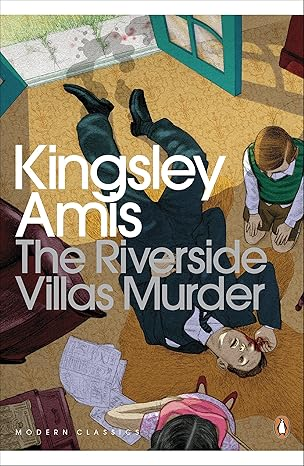
The Riverside Villas Murder by Kingsley Amis, 1973
The Riverside Villas Murder was written in the 1970’s, is set in the 1930’s, and is infused with the dominant social attitudes of the 1950s. Which all adds up to an uncomfortable mix. The story is told principally through the eyes of 14-year-old schoolboy Peter Furneaux. He is a typical 14 year-old, unable to go more than a few minutes at a time without thinking about sex. The mystery element of the story begins with a burglary at a local museum, where a mummified body and some Roman coins are stolen. Later, at a village dance, one of the Riverside Villas residents, a Mr Inman, provokes his neighbours by suggesting he has damaging information about them. During the dance, Mrs Trevelyan, a bored housewife, dances with Peter. Later she invites him to tea at her home, where she ‘seduces’ him. In the 1970’s this may have seemed comical, but fifty years on the scene is quite shocking in many ways. While it is Peter’s first sexual experience, Amis treats it as slapstick comedy: “What he had imagined so often and so long, and what actually happened on Mrs Trevelyan’s bed, resembled each other about as much as a fox-terrier and a rhinoceros.”
A few days later, Inman is murdered. He staggers into the Furneaux home, soaking wet from having fallen into a nearby river and bleeding from a head wound. Peter calls Mrs Trevelyan for help, but Inman dies shortly after. The rest of the novel comprises the police investigation, led by a cast of policemen who I think we are supposed to find comic but to me were one-dimensional and unconvincing and whose investigation is chaotic.
As a murder-mystery the novel is dull – the explanation as to whodunnit, when it is finally revealed, manages to be both predictable, because it follows the traditions of the genre, and at the same time impossible to deduce, given that the murder weapon turns out to be an improbable Heath-Robinson contraption that no-one could possibly have foreseen. The murderer’s motives are also transparently thin.
But there is a much more serious problem with the novel. Amis clearly set out to write a traditional detective novel, with the central character being a young teenage boy. It follows all the tropes of the genre quite carefully, as if the novel were an exercise in nostalgia. The 1930’s setting – Amis was born in 1922, so would have been a teenager himself in the thirties and therefore very familiar with the popular culture reference which litter the novel – allows him to wallow in nostalgia for an England where murderers are executed, housewives are almost invisible unless they are sexual predators and gay men are the object of scorn and disgust. The novel also contains a scattering of casual uses of the n-word and gay slurs, which, when placed in the mouths of old-fashioned men such as Peter’s father or the police provide the excuse of authenticity but at the same time allow Amis to break social taboos. In other words the novel is pointedly offensive. This isn’t social observation, it is autobiography.
Which poses two questions: why read a book with such objectionable ideas, and why review it? I loved Lucky Jim, and while I have developed a much better understanding of some of its problematic aspects, I still have a fondness for it. Amis can craft a striking phrase – the fox-terrier/rhinoceros quote above for example – and he did go on to win the Booker Prize. So it is hard to dismiss him as an author, and I still read him occasionally to see if he could ever recapture the brightness and humour of Lucky Jim. So far there have only been glimpses. As to the question of why one would review a book that deserves to go out of print and remain so, that’s more straightforward. These are not recommendations but posts noting what books I have read. No more no less. I don’t post about every single book I read (although I should according to my self-imposed rules) but I try to miss as few as possible. And if I have saved anyone the experience of reading the Riverside Villas Murder then it will have been worth it.
I’ve always felt very slightly guilty at never having read anything by Agatha Christie. TheTuesday Murder Club stories assuaged this a little, although I would never had read them were it not for the association with Richard Osman. The 4.50 from Paddington was a very late attempt to address this shortcoming. It features one of the author’s recurring detective characters, Miss Marple. Overall I think it is quite seriously flawed. The murder mystery element of the story depends on some utterly bizarre behaviour by the protagonist. There are a series of other serious structural flaws, but these could be forgiven if the murderer had not seemed desperately to do everything he possibly could to be caught. Obviously there is no way I can make this point without extensively spoiling the book for you, so if you ever intend to read this please turn away now.
The novel opens as a traditional ‘murder on a train’ puzzle. Mrs McGillicuddy, a friend of Miss Marple, is travelling by train when her carriage passes another train going in the same direction. When the trains are stopped next to each other she sees a woman being strangled. This was obviously a very strange time to choose to strangle someone. She is convinced this is a case of murder. She reports the attack, but the police are unable to find a body or any other evidence.
Miss Marple decides to investigate, of course. By some analysis of train timetables that was quite dull she works out that the body was probably thrown from the train into the grounds of Rutherford Hall, a stately home just outside Brackhampton. She asks her friend Lucy Eyelesbarrow, to help her investigate by taking a job at the hall as a housekeeper. Lucy is a promising character, but I could not move past the fact that Christie asks us to accept that despite her having a First in Mathematics from Oxford she decides to become a housekeeper. A well paid housekeeper, but a domestic servant nonetheless. I can see Lucy serves a useful role in the novel – she is bright and observant, and acts as Miss Marple’s eyes and ears on the ground within the Hall (a more conventional approach would have been for Miss Marple to have somehow get herself invited to stay with the family) but this is still a deeply implausible career choice for a first class mathematician, and is profoundly old-fashioned. Is this really the optimum career choice for a bright young woman in the 1950s? One character observes of Lucy “She scares the life out of me, she’s so devastatingly efficient. No man would ever dare marry that girl”. Sadly, Christie abandoned the character after this novel, and she never reappears.
We are then introduced to the inhabitants of Rutherford Hall: the cranky patriarch Luther Crackenthorpe, his unmarried daughter, Emma. and his sons Cedric, a painter; Harold, a businessman, and Alfred, occupation undetermined. His older daughter Edith died four years before the novel begins, and her husband Bryan and son Alex are part of the extended family. Another son died in the second world war. Local doctor, Dr Quimper frequently comes to the hall to see to Luther and is ‘close friends’ with Emma. These characters are paraded before the reader several times, and it is quite obvious that this is a list of suspects from whom we are being invited to select the killer.
Lucy uses her free time to search the hall’s grounds, and quickly finds the body hidden in a stone sarcophagus in a barn. Having a stone Greco-Roman sarcophagus lying around in one’s barn is typical eccentric aristocratic behaviour, nor worthy of further comment. The police are of course contacted, and resume their investigation into the original murder, led by Inspector Craddock of the Yard (When did local police forces start investigating murders in their area instead of calling in Scotland Yard?) The police conclude that the body is either that of a dancer, Anna Stravinska, who had gone missing from a ballet troupe, or a French woman called Martine. Martine may have married the eldest brother who died in the war – Emma reveals that she received a letter a few weeks before the woman’s body was found, claiming that she had married Edmund just before he died. The police speculate that Martine may have been murdered by one of the Crackenthorpe family to prevent her making a claim on Luther’s estate. However the ‘Martine’ theory doesn’t last long – a neighbour, Lady Stoddart-West reveals that she is Martine, Edmund’s former fiancee. She explains that Edmund died before they could be married, and since she married another man soon after the war, she had resolved not to bring up the painful past by telling the Crackenthorpes about their connection. Even the author has to accept that this is profoundly improbable – a woman forms a relationship with a British soldier who is killed in action, only to subsequently years later marry another soldier who just happens to be a near neighbour of the first. But this revelation leaves the identity of the body in the sarcophagus/the woman on the train a mystery.
Things then take a turn for the worse when the entire household is poisoned and Alfred dies. Dr Quimper diagnoses arsenic poisoning. Harold then receives a delivery of poisoned tablets from Dr Quimper and he dies. One would have thought that the focus of suspicion would fall on the doctor at this point – not only has he provided Harold with poisoned tablets, but in his role as a GP he would have ready access to arsenic and other poisons. But no, the focus is mysteriously elsewhere. In the novel’s denouement Miss Marple arranges for Mrs McGillicuddy to see Dr Quimper in a pose similar to that she saw the murder, by pretending to choke. Dr Quimper helps here, and as he does so Mrs McGillicuddy enters the room, sees the doctor against the window with his hands at Miss Marple’s throat, and cries out, “But that’s him – that’s the man on the train!” Miss Marple then wraps the case up in a few paragraphs. Her explanation is that the dead woman was Quimper’s wife, who would not divorce him due to being Catholic. He killed her to be free to marry Emma, and then murdered Harold and Alfred to increase Emma’s share of any inheritance.
I don’t know if many readers would finish this novel and conclude that the explanation given makes sense. Certainly we are asked to accept many leaps of faith: that the Doctor would murder his wife on a moving train while visible from a passing train just five minutes out from the destination; that he would (somehow) throw her body out of the train onto an embankment, arrive later that day to collect it from where it landed, carry it (again, somehow) through the estate to the barn, and leave it there, all the time unseen and uninterrupted; that while a police investigation is underway, he decides to murder some of the other family members in order to increase the proportion of the family inheritance he will receive, when Luther dies, and if he can successfully woo Emma. And so on. The absurdities pile up. The doctor takes fantastical risks for little reward, when far more straightforward options are before him.
The whole novel had an anachronistic feel – although written in the 50’s and seemingly set then, it really is an old-fashioned Edwardian country house murder story, uncomfortably superimposed onto a murder on a train story. That explains why the Doctor kills Harold and Alfred when he does, despite the heavy police presence in the immediate vicinity – the tradition of the country house murder story demands more murders. Miss Marple is here a peripheral character, wheeled out to resolve the mystery in the final pages simply by deciding what has happened rather than by any process of deduction or the use of evidence. Without Mrs McGillicuddy’s identification of the Doctor on the basis of what he looks like from behind – a defence barrister would have fun with that – there is no other evidence of him having committed any crime. Miss Marple makes a strange comment right at the end of the novel, having delivered her speech to the assembled family on how she ‘solved’ the murder:
“I am really very, very sorry that they have abolished capital punishment, because I do feel that if there is anyone who ought to hang it is Dr Quimper”.
Capital punishment in the UK had not been abolished in 1957 and people were still being killed by the state well into the 1960’s. Perhaps this was just Christie’s comment on the campaign for the abolition of capital punishment which was obviously gaining momentum at this point. But I think she was getting ahead of herself – she would have to get a conviction first.
On a more positive note, one has to give the Doctor credit for his cunning plan to misdirect the investigation by suggesting that the victim was Martine, laying a paper trail away from his ex-wife, only for that plan to be foiled by the stunning coincidence of the real Martine being alive and well and living in the neighbourhood. Also, Lucy is a promising character who ably fills the absence of Miss Marple, even if she is the world’s most unlikely housekeeper. But overall this felt like an author well past her prime using some of her ‘greatest hits’ material to keep her publishers happy. Which means I have missed the mark in looking for Christie at her best, and need to keep looking.
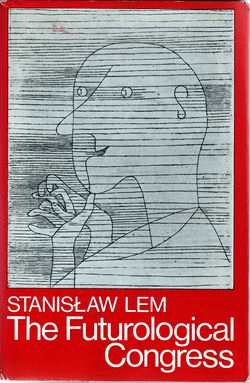
It has been a long time since I have read any science fiction, but while browsing in my local library, The Futurological Congress, a black humour science fiction novel by Polish author Stanisław Lem, caught my eye. I’ve long been interested in dystopian novels – 1984, Brave New World, etc – and I wondered what the future looked like in the early 1970’s, when 2026 seemed an impossibly long way away. It wasn’t a surprise that like most novels of its kind, some aspects of the future are captured with eerie precision and others are wildly wrong. Which always makes me wonder which of the technological innovations we think are inevitable – the rise of AI, self-driving cars, etc – will actually happen, and instead what undreamt of changes will occur in our future?
In The Futurological Congress, Lem’s protagonist, Ijon Tichy, attends the Eighth World Futurological Congress in Costa Rica. The novel is set in an indeterminate future (but not too far ahead, because a later time jump takes Tichy to 2039). The conference is being held to consider the world’s population crisis. Futurologists predict the future from existing trends – and at this point in humanity’s story all predictions for the future of the world are bleak.
Lem’s description of this future is at first dominated by absurdity. Tichy’s hotel room is ‘guaranteed bomb-free’ and includes a palm grove and an orchestra. Conference papers are distributed in hard copy (paper always seems very resilient when people thought about the future of business or education) but speakers call out paragraph numbers to save time. The hotel’s water supply is drugged with a chemical that makes the user profoundly good-natured.
Shortly after the start of the congress, the hotel it is being held at comes under attack by protestors. After an attempt to ignore the bombs Tichy and some other attendees and hotel staff take cover in a sewer beneath the hotel. From here he is evacuated only to realise he is still hallucinating. The next rescue attempt ends with the helicopter taking him away crashing. He wakes up in a hospital to find his brain has been transplanted into the body of a young black woman. This then happens all over again – waking up from a hallucination, attack by mysterious forces, rescue and body transplant – which would I suspect make most people wonder about the nature of reality they are experiencing, but Tichy seems accustomed to a world in which bizarre things happen as a matter of course. Finally, in yet another hospital, he is cryogenically frozen (cryonics was just becoming a ‘thing’ in the US in the late 60’s) and wakes up (in scenes familiar from Austin Powers, Futurama and Sleeper – take your pick) in the year 2039.
When the novel jumps forward to 2039, the tone switches dramatically from being a freewheeling comedy to a rather bleak dystopia. From this point the novel is written in the format of a journal. Initially, 2039 (presumably 2039 Costa Rica?) seems utopian. Everyone is happy, all society’s ills have been cured, war is no more, and everything is abundant. Drugs are used to control everyone’s perception of reality and can do just about anything:
“The most recent of the iamides, heavily advertised – authentium. Creates synthetic recollections of things that never happened. A few grams of dantine, for instance, and a man goes around with a deep conviction that he has written The Divine Comedy. Why anyone would want that is another matter and quite beyond me.”
But slowly Tichy becomes disillusioned with this chemically enhanced ‘paradise’. He stops taking any drugs but doesn’t realise that the air itself is suffused with perception-altering chemicals. Finally his friend, Professor Trottelreiner, tells him a terrible secret:
“By introducing properly prepared mascons (reality-masking chemicals) to the brain, one can mask any object in the outside world behind a fictitious image—superimposed—and with such dexterity, that the psychemasconated subject cannot tell which of his perceptions have been altered, and which have not. If but for a single instant you could see this world of ours the way it really is — undoctored, unadulterated, uncensored — you would drop in your tracks!”
A small dose of an unmasking drug allows Tichy to see the world as it really is: instead of being in a five-star restaurant he is in a dank concrete bunker eating “the most unappetizing gray-brown gruel, which stuck in globs to my tin“. No-one drives a car – they run in the road believing they are doing so, and instead of travelling up and down in lifts they climb the empty elevator shafts. Everyone lives in abject squalor eating horrible muck, all the time believing they are living in luxury. The world is being destroyed by over-population – the very problem that the original Futurological Congress was intending to address. Only a small number of soothseers know the real state of the world. This is Tichy’s red pill moment – the terrifying realisation that the world is actually squalid and disgusting. When finally he is returned to his original time, hiding in the sewers from the bombers attacking the conference, we are left in doubt as to whether this is a return to reality or yet another chemically induced nightmare.
As well as its bleak portrait of the future, the other predominant feature of The Futurological Congress is its experimental use of language. I can imagine that translating the text from Polish to English must have been challenging to say the least, and many of the words must surely be approximations, given that Lem made many of them up in the first place. Take a paragraph like this for example:
In just the last issue of Science Today there had been an article on some new psychotropic agents of the group of so-called benignimizers (the N,N-dimethylpeptocryptomides), which induced states of undirected joy and beatitude. Yes, yes! I could practically see that article now. Hedonidil, Euphoril, Inebrium, Felicitine, Empathan, Ecstasine, Halcyonal and a whole spate of derivatives. Though by replacing an amino group with a hydroxyl, you obtained instead Furiol, Antagonil, Rabiditine, Sadistizine, Dementium, Flagellan, Juggernol and many other polyparanoidal stimulants of the group of so-called phrensobarbs (for these prompted the most vicious behavior, the lashing out at objects animate as well as inanimate—and especially powerful here were the cannibal-cannabinols and manicomimetics).
In the 1970s Poland was still part of the Soviet bloc. The Futurological Congress is (at least in part) a commentary on the communist state that told its citizens they were living in a socialist utopia, but where their actual experience of life was of hardship and want. In 1984 George Orwell makes a similar point – in that novel, instead of chemicals, the state uses terror to force its citizens to believed that rations are being increased even as they are cut. Perhaps Lem was telling us to wake up and take over-population seriously, and not put our faith in political ideologies?
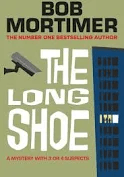
I have a theory: I suspect that early drafts of The Long Shoe were planned as a sequel to The Satsuma Complex (2022) and The Hotel Avocado (2024) – in all probability with a fruit-based title. But this plan had to be abandoned, because The Long Shoe‘s plot needed the central female character, Harriet (Emily in the first two novels) to have a job that runs the risk of her being kidnapped, and Mortimer just couldn’t make the plot work within the constraints of her ‘legacy’ occupation.
So a new context and setting was required. Apart from the change of occupation the novels are strikingly similar, with the protagonist Matt (Gary) a rather feckless character drifting through life (he is a recently unemployed bathroom salesman) living in a London suburb, taking walks in the park, drinking coffee, talking to his pet cat/pigeon/quirky animal of choice, and enjoying a casual relationship with his girlfriend while taking her commitment for granted. The novels’ themes are also similar – mysteries involving organised crime, a violent villain who is physically menacing and a bit disturbed, and a climax in which Gary confronts the bad guys in a clumsy, endearing manner.
This theory would also explain the irrelevance of the novel’s title. The long shoe referred to here is a comically long wooden model of a shoe, purchased from a market stall specialising in quirky conversation pieces. It could have easily been swapped into the novel on a find and replace basis for a whimsical fruit-based object of a similar scale.
Having said all that, it really doesn’t matter if this theory is right or not. The Long Shoe works well enough as a standalone novel, just one that will feel very familiar if you have read the author’s previous two. The premise is simple, if familiar: Matt’s relationship with Harriet is in trouble, as she questions whether they have a long-term future together. She leaves him for a short break to consider her feelings. While she is away Matt is offered out of the blue a caretaking job. which comes with the benefit of a heavily discounted flat in Satsuma Heights, (a little nod to novel one, of course). The new job and flat are all the more welcome as they were having to leave their existing flat in a few weeks. Harriet’s farewell note is ambiguous and Matt is not sure if she has left him for good, or is just taking some time out. Improbably she has also neglected to tell her employer, the Crown Prosecution Service, that she is taking leave, and she stops answering her phone. Instead of reporting her absence to the police, Matt tries to track her down.
The novel’s minor characters include Carol, a deeply unpleasant neighbour who has designs on Matt, Hot Dog, one of Matt’s new neighbours in Satsuma Heights, and a very underwritten waitress who never really emerges as a distinctive character at all (in my alternative version of this novel this character has a more fleshed out role but with all the old plot elements stripped from her she is left hollowed out(.
Around halfway through the novel we discover that Harriet has been kidnapped and over the course of the rest of the novel her predicament is revealed and her rescue effected. The mystery – who has kidnapped her, and why – is well-managed, and the novel’s rather violent climax is genuinely exciting. The novel’s humour is more whimsical than laugh out loud – with Bob I think much of the charm of his humour is in the performance, so on the page the jokes are wryly amusing rather than belly laughs. So overall this novel is amusing and a pleasant enough read, but will not linger long in the mind.
Love in the Time of Cholera by Gabriel Garcia Marquez, 1985
Love in the Time of Cholera is a dense and complex meditation on love and the process of aging. It also contains some very troubling content, of which more later. It is not an easy read and I am still unsure whether it merits the adulation it receives in many quarters.
Set at the end of the nineteenth century in an unnamed but volatile country in the Caribbean, the novel tells the decades long love story of Fermina Daza and Florentino Ariza. As a young man Florentino falls in love with a young woman who lives with her possessive and suspicious father. So far so Romeo and Juliet. After secretly wooing Fermina for months Florentino finally secures her promise to marry him.
But the ‘affair’ is discovered. Fermina’s father refuses to consider the marriage, considering Florentino unsuitable for his daughter and takes her on a years’ long trip through the country’s interior, hoping that this will make her forget him. During the journey scenes of the long-running civil war and the ravages of cholera simply form a background to everyday life and are considered normal. When they finally returns to the city, Florentino attempts to resume the relationship, having continued to write to her using his contacts in the telegraph service. But Fermina suddenly realises that their relationship was just a childish infatuation. Shortly afterwards she marries a local doctor, Juvenal Urbino, and lives a long and moderately happy life with him, raising a family and surviving the normal traumas of married life, until his tragically comic death in old age, a death with which the novel opens.
At the funeral, Florentino, now in his seventies, renews his affection claiming he has never stopped loving her. At first she is not interested – more than fifty years has passed – but gradually he wears her down. Much of the body of the novel consists of the story of how Florentino has spent his time while waiting for Fermina to be free. His career with a riverboat company is the background to his all-consuming passion, seduction. Florentino is a prodigious and undiscriminating lover of women of all backgrounds, ages and class. He has no problem in squaring this lifestyle with waiting for his true love.
Although Florentino is the novel’s central character and sees himself as man of principles, a tragic lover waiting all his life for his one true love, in reality he is simply depraved. He sleeps with over 600 women, many of them vulnerable. One is killed by her husband after he discovers her affair. Later, he conducts an abusive relationship with a 14-year-old girl who is his ward. The author’s portrait of this abuse is as disturbing as anything written by Nabokov:
“She was still a child in every sense of the word, with braces on her teeth and the scrapes of elementary school on her knees, but he saw right away the kind of woman she was soon going to be, and he cultivated her during a slow year of Saturdays at the circus, Sundays in the park with ice cream, childish late afternoons, and he won her confidence, he won her affection, he led her by the hand, with the gentle astuteness of a kind grandfather, toward his secret slaughterhouse.”
He has no insight into how wrong this relationship is – she is a child, he is more than fifty years older than her and in a position of parental responsibility – and when he ends the abusive relationship she commits suicide. In short, he is a scumbag. The novel ends with a reconciliation between the two ‘lovers’. A boat trip into the interior of the country, ravaged by industrialisation, war and disease, provides the novel’s ending and a metaphor for aging and loss.
The novel’s title suggests this is a book about love, but it is not (any more than Lolitais a love story). Two people spend their lives apart and eventually come together in a facsimile of elderly, incontinent married love. Florentino thinks of himself as one of the courtly knights of old who would love his lady from afar, sacrificing all for just one smile. In reality he is a disturbingly lascivious paedophile, a dirty old man whose idea of love is distorted in the extreme. I finished Love in the Time of Cholera with a sense of disquiet that has only worsened the more I think about what actually happens in the book. I accept I am probably missing something, but I am keen to move on as quickly as possible to something that isn’t full of bodily functions slowly breaking down, of sexual abuse, and death.


 The Reading Bug