
A Far Cry from Kensington by Muriel Spark, 1988
Muriel Spark is on my auto-buy list. When browsing in second hand bookshops I have a few authors I always buy if I can find them. As long as the book is reasonably priced, in decent condition, and I don’t already have it, I will always buy novels by, among a small number of other authors, Muriel Spark. Her novels are always interesting and worth reading, and A Far Cry from Kensington was no exception.
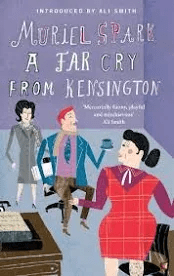
Set in 1955, A Far Cry is narrated by the no-nonsense Mrs Hawkins, a thinly disguised semi-autobiographical portrait of the author. It centres on a “rooming house” in (you guessed it) Kensington – a large house divided into separate one room apartments – where a diverse set residents live under the care and supervision of the landlady, Milly. It is a comfortable community of people in transit, typical of post-war London, settled by individuals and couples looking to establish themselves in London and in life.
Mrs Hawkins works in publishing. Some of her reminiscences (the narrative is told in flashback, some thirty years later) are based on Spark’s own time working in this field. Initially she works for the Ullswater and York Press, a chaotic publishing house that is heading for bankruptcy. I haven’t researched the novel sufficiently to say this for certain but I would put good money on the fact that Ullswater Press has a real-life equivalent that went bust in the mid-1950s, causing something of a scandal at the time as the proprietor was subsequently jailed for fraud.
The novel’s villain is Hector Bartlett, a bad writer who has influential friends who try to secure publication of his writing. Hector takes to accidentally-on-purpose bumping into Mrs Hawkins on her daily walks in the park near her office, attempting to leverage this casual relationship into an introduction to her boss. Hector the writer is described thus
“Hector Bartlett, it seemed to me, vomited literary matter, he vomited and sweated, he excreted it…His writings writhed and ached with twists and turns and tergiversations, inept words, fanciful repetitions, far-fetched verbosity and long, Latin-based words.”
Hector the man is if anything even more harshly described:
“Red hair en brosse, brown corduroy trousers, tweed coat with leather patches on the sleeves, a yellow tie, and a green check shirt….with a pronounced stoop of the shoulders which made him seem older than he was… His face was round with a second fat chin”.
Mrs Hawkins describes him to his face as a ‘pisseur de copie” a urinator of journalistic prose, and never backs down from this undeniably confrontational phrase. Spark denied that Bartlett was a portrait of anyone specific in post-war literary London, which I suppose must be right given how libellous it would otherwise have been!
Bartlett uses his influence with Emma Loy, a successful novelist, to have Mrs Hawkins sacked from Ullswater Press and subsequently from another job in publishing when she continues to use this description of him and also refuses to rewrite his copy to make it acceptable for publication. This doesn’t have a significant impact on her career and even if it would have done she is not the kind of character to back down, even in the face of a direct plea from Ms Loy. She can’t stand him, and her instincts prove spot on when there are further revelations about his damaging behaviour towards other women in the novel.
A Far Cry isn’t just a series of anecdotes about the publishing world. While the residents of the boarding house all have their brief moments centre stage, Wanda, the Polish emigre seamstress, has a defining role when she receives a threatening letter, which leads to a downward spiral that, we eventually find out, was caused by the vengeful pisseur de copie.
Central to the novel is the bizarre practice of ‘radionics’. Radionics is a form of quack therapy that survives to this day (There is a Radionics Association that awards three-year diplomas and sells crystal pendulums). It claims that diseases and other medical conditions can be diagnosed and treated by applying electromagnetic radiation such as radio waves to the body from an electrically powered device. It ‘works’ only through the placebo effect. Mrs Hawkins has no time for it and it is no surprise that Hector Bartlett is an enthusiast proponent of the concept, using it to manipulate other characters in the novel. People undoubtedly do fall prey to this sort of scam, and while radionics may have faded out somewhat, certainly in the UK, other forms of manipulation have of course taken its place. Initially I found this all a bit clumsy, but on reflection the fact that there are many modern forms of the same pseudo-science that people fall prey to every day made me reconsider and feel more charitable towards the idea as a plot device.
This is a complex and rewarding novel in which Mrs Hawkins’ narration, even with the benefit of thirty years of hindsight, reveals only glimpses of what is ‘really’ going on – for example the identity of the anonymous threatening letters to Wanda is only revealed in passing at the end of the novel, the revelation pivoting on the spelling of the word “organisers”. The reader sees the events of the novel through the eyes of 1955 Mrs Hawkins as she experiences them in real time, with only occasional reassuring interjections by the 1980’s narrator. I have enjoyed other Spark novels more, but I could admire the artistry of A Far Cry without being blown away by its sophistication.

 The Reading Bug