Book review

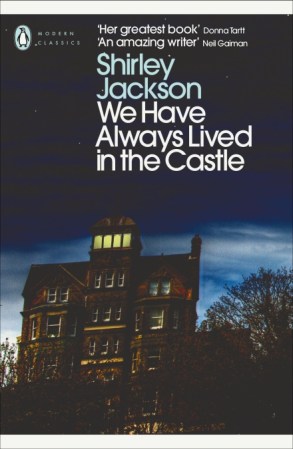
We Have Always lived in the Castle by Shirley Jackson, 1962

I’m trying to read more authors I haven’t read before. Shirley Jackson is a writer I have heard about mainly through references to her chilling short story, The Lottery. As I understand it, The Lottery is widely read in American schools, although it is much less well known in the UK. We Have Always Lived in the Castle was Jackson’s final novel, published three
we have always

years before her death, and tells the story of two sisters, Mary Katherine (Merricat) and Constance Blackwood, who live with their aging and infirm uncle Julian in their isolated home in New England. The Blackwoods were and are a prosperous family. They remain aloof from the common people of the village and make them walk around their property to reach the main road rather than allowing them a short cut across their estate. This creates tension between the villagers and the Blackwoods, tension which turns ugly later in the novel.

Merricat narrates the tale, and it is clear from the opening that this is not a normal family:

“My name is Mary Katherine Blackwood. I am eighteen years old, and I live with my sister Constance. I have often thought that with any luck at all, I could have been born a werewolf, because the two middle fingers on both my hands are the same length, but I have had to be content with what I had. I dislike washing myself, and dogs, and noise. I like my sister Constance, and Richard Plantagenet, and Amanita phalloides, the death-cup mushroom. Everyone else in our family is dead.”

Older sister Constance never ventures further than the garden in the grounds of the family home. We soon learn why – she was tried and acquitted of murdering her family by poisoning their sugar bowl. Although sometimes described as a mystery, it doesn’t take Holmesian powers of deduction to work out who the real poisoner is – the character with the morbid obsession with death, who has sadistic fantasies about the people of the village who taunt her on her twice weekly shopping trips:

“I am walking on their bodies”

“I am going to put death in all their food and watch them die”

“I would have liked to come into the grocery some morning and see them all… lying there crying with the pain and dying”.

Merricat is a troubled young woman. She uses a primitive, childish form of witchcraft to protect her family, marking the boundary of their property with fetishes and totems. She is consumed with harmful thoughts and haunted by OCD rituals. At this point in the story Constance’s mental health, in particular her agoraphobia, appears to be recovering. She welcomes visitors and talks of going down to the village. Merricat feels threatened by this change, but this is nothing compared to her reaction when Cousin Charles, clearly more interested in the contents of the Blackwood family safe than the sisters themselves, comes to visit. Merricat’s murderous fantasies become even more vivid :

I wanted to stamp on him after he was dead, and see him lying dead on the grass.”

“I could wish him dead until he died. I could fasten him to a tree and keep him there until he grew into the trunk and bark grew over his mouth. I could bury him in the hole where my box of silver dollars had been so safe until he came; if he was under the ground I could walk over him stamping my feet.”

Charles’s arrival disturbs the delicate equilibrium of the house and Merricat’s mental health, and things quickly deteriorate. As Merricat desperately tries to drive him away she starts a fire which goes on to destroy much of the house, transforming it into the castle of the novel’s title, with an upper floor open to the elements like battlements. Uncle Julian dies in the fire and Charles flees. Merricat and Constance make a home in the ruins of their house, and this is where the story eventually leaves them, hidden from the rest of the world but finally accepted by the villagers.

We Have Always Lived in the Castle is a troubling tale which leaves the reader with many questions. Why did Constance not find her psychopathic sister the help that she so obviously needs? Why did no-one in the village work out the fairly simple puzzle about the identity of the family’s killer? How are the sisters going to survive in their ruins?

Merricat is an absorbing portrait of mental illness – but is We Have Always more than that? Does it have anything to say about American society, and about the way it treats outsiders? Merricat’s narrative voice is powerful, and can easily distract the reader into thinking that her account of the novel’s events, flawed though it is, is authentic, rather than seen through the distorting lens of her mental illness. We never get to know what precipitated her murderous attack on her family, but it is safe to say it was probably something trivial that lead to her being sent to her room that day. She certainly doesn’t see herself as a mass murderer; in many ways she is still a child, without any understanding of the consequences of her actions. She starts the fire that destroys their home, and although the volunteer firemen of the village put it out, saving the ground floor, they then go on to trash the house.

While the novel ends on a happy-ever-after note for Merricat and Constance, we can tell that their isolated way of life will not last long. Is this a parable for American society, that has survived the chaos and destruction of the second world war, but is living on borrowed time?
Standard
Book review

Patronising Bastards, by Quentin Letts, 2017

Quentin Letts is a sketchwriter for the Daily Mail, a UK newspaper characterised by two predominant emotions- fear and hatred.  (The Mail is frightened of, and therefore hates, difference and change. It hates foreigners, the EU, the BBC, socialists, liberals, remainers, health and safety, and political correctness. It loathes Jeremy Corbyn. So it is hardly surprising that this rambling collection of short essays is dominated by hatred of the above.

Letts had a modest amount of success with an earlier book, 50 People Who Buggered Up Britain, and this is just more of the same – a series of sketches loosely connected by the theme of people whom Letts finds patronising, although ‘people I disagree with” would be a more accurate summary. His targets range far and wide, and there is a random feel to attacks that span Nicholas Serota, Bob Shennan, an obscure radio programmer who had the temerity to move one of Letts’ favourite programmes, Richard Branson, Ian McEwan, Sandi Toksvig and Sir Ivan Rogers. No, I hadn’t hear of him either.

It is entirely understandable that Letts would use hyperbole as his go-to technique. Part of the problem with this book as he really doesn’t have any other way of approaching his subjects – the people he writes about are all mean patronising bastards, and there’s little if any light and shade in his portraits.

Personal insults abound. Obama is described as “feted mainly for being black” which is openly racist as far as I am concerned, Camila Batmanghelidjh is described as “that” (ditto, and sexist for good measure), Dame Judi Murray is a “great cow walrus“, and so on. Dame Vivienne Westwood must really have upset Letts at some point, because he is appalled when she revealed that she went commando to Buckingham Palace one time, saying “Sorry about the swarm of bluebottles, your Maj“. Yes, that’s right isn’t it Quentin, women’s genitals attract flies don’t they? Elsewhere she is “gurning termagant“. He describes Sandi Toksvig and “Sir Sandi” and Gary Lineker as “Dame Gary”. See what he did there – deliberately confused their gender to make fun of them. Hold my sides.

One of the persistent characteristics of Brexiteers is their tendency to portray themselves as outsiders, anti-establishment figures campaigning for the little man. Letts doesn’t really fit that bill (neither does Nigel Farage of course). He has written for The Daily Telegraph, Daily Mail, Mail on Sunday, and The Times, amongst others. He was educated at Haileybury and Imperial Service College, Bellarmine College, Kentucky (now Bellarmine University), Trinity College, Dublin, and then studied Medieval and Renaissance Literature (1982–86) at Jesus College, Cambridge, taking a Diploma in Classical Archaeology. Quite the outsider!

Given all this it was a bit disturbing when I found myself agreeing with one of Letts’ observations on the cultural significance of Church of England hymns. It wasn’t a particularly political point, but he writes well on the importance of hymns in our cultural history and collective experience. The essay itself is spoiled by the tantrum that someone had the temerity to move his favourite programme – an arguable decision perhaps, but a long leap from patronising bastardy.

It’s always good to read books and writers you disagree with, I would be the first to accept that. As a left-leaning, remain-voting, blog-writing southerner I need to better understand why people voted remain, (although I still struggle to improve on Stewart Lee’s take on the situation. I can’t link it here because it is nsfw but google it). Did I come through the ordeal of reading Patronising Bastards with a better understanding of that perspective? Sadly no, because the level of personal abuse clouded almost any effort at constructing a coherent argument. Which was a pity, because 17.2m people can’t all be racists?

Standard
Book review

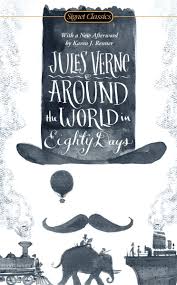
Around the World in Eighty Days, by Jules Verne, 1873

Around the World in Eighty Days charts the adventures of Phileas Fogg and his valet Passepartout as they travel, well, you know what they get up to, and even if you didn’t the novel’s title would probably help you out! Set in the 1870’s, the time of its serial publication, the story takes its inspiration from the recent verneopening of the American transcontinental rail route, which theoretically allowed a journey around the world by land and sea in a time span that in earlier years would have been thought impossible. This is the central concept of the novel, which was obviously original and engaging in its day, although it hasn’t aged well.
Fogg is a caricature of the typically bloodless Englishman (there is a debate about the extent to which Verne established the various features of the Englishman abroad caricature, but that feels like a more academic exercise than I have the appetite for), only interested in his wager and his whist. He largely ignores all the countries he passes through. Passepartout on the other hand is fascinated by all he sees, and gives the reader some interesting insights into the countries they fleetingly visit. The pressures of keeping up to Fogg’s strict timetable give the novel a great pace, but means the countries fly by relentlessly.

I found Fogg’s lack of interest in his journey strangely off-putting – even when he meets an exotic Indian princess and rescues her from a grisly fate he treats her like someone he shares a commute with. Verne defines him largely by negatives:

Certainly an Englishman, it was more doubtful whether Phileas Fogg was a Londoner. He was never seen on ‘Change, nor at the Bank, nor in the counting-rooms of the “City”; no ships ever came into London docks of which he was the owner; he had no public employment; he had never been entered at any of the Inns of Court, either at the Temple, or Lincoln’s Inn, or Gray’s Inn; nor had his voice ever resounded in the Court of Chancery, or in the Exchequer, or the Queen’s Bench, or the Ecclesiastical Courts. He certainly was not a manufacturer; nor was he a merchant or a gentleman farmer. His name was strange to the scientific and learned societies, and he never was known to take part in the sage deliberations of the Royal Institution or the London Institution, the Artisan’s Association, or the Institution of Arts and Sciences.

Fogg is well-named, unremarkable in his appearance and his character. He possesses a self control that is alien to his European assistant and most of the people he meets on his journey. He is described as being:

“about forty years of age, with fine, handsome features, and a tall, well-shaped figure; his hair and whiskers were light, his forehead compact and unwrinkled, his face rather pale, his teeth magnificent. His countenance possessed in the highest degree what physiognomists call “repose in action,” a quality of those who act rather than talk. Calm and phlegmatic, with a clear eye … exactitude personified. … He was so exact that he was never in a hurry, was always ready, and was economical alike of his steps and his motions. He never took one step too many, and always went to his destination by the shortest cut; he made no superfluous gestures, and was never seen to be moved or agitated. He was the most deliberate person in the world, yet always reached his destination at the exact moment.

I am not sure if the reader is supposed to admire or warm to Fogg – we hope he wins his bet, although that’s never in much doubt, even at the close, but his romance with the Indian princess is a matter of supreme indifference.

Passepartout on the other hand is a larger-than-life comic character, constantly getting into schoolboyish ‘scrapes’, although the ease and regularity with which he is extricated from these situations gives the story a lack of authenticity. He introduces himself thus:

“Jean Passepartout, a surname which has clung to me because I have a natural aptness for going out of one business into another. I believe I’m honest, monsieur, but, to be outspoken, I’ve had several trades. I’ve been an itinerant singer, a circus-rider, when I used to vault like Leotard, and dance on a rope like Blondin. Then I got to be a professor of gymnastics, so as to make better use of my talents; and then I was a sergeant fireman at Paris, and assisted at many a big fire. But I quitted France five years ago, and, wishing to taste the sweets of domestic life, took service as a valet here in England.”

Fix, the bumbling policeman pursuing Fogg in the mistaken belief that he is a bank robber, is intended to provide further comedy as well as undermining Fogg’s attempts to keep to time, but we are never under any illusion that the outcome of the wager has been decided long ago. No matter what obstacles Verne throws in the way of the travellers, we always know they are going to waltz right round them and make it to the doorstep of the Reform Club with a minute to spare.

Around the World in Eighty Days is a confident expression of the wonders of the technological innovations of the 19th century and the way they were opening up the world to travellers. Instead of being scared by the inventions and machines (pace Wells) Verne revels in their powers. The novel is a celebration of the European spirit of conquest, exploration and innovation. Obviously we can now see the darker side to that spirit, but Verne sees things only from the perspective of his European characters and is blithely unaware that they are exploiting the people and places they visit. The novel also marks the beginning of long distance travel as something accessible to people other than explorers.  

Although Verne is usually seen as a science-fiction writer, this is a good example of an author writing outside his usual genre. There is a strong emphasis on the events and places in the novel being rooted in the actual, an attempt to make everything feel real and believable – hence for example the obsession with train timetables throughout the book. Now we can circle the globe in hours it all feels a bit quaint and ridiculous, and a wasted opportunity to see the world rather than just rush around it.

Standard
Book review

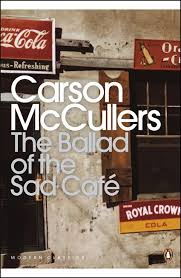
The Ballad of the Sad Cafe, by Carson McCullers,1951

The Ballad of the Sad Cafe is a quirky, unusual novella set in the Southern USA in the (I am guessing here) 1930’s. Miss Amelia Evans runs a small store in a town in the middle of nowhere, topping up her income with sales from her whisky still. One day a stranger arrives in town, the catalyst for many a story. The visitor is a hunchback who claims to be Amelia’s distant Cousin Lymon. Acting out of character Amelia takes him into her home, and they form an unlikely friendship and partnership. Under Cousin Lymon’s influence, the shop transforms into the café of the story’s title.Sad cafe.jpg

Miss Amelia was once briefly married to Marvin Macy, a local troublemaker. The fact that the marriage never worked and was over in ten days was probably due to the fact that Amelia clearly never intended it to be consummated. Rejected, Macy reverted to type and was eventually locked away in the state penitentiary. All this happened long before Cousin Lymon arrived but inevitably Macy is eventually released, and returns to shatter the peaceful relationship between Amelia and Cousin Lymon. What makes matters worse is that Cousin Lymon transfers his affections to Macy, hero-worshipping him. Macy is everything he is not, both physically and mentally. Together they beat Amelia and trash her house and business. She is a fighter but is defeated by this betrayal and closes the cafe for good.

This is a tragic tale of unhappy love and rejection. In many ways it is a classic representation of the Southern Gothic style of writing, using macabre events and characters to comment on the history and experience of the American South.  Southern Gothic builds on the original European traditions of gothic writing, but moulds it to a specifically American purpose. The novel builds suspense slowly – much of the time Amelia and Macy are planning to fight one another, but the fight itself is delayed until the climax of the novel. The characters are grotesque – Cousin Lymon is a hunchback dwarf, Amelia is very tall and stronger than most men, and Macy is abusive and evil.

Decaying rural communities are the typical setting for Southern Gothic stories, and The Ballad of the Sad Cafe certainly fulfils that criteria. Some of the more traditional features of Southern Gothic such as references to the South’s history of slavery and racism are only briefly referenced – Amelia cuts up Macy’s klan robes when he first leaves – but the motif of having a villain disguised as an innocent certainly features. Both Cousin Lymon and Macy try and reform and be kind to Amelia, but in the end both turn on her.

This was my first reading of a text by McCullers, even though I have been aware of her work for a long time. The Ballad of the Sad Cafe is if nothing else a wonderful, evocative title, as is The Heart is a Lonely Hunter, her other best known work. McCullers’s personal narrative is in many ways as tragic as her stories, and she is obviously an important figure in 20th century American literature. ‘Ballad’ is a relatively slight work; I am not sure it will linger long in the memory. The characters are distant and keep their thoughts and feelings closely locked away. At times they behave irrationally and while I can accept this reflects their troubled personalities it makes the narrative more a thing of curiosity than a story I could personally engage with. While her ability to evoke time and place is unquestionable, I am still unsure whether I will follow up this read with more McCullerfor now.

Standard
Book review

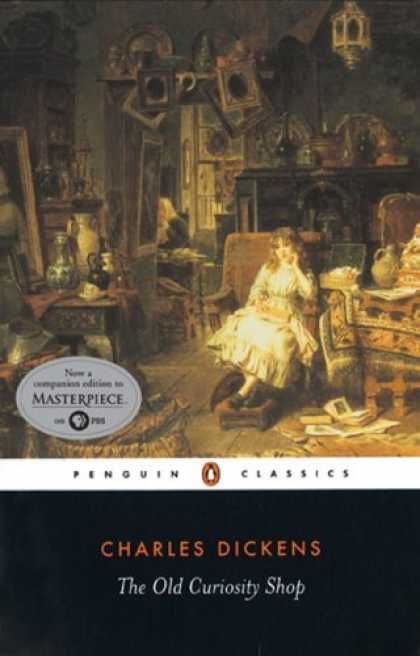
The Old Curiosity Shop, by Charles Dickens, 1841

bddc59cb6cfe0934384e2d9efd57b7ca

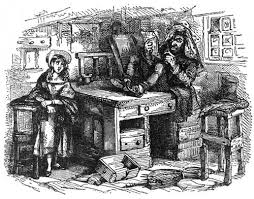
The Old Curiosity Shop tells the story of Nell Trent, an orphan, cared for by  her grandfather in his antique (old curiosity) shop. Unfortunately the old man has a gambling addiction, which quickly drives them into poverty. He borrows money to fund his habit from the deliciously evil Daniel Quilp, a hunchbacked dwarf who has to be one of Dickens’ finest, funniest, most grotesque villains. Quilp repossess the shop and contents, leaving Nell and her grandfather on the streets. They embrace this as a freedom from oppression, and go on a long aimless journey that essentially lasts the rest of the novel. The shop is quietly forgotten as a motif or location in the novel – this must be one of Dickens’ most inappropriately named works!

Written as most if not all of Dickens’s novels were, in serial form, the structure of the novel is of necessity rambling, and therefore well suited to both the ‘on the road’ format of Nell and her grandfather’s journey, and the many other threads of the story that Dickens weaves into the rest of the narrative.

Probably the best known feature of this novel, and therefore not constituting a spoiler, is Nell’s eventual tragic death, succumbing to the mysterious wasting illness that ends so many young lives in nineteenth century novels. The story of people waiting at the New York docks and calling out to ask the sailors whether Nell lives is probably apocryphal, but it is a great story nonetheless, and demonstrates Dickens’ superstar status at the time. In fact Dickens signposts Nell’s fate throughout the novel, so much so that when one knows the outcome it seems a little heavy handed – lots of meditations on death, a preoccupation with the graves of younger children, several other deaths of children featuring, and so on – but Dickens obviously had to soften the blow. It was still a bold choice – he could easily have saved Nell and was under pressure to do so – but held his nerve. So perhaps not all that sentimental after all?

The real star of the show however is the demonic Quilp

Slight and ridiculous as the incident was, it made him appear such a little fiend, and withal such a keen and knowing one, that the old woman felt too much afraid of him to utter a single word, and suffered herself to be led with extraordinary politeness to the breakfast-table. Here he by no means diminished the impression he had just produced, for he ate hard eggs, shell and all, devoured gigantic prawns with the heads and tails on, chewed tobacco and water-cresses at the same time and with extraordinary greediness, drank boiling tea without winking, bit his fork and spoon till they bent again, and in short performed so many horrifying and uncommon acts that the women were nearly frightened out of their wits, and began to doubt if he were really a human creature.” 

Quilp is hunting for the runaways and at the same time pursuing a vendetta against Kit, their former assistant, who is saved by the evidence of Dick Swiveller and ‘the Marchioness’ – their relationship forming some of the most touching scenes in the novel.

Just a few perhaps somewhat random thoughts about the novel. First,  I don’t think it can be a coincidence that Dickens tells us that Nell is “not quite fourteen”. Juliet is almost exactly the same age, just two weeks short of fourteen, and Dickens, whether subconsciously or not, is inviting the reader to compare and link the two characters – Juliet also suffers a tragically early tragic death of course, another hint that this is to be Nell’s fate as well. But it also reminds the reader that Nell, while invariably described as a girl, is also seen by several men in the novel as on the cusp of becoming a young woman. She is spoken of at several points in sexualised terms. Early on her brother looks to marry her off to Richard Swiveller:

“You saw my sister Nell?’

‘What about her?’ returned Dick.

‘She has a pretty face, has she not?’

‘Why, certainly,’ replied Dick. ‘I must say for her that there’s not any very strong family likeness between her and you.’

‘Has she a pretty face,’ repeated his friend impatiently.

‘Yes,’ said Dick, ‘she has a pretty face, a very pretty face. What of that?’

‘I’ll tell you,’ returned his friend. ‘It’s very plain that the old man and I will remain at daggers drawn to the end of our lives, and that I have nothing to expect from him. You see that, I suppose?’

‘A bat might see that, with the sun shining,’ said Dick.

‘It’s equally plain that the money which the old flint—rot him—first taught me to expect that I should share with her at his death, will all be hers, is it not?’

‘I should said it was,’ replied Dick; ‘unless the way in which I put the case to him, made an impression. It may have done so. It was powerful, Fred. ‘Here is a jolly old grandfather’—that was strong, I thought—very friendly and natural. Did it strike you in that way?’

‘It didn’t strike him,’ returned the other, ‘so we needn’t discuss it. Now look here. Nell is nearly fourteen.’

‘Fine girl of her age, but small,’ observed Richard Swiveller parenthetically.

‘If I am to go on, be quiet for one minute,’ returned Trent, fretting at the slight interest the other appeared to take in the conversation. ‘Now I’m coming to the point.’

‘That’s right,’ said Dick.

‘The girl has strong affections, and brought up as she has been, may, at her age, be easily influenced and persuaded. If I take her in hand, I will be bound by a very little coaxing and threatening to bend her to my will. Not to beat about the bush (for the advantages of the scheme would take a week to tell) what’s to prevent your marrying her?’

To his credit, Dick is shocked

“‘And she “nearly fourteen”!’ cried Dick.”

Incidentally I love the way Dick is casually rude to Fred here.

The odious Quilp also plans to marry Nell when he has arranged an unfortunate accident for his first wife, and is constantly drawing attention to her attractiveness in a sexualised way:

nell and quilp

‘Such a fresh, blooming, modest little bud, neighbour,’ said Quilp, nursing his short leg, and making his eyes twinkle very much; ‘such a chubby, rosy, cosy, little Nell!’ . ‘so small, so compact, so beautifully modelled, so fair, with such blue veins and such a transparent skin, and such little feet, and such winning ways”

Dickens’s issues with much younger women have been well covered elsewhere. I appreciate that he is believed to have been working through his grief at the sudden death of his 17 year old sister-in-law when writing about Nell, but these scenes are unquestionably uncomfortable, and it is a relief when the focus moves off this aspect of the character.

Another significant feature of The Old Curiosity Shop that I noticed during this read is the frequency with which characters are anonymised. I don’t think we are ever told the name of Nell’s grandfather or great-uncle, who are known as the old man and the single man respectively. The Marchioness doesn’t know her own name, or possibly doesn’t have one, representing the depths of her abuse by the Brasses; the gentleman who offers Nell shelter at the end of the novel is referred to by all as ‘the bachelor’; even the man who offers Nell a place by his furnace is left unnamed. Why Dickens does this is unclear – in an industrial society people are often stripped of their identity as part of their reduction into the working components of their body – hence the way the term “hands” is used to describe factory workers for example – but some of the more affluent characters in the novel are treated in the same way.

Dickens is an extraordinary novelist, and despite his unquestioned status amongst English writers it could be argued he still doesn’t get the credit he deserves. Yes his characters can be two dimensional – but many are much more rounded and complex than this characterisation would suggest, Quilp being an excellent example. Yes his story lines can meander, but the way he controls his plots despite sometimes writing two novels for weekly publication at the same time is little short of amazing. He may have had issues with the sexualisation of younger women, but he created a huge range of believable and strong women characters. His writing can often be innovative and highly sophisticated, even though it was written for mass consumption. And not least, his support for the poor and down-trodden of Victorian England was authentic – he is the best advocate for social reform the working classes could have wanted:

“If they would but think how hard it is for the very poor to have engendered in their hearts, that love of home from which all domestic virtues spring, when they live in dense and squalid masses where social decency is lost, or rather never found … and [those who rule] strive to improve the wretched dwellings in bye-ways where only Poverty may walk … In hollow voices from Workhouse, Hospital, and jail, this truth is preached from day to day, and has been proclaimed for years.”

Standard
Book review

Comment – Charles Dickens, our most consistent novelist?

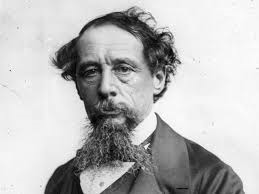
Here’s a challenge for you – which was written first, ‘Oliver Twist‘ or ‘Great Expectations’? And for a bonus point, how many years were there between these two great novels being published? dickens

The answer is in the list below – Oliver Twist was published over 20 years before Great Expectations. Other than looking it up, I can’t think of another way of working that out. There’s little in the texts by way of a clue. This question was prompted by my reading of ‘The Old Curiosity Shop’, this year’s Dickens. I was not sure what period of Dickens’ life and work the novel came from. Its much criticised sentimentality might suggest the work of a younger writer not yet ready to confront the complexities of human character, but many other aspects of the novel suggest a more mature author, not afraid to kill off a central character, controlling a complex plot with considerable skill, and written in a style extraordinarily rich with characterisation and descriptions.

Normally it is not that difficult to work out from which period of an author’s life a text comes. ‘The Tempest’ is so obviously late Shakespeare, reflexive and mature; ;Titus Andronicus‘ is equally obviously an immature work, derivative and clumsy; ‘Hamlet; and ‘King Lear‘ come from that intense period of creativity around the turn of the century when his powers were at their most intense. Taking another example, ‘Northanger Abbey’ is quite obviously early Austen – lighter in tone, and the jokes are not that funny; ‘Pride and Prejudice‘ and ‘Emma‘ are Austen at her best; Persuasion is late Austen, again more reflexive and mature, where happy ever after isn’t the simple solution to everyone’s problems.

With Dickens I don’t think you can make such classifications. His most striking feature as a novelist is his consistency. There is obviously a distinctive Dickensian style, and the method of publication drove the novels’ length and structure. but that was established early on and didn’t seem to change over the years.  His themes ranged from the Gordon Riots of 1780 (Barnaby Rudge) to the French Revolution (A Tale of Two Cities) but always returning to the state of industrial/Victorian England and in particular a compassionate interest in the lives of the working classes.  Pick a Dickens novel at random, and try and tell from its themes, structure, style or composition when it dates from, in relation to the rest of his work. I don’t think you can – can you?

Dickens novels in chronological order

Pickwick Papers’ (full title ‘The Posthumous Papers of the Pickwick Club’) – monthly serial, April 1836 to November 1837

‘Oliver Twist’ (full title ‘Oliver Twist, or, The Parish Boy’s Progress’) – monthly serial in Bentley’s Miscellany, February 1837 to April 1839

The Life and Adventures of Nicholas Nickleby – monthly serial, April 1838 to October 1839

The Old Curiosity Shop – weekly serial in Master Humphrey’s Clock, 25 April 1840 to 6 February 1841

‘Barnaby Rudge’ (full title ‘Barnaby Rudge: A Tale of the Riots of ‘Eighty’ – weekly serial in ‘Master Humphrey’s Clock’, 13 February 1841, to 27 November 1841

‘The Life and Adventures of Martin Chuzzlewit’ – monthly serial, December 1842 to July 1844

‘Dombey and Son’ (full title ‘Dealings with the Firm of Dombey and Son: Wholesale, Retail and for Exportation’) – monthly serial, October 1846 to April 1848

David Copperfield’ (full title ‘The Personal History, Adventures, Experience and Observation of David Copperfield the Younger of Blunderstone Rookery’) monthly serial, May 1849 to November 1850

‘Bleak House’  – monthly serial, March 1852 to September 1853

Hard Times’ (full title Hard Times: For These Times) – weekly serial in ‘Household Words’, 1 April 1854, to 12 August 1854

‘Little Dorrit’ – monthly serial, December 1855 to June 1857

A Tale of Two Cities’ – weekly serial in ‘All the Year Round’, 30 April 1859, to 26 November 1859

‘Great Expectations’ – weekly serial in ‘All the Year Round’, 1 December 1860 to 3 August 1861

Our Mutual Friend’ – Monthly serial, May 1864 to November 1865

The Mystery of Edwin Drood’ – monthly serial, April 1870 to September 1870.  (unfinished)


Standard
Book review

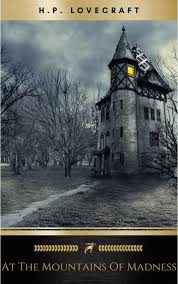
At the Mountains of Madness by H.P. Lovecraft, 1931

Lost world novels were very popular during the end of the major period of European colonisation in the late nineteenth and early twentieth century. King Solomon’s Mines for example establishes many of the characteristics of the genre, and is sometimes considered the first lost-world narrative. European explorers set out to an unexplored part of the lovecraftworld, often protected by some great natural barrier which has previously prevented it from being explored, and discover a great civilisation which they set out to subdue. Rudyard Kipling’s The Man Who Would Be King (1888), Arthur Conan Doyle’s The Lost World (1912), Edgar Rice Burroughs’ The Land That Time Forgot (1918), are all classic examples of this genre. As time went on, unexplored lands were becoming hard to find, which perhaps explains why Lovecraft’s At the Mountains of Madness is set in one of the last remaining wildernesses on earth, the Antarctic.
It seems certain that Edgar Allan Poe’s The Narrative of Arthur Gordon Pym of Nantucket, written almost a century earlier than Lovecraft’s novella, was also an inspiration, hinting as it does at there being undiscovered mysteries at the South Pole, and is explicitly referenced in the later novel at several points.

Written ostensibly as a warning against a forthcoming Antarctic expedition, the first person narration by the geologist and explorer William Dyer, a professor at Arkham’s Miskatonic University, tells the story of his earlier disastrous expedition.

The novel adopts a traditional horror structure of hinting at unknown terrors to be revealed, and only describing them with reluctance after long delays. This is a conventional way of building suspense, but as a warning to the world not to disturb the Antarctic it is hardly convincing. The reader is always happy to suspend disbelief if given a decent enough reason to do so, but when the narrator behaves irrationally and unrealistically like this it undermines the credibility of the relationship between the reader and the text.

The details of the expedition are thoroughly and exhaustively set out, and initially all goes well. The narrator reminds us what we are told we already know, namely that the expedition’s advance party reported the discovery of the remains of prehistoric life-forms unknown to science, before being mysteriously wiped out.  Some form of dissection experiment has been done on one of the slaughtered explorers. Another member of the party is missing – did he go mad and massacre everyone one before heading out into the snow?

Dyer and a fellow explorer, Danforth, fly across the mountain range against which the advance party had pitched camp and discover a massive abandoned city, unlike anything found elsewhere on earth. They explore the city and find murals which tell the history of this lost civilisation. It is at this point that Lovecraft aficionados will start to sit up and listen, as more of the myth of ancient aliens with which Lovecraft is most closely associated is laid out. This city was built by the “Elder Things” in the very early days of the earth’s history, with the help of “shoggoths” — bio-engineered creatures they created to act as their slaves. It takes Dyer and Danforth a while to put the pieces together, and I suspect most readers will be there well ahead of them, but they finally work out that the slaughter at the camp was caused by the Elder Things who have somehow been reanimated. That’s not the end of their problems, because it seems that while the Elder Things killed out of curiosity, hence the attempts at dissection, the shoggoths have also survived and are getting peckish.

There are a number of problems with this novel, not least the structure which makes little sense in the context of it being presented as a warning to the world. There is no character development whatsoever, indeed almost no characterisation – all the explorers are diligent, good at their jobs, but completely anonymous and interchangeable. In terms of the plot the aliens are all there is – there’s no-one working secretly to undermine the expedition, sending secrets to an enemy nation keen to capture the alien technology. The aliens themselves are dull. Virtually all of the first half of the novel is a long set up for the visit to the lost city, where the interpretation of the murals tells the history of the Elder Ones. Devotees of all things Cthulhu will enjoy the canonical detail about the Elder Ones and their intergalactic struggles with the Mi-Go – but it left me cold. The horror element of the story is very limited in impact, and as an adventure story it also misses out – the first person narrative tells us that Dyer survives his ordeal, were that to be in any doubt. The novella is at least short, and I can now honestly say I have given Lovecraft the benefit of the doubt. This is a curiosity, nothing more, and unless you are into alternative mythologies, and I can’t imagine why you would be, I would give this a miss.


Standard
Book review

The Murders in the Rue Morgue and other stories, by Edgar Allan Poe

I was pretty dismissive of ‘The Fall of the House of Usher‘ last month, but I thought I would give Poe a second chance. This is a collection of his shorter stories including:

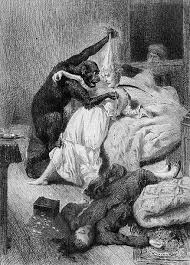
a) The Murders in the Rue Morgue (1841) is best known for developing the template for the modern detective story. Two women are brutally murdered in a classic locked room mystery. Numerous witnesses overhear what they believe to be the murderers. An amateur detective, Monsieur Dupin, investigates, accompanied and narrated by a poefaithful sidekick on hand to record his powers of deduction. The mystery has a farcical and preposterous solution involving an orang-utang, but the features of the detective fiction, including the demonstration of analytical powers before the main crime occurs, the incompetent and bumbling police, deductive analytical processes, even the habit of remaining secluded when not on a case, they are all there. Conan Doyle acknowledges as much by explicitly referencing Dupin in an early Holmes story. This tale is full of holes – the room in which the deaths occur just happens to have a window with a secret catch allowing it to open undetected, for reasons never clearly explained, and the introduction of an orang-utang as the mystery killer made me laugh out loud.
Incidentally I know the illustration here is ridiculous as well (as being gruseome – as are all the others you can find online) but there isn’t a way of illustrating the story without being ridiculous.

b) ‘William Wilson‘ is a well-constructed portrait of schizophrenia. If it was published today it would be unsuccessful – modern readers schooled in the ideas of psychotherapy will recognise very early in the many clues that the two characters, with the same name, appearance, age etc are one and the same person, but to readers of the 1840’s the story’s conclusion may well have been shocking.

c) ‘The Masque of the Red Death‘ is by comparison a dud, in which the supernatural is used as a deus ex machina that we see coming a long way off, and has little else to commend it.

d) ‘The Pit and the Pendulum‘. In this story the narrator is thrown into prison by the Inquisition, and awaits death by means of either a – well, you can guess. The tension is built slowly and effectively, and the prison/torture chamber is ingeniously recreated. The outcome, the narrator’s survival, is ensured by his ability to tell the tale, but his escape from the Inquisition is well managed.

e) ‘Hop-Frog‘ returns to a more fairy-story theme begun in ‘The Masque of the Red Death’.  Set in an unidentified European country in the Middle Ages, a cruel king is unkind to his court jester, and suffers revenge appropriate to his offences.

f) ‘The Case of Amontillado’. A collection of short stories within the horror genre would not be complete without a take featuring someone walled into their grave, and this is it. It is reasonably well done but takes a considerable effort to suspend belief long enough to be in any way disturbed by the outcome, given that it is flagged so early on.

g) ‘The Tell-Tale Heart‘. “I made up my mind to take the life of the old man”. This is a well-written short story in which a man commits a murder, but is betrayed by the sound of the still beating heart. It’s a convincing portrait of psychopathy, in which the speech patterns of the killer, the use of repetition

h) ‘The Man that was Used Up‘ is an extended shaggy dog story not worth the short time it would take to read; the joke falls very flat despite the prolonged set up, at least in part because the narrator is such a boor.

Overall these stories are interesting early examples of the horror genre, and are worth reading for the introduction to the model for Sherlock Holmes if nothing else. I am not sure to what extent Poe’s original readers would have found these stories scary or horrific; they have not aged well as our appetites for blood and guts has become more extreme. Usually attempts at humour fall flat, and it is the simpler stories such as ‘The Tell-Tale Heart’ which are the more effective.


Standard
Book review

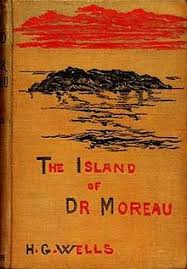
The Island of Doctor Moreau by H. G. Wells, 1896

‘The Island of Dr Moreau’ is another example of the late Victorian fascination with the transformative powers of science. Written during an astonishingly productive period of creativity for Wells, when he also wrote the ‘Invisible Man‘, ‘War of the Worlds‘, and ‘The Time Machine‘, Wells draws heavily and widely on influences. Swift’s ‘Gulliver’s Travels‘ is an obvious influence for example for the scenes at the end of the novel when the protagonist returns to the UK and has trouble to adjusting back to modern life after spending so long alone with the beasts on Moreau’s island:

When I lived in London the horror was well-nigh insupportable. I could not get away from men: their voices came through windows; locked doors were flimsy safeguards. I would go out into the streets to fight with my delusion, and prowling women would mew after me; furtive, craving men glance jealously at me; weary, pale workers go coughing by me with tired eyes and eager paces, like wounded deer dripping blood; old people, bent and dull, pass murmuring to themselves; and, all unheeding, a ragged tail of gibing children... Particularly nauseous were the blank, expressionless faces of people in trains and omnibuses; they seemed no more my fellow-creatures than dead bodies would be, so that I did not dare to travel unless I was assured of being alone. And even it seemed that I too was not a reasonable creature, but only an animal tormented with some strange disorder in its brain which sent it to wander alone,

This is a mood, however, that comes to me now, I thank God, more rarely. I have withdrawn myself from the confusion of cities and multitudes, and spend my days surrounded by wise books,—bright windows in this life of ours, lit by the shining souls of men. I see few strangers, and have but a small household. My days I devote to reading and to experiments in chemistry, and I spend many of the clear nights in the study of astronomy. 

Wells is a great novelist of ideas, but he is also a wonderful and compelling moreaustoryteller. Here he builds the suspense and sense of horror slowly. The narrator, Edward Prendick, is rescued from a shipwreck, having survived in a small boat with two other passengers who at one point contemplate cannibalism, an early introduction to the idea of man as beast. His saviour is Montgomery,

“a youngish man with flaxen hair, a bristly straw-coloured moustache, and a dropping nether lip, was sitting and holding my wrist.…“Have some of this,” said he, and gave me a dose of some scarlet stuff, iced. It tasted like blood, and made me feel stronger.”

Another hint of cannibalism here. Montgomery has a malformed assistant onboard, whose strangeness emerges slowly. At first it is his voice:

“I heard him in violent controversy with someone, who seemed to me to talk gibberish in response to him. The matter sounded as though it ended in blows, but in that I thought my ears were mistaken.”

Later Prendick sees him for the first time and is struck by his appearance. Something is obviously wrong:

“We left the cabin and found a man at the companion obstructing our way. He was standing on the ladder with his back to us, peering over the combing of the hatchway. He was, I could see, a misshapen man, short, broad, and clumsy, with a crooked back, a hairy neck, and a head sunk between his shoulders. He was dressed in dark-blue serge, and had peculiarly thick, coarse, black hair. I heard the unseen dogs growl furiously, and forthwith he ducked back,—coming into contact with the hand I put out to fend him off from myself. He turned with animal swiftness.”

Note how references to this man are always linked with the reactions of the caged dogs:

“In some indefinable way the black face thus flashed upon me shocked me profoundly. It was a singularly deformed one. The facial part projected, forming something dimly suggestive of a muzzle, and the huge half-open mouth showed as big white teeth as I had ever seen in a human mouth. His eyes were blood-shot at the edges, with scarcely a rim of white round the hazel pupils. There was a curious glow of excitement in his face.”

The narrator moves quickly from describing him as a man to a “creature”:

“I had paused half way through the hatchway, looking back, still astonished beyond measure at the grotesque ugliness of this black-faced creature….The creature’s face was turned for one brief instant out of the dimness of the stern towards this illumination, and I saw that the eyes that glanced at me shone with a pale-green light. I did not know then that a reddish luminosity, at least, is not uncommon in human eyes. The thing came to me as stark inhumanity. That black figure with its eyes of fire struck down through all my adult thoughts and feelings, and for a moment the forgotten horrors of childhood came back to my mind.”

When they arrive at (and are dumped unceremoniously on) the mysterious island, they meet some more mysterious, strangely shaped people:

“a strange crew they were. I saw only their faces, yet there was something in their faces—I knew not what—that gave me a queer spasm of disgust…. They seemed to me then to be brown men; but their limbs were oddly swathed in some thin, dirty, white stuff down even to the fingers and feet: . They wore turbans too, and thereunder peered out their elfin faces at me,—faces with protruding lower-jaws and bright eyes. They had lank black hair, almost like horsehair, and seemed as they sat to exceed in stature any race of men I have seen.” 

The astute reader will by now have come to understand that there is more to these strange people than meets the eye. But what? Prendick is not long on the island before he meets the mysterious Dr Moreau and discovers the purpose of his experiments:

“Yet surely, and especially to another scientific man, there was nothing so horrible in vivisection as to account for this secrecy; and by some odd leap in my thoughts the pointed ears and luminous eyes of Montgomery’s attendant came back again before me with the sharpest definition…

What could it all mean? A locked enclosure on a lonely island, a notorious vivisector, and these crippled and distorted men?”

What indeed? At first Prendick concludes that the experiments are intended to turn men into beasts, and suspects he may be the next victim.

“I was convinced now, absolutely assured, that Moreau had been vivisecting a human being… These creatures I had seen were the victims of some hideous experiment. These sickening scoundrels had merely intended to…fall upon me with a fate more horrible than death,—with torture; and after torture the most hideous degradation it is possible to conceive,—to send me off a lost soul, a beast.”

Montgomery and Moreau are finally able to persuade him that the reverse is the case, and that while their experiments may seem cruel, they are being done in a noble cause. The ethics of vivisection are never far below the surface in this horror story, but it is more than a simple campaigning novel. Wells initiates a discussion about what it is to be a man, and his relationship with the rest of the  natural world, from which (as Darwin had only just explained) we come and with which we share a common ancestry.

That is not to say that Wells pulls his punches on the horror of vivisection:

“There was blood, I saw, in the sink,—brown, and some scarlet—and I smelt the peculiar smell of carbolic acid. Then through an open doorway beyond, in the dim light of the shadow, I saw something bound painfully upon a framework, scarred, red, and bandaged; and then blotting this out appeared the face of old Moreau, white and terrible.”

Wells invites the reader to draw comparison between Moreau’s unnatural man-beasts, and the plight of the working man in Victorian industrial cities.

I would see one of the clumsy bovine-creatures who worked the launch treading heavily through the undergrowth, and find myself asking, trying hard to recall, how he differed from some really human yokel trudging home from his mechanical labours; or I would meet the Fox-bear woman’s vulpine, shifty face, strangely human in its speculative cunning, and even imagine I had met it before in some city byway.

This needs care – Wells is not suggesting that the working classes are beast-like, more that they have been treated as beasts of burden, and that doing so constantly might trigger the violent outbursts of anger and rejection of the law that Moreau’s man-beasts finally enjoy. The treatment of the animals on Moreau’s island can also be read as a critique of colonialism – Prendick initially assumes the man-beasts are ‘natives’ of some kind, and explains away their brutish appearance on this basis. European settlers and traders often treated indigenous people as animals, and even conducted social experiments aimed at ‘civilising’ them in the way Moreau does his beasts.

To finish, just a couple of other points: first, it is well known that Wells was politically progressive, and considered himself a socialist. There is a fleeting reminder of this when the narrator half-quotes Shelley’s ‘Masque of Anarchy’, where the implied reference to ‘rising like lions’ is particularly apposite:

“You who listen,” I cried, pointing now to Moreau and shouting past him to the Beast Men,—“You who listen! Do you not see these men still fear you, go in dread of you? Why, then, do you fear them? You are many—”

Second, consider these laws the animals are taught to maintain their obedience:

“Not to go on all-fours; that is the Law. Are we not Men?”

“Not to suck up Drink; that is the Law. Are we not Men?

“Not to eat Fish or Flesh; that is the Law. Are we not Men?

“Not to claw the Bark of Trees; that is the Law. Are we not Men?

“Not to chase other Men; that is the Law. Are we not Men?”

I had never spotted before, nor seen it mentioned, but Orwell clearly drew inspiration from Wells here for his laws of animalism in ‘Animal Farm‘.

Standard
Book review

Where Angels Fear to Tread, by E M Forster, 1905

I first read Forster’s Where Angels forty years ago as one of my ‘O’ level texts. It was interesting to reflect on what I remembered and what had not survived the loss of brain cells over the years. The basic plot outline was still there, although the ending came as a pretty unpleasant surprise. Strangely one sentence about the novel’s protagonist, Philip, one of the fools rushing in where angels fear to tread, remained crystal clear:

“He might be a puppet’s puppet, but he knew exactly the disposition of the strings”.

This was the type of quote that we all were taught to underline and memorise, as a key to understanding Philip’s character. Looking back I am not so sure it works that way, although certainly Forster suggests as much by the heavy handed language (in what way is Philip a puppet’s puppet – who is the puppet who is controlling him – his mother? Hardly a puppet surely, more a very headstrong woman, another fool rushing in without thought or consideration. And ‘he knew exactly’ rather than ‘he knew the exact’ is a clumsy formulation which again serves to make the sentence stand out.)

‘Where Angels’ is a slight novel, chosen I suspect as an ‘O’ level text because of its length rather than any particular intrinsic literary value or its interest to teenagers. Lilia Herriton is widowed in her early thirties, and undertakes a Grand Tour of Italy at the suggestion of her in-laws, who appear keen to get rid of her for a while, despite the fact that she leaves behind a young daughter, Irma. Her travelling companion, Caroline Abbott, a younger single woman, is intended to act as a chaperone, but fails miserably to prevent Lilia from falling in love with and marrying a much younger Italian man, Gino. The Herriton’s suspect Gino is a Mediterranean cad – his father is a dentist for goodness sake!

“A dentist! A dentist at Monteriano. A dentist in fairyland! False teeth and laughing gas and the tilting chair at a place which knew the Etruscan League, and the Pax Romana, and Alaric himself, and the Countess Matilda, and the Middle Ages, all fighting and holiness, and the Renaissance, all fighting and beauty! He thought of Lilia no longer. He was anxious for himself: he feared that Romance might die.” 

(I recognise, of course, that this over-the-top reaction is supposed to be funny, pricking Philip’s pomposity. I am not sure it is though.)

Arguably this is the first of several instances of fools rushing in, but it is quickly followed as Lilia’s brother-in-law Philip hurries to Italy to try to prevent the marriage, arriving too late and leaving ineffectually empty-handed. Philip feels partly responsible for this inappropriate marriage – he was very enthusiastic about the idea of Lilia going on an Italian tour, being something of a connoisseur of all things Italian.

Lilia finds life in Italy much less romantic and interesting than she anticipated – Gino is a stereotypically unfaithful Latin lover, and she is effectively confined to her house in a small provincial town. Forster sometimes uses deus ex machina techniques such as a sudden death to inject drama to his novels, and he succumbs to this plot device again when Lilia dies in childbirth. This felt as if Forster was laboriously setting up the novel’s denouement, getting his pieces in play for the final scene, rather than an integral part of the narrative, and her death is announced casually. The reaction back in England is at first to ignore the new born (who is not a blood relative of the Herritons). Quixotically they change their minds – or more specifically Mrs Herriton, the family matriarch, changes her mind – when she hears that Caroline has decided to go back to Italy to ‘save’ the child from the horror of being brought up motherless, and worse, Italian. Philip follows Caroline accompanied by his scary sister Harriet aiming to gazump Caroline and effectively buy the baby from Gino.

Gino is not interested in selling his son, of course and is planning to remarry to provide him with a mother. In a melodramatic finale Harriet kidnaps the baby and flees for the coast. Racing to meet the train, their coach crashes and the baby is killed. The aftermath of the crash is painful to all. Philip eventually realises that he is in love with Caroline but she is still in love with Gino, having been so all along.

There is a soap opera element to the repeated overnight journeys to Italy and back, the sudden deaths and unsuitable and unrequited romances. In an otherwise positive essay for the Guardian back in 2002, Zadie Smith wrote “there is a lot in Forster that fails, is both cloying and banal” – which made me wonder what she would have said if she really didn’t like his work. I quote her here because this phrase resonated with me – there is a lot in Where Angels that doesn’t work, is sentimental, over-written and dull. When it was first published over 100 years ago the Guardian then called it (again in another not altogether hostile review) “a sordid comedy culminating, unexpectedly and with a real dramatic force, in a grotesque tragedy.” The two elements, humour and tragedy, sit uncomfortably together – the novel is neither a gentle comedy about silly English people and their class distinctions, nor a tragedy about how good intentions can go wrong. Ultimately I found it melodramatic and not in a good way.

Standard