Book review

Goods Omen by Terry Pratchett and Neil Gaiman 1990

Why haven’t I read “Good Omens” before now? That’s not a rhetorical question – tell me why no-one has thrust this book into my hands and said “You love Terry Pratchett and you think Neil Gaiman is pretty good as well, so read this, now”? As you can tell I feel slightly narked at the fact that this wonderful book has not made it onto my reading list until now. Good omens
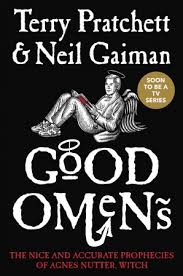
One reason might be that collaborations, especially on novels, have at best a patchy record. Name me a novel written by two people that is as good as any of the novels written by either of the co-authors? That one is a rhetorical question btw. “Good Omens” is the only co-authored novel on the BBC Big Read list of 100 best novels, if you needed any evidence on that point. But something about the way these two worked together, across different continents and time zones, just worked, producing something as good as if not better than their best solo work. It could easily have been written by Douglas Adams, and if you have been paying any attention to anything I have written in the last 5 years or so you will know that there is no higher compliment.

“Good Omens” started life as a Just William parody, and if I were to find a fault with the novel, the extended sections of the prepubescent schoolboys and schoolgirl getting up to no good in an essentially well behaved way are some of the weaker parts of the novel. But that doesn’t really matter, because the cornucopia of ideas and characters that fizz from every page of the rest of the novel more than compensate. Quite how a schoolboy story became a parable about the end of the world I am not sure, but it tells you something about Pratchett and Gaiman’s imaginations. There so much to enjoy here – utterly believable eccentric characters, such as the angel and demon working together to avoid Armageddon, Witchfinder General Shadwell and his assistant Newton Pulsifer, the witch Anathema Device (was/is there any author better at producing fantastic names for his characters than Terry Pratchett was – I give you Cut My Own Throat Dibbler in evidence), a breathless plotline that genuinely leaves it open to doubt whether the world is going to end or not, and on every page some of the best and at the same time wisest jokes you will find in any modern novel.

“It may help to understand human affairs to be clear that most of the great triumphs and tragedies of history are caused, not by people being fundamentally good or fundamentally bad, but by people being fundamentally people.”
“An Angel who did not so much Fall as Saunter Vaguely Downwards.”
“She was beautiful, but she was beautiful in the way a forest fire was beautiful: something to be admired from a distance, not up close.”
This is Pratchett at his very best, and whatever Neil Gaiman contributed to the process and outcome – the appendix at the end of this edition contains interviews with the authors that are frustratingly vague on this point, including the possibility that some of the text was written by neither of them – the combination just worked. I suspect it made Terry a better author in the long run, although I don’t think he ever wrote anything better.
Finally some good news – the novel is being adapted for television by the BBC, with two of Britain’s best actors, Michael Sheen and David Tennant, in the lead roles, and with a wonderful supporting cast. Should be (the light) fantastic.
Standard
Book review

Citizen Clem – John Bew

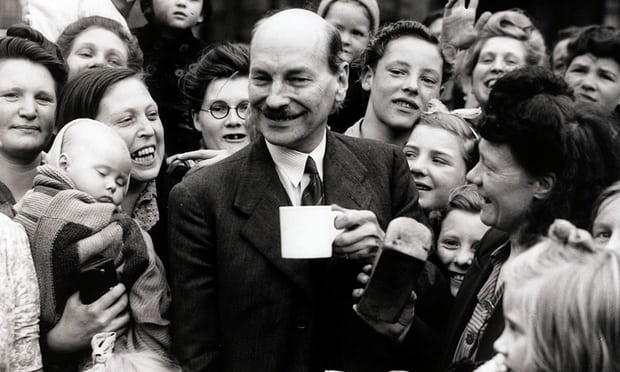
This is a good time to return to the extraordinary story of Clement Attlee’s rise to the leadership of the Labour Party, his twenty-year long period as leader (1935-1955), Deputy Prime Minister (1940-1945) and Prime Minister (1945-1951).  Attlee won two General Elections, saved the Party from the electoral wipe-out of 1931, and governed during Labour’s almost mythical post-war period in office when the Welfare State was brought to fruition.

Attlee

It is timely because the legacy and spirit of the Labour Party is once again the focus for political debate in the UK. It is possible that the party’s much better than expected performance at the 2017 General Election will have quietened that debate for the time being, but few imagine that this will not break out time and again while Jeremy Corbyn remains leader.

Rigidly chronological in structure, this biography charts Attlee’s rise to senior positions within the Labour Party, without his ever really expressing much interest in doing so – he seems to have had an amazing knack of being in the right place at the right time, never more so when he became Deputy Leader after the whitewash of 1931, when the party was reduced to fewer than 50 MPs. After a careful narrative charting Attlee’s childhood, early military career, and his discovery of his social conscience, Bew focuses on the post-war Government which delivered such an amazing legacy of legislation and reform. while at the same time falling short of many of the aspirations generated by such a resounding win.

Despite having made my way through over 500 pages of this biography, Attlee remains something of any enigma. I can’t honestly say I know the man.  You could fill a short book alone with the collected insults offered to him. Nye Bevan is said to have called him ‘a desiccated calculating machine.’ Others compared him to ‘a little mouse’, ‘a poor little rabbit’, or as George Orwell put it, “a recently dead fish, before it has had time to stiffen’. American press said he was `the dullest man in English politics’. Churchill famously said that Attlee was not only a modest man with plenty to be modest about, but ‘a sheep in sheep’s clothing’. Even when people tried to say something supportive or positive about him, they almost always prefaced their comments with another veiled insult about his reserved nature, his modest talents, his poor grasp of economics, and so on.

Bew gives us little of Attlee’s personal life, leaving the reader to conclude that it was as dull as outer appearances suggest. He draws heavily on Attlee’s letters to his brother Tom which are referenced every few pages – as if they provide some unique and previously unknown insights into Attlee’s inner thoughts, when almost always they tell us what we already know and indeed have already been told.

This book won the Orwell Prize for political writing in 2017. I have a sneaking suspicion that the author had half an eye on the prize when writing – the number of shoe-horned in references to Orwell’s work pile up, for example when comparing Attlee to Boxer, the shire horse eventually sent to the knackers’ yard. Boxer represents the ordinary Russian worker who continues to recite party slogans long after they lose all meaning, his faith in the Party unaffected by reality – in other words not at all like Attlee, who was a party faithful all his life but can hardly be described as a mindless functionary. The comparison just doesn’t work, and should have been cut – but the author obviously needed to keep every possible Orwell name-check to keep the book in the prize judges’ eyeline.

I can’t comment on whether this is the definitive Attlee biography, but I am glad I read it – I knew shockingly little about his background as a Major at Gallipoli and in France in World War one, for example, or the collapse of the second Labour Government 1929-1931, although his role in the second World War and the post war Government were naturally more familiar. I did have a couple of quibbles with the book that I can’t let slide.

First, it could have done with a closer edit. Over 500 pages there are always going to be mistakes, but this is not the first edition, and allowing sentences such as (page 144)

“For the moment, he shared the view that the obstacles to self government in India were, for the moment, insurmountable”

is unforgivable. Second, there are some moment of lazy writing. Can you spot what’s wrong with the following paragraph, for example?

(page 147) “The biggest challenge facing the second Labour Government was unemployment. Their task became extremely difficult because of events outside its control. In the last week of October (1929) the bottom fell out of the international economy, beginning with a monumental panic on the New York Stock Exchange that saw traders leap from windows in despair.

Yes, it’s the cliched way of describing the Wall Street crash featuring those leaping traders. Five minutes on Google will tell you that it didn’t happen – suicides rates actually went down during the period of the crash. But even if they didn’t, and they did, why describe the crash in this way? Is the reader supposed to think “Oh that Wall Street crash in October 1929, the one which led directly to the rise of fascism and the resurgence of the National Socialist Party in Germany , I wasn’t sure which one you meant”. If the author can’t be relied on to get simple facts like this right, how reliable is the rest of his narrative?

Standard
Book review

Comments – sticks and stones

I got my first nasty comment yesterday. Having been blogging for several years now I Trollhave previously always welcomed comments. The vast majority have been positive, but even when people have disagreed with my view, they have done so politely. I have tried to adopt the same approach when commenting on other people’s blogs, because, you know, I am a human being not a troll. But my 2013 review of Patrick Suskind’s ‘Perfume‘ really upset one person, because they decided to leave a comment calling me an “miserable trout”!
Anyone not familiar with idiomatic British English may not recognise this phrase. It’s a remarkably mild insult, meaning roughly an unattractive and bad-tempered old woman. I’ll leave it for others to decide on the attractiveness or otherwise of my appearance, although what that has to do with Patrick Suskind’s novel escapes me for the moment. Bad-tempered I will accept in the context of the review – ‘Perfume’ is an appalling novel, and I stand by that judgment of several years ago when I first reviewed the novel – and yes, it put me in a bad mood. More, it upset me. If the descriptions of young women being murdered for sadistic pleasure which form the heart of the novel don’t upset you, perhaps it’s not me with the problem. But it’s the casual assumption that I am a woman that niggled at me – as if only women can call out misogyny when they see it. I thought we as a society or civilisation had outgrown that lazy idea?

For the avoidance of any doubt, I still love getting comments. It’s really one of the things that keeps me blogging and reading blogs, getting to share my ideas about books with other people and discuss them. Of course we will have disagreements. I would love to know in what way this commenter disagreed with me – what is it about Suskind’s portrayal of the mass murder of young women and the commoditisation of their bodies that appealed to him/her? But (s)he chose not to share that information, which was a pity.

Standard
Book review, John Green, Turtles all the way down, Young adult

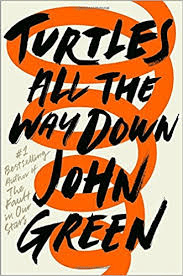
Turtles All the Way Down – John Green, 2017

Should one use the same criteria when judging young adult novels as one does when assessing full-grown adult fiction? I ask because if one were to do so, ‘Turtles’ would probably suffer by comparison, when judged on its own merits as a thoughtful novel for young adults, it is a success.

Turtles

The central character of John Green’s ‘Turtles All The Way Down’ (loving that title), Aza Holmes (‘Holmesy’) suffers from Obsessive Compulsive Disorder (OCD). This makes her extremely anxious, and she self harms as part of her control rituals, opening a wound on her hand, then being terrified it will become infected. As her condition deteriorates she takes to drinking hand sanitizer, in a deluded attempt to purge her body of infection. (NB Do not do this!). She is also haunted by thoughts that she is a fictional creation (which of course she is, although Green does nothing with this paradox). Most of the time she remains in control of her obsessive behaviour, although her internal monologue tells us that she is tortured by harmful thoughts. Despite her condition Aza is in many ways a typical, relatable American teenager – she drives to school in her beloved truck Harold, eats pizza with friends, and watches television with her mum. Green doesn’t spell it out in so many words, but we are invited to conclude that Aza’s OCD was triggered following the sudden death of her father from a heart attack when she was seven.

A fledgling romance with a neighbour whose incredibly rich father has gone missing triggers a more serious episode, and she is eventually hospitalised. The parallels with the loss of her own father are quietly underlined, and form the basis of her relapse. She eventually recovers sufficiently to overcome her anxiety and in a strange conclusion to the novel attends an art exhibition in a sewer, where she comes close to solving the mystery of the missing billionaire. I probably shouldn’t focus on this detail, but I doubt whether many OCD suffers would be prepared to go into a sewer for any price, let alone wander around in the dark in one. This ending to the novel was for me its weakest part, and fails on any level, providing an unsatisfactory ending to the ‘mystery’ element of the novel, which had a lot of potential but which Green seemed to lose interest in.

What elements do you look for in an adult novel that we can forgive being missing from a YA novel? Characterisation? Obviously not, we need the characters to be fully fledged and believable. Green does reasonably well here – some of his characters are generic, off-the shelf quirky teenagers distinguishing themselves from one another by their choice of hair style or interest in music. I quite liked Daisy, the inevitable reliable best friend, but Davis, the missing billionaire’s son, who provides the only significant romantic interest in the novel, isn’t well developed – in fact his brother Noah, who is mourning the loss of his father, but hides his grief and distress in video games, was more believable. There’s a whole missing novel there in fact – the two brothers waiting for their father to return, unable to draw any solace from their preposterous riches.

Plot? The story line in ‘Turtles’ goes missing quite early on, and never resurfaces until the hurried and unconvincing conclusion. Green starts out writing a conventional if slightly Scooby Dooish mystery, but this element fizzles out early on, and the focus shifts instead to Aza’s illness and its impact on her life.

Quality of writing. Green does a good job, so far as I can tell, in representing the voice and thoughts of a teenage OCD sufferer. His writing is straightforward and extremely easy to read – this is the kind of novel that you can polish off in a few hours easily. There are no rhetorical flourishes or difficult passages.

Originality. It would be being harsh to say Green was on auto-pilot here, but there is a very familiar clichéd feel to this novel. Angsty teenagers have mild romantic entanglements to the backdrop of a high-school experience, something easy for US teenagers to identify with from real-life, (and other readers from anyone who has watched US television) the kind of high school where you pull up in front of the school and there is always a parking space waiting; where lessons take a few minutes and time is mainly spent being cool in the cafeteria, and pupils quote Shakespeare to one another in their texts. It was as believable as Buffy the Vampire Slayer, but a bit less glamorous.

Ultimately, the answer to my opening question is a clear no. This isn’t a book that adults will be able to take much from, but younger readers (I really wouldn’t get hung up on the YA label; I would have thought pre-teens could enjoy this as well. There are some adult themes such as references to dick pics, but that is about as strong as it gets) will find it an interesting and comforting read – or in the words of the Guardian’s reviewer “It will resonate with, and comfort, anxious young minds everywhere” , which I think is spot on.

P.S. What a disappointing book cover by the way – we get it that depression is like a spiral (not that that image is in any way helpful or clear) but the missed opportunity for pictures of some turtles will hopefully be rectified in the paperback!!

Standard
Book review

Mistakes Were Made (but Not by Me): Why We Justify Foolish Beliefs, Bad Decisions and Hurtful Acts by Carol Tavris and Elliot Aronson

When I use the term “challenging” to describe a book, this is usually a euphemism for “hard to read” – either because it is badly written, or just long-winded. ‘Moby Dick’ is a challenging novel, for example. So are ‘Ulysses’ and ‘Middlemarch’, and any other number of Victorian blockbusters (I know Ulysses isn’t Victorian!)  But I found ‘Mistakes Were Made’ challenging in a very different way – it challenged some of my deeply held beliefs. Which was unusual and very refreshing. I didn’t agree with everything the authors wrote or argued, but being shown a different perspective has to be a good thing.

‘Mistakes were made, but not by me’ is a book of popular (i.e accessible, rather than academic or textbook) psychology, exploring the concept of cognitive dissonance, the mental discomfort (psychological stress) experienced by us all when we simultaneously hold contradictory beliefs, ideas, or values. Cognitive dissonance is a consequence of a person performing an action that contradicts personal beliefs, ideals, and values; and also occurs when confronted with new information that contradicts said beliefs, ideals, and values. So for example you believe the NHS I being under-funded, but when you look the statistics up you find that investment is going up above the rate of inflation. Instead of saying, how interesting, you tart to look for other statistics that will undermine this, and tell you what you really want to hear – that relative to other countries funding is down for example. This is an entirely natural response. When we experience CD we all have the impulse to minimise the uncomfortable feeling by refusing to accept the new information (“fake news”). On social media we are much more likely to be believe (and retweet or share) a post that endorses our ideas than one that challenges them. This is the reason for the so-called echo chamber phenomenon.

The authors go on to examine how cognitive dissonance causes mistakes to be made – we find it hard to accept our initial thoughts or conclusions are wrong, and seek out any number of ways to defend ourselves against the discomfort this causes, to the extent of denying or ignoring hard facts against us.

While this is a very accessible, readable account, the 40 pages of footnotes are clear evidence that this is also well-researched. Most of the examples are drawn from the United States, but that’s fine – the authors are American and write about the area they know best.

So why did I find it challenging? At the heart of the issue is the compelling section of the book about repressed memory. This really got me thinking, and reading other sources. I had accepted for a long time, without really thinking about it very much, that the repressed memory was a real thing. It’s a Freudian concept, and there is evidence (not discussed here) that the idea was not previously thought of before Freud. The authors make the familiar point that for most trauma, the challenge is forgetting the pain and distress, rather than remembering it. They also highlight research that shows how easy it is to implant false memories of childhood trauma – the so-called ‘Lost in the Mall’ experiment, where adults were easily persuaded that they had a childhood experience if being lost in a shopping centre, when they hadn’t.

So why am I still resisting the idea that repressed memory doesn’t exist? I think there are three main reasons: first, it sounds plausible. That’s obviously a cognitive dissonance coping strategy – ignore the evidence, and rather than presenting counter evidence just say that your original ideas are valid because they just are. Second, I think I have read about examples of repressed memory – but have I? Or were these fictional representations, in films or books? I have a sneaking suspicion they might have been. Lastly, while the concept of repressed memory is less widely supported than twenty years ago or so, the fact remains that large numbers of psychiatrists and psychologists still accept the concept. So I think the jury is still out, but the authors don’t have any doubts. They don’t hedge their position by referring to the evidence that suppressed memories exist – they would argue there is none. There’s obviously a baby/bathwater risk here – if all recovered repressed memories of childhood trauma or abuse are implanted or otherwise false, there is a risk that people take the wrong next step of concluding that all memories of such abuse are equally open to question or challenge? These are deep waters, and I still don’t know what I think about them – I certainly haven’t accepted the authors’ position unsceptically – but I am sure you can see why I found the book so thought-provoking.

If you are interested in how memory works, enjoy having your preconceptions challenged, and don’t mind revisiting some familiar psychological experiments, then ‘Mistakes Were Made (but not by me)’ is recommended. We can all benefit from acknowledging that we are as vulnerable to mis-remembering or making mistakes – we alone are unlikely to be infallible, while all around are prone to error – and that challenging our preconceptions (“I think I can remember that, but I might be wrong”) is a healthy reflex.

Standard
Book review

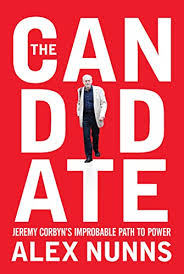
The Candidate – Jeremy Corbyn’s Improbable Path to Power by Alex Nunns

CandidateFirst, I need to declare an interest – I know and have a huge amount of respect for the author, as well as a long term interest in the subject matter. I’d like to think this hasn’t affected my review, but that’s hard for me to judge.
’The Candidate’ is, as the subtitle explains, the story of Corbyn’s improbable, almost unbelievable, ascent to the top of the Labour Party. Or as John McDonnell, Shadow Chancellor of the Exchequer, put it in endorsing the book “”This is a fascinating account of why—as well as how—Jeremy became leader of the Labour Party and transformed our politics. For anyone engaged in this movement, understanding precisely how we came to be where we are can only make us more effective as we go forward. That’s why Alex Nunns’ book is so important.”

Some events (political and otherwise) are so unlikely that no-one sees them coming, not even those closely involved. Few if any in the small group of MPs that constituted what remained of the Bennite Left in the Labour Party thought Jeremy Corbyn would be on the leadership ballot in 2015 following Ed Miliband’s resignation, let alone that he would win. His selection as a candidate was almost an afterthought, when several other potential (and with hindsight, far less suitable) candidates had been ruled out. Looking back at the events of the campaign it is easy to see Corbyn’s subsequent and almost effortless rise to power as inevitable, but Nunns’ forensic day by day, sometimes minute by minute, account, often using the present tense, makes it clear that the outcome was anything but a done deal. This is a definitive version of the extraordinary events of summer 2015, and the revolution that shook the Labour Party.

Nunns’ greatest strength is what I would characterise as myth-busting. Calmly he presents clear thoroughly researched evidence to destroy the various claims and distortions that surrounded Corbyn and his campaign, lies which continue to be recycled to this day. This is reflected in the author’s meticulous approach to research – how many other political narratives have 40 pages of footnotes?

This is not the book for you if you want to learn more about Corbyn’s Wiltshire childhood or his years on the back benches – Wikipedia covers this off pretty comprehensively. Some of the controversies that have been manufactured by his opponents – his close ‘association’ with Sinn Fein for example – are mentioned but do not form the focus of this book. Equally this is probably not the book for you if you are hostile to Corbyn, unless you are exceptionally open-minded – while Nunns is not unaware of Corbyn’s faults, or those of his campaign (for example, the initial failure to appoint any women to senior positions in the Shadow Cabinet is criticised), he doesn’t hesitate to make his allegiances clear. Nunns is particularly sharp in lancing the pomposity of the commentators, pundits and politicians who claimed Corbyn was a joke candidate who could never win, whilst simultaneously saying his victory would be a disaster for the party and the country.

I suspect that when the history of this period of the Labour Party comes to be written, ‘The Candidate’ will be considered an important reference work. Which makes the absence of an index more surprising (although I understand this was not the author’s choice). Similarly the blurb on the paperback edition, again nothing to do with the author, reads like a clumsy attempt to portray the book as a political thriller rather than a serious analysis. Minor quibbles aside, my only argument of any substance with the author would be in his treatment of the Parliamentary Labour Party. In this narrative, the PLP is characterised as monolithic and overwhelmingly Blairite, a product of an iron grip on selection in the Blair/Brown years. This overlooks the fact that Liz Kendall, the Blairite candidate – Kendall rejected this label, but given her endorsements it’s unavoidable – received just 41 MP’s nominations for the leadership, only five more than Corbyn. This perspective distorts the treatment of the 2016 ‘coup’, where the co-ordinated mass resignations from the Shadow Cabinet are characterised simply as ‘the revenge of the Blairites’ (my term). My guess is that MP’s dissatisfaction with Corbyn’s leadership and their reasons for resigning were more complex than simply an attempt to reinstate the status quo. There was widespread dismay at the outcome of the 2016 Brexit referendum, and inevitably Corbyn was the focus of some of that anger. It was not just the PLP who had their doubts, particularly as Labour’s position in the polls deteriorated – even the Guardian’s Owen Jones wrote more than once questioning the wisdom of Corbyn’s retaining the leadership, (“not good enough – his (Corbyn’s) policies are right but his leadership is clearly failing”)

It turns out of course that just about everyone called this wrong, and Labour came agonisingly close to securing victory in the 2017 general election. That campaign, and its aftermath, are the subject of a revised edition of ‘The Candidate’ which is due out early next year. I can’t wait.


Standard
Book review

Autumn by Ali Smith, 2016

My reading slump persists, and ‘Autumn’ has had no impact whatsoever on my jaded appetite for contemporary literature. While it was a gentle, undemanding read, the lack of a strong narrative thread meant this didn’t grip in the way I need right now.

In a highly fragmented manner this novel tells the story of the friendship between Elisabeth Demand, a thirty-something art historian, and her elderly European neighbour, Daniel Gluck. Parts of the non-linear narrative include Daniel’s dreams of being young again. ‘Autumn’ has been described as the UK’s first post-Brexit novel, which may be correct, but it also contains many references to the 1960’s, including pop-art and the Profumo scandal.

To be blunt, I didn’t engage with the narrative. I didn’t care about the characters who never really came to life for me, and who don’t really do much anyway. There is no plot to speak of, not that that usually troubles me. Attempts at humour are clumsy – the Post Office scenes, when Elisabeth goes to renew her passport, felt like amateurish stand-up. Which leaves us with the social and political commentary (where Smith tries not to come down on one side of the Brexit argument or another, is clearly a metropolitan liberal, of course she is) and the prose. Smith’s prose is easy to read, but I found it mainly uninspiring and flat. Take these two descriptions of autumn (and having named the novel after the season, you would hope that these paragraphs are where Smith would deploy her big guns), annotated with my notes:

“October’s a blink of the eye (1). The apples weighing down the tree a minute ago are gone and the tree’s leaves are yellow and thinning. A frost has snapped millions of trees all across the country into brightness. The ones that aren’t evergreen are a combination of beautiful and tawdry, red orange gold the leaves, then brown (2), and down.

The days are unexpectedly mild. It doesn’t feel that far from summer, not really, if it weren’t for the underbite(3) of the day, the lacy creep of the dark and the damp at its edges, the plants calm in the folding themselves away, the beads of the condensation on the webstrings(4) hung between things (5).”

  • No, it is not a blink of the eye. The phrase is “gone in the blink of an eye, meaning passes quickly, Of course Smith has abbreviated the phrase deliberately – we don’t always think in full phrases, but October doesn’t pass quickly. Most people wish it would, but as the first frosts kick in it seems an age since summer, the first colds of the year start to spread, and it is months until Christmas. October crawls past.
  • There’s little imagery here – lacy creep I suppose – and the efforts to describe autumn colours “red orange gold the leaves, then brown” wouldn’t win any awards in a primary school – although the narrator helpfully points out that it is only the trees which are not evergreen to which this description applies. She attempts to get some movement into the description – “and down” – which also ends the internal rhyme. Stilted word order again is an attempt at poetical phrasing – “the plants calm in the folding themselves away”.
  • The term underbite describes “the position of the teeth in which the lower teeth go over the upper teeth”, so try as I might I can’t see the term being used to describe the late cold of the day in the way the speaker does here – she is groping for a way of describing the way the days get colder quickly as night falls, despite the late bright sunshine October days often enjoy.
  • And (5) By using compound words – underbite, webstrings – Smith is taking liberties with the language in order to be ‘poetic’. This description ends tamely, with the webstring hung between “things”. Well what a picture that conjures up?!

The test here is really a simple one – does this paragraph evoke autumn for you? Can you taste, it, sense it, feel it? Does it make you want to close your curtains, turn on a lamp and put another log on the metaphorical fire? What if you read it in May or June – would it work as well then?

Now it’s November

“November again. It’s more winter than autumn. That’s not mist. It’s fog. The sycamore seeds hit the glass in the wind like – no, not like anything else, like sycamore seeds hitting window glass.(1) There’ve been a couple of windy nights. The leaves are stuck to the ground with the wet. The ones on the paving are yellow and rotting, wanwood, leafmeal. (2) One is so stuck that when it eventually peels away, its leafshape left behind, shadow of a leaf, will last on the pavement till next spring. The furniture in the garden is rusting. They’ve forgotten to put it away for the winter. The trees are revealing their structures. There’s the catch of fire in the air. All the souls are out marauding. But there are roses, there are still roses. In the damp and the cold, on a bush that looks done, there’s a wide-open rose, still. Look at the colour of it.”(3)

  • This couldn’t be more clumsy if it tried –; sycamore seeds hitting glass are like sycamore seeds hitting glass? Well thanks for that vivid imagery there! Unless you have lived or worked next to a sycamore tree this image will have no resonance whatsoever.
  • The reference to wanwood and leafmeal are from Manley Hopkins’s poem about mortality, ‘Spring and Fall’

“Though worlds of wanwood leafmeal lie;

And yet you will weep and know why”

  • This is better. Smith has noticed the incredible resilience of the late blooming rose, still there despite all that autumn can throw at it.

TLDR

I’ve never felt the need to use a scoring system for my reviews, but if I did I would give ‘Autumn’ a ‘meh’ out of ‘whatever’.

Standard
Book review

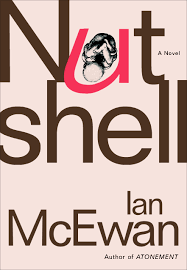
Nutshell, by Ian McEwan

I am not going to review this novel. If you want to read an intelligent, thoughtful if slightly showy-offy review, try this or this even more florid review by Adam Mars Jones. This blog is a reading diary (hence the recent absence of content) where I record my impressions of the books I read. Usually these look at first glance quite similar to reviews, without the clarity of expression or depth of analysis you might otherwise expect.Nutshell

Nutshell’ is a curious, whimsical novel. In the last few years the Hogarth Press has been commissioning authors to write a series of novels re-imaging Shakespeare’s plays, and I thought at first that ‘Nutshell’ was a part of or inspired by this series. It appears not, it is a solo, voluntary effort.

In a nutshell, in ‘Nutshell’ McEwan takes the themes and ideas of Hamlet, and updates them to the present day. Hamlet is played by not a moody young prince, but an about to be born foetus. His mother and her brother in law lover are planning to murder his father. The unnamed and apparently unwanted baby is a passive observer of events, with much energy expended on maintaining the conceit that he can detect what is going on in the outside world through hearing, taste, and a fair amount of guesswork.

McEwan’s fierce dazzling intelligence shines through this short novel. It has an extraordinary breadth, ranging through many different genres, least successfully crime (the resolution whereby the lovers are caught by the dogged but uninspired police is appallingly clumsy). Contemporary politics, the Royal family, Brexit, Trump, are all referenced and swiftly disposed of for the more substantial feasts of philosophy, literary criticism, and absurd levels of sophistication in wine-appreciation (“No one seems to want to read aloud the label so I’m forced to make a guess, and hazard an Echézeaux Grand Cru. Put … a gun to my head to name the domaine, I would blurt out la Romanée-Conti, for the spicy cassis and black cherry alone. The hint of violets and fine tannins suggest that lazy, clement summer of 2005, untainted by heatwaves, though a teasing, next-room aroma of mocha, as well as more proximal black-skinned banana, summon Jean Grivot’s domaine in 2009”)

There is, inevitably, a ‘but’ coming. More precisely two. The first is something that seems to have only been an issue for me, and that is that the narrator character, an extraordinarily erudite and cultured baby, reminded me unavoidably of Stewie from ‘Family Guy’. Once that narrative voice got in my head that was it. Stewie, as I shall now call him, channels Jacob Rees Mogg in his social conservatism, (or is this McEwan letting loose his inner fogey?):

A strange mood has seized the almost-educated young. …A social-media site famously proposes seventy-one gender options – neutrois, two spirit, bigender…any colour you like, Mr Ford. …I declare my undeniable feeling for who I am. If I turn out to be white, I may identify as black. And vice versa. I may announce myself as disabled, or disabled in context. If my identity is that of a believer, I’m easily wounded, my flesh torn to bleeding by any questioning of my faith. Offended, I enter a state of grace. Should inconvenient opinions hover near me like fallen angels or evil djinn (a mile being too near), I’ll be in need of the special campus safe room equipped with Play-Doh and looped footage of gambolling puppies. Ah, the intellectual life! I may need advance warning if upsetting books or ideas threaten my very being by coming too close, breathing on my face, my brain, like unwholesome drugs.

The more serious issue is that McEwan is demonstrably better than this. For him to be writing a comedic novel about a ham(let)-fisted murder with a sub-Colombo style solution, constructed however cleverly around the scaffolding of the plot of Hamlet, seems such a waste of his energies and talents, almost like an academic exercise (“Rewrite Hamlet as a comic novel from the perspective of Hamlet as a foetus. No more than 200 pages, by Friday”). The jokes about the discomfort of a foetus being a few inches away from his uncle’s penis, for example, were obvious and clumsy. The novel’s anachronistic tone troubled reviewers (see for example the LRB review referenced earlier) but I think McEwan just about gets away with it, probably because the majority of his readers will share a generation with him, if not a world view.

At a shade under 200 pages, ‘Nutshell’ is an easy read with some jokes that make you chuckle, and some stunningly impressive prose. But it is not McEwan at his best, not by a long distance.

Standard
Book review

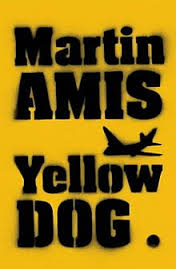
Yellow Dog, by Martin Amis, 2003

There is an undeniable trajectory to Martin Amis’s novels – downward. Not just in quality but in coherence, tone and taste. He peopled his 2003 effort ‘Yellow Dog’ with disgusting grotesques and events that made it hard to stomach. The best I can say about this novel is that it is not as bad as ‘Lionel Asbo’, but from the author of ‘Money’ this is such a fall.amis yellow dog

‘Yellow Dog’ was one of those novels that bitterly divided reviewers when it was first published. If you enjoy critical reviews, you will probably appreciate these more than the novel itself. In an industry where most reviews are by default favourable, this in itself was extraordinary. The Independent gave it both barrels:

Yellow Dog is a strange, sad stew of a novel, so aggressively unpleasant that it would perhaps be best accompanied by an author photograph of Amis flicking Vs at the reader….The fact that Yellow Dog is so bad is not a cause for celebration. Anyone interested in English fiction will be deeply saddened to see one of our country’s greatest talents produce such a purposeless novel

The Times Literary Supplement was more surgical, describing the novel as “not absolutely terrible”.

Tibor Fischer, one of Amis’s contemporaries went even further with this celebrated denunciation:

“It’s like your favourite uncle being caught in a school playground, masturbating”

If you have time you can also read numerous monsterings of the novel on Goodreads, which gives ‘Yellow Dog’ one of the lowest average scores I can remember seeing.

Plotwise the novel is a complete mess. Amis runs several storylines in parallel, tying them together at the end of the novel with a summary neatness that seems insulting, as if he just lost interest and stopped writing. We have an author assaulted in a pub, and acquiring a sexual interest in his daughter as a result; a plane slowly approaching a crash landing; a comet passing near to the earth, and a blackmail plot involving a sex tape and a princess. A tabloid journalist for the Morning Lark buzzes around doing what journalists in comic novels do, making up headlines and being offensive. None of this has any point or purpose. A visit to America to visit a porn studio is a clumsily inserted (forgive the pun) piece of repurposed journalism.

None of these plotlines are particularly interesting, devoid as they are of real characters. In fact, the image that came to mind when reading yet another set piece of absurdity was the adult comic, Viz. Joseph Andrews, the psychotically violent gangster, is surely a thinly disguised Big Vern, Henry 9th, King of England in this parallel universe, is any one of the comic’s thick but dim upper class characters; Clint Smoker is a tabloid journalist with a micro-penis. Like Viz but without the humour, Amis sets out to offend with these caricatures, the sexual violent, incestuous paedophiles that people the pages of ‘Yellow Dog’. The class hatred that seeped from the pages of ‘Lionel Asbo’ is equally obvious here. The working class are amoral, ultra-violent criminals, although in the interests of balance the upper classes don’t come off much better.

What redeemed ‘Money’ from these obvious criticisms was Amis’s ability to craft an elegant metaphor, a skill that seems to have abandoned him here. Here’s an example of a paragraph which is Money would have fizzed with vividness:

The bright sky was torn by contrails in various stages of dissolution, some, way up, as solid-looking as pipecleaners, others like white stockings, discarded, flung in the air, or light bedding after beauty sleep, others like breakers on an inconceivably distant shore.” (page 289)

Do these images work for you? Do they conjure up thoughts of a bright sky crossed by aircraft trails? I wonder how many readers will still know what a pipecleaner looks like? The ‘light bedding after beauty sleep’ simile works after a fashion, although the beauty sleep addition is pretentious. He’s working hard, and it is not bad writing, it just doesn’t impress in the way ‘Money’ did, and to redeem the other features of the novel it really needed to be magnificent. I’ve chosen one of the more innocuous passages from the novel – dip into any page and there is gratuitous often sexual violence and pretentious philosophising.

This was a 50p charity shop find – I am glad I didn’t pay more.


Standard
Book review

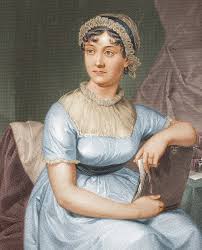
Pride and Prejudice in ten key paragraphs (Part 2)

austen 2Chapter 43 This chapter opens with the fateful visit to Pemberley, where Elizabeth is so anxious to avoid accidentally bumping into Darcy that she travels halfway across the country to visit his family home.

Elizabeth, as they drove along, watched for the first appearance of Pemberley Woods with some perturbation; and when at length they turned in at the lodge, her spirits were in a high flutter.

The park was very large, and contained great variety of ground. They entered it in one of its lowest points, and drove for some time through a beautiful wood stretching over a wide extent.

Elizabeth’s mind was too full for conversation, but she saw and admired every remarkable spot and point of view. They gradually ascended for half-a-mile, and then found themselves at the top of a considerable eminence, where the wood ceased, and the eye was instantly caught by Pemberley House, situated on the opposite side of a valley, into which the road with some abruptness wound. It was a large, handsome stone building, standing well on rising ground, and backed by a ridge of high woody hills; and in front, a stream of some natural importance was swelled into greater, but without any artificial appearance. Its banks were neither formal nor falsely adorned. Elizabeth was delighted. She had never seen a place for which nature had done more, or where natural beauty had been so little counteracted by an awkward taste. They were all of them warm in their admiration; and at that moment she felt that to be mistress of Pemberley might be something!

Indeed, later (ch. 59) Elizabeth tells Jane, only half joking, and in an attempt to persuade Jane that her acceptance of Darcy is sincere, that it was not until she saw Pemberley that she loved him:

“My dearest sister, now be serious. I want to talk very seriously. Let me know every thing that I am to know, without delay. Will you tell me how long you have loved him?”

“It has been coming on so gradually, that I hardly know when it began. But I believe I must date it from my first seeing his beautiful grounds at Pemberley.”

We are of course seeing Pemberley through Elizabeth’s admiring eyes. Her language predominantly uses adjectives relating to size and scale:

“very large, great variety, for some time, stretching over a wide extent, a considerable eminence, a large, handsome stone building, standing well on rising ground, swelled into greater”

No wonder that this demonstration of Darcy’s wealth and power has such a profound impact on her feelings, even if only to persuade her to accept what she has thus far been denying.

Chapter 56 – Lady Catherine comes to confront Elizabeth with the rumours of Darcy’s intentions towards her. Rudely she arrives unannounced, and ignores the rest of the family, instead asking her for a private conversation outside.

Miss Bennet, there seemed to be a prettyish kind of little wilderness on one side of your lawn. I should be glad to take a turn in it, if you will favour me with your company”.

Preserving a corner of one’s grounds for a kind of little wilderness was a Regency fashion, one which wildlife enthusiasts of today would approve. But what is interesting is Lady Catherine’s decision to stage her confrontation in this particular part of the garden, diametrically opposite the more formal manicured lawns of Longbourn. This is a gloves-off challenge, a jungle arena where the usual conventions of language and class are deliberately albeit temporarily set aside. This allows Elizabeth to tap into her inner goddess, and give Lady Catherine a furious response when she attempts to bully her into promising to reject any proposal from Darcy.

Chapter 58 The climatic renewal of Mr Darcy’s proposal:

“You are too generous to trifle with me. If your feelings are still what they were last April, tell me so at once. My affections and wishes are unchanged; but one word from you will silence me on this subject for ever.”

Darcy does not directly profess his love, and the narrator does not tell us Elizabeth’s direct response, only that she

“feeling all the more than common awkwardness and anxiety of his situation, now forced herself to speak; and immediately, though not very fluently, gave him to understand, that her sentiments had undergone so material a change, since the period to which he alluded, as to make her receive with gratitude and pleasure, his present assurances.”

The formality and clumsiness of the narrators presentation of the scene is a brilliant touch – it begins the process of pulling away from the couple and respecting their privacy, and recognises that Elizabeth is not at her most articulate at this point, choked up with emotion rather than formality. It is a wonderful end to the story arc, and shows yet again Austen’s genius in presenting this most compelling of romances.


Standard