Book review

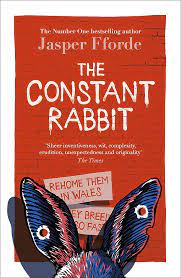
The Constant Rabbit, by Jasper Fforde, 2020

Jasper Fforde is one of our most consistently inventive writers. In The Constant Rabbit he has once again shown this with a surreal allegory which at its heart is about difference. What could so easily have been a heavy-handed satire on Brexit and racism becomes a thoughtful discussion of how people cope with discrimination, both from the perspective of the discriminated against and that of the prejudiced. But I was left wondering whether Fforde at times overstepped the invisible line between dark humour and bad taste.

The central premise of the novel is that in 1965 an “anthropomorphising event” in the UK transformed a small number of rabbits into intelligent, talking, human-scale rabbits. By 2020 their population has grown to over a million. In response to concerns about their impact on the country, the United Kingdom Anti-Rabbit Party, originally a fringe protest group, has taken office in Westminster. Attacks on the rabbit community by hate groups such as TwoLegsGood (a nod to Orwell, of course) are frequent and the courts have decided that rabbits do not merit the protection of the law (any more so than any other animal). For their ‘protection’ the Government is planning to herd all rabbits into an isolated community ominously labelled the Mega-Warren. Society has subtly changed after the years of human/rabbit coexistence, with institutions such as RabCoT, the Rabbit Compliance Task Force, emerging to deal with the Event. Rabbits have developed their own culture of course, a blend of animal and human behaviours, which Fforde expounds on in detail – it’s a strangely recognisable version of our own society but adapted to cope with rabbit life-spans, libidos and compulsion for digging burrows.

Other animals were anthropomorphised as well, most notably foxes, who now murderously predate the human rabbit population without fear of consequences or reprisal. It must be pretty terrifying to be a rabbit in these circumstances, but (we are told) they are used to a life where sudden death is an every day possibility, so are not as bowed by the experience as one might expect. There’s a long and respected tradition of authors using animals as avatars for humanity, looking at our behaviour towards animals as a lens through which to see our behaviour towards one another. This tradition dates through Swift’s Houyhnhnms and beyond to Greek drama. Apart from Beatrix Potter and Watership Down rabbits have rarely been at the centre of this tradition – I suspect mainly because they aren’t very anthropomorphic.

The narrative is told from the point of view of Peter Knox, a rabbit “spotter”. As most humans are unable to distinguish one rabbit from another, spotters play a niche role in enforcing laws against the rabbit population. Knox is uncomfortable with his role within an oppressive state apparatus that spies on its population. He lives with his daughter in the village of Much Wenlock, a rural idyll full of small-mindedness and anti-rabbit bigotry. Into this dangerous and toxic environment comes Constance. Constance was Peter’s friend in university until she was expelled for the offense of being a rabbit. While at university Peter had a huge crush on her, and meeting her again caused all those feelings to come flooding back. Cross species relationships are frowned upon in this alternative reality, but not unheard of. We are invited to think of Connie as cross between Jessica Rabbit and the (inappropriately sexualised) Caramel Bunny. She is also several times smarter than Peter, and manipulates him very easily into supporting the rabbit resistance and leaking sensitive information from his work. Once Peter is sucked into this intrigue, forced to choose between his job and his sympathies for the oppressed rabbit-kind, the adventure rapidly accelerates towards a showdown between the apparatus of the state and the rabbit population.

This was at times a slightly awkward mix of political allegory and lowbrow humour. There are powerful echoes of different national and liberation struggles throughout the novel, from apartheid – the rabbits are prevented from going to university and forced to live in fenced-off communities; to Palestine, the civil rights movement in the USA – rabbits live in fear of sudden attacks from mobs in which they are ‘jugged’ (that is to say, murdered in a grotesque parody of lynching), and many others. Some of the targets are fairly explicit – the Anti-Rabbit Party, lead by Nigel Smethwick, is an obvious reference to UKIP/The Brexit party and Nigel Farage – indeed Rabxit is mentioned a few times.

I never thought I would say this of Fforde, who usually has a very deft touch with his humour, but some of this was in poor taste. Are lynchings, or ‘jugging’, the rabbit equivalent, really a source of humour? I must admit Fforde lost me here – to try to draw laughs out of the obvious parallels with the lynching of black Americans was tasteless (the term ‘jugging‘ comes from the traditional practice of cooking an animal inside a jug which is placed in a pan of hot water). I appreciate this is dark humour for the purposes of satire, and we will all have our own lines that should not be crossed, but this was for me inappropriate – the satire is dark enough as it is. In this world foxes are able to kill rabbits with impunity, and take pleasure in doing so – the main fox character Torquil Ffoxe (Peter’s menacing boss) is credited with killing several thousand rabbits before he meets his well deserved end, and at one point is shown with a bloodied corpse of a rabbit in a sack in his office. This is gruesome stuff, but the tone of the novel rarely acknowledges the bleakness of rabbits’ lives – they are shown as happy-go-lucky, sexually adventurous characters who make a significant contribution to society including serving in the military. They are the good guys from whom humanity could learn a lot.

Satire has no obligation to identify solutions – it points out what’s wrong with the world but doesn’t have to tell us how to sort it out. True to form there’s no call to action here other than to be nice to one another, the standard liberal response to racism and bigotry. The novel’s ending suggests that there is no solution other than escape, an option not available to most oppressed sections of society. If it makes us look afresh at the oppression of marginalised people across the world then it has done its job.

Standard
Book review

In a Free State by V S Naipaul, 1971

The version of In a Free State which won the 1971 Booker prize consists of a framing narrative and three short stories – “One out of Many,” “Tell Me Who to Kill,” and the title story, “In a Free State.” In his introduction to the edition of the novel that I have just read, Naipaul explains that he was originally advised by his editor to publish just the core narrative as a stand-alone novella, without the supporting stories and text, but how at the time he over-rode her advice, and obviously felt vindicated given the Booker award. However, he goes on to say that he eventually came to realise that her advice was correct. In a Free State is now published on its own without the supporting text, and that was the version I read for this review. Part of me thinks that might constitute taking a short cut, and that I ought to go back and read the longer, prize-winning version, but that would be sadistic. The stand-alone version works fine.

This image has an empty alt attribute; its file name is images

In a Free State is set in an unnamed African country that has recently acquired independence from a colonial power. The king has been deposed in an ongoing coup, with the President about to take power. The king and the President are from different tribes, and the delicate balance of power introduced by the colonial government has started to collapse almost immediately after independence.

The narrative is told by Bobby, a Government official. We are never told his role or status, but we are led to understand that he is white and has decided for now to remain in the country. He has been attending a conference in the capital city in the north of the country, the President’s power-base, and he plans to drive back to the south where the King is based. He offers a lift to Linda, the wife of a colleague, who wants to make the same journey.

The night before the journey begins Bobby tries to pick up a young man in the hotel bar. The bartering over price goes badly, and the young man spits in his face. This is a disturbing scene: Bobby has obviously been comfortable paying for sex before now, when his role in Government gave him a position of authority, but now his status is beginning to slip:

“Bobby thought: this boy is a whore. Bobby was nervous of African whores in hotel bars. But he was prepared to bargain. He said

“You are a brave man. Going about with all that cash. I never carry more than sixty or eight shillings on me.”

“You need two hundred to do anything in this town”.

“A hundred at the outside is enough for me”.

The rest of the novella is a traditional road journey across the divided country, with strong echoes of Conrad’s Heart of Darkness. While the Conrad novella is a portrait of a primitive Africa in the early stages of colonialisation, In a Free State is set at the end of Empire. The novel is dominated by images of the decay of the ‘civilisation’ that the white settlers have constructed. The landscape is reclaiming the towns and settlements built by the Europeans and reverting to a more ‘natural’ state, reversing the process of colonisation:

Many of the houses that looked abandoned were occupied, by Africans who had come in from the forest and had used the awkward, angular objects they had found, walls, doors, windows, furniture, to re-create the shelter of the round forest hut. Within drawing-rooms they had built shelters; they had raised roofs on verandah half-walls. Fires burned on pieces of corrugated iron; bricks were the cooking stones.. ..On the sidewalk grass had grown around rubbish from the houses, things that couldn’t be used and had been thrown out: cracked squares of picture glass, fragments of upholstered chairs, mattresses that had been disembowelled for their springs, books and magazines whose pages had stuck together in solid, crinkled pads.

The 2001 Nobel Committee described Naipaul as “Conrad’s heir as the annalist of the destinies of empires in the moral sense: what they do to human beings…His authority as a narrator is grounded in the memory of what others have forgotten, the history of the vanquished”. I’m struggling to relate this comment to In a Free State, which is dominated by the voices and perspectives of the white settlers, with the black characters often sullenly mute, or saying what they are ordered to say. The central characters’ attitudes towards the African people they meet are consistently negative; they are nameless, mostly fat, and there are persistent references to how they “stink,” and smell like “rotting vegetation.” That in itself doesn’t invalidate the novel – what Empire does to the imperialists is something worth exploring – but it doesn’t feel like a history of the vanquished.

Bobby is a unlikeable character. His recent experience of mental illness is mentioned but not explained – as a representative of the colonial power I read this as suggesting that colonialism itself is sick. It is possible that Naipaul intended the same suggestion by making Bobby gay (there is one bizarre episode where he is repulsed by the concept of a vaginal deodorant!). Midway through their increasingly difficult journey Bobby and Linda, (such bland European names) spend the night at a hotel run by a colonel who treats his African servants like slaves. The hotel was built to attract European tourists to the area, and is in an obvious and accelerating state of decay, with only muddy water coming out of the taps. (The echoes of these scenes with J G Farrell’s Troubles, another portrait of a military figure trapped in a decaying hotel at the end of Empire, are inescapable. Did this theme, also central to Something to Answer For, really dominate the English novel of the 1960s and 70’s, or is this a coincidence?) The Colonel fully expects to be murdered one day by the servants he abuses. Bobby has another unsuccessful attempt to pick up a young man for sex; he also seems trapped in a cycle of failure and frustration.

The road journey format of the novel works well, building the suspense as the military presence in the area increases and they approach their destination. Towards the end of the journey Bobby is beaten by some soldiers at an army checkpoint, a beating he accepts stoically as the price of his presence in this part of the world. Finally the compound is reached, and while the rest of the town and countryside is in flames, the area preserved for white settlers seems untouched. Perhaps this suggests that the real price of being in a Free State is paid by the freed rather than by the colonialists?

I didn’t enjoy In a Free State at first. The central characters are unappealing. The descriptions of the countryside are repetitive and a bit flat.

The verges widened; a few tarnished villas were set in large gardens. There was a roundabout, its garden still maintained, and the highway entered the town. Cross-streets, each with a new black-and-white board bearing the name of a minister in the capital, could be seen to end in mud after two or three hundred yards. The town had been built to grow. It hadn’t grown. It remained a collection of old tin-and-timber buildings, its flimsiness pointed by the small new bank building, the motor car and tractor showroom. The mud-splashed police barracks, low white concrete sheds flat to the ground, already looked like the hutments of the African quarter in the capital.

But while this is without doubt a book that is hard to warm to, my instinct is that it will grow on me.

Standard
Book review

Troubles, by J G Farrell, 1970

It’s really nice to now be able to give an early Booker prize-winning novel a positive review, after having severely panned John Berger’s G., followed by the indifferent Something to Answer for.

Because Troubles was wonderful. (OK, strictly speaking Troubles isn’t an ‘early’ Booker prize winner. It won the Lost Booker Prize in 2010, when the absence of a book published in 1970 in the series, caused by a change in the qualification rules, became too difficult for people who don’t like interrupted sequences to bear. But it was published in 1970, which in my book counts as early.)

Troubles tells the story of the final years of a once grand Irish hotel, the Majestic, during the years of the Irish War of Independence (1919–1921). It is the first instalment in what is sometimes described as Farrell’s ‘Empire Trilogy’, preceding The Siege of Krishnapur and The SIngapore Grip, although I am not sure the term ‘trilogy’ is appropriate for three novels that are only loosely connected. It was widely praised when first published, and rightly so.

The novel opens in 1919, when, after surviving the horrors of the First World War, although not without some psychological wounds, Major Brendan Archer travels to Ireland to try and discover whether he is engaged to Angela Spencer, a young woman who he met while on leave in England, and who wrote to him thereafter describing herself as his fiancé. (“He remembered declaring that he would come back to her, but not very much else.”) Angela’s Anglo-Irish family owns the ramshackle and ironically named Majestic Hotel. The hotel is enormous, with hundreds of rooms and just about every facility you can imagine, from swimming pools to squash courts and ballrooms, all of which are derelict and out-of-order. (One of the more surreal aspects of the novel is the way the hotel seems to expand in scale all the time, with new floors, cellars, grounds etc constantly being revealed.) The hotel is falling apart. It barely functions as a hotel with only a handful of guests. Herds of cats have taken over the upper stories. The term “herding cats” is used in this novel to describe the difficulty of getting a large group of cats to do what you want them to do – it is possibly the origin of the phrase, although all online references refer to later origins:

“It is impossible to control a herd of cats; each one makes up its own mind where it wants to go.”

The Majestic quickly becomes the dominant character of the novel, a symbol of both Empire and Ireland. While it is a hotel, it might be easier to think of it as a castle. That way the novel’s place in the tradition of gothic novels makes a lot more sense. What is unusual if not unique about Troubles is that there is no attempt to underplay or disguise the use of symbolism. The hotel may as well have been called ‘The Empire’ or ‘The Symbol’! Most novels which use symbolism as central features of the narrative are far less direct – the reader is left to do some of the work, and the symbol is more elusive than a shameless X = Y. Any close correlation between the symbol and the symbolised often leads to the narrative becoming a parable. (I am thinking for example of Animal Farm). Troubles is the only novel I can think of where there is no attempt to separate the symbol from its signifier. The novelist places the equation front and centre and constantly draws explicit parallels between the two components. A good example of this is the cats with orange fur and green eyes which breed in vast numbers, over-run the upper floors of the hotel and die violently at the hands of the Major and Edward Spencer, the hotel’s Anglo-Irish owner. A reader would have to be particularly dim-witted to not notice the (uncomplimentary) parallels between the cats and Ireland’s Catholic population. If any such reader were to be in need of further help interpreting the novel, Farrell intersperses the narrative with a series of increasingly dark news articles about the Troubles and the decay and breakdown of colonial order throughout the Empire.

I’ve already mentioned the slightly surreal nature of the narrative. This is a hotel where the Addams Family would have felt at home:

In the foyer at the foot of the vast flowing staircase there stood a statue of Venus; a dark shading of dust had collected on her head and shoulders and on the upper slopes of marble breasts and buttocks. The Major screwed up his eyes in a weary, nervous manner and looked round at the shabby magnificence of the foyer, at the dusty gilt cherubs, red plush sofas and grimy mirrors.
“Where can everyone be?” he wondered. Nobody appeared, so he sat down on one of the sofas with his suitcase between his knees. A fine cloud of dust rose around him.
After a while he got to his feet and found a bell … The sound echoed over the dusty tiled floor and down gloomy carpeted corridors and away through open double-leafed doors into lounges and bars and smoking rooms and upwards into spiral after spiral of the broad staircase (from which a number of brass stair-rods had disappeared, causing the carpet to bulge dangerously in places) until it reached the maids’ quarters and rang in the vault high above his head … from this vault there was suspended on an immensely long chain, back down the middle of the many spirals from one floor to another to within a few inches of his head, a great glass chandelier studded with dead electric bulbs … all was silent again except for the steady tick-tock of an ancient pendulum clock over the reception desk showing the wrong time.

The plants in the Palm Court begin to take on a life of their own and tear apart the hotel. Animal deaths abound – cats are shot and have their heads smashed against the wall, a peacock is throttled for its feathers, and the piglets are slaughtered by ‘Shinners’ (Sinn Fein supporters). Murphy, a sinister servant lurks in the darker corridors, muttering to himself, while the hotel’s owner, Edward Spenser, plans to conduct medical experiments on him. The old ladies who constitute the hotel’s few surviving guests play whist and act as a chorus to the action of the novel, while Edward’s elderly mother seems to live in a cupboard, emerging once a day for dinner clutching an unloaded revolver. It’s quite mad! I read that it has been filmed once, but I would love to see a series made of it, Downton Abbey on acid. There’s enough material for several series in fact.

There are a couple of scenes that over-step the mark. In one, a soldier tries to rape one of the teenage Spenser twins, who is unconscious having drunk too much. He fails because she is wearing multiple layers of under-garments:

“It’s not at all easy to undress someone who is unconscious – and Charity was wearing a great many layers of clothes. Fortunately Matthews was deft and experienced at removing ladies’ garments”

The scene is played as dark humour; in the neighbouring bedroom her twin is with another soldier who is desperate to avoid sex because of what appears to be his latent homosexuality, possibly scarred by an unpleasant experience in a brothel in France:

“He had only to close his eyes to see glittering-ringed fingers parting thick white curtains of fat to invite him into some appalling darkness”.

The other scene which has not aged well is in which Padraig, a friend of the family, is encouraged by the twins to dress up in women’s clothing, and thereafter habitually dresses a woman. His change in appearance is accepted and even welcomed by the hotel’s residents, but towards the end of the novel he is thrown into the hotel’s abandoned swimming pool (fortunately still filled) by some rowdy soldiers. Again this is written largely as a comic scene, but the homophobic/transphobic bullying is uncomfortable reading to a modern reader.

It is a coincidence that I read this novel immediately before Something to Answer for, which addresses the end of the next phase of colonialism. Troubles makes a great companion piece to the Newby novel, sharing a similar structure – a colonial possession seen through the eyes of an Englishman abroad as the period of English rule draws to an end. But while Something is unstructured and a mess, Troubles is a carefully controlled dark farce. It’s one of the best, most original novels I have read in a long time. it could so easily have descended into chaos but manages to balance all the elements with considerable skill. The romantic elements – the Major develops an unrequited love for a local woman who flirts with him but avoids any further attempts at intimacy – are probably the least successful, and the dramatic ending is revealed in the opening pages and are therefore devoid of any suspense. But the success of the novel is in the portrait of the decaying, mad hotel and its inhabitants, as the try to avoid the inevitable and almost succeed.

Standard
Book review

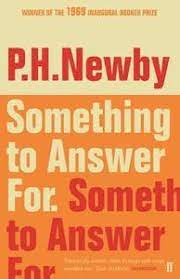
Something to Answer For, by P H Newby, 1969

Let’s be honest – this novel would be out of print and gathering dust if it wasn’t for it being the winner of the inaugural Booker prize in 1969. That’s really its only point of interest. Otherwise the plot is banal to the extent that it exists at all, the characterisation outside the handful of central characters is slim, and the commentary on the Suez Crisis (as it is euphemistically known in the UK) is worthy but dated.

Set in 1956 at the time of said ‘crisis’, the unappealing central character, Townrow has returned to Port Said in Egypt, a place he first visited when in the army in the Second World War. He now works for a charitable trust which he finds it much easier to embezzle than to administer. He has returned to Egypt at the request of Mrs Khoury, the widow of an Egyptian friend Townrow had made during the war. Mrs Khoury believes her husband was murdered and wants Townrow to investigate. Townrow has no intention of doing any investigating – instead he is interested in drinking, womanising (in a very disinterested, lazy way) and looking for opportunities to con Mrs Khoury out of her estate. On his first night back in Egypt he gets drunk, is attacked and suffers a head injury which leaves him dazed and disorientated for the remainder of the novel.

In parallel, Egypt nationalises the Suez Canal precipitating said crisis, which unfolds around Townrow as he stumbles through the various staged incidents which pass for a plot. Townrow is confused about his nationality, underlining the ambiguity of his status as a representative in the novel of the occupying powers. He recalls a conversation he had with a passenger he met on route to Egypt who accuses Britain of having been aware of the holocaust but doing nothing to warn European Jews of the threat to their lives, a claim he rejects forthrightly. It is not clear if we are intended to take this claim seriously – is British guilt by association for the holocaust linked with the creation of Israel? Decoding the politics of this novel is difficult given the distance of the decades, even if Newby’s overall point is relatively clear.

The humour of the novel, which relies mainly on farce, has faded badly since the late 1960’s. The imperial mindset in which one waved a British passport and shouted loudly at foreigners in obviously not completely a thing of the past, but it is no longer much of a target for satirists either, to the extent of incomprehensibility. Newby’s satirising of the British imperial mindset is simply ineffective – the fact that the Suez crisis marked the end of Empire was hardly much of an insight, even in 1969. The farcical elements of the novel are clumsy and unconvincing confusion, ostensibly the result of his knock on the head, muddles the narrative to the extent that not only can the reader not work out what is happening, whether what we are being told is one of his dreams, memories or ‘real’ events, to the extent that one quickly stops caring.

There probably is a novel to be written about the Suez Crisis and its impact on British attitudes to its colonial past. There are many examples of ‘an Englishman Abroad’ novels, the confused, well-meaning and mild-mannered ex-pat trying his best not to be racist (for example, this example from the inevitable Kingsley Amis) and being successful in his seduction efforts simply on the strength of his Englishness. But Newby’s decision to write a psychedelic novel in which the reader is constantly disorientated, however modern and experimental it may have been in the 1960’s, now falls flat. Yes, I get it that Townrow’s head injury, the resulting confusion and his loss of faith in British decency is an effective symbol of the changing nature of the national psyche following the post-war loss of Empire – but it doesn’t make it a good novel.

As a central character, Townrow is pretty unappealing. He’s a crook, has very dated views towards women, Jews and Egyptians, and has few redeeming features. Some novels with anti-heroes at their centre are successful because the protagonist is charming, a rogue, etc – we like them despite their failings. But I’m afraid I can’t say the same of Townrow – there’s simply not enough substance to the character to like.

There are a lot of bloggers out there who start out with the intention of reading all of the Booker prize winners, but who don’t make it. Part of the reason for this might be because some of the early winners are duds, which haven’t stood the test of time. Something to Answer for falls into that category I’m afraid – I can imagine a lot of readers thinking “sixty more novels like that – no thanks!”. The good news is there are a lot more strong novels in the list of winners than duds, so the reward is there for the persistent. But outside the ranks of Booker completists or would-be completists I can’t imagine this novel will have retained much of a wider audience at all.

Standard
Book review

Bartleby the Scrivener, by Herman Melville, 1853

Herman Melville’s ‘Bartleby the Scrivener, A Story of Wall Street‘ tells the curious story of a scrivener – a copyist – who gives up on work and life, responding to all requests for him to do anything with the simple “I would prefer not to“. The narrator, his employer, knows almost nothing about Bartleby – he remains an enigma throughout the story. His reasons for declining specific tasks and then for stopping work altogether are let to the reader to decide.

The story opens with an introduction by the narrator, an elderly New York lawyer. He employs two clerks, Nippers and Turkey, to copy legal documents by hand. Nippers and Turkey are, as their names suggest, comic figures, both with substance abuse issues. The narrator, looking to expand his business, hires Bartleby, partly in the hope that he will moderate the extremes of temperaments of the other two. Initially Bartleby is an exemplary worker, but one day, when asked to help proofread a document, he answers with what soon becomes his catchphrase:

“I would prefer not to”.

Bartleby slowly shuts down, completing less and less work and spending long periods of time staring out one of the window at a brick wall. All attempts to persuade him to do some work or to leave fail, so eventually the narrator himself moves out. The new tenants come to him to ask for help in removing Bartleby, who now sits on the stairs all day and sleeps in the building’s doorway. Finally Bartleby is forcibly removed and imprisoned where he dies of starvation. The story closes with the narrator’s refrain, “Ah Bartleby! Ah humanity!”. (This phrase reminded me of the words of the newscaster at the explosion of the Hindenburg).

This is an enigmatic story, not what I was expecting at all from the author of Moby Dick. It’s an intense psychological piece reflecting on the pointlessness of the human condition that could easily have come from a French existentialist author. It is also a very personal piece – for an author to imagine a character who thinks writing – scrivening – is a pointless, empty activity is in some ways quite shocking. Melville is very much ahead of his time in other ways – Bartleby can be read as a warning of the industrialisation of office work in which people are hemmed into ever smaller cubicles without any personal life outside the office, eating meagre meals at their desk, performing menial repetitive tasks for little reward (Bartleby moves into the lawyers office and never seems to leave).

“Ah, Bartleby, Ah humanity”.

Bartleby is a short story but an immensely impactful and surprising piece that I am very glad to have read – it gives another dimension to one of America’s most significant authors who I had previously only known through Moby Dick.

Standard
Book review

G. by John Berger, 1972

The Bad Sex prize was set up in 1993 by Auberon Waugh, with the intention of “gently dissuading authors and publishers from including unconvincing, perfunctory, embarrassing or redundant passages of a sexual nature in otherwise sound literary novels”. It’s such a pity that the award wasn’t around when John Berger published G., because he would have run away with it. Perhaps they should introduce a retrospective prize?

Set at the end of the nineteenth and early twentieth century, G. is the story of a modern Don Juan, someone totally focussed on the pursuit of sex, to the exclusion of any other concerns or interests. Women fall out of their clothes and sleep with him at the first opportunity – he is irresistible to them. Strange how women only behave like that in novels written by men, isn’t it? Contemporary historical events, such as the outbreak of the First World War, are used as a backdrop to his sexual adventurism.

Trigger warning for very badly written sex:

“She opens her legs. He pushes his finger towards her. Warm mucus encloses his finger as closely as if it were a ninth skin. When he moves the finger, the surface of the enclosing liquid is stretched – sometimes to breaking point. Where the break occurs he has a sensation of coolness on that side of his finger – before the warm moist skin forms again over the break. She holds his penis with both hands, as though it were a bottle from which she were about to pour towards herself.” (109)

Berger was an art critic, and apparently developed the concept of the male gaze, (in feminist theory, the male gaze is usually defined as “the act of depicting women and the world, in the visual arts and in literature, from a masculine, heterosexual perspective that presents and represents women as sexual objects for the pleasure of the heterosexual male viewer”) which makes it all the more remarkable that his writing about sex is completely from the male perspective, devoid of any empathy with women. Reddit has a forum called “Men writing about Women” which collects examples of men demonstrating their ignorance of female anatomy. Berger would fit right in there as well:

When he enters her, when this throbbing, cyclamen headed, silken, apoplectic fifth limb of his reaches as near to her centre as her pelvis will allow, he, in it, will be returning, she believes, to the origin of his desire.” (204)

If this cyclamen headed monstrosity wasn’t enough, the scene is illustrated by a childish sketch of a “fifth limb” that would not be out of place on a bathroom wall.

Later Berger pontificates on the differences between men and women:

If a woman threw a glass on the floor, this was an example of how she treated her emotion of anger and so of how she would wish it to be treated by others. If a man had done the same, his action would only have been an expression of his anger….This subjunctive world of the woman, this realm of her presence, guaranteed that no action undertaken within it could ever possess full integrity”. (150)

I’d like to think our understanding the differences between the sexes has matured somewhat since the early 1970’s!

I appreciate this all makes me sound very prudish, but to be clear, my concern isn’t with the fact that Berger describes sex, it is that he describes sex so very badly. But this isn’t just a bad sex novel. It’s a bad everything novel. The sex is as bad as the rest of the novel I am sorry to say. There are scenes of such intense embarrassment that I very nearly gave up –only the most stubborn completist streak in me kept me going. In a clumsy attempt at post-modernism, random fourth wall breaks are introduced into the text with irritatingly pompous asides by the author or narrator, such as

Some say of my writing that it is too overburdened with metaphor and simile: that nothing is ever what it is but is always like something else. This is true, but why is it so? Whatever I perceive or imagine amazes me by its particularity.” (136)

I know of course that this is intended, along with the fragmented narrative and various other ostentatious techniques to tell the reader that this is a post-modern novel where their expectations will be regularly confounded. It tries hard to be innovative and European, but underneath it all is a rewarmed version of a traditional sexual adventurer’s story.

I have written about this before, but one thing I can’t stand in realist novels is inauthenticity. Characters behaving in a mannered, unrealistic and obviously fictional way, not because the author wants to make it clear this is a non-realist text but because the author can’t write realistically. There is one scene in G. where this point was illustrated perfectly. G. is buying a woman, Camille (he endearingly calls her Camomile) a pair of Italian leather gloves, as part of his whole flawless, irresistible seduction technique:

“The Italian woman blew into the second glove before passing it to Camille. Filled with her breath, the glove took on the form of a hand which suddenly and deeply frightened Camille. It was a languid boneless hand, a hand without will, a hand floating in the air like a dead fish with its white stomach uppermost.” (172)

If you can persuade me that anyone, ever, was frightened by a glove, however fragile and nervous they might be, while buying a pair of gloves then I will give up reading this minute. It’s the second glove as well – it’s not like the gloves loomed up at her unexpectedly. This irritated me far more than it ought to have done, but for me it is the cardinal sin of the novelist. The characters become themselves mere puppets, tools of the novelist to display archetypal feelings or reactions, all to further the novel or avoid a plot complication. It’s not absurdist or experimental, it’s bad. Defenders of this novel will claim this alienation technique is deliberate, and that I am being far too literal in my reading. Which of course is quite possible. Is this a clumsy technique to ensure the reader pays attention to the construction of the novel as a cultural artefact? Or is it just bad writing? Some authors have earned the benefit of the doubt, and I will usually try to work out what really is going on when I am pulled up short by some apparently awful writing. But Berger, an English art critic, essayist, novelist, painter and author, hasn’t earned that degree of commitment from me as a reader.

Time can be cruel to a novel and novelists. G. was once deemed by a Booker prize jury to be the best novel written in 1972, albeit against a pretty forgettable shortlist (Susan Hill’s The Bird of Night, Thomas Keneally’s The Chant of Jimmie Blacksmith, and David Storey’s Pasmore. Both Keneally and Storey were to go on and win the prize themselves. Susan Hill said of her The Bird of Night that it “was a book I have never rated. I don’t think it works, though there are a few good things in it. I don’t believe in the characters or the story.”) Now G. is largely forgotten, unread except by Booker winner completists, and sometimes not even then. It’s not all bad, there are moments of interest – the description of the battles of World War One are actually readable. But these are brief interludes in the otherwise stultifying descriptions of G.’s attempts to seduce yet another young woman interspersed with the author’s pontifications on whatever idea had briefly captured his attention.

P.S. Goodreads says of Berger that “One of the most common themes that appears on his books is the dialectics established between modernity and memory and loss”. (That should be in his books surely?) Anyway, does anyone know what “the dialectics established between modernity and memory and loss” means?

Standard
Book review

The Testaments, by Margaret Atwood, 2019

This review is going to get me into trouble, at home if nowhere else. Because The Testaments was such a disappointment! While living up to the standards of her earlier works was always going to be difficult, some elements of the novel were reminiscent of fan-fic – based in the world so chillingly described in The Handmaid’s Tale, but unevenly written with poorly conceived characters and an implausible plot.

Of course I could self-censor, write about the things in the novel that I did like – Gilead is no less a scary dystopia than it was before, and of course Atwood hasn’t become a bad writer overnight – but what would be the point of that? If this blog has any purpose at all it is to act as a place where I record my authentic impressions of what I read, not what I am supposed to think. Having said that, I also owe any author, let alone one of such distinguished status as Margaret Atwood, the effort of trying to recognise the strengths in their work. So let’s start there.

Atwood’s political analysis of the oppression of women hasn’t fundamentally changed from Handmaid’s, but it remains as sharp as ever. For example, where she identifies what made women particularly vulnerable when Gilead first took over:

“All that was necessary was a law degree and a uterus: a lethal combination.”

Young women growing up in Gilead are brain-washed into thinking their bodies are the source of all sin:

“We were precious flowers that had to be kept safely inside glass houses, or else we would be ambushed and our petals would be torn off and our treasure would be stolen and we would be ripped apart and trampled by the ravenous men who might lurk around any corner, out there in the wide sharp-edged sin-ridden world.”

What has changed from Handmaid’s is that Atwood identifies the role of women as instruments of their own oppression. Some women are zealots who seem to genuinely believe men are the stronger sex who have the right to control women’s bodies; others simply do what they have to do to survive. As Aunt Lydia tells us:

Two roads diverged in a yellow wood, and I took the one most travelled by. It was littered with corpses, as such roads are. But as you will have noticed, my own corpse is not among them.”

The threats to women’s autonomy remain as significant as they were when Handmaid’s was written – but arguably that just makes the original novel all the more pertinent rather than requiring a sequel. Atwood’s reasons for writing this follow-up may well be as much to do with the success of the television adaptation as a burning desire to explore further the complexities of Gilead. I can’t blame her for that, and to be fair she doesn’t just write Handmaid’s Tale 2.

The original novel has an ambiguous ending. We know, due to the appendix, that Gilead doesn’t survive, but we don’t know how the regime ends, and we know nothing about the fate of the central character, Offred. We don’t even know her real name. Atwood has returned to Gilead to answer some of these questions. The novel uses the always popular multi-narrator approach, threading the testimonies of three key women. We hear more from Aunt Lydia about the circumstances in which Gilead and its institutions were founded, how it survived despite conflict on all its borders, and how eventually it fell. I haven’t worked out a clear timeline for the events of the novel, but the whole period seems little more than a few decades from creation to fall.

We also learn about life outside Gilead, in Canada and elsewhere, and the efforts of Mayday, an underground organisation, to rescue women from Gilead. Their work is consciously modelled on the Underground Railroad.

The Testaments by Margaret Atwood | Penguin Random House Audio

As well as Aunt Lydia’s narrative the novel interweaves testimonies – testaments – by two teenage girls, Agnes, the adopted daughter of Commander Kyle and his wife Tabitha, and Daisy, growing up in Toronto with her adoptive parents, Neil and Melanie, who run a second-hand clothes store. The three narrators alternate in short chapters which gave considerable pace to the narrative. It was obvious early on that the secrets about Daisy and Agnes’s parentage would be revealed, and how the threads of the narrative would eventually join.

Aunt Lydia is the dominant character in the novel – shrewd, knowledgeable, and a survivor. She is not above suspicion, but is able to manipulate (a little too easily) the characters around her to protect herself, while all the time working to undermine Gilead. The teenage girls show two completely different views of Gilead – Agnes has been born and raised in the country and has adopted its worldview unquestioningly. She has been taught that women must cover up to avoid inflaming male passions, and that reading is a source of sin. Her body is dangerous and she must be married at an early age to fulfil her purpose of having children. She is profoundly religious and keeps her faith even when her belief in the ideals of Gilead are shaken. Daisy on the other hand, having been raised in Canada, is an atheist and is opposed to everything Gilead stands for. She happily volunteers to go undercover into Gilead to recover some damning information about the regime, despite the obvious dangers.

Despite its status as a feminist novel of ideas, The Testaments works most effectively as an action novel. The climax of the narrative features a breathless escape from Gilead, with speedboats and helicopters thrown in for good measure, secret information hidden in a micro-dot (how very 1970’s!) hidden under one of the girl’s skin, disguised by a GOD/LOVE tattoo.

Atwood’s skill as a writer is without question, but her ability to craft a phrase stands out:

“The truth can cause a lot of trouble for those who are not supposed to know it.”
“how easily a hand becomes a fist.”
“No one wants to die…but some people don’t want to live in any of the ways that are allowed.”

That skill falters slightly when she writes as a teenage girl, where an element of inauthenticity appears. Would a teenage girl, even when writing in later life, write “Nobody is any authority on the fucks other people give“? Much quoted (in reviews) phrases such as “You don’t believe the sky is falling until a chunk of it falls on you” or “As they say, history does not repeat itself, but it rhymes” sound quite impressive on a first reading but I am not sure they actually mean anything.

So what’s the problem with The Testaments? I’ve touched on some of the issues above. But my main concern was with the action elements of the novel. Perhaps they would work better on television, but on the page they came across as a parody of a spy novel. What is more they didn’t really make any sense. I found Daisy’s decision to return to Gilead disguised as a Pearl Girl (a missionary) completely unconvincing, and Commander Judd’s decision to keep quiet about her return was baffling. Of all the people you would send back to Gilead to recover some vital intelligence, Daisy would be the very last choice. And once her return to Gilead was known why the Commander would keep it quiet and allow her to escape back to Canada I have no idea.

Other elements such as the casually announced death of one of the minor characters suggested a rush to end the novel and tie up loose ends without thinking through the detail. There were other signs of this, such as how trainee aunts, totally illiterate when they arrive at Ardua Hall in their mid teens, are fluent readers in a few months despite starting with modestly coloured-in Dick and Jane books.

Despite all this I enjoyed reading this novel. I recognise I should probably consider it on its own merits rather than as the sequel to an iconic classic. It’s ironic that this won the Booker rather than the original, which is probably the judges’ way of correcting history. I am pretty sure that Handmaid’s will be read in decades if not centuries to come as an important statement of protest at society’s treatment of women, while The Testaments will be remembered as a less interesting addendum.

Standard
Book review

An Occurrence at Owl Creek Bridge, by Ambrose Bierce, 1890

Recently I came across this gem of a post on the ever-wonderful LitHub about the best short stories ever written and it prompted me to guiltily read more of this neglected (by me) genre (although this is a great list, there are some obvious omissions; Ray Bradbury’s A Sound of Thunder is missing for a start. A Sound of Thunder is the “butterfly effect” story in which time-travellers to the age of the dinosaurs inadvertently affect the future.) Most of the stories on this list can easily read in less than an hour and they are usually available for free on the internet.

An Occurrence At Owl Creek Bridge eBook: Ambrose Bierce: Amazon.co.uk:  Kindle Store

I started with An Occurrence at Owl Creek Bridge for reasons of nostalgia. I have a vivid memory of being shown the film adaptation of this story in school one day – I have no idea in what lesson – and to this day it seems a very dark film to show schoolchildren.

An Occurrence is a/the near perfect short story. The title is carefully understated, but we soon learn the nature of the occurrence due to happen on the bridge – a man is to be hung. You probably are familiar with the story and its wonderfully executed (forgive me) twist, but just in case you aren’t I am going to avoid summarising the plot – with the whole story running to only a handful of pages any summary would be largely redundant anyway.

Kurt Vonnegut famously described An Occurrence as “that greatest American short story….a flawless example of American genius“. Without wanting to pick an argument with Mr Vonnegut there’s nothing uniquely American about the story nor its conception. Being just an American story would diminish it. Its universality lies in the use of point of view narration. The reader trusts the story we are being told by the captured (and clearly guilty) plantation owner about to be hung from the bridge because we have been taught to trust narrators. Why would someone about to die mislead us about what happens. His apparent escape from his fate is plausible simply because of the conventional understanding that he must have survived in order to tell his tale.

The narrative emphasises the mundane and everyday nature of what is happening. This is an occurrence, nothing more. A man is about to die, but this is something that in war happens all the time. The setting is just Owl Creek Bridge, an insignificant bridge over an insignificant stream. Everyone involved in the execution is calm and business-like, even the condemned man himself. Everything is ordered and well-prepared.

A man stood upon a railroad bridge in northern Alabama, looking down into the swift water twenty feet below. The man’s hands were behind his back, the wrists bound with a cord. A rope closely encircled his neck. It was attached to a stout cross-timber above his head and the slack fell to the level of his knees. Some loose boards laid upon the ties supporting the rails of the railway supplied a footing for him and his executioners—two private soldiers of the Federal army, directed by a sergeant who in civil life may have been a deputy sheriff. At a short remove upon the same temporary platform was an officer in the uniform of his rank, armed. He was a captain. A sentinel at each end of the bridge stood with his rifle in the position known as “support,” that is to say, vertical in front of the left shoulder, the hammer resting on the forearm thrown straight across the chest—a formal and unnatural position, enforcing an erect carriage of the body. It did not appear to be the duty of these two men to know what was occurring at the center of the bridge; they merely blockaded the two ends of the foot planking that traversed it.

The execution is being carried out with military precision, so it is a shock when, remarkably, an opportunity to escape appears:

All at once, with terrible suddenness, the light about him shot upward with the noise of a loud splash; a frightful roaring was in his ears, and all was cold and dark. The power of thought was restored; he knew that the rope had broken and he had fallen into the stream. There was no additional strangulation; the noose about his neck was already suffocating him and kept the water from his lungs. To die of hanging at the bottom of a river!—the idea seemed to him ludicrous. He opened his eyes in the darkness and saw above him a gleam of light, but how distant, how inaccessible! He was still sinking, for the light became fainter and fainter until it was a mere glimmer. Then it began to grow and brighten, and he knew that he was rising toward the surface—knew it with reluctance, for he was now very comfortable.

An Occurrence is much more than a commentary on war and what men will do for their country. It reminds us that life is short and sweet, and that our perception of time can be strangely distorted in the moment. It also teaches us that narrators and authors can be misleading, and that wishful thinking is a powerful thing. It is also an object lesson in the importance of close and careful reading. If you just engage with this text as an adventure story you will almost certainly miss the clear indications that there is more to this story than the narrator tells us. Bierce wrote about “bad readers—readers who, lacking the habit of analysis, lack also the faculty of discrimination, and take whatever is put before them”. I don’t think there is such a thing as a bad reader, but we can all read more carefully and analytically, not taking at face value what we are told, whether it be a short story, a novel, or the news on our screens, and An Occurrence is an object lesson in why this an important skill.

An Occurrence at Owl Creek Bridge, by Ambrose Bierce, 1890

Aside
Book review

Girl, Woman, Other by Bernadine Evaristo, 2019

When is a novel not a novel? When it is, as here, a collection of loosely related narratives, or a “collage of well-composed individual stories” as one reviewer described it, without much in the way of plot. Is the distinction an important one? I think so, but let’s come back to that question.

Girl, Woman, Other tells the stories of the lives of the novel’s 12 principal characters. Most the large cast of characters are black and mixed race women, and of course their stories focus on this aspect of their lived experience. The book is divided into four chapters each telling the stories of three women who are connected to one another in some way. Although each story is a separate and often compelling narrative in its own right, they slowly interweave to create the overall narrative. The novel’s focal point to which it returns from time to time is the opening night of a ground-breaking new play, The Last Amazon of Dahomey. The implicit point is that all of the women portrayed in the novel are one way or another Amazons themselves, warrior women who have had to fight for everything they have achieved.

While GWO has been widely lauded, and of course won the 2019 Booker prize (jointly with Margaret Atwood’s sequel to The Handmaid’s Tale, The Testaments), the author’s choice to not use capitals and full stops to signal the start and end of sentences has upset some readers disproportionately. A good example is this passionate post from the Orangutan Librarian. For me, this wasn’t really an issue. Rules are there to be broken by writers and I found I quickly adjusted to the convention the author used to signal a new sentence, namely a line break. To an extent this made the choice to abandon full stops etc fairly pointless (sorry). I assume the author was aiming for a free-flowing representation of the characters’ internal monologues, something akin to stream of consciousness. Because my mind reconstructed the sentence structure fairly easily, and after while without noticing, this effect was largely lost.

It is hard to write this without sounding spiteful, but my main concern with GWO was not the choices around punctuation, but the quality of the writing. As an experiment I opened my copy of the text at random half a dozen times, and noted the following:

“he sold the farm for a song” (178)

“the two love-birds sat holding hands on the sofa” 269

“over time Shirley became an experienced schoolteacher who remained committed to giving the kids a fighting chance” (sorry forgot to note page number!)

“Mummy went through the roof, literally exploded like a rocket” 205

“it’s way too early for the youngsters to begin their death-defying leaps and twists without helmets or knee-pads” (23)

“apparently Tyrone, Section Manager of Electronics and Appliances, has a thing for her” (213)

(Incidentally, I can’t resist pointing out that the author’s rejection of capitals doesn’t extend as far as names and job titles!)

The weight of cliché here is, for me, problematic. Of course it is difficult to represent people’s internal monologues without using cliché if that’s how you think they would express their thoughts. But do people really think in clichés? In any event most writers would try and find a way around that issue rather than just weighing down the narrative with an accumulation of stale expressions.

The text only really takes off and becomes lyrical and expressive when political views are being discussed. Some reviewers have found this aspect of the novel didactic. I didn’t see it that way – each character represented is shown as having their own prejudices and biases, and there is no single perspective that is endorsed as being definitive, simply that we all carry our own burden of experiences and ideas, which change over time. That’s not to say the novel is entirely neutral, respectful of all views. Right wing readers will struggle with the representation of the progressive portrayal of oppression in all its forms that the women in the novel experience. The discussion of white privilege between the students in the novel is entertaining as well as being informative:

People won’t see you as just another woman any more, but as a white woman who hangs with brownies, and you’ll lose a bit of your privilege, you should still check it, though, have you heard the expression, check your privilege, babe?
Courtney replied that seeing as Yazz is the daughter of a professor and a very well-known theatre director, she’s hardly underprivileged herself, whereas she, Courtney, comes from a really poor community where it’s normal to be working in a factory at sixteen and have your first child as a single mother at seventeen, and that her father’s farm is effectively owned by the bank
Yes but I’m black, Courts, which makes me more oppressed than anyone who isn’t, except Waris who is the most oppressed of all of them (although don’t tell her that)
In five categories, black, Muslim, female, poor, hijab bed
She’s the only one Yazz can’t tell to check her privilege
Courtney replied that Roxane Gay warned against the idea of playing ‘privilege Olympics’ and wrote in Bad Feminist that privilege is relative and contextual, and I agree, Yazz, I mean, where does it all end? Is Obama less privileged than a white hillbilly growing up in a trailer park with a junkie single mother and a jailbird father? Is a severely disabled person more privileged than a Syrian asylum-seeker who’s been tortured? Roxane argues that we have to find a new discourse for discussing inequality

While many characters are well rounded in all their flawed humanity, others are more lightly sketched and less convincing. One example is Roland, Yazz’s father, who at one point describes his partner’s disturbing way of rejecting homophobia:

“Sylvester shouting Take that, Maggie T! at the point of ejaculation was quite off-putting” (407)

Did anyone ever call Mrs Thatcher “Maggie T”? Surely it was either Maggie or Mrs T? This lack of authenticity in a novel grounded in attempts to accurately reflect the experience of black and mixed race women growing up and growing old in the UK was disappointing but probably the exception, although this lack of authenticity is echoed elsewhere by some of the exchanges on race and feminism:

“We should celebrate with that many more women are reconfiguring feminism and that grassroots activism is spreading like wildfire and millions of women are waking up to the possibility of taking ownership of our world as fully-entitled human being how can we argue with that?” (said after two bottles of red wine and 4 lines of coke!) or elsewhere “Her mother was unthinkingly repeating patterns of oppression based on gender”

To return to the question I posed at the start of this post, is the novel taken as a whole greater than its constituent parts? I can certainly see each portrait as a separate sketch being published in serial form in a magazine without any loss of impact. (And to be clear, I mean no disrespect by this. Dickens published his novels in serial form in magazines, and he was a fairly good writer!). Part of the problem is a failure or inability to draw the stories together – the links between them are fragile, and the attempt to introduce a surprise ending falls flat given how clearly it has been telegraphed earlier in the novel (one mixed-race character is adopted as a baby and doesn’t know anything about her birth parents; another has her mixed-race baby removed from her by her parents and placed for adoption – who could guess how this development would be resolved? One review described this approach as:

“too many delicious starters without a truly satisfying main course.

Which I think is about right.

Standard
Book review

In Between the Sheets by Ian McEwan, 1978

In hindsight I don’t think I should have gone back to this very early collection of short stories by McEwan, his second volume after the well received First Love, Last Rites. They read as works by an immature writer (although McEwan was thirty when they were published), out to shock but largely failing to do so, containing none of the control or focus that is such a feature of his later works (and which should be so much easier to pull off in this format).

In Between the Sheets by Ian McEwan

There are seven stories in total:

“Pornography” is about a deeply unpleasant character who sells pornography. Although he is suffering from an unspecified venereal disease he continues to sleep with two women. Even to their faces he shows them little or no respect. The story takes a disturbing direction when they find out he has been sleeping with both of them (nowadays a far less shocking revelation) and decide to punish him. This felt like a disappointing episode of ‘Tales of the Unexpected’, where the ending is stale and predictable but also unbelievable.

Reflections of a Kept Ape” is told from the point of view of a pet monkey. The ape has an urbane outlook on life, and has just ended a sexual relationship with his female owner. Again McEwan seems to be working hard to shock, and failing.

Two Fragments” is set in post-apocalyptic London where society is breaking down but people are still working hard to preserve relationships and protect their families. To be fair to McEwan he doesn’t try to avoid the obvious fact that this is a fragment of a longer piece, possibly a long-abandoned novel which had been recycled to add to this collection. It’s a moderately interesting scenario, but it doesn’t go anywhere – I finished reading it yesterday but I have already forgotten how (and whether) the story is resolved, which tells you what an impression it made.

Dead As They Come” was for me the stand-out story of the collection. An extremely wealthy businessman tells the reader about his obsession with a mannequin. He sees her in a shop window, becomes obsessed with her, buys her and conducts a brief, torrid and of course entirely one-way relationship with her. The narrator seems himself as a grand lover wooing someone aloof and unobtainable:

But soon I loved her completely and wished to possess her, own her, absorb her, eat her. I wanted her in my arms and in my bed, I longed she would open her legs to me.

The one joke – that he sees her immobility as variously aloofness, concentration, rest etc – is well done. The story shows the dangers of sexual obsession. But I am not sure it was much more than just the one extended joke.

In Between the Sheets” is a really strange story, which in a collection that includes a story about someone having sex with their pet monkey is saying something. It is told from the point of view of the father of a young daughter. He is estranged from his wife, the daughter’s mother, and is trying to find a way to remain in her life. He is disturbed by her approaching puberty, although the narrative does not suggest there is any element of attraction in his thoughts, even if his behaviour is sometimes inappropriate given her age. The daughter has a midget friend who adds an element of the bizarre to the tale (not that midgets are bizarre I should emphasise, simply the way the character is portrayed here). The story ends ambiguously.

To and Fro“. I can honestly say I have no idea what To and Fro was about – its incoherence made it almost unreadable.

Psychopolis” is a more conventional portrait of a British traveller in America, not fitting in and feeling alienated.

Mm

“We went to a club where singers and stand-up comedians performed in the hope of being discovered. A thin girl with bright red hair and sequined T-shirt reached the end of her passionately murmured song on a sudden shrill, impossible top note. All conversation ceased. Someone, perhaps kalkholdigi, dropped a glass. Halfway through, the note became a warbling vibrato and the singer collapsed on the stage in an abject curtsy, arms held stiffly in front of her, fists clenched. Then she sprang to her tiptoes and held her arms high above her head with the palms flat as if to forestall the sporadic and indifferent applause. “They all want to be Barbra Streisand or Liza Minnelli,” George explained as he sucked a giant cocktail through a pink plastic straw. “But no one’s looking for that kind of stuff anymore.”“

This story had echoes of Hunter S Thompson or Jack Kerouac, travelogues with lots of alcohol being consumed, people entering and leaving the narrative arbitrarily, and little or no plot line. Narratives like this where the characters are only loosely introduced, events are or feel random, and the narrator feels disengaged with his story feel experimental, and I am glad McEwan went on to embrace more traditional formats. He is a great example of a writer who can work within the novel format to do new things (Sweet Tooth being a great example), rather than having to abandon the constraints of format altogether.

If you are a McEwan completist then you will need to read this, but for anything else I wouldn’t bother. McEwan has written some wonderful novels since this, and I am sure there are more to come.

Standard