Book review

The Testaments, by Margaret Atwood, 2019

This review is going to get me into trouble, at home if nowhere else. Because The Testaments was such a disappointment! While living up to the standards of her earlier works was always going to be difficult, some elements of the novel were reminiscent of fan-fic – based in the world so chillingly described in The Handmaid’s Tale, but unevenly written with poorly conceived characters and an implausible plot.

Of course I could self-censor, write about the things in the novel that I did like – Gilead is no less a scary dystopia than it was before, and of course Atwood hasn’t become a bad writer overnight – but what would be the point of that? If this blog has any purpose at all it is to act as a place where I record my authentic impressions of what I read, not what I am supposed to think. Having said that, I also owe any author, let alone one of such distinguished status as Margaret Atwood, the effort of trying to recognise the strengths in their work. So let’s start there.

Atwood’s political analysis of the oppression of women hasn’t fundamentally changed from Handmaid’s, but it remains as sharp as ever. For example, where she identifies what made women particularly vulnerable when Gilead first took over:

“All that was necessary was a law degree and a uterus: a lethal combination.”

Young women growing up in Gilead are brain-washed into thinking their bodies are the source of all sin:

“We were precious flowers that had to be kept safely inside glass houses, or else we would be ambushed and our petals would be torn off and our treasure would be stolen and we would be ripped apart and trampled by the ravenous men who might lurk around any corner, out there in the wide sharp-edged sin-ridden world.”

What has changed from Handmaid’s is that Atwood identifies the role of women as instruments of their own oppression. Some women are zealots who seem to genuinely believe men are the stronger sex who have the right to control women’s bodies; others simply do what they have to do to survive. As Aunt Lydia tells us:

“Two roads diverged in a yellow wood, and I took the one most travelled by. It was littered with corpses, as such roads are. But as you will have noticed, my own corpse is not among them.”

The threats to women’s autonomy remain as significant as they were when Handmaid’s was written – but arguably that just makes the original novel all the more pertinent rather than requiring a sequel. Atwood’s reasons for writing this follow-up may well be as much to do with the success of the television adaptation as a burning desire to explore further the complexities of Gilead. I can’t blame her for that, and to be fair she doesn’t just write Handmaid’s Tale 2.

The original novel has an ambiguous ending. We know, due to the appendix, that Gilead doesn’t survive, but we don’t know how the regime ends, and we know nothing about the fate of the central character, Offred. We don’t even know her real name. Atwood has returned to Gilead to answer some of these questions. The novel uses the always popular multi-narrator approach, threading the testimonies of three key women. We hear more from Aunt Lydia about the circumstances in which Gilead and its institutions were founded, how it survived despite conflict on all its borders, and how eventually it fell. I haven’t worked out a clear timeline for the events of the novel, but the whole period seems little more than a few decades from creation to fall.

We also learn about life outside Gilead, in Canada and elsewhere, and the efforts of Mayday, an underground organisation, to rescue women from Gilead. Their work is consciously modelled on the Underground Railroad.
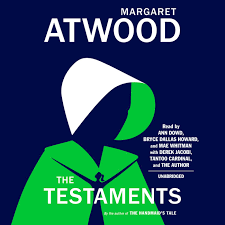
The Testaments by Margaret Atwood | Penguin Random House Audio

As well as Aunt Lydia’s narrative the novel interweaves testimonies – testaments – by two teenage girls, Agnes, the adopted daughter of Commander Kyle and his wife Tabitha, and Daisy, growing up in Toronto with her adoptive parents, Neil and Melanie, who run a second-hand clothes store. The three narrators alternate in short chapters which gave considerable pace to the narrative. It was obvious early on that the secrets about Daisy and Agnes’s parentage would be revealed, and how the threads of the narrative would eventually join.

Aunt Lydia is the dominant character in the novel – shrewd, knowledgeable, and a survivor. She is not above suspicion, but is able to manipulate (a little too easily) the characters around her to protect herself, while all the time working to undermine Gilead. The teenage girls show two completely different views of Gilead – Agnes has been born and raised in the country and has adopted its worldview unquestioningly. She has been taught that women must cover up to avoid inflaming male passions, and that reading is a source of sin. Her body is dangerous and she must be married at an early age to fulfil her purpose of having children. She is profoundly religious and keeps her faith even when her belief in the ideals of Gilead are shaken. Daisy on the other hand, having been raised in Canada, is an atheist and is opposed to everything Gilead stands for. She happily volunteers to go undercover into Gilead to recover some damning information about the regime, despite the obvious dangers.

Despite its status as a feminist novel of ideas, The Testaments works most effectively as an action novel. The climax of the narrative features a breathless escape from Gilead, with speedboats and helicopters thrown in for good measure, secret information hidden in a micro-dot (how very 1970’s!) hidden under one of the girl’s skin, disguised by a GOD/LOVE tattoo.

Atwood’s skill as a writer is without question, but her ability to craft a phrase stands out:

“The truth can cause a lot of trouble for those who are not supposed to know it.”
“how easily a hand becomes a fist.”
“No one wants to die…but some people don’t want to live in any of the ways that are allowed.”

That skill falters slightly when she writes as a teenage girl, where an element of inauthenticity appears. Would a teenage girl, even when writing in later life, write “Nobody is any authority on the fucks other people give“? Much quoted (in reviews) phrases such as “You don’t believe the sky is falling until a chunk of it falls on you” or “As they say, history does not repeat itself, but it rhymes” sound quite impressive on a first reading but I am not sure they actually mean anything.

So what’s the problem with The Testaments? I’ve touched on some of the issues above. But my main concern was with the action elements of the novel. Perhaps they would work better on television, but on the page they came across as a parody of a spy novel. What is more they didn’t really make any sense. I found Daisy’s decision to return to Gilead disguised as a Pearl Girl (a missionary) completely unconvincing, and Commander Judd’s decision to keep quiet about her return was baffling. Of all the people you would send back to Gilead to recover some vital intelligence, Daisy would be the very last choice. And once her return to Gilead was known why the Commander would keep it quiet and allow her to escape back to Canada I have no idea.

Other elements such as the casually announced death of one of the minor characters suggested a rush to end the novel and tie up loose ends without thinking through the detail. There were other signs of this, such as how trainee aunts, totally illiterate when they arrive at Ardua Hall in their mid teens, are fluent readers in a few months despite starting with modestly coloured-in Dick and Jane books.

Despite all this I enjoyed reading this novel. I recognise I should probably consider it on its own merits rather than as the sequel to an iconic classic. It’s ironic that this won the Booker rather than the original, which is probably the judges’ way of correcting history. I am pretty sure that Handmaid’s will be read in decades if not centuries to come as an important statement of protest at society’s treatment of women, while The Testaments will be remembered as a less interesting addendum.
Standard
Book review

An Occurrence at Owl Creek Bridge, by Ambrose Bierce, 1890

Recently I came across this gem of a post on the ever-wonderful LitHub about the best short stories ever written and it prompted me to guiltily read more of this neglected (by me) genre (although this is a great list, there are some obvious omissions; Ray Bradbury’s A Sound of Thunder is missing for a start. A Sound of Thunder is the “butterfly effect” story in which time-travellers to the age of the dinosaurs inadvertently affect the future.) Most of the stories on this list can easily read in less than an hour and they are usually available for free on the internet.

An Occurrence At Owl Creek Bridge eBook: Ambrose Bierce: Amazon.co.uk:  Kindle Store

I started with An Occurrence at Owl Creek Bridge for reasons of nostalgia. I have a vivid memory of being shown the film adaptation of this story in school one day – I have no idea in what lesson – and to this day it seems a very dark film to show schoolchildren.

An Occurrence is a/the near perfect short story. The title is carefully understated, but we soon learn the nature of the occurrence due to happen on the bridge – a man is to be hung. You probably are familiar with the story and its wonderfully executed (forgive me) twist, but just in case you aren’t I am going to avoid summarising the plot – with the whole story running to only a handful of pages any summary would be largely redundant anyway.

Kurt Vonnegut famously described An Occurrence as “that greatest American short story….a flawless example of American genius“. Without wanting to pick an argument with Mr Vonnegut there’s nothing uniquely American about the story nor its conception. Being just an American story would diminish it. Its universality lies in the use of point of view narration. The reader trusts the story we are being told by the captured (and clearly guilty) plantation owner about to be hung from the bridge because we have been taught to trust narrators. Why would someone about to die mislead us about what happens. His apparent escape from his fate is plausible simply because of the conventional understanding that he must have survived in order to tell his tale.

The narrative emphasises the mundane and everyday nature of what is happening. This is an occurrence, nothing more. A man is about to die, but this is something that in war happens all the time. The setting is just Owl Creek Bridge, an insignificant bridge over an insignificant stream. Everyone involved in the execution is calm and business-like, even the condemned man himself. Everything is ordered and well-prepared.

A man stood upon a railroad bridge in northern Alabama, looking down into the swift water twenty feet below. The man’s hands were behind his back, the wrists bound with a cord. A rope closely encircled his neck. It was attached to a stout cross-timber above his head and the slack fell to the level of his knees. Some loose boards laid upon the ties supporting the rails of the railway supplied a footing for him and his executioners—two private soldiers of the Federal army, directed by a sergeant who in civil life may have been a deputy sheriff. At a short remove upon the same temporary platform was an officer in the uniform of his rank, armed. He was a captain. A sentinel at each end of the bridge stood with his rifle in the position known as “support,” that is to say, vertical in front of the left shoulder, the hammer resting on the forearm thrown straight across the chest—a formal and unnatural position, enforcing an erect carriage of the body. It did not appear to be the duty of these two men to know what was occurring at the center of the bridge; they merely blockaded the two ends of the foot planking that traversed it.

The execution is being carried out with military precision, so it is a shock when, remarkably, an opportunity to escape appears:

All at once, with terrible suddenness, the light about him shot upward with the noise of a loud splash; a frightful roaring was in his ears, and all was cold and dark. The power of thought was restored; he knew that the rope had broken and he had fallen into the stream. There was no additional strangulation; the noose about his neck was already suffocating him and kept the water from his lungs. To die of hanging at the bottom of a river!—the idea seemed to him ludicrous. He opened his eyes in the darkness and saw above him a gleam of light, but how distant, how inaccessible! He was still sinking, for the light became fainter and fainter until it was a mere glimmer. Then it began to grow and brighten, and he knew that he was rising toward the surface—knew it with reluctance, for he was now very comfortable.

An Occurrence is much more than a commentary on war and what men will do for their country. It reminds us that life is short and sweet, and that our perception of time can be strangely distorted in the moment. It also teaches us that narrators and authors can be misleading, and that wishful thinking is a powerful thing. It is also an object lesson in the importance of close and careful reading. If you just engage with this text as an adventure story you will almost certainly miss the clear indications that there is more to this story than the narrator tells us. Bierce wrote about “bad readers—readers who, lacking the habit of analysis, lack also the faculty of discrimination, and take whatever is put before them”. I don’t think there is such a thing as a bad reader, but we can all read more carefully and analytically, not taking at face value what we are told, whether it be a short story, a novel, or the news on our screens, and An Occurrence is an object lesson in why this an important skill.

An Occurrence at Owl Creek Bridge, by Ambrose Bierce, 1890

Aside
Book review

Girl, Woman, Other by Bernadine Evaristo, 2019

When is a novel not a novel? When it is, as here, a collection of loosely related narratives, or a “collage of well-composed individual stories” as one reviewer described it, without much in the way of plot. Is the distinction an important one? I think so, but let’s come back to that question.

Girl, Woman, Other tells the stories of the lives of the novel’s 12 principal characters. Most the large cast of characters are black and mixed race women, and of course their stories focus on this aspect of their lived experience. The book is divided into four chapters each telling the stories of three women who are connected to one another in some way. Although each story is a separate and often compelling narrative in its own right, they slowly interweave to create the overall narrative. The novel’s focal point to which it returns from time to time is the opening night of a ground-breaking new play, The Last Amazon of Dahomey. The implicit point is that all of the women portrayed in the novel are one way or another Amazons themselves, warrior women who have had to fight for everything they have achieved.

While GWO has been widely lauded, and of course won the 2019 Booker prize (jointly with Margaret Atwood’s sequel to The Handmaid’s Tale, The Testaments), the author’s choice to not use capitals and full stops to signal the start and end of sentences has upset some readers disproportionately. A good example is this passionate post from the Orangutan Librarian. For me, this wasn’t really an issue. Rules are there to be broken by writers and I found I quickly adjusted to the convention the author used to signal a new sentence, namely a line break. To an extent this made the choice to abandon full stops etc fairly pointless (sorry). I assume the author was aiming for a free-flowing representation of the characters’ internal monologues, something akin to stream of consciousness. Because my mind reconstructed the sentence structure fairly easily, and after while without noticing, this effect was largely lost.

It is hard to write this without sounding spiteful, but my main concern with GWO was not the choices around punctuation, but the quality of the writing. As an experiment I opened my copy of the text at random half a dozen times, and noted the following:

“he sold the farm for a song” (178)

“the two love-birds sat holding hands on the sofa” 269

“over time Shirley became an experienced schoolteacher who remained committed to giving the kids a fighting chance” (sorry forgot to note page number!)

“Mummy went through the roof, literally exploded like a rocket” 205

“it’s way too early for the youngsters to begin their death-defying leaps and twists without helmets or knee-pads” (23)

“apparently Tyrone, Section Manager of Electronics and Appliances, has a thing for her” (213)

(Incidentally, I can’t resist pointing out that the author’s rejection of capitals doesn’t extend as far as names and job titles!)

The weight of cliché here is, for me, problematic. Of course it is difficult to represent people’s internal monologues without using cliché if that’s how you think they would express their thoughts. But do people really think in clichés? In any event most writers would try and find a way around that issue rather than just weighing down the narrative with an accumulation of stale expressions.

The text only really takes off and becomes lyrical and expressive when political views are being discussed. Some reviewers have found this aspect of the novel didactic. I didn’t see it that way – each character represented is shown as having their own prejudices and biases, and there is no single perspective that is endorsed as being definitive, simply that we all carry our own burden of experiences and ideas, which change over time. That’s not to say the novel is entirely neutral, respectful of all views. Right wing readers will struggle with the representation of the progressive portrayal of oppression in all its forms that the women in the novel experience. The discussion of white privilege between the students in the novel is entertaining as well as being informative:

People won’t see you as just another woman any more, but as a white woman who hangs with brownies, and you’ll lose a bit of your privilege, you should still check it, though, have you heard the expression, check your privilege, babe?
Courtney replied that seeing as Yazz is the daughter of a professor and a very well-known theatre director, she’s hardly underprivileged herself, whereas she, Courtney, comes from a really poor community where it’s normal to be working in a factory at sixteen and have your first child as a single mother at seventeen, and that her father’s farm is effectively owned by the bank
Yes but I’m black, Courts, which makes me more oppressed than anyone who isn’t, except Waris who is the most oppressed of all of them (although don’t tell her that)
In five categories, black, Muslim, female, poor, hijab bed
She’s the only one Yazz can’t tell to check her privilege
Courtney replied that Roxane Gay warned against the idea of playing ‘privilege Olympics’ and wrote in Bad Feminist that privilege is relative and contextual, and I agree, Yazz, I mean, where does it all end? Is Obama less privileged than a white hillbilly growing up in a trailer park with a junkie single mother and a jailbird father? Is a severely disabled person more privileged than a Syrian asylum-seeker who’s been tortured? Roxane argues that we have to find a new discourse for discussing inequality

While many characters are well rounded in all their flawed humanity, others are more lightly sketched and less convincing. One example is Roland, Yazz’s father, who at one point describes his partner’s disturbing way of rejecting homophobia:

“Sylvester shouting Take that, Maggie T! at the point of ejaculation was quite off-putting” (407)

Did anyone ever call Mrs Thatcher “Maggie T”? Surely it was either Maggie or Mrs T? This lack of authenticity in a novel grounded in attempts to accurately reflect the experience of black and mixed race women growing up and growing old in the UK was disappointing but probably the exception, although this lack of authenticity is echoed elsewhere by some of the exchanges on race and feminism:

“We should celebrate with that many more women are reconfiguring feminism and that grassroots activism is spreading like wildfire and millions of women are waking up to the possibility of taking ownership of our world as fully-entitled human being how can we argue with that?” (said after two bottles of red wine and 4 lines of coke!) or elsewhere “Her mother was unthinkingly repeating patterns of oppression based on gender”

To return to the question I posed at the start of this post, is the novel taken as a whole greater than its constituent parts? I can certainly see each portrait as a separate sketch being published in serial form in a magazine without any loss of impact. (And to be clear, I mean no disrespect by this. Dickens published his novels in serial form in magazines, and he was a fairly good writer!). Part of the problem is a failure or inability to draw the stories together – the links between them are fragile, and the attempt to introduce a surprise ending falls flat given how clearly it has been telegraphed earlier in the novel (one mixed-race character is adopted as a baby and doesn’t know anything about her birth parents; another has her mixed-race baby removed from her by her parents and placed for adoption – who could guess how this development would be resolved? One review described this approach as:

“too many delicious starters without a truly satisfying main course.“

Which I think is about right.

Standard
Book review

In Between the Sheets by Ian McEwan, 1978

In hindsight I don’t think I should have gone back to this very early collection of short stories by McEwan, his second volume after the well received First Love, Last Rites. They read as works by an immature writer (although McEwan was thirty when they were published), out to shock but largely failing to do so, containing none of the control or focus that is such a feature of his later works (and which should be so much easier to pull off in this format).

In Between the Sheets by Ian McEwan

There are seven stories in total:

“Pornography” is about a deeply unpleasant character who sells pornography. Although he is suffering from an unspecified venereal disease he continues to sleep with two women. Even to their faces he shows them little or no respect. The story takes a disturbing direction when they find out he has been sleeping with both of them (nowadays a far less shocking revelation) and decide to punish him. This felt like a disappointing episode of ‘Tales of the Unexpected’, where the ending is stale and predictable but also unbelievable.

“Reflections of a Kept Ape” is told from the point of view of a pet monkey. The ape has an urbane outlook on life, and has just ended a sexual relationship with his female owner. Again McEwan seems to be working hard to shock, and failing.

“Two Fragments” is set in post-apocalyptic London where society is breaking down but people are still working hard to preserve relationships and protect their families. To be fair to McEwan he doesn’t try to avoid the obvious fact that this is a fragment of a longer piece, possibly a long-abandoned novel which had been recycled to add to this collection. It’s a moderately interesting scenario, but it doesn’t go anywhere – I finished reading it yesterday but I have already forgotten how (and whether) the story is resolved, which tells you what an impression it made.

“Dead As They Come” was for me the stand-out story of the collection. An extremely wealthy businessman tells the reader about his obsession with a mannequin. He sees her in a shop window, becomes obsessed with her, buys her and conducts a brief, torrid and of course entirely one-way relationship with her. The narrator seems himself as a grand lover wooing someone aloof and unobtainable:

But soon I loved her completely and wished to possess her, own her, absorb her, eat her. I wanted her in my arms and in my bed, I longed she would open her legs to me.

The one joke – that he sees her immobility as variously aloofness, concentration, rest etc – is well done. The story shows the dangers of sexual obsession. But I am not sure it was much more than just the one extended joke.

“In Between the Sheets” is a really strange story, which in a collection that includes a story about someone having sex with their pet monkey is saying something. It is told from the point of view of the father of a young daughter. He is estranged from his wife, the daughter’s mother, and is trying to find a way to remain in her life. He is disturbed by her approaching puberty, although the narrative does not suggest there is any element of attraction in his thoughts, even if his behaviour is sometimes inappropriate given her age. The daughter has a midget friend who adds an element of the bizarre to the tale (not that midgets are bizarre I should emphasise, simply the way the character is portrayed here). The story ends ambiguously.

“To and Fro“. I can honestly say I have no idea what To and Fro was about – its incoherence made it almost unreadable.

“Psychopolis” is a more conventional portrait of a British traveller in America, not fitting in and feeling alienated.

Mm

“We went to a club where singers and stand-up comedians performed in the hope of being discovered. A thin girl with bright red hair and sequined T-shirt reached the end of her passionately murmured song on a sudden shrill, impossible top note. All conversation ceased. Someone, perhaps kalkholdigi, dropped a glass. Halfway through, the note became a warbling vibrato and the singer collapsed on the stage in an abject curtsy, arms held stiffly in front of her, fists clenched. Then she sprang to her tiptoes and held her arms high above her head with the palms flat as if to forestall the sporadic and indifferent applause. “They all want to be Barbra Streisand or Liza Minnelli,” George explained as he sucked a giant cocktail through a pink plastic straw. “But no one’s looking for that kind of stuff anymore.”“

This story had echoes of Hunter S Thompson or Jack Kerouac, travelogues with lots of alcohol being consumed, people entering and leaving the narrative arbitrarily, and little or no plot line. Narratives like this where the characters are only loosely introduced, events are or feel random, and the narrator feels disengaged with his story feel experimental, and I am glad McEwan went on to embrace more traditional formats. He is a great example of a writer who can work within the novel format to do new things (Sweet Tooth being a great example), rather than having to abandon the constraints of format altogether.

If you are a McEwan completist then you will need to read this, but for anything else I wouldn’t bother. McEwan has written some wonderful novels since this, and I am sure there are more to come.

Standard
Book review

The Man Who Would be King, by Rudyard Kipling, 1888

The Man Who Would be King runs to not much more than 20 pages. It was first published in Kipling’s collection The Phantom Rickshaw and other Eerie Tales and later in Wee Willie Winkie and Other Child Stories. So there can be no argument that Kipling conceived the story as an adventure tale for children. But it is equally true that today, perhaps in part because of the success of the book’s 1960’s film adaptation, but more probably because of its what are now perceived as out-dated attitudes to empire, it is more often read by adults. It’s interesting how some books originally written for children over time become seen as books for adults and vice-versa. An example of a book travelling in the opposite direction is Black Beauty which was first published for adults but is now mainly read by or to children.

The Man Who Would Be King by Rudyard Kipling

The Man tells the story of two adventurers, Daniel Dravot and Peachey Carnehan, as told by the narrator journalist they meet during their travels in Imperial India. They have concocted a mad, dangerous plan – to become kings of the remote country of Kafiristan. Their plan involves using firepower – rifles – the likes of which the natives will not have seen before and will consider almost magical in their ability to kill a man stone date at great distances. They also plan to use the standard imperialistic playbook of divide and conquer between the local chieftains and kings.

Two years pass and Carnehan returns alone, a broken man, crippled and in rags. He tells the narrator that he and Dravot succeeded in becoming kings, but ultimately at great cost. The pagan mountain tribesmen acclaimed them as beyond kings, as gods, helped by a bizarre form of Masonic ritual which Dravot and Carnehan were able to show knowledge of, perhaps as a legacy of some long-forgotten previous explorers. But becoming gods is a dangerous position, and when Dravot was exposed as only human after all this was seen as a shocking betrayal. Retribution was swift. Carnehan survived and escaped with only his life and one grisly memento of his adventure. The price of colonialism in this part of the world is high.

The Man Who Would be King would make a great companion text for anyone studying Heart of Darkness. Both are explorations of the impact of colonialism on the colonisers, who go too far in their efforts to conquer the unconquerable. The two main characters in The Man, Daniel Dravot and Peachy Carnehan pose as gods to impress the people they are attempting to subdue in Kafiristan, in the same way Kurtz assumes a god-like status in the Congo. Empire itself is described in similar ways. Kipling’s narrator describes the native states of India (those not under direct British rule) as

“the dark places of the earth, full of unimaginable cruelty”.

Compare Marlow’s first words in ‘Heart of Darkness’

“And this also [. . .] has been one of the dark places of the earth”.

Both stories are told by survivors of the expeditions that form the central narratives, stories which are then retold by the anonymous narrator. The process by which the local people are subdued is very similar, and the objectives of the protagonists – a dangerous combination of greed and a lust for adventure – are also alike. Equally the resolution of each story is essentially the same. The experience of being god-like drives the protagonist mad and leads to their downfall. In The Man when Carnehan bleeds he is shown to be merely human and is killed; in Heart Kurtz dies suddenly of a fever. In both stories the secondary narrator (the person who recounts the story to the actual narrator) escapes by the skin of his teeth with a memento of their adventure.

As far as I have been able to establish Conrad did not acknowledge The Man as a source for or influence on Heart, and many of the elements I have described here are, one might argue, standard components of all adventure stories. I’m not going to try and resolve the question as to the relationship between the two texts, other than to recognise there must surely be one, because this is a review rather than a thesis, but I think it is worth further investigation.

The narrative style of The Man is informal. The Kipling character is relaxed, recounting a story from his days in India, probably one of many, but chosen as a warning of the dangers of colonialism. He heavily foreshadows the story’s ending in his first paragraph:

I once came near to kinship with what might have been a veritable King and was promised the reversion of a Kingdom — army, law-courts, revenue and policy all complete. But, to-day, I greatly fear that my King is dead, and if I want a crown I must go and hunt it for myself.

Carnehan and Dravot are introduced as eccentric, larger than life adventurers,

“a huge gentleman, …a wanderer and a vagabond like myself, but with an educated taste for whiskey. He told tales of things he had seen and done, of out-of-the-way corners of the Empire into which he had penetrated, and of adventures in which he risked his life for a few days’ food.”

“He’s a big man with a red beard, and a great swell he is.“…“We have been all over India, mostly on foot. We have been boiler-fitters, engine-drivers, petty contractors, and all that, and we have decided that India isn’t big enough for such as us.”

The Kipling narrator by comparison is a passive observer, spending his time waiting for things to happen:

One Saturday night it was my pleasant duty to put the paper to bed alone. A King or courtier or a courtesan or a community was going to die or get a new Constitution, or do something that was important on the other side of the world.

The outlandish plan Carnehan and Dravot outlined to the narrator is obviously extremely risky:

“You’ll be cut to pieces before you’re fifty miles across the Border,” I said. “You have to travel through Afghanistan to get to that country. It’s one mass of mountains and peaks and glaciers, and no Englishman has been through it. The people are utter brutes, and even if you reached them you couldn’t do anything.”

Their expedition starts in a typically unconventional fashion, with Dravot and Carnehan disguised as a mad priest and his follower:

A priest attired in fragments of ribbons and rags stalked up to me, gravely twisting a child’s paper whirligig. Behind him was his servant, bending under the load of a crate of mud toys. The two were loading up two camels, and the inhabitants of the Serai watched them with shrieks of laughter. “I will go even now!” shouted the priest. “I will depart upon my winged camels, and be at Peshawar in a day! Ho! Hazar Mir Khan,” he yelled to his servant “drive out the camels, but let me first mount my own.”

The element of theatre in this start to their journey is key to their plan – they are going to hoodwink their way onto the throne. The narrator doesn’t expect to see them alive again. His life continues as before with world affairs happening elsewhere, life leaving him behind:

The wheel of the world swings through the same phases again and again. Summer passed and winter thereafter, and came and passed again. The daily paper continued and I with it, and upon the third summer there fell a hot night, a night-issue, and a strained waiting for something to be telegraphed from the other side of the world, exactly as had happened before. A few great men had died in the past two years, the machines worked with more clatter, and some of the trees in the office garden were a few feet taller. But that was all the difference.

In Heart of Darkness there is little ambiguity about Kurtz’s attitudes towards the people he comes to lead – they are brutish and anonymously disposable. Carnehan and Dravot have a less directly racist attitude to the people they come to reign over. For a start they are not as dark-skinned:

“The Chiefs come round to shake hands, and they was so hairy and white and fair it was just shaking hands with old friends.”

They also have some understanding and possibly even experience of the masonic rituals that Carnehan and Dravot enact, with the suggestion that they are not the first white men to travel in the area:

“The old priest was a stranger come in from beyond the village of Bashkai. The minute Dravot puts on the Master’s apron that the girls had made for him, the priest fetches a whoop and a howl, and tries to overturn the stone that Dravot was sitting on…ten priests took and tilted over the Grand-Master’s chair … The priest begins rubbing the bottom end of it to clear away the black dirt, and presently he shows all the other priests the Master’s Mark, same as was on Dravot’s apron, cut into the stone.”

Dravot claims to be able to detect that ethnically the locals are closer to being European than Asian, not so much by their skin colour but by their behaviour:

“‘I won’t make a Nation,’ says he. ‘I’ll make an Empire! These men aren’t n******; they’re English! Look at their eyes — look at their mouths. Look at the way they stand up. They sit on chairs in their own houses. They’re the Lost Tribes, or something like it, and they’ve grown to be English.

Englishness is defined by the way people sit!

Dravot then outlines his plan to make his kingdom a strategically important part of the British Empire:

I’ll take a census in the spring if the priests don’t get frightened. There must be a fair two million of ’em in these hills. The villages are full o’ little children. Two million people — two hundred and fifty thousand fighting men — and all English! They only want the rifles and a little drilling. Two hundred and fifty thousand men, ready to cut in on Russia’s right flank when she tries for India! …When everything was ship-shape, I’d hand over the crown — this crown I’m wearing now — to Queen Victoria on my knees, and she’d say:— “Rise up, Sir Daniel Dravot.”

This is the ultimate objective for Dravot, something, Kipling hints, behind the schemes of all colonial adventurers – acceptance by the British establishment, a knighthood, and being able to leave behind his days as a disreputable character in the border countries of the Empire and on the edges of criminality. It is a dream he does not live to see fulfilled.

It is easy to forget when reading boy’s own adventure stories of this kind, with slightly cartoonish characters and uncomplicated plot-lines, that Kipling won the Nobel Prize for Literature at an early age (I believe he remains the youngest person to have ever won this award) and was a dominant figure in English literature for decades. His status now is much reduced. He is largely remembered as a teller of children’s stories and one or two great poems, but also as a representative and defender of all that was wrong with the British Empire. He is probably overdue a re-evaluation. The Man Who Would be King might be a good place to start.

Standard
Book review

The Mercies, by Kiran Millwood Hargrave, 2020

The raw harshness of The Mercies is pretty unrelenting. Based on a real-life seventeenth century witch trial, Hargrave’s novel is either “an atmospheric tale of self-sufficient womanhood and sexual suspicion in a tight-knit island community” as the publisher would claim, or an extraordinarily bleak portrait of how awful life was for women and minorities in this period.

The first thread of the narrative is told by a young woman living in a small fishing community in Northern Norway, close to the Arctic Circle. It opens with a fierce storm (on Christmas Eve, just to rub it in) in which forty fishermen are drowned, watched from the cliff-tops by their womenfolk. The community – Vardo – is an island, largely isolated from the outside world. An already difficult, subsistence way of life suddenly becomes much harder. Word of the tragedy eventually reaches the outside world, but such is the state of public life in Norway in this period, the state’s reaction is to send them a priest, to make sure the women don’t get up to any inappropriate behaviour – such as going fishing to feed themselves. Women doing men’s work is seen by the Puritanism gripping the country to be ungodly, as is wearing trousers, not going to church, and just about any deviation from orthodoxy.

We are introduced to one of the complexities of social life at this time. The indigenous people – the Sami – live alongside the Christian incomers in this part of the world. There is some tension between the two communities but they have largely come to terms with one another. However, the new puritanism that has gained hold in Norway from across the sea in Scotland, where King James preaches against witchcraft, is being used to persecute the Sami and seize their property. It is clear that it is only a matter of time before any traditions relating to the Samis and their way of life become taboo.

The novel’s second narrative begins in Bergen, where a young woman, Ursa, is sold into marriage by her father. Because this is apparently common practice she accepts this servitude without protest. Her new husband immediately takes her with him on his journey to become the Commissioner of Vardo. He is on a mission to cleanse the community of heresy – in other words he is a witchfinder. Ursa’s husband rapes her nightly and of course there is no affection or connection of any kind between husband and wife. The impact of the Commissioner’s eventual arrival in Vardo is explosive and dangerous.

One of the many challenges writers must struggle with when constructing the plots of their novels is how to ensure that the ending doesn’t come as a complete out-of-the-blue surprise to the reader, but at the same time isn’t blindingly obvious. Give too many clues and the element of suspense is gone; give too few and the conclusion will feel like a deus ex machina. Sadly here the author flags the ending very early on. Without giving anything away, which is an approach the author does not adopt, the nature of the relationship between the two central characters is hinted almost immediately. The fact that the witchfinder quickly finds some witches will equally come as no surprise to any reader. One character sees the inevitable coming and flees the village – others are too stubborn to save themselves. Any element of suspense was stripped from the novel by this heavy-handed foreshadowing – it was a question of when things happened rather than whether.

There are other points of interest in the novel beyond the plot-lines and the stories of the two central characters. The evocation of a sense of place is powerful and I learnt more about seventeenth-century Norwegian fishing communities than I knew there was to be learnt. The characterisation was well done. The horrors of the treatment of women suspected of witchcraft was vividly hard to read. It all comes together into a strongly contemporary story of how women are persecuted when men feel threatened by their power. Sadly that message couldn’t be more relevant today. On that level The Mercies succeeds as a powerful reminder of the fundamental injustices women face in society. There’s no question its heart is in the right place. But I can’t say I really enjoyed reading The Mercies – I am not even sure I was supposed to.

Standard
Book review

Raising Steam (Discworld 40), by Sir Terry Pratchett, 2013

This is the final novel in my reread of the Discworld series – now is not the time to be to revisiting the bitter-sweet The Shepherd’s Crown .

Raising Steam | Terry Pratchett Books | Discworld Novels

Raising Steam is a Moist von Lipwig story. The previous Moist novels (Going Postal and Making Money) saw him take on Ankh-Morpork institutions desperately in need of modernisation, and use his street smarts and quasi-criminal abilities to achieve the impossible. Raising Steam takes a different track. The industrial revolution, already foreshadowed in the arrival of the printing press (The Truth) and the clacks (Going Postal) has now reached the age of steam. Dick Simnel, a self-taught engineer (whose father, Ned Simnel, appeared all the way back in Reaper Man), has perfected the design of a steam engine, one which doesn’t spontaneously explode leaving anyone in the vicinity a red mist. He finds the ideal business partner and investor in the King of the Golden River, Sir Harry King. from this point the railways erupt, with Moist at the heart of making sure they can go where they need to go, and that the Ankh-Morpork and Sto Plains Hygienic Railway company has the resources it needs to succeed.

The Patrician appoints Moist von Lipwig, by now (ironically) one of his most reliable employees, to represent him in the management and expansion of the railway. A line is quickly laid to the coast at Quirm, where fresh sea-food now becomes available to the diners of Ankh-Morpork. Moist negotiates with landowners for permission to build across their land, and finds alternative routes when he is refused. The Patrician pushes Moist relentlessly to ensure that the next phase of expansion, the line to Uberwald over a thousand miles away, is completed at breakneck speed.

One of the many joys of Raising Steam is in its imaginative recreation of the early days of the railways. Train spotters write “1” carefully in their notebooks when the first engine appears. Track-side catering, third class carriages, overnight sleepers and flat-bed trucks for the larger customer (i.e. trolls) are all fitted seamlessly into the narrative. Moist is at the heart of spotting the commercial potential of the railways, even down to the marketing of small train sets for (ahem) children. The novel also has its own spin-off. At one point Moist meets a lady traveller, Mrs Bradshaw, who impresses him with her independent and inquiring mind. He commissions her to write an account of her travels on the railway in return for a free go-anywhere ticket. The product of that meeting is Mrs Bradshaw’s Handbook, which is great fun, full of additional detail about Discworld and lots of terrible puns. My favourite was the description of a rat-inna-bun as a “royale with fleas”*

In Thud, Pratchett describes the signing of the Koom Valley Accord, a historic peace agreement between dwarves and trolls. But that agreement is now under attack due to the relentless rise of dwarven fundamentalism. Extremists, led by the sinister grags, begin a terrorist campaign against the most visible signs of modernism, the clacks towers. Attacks on the railroad soon follow. This is all a prelude to a coup against the Low King of the Dwarfs. In the classic tradition of these things the coup is launched while the Low King is attending an international conference in Quirm. The reason for Vetinari’s insistence on the completion of the track to Uberwald now becomes clear – the Low King has to be rushed back to resist the coup. (OK, if Vetenari was so far sighted as to realise the express service to Uberwald was going to be needed, could he not have just organised the conference at a slightly more suitable, less remote location. Or had the Low King send a deputy? No, you are right, it doesn’t really matter.)

If the first half of the novel is an enjoyable spin through the exciting early days of steam, the second half revolves around the Low King’s break-neck journey back to Uberwald. Anticipating attempts to prevent him from returning to court, the Low King sets off in disguise, decoy carriages are sent to throw the grags off his scent, and half the Watch accompany the party to provide an extended bodyguard. Moist goes along for the ride, to make sure the train arrives on time. As expected the train comes under attack almost straight away, and they face a increasingly serious series of ambushes and attempts at sabotage along the way, requiring Moist to carry off one of his trademark feats of showmanship before finally arriving in Uberwald.

Raising Steam map | humanitysdarkerside

There’s a large supporting cast of characters in Raising Steam. Perhaps this was some kind of farewell? Most of the Watch appear, including of course Commander Vimes who plays an important part in defending the train from the grags and restoring the Low King to his throne. Vimes fans are treated to the wonderful image of him fighting dwarves on the top of the train as it speeds along:

“The commander went, as they say in Ankh-Morpork, totally Librarian on them.”

Adora Belle is suitably acerbic, although the reader is assured that her marriage to Moist is supremely happy. Lu-tze walks on and off-stage briefly. The Patrician is the Patrician, feeling slightly rattled by the increasing difficulty of his crossword, while his clerk, Drumnott, indulges his obsession with all things rail-related. Death returns to remind people what to do when they die. Even Rincewind makes the briefest of appearances in a couple of footnotes – Pratchett could never quite say goodbye to his first wizzard.

You can’t reduce forty-one novels to a single message, of course not, but inclusion has always been at its heart, and that idea remains central to the series even at the end. The message perhaps becomes even more insistent as the series comes to a close. Social change is speeding up in Discworld – we see goblins going from vermin and prey in Snuff to valuable members of society in a few short years. The Watch continues to recruit non-humans to its ranks and spread good policing practice across the hub. There is also time in the novel to find a non-didactic resolution (of a kind) to the long-running discussion of dwarven gender identity, as the Low King is revealed to be the Low Queen.

When I come back to the novels of Sir Terry it won’t be for the jokes or the plots. It will be for his characters and his kindness and understanding. He know that technology can change society profoundly and shows us how it can be exciting and transformative rather than harmful:

“Here is the new thing and here it is. And yesterday you never thought about it and after today you don’t know what you would do without it. That was what the technology was doing. It was your slave but, in a sense, it might be the other way round.”

This will be the final time I say this, having said it far too many times already, but please do read some Terry Pratchett. It is all quite wonderful.

*little nod to Pulp Fiction there if you hadn’t spotted it.

Standard
Book review

Bleak House, by Charles Dickens,1852-53

I am not sure which was more daunting – reading the near 1000 pages of Bleak House, or trying to summarise the experience in a few paragraphs for this post. Where to begin? This could be the complete English novel. Pride and Prejudice is a more perfect romance, Wuthering Heights a more dramatic melodrama, The Big Sleep a better detective story, and The Ragged Trousered Philanthropist a more devastating social critique. But Bleak House is all of the above and so much more. It’s a dazzling display of literary technique, without ever being showy; it is a masterful exhibition of characterisation (of which more later) and the use of themes and motifs is extraordinary. So I ask again, where to begin?

Perhaps a brief plot summary, although to do justice to the byzantine complexity of this novel is quite a challenge in itself. As you may know, Bleak House revolves around the long-running Chancery suit of Jarndyce vs Jarndyce, a dispute about a series of wills and the associated inheritances. Trapped in this case are two wards of court, who go to live with their uncle, John Jarndyce, in the novel’s title location, Bleak House. Also involved in the litigation is Sir Leicester Dedlock and his wife Lady Dedlock. There is clearly an element of mystery about Lady Dedlock’s background – as early as the second chapter it is established that she has secrets. While consulting with the family solicitor, Mr Tulkinghorn, she recognises the handwriting on one of his documents.

“My Lady, changing her position, sees the paper on the table – looks at them nearer – looks at them nearer still – asks impulsively “Who copied that?”

Mr Tulkinghorn notices this reaction, and quickly finds out that the copywriter, “Nemo”, has recently died. The only person who can identify him is the crossing sweeper Jo, who lives in Tom-All-Alone’s, a slum in the poorest part of the City (Tom-All-Alone’s was very nearly the novel’s title).

The novel’s second narrator, Esther Summerson now takes over the tale. This alternating narrative structure, with one a named character, the other unnamed and omniscient, is unusual if not unique. It works well in varying the narrative voice. Esther is naive and reluctant to show her feelings about some close to home topics such as her feelings for Mr Woodcourt, whereas the omniscient narrator is more revealing. Esther starts her narrative by telling the reader about her childhood. She was raised by a Miss Barbary, who denied her affection and told her:

“Your mother, Esther, is your disgrace, and you were hers“.

She is obviously illegitimate, but beyond that knows little about her parents or family. After Miss Barbary dies, Esther becomes the ward of Mr Jarndyce, one of the litigants in the long-running case. She eventually moves in with him along with two other wards in the Jarndyce case, Richard Carstone and Ada Clare.

These parallel storylines – the Jarndyce wards and the Dedlock mystery – intertwine. The mystery of Esther’s parentage is slowly revealed. Along the way Dickens takes any number of diversions, introducing a multitude of characters and sub-plots, all of whom contribute to the development of the novel.

In earlier Dickens novels the villains are often somewhat one dimensional with little to say for them in mitigation. Great characters, but not very nuanced. Bleak House doesn’t really have anyone in this role – in fact it is the law itself which is the real villain of the piece. Many of the other characters while without question fallible have a complexity that allows us to like them even when we disagree with their actions. Lord Dedlock is originally established as the stuffy aristocrat permanently at war with his neighbours and over-bearing to family and servants, but he becomes an almost endearing character by the end of the novel, loving and faithful to the memory of his wife. Tulkinghorn may initially be cast as the scheming lawyer out to fleece his clients of everything he can get his hands on, but as the picture emerges he does seem to be genuinely trying to protect the best interests of his clients, and he doesn’t deserve the fate that befalls him. The aloof Lady Dedlock finds redemption in sacrifice. Inspector Bucket, cruel towards Jo and sinister when he appears as if a ghost in his early scenes, ends up heroically trying to rescue Lady Dedlock and being thoughtful and considerate towards Esther.

Keeping track of the cast of eccentrics in the novel is part of the challenge. I counted over 60 named characters, and there’s no doubt that it is easy to forget who is who unless you are reading the novel with particular care.  Inevitably some of the minor characters are a little one-dimensional, but Dickens creates a vivid cast of grotesques, such as the appalling Mr Skimpole, eternally sponging off his friends while maintaining a pretence of his own childishness. Speaking of himself he confesses to

two of the oldest infirmities in the world: one was, that he had no idea of time; the other, that he had no idea of money. In consequence of which he never kept an appointment, never could transact any business, and never knew the value of anything! . . . He was very fond of reading the papers, very fond of making fancy sketches with a pencil, very fond of nature, very fond of art. All he asked of society, was to let him live. That wasn’t much. His wants were few. Give him the papers, conversation, music, mutton, coffee, landscape, fruit in the season, a few sheets of Bristol-board, and a little claret, and he asked no more. He was a mere child in the world, but he didn’t cry for the moon. 

There is a complexity to Dickens’s writing that is easy to overlook. His ear for the way people speak is acute. To give just one example, the lawyer’s formal phrase “I beg your Lordship’s pardon” is rendered “begludship’s pardon” (chapter 1) which as well as capturing the clipped tones of the courtroom also speaks to the incomprehensibility of the proceedings. Later a relative of Lord Dedlock speaks in a similar almost incomprehensible manner:

‘The debilitated cousin holds that it’s sort of thing that’s sure tapn slongs votes—giv’n—Mob.”

(“It is the sort of thing that is sure to happen so long as votes are given to the mob” – in other words a casual condemnation of increasing the popular franchise.)

Modern readers will find the relationship between Esther and her guardian, John Jarndyce, inappropriate if not abusive. It creeped me out every time she refers to him as her loving Guardian after they were engaged. My concern is not so much the substantial age gap but the power imbalance – she is his ward, legally his responsibility and therefore completely off limits. Dickens thankfully swerves at the last minute and allows Esther a more traditional marriage to the eminently suitable Allan Woodcourt.

I know the novel’s famous opening has been analysed to death but I did want to acknowledge Dickens’s audacity as a novelist to open with the one-word sentence – “London” – throwing out all the rules we have ever been taught about sentence structure, and then following it with a series of incomplete sentences:

“Michaelmas Term lately over, and the Lord Chancellor sitting in Lincoln’s Inn Hall. Implacable November weather. As much mud in the streets as if the waters had but newly retired from the face of the earth, and it would not be wonderful to meet a Megalosaurus, forty feet long or so, waddling like an elephantine lizard up Holborn Hill.

It’s not until the fourth paragraph that a traditionally complete sentence appears, (“The raw afternoon is rawest, and the dense fog is densest, and the muddy streets are muddiest near that leaden-headed old obstruction, appropriate ornament for the threshold of a leaden-headed old corporation, Temple Bar” This sentence stands out and draws the reader’s attention precisely because it is complete). If one wanted, a whole essay could be constructed around Dickens’ use of this motif of mud, dirt and dust in the novel. Often the words are used euphemistically – for example where the author writes of the “stagnant channel of mud which is the main street of Tom-all-Alone’s,” That’s not mud really is it? The critic and academic John Sutherland has fun with “the laundered quality of Victorian literary language” in his article in the London Review of Books,

“Assuming, for instance, that the dust heaps in Our Mutual Friend are what Humphry House claimed, urban mountains of shit, is Dickens’s ‘dust’, the modesty of the novel, or the modesty of a man of Dickens’s class and time? One knows that Jo, in Bleak House, is a crossing-sweeper: but why are we never told what it is he is employed to sweep out of the way? (Horse dust, presumably.)

Dust also brings to mind ashes, (one of Miss Flite’s birds is named Ashes) and the inevitable association with fire and death.

Another example of Dickens’s ability to imbue minor incidents or characters with significance to the whole novel is the involvement of the brick-builders. These are impoverished labourers and their families, who we first meet when Esther is dragged off to dispense charity to them by Mrs Pardiggle. While they are there one of the babies, malnourished and sick, dies abruptly. Esther deals with the situation as best she can, and wraps the baby in one of her handkerchiefs. In a nod to Othello this handkerchief is later recognised by Lady Dedlock and is an important clue in her realisation that her long-lost daughter is really alive. The baby’s death is not just a plot-device – the handkerchief could have been left behind for any number of reasons – but also a reminder of the proximity of sudden death for the labouring classes in nineteenth century England. Later the brick-builders appear in London at Tom’s-All-Alone, and then at the novel’s climax in the chase to find Lady Dedlock. As well as playing an important role in the novel’s plot, the brick-builders represent the people who are transforming the country through their labour but sharing no part in the benefits of industrialisation. The working classes are in no way romantised though – the men are alcoholics and beat their wives, who stoically bear it all and join the men in drinking.

I’ve only really scratched the surface in looking at some of Dickens’ techniques in constructing Bleak House. It is a novel that can be read and reread time and again, and analysed from many different perspectives. Apart from its length it is not a difficult read. Sharing the monthly instalments when it was first published in the 1850’s must have been an amazing collective experience, very different from the ‘all in one go’ way of reading the novel one uses today. This was my one-a-year reread of Dickens, and although there is admittedly a sense of having ticked off another reading target for 2021 I am really glad I chose to revisit this epic of Victorian literature.

Standard
Book review

Snuff (Discworld 39) by Sir Terry Pratchett, 2011

When published in 2011, Snuff was the third-fastest-ever selling novel in the UK. Of course at the time we didn’t know it was going to be the ante-penultimate Discworld novel, but enough was known about Sir Terry’s condition to make people aware that this well of wonderfulness was one day going to run dry, and perhaps that knowledge played its part in the novel’s popularity – that and of course that by this point the series had earned a huge and entirely justified reputation and an international fanbase.

Image result for snuff terry pratchett

Set around three years after the events of Thud, which left their mark on Commander Vimes and which are referenced several times here, this is the final novel in the Watch series. Sam is persuaded against his better judgment to take a family holiday out at the Ramkin country estate. Young Sam is now six, and has graduated from Where’s My Cow and is now, like many six-year olds, obsessed with every possible variety of poo. Much amusement is also derived from the fish-out-of-water experience for Ankh-Morpork born-and-bred copper Sam getting used to the many bizarre country traditions and practices.

Inevitably and in accordance with strict convention Sam encounters suspicious behaviour by the locals almost from the moment he arrives, and stumbles into an investigation, at least in part to stave off the boredom of the countryside. Family time, particularly showing Young Sam around the countryside and its strange practices, has to be fitted into those moments when he is not following up on clues or fighting surly locals. His butler Willikins, a formidable assassin and street-fighter in his own right, comes in very handy as a side-kick in the absence of the usual Watch supporting cast.

In the course of what are obviously unwelcome investigations Vimes is arrested by the local constable, Feeney Upshot, on suspicion of murder. This allows Vimes to mentor Feeney in some of the tricks of the policing trade. Together they visit the local goblin cave, where they find evidence of an even more serious crime – a crime against humanity, after a fashion. Back in Ankh-Morpork some important clues relevant to this investigation are found, and it is not long before the dots are joined up and the chase is afoot.

Snuff is mis-titled – the tobacco product is barely mentioned, and the other meanings of the word don’t really play any part – and is a frustrating combination of absolutely wonderful touches of Pratchett (and Sam Vimes) magic, combined with the occasional off-note. Not least of these is the central goblin-storyline. Previous Discworld novels have followed the integration of other races into Ankh-Morpork society, (most recently the orcs in Unseen Academicals) which is often symbolised by the appointment of a representative of the race into the City Watch. Trolls, zombies, vampires and werewolves all go from being a feared ‘other’ to being recognised as valuable members of society. Goblins are the last known species to be outside that family of sentient species – in the countryside especially they are considered vermin, and the severed head of a goblin is displayed alongside other ‘animals’ on the wall of a local pub. To be fair the goblins don’t help change perceptions, not least by their practice (in desperation) of cannibalistic infanticide (as I have said many times, Pratchett will go to the dark places other authors would back away from) and their unusual religion of unggue, in which everything that is expelled from their bodies – snot, saliva, etc – is treated with reverence and stored in pots for final disposal with their bodies.

When not being slaughtered, goblins are enslaved and made to work on tobacco plantations (hence the tenuous link with the novel’s title), and while not illegal Vimes deems this practice unacceptable, and goes about arresting those involved. He also shows how society’s views on such issues can be transformed; by the end of the novel the way people think of goblins is beginning to change. It’s so easy to forget how profoundly political a writer Pratchett was – here goblins can be symbols for ethnic or racial minorities, other oppressed groups, or possibly even our behaviour towards the animal kingdom.

Wonderful though it is, Snuff has its faults. The river chase scene feels like it was lifted from the Ankh-Morpork archives and dropped wholesale into the novel. The idea of the river being of a scale sufficient to support a luxury paddleboat cruiser and at the same time fast-flowing and dangerous enough for a boat to have to swerve around corners just didn’t feel plausible. I recognise this – implausibility – is a strange criticism of a novel about goblins, but the consistency of Pratchett’s world-building is usually one of the strongest features of the series. Vimes’s plot armour is now ten-foot thick, so something else was needed to inject some sense of peril into the novel, but it’s missing. There’s never any question that the bad guys are going to be caught and justice served to the living and the dead. Lots of familiar characters have brief walk-on parts, although as is often the case with this series is the new characters, local copper Feeney Upshot and children’s author Miss Felicity Beedle, world’s greatest authority on poo, who are the most interesting. The dad jokes are an acquired taste, and of course some work better than others –

“Vimes thought for a moment and said, ‘Well, dear, it is a truth universally acknowledged that a man with a lot of wood must be in want of a wife who can handle a great big–”

or this obviously quite personal quip:

“How hard can writing be? After all, most of the words are going to be ‘and,’ ‘the,’ and ‘I,’ and ‘it,’ and so on, and there’s a huge number to choose from, so a lot of the work has been done for you.”

Pratchett wrote some quite exceptional police procedural/detective novels, but this isn’t one – the mystery is very straightforward and doesn’t detain us long, and all Vimes really has to do is follow his nose. He almost literally trips over the clues. But this is Vimes’ swan-song. where the murder-mystery elements are largely incidental beside the bigger picture in which Vimes, happily and contentedly married, a father, indispensable to the Patrician and with an international reputation in policing, gets his happily ever after. Not a bad way for him to bow out.

I savoured every line of Snuff, knowing how close we were coming to the end. It is full of wisdom, humour, kindness, and love. It is a wonderful addition to the series, and the flaws I have mentioned are like the lines on the face of an old friend, which don’t detract in the slightest from the novel overall. I loved it.

Standard
Book review

Pnin, by Vladimir Nabokov, 1957

Goodreads tells us that Pnin is one Nabokov’s “best-loved novels” and that it “features his funniest and most heart-rending character”, comments that I have to say gave me pause for thought. Published just after Lolita, Pnin is apparently the novel which established Nabokov in the public mind, or at least that much of it that exists in America. It follows the titular Professor Timofey Pnin, a comically disorganised Russian émigré lecturer working at an American college in the 1950’s. Pnin is an everyman character struggling with the challenges of everyday life – driving a car, taking a bus, hosting a drinks party, and not least the complexities of the English language. As you would expect with Nabokov the novel features a slightly sinister narrator who is far more than just unreliable but who towards the end of the novel seems to be actively malevolent towards Pnin. By this stage the reader feels protective towards Pnin, but the peril dissolves without coming to a head.

Image result for pnin

Pnin was first serialized in The New Yorker and then published in book form in 1957.  It is everything Lolita is not – gently comic, uncontroversial in its subject matter, and comparatively straightforward. There are some autobiographical elements – Nabokov was a refugee from Nazi-occupied France, arriving in the USA in 1940, and taught Russian at an American university. I am a massive fan of Nabokov’s transgressive, challenging novels, so there’s no point in trying to disguise the fact that I was a little disappointed in Pnin. I am sure the problem was that I was expecting or hoping for something in the same vein as Lolita (or Pale Fire, another wonderful novel), and the gentle comedy just took me unawares. On its own terms its a perfectly successful novel, it’s just not the Nabokov I expected.

There is an episodic character to the novel, without doubt deriving from its original publication format. Pnin is sensitive to noise and moves from house to house, hoping to find a noise-free environment, but finding each noisier than the last. He tries painfully to be a welcoming host at his little dinner party, but ends the evening with the devastating news that he is being fired. He fails, then passes, his driving test:

“…If he failed the first time he took his driver’s licence test, it was mainly because he started an argument with the examiner in an ill-timed effort to prove that nothing could be more humiliating to a rational creature than being required to encourage the development of a base conditional reflex by stopping at a red light when there was not an earthly soul around, heeled or wheeled. He was more circumspect the next time, and passed…”

It would take a harder heart than mine not to be touched when he throws away the football bought with some difficulty for his ex-wife’s son after finding out he is not interested in sport. Slowly the character of a kind, well-meaning man at odds with the modern world emerges. On its own terms it is engaging and entertaining – I can see how it would have worked in serial magazine form, where there wasn’t time for the understatement to become underwhelming.

I am not sure whether it is best to read Pnin as a companion piece to Lolita, a palette cleanser after the monstrosities of Humbert Humbert, or to try and isolate the two works and read Pnin entirely on its own merits. In practice I suppose the latter is impossible, so the former it is. It is clearly from the same hand as Lolita, showing a command of the subtlest nuances of English which from a non-native speaker is breath-taking. Here’s Pnin recovering from having all his teeth taken out for example:

“A warm flow of pain was gradually replacing the ice and wood of the anaesthetic in his thawing, still half-dead, abominably martyred mouth. After that, during a few days he was in mourning for an intimate part of himself. It surprised him to realize how fond he had been of his teeth. His tongue, a fat sleek seal, used to flop and slide so happily among the familiar rocks, checking the contours of a battered but still secure kingdom, plunging from cave to cove, climbing this jag, nuzzling that notch, finding a shred of sweet seaweed in the same old cleft; but now not a landmark remained, and all there existed was a great dark wound, a terra incognita of gums which dread and disgust forbade one to investigate. And when the plates were thrust in, it was like a poor fossil skull being fitted with the grinning jaws of a perfect stranger.”

What an extraordinary collection of imagery packed into that brief paragraph! I can’t quite forgive Pnin for not being another Lolita, but I know it deserves more than that. At just over 160 pages it is the briefest of reads, so perhaps I should return to it when feeling less locked-down and in need for something escapist?

Standard