Book review

The Lottery, and other stories, by Shirley Jackson, 1949

I haven’t checked but I think this may well be the first collection of short stories I have reviewed in over 400 posts. That must at least be in part because I focused on the Guardian’s top 100 novels for a long time, but it is probably also a comment on the limitations of the short story as a literary form. Most publishers, even in this case, feel compelled to gather them together in a quasi-novel format of approximate novel length.

Having said that, this collection works well as a whole, and the use of The Lottery as a conclusion gives the whole text a strong collective punch. The Lottery is by far Jackson’s best known short story, and rightly so – it is an extraordinary, bleak portrait of rural America descended into a controlled, ritualistic form of Taliban-style barbarism. The citizens of a small, unnamed farming community gather on 27th June for a traditional ceremony involving the drawing of lots, the purpose of which is only fully revealed in the story’s closing lines. The ceremony is a harvest sacrifice – “Lottery in June, corn be heavy soon” – of the kind practised by primitive societies. Whilst the story is chillingly bleak, there is some hope offered in the asides that confirm that some communities are abandoning what is obviously a long-established tradition of human sacrifice by stoning to death.

Originally published in 1948 The Lottery revealed the potential for savagery lurking under the veneer of civilisation in America. I understand it is read widely in American schools, although in the UK it is not, by comparison, well known. If I was teaching English teenagers I would definitely use this powerful exploration of how we in the West think of ourselves as so advanced but how we are just one step away from the jungle. The tiny details in The Lottery are what give it its power – the calm, bucolic portrait of the villagers gathering in good cheer, chatting quietly to one another about this and that, the officials fussing about getting things underway, and then slowly the panic builds as the lottery starts.

I am sure this point has been made many times before, but there are strong echoes between The Lottery and The Hunger Games. Instead of a simple sacrifice the later novel uses the concept of a lottery as the starting point for a to-the-death gladiatorial contest, but the random selection of an ordinary person chosen for the sacrifice is such a powerful concept that I can understand why Collins would have been inspired by it.

None of the other short stories in this collection feature such a gruesome turn of events as that in The Lottery. They are mainly set in domestic, suburban settings, in which housewives, often newly wed or with small children, struggle to settle into new homes. Usually there is a sinister undertone to the stories, a sense of repressed threat which finally explodes in the Lottery, thus justifying its place at the climax of the collection. Sometimes the stories are simply sketches of brief if unsettling incidents, such as The Witches, in which an old man on a train disturbs a family with inappropriately gruesome reference to witchcraft. Other longer stories feature women past their prime living lives of quiet desperation, with the minutiae of everyday life becoming oppressive.

Jackson links these 25 stories thematically and in terms of their setting – they all seem to take place at roughly the same period of time, and in the same middle-American setting. They are linked further by the use of the same name for several characters across the different stories – indeed the original title of the collection was going to be ‘The Lottery and the Adventures of James Harris’. This unsettles the reader – are we following different events in the lives of the characters, or unrelated stories featuring people who just happen to share a common name? Is there any continuity between the stories? This is a world in which the supernatural still lurks beneath the surface of everyday life, a world where the memory of Salem Witch trials still troubles, and where people believe in daemons.

Jackson is a fine stylist. Not a word is wasted. If you want to dip into her work The Lottery is a great if atypical starting point, but I would recommend this collection as a more representative selection of her writing.
Standard
Book review

One Flew Over the Cuckoo’s Nest, by Ken Kesey, 1962

One Flew Over the Cuckoo’s Nest is one of those novels (such as The Wizard of Oz, Gone with the Wind) where the film of the book is better known than the book itself. In this case that is completely understandable – Jack Nicholson’s Oscar winning performance in the 1975 film is truly memorable, there are loads of other wonderful performances, and the editorial choices are really well thought through. It must be almost 30 years since I last saw the film, but I still remember certain scenes vividly, such is the impact it made. It also made an impact on wider society and an important contribution to the discussion on the treatment of the mentally-ill.

One Flew Over the Cuckoo’s nest (cuckoo being a pejorative term for the mentally-unwell) is set on an Oregon hospital ward. The patients are all settled in their secure environment, bullied by the senior nurse Ratched and her orderlies, but relatively comfortable. The narrator is Chief Bromden, a native American who pretends through most of the novel to be deaf and dumb, even though he is perfectly capable of speaking and hearing. His silence is effectively a protest about the way he and his people are ignored in modern America. The discovery that he can actually speak is a minor development in the novel, but in the film it is presented as a significant moment.

Into this environment bursts Randle MacMurphy, transferred into the hospital from prison. It is suggested, by MacMurphy himself, that he has engineered this transfer to serve his sentence in greater comfort, although the precise extent of his illness, if any, is never completely resolved. MacMurphy sets about challenging the autocracy of Nurse Ratched, and a battle of wills ensues. When MacMurphy eventually realises that Ratched has the power to extend his detention indefinitely, it looks as if he is going to knuckle down, take his medicine, literally, and serve his time, but that fragile peace is never going to hold for long.

One Flew Over the Cuckoo’s Nest can be read on a number of different levels. Superficially it is a protest about the treatment of the mentally ill in America. In portraying the patients as largely normal, perhaps a little quirky, and with a central character, MacMurphy, who at time seems saner than anyone, Kesey weights the argument heavily in favour of his call for the more humane, liberal treatment of the mentally unwell. In so far as the novel (and the film) moved America and the west to this position then it had a positive effect, but the novel’s portrayal of electro-convulsive therapy as being akin to torture, and being used by the hospital as a form of punishment, gave this treatment (which is still used effectively to this day) a terrible reputation from which it continues to suffer. The use of lobotomy was already in steady decline by the time this book was written and published, but if One Flew gave this operation a final shove down the stairs of history then obviously it made a significant contribution. There is still a long way to go in the process of removing the stigma from mental illness, but this novel was an important step on the way, making us think of the mentally ill as people not threateningly alien.

The novel is not just a treatise on the treatment of the mentally ill. On another level it is a parable of the story of Christ, his life and crucifixion. MacMurphy is brought amongst the poorest and weakest in society, and goes about healing them and making them whole. He makes them fishers of men, (the chapters where the inmates are allowed out of the hospital to go on a fishing trip are so profoundly improbable that they can really only serve to contribute to the narrative if we accept their metaphorical significance). MacMurphy consorts with fallen women, and eventually sacrifices himself (his sadness, which the Chief notices on the fishing trip, suggests he is aware that this is going to be his fate) for the sake of his friends after a riotous last supper, and after being betrayed by Billy Bibbitt, who goes on to kill himself after having accepted his metaphorical pieces of silver. When accepting his electro-convulsive treatment MacMurphy even explicitly makes this association himself, asking if he is going to be given a crown of thorns. MacMurphy is brought into the world, suffers and dies so that our sins may be forgiven.

The novel concludes with a crushing loss but also with freedom, a refusal to accept oppression. It argues that the revolution will not be without cost, but also suggests that the ultimate prize may be worth the price. This makes One Flew Over the Cuckoo’s Nest one of the most important texts of the 1960’s counter-revolution.

Standard
Book review

We Have Always lived in the Castle by Shirley Jackson, 1962

I’m trying to read more authors I haven’t read before. Shirley Jackson is a writer I have heard about mainly through references to her chilling short story, The Lottery. As I understand it, The Lottery is widely read in American schools, although it is much less well known in the UK. We Have Always Lived in the Castle was Jackson’s final novel, published three

we have always

years before her death, and tells the story of two sisters, Mary Katherine (Merricat) and Constance Blackwood, who live with their aging and infirm uncle Julian in their isolated home in New England. The Blackwoods were and are a prosperous family. They remain aloof from the common people of the village and make them walk around their property to reach the main road rather than allowing them a short cut across their estate. This creates tension between the villagers and the Blackwoods, tension which turns ugly later in the novel.

Merricat narrates the tale, and it is clear from the opening that this is not a normal family:

“My name is Mary Katherine Blackwood. I am eighteen years old, and I live with my sister Constance. I have often thought that with any luck at all, I could have been born a werewolf, because the two middle fingers on both my hands are the same length, but I have had to be content with what I had. I dislike washing myself, and dogs, and noise. I like my sister Constance, and Richard Plantagenet, and Amanita phalloides, the death-cup mushroom. Everyone else in our family is dead.”

Older sister Constance never ventures further than the garden in the grounds of the family home. We soon learn why – she was tried and acquitted of murdering her family by poisoning their sugar bowl. Although sometimes described as a mystery, it doesn’t take Holmesian powers of deduction to work out who the real poisoner is – the character with the morbid obsession with death, who has sadistic fantasies about the people of the village who taunt her on her twice weekly shopping trips:

“I am walking on their bodies”

“I am going to put death in all their food and watch them die”

“I would have liked to come into the grocery some morning and see them all… lying there crying with the pain and dying”.

Merricat is a troubled young woman. She uses a primitive, childish form of witchcraft to protect her family, marking the boundary of their property with fetishes and totems. She is consumed with harmful thoughts and haunted by OCD rituals. At this point in the story Constance’s mental health, in particular her agoraphobia, appears to be recovering. She welcomes visitors and talks of going down to the village. Merricat feels threatened by this change, but this is nothing compared to her reaction when Cousin Charles, clearly more interested in the contents of the Blackwood family safe than the sisters themselves, comes to visit. Merricat’s murderous fantasies become even more vivid :

I wanted to stamp on him after he was dead, and see him lying dead on the grass.”

“I could wish him dead until he died. I could fasten him to a tree and keep him there until he grew into the trunk and bark grew over his mouth. I could bury him in the hole where my box of silver dollars had been so safe until he came; if he was under the ground I could walk over him stamping my feet.”

Charles’s arrival disturbs the delicate equilibrium of the house and Merricat’s mental health, and things quickly deteriorate. As Merricat desperately tries to drive him away she starts a fire which goes on to destroy much of the house, transforming it into the castle of the novel’s title, with an upper floor open to the elements like battlements. Uncle Julian dies in the fire and Charles flees. Merricat and Constance make a home in the ruins of their house, and this is where the story eventually leaves them, hidden from the rest of the world but finally accepted by the villagers.

We Have Always Lived in the Castle is a troubling tale which leaves the reader with many questions. Why did Constance not find her psychopathic sister the help that she so obviously needs? Why did no-one in the village work out the fairly simple puzzle about the identity of the family’s killer? How are the sisters going to survive in their ruins?

Merricat is an absorbing portrait of mental illness – but is We Have Always more than that? Does it have anything to say about American society, and about the way it treats outsiders? Merricat’s narrative voice is powerful, and can easily distract the reader into thinking that her account of the novel’s events, flawed though it is, is authentic, rather than seen through the distorting lens of her mental illness. We never get to know what precipitated her murderous attack on her family, but it is safe to say it was probably something trivial that lead to her being sent to her room that day. She certainly doesn’t see herself as a mass murderer; in many ways she is still a child, without any understanding of the consequences of her actions. She starts the fire that destroys their home, and although the volunteer firemen of the village put it out, saving the ground floor, they then go on to trash the house.

While the novel ends on a happy-ever-after note for Merricat and Constance, we can tell that their isolated way of life will not last long. Is this a parable for American society, that has survived the chaos and destruction of the second world war, but is living on borrowed time?

Standard
Book review

The Ballad of the Sad Cafe, by Carson McCullers,1951

The Ballad of the Sad Cafe is a quirky, unusual novella set in the Southern USA in the (I am guessing here) 1930’s. Miss Amelia Evans runs a small store in a town in the middle of nowhere, topping up her income with sales from her whisky still. One day a stranger arrives in town, the catalyst for many a story. The visitor is a hunchback who claims to be Amelia’s distant Cousin Lymon. Acting out of character Amelia takes him into her home, and they form an unlikely friendship and partnership. Under Cousin Lymon’s influence, the shop transforms into the café of the story’s title.Sad cafe.jpg

Miss Amelia was once briefly married to Marvin Macy, a local troublemaker. The fact that the marriage never worked and was over in ten days was probably due to the fact that Amelia clearly never intended it to be consummated. Rejected, Macy reverted to type and was eventually locked away in the state penitentiary. All this happened long before Cousin Lymon arrived but inevitably Macy is eventually released, and returns to shatter the peaceful relationship between Amelia and Cousin Lymon. What makes matters worse is that Cousin Lymon transfers his affections to Macy, hero-worshipping him. Macy is everything he is not, both physically and mentally. Together they beat Amelia and trash her house and business. She is a fighter but is defeated by this betrayal and closes the cafe for good.

This is a tragic tale of unhappy love and rejection. In many ways it is a classic representation of the Southern Gothic style of writing, using macabre events and characters to comment on the history and experience of the American South.  Southern Gothic builds on the original European traditions of gothic writing, but moulds it to a specifically American purpose. The novel builds suspense slowly – much of the time Amelia and Macy are planning to fight one another, but the fight itself is delayed until the climax of the novel. The characters are grotesque – Cousin Lymon is a hunchback dwarf, Amelia is very tall and stronger than most men, and Macy is abusive and evil.

Decaying rural communities are the typical setting for Southern Gothic stories, and The Ballad of the Sad Cafe certainly fulfils that criteria. Some of the more traditional features of Southern Gothic such as references to the South’s history of slavery and racism are only briefly referenced – Amelia cuts up Macy’s klan robes when he first leaves – but the motif of having a villain disguised as an innocent certainly features. Both Cousin Lymon and Macy try and reform and be kind to Amelia, but in the end both turn on her.

This was my first reading of a text by McCullers, even though I have been aware of her work for a long time. The Ballad of the Sad Cafe is if nothing else a wonderful, evocative title, as is The Heart is a Lonely Hunter, her other best known work. McCullers’s personal narrative is in many ways as tragic as her stories, and she is obviously an important figure in 20th century American literature. ‘Ballad’ is a relatively slight work; I am not sure it will linger long in the memory. The characters are distant and keep their thoughts and feelings closely locked away. At times they behave irrationally and while I can accept this reflects their troubled personalities it makes the narrative more a thing of curiosity than a story I could personally engage with. While her ability to evoke time and place is unquestionable, I am still unsure whether I will follow up this read with more McCullerfor now.

Standard
Book review

The Fall of the House of Usher, by Edgar Allan Poe, 1837

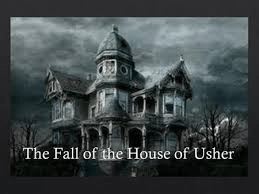
When I finish reading a text I will often consult the internet for some perspective – reviews, commentary, background, etc. My reading about ‘The Fall of the House of Usher‘ was largely un-illuminating – lots of people writing about how wonderful the story is – gothic, macabre, atmospheric are the terms most often used – but no-one able to clearly articulate why. It seems either you ‘get’ Poe or you don’t, and so far I don’t.usher

Here, for example, is some commentary in the journal of the Edgar Allan Poe Society of Baltimore (and let’s not pass too quickly over the fact that there is an Edgar Allan Poe Society of Baltimore) written by someone from the Tennessee Technological University (which sounds a really august centre of learning):

“Many readers consider Edgar Allan Poe’s ‘The Fall of the House of Usher’ to be one of the greatest short stories in all of world literature”.

Do they, really? I can’t find any evidence for that, and none is cited, which for an academic publication is disappointing. The writer continues:

“Few would disagree, at least, that it is one of Poe’s most popular and justifiably famous works.”

If this hyperbole were a one-off then I would be unjustified in quoting it, but that is far from the case – the reviewers on Goodreads, Amazon/com and Amazon.uk are near unanimous that Poe is a genius (which I am sure explains the whole marrying your 13 year old cousin thing) and that his story-telling and prose is outstanding. The editor of the Penguin Classics edition, David Galloway, describes ‘The Fall‘ as “one of Poe’s finest tales ….whose richness and totality of effect entitles it to unquestioned place among the short-fiction masterpieces of all time. Perhaps no other single short story has exerted such profound influences on other artists as Poe’s ‘Germanic’ tale“. Unquestioned place? Not ‘an unquestioned place’ – has the author’s gothic way of expressing himself transferred itself to the editor?

So what is it I am missing? I decided to give ‘The Fall‘ a further look following this research – surely the story has more to offer than I originally thought?

“During the whole of a dull, dark and soundless day in the autumn of the year, when the clouds hung oppressively low in the heavens, I had been passing alone, on horseback, through a singularly dreary tract of country, and at length found myself, as the shades of the evening drew on, within view of the melancholy House of Usher”. 

Poe establishes his themes and techniques as soon as possible – he piles up the adjectives, alliteratively where possible, keeps on adding subordinate clauses one after the other, and is slow to tell the reader what is going on, even though the tale is told in the past tense (or more strictly the pluperfect – “I had been passing alone”). This is almost a prose poem, and makes it quite easy to copy and/or parody. Indeed, so over the top is Poe’s writing that it can easily be read as self-parody.

Poe also establishes early on that the phrase “The House of Usher” means both the family, and their home. Thus the term “fall” used in the story’s title tells us that both the house and the family are to meet their end in the course of the tale. The description of a “fissure, which, extending from the roof of the building in front, made its way down the wall in a zigzag fashion” together with a long description of the decayed fabric of the house, suggests a likely fate for both the house and the family. The additional suggestion a little later that the house has gained a form of sentience from the family, builds even closer links between the two.

Switching to the present tense, to give a more immediate sense to the narrative, the narrator describes his host, Roderick Usher, clearly suffering from a psychological illness of an undefined nature – he is pale and lethargic, suffering from nerves and ‘fear’. His sister, Madeline, has a mysterious sickness that doctors cannot treat. The narrator tries to cheer Roderick up – he listens to him play the guitar, and reads him stories, but without effect.

“I have just spoken of that morbid condition of the auditory nerve which rendered all music intolerable to the sufferer, with the exception of certain effects of stringed instruments. It was, perhaps, the narrow limits to which he thus confined himself upon the guitar which gave birth, in great measure, to the fantastic character of the performances. But the fervid facility of his impromptus could not be so accounted for. They must have been, and were, in the notes, as well as in the words of his wild fantasias (for he not unfrequently accompanied himself with rhymed verbal improvisations), the result of that intense mental collectedness and concentration to which I have previously alluded as observable only in particular moments of the highest artificial excitement. 

It would be ridiculous to hold Poe to any normal standard of coherence or clarity in what is a tale of the supernatural, but his characters’ behaviour is still puzzling. The Lady Madeline passes away from her mysterious illness, and Roderick announces that he plans to inter her body in one of the vaults within the main family house, rather than the nearby burial grounds. The reasons given are, as always, ambiguous and vaguely sinister. The vault is lined with metal walls and a heavy iron door. Our last look at the corpse sees that she has “a faint blush upon the bosom and face, and that suspiciously lingering smile upon the lip which is so terrible in death.”

Any reader versed in the conventions of the gothic will be able to fill in the rest of the narrative without assistance from the author (or reviewer).

I could continue to delve into the depths of this narrative to try and find some additional value, but there comes a point when you just have to accept that certain styles of writing are just not to your taste. If you enjoy overblown, over the top, over-written gothic horror then this will be your cup of tea. But don’t be disappointed if you don’t find it the masterpiece that some believe it to be.

Standard
Book review

The Long Goodbye, by Raymond Chandler, 1953

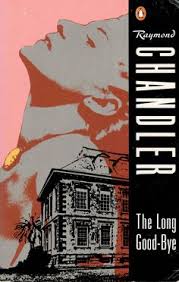
I first read ‘The Long Goodbye‘ around 25 years ago, and returning to it was an absolute pleasure. It is another Marlowe novel, and is (as they all are), a gem. Some novels change over time, but Chandler’s work has a timeless quality. It doesn’t matter what is happening in the outside world, Marlowe will always be there with a smart line and a stiff drink, even if he has just discovered a body and been socked over the head.  ‘The Long Goodbye’ is late Marlowe/Chandler, with a reflective quality that shows that both men have been through a lot, and are beginning to feel their age.chandler

The plot is complex, as you would expect. Marlowe meets a drunk, Terry Lennox, outside a club. Lennox is a lush, married to a rich women who is serially unfaithful to him, and has a mysterious past, testified to by the scars down one side of his face. Marlowe and Lennox become unlikely and occasional drinking friends until Lennox shows up late one night needing a ride to the airport, no questions asked. Marlowe knows he must have very good reasons for this request, but doesn’t ask any awkward questions. He is a good enough detective to know there are only one or two reasons why someone in Lennox’s position would want to fly the country in the middle of the night. So it is no surprise when on his return from the airport, the police confirm that Mrs Lennox has been murdered. Marlowe refuses to co-operate with the police, and is slung in jail for his efforts. But his interrogation is cut short when news arrives that Lennox has committed suicide leaving a confession. Marlowe later receives a letter from Lennox containing a Madison, a $5,000 bill, and some cryptic comments that leave Marlowe with some questions about what has happened.

Chandler’s novels are often built around earlier magazine stories. Knowing this I was expecting a new storyline to be introduced at this point, and it comes when Marlowe is asked by a publisher to work out the dark secrets of one of his (the publisher’s) writers, Roger Wade. Wade is being driven to drink by whatever is troubling him, and when drunk he becomes violent, not least towards his wife. Wade has also gone missing.

Marlowe quickly tracks Wade down to a detox facility in an isolated ranch. Case solved. Inevitably that is not the end of Marlowe’s involvement with the Wades. They try to convince him to work for them as what we would now call Roger’s sober companion, but Marlowe is not interested. Meanwhile, the Lennox ‘case’ refuses to go away, even though there appears nothing left to investigate. Marlowe’s work with the Wades leads other people to conclude that he is still looking into the deaths of Mrs Lennox and her husband. This is a close-knit community where everyone knows everyone else, and there is a suggestion that Wade and Mrs Lennox were lovers . Marlowe is menaced by a mobster friend of Lennox’s, Mendy Menendez, and by Lennox’s ultra-rich father-in-law, to drop the case, even though he tells them repeatedly that he is not investigating it. Slowly, details emerge of the lives of these troubled people. Marlowe learns that Terry Lennox had lived in England, fought in the Second World War, and had been previously married.

Wade starts drinking again, and then apparently commits suicide. Marlowe is suspicious, but because he was alone with Wade at the time of his death it is he that becomes a suspect, although never seriously. In a traditional reveal scene Marlowe walks us through who really killed Mrs Lennox and Wade, and finally what really happened to Terry Lennox.

Chandler’s byzantine plots mean that even though I have read this novel before I was constantly kept guessing as to who killed whom. But as I have said before you shouldn’t read Chandler for the plots, but the wonderful prose:

When I got home I mixed a stiff one and stood by the open window in the living room and sipped it and listened to the groundswell of traffic on Laurel Canyon Boulevard and looked at the glare of the big angry city hanging over the shoulder of the hills through which the boulevard had been cut. Far off the banshee wail of police or fire sirens rose and fell, never for very long completely silent. Twenty four hours a day somebody is running, somebody else is trying to catch him. Out there in the night of a thousand crimes, people were dying, being maimed, cut by flying glass, crushed against steering wheels or under heavy tires. People were being beaten, robbed, strangled, raped, and murdered. People were hungry, sick; bored, desperate with loneliness or remorse or fear, angry, cruel, feverish, shaken by sobs. A city no worse than others, a city rich and vigorous and full of pride, a city lost and beaten and full of emptiness. It all depends on where you sit and what your own private score is. I didn’t have one. I didn’t care. I finished the drink and went to bed.” 

This is a melancholy and reflective novel in which the portraits of two serious drinkers, Wade and Lennox, are both considered self-portraits of the author.  Marlowe still takes a punch with the best of them, but it takes him just that little bit longer to come round. He is still a sucker for a pretty face, and when he takes a lover it forms part of the long goodbye of the novel’s title. I can’t rank Chandler’s novels against one another, and they are equally hard to compare to other detective fiction, such is their distinctiveness. All I can say is that if I had a desert island disc decision to make, Chandler would be very near if not at the top of my list. He is one of the language’s great stylists, and if you haven’t read him before, and aren’t offended too easily, I can’t recommend his work highly enough.

Standard
Book review

Farewell, My Lovely, by Raymond Chandler, 1940

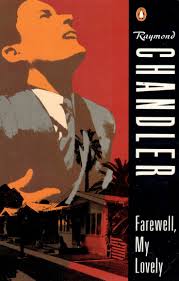
farewell

I’ve written previously on this blog about my admiration of Chandler’s prose. His flair for dramatic imagery is really unsurpassed in the detective fiction genre. People have tried to copy it, but never achieved the same vividly imaginative description.
Plot is in many ways secondary in these novels, which is surprising given that in most detective fiction whodunnit is the central question. For Chandler the journey is more important than the destination and when we arrive at the novel’s denouement the reveal can be a little anti-climactic.

‘Farewell My Lovely’ has a typically byzantine plot, where it is really easy for the reader to get lost as to what is happening, even after several rereads. (Where I say ‘the reader’ I am thinking of one specific reader in particular, me – other people may not have these issues. See what you think)

Marlowe is investigating a missing person’s case when he crosses the path of the novel’s anti-hero, Moose Malloy. Malloy is a prodigiously large man, and has just got out of prison after serving an eight years sentence. He is looking for his former girlfriend, Velma. Malloy is slow on the up-take, but extremely persistent. In the course of a visit to a club where Velma once worked, Malloy casually kills the owner. Having witnessed the killing, Marlowe decides to track down Velma.

He locates the widow of the nightclub’s former owner but this seems a dead end as she claims Velma is dead. That evening Marlowe picks up another case in which he is asked to act as a bodyguard for a man delivering a ransom for some stolen jewellery. The reader is hardly surprised when this payment goes badly wrong, and while Marlowe escapes with a bump on the head, his client, Lindsay Marriott, is murdered.

Anne Riordan, daughter of a former chief of police, finds the coshed Marlowe, and decides to help him with his investigation. She is not the typical sidekick – Marlowe doesn’t seem to welcome her help – but she races ahead with the case, finding out that the jewellery that was to be ransomed belonged to a Mrs Grayle, the young wife of a wealthy industrialist. Prompted by Anne, Marlowe visits Mrs. Grayle. There is an immediate spark between them, and after making out they agree to go on a date at a club owned by the local kingpin, Laird Brunette. Experienced detective fiction readers will be twitching at this point, knowing that there is more to both Mrs Grayle and Laird than meets the eye, but the speed of the action is such that there is little time to contemplate this development before Marlowe is off pursuing another red herring.

While investigating Marriott’s possessions, Marlowe finds some cannabis cigarettes, and inside these the business cards of a psychotherapist, as we would now call him, called Amthor. Marlowe begins to formulate an idea that Amthor identified his clients as potential victims, and then passed their details to Marriott, who gets to know them, sets up the robbery, and then manages the payment of the ransom. Confronting Amthor turns out to be a big mistake, as Marlowe is beaten up by first his bodyguard and then two local policemen on Amthor’s payroll, then kept drugged in a private hospital run by the sinister Dr. Sonderborg. He escapes, but on the way out he sees Malloy in another room. Marlowe subsequently works out that Malloy may now be hiding out on a gambling boat anchored beyond the city’s three-mile limit, and run by Brunette Laird, who we have met before.

The novel now moves swiftly to a conclusion. In a tense scene Marlowe sneaks on board the gambling boat, before the final confrontation between Malloy, such a strong presence in the novel despite only the briefest of appearances, Marlowe, and the ghosts of the past.

As was often the case with Chandler’s novels, ‘Farewell my Lovely’ is something of a Frankenstein’s monster in which earlier short stories are welded together to create the one narrative. If you look hard for the joints you can find them, but the fact that detectives will often pursue several cases at once gives this a plausibility it might otherwise lack. But as I have said earlier, you shouldn’t read Chandler for the plot. He is above all a superb stylist.

The eighty-five cent dinner tasted like a discarded mail bag and was served to me by a waiter who looked as if he would slug me for a quarter, cut my throat for six bits and bury me at sea in a barrel of concrete for a dollar and a half, plus sales tax.”

“She gave me a smile I could feel in my hip pocket.”

“1644 West 54th Place was a dried-out brown house with a dried-out brown lawn in front of it. There was a large bare patch around a tough-looking palm tree. On the porch stood one lonely wooden rocker, and the afternoon breeze made the unpruned shoots of last year’s poinsettias tap-tap against the cracked stucco wall. A line of stiff yellowish half-washed clothes jittered on a rusty wire in the side yard.”

Just occasionally Chandler goes over the top – “The wet air was as cold as the ashes of love.” – but you feel happy to overlook this given the percentage of hits to misses. But it is as king of the simile that Chandler reigns supreme:

“Even on Central Avenue, not the quietest dressed street in the world, he looked about as inconspicuous as a tarantula on a slice of angel food.”

and

“It was a blonde. A blonde to make a bishop kick a hole in a stained glass window” (a line that can still make me laugh out loud).

Having said all that, I can’t finish this review without mentioning the racism that is scattered throughout this novel. It’s painful to read and hard to separate out the racism of 1940’s America which is I am sure being accurately portrayed from the racist attitudes of the author. I don’t think it fatally damages the novel as a whole, but it does a good job at trying. A politically correct Philip Marlowe would be an abomination, agreed, but there is something about the casual way that racist terms are used that is distasteful.

Standard
21st century literature, American literature, Book review, Jonathan Safran Foer

Here I Am, by Jonathan Safran Foer, 2017

As I may have mentioned once or twice, I keep this blog as a record of what I read. If I don’t blog it’s probably because I haven’t been reading, but occasionally there are novels that really challenge my ability to say something interesting. ‘Here I Am’, Jonathan Safran Foer’s third novel, is a case in point. I read it a couple of months ago, but found it so underwhelming that when I finally found the time to write this review I had to look the title up. What is more remarkable is that it seems to have taken the author 10 years or more to write it!

‘Here I Am‘ is the story of the Blochs, a very familiar dysfunctional American family. Julia, an architect, and husband Jacob, a TV screenwriter, live in Washington DC with their three sons, Sam, Max and Benjy. Their marriage is falling apart for all the usual reasons – boredom, disrespect, mid-life crises, infidelity. An extended family provides supporting cast members including Jacob’s grandfather Isaac, planning to defer death until after Sam’s bar mitzvah; Jacob’s parents, Irv and Deborah, and others.

The Guardian’s review described “Here I Am” as

a novel of diaspora, of the elasticity of its numerous possible meanings, and of the pain caused by both the presence and the absence of the homeland it invokes. It moves from the intimate dissection of a family that has ceased to become a home for its members to the question of what Israel means to American Jews, and what they might consider to be their duty in the face of its imperilment.”

Which is a useful thematic summary, but will also give you a strong flavour of the worthiness of the novel. Worthiness can be fatal to any attempt at comedy. Because despite the big themes, this is undoubtedly intended to be an albeit dark comic novel. Divided between writing a serious novel about the experience of being a Jewish American family (already very well-explored novelistic territory) and the more comic aspects of that experience (ditto) Safran delivers neither very well.

Part of the problem is that very little happens, and it takes a long time to not happen. Minor incidents become central plot elements. Sam leaves a list of “rude” words on his desk at school then denies doing so – it is not until near the end of the novel that we find out he did write the list, as a profoundly unrealistic exercise in intellectual curiosity. Jacob “loses” the secret mobile phone on which he and a producer have exchanged explicitly sexual texts, in a pretty pathetic attempt to make himself more interesting to his wife. As mid-life crises go this is mundane stuff.

The bulk of the narrative is conveyed through the family’s conversations. The repetitive dialogues and monologues may be realistic representations of the way families talk to one another, but it felt a bit like being harangued for 500 and more pages. Realising the novel needed something by way of incident or drama, Safran Foer goes “all-in”. An apocalyptic earthquake in the Middle East strikes Israel, gifting the surrounding states an opportunity to recover lost territories/invade, depending on your perspective. A domestic chronicle suddenly becomes a diary of this catastrophe, which ends with the Israeli prime minister’s absurdly unlikely call to the men of the Jewish diaspora to return “home”. As if a country struck by an earthquake needs an influx of untrained volunteers to defend it. Jacob’s half-hearted attempt to volunteer falls flat, being turned away at the airport due to him having nothing worthwhile to contribute. As a metaphor for the turbulence in the Bloch family the earthquake and ensuing crisis is clumsy in the extreme, and as a statement on the position in the Middle East it is at best irrelevant and worst tasteless.

And if you have found the preceding paragraphs an unsatisfactory account of this novel, well you can’t say I didn’t warn you!

Standard
Book review

The Shrinking Man, by Richard Matheson, 1956

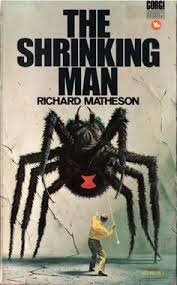
You may be more familiar with this novel through the film adaptation (pointlessly retitled the Incredible Shrinking Man, as if the shrinking bit was otherwise credible). It tells the story of Scott Carey, caught in one of those freak nuclear accidents that were almost unavoidable in 1950s America. Instead of imbuing him with superpowers, he begins to shrink. Every day he loses one seventh of an inch in height and overall mass. Doctors are unable to halt his inexorable decline.Shrinking Man

Matheson focuses his narrative on the end of Carey’s experience, when he is less than an inch tall, and is trapped in the family cellar, menaced by a Black Widow spider hungry for a snack. A lot of attention is paid to the practical detail of moving around when you are less than an inch tall, finding food, water and safety. In brief moments of calm Carey remembers his slow decline from a strong, six foot two husband and father, through an inverted adolescence, finally being housed in a doll’s house by his towering but ever faithful wife.

The novel cries out to be read as a parable. Carey’s emasculation, as he shrinks in both size and status, leading him to be more and more impotent, is a thoughtful commentary on the role of men in 1950’s American society. He is unable to provide for his family, and he becomes vulnerable first to a drunken paedophile and then teenage bullies. He briefly rediscovers his sexuality by spying on his daughter’s babysitter, who has a convenient propensity to remove her clothing and later has a brief affair with a fairground dwarf.

Size really does matter is the simple interpretation of this text, but to be honest I found the novel much more interesting if read as a commentary on the space race and the Cold War. Despite the seemingly impossible challenges Carey faces, he never gives up, and always ends up on top. He defeats his much larger enemies, and uses good old American pluck to win through. Each day’s shrinkage is another challenge to be confronted and beaten. At the end of the novel, he lies on his back looking up at the stars:

How beautiful they were, like blue-white diamonds cast across a sky of inky satin. No moonlight illuminated the sky. There was only total darkness, broken by the flaring pin points of the stars. And the nicest thing about them was that they were still the same. He saw them as any man saw them, and that brought a deep contentment to him. Small he might be, but the earth itself was small compared to this.”

Just at this time the USA and the USSR were both planning to launch satellites, and were contemplating the vastness of the challenge in front of them. The space race was a proxy expression of the Cold War. Matheson seems to say here that nuclear weapons will present a challenge for America, but that no matter what is thrown at it, it will survive and go on to conquer. The novel ends on a remarkably positive note in language which anticipates some of the purple prose used by the first astronauts:

“If there were other bursts of radiation, other clouds drifting across seas and continents, would other beings follow me into this vast new world? So close — the infinitesimal and the infinite. But suddenly, I knew they were really the two ends of the same concept. The unbelievably small and the unbelievably vast eventually meet — like the closing of a gigantic circle. I looked up, as if somehow I would grasp the heavens. The universe, worlds beyond number, God’s silver tapestry spread across the night. And in that moment, I knew the answer to the riddle of the infinite. I had thought in terms of man’s own limited dimension. I had presumed upon nature. That existence begins and ends in man’s conception, not nature’s. And I felt my body dwindling, melting, becoming nothing. My fears melted away. And in their place came acceptance. All this vast majesty of creation, it had to mean something. And then I meant something, too. Yes, smaller than the smallest, I meant something, too. To God, there is no zero. I still exist!

Matheson came up with a superb idea here and has created one of the seminal 1950s science fiction texts (he also wrote ‘I am Legend’). Although the narrative can get bogged down with a “how tiny me climbed the side of the chair to recover some breadcrumbs” level of detail, I wasn’t too distracted by this, and enjoyed the adventure elements of the story.

Standard
Book review

The Sellout, by Paul Beatty, 2015

I turned to Paul Beatty’s ‘The Sellout’ as some light relief after the torture that was ‘The Golden Bowl’. You can tell how bad things have got when a Booker Prize winner constitutes light relief! But it was. ‘The Sellout’ works best as an extended stand up routine – at times angry, often lyrical, usually very funny, challenging, and fast paced enough to ensure that the jokes that don’t work are quickly left behind and you are onto to the next. The Sellout

The narrator, “Me”, opens the narrative in the United States Supreme Court, where a case against him is being heard. The majority of the novel explains how the case occurred (i.e. in flashback). The narrator comes from and lives in the ‘agrarian ghetto’ of Dickens, a suburb or ghetto of Los Angeles.  He is raised by his sociologist father, who uses him as the subject of some bizarre social and racial experiments, which are hard to distinguish from child abuse (“I wasn’t fed; I was presented with lukewarm appetitive stimuli. I wasn’t punished, but broken of my unconditioned reflexes. I wasn’t loved, but brought up in an atmosphere of calculated intimacy and intense levels of commitment“). After his father is casually gunned down by the police and he inherits the family small holding, and his father’s taste for outrageous racial experiments.

The central conceit of the novel is launched when the narrator re-introduces slavery and segregation to Dickens. The segregation of bus passengers along racial lines is widely welcomed by the passengers, who are almost exclusively black in any event. Emboldened by the unlikely success of this initial experiment the narrator segregates the local all-black school, by renting a vacant lot opposite and advertising a soon-to-be-opened all-white college. Attendance and grades at the existing school quickly begin to improve. Further inventive ways of segregating an all-black community continue until the law intervenes.

This rather bald summary may make it look as if Beatty’s satire is unsubtle, if not reactionary. Is he suggesting that the position of some black people in America have not improved since the end of slavery and the struggles of the civil rights movement? The narrator is very clear that is not the point being made, however much it may appear to be the case. The Republican argument that more black children grew up with two parents during the days of slavery than they do today is comprehensively destroyed. But equally the advances in civil rights and representation since those days, such as the election of a black President, are not something that the angry voice of the novel takes for granted, or considers enough.

I’m so fucking tired of black women always being described by their skin tones! Honey-colored this! Dark-chocolate that! My paternal grandmother was mocha-tinged, café-au-lait, graham-fucking-cracker brown! How come they never describe the white characters in relation to foodstuffs and hot liquids? Why aren’t there any yogurt-colored, egg-shell-toned, string-cheese-skinned, low-fat-milk white protagonists in these racist, no-third-act-having books? That’s why black literature sucks!”

The election of the most reactionary President since I have no idea has underlined the novel’s argument that we are not yet living in a post-racial world.

While being a complex and nuanced discussion of race in America today, the novel is not for the lily-livered. The language is full-on, as above, and the n-word is used throughout the text. Some of the jokes miss their mark, such as

“Foy was no Tree of Knowledge, at most he was a Bush of Opinion”

or are predictable
“If New York is the City That Never Sleeps, then Los Angeles is the City That’s Always Passed Out on the Couch.
But these are exceptions, and virtually every page has one or more great lines, such as this description of a character “listing hard to the right like a drunken seaman with an inner ear infection” or this joke about the meaning of the word bi-monthly: “The meetings consisted mostly of the members who showed up every other week arguing with the ones who came every other month about what exactly “bimonthly” means.”
I enjoyed ‘The Sellout’. I can’t say whether it was a worthy winner of the Booker, because I haven’t read all the other short-listed novels, and I wasn’t on the jury anyway, but this is a book that will make you think, and I can’t praise it more highly than that.
Standard