Book review

The English Patient, Michael Ondaatje, 1992

The English Patient has given me doubts about my whole approach to reading. How can a novel so widely, almost universally praised, leave me so cold? What am I missing? Am I reading just for the sake of meeting some arbitrary blog-related target (bad) or for pleasure (good). Do I need to rethink how I read these novels? Sometimes it is interesting to spend time working out precisely why the novel in question missed the mark, but it would be nice from time to time to be able to write about what it did well. Perhaps I am just on a bad streak, missing the Terry Pratchett novels which were such a release from ‘literature’.

The English Patient: Winner of the Golden Man Booker Prize

The novel is set in Italy at the end of the Second World War. The text has a complex narrative structure in which events are told out of sequence. A severely burned “English” patient in the bomb-damaged Villa San Girolamo an Italian monastery, is being cared for by Hana, a Canadian nurse. He is the only patient left after the rest of the hospital has been evacuated at the end of the war in Europe. His only possession is a battered copy of Herodotus’s The Histories. Also in the villa/hospital is an Italian/Canadian/British thief and spy, Caravaggio. Of all the novel’s characters Caravaggio is the least well realised. The descriptions of him burgling various properties in the nude were bizarre and when he has his thumbs cut off as a punishment for his thieving it seems a fairly light sentence in the circumstances. Eventually these disparate and troubled characters are joined by Kip, an Indian bomb disposal engineer working with the British Army in the area. 

The English patient is horrendously burnt and will almost certainly die, but is lucid and able to recall some of his experiences leading up to his accident. His memory comes back to him intermittently, although he can never remember his name nor confirm his nationality. (We eventually discover he is not English at all – one of the many instances in the novel where things are not what they seem). He seems to have been slowly dying for several years, although the little I know about severe burns cases suggests that would be highly unlikely if not impossible. Previously he was part of a group of explorers mapping the North African desert. His adventures and those of the other inhabitants of the villa are the focus of the novel – little happens in the villa itself until the very end of the war.

In The English Patient Ondaatje has constructed a complex, elusive novel. It has some finely drawn characters, plenty of incident, and a mystery which is slowly revealed. It was quickly translated into an award winning film. The director made some striking choices about the way the narrative is presented, which highlighted some of the weaknesses in the novel’s construction. Incidents which are central to the film and prove heart rending and dramatic are almost thrown away in the novel. The most obvious example of this is the scene which forms the climax of the movie. The English patient is involved in a plane crash in the middle of the desert. His lover is seriously injured and her husband who was piloting the plane, dies. It is suggested that the crash may have been a deliberate attempt by the husband to kill his wife, and possibly her lover, in revenge for her infidelity. The patient rescues the wife and carries her into a nearby cave. She is seriously wounded but might survive, although the nearest town is three day’s journey away, and without the plane the patient has no way of getting help any faster. He walks to the town where he is immediately taken into custody on suspicion of being a spy. No-one will listen to his pleas, that he has left an Englishwoman out in the desert without food or drink, and she will surely die if he doesn’t go back to her.

In the novel, instead of this scene providing a heart-breaking climax to the patient and his lover’s affair, it is simply one of many fragmented recollections that surfaces during the morphine injections used to control his pain. It is not given any particular emphasis within the narrative structure. Of course I appreciate this was a deliberate choice by the author – war is full of tragedy – but the different choice made by the film director was clearly more impactful. The film also evens the novel’s timeline out, making the structure more straightforward while retaining the multiple flashbacks that are at its core.

Just to be clear, I appreciate that Ondaatje’s decisions to structure the novel in the way he did, to foreground some events and leave others in shadow, were obviously carefully thought through. They all add to the elusive nature of the novel in which the reader has to invest thoroughly in the narrative in order to construct the whole. Hence my feelings of guilt that I didn’t come to the novel prepared to do this work, put this effort in, and as a result didn’t benefit from the reward that would have brought. Putting it simply, I didn’t pay sufficient attention. And that’s entirely down to me.

Having offered that mea culpa, the novel is weakened from the uneasy combination of different narratives. As well as the present day events in the villa, described in the present tense, there are the patient’s memories of time spent exploring the desert, Caraveggio and Hana’s personal reminiscences, and Kip’s training as an unexploded bomb disposal engineer in England. These last scenes in particular, full of technical bomb-making detail, for which Ondaatje obviously did a lot of research, seemed lifted from an entirely different novel and grafted onto this narrative. 

And finally there is the prose. Much praised for its lushness, its vibrancy, its – well, pick the adjective of choice. But I found much of it just pretentious. I know it is unfair to quote the novel and make fun of the empty sentences, having emptied them myself of context and meaning, but how else can I demonstrate the point? You will either enjoy this style of writing or not – and I found it vacuous and empty. Worse at times it descends into meaninglessness.

“We die containing a richness of lovers and tribes, tastes we have swallowed, bodies we have plunged into and swum up as if rivers of wisdom, characters we have climbed into as if trees, fears we have hidden in as if caves.”

“I wish for all this to be marked on my body when I am dead. I believe in such cartography – to be marked by nature, not just to label ourselves on a map like the names of rich men and women on buildings. We are communal histories, communal books. We are not owned or monogamous in our taste or experience.”

I believe this. When we meet those we fall in love with, there is an aspect of our spirit that is historian, a bit of a pedant who reminisces or remembers a meeting when the other has passed by innocently…but all parts of the body must be ready for the other, all atoms must jump in one direction for desire to occur.”

“There are betrayals in war that are childlike compared with our human betrayals during peace. The new lovers enter the habits of the other. Things are smashed, revealed in a new light. This is done with nervous or tender sentences, although the heart is an organ of fire.”

“Her hand touched me at the wrist. “If I gave you my life, you would drop it. Wouldn’t you?”

In most cases these are the author’s characters speaking rather than the narrator, so it is the characters who are being over the top, pompous, or plain ridiculous. But when everyone speaks like this, more or less (Kip is the primary exception) then I can be forgiven for finding it wearying. It certainly didn’t leave me wanting to read more of this author.

Standard
Book review

The Secret History by Donna Tartt, 1992

The Secret History was Donna Tartt’s debut novel. It opens ominously with the announcement of a murder, with this gripping first line:

“The snow in the mountains was melting and Bunny had been dead for several weeks before we came to understand the gravity of our situation.

Much of the rest of the novel is dedicated to describing the circumstances leading up to the killing, and to answer the question: how did five educated, cultured and relatively genial young people come to kill someone they once considered their friend?

The novel’s narrator is Richard Papen, a student from California who escapes an unhappy childhood home to go to university the other side of the country in Vermont. Richard becomes part of a close-knit group of classics students, taught almost exclusively by a charismatic professor, Julian Morrow. (Morrow is perhaps a nod to Dr Moreau, another creator of monsters, and suggests Julian may share the burden of responsibility for what happens in the novel). As a character Richard has strong echoes of Nick Carraway, the narrator of the Great Gatsby, witness to another tragic east Coast story of rich people and how their money spoils them. The novel is told several years after the event, and Richard’s testimony makes it clear that the group were never convicted for their involvement in the killing of their friend Edmund “Bunny” Corcoran.

Richard is in no hurry to rush to the details of the murder. This is a confessional, and he believes it is important we understand the full background to what happened, their ‘secret history’. We are introduced to Julian’s small group of students: twins Charles and Camilla Macaulay, Francis Abernathy, Henry Winter, and Edmund “Bunny” Corcoran. Francis and Henry are both independently wealthy, but while Bunny’s family has money he is always borrowing from his friends. The others are cultured intellectuals but Bunny is an outlier, crude and unsophisticated, who takes advantage of his friends and tells unfunny jokes at their expense.

For Bunny’s murder to be portrayed as something the group were forced to do, but for the reader at the same time to feel some sympathy for the victim and understand why he was initially their friend, Tartt has to have Bunny undergo something of a personality change over the course of the novel. Bunny’s faults, at first either not mentioned or tolerated as eccentricities, slowly become magnified to the point of being unbearable. Instead of just sponging off his friends for an occasional meal, he eventually forces them to spend thousands of dollars on him every week, to the extent that their families all think they have drugs problems. None of this would have mattered if Bunny did not know that the group – excluding Richard – had a dark secret which if exposed would ruin their lives. It is the knowledge that sooner or later he will deliberately or otherwise expose them which causes them to act.

The Secret History, front cover.jpg

Bunny’s murder – they push him into a ravine, breaking his neck – is described at the climax of the first half of the novel, and once the deed is done the pace of the narrative almost inevitably begins to flag. There is no suspense as to whether they are investigated or arrested – Richard’s narration has already made it clear that they get away with the murder. Because it appears Bunny has accidentally fallen to his death, and because the body is not discovered for ten days, the inquest finds that he died accidentally, and there is no murder investigation. Things don’t go entirely smoothly – the extended search leads to suspicions that Bunny has been kidnapped (at one point ‘arabs’ are implicated) or was involved in drugs. The FBI is called in, but any threat to the group quickly evaporates once his body is found.

Despite the lack of legal consequences, the impact of their involvement in the murder of their friend is felt by the group nonetheless.

But walking through it all was one thing; walking away, unfortunately, has proved to be quite another, and though once I thought I had left that ravine forever on an April afternoon long ago, now I am not so sure. Now the searchers have departed, and life has grown quiet around me, I have come to realize that while for years I might have imagined myself to be somewhere else, in reality I have been there all the time: up at the top by the muddy wheel-ruts in the new grass, where the sky is dark over the shivering apple blossoms and the first chill of the snow that will fall that night is already in the air.”

Charles begins to drink heavily (as to some extent do all the others), and he eventually becomes unstable and abusive towards his sister. Henry arranges for Camilla to move into a hotel to get away from Charles. It emerges that Camilla and Charles have had an on-off incestuous relationship, and jealousy of Henry causes Charles to threaten him. At the same time Julian discovers the group’s responsibility for Bunny’s murder when he receives an incriminating letter from Bunny that had gone missing in the university’s arcane internal post system. Instead of reporting the crime, Julian walks out of the college and leaves the students to their fate.

The classics – Ancient Greek and the authors of the period – play an important part in the atmosphere of the novel. The students consider themselves an elite because of the subject they study, and hold themselves accountable to a different set of standards from the rest of the student body. Mainly this comes across as pretentiousness:

“Mais, vrai, J’ai trop pleure! Les aubes sont navrantes. What a sad and beautiful line that is. I’d always hoped that someday I’d be able to use it.”

Richard remains something of an outsider because he has friends outside the group, “somehow despite my efforts, I am never able to blend myself in entirely and remain in some respects quite distinct from my surroundings, in the same way that a green chameleon remains a distinct entity from the leaf upon which it sits, no matter how perfectly it has approximated the the subtleties of the particular shade.” But while Richard can at least approximate the behaviour of his waspish friends, Bunny’s involvement in the group is a complete anomaly. Most of the time he behaves like a typical undergraduate, drinking, taking drugs, and generally being boorish, completely out of place amongst his cultivated ‘friends’.

The Secret History is an ambitious novel. It introduces the reader to a close and complex group of friends and I think we are supposed to find them fascinating – Henry the savant, the enigmatic twins, and so on. I struggled to identify with them – they are all dependent on prosperous parents, and the extent to which they rely on the bank of mum and dad is exposed when Francis, openly gay when with his friends, feels forced to agree to an arranged marriage to a woman he despises just so he can ensure his allowance and inheritance. The novel is slightly less than the sum of its parts – the discussions of Ancient Greek literature and philosophy feel more important and profound at the time than when recalled at the end of the novel – are they just pretentious, spoiled students showing off and attempting to justify their homicidal tendencies?

Tartt is clearly an accomplished writer. She publishes approximately one novel per decade which shows how complex and immaculately crafted her novels are. Why The Secret History has never been adapted for the cinema of television is one of those mysteries that will never make sense, because it is incredibly filmic (I can imagine Bunny and Henry’s Christmas break in Rome would translate particularly well to the screen) , but hopefully one day one of the streaming services will pick it up.

Standard
Book review

The Voyage of the Dawn Treader, by C S Lewis, 1952

The Voyage of the Dawn Treader is the third story in the Narnia series (other numbering sequences are available, but ignore them and read these novels either to yourself or your children in publication sequence). To my mind it’s the last of the really great Narnia novels – I think the series divides into a) the first three novels, which are all quite magical, b) the next three novels, which are wonderful but mainly for existing Narnia fans, and not as well constructed or engaging as the first three, and c) the Last Battle, which is the Narnian equivalent of series 8 of Game of Thrones.

The Voyage of the Dawn Treader

Following the structure established in The Lion, the Witch and the Wardrobe and Prince Caspian, the Pevensie children are summoned into Narnia to help with a quest. This time it is only Lucy and Edmund, the two younger children, who make the journey – Peter and Susan were warned at the end of Caspian that they would not be returning because they were getting too old. At the time Lucy and Edmund are staying with their aunt and uncle Scrubb in Cambridge. These relatives are ‘progressive parents’, and there are lots of not so subtle comments on their parenting style. (I wonder whether Lewis, a long term Oxford academic, was having a little dig at Cambridge in making it the home of the appalling Scrubb family?) Peter is studying for an exam with Professor Kirke, the kindly old gentleman who featured in the first novel, and sister Susan, clearly her parents’ favourite, is travelling with them in America. Cousin Eustace Scrubb is a brat and a bully, and clearly needs some time in Narnia to grow up. I have quoted the novel’s opening line before, but it still packs a punch:

There was a boy called Eustace Clarence Scrubb, and he almost deserved it.

The magic obliges, and the children travel to Narnia through a picture of a ship at sea. The three children land in the ocean near the Dawn Treader, and are taken aboard.

TheVoyageOfTheDawnTreader(1stEd).jpg

And thus begins the adventure of The Voyage of the Dawn Treader. The ship belongs to Caspian the Tenth, King of Narnia, who the Pevensie children helped gain the throne in Prince Caspian. This time only three years has passed since the children were last in Narnia. In that time Caspian has brought peace to his realm, conquered the Ice Giants of the frozen North, and is now undertaking a quest to fulfil his coronation oath to sail east to find the seven lost Lords of Narnia. These lost lords were first mentioned in Prince Caspian, described as having sailed east on a voyage mainly to avoid King Miraz, Caspian’s evil uncle, showing the extent to which Lewis planned the series well in advance.

Eustace appears to not understand he is in Narnia, rejects the evidence of his own eyes in the form of talking animals etc, and asks to be put ashore at the nearest place that has a British consulate. Reepicheep, the magnificent talking mouse who I somehow forgot to mention in my notes about Prince Caspian, teaches Eustace some sharp lessons about politeness. Once the voyage is underway the novel becomes a fairly straightforward adventure story. The Dawn Treader sails steadily east, visits a series of islands, and on each the children and crew have an adventure and discover one or more of the missing lords. They are captured as slaves, attacked by a sea-serpent, meet mer-people, find a magic stream that can turn anything dipped in it into gold, and so on. On Dragon Island Eustace is transformed magically into (you guessed it) a dragon, and this transformative experience does much to turn him into a nicer person, helped by a personal encounter with Aslan. On Duffers’ Island Lucy removes an invisibility spell from the Dufflepuds, comic creatures with one foot. There’s an element of silliness about this chapter which will appeal to younger readers, although the subtext about colonialism – the Dufflepuds are too stupid to manage their own affairs, and need to be governed by a patriarchal wizard – is fairly uncomfortable. The religious symbolism in the novel remains largely under control, although it surfaces unambiguously once more at the end. Apart from the children’s instalment-friendly adventures on each island the main attraction of the novel is Eustace’s steady transformation under the positive influence of Narnia from an appalling brat and a bully to a much more thoughtful considerate young man.

Partly to justify my reading children’s stories I have been trying to work out why these novels were so compelling (and memorable) when I was a child, and why the remain popular to this day. Lewis’s world-building is wonderful – Narnia is utterly believable, and while it avoids being derivative it is immediately recognisable. The children are the heroes of each story, and behave and are treated as adults. Peter fights a king in Caspian, and almost wins. At the end of The Lion, The Witch and the Wardrobe the children grow up, reign as adults and the girls are courted by princes from other countries – adult experiences which seem quickly forgotten when they return to our world. What child doesn’t want to imagine a world in which they are the equal of adults, with no bedtimes, no school, and unlimited Turkish delight? The sense of peril in the novels is carefully contained – while the White Witch is a serious villain, she is swept aside when Aslan gets serious (prompting adults to wonder why it took him a hundred years to get round to returning to Narnia?) and later novels don’t have antagonists on the same scale. No-one dies in Voyage, and the battles in Prince Caspian go on for days with only bruises and cuts to show for it. (The account of one of the battles at Aslan’s How, before the children arrive, ends with the line “The best of the Bears had been hurt, a Centaur terribly wounded, and there were few in Caspian’s party who had not lost blood.”

There are many comic, slapstick moments in the series that will appeal to children, such as Mrs Beaver’s madcap approach to packing for a flight in the snow (insisting on taking her sewing machine!), or the comedy turn that is the Dufflepuds. There’s also a strong moralistic tone to the novels which children respond to (or should I say responded to?) – not least Eustace’s journey from being a nasty spoiled brat to where at the end of the novel “back in our own world everyone soon started saying how Eustace had improved, and how “You’d never know him for the same boy”: everyone except Aunt Alberta, who said he had become very commonplace and tiresome and it must have been the influence of those Pevensie children.

I wonder whether these novels have aged well? Are they still read with the same sense of wonder by children of the internet age? Is the Christian allegory just a bit too insufferable? It would be a bit sad if that were to be the case. Certainly they all remain in print, and the films of the first three novels few years back were reasonably successful, but part of me suspects they will have lost some of their shine.

Standard
Book review

Staying On, by Paul Scott, 1977

Staying On is effectively a post-script to The Raj Quartet , Scott’s earlier sequence of novels about the end of the British occupation of India. Set in 1972, shortly after the India/Pakistan war that led directly to the creation of Bangladesh, it tells the story of a British couple, Tusker and Lucy Smalley (briefly mentioned in the latter two books of the Quartet) who are the last British couple living in the small hill town of Pankot. Tusker, formerly a colonel in the British Army, chose to stay on in India after independence, when most British people returned to the UK, initially opting for a post in business and then finally retirement. One of the reasons for staying on was that the couple’s meagre savings would go much further in India than in the UK. But inevitably they slowly become more and more isolated as others leave.

The Smalleys live in The Lodge, an annexe to Smith’s Hotel. Their status as slightly unwelcome lodgers is obviously symbolic of the role of the British in India after the end of the Raj and reminiscent of J G Farrell’s use of the hotel as a symbol of Imperialism in his wonderful 1970 novel Troubles.

Staying On: Amazon.co.uk: Scott, Paul: 9780099443193: Books

Formerly the town’s principal hotel, Smith’s is now overshadowed by neighbouring The Shiraz, a much larger and more modern hotel built by a consortium of Indian businessmen. This is obviously the shape of things to come for Smith’s, now as anachronistic (and unprofitable) as the Smalley’s themselves. The novel focusses on the relationship between the brash, monosyllabic Tusker and his thoughtful, considerate wife, and in turn their relationships with the community around them. This is a detailed portrait rather than the sweeping descriptions majesties of post-Imperial India that the reader (well, this one) might have expected. Little happens in Pankot – no tiger hunting from the back of an elephant, no tribal communal riots or violence. Life as an expat in Pankot, relayed to the reader through Lucy’s lively inner monologue, is a restrained affair in which a letter from England is a cause for excitement.

In an imagined conversation to a prospective British visitor, Lucy reminisces about her childless marriage to Tusker and the decisions he made along the way that caused her such pain, most of all the decision to stay on when they had an opportunity to return to the UK. She has endured his buffoonery and occasional infidelity (the suggestion being that it is the former that was more painful) with a traditional stiff upper lip, but is coming close to breaking point. She knows Tusker is unwell, and is worried about her financial position should he die. Having borne multiplies slights from other army wives, she was looking forward to being shown respect as a ex-patriate, but finds that life has not turned out as she expected. Having lived with the fine racial and social distinctions that were so important to life as an Army wife, Mrs Smalley is unable to make any close friends among her Indian neighbours, and is obviously lonely and isolated.

In parallel to the Smalley’s relationship, Mrs Lila Bhoolabhoy, owner of Smith’s Hotel, bullies her hen-pecked husband, the hotel manager. Mrs Bhoolabhoy, without consulting her husband, makes plans to sell the hotel for redevelopment. This will lead to the Smalleys eviction, the news of which precipitates Tusker’s fatal heart attack. Scott sketches in a number of other characters that complete the Smalley’s small circle of acquaintances – their loyal servant, Ibrahim, their new gardener, Mrs Bhoolabhoy’s maid Minnie, the local vicar, and Susy, Mrs Smalley’s mixed-race hairdresser.

This is not a novel driven by events. The one major turning point – Tusker’s death – is announced in the opening sentence and the remainder of the novel is an explanation of how his heart attack is triggered by the eviction notice. There is no mystery about the cause of death – Tusker’s health issued are mentioned throughout, as is his tendency to flare-up in response to any perceived slight from his landlord. Instead the focus is on the minutiae of the Smalley’s lives in the days leading up to his death.

This was an enjoyable if slight novel that is in some ways more interested in the Smalley’s relationship than the setting. I suspect that the return to the UK that Mrs Smalley yearned for would have still left her marriage under strain, and her friendships limited by social constraints of class, religion or race. Ideally I would have read The Raj Quartet first before Staying On, which would have made it a very different read, more an epilogue than a stand-alone novel. These are some of the difficulties of working one’s way through the Booker prize winners in such a haphazard way. I doubt The Raj Quartet will now ever make its way onto my hypothetical to be read list, but you never know.

Standard
Book review

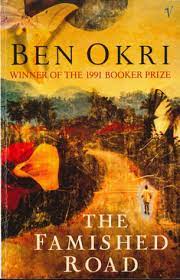
The Famished Road, by Ben Okri, 1991

Ben Okri’s The Famished Road won the Booker Prize in 1991. I found it a difficult, challenging book. I am not the only one – many reviewers (good example here) have found the novel so hard to read to the extent they reported giving up in frustration at the bewildering narrative style. Which is a pity, because underneath all the badly written magical realism is an interesting, even uplifting story about life in a rapidly changing African village.

The Famished Road tells the story of Azaro, an abiku, a child spirit who repeats over and over again the cycle of life and death. For reasons that never become clear Azaro finally decides to stay on earth and live a full life. But his family have a hard existence – they live in one, damp-sodden room, haunted by rats in the walls. Work is brutally exhausting. The family is always crippled by debt and any time they do have any money it is quickly frittered away. Political parties promise change but are obviously, openly corrupt. They have no real friends – their neighbours are hostile and unwelcoming. Meanwhile all around the forest is being cut down to make space for more roads and housing.

Early in the novel Azaro is kidnapped and about to be sacrificed by a police officer and his wife before being saved by his mother. But he is a resilient child, bouncing back after being beaten or thrown out of the local bar. His father has the same irrepressible spirit. He is an amateur boxer who seems to win every fight against all the odds. His mother sells small household goods from the street, scratching out a living in pennies.

As an abiku, Azaro often sees spirits and enters the spirit world. These dreamlike scenes were the most difficult to read – intensely episodic and devoid of any logic or structure. This is not the magical realism found in authors such as Garcia Marquez; magic is not integrated into the everyday work, experienced by everyone and accepted as normal. Here it happens to Azaro alone – no-one else can see the spirits that appear to him. These scenes have a drug-induced quality and go on for many long pages. I could quote them at length but here are a few shorter examples:

The trees were running away from human habitation. My eyes became charged too and I saw people with serene bronze masks emerging from trees. I saw a bird with a man’s hairy legs flying clumsily over the branches of the rain-tree. An antelope with the face of a chaste woman stopped and stared at me…An old man emerged from the anthill that had been following me”.

“I heard the cry of a cat. A dog’s eyes stared into mine…An eagle flew in from the door and landed on the old one’s head. He touched the eagle with his good hand and a black light shot into my eyes. When I opened them I saw I was in a field. Around me snaked a green river. I looked up and saw a blue mountain…A cat jumped right through me…The beggar laughed. “

Inside a cat there are many histories” (572). (Indeed there are).

I like to think I am a bit of a connoisseur of the meaningless sentence, and The Famished Road added quite a few to the collection. For example: “I stayed outside for while, planting my secrets in the silence of my beginnings”. (288) That sounds meaningful, but it could mean so many different things it ends up meaning nothing. Perhaps it is intended to mean something different to each reader. I recognise that in quoting it I have had to strip the sentence from its context, but there are times when you just have to abandon attempts at understanding and listen to the poetry.

Her snoring altered the geography of our destinies” (568)

And so on. I am sure it is these exhausting sequences which will have put off so many readers. The story of Azaro and his family’s struggles failed to escape from the burden of this dominant element of the narrative. Okri has some important points to make about the reasons for the family’s impoverishment:

“He saw the world in which black people always suffered and he didn’t like it. He saw a world in which human beings suffered so needlessly from Antipodes to Equator, and he didn’t like it either. He saw our people drowning in poverty, in famine, drought, in divisiveness and the blood of war. He saw our people always preyed upon by other powers, manipulated by the Western world, our history and achievements rigged out of existence.”

The novel ends with this message of hope:

“There will be changes. Coups. Soldiers everywhere. Ugliness. Blindness. And then when people least expect it a great transformation is going to take place in the world. Suffering people will know justice and beauty. A wonderful change is coming from far away and people will realise the great meaning of struggle and hope. There will be peace.”

The unnamed African country Okri describes is very undeveloped even though it is rapidly modernising. Witchcraft and primitive medicine – juju – is a dominant theme throughout the novel. Herbalism is the term used to describe traditional medicine but it appears as a little more than a rebranded and sanitised version of witchcraft. These scenes and characters have a troubling subtext, and it concerned me that Okri appeared to give serious credence to the concept of child-spirits and witchcraft. This concept of the spirit child may have been society’s way of rationalising high rates of infant mortality. Children die because they are spirits fated to be reborn, rather than because of preventable disease or deprivation. But Okri doesn’t introduce this idea. Instead spirit children are presented as a fact of life. No-one questions their existence in the novel.

Even in the twenty-first century, African witchcraft beliefs are widespread, and have been incorporated by some into a local brand of Christianity. This has led to much violence against young Nigerians in particular. Children and babies branded as ‘evil’ are being abused, abandoned and even murdered. Preachers provide expensive exorcism services, profiting from childhood illnesses. Human rights activists opposing this practice are threatened and harassed. One source quoted in Wikipedia estimates 15,000 children in the Niger Delta alone have been forced onto the streets by witchcraft accusations. “Children are taken to churches where they are subjected to inhumane and degrading torture in the name of ‘exorcism’. They are chained, starved, hacked with machetes, lynched or murdered in cold blood. In Akwa Ibom State and Cross River State of Nigeria, about 15,000 children were branded as witches and most of them end up abandoned and abused on the streets.”

It is easy for me to preach but I think an author has a responsibility when writing about these topics to not passively endorse the wide-scale harm that occurs due to these ideas. Okri may have wanted to reflect a genuine part of African culture, without passing judgment and allowing the reader to draw their own conclusions. However, there is a difference between reflecting people’s lived experiences and presenting their superstitions in a vivid and confirmatory manner, especially in a novel that is otherwise realistic. Okri needs to show recognition of the negative impacts of the perception of spirit children and do more than just reflect the existence of these beliefs.

I would love to hear what you thought of the novel and specifically this particular issue.

Standard
Book review

Rites of Passage, by William Golding, 1980

Rites of Passage is an account of a voyage by sea to Australia. Set in 1812, at the end of the Napoleonic war, the voyage is undertaken by a group of Britons in search of a new life in Australia. The ship is a converted man-of-war, an aging battleship. The story is told in the form of a journal written by Edmund Fitzhenry Talbot, a young aristocrat. We are told this journal is being written to entertain Talbot’s godfather, who is apparently a very influential man, and who has arranged for Edmund to work for the Governor of New South Wales in the colony. Talbot describes the ship’s layout, its crew and passengers, and the mainly weather-related incidents that comprise the voyage. He loses track of the days at sea when he falls ill, but as the ship approaches the equator the narrative slowly focusses on the fate of one other passenger, Reverend Colley, and something that happens to Colley when the ship crosses the equator – the rite of passage in the novel’s title.

Colley’s role in the novel is largely one of scapegoat. He accidentally offends the ship’s captain by intruding on the quarterdeck without permission, something forbidden in ship’s orders. Colley makes clumsy efforts to repair his relationship with the captain, but is rebuffed. He becomes a focus for the crew’s attention, and is hazed during the crossing the equator rituals. These central events happen ‘off-screen’ – Talbot the novel’s principal narrator isn’t present when they happen, and is only vaguely aware of them (his focus is on chasing a young woman of negotiable affection around the ship) and in the subsequent journal pages written by Colley they are only alluded to tangentially and ambiguously. Whatever happens, Colley then gets blind drunk and there is a further incident with the crew in which sexual activity with one or more of the ship’s crew is hinted at. Struck by shame Colley retreats to his cabin, refuses all food and drink, and eventually dies. In the nineteenth century shame could be fatal, apparently.

Golding seems to have based this incident on the well-documented practice of humiliating crew members when they cross the equator for the first time. If the Wikipedia entry is to be believed this practice continues in navies around the world to this day. It seems likely in the nineteenth century these ceremonies would have been less restrained than they are now. A record of the second survey voyage of HMS Beagle describes the crossing thus:

As they approached the equator on the evening of 16 February 1832, a pseudo-Neptune hailed the ship. Those credulous enough to run forward to see Neptune “were received with the watery honours which it is customary to bestow”.[2] The officer on watch reported a boat ahead, and Captain FitzRoy ordered “hands up, shorten sail”. Using a speaking trumpet he questioned Neptune, who would visit them the next morning. About 9am the next day, the novices or “griffins” were assembled in the darkness and heat of the lower deck, then one at a time were blindfolded and led up on deck by “four of Neptune’s constables”, as “buckets of water were thundered all around”. The first “griffin” was Charles Darwin, who noted in his diary how he “was then placed on a plank, which could be easily tilted up into a large bath of water. — They then lathered my face & mouth with pitch and paint, & scraped some of it off with a piece of roughened iron hoop. —a signal being given I was tilted head over heels into the water, where two men received me & ducked me. —at last, glad enough, I escaped. — most of the others were treated much worse, dirty mixtures being put in their mouths & rubbed on their faces. — The whole ship was a shower bath: & water was flying about in every direction: of course not one person, even the Captain, got clear of being wet through.” 

All good fun but the element of humiliation is never far off.

For a novel about a sea voyage there is surprisingly little about sea-voyaging in Rites of Passage. Yes, there’s plenty of description of the ship and its working, and Talbot devotes a lot of time to learning ‘tarpaulin’, which he claims is the sailors name for their slang and technical terms about the working of the ship. But for a voyage half-way round the world, the novel is in many ways claustrophobic, confided within the narrow constraints of the ship. There’s no mention of the ship ever docking for supplies for example. At the end of his journal Talbot describes it as: “some kind of a sea-story but a sea-story with never a tempest, no shipwreck, no sinking, no rescue at sea, no sight nor sound of an enemy, no thundering broadsides, heroism, prizes, gallant defences and heroic attacks. Only one gun fired, and that a blunderbuss!” which is about right.

This is largely because the novel isn’t really about the voyage at all. It ends long before Australia is reached for one thing – the destination and the new world it represents is unimportant. This novel is really much more interested in the social structures which govern life on board. The ship as a metaphor for society is an image that goes back as far as Plato. In case the reader has missed the point, Golding names his ship Britannia. The passengers and crew are carefully stratified into a class system distributed through the ship’s decks, with strict codes of conduct and conventions (which of course Colley is punished for breaking).

Ostensibly Rites of Passage is a straightforward story of a sea-voyage. But as you might expect from a Nobel-winning novelist there’s plenty more going on than you are initially led to believe from the flawed narrative voices. But the novel also felt very old-fashioned. It could easily have been written by Conrad in the first decade of the twentieth century, o, earlier. People dying of shame tends not to happen in novels written towards the end of the twentieth century! The narrative structure, based around Talbot’s journal, felt forced to me, harking back to the early epistolary novels of the eighteenth century. For all his status and education Talbot is an unobservant narrator, never able to get to the bottom of what causes Colley’s death. The text within a text, Colley’s fragmentary notes which Talbot discovers in his cabin and pastes into his journal, are written in a more authentic, accessible voice, and came as a bit of a relief.

I can’t honestly say this was an enjoyable read, with the archaic language and the claustrophobic setting combining to give the novel a constricted, stifled atmosphere. It is is the first in a series in which Golding continued the voyage towards Australia, and we find out more about the characters he introduces here. Once again I find myself hesitant about investing more time in a trilogy, although this time for very different reasons than when I finished The Ghost Road!

Standard
Book review

The Ghost Road, by Pat Barker, 1995

I think it would be fair to say that my experience of reading Booker prize winning novels has so far been patchy, to say the least, certainly recently having focussed on some of the earlier winners. Along the way there have been some incredible novels, but also a fair share of stinkers. I am delighted to say that The Ghost Road was very much in the first category. It was outstanding – original, touching, and very well written.

The Ghost Road

The Ghost Road is the third novel in the Regeneration trilogy. I found this out after buying the novel, which put me in a bit of a quandary – do I read the previous two novels or just push ahead with this one on its own? In the end I decided to read this novel first – which I now regret. If it had been a stinker then I could just tick it off the Booker list and move on, but it was such a well-written book that I really think I ought to read the first two in the trilogy. But of course that’s a daft way to read any series of books! So I just have to live with my decision.

Ghost Road follows the continuing adventures of Billie Prior, who in the earlier books had served in the trenches in World War One and been hospitalised suffering from shell-shock. This novel sees his recovery and return to the front. It opens with a scene in which Prior leers at women sun-bathing on the beach (a reference to the Nausicaa chapter in Ulysses?). He is keen to return to France despite being offered the opportunity to serve out the rest of the war in a desk job in the Ministry of Munitions, while at the same time accepting fatalistically that his chances of being killed are high. Prior is a sexually adventurous and ambivalent young man – Barker recounts his numerous encounters graphically without ever being salacious.

The battle scenes in the last days of the Great War are reserved for the final chapters of the book and arrive with huge impact. A futile war becomes even more pointless as the armistice is just days away; readers will be aware of that ticking clock and the imminent death of Prior’s fellow officer, Wilfred Owen. These powerful scenes are hard to read but incredibly well written.

The other main thread of the novel interwoven with the story of Prior’s return to France is told by his former doctor, Rivers. While continuing to care for his patients as the Spanish flu begins to take grip, Rivers recalls his time on an anthropological expedition to the Solomon Islands to study the local culture. This section is based on the work of the real-life character of Dr Rivers. Throughout the novel Barker draws on factual accounts and experiences, but integrates them seamlessly into the narrative to the extent that it is impossible to tell which is fiction and which fact, nor that it really matters. This is one of those novels that sends the reader down a series of internet rabbit-holes as passing references to the executor of Oscar Wilde’s estate for example, or the gay sub-culture of the Edwardian era appear in the narrative. The Solomon islanders culture, dying out due to the imposition of European ‘law and order’, is focused on the capturing of prisoners from local tribes and beheading them. This death cult is implicitly contrasted with the industrialisation of death on the Somme and Passchendaele, and seems almost civilised by comparison.

The First World War is very familiar ground for novelists, but Barker has used this setting with a highly original approach to create a powerful novel. I caught some echoes of Catch 22 in the descriptions of the struggles to capture an insignificant piece of land days before the Armistice. I could have done with more Prior and less Rivers in the overall balance of the novel – I found Billie the more interesting character – a working class officer recovering from shell-shock with an out of control libido and friends with some of the greatest poets of the twentieth century, what’s not to like?

This is a brave and interesting novel and a worthy winner of the 1995 Booker, a self-conscious and stunningly successful attempt to break away from the northern, working class, feminist stereotypes Barker previously found herself constrained by. The novel addresses the profound contradiction of the heart of the Great War – that it was at once terrible and, for some, exciting and worthwhile or rewarding. Barker explained in an interview:

I think the whole British psyche is suffering from the contradiction you see in Sassoon and Wilfred Owen, where the war is both terrible and never to be repeated and at the same time experiences derived from it are given enormous value”.

Prior thinks he is mad to have come back to France, but would equally have been mad not to. The novel’s ending is hard to read after all that has come before, as the attempt to cross the canal is beaten back:

“Prior was about to start across the water with ammunition when he was himself hit, though it didn’t feel like a bullet, more like a blow from something big and hard, a truncheon or a cricket bat, only it knocked him off his feet and he fell, one arm trailing over the canal.

He tried to turn to crawl back beyond the drainage ditches, knowing it was only a matter of time before he was hit again, but the gas was thick here and he couldn’t reach his mask. Banal, simple, repetitive thoughts ran round and round his mind. Balls up. Bloody mad. Oh Christ. There was no pain, more a spreading numbness that left his brain clear. He saw Kirk die. He saw Owen die, his body lifted off the ground by bullets, describing a slow arc in the air as it fell. It seemed to take forever to fall, and Prior’s consciousness fluttered down with it. He gazed at his reflection in the water, which broke and reformed and broke again as bullets hit the surface, and then, gradually, as the numbness spread, he ceased to see it.”

Is this not wonderful, under-stated writing?

Standard
Book review

The Lion, the Witch, and the Wardrobe, by C.S.Lewis, 1950

Many of the 24,000 reviewers of The Lion, the Witch and the Wardrobe on Goodreads share a common memory: of being read this book by an adult when they were a child, being utterly bewitched by it, and so happy to find out that there were other adventures in Narnia to explore. I am sure you will be familiar with the story of the children’s wartime evacuation to a mysterious country house, their discovery of a portal to a magic land bewitched by a wicked witch to be always winter but never Christmas, and their adventures there. Lewis created so many memorably iconic characters and scenes in this wonderful novel which it was a pleasure to revisit. This is not one of those childhood novels that transform into something else when read as an adult. Yes the Christian allegory will be more obvious, but at this stage of the series it remains a gentle introduction to Christian ideas rather than the insistent sermon some find it.

The novel has aged surprisingly well, but of course the attitudes to women are hardly progressive. Even though Lucy has a leading role and is usually the figure whose judgment is to be trusted, the girls are given more caring, supportive roles – for example it is Susan’s idea to take the fur coats from the wardrobe when exploring Narnia (“They immediately carried out Susan’s very sensible plan.”) When giving them their special gifts, Father Christmas bluntly warns them not to get involved in the coming battle with the witch’s forces:

“Last of all he said, “Lucy, Eve’s Daughter,” and Lucy came forward. He gave her a little bottle of what looked like glass (but people said afterwards that it was made of diamond) and a small dagger. “In this bottle,” he said, “there is a cordial made of the juice of one of the fire-flowers that grow in the mountains of the sun. If you or any of your friends are hurt, a few drops of this will restore you. And the dagger is to defend yourself at great need. For you also are not to be in the battle.” “Why, Sir,” said Lucy. “I think—I don’t know—but I think I could be brave enough.” “That is not the point,” he said. “But battles are ugly when women fight.”

Some of the influences of the Narnia series on J K Rowling’s Harry Potter books became more obvious at this rereading. The way Harry gets onto the platform at Kings Cross has echoes of the way the Pevensie children travel to Narnia, where magic is real, creatures can talk, and evil has to be confronted. Harry is a strikingly obvious Christ-figure – he is born to be sacrificed, he dies and rises again – while Aslan’s death and resurrection to absolve Edmund’s sins are central to this novel. Each series seem to have been planned well in advance – Lewis published seven novels in seven years in rapid succession, and sows seeds of later books in the series as early on as The Lion, the most obvious example being his future plans for Susan (see below – the problem with Susan). I found it interesting that while fundamentalist Christians had some serious problems with the Harry Potter books on the basis that they were seen to promote witchcraft, they had no such problems with the Narnia novels in which a talking lion brings statues to life.

There’s a lot to enjoy in The Lion. The story is told with a breathless economy. We are in Narnia almost straight away, and from Aslan’s resurrection to the final battle and the return to the wardrobe is only a matter of pages. (From the death of the White Witch, the coronation at Cair Paravel, the tying up of loose ends and the return to England is all done in less than 2500 words). Superfluous description is stripped away, leaving the reader to imagine Narnia and the children for themselves, although I always enjoyed the wonderful illustrations by Pauline Baynes (see above). Lewis creates vividly memorable characters in the briefest of sketches. Mr Tumnus for example really only appears in chapter 2 (What Lucy Found There). He is mentioned in passing in chapter 4 (Turkish Delight) and reappears at the end of the novel when brought back to life by Aslan, where he gets precisely one line. And yet say the name Mr Tumnus to any adult of my generation and he will be brought vividly to life, with his mysterious parcels (where had he been shopping?) and guiltily nervous manner.

I like to think the mid-twentieth century equivalent of the Health and Safety Executive in some way got to Lewis and ensured that he didn’t encourage a generation of children to get trapped in wardrobes. The warnings to never close the door behind you if you do get into a wardrobe are repeated time after time, with an insistence that goes beyond paranoia. Forget about the dangerous creatures out to kill you in Narnia, just don’t shut that door!

I wanted to say a few words about what is now called “the problem with Susan”. In the final novel of the series, The Last Battle (spoilers – please don’t read on if you don’t want to know what happens) Susan is denied entry into Narnia because she has lost her faith and been seduced by earthly pleasures:

“My sister Susan,” answered Peter shortly and gravely, “is no longer a friend of Narnia.”

“Yes,” said Eustace, “and whenever you’ve tried to get her to come and talk about Narnia or do anything about Narnia, she says ‘What wonderful memories you have! Fancy your still thinking about all those funny games we used to play when we were children.'”

“Oh Susan!” said Jill, “she’s interested in nothing now-a-days except nylons and lipstick and invitations. She always was a jolly sight too keen on being grown-up.”

“Grown-up, indeed,” said the Lady Polly. “I wish she would grow up. She wasted all her school time wanting to be the age she is now, and she’ll waste all the rest of her life trying to stay that age. Her whole idea is to race on to the silliest time of one’s life as quick as she can and then stop there as long as she can.”

This decision – to portray faith as being something essentially childlike, and loss of faith due to the distractions of the flesh – nylons and lipstick – seems to many readers to be a punishment of Susan for discovering her sexuality. As well it may be. Certainly Lewis’s version of heaven means nothing if everyone can enter irrespective of their behaviour or ideas. Someone had to be left behind. But what is interesting to me is how early Lewis seems to have been planning this sacrificial role for Susan. She is consistently shown even in this novel as the one whose faith is not as steadfast as the others. Early on, when the weather closes in and they are not sure where to go, she is the first to suggest going back:

“I—I wonder if there’s any point in going on,” said Susan. “I mean, it doesn’t seem particularly safe here and it looks as if it won’t be much fun either. And it’s getting colder every minute, and we’ve brought nothing to eat. What about just going home?

In the sequel, Prince Caspian, Susan is the last one of the Pevensie children to be able to see Aslan when he reappears in Narnia (Lucy is the first, of course). I am sure Lewis always had it in mind for Susan to be the one who doesn’t make it to Narnia in the end.

Finally, just a word on the question, why read children’s books? I’ve addressed this question in previous posts, so I don’t want to go over old ground too much, but the simple answer to this is “Why not?”. The longer answer is to reject the whole concept of children’s books, although to be fair Lewis doesn’t make this argument any easier by sub-titling this novel “A Story for Children“! Suffice to say this is a novel that can be enjoyed by all ages, and the nostalgia value alone made it a wonderful read.

Standard
Book review

Saville, by David Storey, 1976

There weren’t any whippets or homing pigeons in David Storey’s Saville. Apart from that I don’t think there was a single cliché about Northern working class life that it avoided, from trouble at mill, musically gifted lad bullied by his dad for being in touch with his feminine side, people dying of rickets and on and on and on – it was just so overwhelming the It’s Grim up North relentlessness of it all.

It all starts so well:

“Towards the end of the third decade of the present century a coal haulier’s cart, pulled by a large, dirt-grey horse, came into the narrow streets of the village of Saxton, a small mining community in the low hill-land of south Yorkshire.”

This has strong echoes of D H Lawrence, but equally of an earlier novelist of rural working class lives, Thomas Hardy:

“On an evening in the latter part of May a middle-aged man was walking homeward from Shaston to the village of Marlott, in the adjoining Vale of Blakemore or Blackmoor.”

But it doesn’t last, and we are quickly pitched into the minutiae of depressingly deprived life in the Yorkshire mining villages. Colin Saville is the bright but emotionally stunted son of the coal-miner and his timid wife, who passes the eleven-plus and sees education as a possible route out of the poverty-stricken life of his parents. My guess is that the narrative is principally autobiographical, because nothing else would seem to justify the sheer volume of pointless detail crammed into the novel’s 550 pages. For most of the novel Colin is a passive figure – events happen to him but he seems to have no agency, no personality. Towards the end of the novel a personality of sorts emerges, and Colin becomes a distinctly less-likeable individual, fighting with his family and treating the women in his life with disrespect and contempt.

While there are events in the novel – the Second World War starts in the background and continues to its conclusion while only minimally intruding on Colin’s day to day life – they are largely a distraction from the recording of every last detail of his existence. To be fair, if one grew up in a mining village in the thirties and forties I am sure the war would have seemed very distant, especially as miners were exempt from conscription. Colin seems to spend most of the novel either riding on a bus (trains being too expensive), waiting for a bus, going to catch a bus, or talking about all of the above. No detail of his tedious life is too irrelevant to be excluded from the narrative. He goes for a walk in the park, cleans the windows, washes the dishes, meets a girl – but feels nothing, or reveals nothing about what he thinks and feels.

The novel does a good job of capturing the confusion and mysteriousness of childhood. Things happen and are accepted without explanation. Colin’s mother, for example, suffers several illnesses and hospital spells which are never explained. Colin is warned that when he goes to grammar school that older boys will flush his head in the toilets. He spends hours practising holding his breath in preparation for this ritual, but when school starts and the threatened humiliation never happens, the danger is quickly forgotten.

There’s an ambivalence about working class life in Saville best encapsulated by the obsession with dirt and cleaning. Miners and their families are both perpetually filthy and constantly cleaning:
“A bucket of water stood by the hearth; in the top of it floated a wooden scrubbing-brush. The carpet had been rolled up in front of the fire and the stone floor between there and the door opening to the yard scrubbed clean. There was a smell of soap in the room, overlain by the musty, almost stifling odour which came from the bed.” This duality of dirt and cleanliness/cleaning comes to act as a symbol for Colin’s relationship with his family and his community – he is desperate to escape, but feels chained to home and parents. He turns down the chance to go to university, instead opting for a local teacher training college which allows him to remain at home, contributing to family income.

Misery memoirs became more popular later in the twentieth century – Saville is an early example of the genre. Some reviewers have seen the novel as a political statement, but if it is it is highly ambivalent. Communism is mentioned cynically as being irrelevant to the lives of the miners. There is no suggestion that the Attlee government of the post-war years had any impact on their lives apart from a passing mention of the nationalisation of the mines, which surely can’t have been right – free healthcare for the miners and families would have been transformative, and the state of Colin’s mother’s health meant it would have had an immediate beneficial impact.

I haven’t said this for a while, but sometimes I read these novels so you don’t have to. Saville was grim and cliched and while not a hard read it did make me want to bury myself in something joyful and entertaining for a week or so before returning to the Booker winners of the 1970s.

Standard
Book review

Bring Up the Bodies, by Hilary Mantel, 2012

There are certain authors I feel a sense of guilt about not admiring. Coetzee is the obvious example – everyone tells me Disgrace is a masterpiece, but it left me cold. Hilary Mantel’s novels fall into the same category – even as I was reading Bring up the Bodies I could feel the pressure to enjoy the craftsmanship and characterisation, to marvel at the wealth of detail, and to ignore some of the problematic issues (which of course I am not going to do.)

Bring up the Bodies is the second novel in Mantel’s series about the life of Thomas Cromwell, a sequel to Wolf Hall. It recounts the dramatic events running up the end of Henry the Eighth’s marriage to Anne Boleyn. It imaginatively recreates these events from Cromwell’s Machiavellian perspective, using his inner monologue as the narrative voice. The novel is prefaced by five pages of characters and several family trees, which I referred to throughout the novel (‘Which one is he?’). This should give you some idea of the complexity of the narrative. I certainly know more now about the history of this period than I did previously!

I confess I did not know what happened to Cromwell after he engineered the end of Henry’s second marriage – but I was sure that it did not work out well (spoiler – it does not). I think we are intended to see he, Cromwell as a master manipulator, someone pulling all the strings, carefully orchestrating the downfall of the Boleyns, serving the interest of the king but at the same time ensuring his own position is secured. But actually he is not in control of events in any sense. Henry is volatile and dangerous. While Cromwell is on the right side of the king he prospers, but it is clearly only a matter of time before he falls out with him and is used as a scapegoat for all the king’s crimes and misdemeanours. He’s simply too convenient an excuse – ‘Cromwell made me do it’ – not to be used sooner or later, not to mention the fact that his money and his offices of state could then be redeployed around the court for more influence and favour. As he becomes more powerful at court, he accrues more enemies, and comes closer to the day of his eventual demise. He is a threatening figure at Court, and dangerous people are likely to be brought down sooner or later. No-one can be more powerful than the king. As Call-me Wriothesley puts it:

“If this is what Cromwell does to the cardinal’s lesser enemies, what will he do by and by to the king himself?”

Henry is dangerous and ruthless, and there is no way this is going to end well for Cromwell. He seems to sense this himself – it’s hardly the most profound of insights:

“You can be merry with the king, you can share a joke with him. But as Thomas More used to say, it’s like sporting with a tamed lion. You tousle its mane and pull its ears, but all the time you’re thinking, those claws, those claws, those claws.”

There is a lot we do not know about the end of Anne and Henry’s marriage. At its most basic, we do not know if she was guilty as charged. She was charged with and convicted of adultery with a number of other men, including George Boleyn, her brother. It seems highly unlikely that she would have risked her life for – what? The chance of another pregnancy, or simply because Henry was an inadequate lover? For perfectly understandable reasons Mantel does not try to answer this – she leaves it ambiguous as to whether Boleyn was guilty or not. The obvious answer – that Henry was bored with Anne and didn’t want to go through another protracted divorce, so turned to Cromwell to fix the problem – is avoided, I suspect simply because it is not that interesting an answer. Instead the solution presented to the reader is that this outcome is the result of Cromwell’s deviousness.

At the heart of the novel is his investigation into this allegation. As part of his enquiry he, Cromwell, invites one of the suspects, Mark Smeaton, to supper. Mark is a Flemish lute-player, the most junior of the suspects, and a member of the queen’s court. Court gossip has implicated him as one of the queen’s lover. Here he jokes with him (he, Cromwell) and in the course of the conversation Smeaton confesses to sleeping with the Queen. Smeaton must have been profoundly stupid to think he could boast of cuckolding the King, a man not known for his patience or understanding, to a senior minister with a fearsome reputation for being the King’s enforcer, and that there would be no consequences. The traditional or conventional explanation of Smeaton’s confession is that he was brutally tortured, but that would make Cromwell seem more of a brute and less of a manipulator, able to coax a damning confession out of a man using flattery and suggestion.

The passage where Smeaton confesses is key to the novel’s denouement. For Cromwell this is an interrogation; Smeaton thinks it is an informal chat, a delusion Cromwell fosters:

(Cromwell to Smeaton): “I ask your charity… I come to you because you are close to the queen, and the other gentlemen will not help me.

(This is of course flattery. Cromwell gives Smeaton the title of ‘gentleman’ even though he is a commoner, and appeals to his sense of importance as someone close to the queen.)

I have the power to reward you, and will make sure you have everything you deserve, if only you can give me some window into the queen’s desires.

(Cromwell makes it clear he is the one in control of the conversation (I have the power), but hints he wants to reward Smeaton rather than punish him. Smeaton should have noticed the reference to him having what he deserves rather than desires. The next reference to the queen’s desires introduces the idea of her as someone with bodily appetites).

I need to know why she is unhappy, and what I can do to remedy it. For it is unlikely she will conceive an heir while her mind is unquiet. And if she could do that: ah, then all our tears would be dried.’

Mark looks up. ‘Why, it is no wonder she is unhappy’, he says. ‘She is in love’.

‘With whom?’

‘With me.’

He, Cromwell, leans forward, elbows on the table: then puts a hand up to cover his face. (To disguise his reaction)

‘You are amazed’ Mark suggests.

That is only part of what he feels. I thought, he says to himself, that this would be difficult. But it is like picking flowers.” (273/274)

There’s no question this is subtly done – Cromwell flatters the young man and gives him a false sense of security. He implies he is acting in the queen’s best interests, and that if he is able to help he will get everything he ‘deserves’, a dangerous ambiguity. Later Cromwell encourages Smeaton to be more explicit about his relationship with the queen by suggesting he thought he was a ‘sodomite’.

But despite all this, it still beggars belief that Smeaton would confess so casually and freely. This is not a bar-room boast, but a conversation with the King’s most senior and most dangerous advisor. Smeaton is aware that Cromwell is not his ally, and realises his mistake, but far too late, and he is placed under arrest. From this point the whole case against the queen and the others accused is constructed, and leads quickly to their conviction and execution. In the moment this account is a plausible explanation for the known historical events, but when one takes a step back and considers the conversation in context it seems highly unlikely that Smeaton would have blurted his confession out with nothing more than flattery to persuade him to cooperate.

That is one example, but the rest of the historical interpretation of the novel is often equally hard to swallow. The popular myth that the queen had six fingers on one hand and was therefore condemned at trial as a witch is demonstrably untrue, (none of her contemporaries mention any such feature, nor do any of the paintings of her show it – it’s not something that would have been easy to hide!) but instead of treating it with the contempt it deserves Mantel nods to the idea, suggesting that the myth may have had its origins in the belief that Boleyn had in some way enchanted the king.

ButB is an easier read than Wolf Hall. The irritating over-use of the personal male pronoun is not dropped, but Mantel clarifies who the ‘he’ is where it is ambiguous by persistently inserting the phrase ‘he, Cromwell’. I would rather she did this than spending half the novel wondering what is going on/who is speaking, but as a device it seemed clumsy given how flexible English is in telling us who is doing what.

I would never say never, but I doubt I am going to read The Mirror and the Light, the third in the trilogy, any time soon. For one thing it is around 800 pages long, and I know how it ends! I appreciate that sounds infantile, but with so many books and so little time this is all about choices. Historical novels always have to address the fact that the outcome of the novel is known. There’s no suspense about how it ends. Mantel deals with this by imaginatively showing us events through the eyes of a character who previously has not been given a central role in earlier histories, and by speculating on details of the key turning points in these tumultuous and dangerous times. Cromwell always remains just out of reach, never the hero, never entirely sympathetic. His cold-bloodedness is excused, even justified, but is harm to stomach at times.

Struggling to put my finger on the source of my mild dissatisfaction with this novel, I thought back to Maggie O’Farrell’s Hamnet. Set only a few decades later, this historical novel aims to do much of what Mantel aspires to with Bring up the Bodies – to bring to light some historical events through the eyes of a character who previously has not been a focus of analysis compared to the major protagonists, and to speculate about some of the questions that have puzzled historians for so long. Both authors bring to life their narrators and imaginatively recreate what living at this time must have been like. Perhaps O’Farrell simply chose a more sympathetic narrator, but Hamnet has a vitality and authenticity that BuTB does not. I can’t be sure but I suspect it all comes down to the fact that I found the lives of Warwickshire working people more interesting than Tudor court intrigue, however much more ostensibly dramatic and historically significant the latter may have been.

Standard