This 1970 Booker winner opens with the following quote:
“If patients are disturbed, their families are often very disturbing.”
This really tells you all you need to know about this novel. The central character, Norman Zweck, is mentally ill, and his illness can be traced directly back to his profoundly dysfunctional family.
Norman comes from a traditional Jewish family. His father came to London from Lithuania with just a suitcase and a name and address written on a scrap of paper. Despite being forty Norman lives at home (and indeed has never left) with the ghost of his controlling mother and his weak-willed father. His older sister, Bella, still lives at home as well and wears ankle socks every day as a vivid reminder of her frozen adolescence. Younger sister Laura left home and married outside their religion, and has therefore been expelled from the family circle – mention of her name is forbidden.
The primary symptom of Norman’s mental illness is that he sees silverfish crawling everywhere. It’s a horribly and vividly realised psychosis, and it cripples him, leaving him unable to leave his bedroom, work, or sustain a relationship.
We slowly learn the details of the family history through the reminiscences of the characters as they react to Norman’s most recent breakdown. He is addicted to amphetamines, although the precise cocktail of drugs and childhood trauma that leads to his illness is not ever entirely resolved. However his family are unable to cope, so on the advice of the family doctor they have him committed to a psychiatric hospital for treatment. Here he quickly finds someone ready to sell him more amphetamines, meaning any treatment is unlikely to work. Back home his family suffers feelings of guilt that they have not been able to help him. Bella, we eventually find out, had an incestuous relationship with her brother. Laura ran away from a relationship with Norman’s best friend, David, who we are given to understand (without it ever being made explicit) was his lover. Thoughts of and actual suicides haunt the novel, giving it a structure in which we come to see that the mental institution Norman is committed to is very similar to the home he was unable to leave.
The novel’s title is puzzling. One of Norman’s fellow inmates in the hospital has delusions he is in the Cabinet, although he is always referred to as Minister rather than the elected member, or any variation thereof, and in any event is a relatively peripheral character upon which to name the novel. The title could refer to Norman being the chosen one, the golden boy on whom the hopes of his family came to rest – he was gifted with languages, and qualified as a barrister – although the ‘member’ element of the title still escapes me.
Bernice Rubens had a long writing career, and most of her many novels remain in print, so there must be an audience for them somewhere. But whilst I found The Elected Member a largely inoffensive read, it left me with no appetite for following up with anything else by this author.
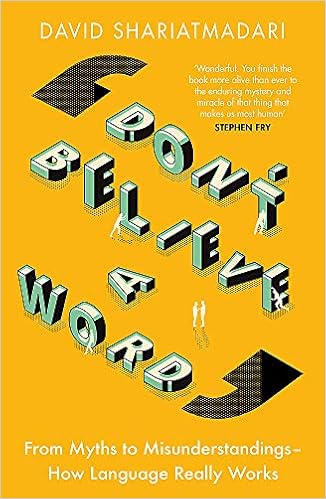
Don’t Believe a Word is subtitled “From Myths to Misunderstandings – How Language Really Works” which is a pretty bold claim, and one I suspect Shariatmadari would probably disavow. Because this is much more a summary of the current state of research into some of the larger issues around language acquisition and use than anything approaching a comprehensive final set of answers to some of the difficult questions about this issue.
Because language is profoundly mysterious. How we as a species came to uniquely acquire the power of language is endlessly fascinating, and I was hoping for something that attempted to described the processes whereby we went from the simple sounds required to warn of predators or communicate during a hunt to the infinitely more complex process I am using to write these sentences, however inelegantly. Unfortunately the author really only skims these issues for the safer, more familiar ground of why language is not ‘going to the dogs’ or the differences between languages, dialects and ideolects.
The structure for the book is that each chapter is intended to expose a common myth about language. Demonstrating that standards of English are not declining, and never have, is done easily enough, by quoting the same complaint made across the centuries. Older people will always feel alienated from the language of the young who are much more innovative in their use of language, and will use their positions of authority that come with age to define standard English and try to shame younger people into conformity. Which means I can look forward to hopefully one day hearing the incessant use of the word ‘like’ as a meaningless filler to become the ‘correct’ way of expressing oneself, and youngsters chastised for not using it appropriately.
Each generation will think of itself as exceptional, and find reasons why the language they are using is different from that of their predecessors. Much of this is down to the rapid spread of technology which introduces words and ideas simply not required before. I am grateful to the author for bringing to my attention this brilliant summary of the issue from the wonderful Douglas Adams (from The Salmon of Doubt):
1. Anything that is in the world when you’re born is normal and ordinary and is just a natural part of the way the world works. 2. Anything that’s invented between when you’re fifteen and thirty-five is new and exciting and revolutionary and you can probably get a career in it. 3. Anything invented after you’re thirty-five is against the natural order of things.”
Another ‘myth’ Shariatmadari addresses is the idea that foreign languages have untranslatable words. Is that really a language myth that needs to be challenged, or just a bit of fun on the internet that no-one takes particularly seriously? Yes it makes other cultures sound sound quaint or bizarre. and can contribute to the ‘othering’ of foreigners. But other cultures are often profoundly different from our own (not better or worse, just different) so it would be surprising if they didn’t have words for things we use phrases or sentences to describe.
There’s a thoughtful discussion of whether our languages shape how we think, rather than the other way round. Those of us exposed to George Orwell’s thesis (in 1984) that we need a language of nuance and expression to articulate concepts such as democracy will be open to the idea that we need words to explain ideas before those ideas can exist. But mentioning Orwell brings me to a minor quibble with this book. In the chapter on whether language is deteriorating, the author cites Orwell as “clearly wrong when he imagined that language would become decadent and ‘share in the general collapse’ of civilisation unless hard work was done to repair it.” The text Shariatmadari is quoting here is not cited, but the internet being the wonderful thing it is I easily found it in Politics and the English Language. Now you won’t find a better. more powerfully argued essay in favour of clear writing in politics that this. Shariatmadari unfairly dismisses it because Orwell opens with the deliberately contentious argument that:
Most people who bother with the matter at all would admit that the English language is in a bad way, but it is generally assumed that we cannot by conscious action do anything about it. Our civilization is decadent and our language — so the argument runs — must inevitably share in the general collapse.
Orwell, Politics and the English Language, 1946
To break one of Orwell’s prime rules (‘never use a metaphor, simile, or other figure of speech which you are used to seeing in print’) this is throwing the baby out with the bathwater. All Orwell is arguing is that bad writing about politics is often bad for specific reasons: “to make lies sound truthful and murder respectable, and to give an appearance of solidity to pure wind”. Which is surely a more important point than the one he is being discredited with?
Later, Shariatmadari gives a respectful, if sceptical account of Noam Chomsky’s universal grammar theory. The idea that humans are born with an innate language ability far in advance of any other skill or ability in life (compare the struggles we have to walk or feed ourselves) has yet to be proven beyond all doubt, but the alternative, that language is “a medium that is formed as it is used … a road that is paved at the same time as we walk it” seems inadequate when contrasted with the other clumsy abilities we develop as children. If you want a primer on Universal Grammar and the current research on the theory this is not a bad place to start.
Overall this is an entertaining, accessible and well-evidenced summary of the state of linguistics as it is currently understood. As with the book I recently read on genetics, I left this with the impression that there is still a lot of research to be done on this subject, and that our understanding of ‘how language really works’ is as elusive as ever.
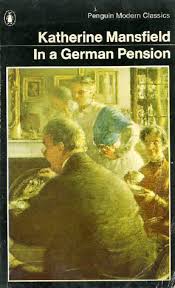
In a German Pension joins that small subset of books that the author didn’t want to see republished. It was Katherine Mansfield’s first published collection, although most of the stories had been previously published in various magazines. Because of the war and problems with the publisher (it went into liquidation) the book was quickly forgotten, and when the idea of republishing it was later floated by her then husband, John Middleton Murry, Mansfield refused. She considered the stories juvenalia and feared, I am sure rightly, that they would contribute to post-war anti-German sentiment.
Have the stories weathered the passage of the following century, or should Mansfield’s wishes have been respected? I would strongly argue the former – the tone of the collection might be uneven, and some of the portraits are caricatures, but overall this is a powerful group of stories in which the focus is not so much the German residents of the pension (a boarding house) with which the earlier stories are concerned, but the role of women in German and European society in the later stories which emerges as a more dominant theme.
The stories were written after her stay in a German spa before the first world war broke out. Mansfield was there to recuperate after a miscarriage. The collection is formed of thirteen stories, some only a few pages long, with the whole collection barely a hundred pages in total. The early stories are slightly whimsical observations of the characters in the pension, observed by a narrator who captures the chatter of the residents with the minimum of commentary. The Germans are boorish and judgmental towards the English narrator, although already the themes of maternity and women’s role in society are beginning to emerge:
“Is it true,” asked the Widow, picking her teeth with a hairpin as she spoke, “that you are a vegetarian?”
“Why, yes; I have not eaten meat for three years.”
“Im—possible! Have you any family?”
“No.”
“There now, you see, that’s what you’re coming to! Who ever heard of having children upon vegetables? It is not possible. But you never have large families in England now; I suppose you are too busy with your suffragetting. Now I have had nine children, and they are all alive, thank God. Fine, healthy babies—though after the first one was born I had to—”
“How wonderful!” I cried.
“Wonderful,” said the Widow contemptuously, replacing the hairpin in the knob which was balanced on the top of her head. “Not at all! A friend of mine had four at the same time. Her husband was so pleased he gave a supper-party and had them placed on the table. Of course she was very proud.”
This is carefully nuanced writing. What is not said is as important as what is, and the reader is able to gain a picture of the narrator’s situation without it ever being made explicit. After a few more short stories in which German attitudes to class are lightly mocked, the collection takes a more serious turn. Frau Brechenmacher Attends a Wedding is a chilling portrait of an abusive marriage. Herr Brechenmacher is a bully who orders his wife around. She has five children under the age of nine, but is looking forward to a night off attending a wedding celebration. This is how the author closes the story:
“They walked home in silence. Herr Brechenmacher strode ahead, she stumbled after him. White and forsaken lay the road from the railway station to their house—a cold rush of wind blew her hood from her face, and suddenly she remembered how they had come home together the first night. Now they had five babies and twice as much money; but—
“Na, what is it all for?” she muttered, and not until she had reached home, and prepared a little supper of meat and bread for her man did she stop asking herself that silly question.
Herr Brechenmacher broke the bread into his plate, smeared it round with his fork and chewed greedily.
“Good?” she asked, leaning her arms on the table and pillowing her breast against them.
“But fine!”
He took a piece of the crumb, wiped it round his plate edge, and held it up to her mouth. She shook her head.
“Not hungry,” she said.
“But it is one of the best pieces, and full of the fat.”
He cleared the plate; then pulled off his boots and flung them into a corner.
“Not much of a wedding,” he said, stretching out his feet and wriggling his toes in the worsted socks.
“N—no,” she replied, taking up the discarded boots and placing them on the oven to dry.
Herr Brechenmacher yawned and stretched himself, and then looked up at her, grinning.
“Remember the night that we came home? You were an innocent one, you were.”
“Get along! Such a time ago I forget.” Well she remembered.
“Such a clout on the ear as you gave me…. But I soon taught you.”
“Oh, don’t start talking. You’ve too much beer. Come to bed.”
He tilted back in his chair, chuckling with laughter.
“That’s not what you said to me that night. God, the trouble you gave me!”
But the little Frau seized the candle and went into the next room. The children were all soundly sleeping. She stripped the mattress off the baby’s bed to see if he was still dry, then began unfastening her blouse and skirt.
“Always the same,” she said—“all over the world the same; but, God in heaven—but stupid.”
Then even the memory of the wedding faded quite. She lay down on the bed and put her arm across her face like a child who expected to be hurt as Herr Brechenmacher lurched in.”
That last line is like a punch in the face – “She lay down on the bed and put her arm across her face like a child who expected to be hurt”. The narrative is now much darker. Women are cursed with eternal pregnancies which are dangerous and potentially fatal (“my insides are all twisted up with having children too quickly” on character observes) and children are a burden not a joy. The stories are often told from the perspective of servants who are also oppressed, a situation which finds its apotheosis in The Child Who Was Tired, in which an exhausted child is expected to be the principal carer for her younger siblings, and finds the burden too much:
“I don’t believe Holy Mary could keep him quiet,” she murmured. “Did Jesus cry like this when He was little? If I was not so tired perhaps I could do it; but the baby just knows that I want to go to sleep. And there is going to be another one.”
She flung the baby on the bed, and stood looking at him with terror.
From the next room there came the jingle of glasses and the warm sound of laughter.
And she suddenly had a beautiful marvellous idea.
She laughed for the first time that day, and clapped her hands.
“Ts—ts—ts!” she said, “lie there, silly one; you will go to sleep. You’ll not cry any more or wake up in the night. Funny, little, ugly baby.”
He opened his eyes, and shrieked loudly at the sight of the Child-Who-Was-Tired. From the next room she heard the Frau call out to her.
“One moment—he is almost asleep,” she cried.
And then gently, smiling, on tiptoe, she brought the pink bolster from the Frau’s bed and covered the baby’s face with it, pressed with all her might as he struggled, “like a duck with its head off, wriggling”, she thought.
She heaved a long sigh, then fell back on to the floor, and was walking along a little white road with tall black trees on either side, a little road that led to nowhere, and where nobody walked at all—nobody at all.”
Powerful, distressing stuff. Mansfield may have wanted to forget this collection when she moved on to later work, but I am glad these stories remain in print. The anti-German sentiment has faded and we can now see these stories as a very personal and rather touching narrative.
The structure of this novel is fascinating. The principal thread holding it together is a first person narration by the novel’s central character, Iris Chase. In her old age she writes a memoir for her grand-daughter. Her narrative recalls memories of her childhood and the early years of her unhappy marriage to a Toronto businessman, Richard Griffen. She also describes her present-day life in Port Ticonderoga, her Canadian home-town, dependent on the goodwill of her friend Myra for her everyday needs. Interspersed with this narrative is the text of a novel, The Blind Assassin, apparently written by Iris’s sister Laura, and published posthumously just after the end of the second world war. The Blind Assassin itself contains a third narrative, a pulp science fantasy story – and it is this story which is the tale of the eponymous blind assassin. This might sound an overly complex structure, but it is easy to follow once you understand the conventions Atwood uses to signal which of the stories we are being told.
Intertwined narratives of this kind are not that new or innovative – A S Byatt’s 1990 Possession does something quite similar. What is so striking about this novel is the way Atwood draws together the threads of her stories and step by step reveals the truth underlying the initial presentation. It will come as no surprise to hear that Iris is an unreliable narrator and it is the contrast between her account and her sister’s novel, slowly revealed to be based on real life, which allows a truth to emerge. Again, this concept of there being a ‘true’ narrative hiding behind the lies and misrepresentations offered by the narrator is not entirely new, but it is done with considerable skill here.
Atwood uses one other device to drive the narrative. Key moments of the story are revealed through newspaper stories. We are told about the premature deaths of central characters. The novel therefore becomes a mystery story – we are less interested in what happens, but why, and how the events are related to one another.
The temptation in reviews of this kind is to take a retrospective view of the events of the novel and to flatten them out – to present them in a linear chronological fashion, whereas the presentation within the novel is complex and at times even chaotic. So if I were to tell you the story of the Chase sisters, their wealthy manufacturing family, Iris’s unhappy marriage to Toronto manufacturing tycoon Richard Griffen, etc, it would all be true, but it would give a distorted version of the novel. Sometimes such summaries are useful, when it is hard to follow the plot or where there is uncertainty about some of the detail (this is particularly true of those novels spanning generations where everyone seems to have at least three different interchangeable names!). But here I think I will pass – plot summaries are easy to find online if required, but would reduce this novel to a story, which would be reductive and misleading.
I found it interesting to compare this novel in all its complexity to Atwood’s 1972 novel Surfacing, It clearly demonstrates her growth as a novelist – while Surfacing is a convincing portrait of one woman’s mental deterioration, the contrast with The Blind Assassin makes it look superficial and incomplete.
I have disagreed with the choices of the Booker judges many times over the years, but this must have been one of the simpler choices they ever had to make.
I wanted to take a closer look at the portrait of Alec D’Urberville in Thomas Hardy’s Tess. Alec is an archetypal rogue of fiction, one in a long line of roues that can be traced back to Robert Lovelace in Richardson’s Clarissaand beyond. These men are always attractive, but dangerous and amoral. Alec is largely a two-dimensional character. As early as Chapter 12 he tells Tess
“I suppose I am a bad fellow—a damn bad fellow. I was born bad, and I have lived bad, and I shall die bad, in all probability.” (77).
So one has to ask, is there anything else to him than a symbol of male oppression and sinfulness?
I’m going to look more closely at how Hardy represents Alec. When he first meets Tess he is dressed as a young country gent:
“The driver was a young man of 3 or 4 and twenty, with a cigar between his teeth; wearing a dandy cap, drab jacket, breeches of the same hue, white neckcloth, stick-up collar, and brown driving gloves” (52).
Earlier we are told he has “a well-groomed black moustache with curled points” which completes the picture – this is someone confident in his appearance and his attractiveness to the opposite sex, over-dressed for the role of driver. This establishes a template for virtually every time Alec appears – he is never recognised straightaway by Tess. Or to be more precise his identity is never immediately acknowledged by the narrator, usually because he appears in disguise.
If Tess and Angel are consistently characterised as Adam and Eve, both before and after the Fall, Alec is the tempter. In his multiple disguises he promises her riches or a better life.
“”About the children – your brothers and sisters,” he resumed. “I’ve been thinking about them”. Tess’s heart quivered – he was touching her in a weak place. Since returning home her soul had gone out to those children with an affection that was passionate.....if your mother does not recover, somebody ought to do something for them; since your father will not be able to do much I suppose”.
(Tess angrily rejects him, and in response )
“D’Urberville in anger retreated from her to the hedge, where he pulled off the long smockfrock and red neckerchief which had mainly disguised him”.
350
He disappears from the narrative for a several chapters while Tess and Angel are falling in love at the dairy, only to return in dramatic fashion. At the end of chapter 44, coming back from an unsuccessful visit to Angel’s parents, Tess meets Alec preaching to a small crowd. He is a reformed man and has found god. She hears him before she sees him, and it dawns on her that the voice, preaching “a vehement form of the views of Angel’s father” is that of Alec. (305-6). From this point he begins to haunt Tess, seeking her out time and again. He next appears (314) as “a black speck” and is “perceived to be a man in black…in a semi-clerical costume” (my emphasis). He tracks her down to her cottage, and then pesters her while she works on a threshing machine:
“Just before the dinner-hour a person had come silently into the field by the gate, and had been standing under a second rick watching the scene, and Tess in particular. He was dressed in a tweed suit of fashionable pattern, and he twirled a gay walking-cane”. (327).
We don’t have long to wait before Alec resumes his persistent attempts to persuade Tess to resume her relationship with him. She returns home to Marlott where her mother has been taken ill. One evening she is working on the family’s small-holding when she becomes aware of someone working alongside her in the twilight:
“Tess did not speak to her fellow-worker, nor did he speak to her. Nor did she think of him further than to recollect that he had not been there when it was broad daylight….by and by he dug so close to her that the fire-beams were reflected as distinctly from the steel prongs of his fork as from her own. On going up to the fire to throw a pitch of dead weeds upon it, she found that he did the same, on the other side, the fire flared up, and she beheld the face of D’Urberville. “
Alec’s demonic appearance, pitchfork and all, is re-emphasised. Once again he is in disguise – almost one might say in fancy dress:
“The unexpectedness of his presence, the grotesqueness of his appearance in a gathered smockfrock, such as was now worn only by the most old-fashioned of the labourers, had a ghastly comicality that chilled her as to its bearing. …
“A jester might say this is just like paradise. You are Eve, and I am the old Other One come to tempt you in the disguise of an inferior animal. I used to be quite up in that scene of Milton’s when I was theological.”
349
Their penultimate meeting is in Kingsbere church, among the tombs of the ancient D’Urbervilles. Tess is looking round the old church, home to her ancestors:
“She musingly tuned to withdraw, passing near an altar-tomb, the oldest of them all, on which was a recumbent figure. In the dusk she had not noticed it before, and would have hardly noticed it now but for an odd fancy that the effigy moved. As soon as she drew close to it she discovered all in a moment that the figure was a living person; and the shock of her sense of not having been alone was so violent that she was quite overcome, and sank down nigh to fainting, not however till she had recognised Alec D’Urberville in the form.
(363).
What are we to make of this presentation of Alec? The references to his demonic appearance aren’t that hard to decode (!) but the narrator’s persistent failure to identify him on his first appearance in each scene is more problematic. Is this just a stylistic quirk, a way of allowing the reader to guess his identity before it is confirmed, giving the false impression that the reader is slightly ahead of the narrator in their understanding of the story? Possibly, but if this was all that is going on it would be quite a tired device. When a mysterious stranger appears in the Sherlock Holmes stories (by comparison) the real surprise is when it is not Holmes in disguise. We quickly learn that it will be Alec who appears out of the gathering darkness whenever someone appears.
With regard to his disguises and costumes, I think these are a way for the author to signal Alec’s instability and unpredictability, the mercurial nature of his character and his insincerity. He presents himself to the world in the way he wants to be seen, and when that character has served its purpose it is discarded. He may even be sincere in his presentation, but it is no less shallow and superficial for all that. It is this that makes him so dangerous.
Literature has worse villains than Alec D’Urberville, but it is hard to feel sorry for him when Tess finally extracts the retribution he has coming to him.
I’d be interested what any readers of this post make of Alec – is there more to him than the stage-villain with a curled moustache and a cloak?
I am not sure why my feelings towards the novels of Thomas Hardy are so ambivalent. It could be the fairly turgid poetry I was force-fed at school, dating from the period of his life when he gave up writing novels (apparently because of the hostile popular reaction to Tess and 1895’s Jude the Obscure). It could also be because Hardy is so often the “go-to” writer for film and television adaptations, so I have a pretty good understanding of what happens in his novels, meaning that they can feel over-familiar.
Despite these reservations I am slowly coming round to the uncontroversial view that Hardy is a wonderful writer. I have many more of his novels to read, but thus far Tess is to my mind his most successful novel – in fact one of the best Victorian novels ever written, up there with Dickens at his finest.
Set in rural Wessex at the end of the nineteenth century, as technology slowly transforms country life, Tess is the tragic tale of a young country woman who has the misfortune to have an ancient family name, Durbeyfield. Her parents believe this to be a corruption of “d’Urberville”, the surname of a noble Norman family. This seemingly unimportant discovery is the spark for Tess’s tragedy .
We first see her at a village May Dance, a traditional ritual to welcome the spring. The dance is joined by Angel Clare, on a walking tour with his brothers – he notices Tess but doesn’t speak to her and the incident is soon forgotten. Meanwhile, Tess’s parents hatch a plan to recover their family fortunes. They send her to visit Mrs D’Urberville, a rich widow in the nearby town of Trantridge, to “claim kin”. There Tess meets Mrs D’Urberville’s son Alec, who persuades his mother to offer her a job as a poultry keeper. Alec’s interest in Tess is apparent. Her parents are well aware they are exposing the young and vulnerable Tess to risk in sending her to work at Trantridge, but they openly encourage the idea that Alec might marry her.
Late one night, walking home from town Alec offers Tess a ride home. They reach a grove in a forest where he drugs and rapes her. The attack is only implied, but there’s very little ambiguity in terms of what happens. What happens immediately after the attack is less clear. The narrator fast forwards several months to a new section of the text, entitled “Maid no More”. Tess is returning home, pregnant, angry and ashamed. This is a novel of silences and ambiguity, not least here. Was Tess living with Alec as his lover, perhaps with a promise of marriage? The text gives only hints and we are left to fill most of the gaps . Tess’s mother Joan hints she was aware all was not well: “After all the talk about you and him which has reached us here” (81) and Tess is even more ambiguous, telling Alec “I made up my mind (to leave) as soon as I saw – what I ought to have seen sooner” – presumably that Alec had no serious intention of marrying her.
Tess has a complex publication history – it first appeared in serial publication in a magazine, and the publisher required Hardy to make a number of changes to the text to make it more palatable to late-Victorian mores. This gave Hardy the opportunity to test public reaction and make changes when the text appeared in novel form a couple of years later. The chapters in which Tess is “seduced” (as it might have been seen at the time) or more rightly attacked, were fine-tuned by the author to leave sufficient ambiguity as to the precise relationship – and degree of immorality – between Tess and Alec. Hardy wants us to be on Tess’s ‘side’. He portrays her as a victim of male depravity and the judgmental social attitudes of the time. The novel’s defiant sub-title “A Pure Woman Faithfully Presented” emphasises Hardy’s close identification with his heroine.
Once she has left Trantridge, Tess gives birth to a sickly infant son, who only lives a few weeks. Just before he dies she baptises him herself with the name Sorrow, and then buries him in a “shabby corner” of the churchyard reserved for unbaptised infants under a homemade cross. These are some of the most heart-breaking moments of the novel, but more is to come.
Two years pass, and a wiser, sadder Tess finds a job as a milkmaid at a dairy, far enough away from her home village so her reputation as a ‘fallen woman’ can be left behind. There she meets Angel Clare again, now an apprentice farmer learning dairy management. Angel has rejected his father’s suggestion that, like his two brothers, he becomes a clergyman, although their theological differences seem obscure. In this bucolic paradise, Angel and Tess fall in love. At one point they wander into a wild party of the farm’s garden, a nascent Eden, and the author makes the comparison explicit:
“The outskirt of the garden in which Tess found herself had been left uncultivated for some years”…”This spectral, half-compounded, aqueous light, which pervaded the open mead, impressed them with a feeling of isolation, as if they were Adam and Eve”.
122-130
For a while they enjoy an innocent courtship, but Angel’s proposal of marriage puts Tess in a difficult situation – would he still want to marry her if he knew of her former ‘relationship’ with Alec? Tess chooses the worst possible option – she tells him after they marry. Unable to overcome the Victorian concept that brides must be virgins (“maids”) , Angel is appalled, and rejects Tess, although seems unable to decide what to do next. In a doom-laden scene he carries Tess while sleep-walking (sleep carrying?) to a nearby church, and places her in a tomb. Foreshadowing anyone? To bring an end to the torture of indecision Tess suggests they separate, saying she will return to her parents. Rather melodramatically Angel leaves the country and goes to Brazil to seek his fortune. Things accelerate from this point. Alec reappears in Tess’s life, and further misfortune dogs her. The novel’s famous ending scene finally comes almost as a relief to the tortured Tess.
This is a rich, rewardingly complex novel. It is awash with symbolism and foreshadowing. As early as page 35 we are told that Tess’s “face was dry and pale, as though she regarded herself in the light of a murderess”. The novel is suffused with religious references, as well as a multitude of direct and indirect quotes from nineteenth century and earlier poets, and of course Shakespeare. The novel opens with an epigram from The Two Gentlemen of Verona, and thereafter includes mentions from Much Ado, Lear, Measure for Measure, Hamlet, As You Like It, The Rape of Lucrece, and of course, Romeo and Juliet, to mention the few I spotted (one of which, “He suited the action to the word” (page 62), a reference to Hamlet, Act 3 scene 2, was not spotted by the otherwise exhaustively detailed footnotes provided in the Penguin Classic edition!)
While some critics have found the male leads in the novel to be two-dimensional, Tess is in many ways a modern heroine. She is strong-willed and does more than anyone could ever humanly expect to avoid her fate. If she makes mistakes it is hardly surprising given the lack of role models and support she has in her life. When there is finally no escape she takes matters into her own hands – even the pious Angel seems to accept without judgement her decision to end her relationship with Alec in the way she does.
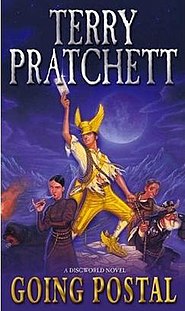
I have to warn you now that this is going to be one of those posts in which I blather on about how many different types of wonderful Terry Pratchett’s novels are. Going Postal is Pratchett at the peak of his powers. Incidentally it also made by far the best television adaptation, which I think successfully captures the spirit of the novel and retains almost all the central ingredients.
Going Postal is a devastating attack on the rapacious form of asset stripping capitalism. In the novel the clacks, the Discworld telegraph system, has been taken over by an aggressive consortium of bankers interested only in squeezing profit from their new enterprise. To this end they refuse to invest in maintenance of the system, cut corners, and put the safety of their staff at risk. The chief engineer Mr Pony, who stays with the company, knows the lives of his workers are being put at risk but protects himself with copies of warning memos. He is a deeply sad figure, but all too recognisable in late-stage early 20th century capitalism. Pratchett dismantles surgically the smoke and mirrors behind high-finance:
“But, in truth, it had not exactly been gold, or even the promise of gold, but more like the fantasy of gold, the fairy dream that the gold is there, at the end of the rainbow, and will continue to be there forever – provided, naturally, that you don’t go and look. This is known as finance.“
So what happens? Moist von Lipwig, a consummate swindler, is hanged for his crimes. His still living body is recovered from the scaffold, resuscitated and taken before the Patrician. Vetinari presents him with a choice: become Postmaster General of the city’s postal service or death. Moist takes the job, intending to run away at the earliest possible opportunity. However, his probation officer, a golem named Mr Pump (after his former occupation), brings him back to Ankh-Morpork, where Vetinari explains escape from a golem is impossible. So the Post Office it is.
The scale of the challenge is soon revealed. The Post Office has not operated for many years, and the building is full of undelivered mail and pigeon dung. Four previous recently appointed Postmasters have died in suspicious circumstances. Of the many portraits in Going Postal one of the most relevant (although I think they are all relevant) is of Reacher Gilt, the chair of the Grand Trunk Company which runs the clacks. Gilt is a financial pirate who operates in plain sight – he even has a parrot that squawks “twelve and a half per cent” (= pieces of eight, not the worst joke in the novel). Gilt has a penthouse office in Tump Tower and has ambitions to become Patrician one day – see what Pratchett was hinting at there? It is quickly apparent that Gilt is the villain of the piece, is behind the deaths of the previous Postmasters, and plans to remove Moist as soon as possible.
This is just the beginning of an extraordinarily action-packed novel – there’s a wonderfully rich cast of junior characters such as pin-collector Stanley Howler; Sachrissa Cripslock, reporter for the Ankh-Morpork Times (first introduced in The Truth); and Anghammarad, a nineteen thousand year-old golem waiting for the end of the world. There’s a fire, a visit to the Mended Drum, a race to Genua, and guest appearances from the Watch and the wizards of the Unseen University, to mention just a few highlights. Romance is provided by another of Pratchett’s amazing strong women: golem-rights activist and chain smoker Adora Belle Dearheart. It’s all utterly wonderful. Moist is another brilliantly realised creation in all his complexity and carries the weight of the narrative effortlessly. The moment he realises his responsibility for Adora’s loss of her job (which the television adaptation made even more dramatic in a very effective edit) is extraordinary.
This is also the Discworld novel where the GNU tradition originates. John Dearheart, murdered brother of Adora, is remembered by his colleagues on the clacks by a piece of code – “GNU John Dearheart” – which echoes his name up and down the lines. “G” means that the message must be passed on, “N” means “not logged”, and “U” means the message should be turned around at the end of a line. (This is of course a tech joke: GNU is a free operating system, “GNU’s not Unix”.) The code causes John’s name to be repeated indefinitely throughout the system, because: “A man is not dead while his name is still spoken“, a phrase with so much more resonance since Sir Terry’s passing.
I know I have said this many times before, but Pratchett is a profound moral philosopher and this novel is over-flowing with insights into the human condition:
“There was no safety. There was no pride. All there was, was money. Everything became money, and money became everything. Money treated us as if we were things, and we died.
In fact, I am giving serious consideration to starting my own minor religion based on the words of wisdom found in Going Postal alone. If you read a sentence like this in a book of philosophy you would almost certainly nod your head in agreement and appreciate the author’s wisdom and sagacity;
“all freedom is limited, artificial, and therefore illusory, a shared hallucination at best. No sane mortal is truly free, because true freedom is so terrible that only the mad or the divine can face it with open eyes.
I used to always say Night Watch was Pratchett’s finest novel – having re-read Going Postal I am no longer quite so sure.
Surfacing, Atwood’s second novel, is an elusive narrative. Ostensibly it is a simple story – after a long absence an unnamed narrator returns to her childhood home in the remote Canadian countryside to try and find her missing father. Her boyfriend, Joe, and a married couple, Anna and David, complete the group. The homecoming is uneasy – despite being familiar the setting feels alien and disturbing. On arrival at the family home there is no obvious sign of her father. The group agrees to stay for a week and turn the visit into a short, back to nature holiday. Tensions between each couple slowly emerge – David belittles Anna, who tells the narrator that he is a philanderer who objectifies women – for example he insists that she always wears makeup. The narrators relationship with Joe is equally strained.
Time is whiled away in fairly banal tasks – they go blueberry-picking, fishing and swimming, weed the vegetable patch and play board games. The women do the bulk of the domestic tasks. The narrator’s mental state slowly deteriorates and the narrative begins to fragmented. Sentences become short and disjointed, and eventually incoherent. The narrator is haunted by memories of her marriage, her child, and the abortion she was pushed into having. Her increasing sense of paranoia is fuelled by David’s constant references to an impending American invasion of Canada, which she treats entirely seriously. She sees hidden messages from her parents in every day objects around the house, and cannot decide if he is really alive or dead. Meanwhile David and Joe are making a modernist film, Random Samples, which is really just a collage of miscellaneous scenes. This again emphasises the narrator’s sense of alienation, making her feel like a performer rather than a real person with her own identity.
The novel draws to a climax when both men attempt unsuccessfully to pressurise the narrator into having sex with them – when rebuffed they sulk. This may have been the final trigger for the narrator’s descent into a full blown psychotic episode. She destroys David’s film and escapes in a canoe, hiding in the forest until the others leave the island. She trashes everything in the cabin, and runs around naked, eating unwashed plants, and living outside. I found these quite disturbing scenes, and although the end of the novel suggests a return to some form of normality it was something of a relief. This will probably sound patronising, but this felt like an early sketch for a novel – lots of themes and ideas are laid out for consideration, but the narrative was erratic and very difficult to engage with. There’s little here to suggest the impressive prose and strong ideas that Atwood was to develop in her later work.
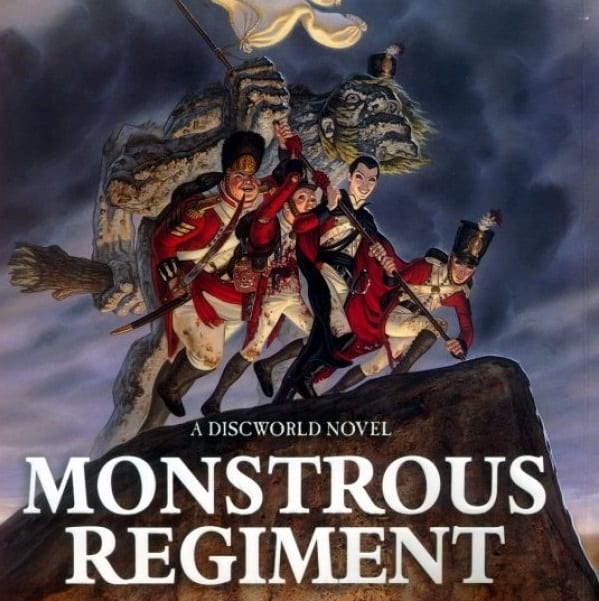
Did I mention that Terry Pratchett was, amongst many other things, a brave writer? In his novels he tackles some of the most difficult subjects, and the fantasy settings can only provide so much “it’s only a story about vampires and trolls” cover. In Monstrous Regiment he addresses some seriously weighty issues – war, the status of women in the military and wider society, and fundamentalist religion.
For much of the time he is on a tightrope, balanced finely between being preachy while also avoiding being insensitive – these are not laughing matters. Amazingly he pulls it off – there’s never a point in this novel where I felt spoken down to or where the material wasn’t treated with the respect it deserved, while all the time making a series of serious points about the issues discussed. It’s mature writing of the highest order, Pratchett at the peak of his powers.
Which begs the question – what’s the novel about? Monstrous Regiment is set in Borogravia, a deeply traditional country not far from Uberwald, and therefore a long way from anywhere else. Its people are followers of Nuggan, a weirdly strict deity who rules through his representative on earth, or in the part of it that is Borogravia, the Duchess, the country’s monarch, who is almost certainly long-dead. There is strong middle-European feel to this country, not least to its constant border disputes with its neighbours over who owes a particular field or tree.
The current war with Zlobenia is going badly for Borogravia, and we join the novel with recruiters scouring the countryside for anyone who can hold a gun. The narrator follows Polly Perks, who joins up to try and find her missing in action brother Paul. (This is not just sisterly love – if Paul cannot be traced the family pub will pass to her drunken cousin when her father dies. It is one thing to recognise the unfairness to women of inheritance law, and another to include such reference in a fantasy novel). Joining a long tradition of women in the military, Polly disguises herself as a man. Much fun is had with her attempts to adopt a male swagger, to occupy space, and to fart and belch convincingly. Other recruits sign up – Maladict, a vampire, a troll called Carborundum, an Igor, and Tonker, Shufti, Wazzer and Lofty. Without wanting to spoil the reveal, this unlikely bunch of recruits are not what you might expect of a group of young men and persons joining the army.
They set off for the front, led by Sergeant Jackrum, a corpulent and highly experienced recruiting officer and their commanding officer, Lieutenant Blouse. Their first encounter with an arrogant troupe of Zlobenian cavalry is surprisingly successful. even more so when their unlikely victory is reported on by war correspondent William de Worde, he of The Truth. They quickly become popular figures of interest followed back home, and elsewhere by Commander Vimes, sent from Ankh-Morpork to try to broker a peace and protect Ankh-Morpork interests. Vimes sees that a straightforward Zlobenian victory will lead to an imbalance of power in the area, so he wonders whether the small band of plucky recruits working their way to the war might prove more useful than just cannon fodder. Sergeant Angua keeps track of the recruits as they make their way to the front, occasionally providing help, such as an unexpected package of coffee when Maladict, a black ribboner, (a vampire who has foresworn blood) begins to suffer withdrawal symptoms. On their journey the links between the unlikely recruits grow stronger, and their various backstories and secrets slowly emerge.
When they reach the front the recruits realise that the war is at a stalemate – Borogravian troops are pinned down and unable to break out of a small area of land; Zlobenian and alliance troops holding the area’s principal fortress but are unable to press their advantage. Control of the castle is key, and in a highly risky plan (which is therefore guaranteed success) they decide to infiltrate the Keep disguised (of course) as washerwomen, free the prisoners, and end the war.
I can’t tell you much more without revealing some important plot points, and for once I don’t intend to do so. As always with Pratchett the plot is really secondary to the character development anyway, and the outcome is not really that much of a surprise.
This is one of my favourite later Discworld novels – it’s set in largely new territory with only a brief appearance of regular characters, but remains unquestionably Discworld in feel throughout. The sensitivity with which the material and issues are handled is impressive, and although the jokes as always are pretty basic, the central characters are fully rounded and utterly believable. There are no bad starting places in the series, but if you have preconceptions about fantasy novels as being full of dwarves and dragons, there are worse places to put you straight than this.
P.S. I am sure you will have spotted it, but just in case, the title is an ironic reference to this 16th century misogynist pamphlet against women in positions of authority.
P.P.S. Towards the end of the novel, Pratchett uses the haunting refrain “the world turned upside down” several times. You might recognise this phrase from the musical ‘Hamilton‘. But Wikipedia tells me that the phrase derives from a pamphlet published in the 1640s “as a protest against the policies of Parliament relating to the celebration of Christmas” and has an even earlier origin in Scripture:
“These that have turned the world upside down are come hither also; Whom Jason hath received: and these all do contrary to the decrees of Caesar, saying that there is another king, one Jesus‘.” Acts 17:5-7
The Hamilton reference derives from a legend that the British army marched to this tune when they surrendered after the Siege of Yorktown. The British army would apparently have played an American or French tune in tribute to the victors, but General Washington refused them the honours of war and insisted that they play “a British or German march.” Like most good stories of this kind it is probably apocryphal – it first appears in the historical record a century after the surrender!
Some books are harder to review than others. Sometimes it’s just difficult to find something interesting or original to say, and you don’t want to just summarise the plot and wrap it up with some platitudes about the author’s writing style. But this isn’t that kind of difficult. The Wee Free Men is so full of wonderfulness that it is impossible to capture it all – and to fail would be a disservice to the breadth of Pratchett’s skill as an author. It’s not perfect of course but it’s pretty damn close. For younger readers it is an ideal entry point into Discworld.
The Wee Free Men features the magnificent nine-year old Tiffany Aching. She lives with her farming family, helps out around the farm, and looks after her irritating younger brother Wentworth. Tiffany is special – ferociously intelligent and with a thirst for knowledge and understanding.
I am careful and logical and I look up things I don’t understand! When I hear people use the wrong words, I get edgy! I am good with cheese. I read books fast! I think! And I always have a piece of string! That’s the kind of person I am!
Pratchett’s ability to create fully-rounded female characters always astounds me, and here he does it again, entering imaginatively into the mind of a precocious young girl and getting it pitch perfect. I can’t think of another author of his generation who writes such brilliantly fierce, independent and strong women as Pratchett. They are not just adornments to his novels, they are centralised and given distinctive voices which articulate the reality of their lives. Of course a man can never fully understand what it is to live the life of a woman, but Pratchett does an amazing job of trying. And he defies stereotypes at each turn, not in a self-conscious “I am going to create a gender-fluid character to show how progressive I am” way, but because such characters genuinely interest him.
Although this is a younger reader’s novel, there’s nothing patronising or simplified about the story – it is nuanced, layered, and contains several moments of genuine peril. The bad guys have grim-hounds, dream-stealers and things too scary to describe, and are led by a witch several times scarier than anything in Narnia.
“Zoology, eh? That’s a big word, isn’t it?” “No, actually it isn’t,” said Tiffany. “Patronising is a big word. Zoology is really quite short.“
In the previous novels in the series Pratchett created many vividly imagined settings: the sprawling chaos that is Ankh-Morpork; the mountain kingdom of Lancre, the Unseen University, and so on. The Wee Free Men is set in the countryside, a sheep-farming area of grassland known as The Chalk. This small patch of Discworld is vividly evoked and drawn with so much reverence and respect – you have to wonder if Sir Terry grew up somewhere similar to The Chalk.
Anyway, back to the novel. One day while out for a walk with Wentworth, Tiffany sees what the reader knows are Nac Mac feegles, tiny blue kilted men speaking a chaotic and hugely entertaining form of Glaswegian. They warn her of a monster lurking in the river. Using Wentworth as bait, Tiffany bashes the creature with a frying pan. Without mentioning this supernatural experience to any other adult, all of whom are too busy to listen anyway, she seeks out Miss Tick, a visiting witch, who teaches Tiffany some important lessons:
“If you trust in yourself. . .and believe in your dreams. . .and follow your star. . . you’ll still get beaten by people who spent their time working hard and learning things and weren’t so lazy.”
She also tells her all about the Nac Mac Feegle. These riotous pictsies are at the heart of the novel, and are an inspired, vibrant creation. I particularly enjoyed their fear of lawyers – “We’ve got a cheap lawyer an’ we’re not afraid to use him!” In a nod to Tolkien, the Feegles’ swords glow blue in the presence of lawyers. The Feegles believe they are dead – this world is so full of wonders that it must be heaven. When they die therefore there is no cause for grief – you can’t die if you are already dead. That feels seriously profound to me – comforting and at the same time reminding one to appreciate the world as it is.
All of which is a prelude to Wentworth being kidnapped by the Queen of the Fairies, and Tiffany’s rescue mission. She is aided by the Nac Mac Feegles, including Rob Anybody (I confess I only got that joke (that he will steal from anyone) when I read the name out loud; before that I just thought it was a silly name. This might suggest that the novel was written to be read to younger children perhaps?) Big Yan, Daft Wullie, Hamish, the Feegle’s Gonnagle William. The Gonnagle is the Feegle’s battle poet, reciting poetry of Vogon severity that causes enemies to flee. Well I never said the jokes were going to be sophisticated did I?
Tiffany and the Feegles’ adventures in fairyland are scary enough. All through the novel Tiffany remembers her Granny, Granny Aching, an iconic figure of the Chalk who died a few years earlier but remains a crucial figure in her life. This is a touching tribute to the importance of grandparents in children’s lives, and I am sure would be a comfort to any younger reader going through a similar loss.
The novel ends with what is in effect a guest appearance by Granny Weatherwax and Nanny Ogg. In true fairy godmother style, Granny gives Tiffany an imaginary witch’s hat. Tiffany asks
“Is it really there?”
“Who knows….It’s virtually a pointy hat. No-one else will know it’s there. It might be a comfort.”
“You mean it just exists in my head?” said Tiffany.
“You’ve got lots of things in your head. That doesn’t mean they aren’t real”.
The Wee Free Men, page 307
Surely it’s not just me who sees this line reappear in Harry Potter and the Deathly Hallows, when Dumbledore says to Harry:
“Of course it is happening inside your head, Harry. But why should that mean that it is notreal?”
I’ve only scratched the surface of the wonders of this novel. If you haven’t read it before I am so jealous.