Book review

Julia, by Sandra Newman, 2023

My first review of 2025 is of Sandra Newman’s compelling Julia, a retelling of the events of George Orwell’s 1984 from the perspective of Winston Smith’s young lover, whom he betrays in the novel’s bitter climax in Room 101 “‘Do it to Julia! Do it to Julia! Not me! Julia! I don’t care what you do to her. Tear her face off, strip her to the bones. Not me! Julia! Not me!'”

Which poses the very simple question as to whether 1984 needs to be retold from Julia’s perspective. The source novel is told from Winston’s point of view. Through Winston (and bearing in mind his relationship with her is quite short and comprises a few snatched moments and afternoons) we learn a little about her background and childhood, her life as a mechanic in the Fiction Department of the Ministry of Truth, and her living arrangements, sharing a hostel room with thirty other young women.

Julia sent me back to 1984 to try and ascertain how much was the author’s creation, filling in the gaps left by Orwell’s account, and how much was based on the source material. I was surprised at how much the original novel does actually tell us about Julia – she certainly isn’t the two dimensional character some critics would have you believe, and I don’t think she necessarily needed to be re-imagined by this novel to be made more believeable or rounded. Of course the original novel doesn’t contain her full life story or her internal monologue – Winston’s point of view narration precludes this. More honestly, Winston isn’t that interested in Julia’s background or history. Their relationship is not simply one of an older man being sexually attracted to a younger, more independent woman – Winston is genuinely interested in Julia’s ideas and is guided by her in acts of rebellion other than ‘sex-crime’ – “In some ways she was far more acute than Winston, and far less susceptible to Party propaganda. Once when he happened in some connexion to mention the war against Eurasia, she startled him by saying casually that in her opinion the war was not happening. The rocket bombs which fell daily on London were probably fired by the Government of Oceania itself, ‘just to keep people frightened’. This was an idea that had literally never occurred to him. She also stirred a sort of envy in him by telling him that during the Two Minutes Hate her great difficulty was to avoid bursting out laughing.”

A lot of the critical commentary on Julia is based on the assumption or claim that the original novel is in some way unfair to her. The Guardian put it this way: “This ambitious retelling from Julia’s point of view gives Winston Smith’s lover the agency she lacked. ” Is this fair? Did Orwell have a ‘women problem’? And does 1984 underplay Julia’s role, reducing her to a sexual partner and victim, requiring this attempt to rehabilitate her? Certainly women play only minor roles in most of his earlier novels, and the one exception, Dorothy in A Clergyman’s Daughter, is a largely unconvincing portrait used principally as an avatar for Orwell to recycle some of his journalism. But I think there is a case to made for Julia being one of his most fully-rounded female characters. She is independent, brave, forthright, and kind. The Julia we are introduced to in Newman’s novel is very closely modelled on Orwell’s original – Newman has been very respectful to the source material, and only made one significant change. Fairly early in in the novel Julia is recruited into the Thought Police, and in addition to her relationship with Winston she is instructed to seduce a number of other Outer Party members and encourage them to commit thought- and sex-crimes.

The idea that Orwell’s version of Julia lacks agency is unfair and wrong – it is Julia who initiates the affair with Winston, finds them somewhere to go to have sex, and has previously had many other lovers. She is a strong woman who knows what she wants and is perfectly willing to take calculated risks. Newman’s Julia is not significantly more independent than Orwell’s – arguably her early recruitment into the Thought Police actually reduces her agency. From that point she is compelled to follow their instructions and cannot freely pursue her own choices.

Day to day life in Airstrip One is vividly described in 1984. These descriptions would have been painfully familiar to Orwell’s original audience in a Britain only slowly emerging from the hardships of the Second World War. Newman builds upon this portrait, giving more detail on the petty humiliations that young women have to face. She describes the Party’s ArtSem (artificial insemination) programme which is used as cover when women fall pregnant outside of marriage and other aspects of women’s lives which the original novel did not describe or consider. Overall the Airstrip One she describes is vividly recognisable and very faithful to Orwell’s portrait.

As long as Julia remains safely within the guide rails of the source material, the novel remains on track, but the text fails to convince as soon as it goes beyond the undeniably bleak ending of 1984. Newman understandably chooses to omit Orwell’s suggestion that Julia has been lobotomised during her torture and goes on to suggest that the end of Big Brother’s rein of terror is imminent. This is nowhere suggested in the source text – quite the opposite, Orwell suggests that Big Brother is unbeatable (although the appendix on Newspeak implies that one day IngSoc’s rule comes to an end).

Orwell’s handling of Winston’s torture, and in particular the climax of this process in Room 101, is a very hard read. Newman takes this several steps further – the descriptions of Julia’s abuse is really hard to stomach. Orwell would not have been allowed by his publishers to be this explicit, but sometimes less is more. Newman doesn’t blink and follows through with the implication that the ultimate torture conceived for Winston is applied instead to Julia. The horror of this is undermined by the deus ex machina resolution Newman applies, which is that Julia survives the torture because the time each victim has in Room 101 is limited to fifteen minutes, because of the sheer volume of torture candidates. This is a serious misstep – I understand why Newman wanted to show the horrific consequences of Winston’s betrayal and at the same time keep Julia alive, but this resolution is deeply improbable in a world of bitterly realistic situations.

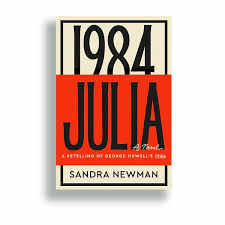
Novels based on and inspired by well-known original texts need to overcome some high hurdles to avoid being dismissed as mere fan-fiction. They need to be respectful to the source material – in most respects Newman does this, with some important exceptions. They need to have a clear reason for returning to the source material, and I think Newman ticks that box as well, giving a clear and recognisable voice to a character who often appears enigmatic in the source text, and exploring what life on Airstrip One would be like for women, a subject Orwell is largely silent on. The tightrope between simply being an attempted impersonation of Orwell’s voice and being faithful to his creation is an awfully difficult line to tread and I think for the most part, with one or two significant exceptions, Newman achieves this. It often felt like I was reading an authentic description of life under Big Brother, chapters that Orwell would have not disowned. For these good reasons alone Julia is definitely worth reading. I did have just one minor complaint – the cover design is awfully drab. It tries to suggest the relationship between the novel and the source text but I am sure there must be better ways of doing it.

Julia, by Sandra Newman, 2023

Aside
Book review

Summing Up 2024, and looking forward to 2025

I reviewed 35 books in 2024, which is about average for me in a typical year, but a little disappointing nonetheless. One book every ten days, read and reviewed, doesn’t sound too bad, and that does include Dombey and Son – but almost all the other books were either average length or shorter. Definitely a ‘must try harder’ year. Likes and views were slightly down on 2023, but still better than any other year. My five most popular posts were my reviews of Bob Mortimer’s underwhelming The Satsuma Complex, Richard Osman’s The Last Devil to Die, fourth in the Thursday Murder Club series, Ben Okri’s The Famished Road, and Graham Greene’s The Third Man. The other post in my top five is one in which I discuss Clothing in Jane Eyre, which was posted back in 2016 and which is by some considerable distance my most visited post of all time. I can just about understand why the Mortimer and Osman reviews are popular – these were both huge sellers from the end of 2023 – but the persistent popularity of the other posts are baffling. Not that I am complaining!

My reading in the first quarter of the year is as always going to be focussed on the outstanding selection of books received as presents, including new novels by the aforementioned Mortimer and Osman, as well as a book I am very much looking forward to, the latest Jasper Fforde novel. My 2025 Dickens is going to be his last completed novel, Our Mutual Friend. Beyond that I do not have any specific reading targets, but I would like to improve on this year’s total if possible. While I have abandoned my attempt to read all the Booker Prize winning novels – I was left with a small residue which I simply didn’t like the look of – I will be catching up on one or two of the more recent winners this year. Above all I will be trying to recapture the reading bug, that love of reading that is such a blessing and which gives this blog its corny name.

Summing up 2024, and looking forward to 2025

Aside
Book review

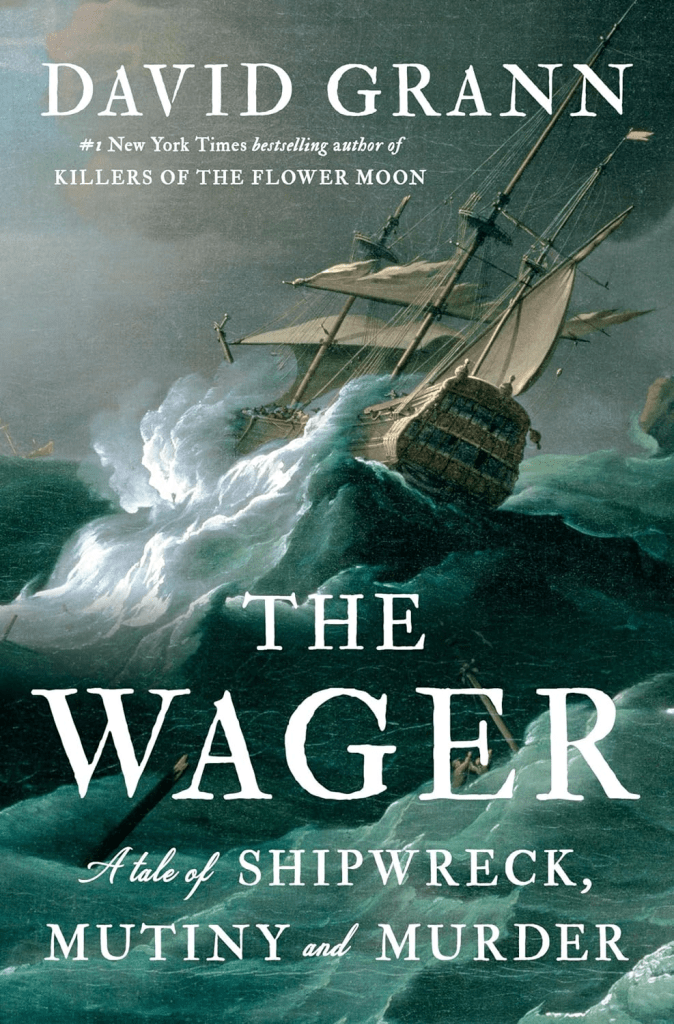
The Wager: a Tale of Shipwreck, Mutiny, and Murder by David Grann, 2023

The Wager is everywhere at the moment. After President Obama listed it as one of his books of the year in 2023 it topped The New York Times best-seller list and stayed in the top ten for six months. The film rights were snapped up by Martin Scorsese and Leonardo di Caprio. It featured in many best books of 2023 lists: as usual I am coming very late to the party. Accordingly my expectations were sky-high and predictably I was a little disappointed – if it hadn’t had this much hype I would have been able to read and appreciate the book on its own terms. Oh well.

The book’s blurb and description on Amazon give this summary (I’ve tried to edit it because it is quite long, but in the end I decided to keep it full-length because the detail actually matters):

On January 28, 1742, a ramshackle vessel of patched-together wood and cloth washed up on the coast of Brazil. Inside were thirty emaciated men, barely alive, and they had an extraordinary tale to tell. They were survivors of His Majesty’s Ship the Wager, a British vessel that had left England in 1740 on a secret mission during an imperial war with Spain. While the Wager had been chasing a Spanish treasure-filled galleon known as “the prize of all the oceans,” it had wrecked on a desolate island off the coast of Patagonia. The men, after being marooned for months and facing starvation, built the flimsy craft and sailed for more than a hundred days, traversing nearly 3,000 miles of storm-wracked seas. They were greeted as heroes.

But then … six months later, another, even more decrepit craft landed on the coast of Chile. This boat contained just three castaways, and they told a very different story. The thirty sailors who landed in Brazil were not heroes – they were mutineers. The first group responded with countercharges of their own, of a tyrannical and murderous senior officer and his henchmen. It became clear that while stranded on the island the crew had fallen into anarchy, with warring factions fighting for dominion over the barren wilderness. As accusations of treachery and murder flew, the Admiralty convened a court martial to determine who was telling the truth. The stakes were life-and-death–for whomever the court found guilty could hang.

To be fair, this is not just the publisher’s summary – in the book’s opening chapter this version of what it to come is largely the same: this is a story of a shipwreck that leads to mutiny, murder, and finally a form of retribution for the survivors. Except it is not.

For a start there was no real mutiny – no-one was tried for this incredibly serious charge. If the Admiralty had thought there was any risk of this offence being condoned they would have seen to it that people hanged, just in case anyone thought mutiny was acceptable in any circumstances. They took law and order extremely seriously. There was no question a dispute amongst the survivors about how to reach civilisation once the Wager had been shipwrecked on an isolated (but not completely deserted) island. The bulk of the survivors ignored the captain’s wishes to sail north to Chile and instead headed off in the opposite direction – but the Admiralty did not think this constituted mutiny. If the breakaway group had really thought they were committing mutiny they would almost certainly have destroyed the many paper records that they carried with them back to England and for that matter they would have avoided handing themselves in to the authorities by travelling back to England in the first place.

For an event that happened on the other side of the world almost three hundred years ago, there is a remarkable amount of documentary evidence about the wreck of the Wager and the subsequent ordeal of its crew. Many of the survivors wrote extensively about their adventures – the account by the leader of the expedition of which the Wager was a part, George Anson, is still in print – and in addition many of the contemporaneous records including log books and diaries survived and are available to historians (to be completely fair to Grann whether he is an academic historian or not (not) I nevertheless include him in this category; his account is very well researched and evidenced. It’s just not a new or untold story).

There was no trial, no-one was found innocent or guilty, and no-one was hanged. There was an investigation with a very limited scope, but that quickly found that no further action was required. This is all a bit of a damp squib after the long build-up in which the reader is explicitly lead to believe that a trial would decide who was telling the truth about the shipwreck. In fact the introduction suggests this is the whole point of the narrative. Surprisingly there were no significant differences between the survivors as to what happened; broadly speaking their accounts agreed, not least because of the extent of the written record. Whether the actions of the protagonists were justified was disputed, but what they actually did or did not do was not disputed.

So this is not the book we are led to believe it is going to be. It is instead a dramatic but as far as possible accurate retelling the story of the Wager. Much of the book is dedicated to the preparation for setting sail and then the journey to South America and beyond, the challenges of assembling a crew and then the privations once on board and under sail. The Wager was part of a wider expedition which in turn was part of the English campaign against the Spanish that in this period. usually described as the War of Jenkins’ Ear. The shipwreck and the appalling conditions on the island that the survivors experienced (although ironically the diet of scavenged seaweed and sea celery help cure the ravages of scurvy all the men had faced) are brought to life and it is from this point, almost three-quarters of the way through the book, that the ‘slow-motion mutiny’ (as Wikipedia describes it) unfurls.

The Wager has some striking similarities with Batavia’s Graveyard, Mike Dash’s 2002 account of a shipwreck some 100 years earlier, in which the survivors faced a life and death struggle for survival, order quickly broke down and brutality engulfed the survivors. The crew of the Wager behaved in a relatively civilised fashion compared to their East Indian counterparts from the Batavia. To be fair their island was better equipped – they even had friendly natives on hand to bring them food (although the quickly scared them off with their behaviour). If you are looking for books with a similar theme and structure to The Wager, Batavia’s Graveyard is highly recommended.

When a book doesn’t live up to the hype it can be disappointing, but judged on its own merits The Wager was an enthralling read. The book’s epilogue, telling the story of the rest of the fleet which was slowly destroyed, leaving just one surviving ship, which in a ferocious sea battle captured a Spanish treasure ship and made its way home from halfway around the world , is told almost as an afterthought, but it is hard to resist the thought that this was the more compelling adventure.

The Wager: a Tale of Shipwreck, Mutiny, and Murder by David Grann, 2023

Aside
Book review

The Mandibles by Lionel Shriver, 2016

It’s been a very long time – I am struggling to remember the last time it happened – since a book has haunted me in the way that Lionel Shriver’s The Mandibles did. By ‘haunted’ I don’t mean scared (although there is plenty that is scary here), but that the characters and their situation stayed with me when I was not reading the book. The feelings of nervousness and anxiety that it engendered hung over me, so that when I wasn’t thinking about the book I was feeling it. I wasn’t quite stock-piling toilet paper and checking my bank account every five minutes, but it was not far off!

For context, The Mandibles is set in the USA in 2029. The American economy is in the midst of an economic crisis of the kind it narrowly dodged in 2008. Unemployment and inflation soar, law and order begins to break down, and America reneges on its international debts. We experience this crisis through the eyes of an extended middle class American family, the Mandibles. Yes this is a strange name, and no I don’t know if it has any particular significance (it’s possible that the fact it is the only mobile bone in the human body is a reference to the family’s ability to be agile and keep one step ahead of the crisis, but that’s really stretching things!).

In 2029, America has already changed dramatically from the relatively stable economy and political landscape of the year of publication, 2016. In the real world of spring 2016, Trump had already announced his run for the White House and the UK’s Brexit referendum was looming, but it was hard to anticipate the political turmoil that was to follow months after this novel was published, let alone the lockdown and pandemic four years later. In Shriver’s 2029 America is already significantly diminished. Previously the country had temporarily lost access to the internet and as a result all financial transactions now take place either on paper or in hard cash. China is suspected as being behind the cyber-attack, as part of its wider ambitions to replace America and the dominant superpower. Things however are slowly beginning to return to normal when the crash hits. A new international reserve currency, the bancor, (which in real life had been proposed by Keynes in the 1930’s and remains an idea some economists support – for example it was called for as recently as 2009 by the Governor of the Bank of China) collapses the American economy. This is not just a depression or a recession but far worse – money loses most of its value, millions lose their jobs, savings are wiped out and prices go through the roof. The US Government’s disastrous response is to ban American’s from owning bancors (thereby closing down almost all international trade) and sequesters all gold owned by people and business.

Prior to the crash the four generations of the Mandible family are relatively well off and live in expectation of an inheritance from their very wealthy patriarch. His savings and investments are completely wiped out. One son-in-law is an economist who is sacked from his professorship, but who right until the end of the book continues to argue that the crash was avoidable and that he was right while everyone else was wrong. This satirical teasing of economists who are unable to understand the economy or predict its behaviour is one of the gentler aspects of the novel. As the crisis deepens the family move in together and adjust to their straitened circumstances, showering only once a week, stockpiling supplies, and generally having a miserable time. While the adults are to a greater or lesser extent in denial about how bad things are going to get, one of the younger family members, Willing, is the calm centre of both the family and the novel. Willing is able to tell that things are going to get a lot worse and plans accordingly, learning practical skills such as how to pick locks and developing a plan for the family that could see them escaping from the city and to safety.

Three quarters of the way through the novel, with the family homeless and at crisis point, the story jumps forward fifteen years. I can’t lie, I found that decision irritating. It seemed as if the novelist got tired of charting their struggles with the breakdown of society and hit the fast forward button. It might have been because this is quite familiar territory – dystopias in which society collapses aren’t exactly uncommon. The final quarter of the book acts almost like a postscript. Most of the characters have adapted and survived and society is slowly being rebuilt. The United States government has become extremely authoritarian, with everyone being compulsorily ‘chipped’ like pets. A small separatist enclave has been built in Nevada and the remaining family members, lead once again by Willing, set off to see if this new land of the free can be sustained.

The financial crisis of 2008 and the world’s subsequent turmoil have only served to underscore what I think most of us already knew – that civilisation is only skin deep. The American journalist  Alfred Henry Louis put it like this back in 1896:

Those of us who are well fed, well garmented and well ordered, ought not to forget that necessity makes frequently the root of crime. It is well for us to recollect that even in our own law-abiding, not to say virtuous cases, the only barrier between us and anarchy is the last nine meals we’ve had. It may be taken as axiomatic that a starving man is never a good citizen.

While the novel’s portrait of society’s collapse is chillingly believable, The Mandibles is a strangely optimistic dystopia. Shriver said of the novel that “My reading on what happened in 2008 is that we dodged a bullet. I feel as if that bullet is still whizzing around the planet” which is almost completely unarguable. Next time we might not be so lucky. But terrible though the collapse of the American economy may be, the rest of the world is surprisingly immune to its effects – the bancor is not just an attack on the dollar but it is also an insurance policy. Mexico becomes an economic super-power and has to build a wall to prevent American refugees from escaping into the country. As satire that might feel a bit obvious, but the main impact on America is a sense of humiliation rather than anything more punitive. The key point is that the country recovers from near-total collapse, the economy starts to rebuild, and as authoritarian dystopian Governments go this one is relatively benign.

I enjoyed The Mandibles. Shriver is an interesting, iconoclastic writer and I will look out for more opportunities to read her work.

The Mandibles by Lionel Shriver, 2016

Aside
Book review

Invisible Man, by Ralph Ellison, 1952

Invisible Man appears on many lists of the best novels of the twentieth century. It is a powerful and often disturbing account which challenges many of the conventional ideas of the form and structure of the novel.

It opens with the narrator, an unnamed black man, living in an underground room lit by hundreds of electric lights powered by electricity stolen from the city’s grid. He tells his story in flashback, attempting to explain why he feels socially and sometimes literally invisible.

“I am an invisible man. No, I am not a spook like those who haunted Edgar Allan Poe; nor am I one of your Hollywood-movie ectoplasms. I am a man of substance, of flesh and bone, fiber and liquids — and I might even be said to possess a mind. I am invisible, understand, simply because people refuse to see me. Like the bodiless heads you see sometimes in circus sideshows, it is as though I have been surrounded by mirrors of hard, distorting glass. When they approach me they see only my surroundings, themselves, or figments of their imagination — indeed, everything and anything except me.”

Born in the American South, he lives in a highly segregated society, in which black people live in fear and subjugation. He intends to escape the poverty which defines black lives in this community and wins a scholarship to an all-black college. Integrated education in the South at this time was unheard of. He works to support himself by taking a chauffeuring job. One day, while chauffeuring Mr. Norton, a trustee of the college, he makes a series of disastrous decisions. Norton, a white man, is curious about the lives of local black people. The narrator takes him to the old slave-quarters near the college campus. The fact that there even are old slave quarters still standing shows that slavery is still part of people’s lives, despite it formally ending almost a century beforehand. Here Mr Norton meets Jim Trueblood, a notorious local figure who has got both his wife and his daughter pregnant ‘in his sleep’. This is an uncomfortable portrait of black poverty in which people live little better than slaves and ignore social conventions regarding incest. Norton is appalled and asks to be taken somewhere for a stiff drink. Inexplicably the narrator takes him to a local brothel, where a riot breaks out caused by a surreal day-outing of patients from a nearby mental hospital. (There is an echo of this scene in One Flew Over the Cuckoos Nest, where the patients are taken out for the day, with similarly disastrous consequences).

The narrator is summarily expelled from college. He sees it as an unfair punishment but his principal is appalled that he has exposed the dark side of black people’s lives behind the civilised facade of the campus. The narrator travels to New York and finds work in a paint factory. More chaos ensues – he is a magnet for trouble and has no control over his life. He unwittingly causes an explosion at the factory, is hospitalised and given electric shock treatment. He escapes the hospital and stumbles into the next, decisive phase of his life. Happening across the eviction of an elderly black couple he makes an impassioned speech in their support, accidentally inciting the crowd to attack the bailiffs and triggering yet another riot. His oratorical skills are recognised by a group known as “the Brotherhood” which appears to be a black nationalist movement. He signs up and quickly becomes one of the group’s keynote speakers. Internal politics eventually turns this sour, and he becomes disillusioned with the group. Its message of gradual change and co-operation with whites is challenged from the left by more radical voices, led by a figure known as Ras the Exhorter. The novel reaches its climax with the narrator getting caught up in a race riot in Harlem. He narrowly escapes being lynched by supporters of Ras the Exhorter who perceive him as a traitor to his race.

Invisible Man is vivid, impressionistic, and unconventional. Superficially it follows a traditional narrative structure but the narrator’s adventures and mishaps are chaotic and often appear random. It charts a very specific time in Black American history at the birth of the Civil Rights movement, when many of the debates about how best to combat segregation and oppression were at their fiercest. It’s not a comfortable read but it is an important, unique book.

Invisible Man, by Ralph Ellison, 1952

Aside
Book review

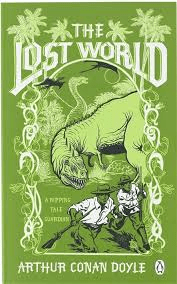
The Lost World by Sir Arthur Conan Doyle, 1912

The Lost World is an unashamedly escapist adventure story. Although published shortly before the outbreak of the First World War, there is barely a hint of the looming conflict. There is one brief glimpse of the real world – when celebrating the success of the stories of Malone, the plucky young reporter for the Daily Gazette, his editor tells him “What a three column article for the paper! What a foundation for a career! A correspondentship in the next great war might be within my reach.” As with so many other texts of this period, the inevitability of a future ‘great war’ is accepted as a matter of fact. I also find it interesting that it was referred to as ‘the great war’ even before it had started! – great here is simply a reference to scale rather than the later suggestion that it was glorious in any way.

You will be familiar with what happens in The Lost World because it is the source of many of the tropes of the genre to which it gives its name. Malone, the reporter mentioned above, asks his editor for an assignment to somewhere exotic and challenging in order to impress Gladys, the woman he loves. In rejecting his marriage proposal she tells him that she will only marry a man of action and achievement:

“He must be a man who could do, who could act, who could look Death in the face and have no fear of him, a man of great deeds and strange experiences. It is never a man that I should love, but always the glories he had won; for they would be reflected upon me. Think of Richard Burton! When I read his wife’s life of him I could so understand her love! And Lady Stanley! Did you ever read the wonderful last chapter of that book about her husband? These are the sort of men that a woman could worship with all her soul,”

Malone takes this rejection at face value, and decides to find a way of meeting her expectations. His editor is sceptical as to whether such great deeds and strange experiences can be found any more:

Dear me, Mr. Malone, this is very—very exalted. I’m afraid the day for this sort of thing is rather past. The expense of the ‘special meesion’ business hardly justifies the result, and, of course, in any case it would only be an experienced man with a name that would command public confidence who would get such an order. The big blank spaces in the map are all being filled in, and there’s no room for romance anywhere.

The mention of an ‘experienced man with a name to command public confidence’ gives him an idea. He suggests that Malone approaches Professor Challenger for a place on his next expedition. Challenger is a blimpish, cartoon-like figure who challenges to a fist-fight anyone who cast doubt on his account of his recent expedition to the Amazon, where he claims to have discovered a lost world where dinosaurs still roam.

At a rowdy public meeting Challenger announces he is going back to the Amazon, and Malone volunteers to join him, along with Professor Summerlee, a zoologist who has publicly questioned Challenger’s claims and Lord John Roxton, a professional adventurer. It is not long before the Atlantic has been crossed and the party of explorers sets off up the Amazon in search of the Lost World. Their party, along with the ubiquitous native guides, quickly reaches the isolated plateau, cut off from the surrounding countryside, where the prehistoric wildlife is to be found. There’s an economy to the narrative – not much time is wasted with exposition, speculation or character development. The cliffs to the plateau cannot be climbed, but the party is able to scale a nearby spire of rock. Using a tree as a bridge they cross over to the plateau.

A treacherous guide, seeking revenge on Roxton for a grudge held from a previous adventure, pushes the tree-bridge off the pinnacle, stranding the party of four, who have no choice but to set off and explore this lost world. They encounter dinosaurs and other animals, insects and plants previously thought extinct, many of which are highly dangerous. It’s not just the wildlife they have to be cautious about, because while Malone is off one night exploring the plateau’s central lake, his companions are taken prisoner by some ape-men, referred to by Malone (acting as the novel’s narrator) as the missing link. Roxton escapes and with Malone’s help rescues the others, together with some indigenous cave people who are at war with the ape-men. A battle royale ensues in which the white men’s guns tip the bitter long-running struggle in the favour of the cave men, wiping out the ape-men and enslaving their women and children.

Eventually the explorers find a tunnel leading off the plateau and on to civilisation. The novel ends with a rerun of the public meeting in which Challenger’s claims about the lost world are repeated and once again challenged, the difference being when he produces a young pterodactyl as proof, triggering a small riot. The novel doesn’t quite end there. Two final scenes close the show. First, Malone returns to Gladys, who had married a banker in his absence, the very opposite of the man of action she described. I think the reader is meant to conclude women are fickle from this scene, but my reaction was that she was letting Malone down gently. At a private celebratory dinner Roxton then reveals that he has brought back £200,000 worth of diamonds from the expedition, making them all rich. With nothing to keep him in London Malone he decides to accompany Roxton back to the lost world. If this was the cinema the ending would be a great set-up for Return to the Lost World, but Conan Doyle obviously thought better of the idea (Hollywood disagreed, and Return to the Lost World is actually a real film!)

You may be wondering why I am reading Edwardian adventure novels? I think the simple answer is that they give an insight into how people – not everyone of course, but in particular the educated novel-reading and -writing classes – were thinking about the Empire and Britain’s place in the world at the close of the Victorian era. There was a nervousness about a decline in military strength relative to countries like Germany, France and Austro-Hungary. The Boer War had exposed serious weaknesses in the strength of the British army, particularly if conscription were ever to be needed. The trade unions were flexing their muscles and had set up the Labour Party. The world was changing and the extent to which these changes were reflected in the books people wrote and read at the time, and how their feelings about these changes are worked through in the stories, fascinates me. The Lost World is mainly an exercise in escaping the chaos that was about the erupt across Europe – but it doesn’t always succeed. When Malone and companions are fighting for their lives in the decisive battle between ape-men and cave-men, the struggle is a visceral matter of life and death:

For an hour or more after we entered the wood, there was a desperate struggle in which for a time we hardly held our own. Springing out from among the scrub the ape-men with huge clubs broke in upon the Indians and often felled three or four of them before they could be speared. Their frightful blows shattered everything upon which they fell. One of them knocked Summerlee’s rifle to matchwood and the next would have crushed his skull had an Indian not stabbed the beast to the heart….Once our allies broke under the pressure, and had it not been for the execution done by our rifles they would certainly have taken to their heels. But they were gallantly rallied by their old chief and came on with such a rush that the ape-men began in turn to give way… I was emptying my magazine as quick as I could fire, and on the further flank we heard the continuous cracking of our companion’s rifles.

War is brutal and lethal, as Europe (and Conan Doyle) were about to fight out.

The Lost World by Sir Arthur Conan Doyle, 1912

Aside
Book review

Hag-Seed, by Margaret Atwood, 2013

Hag-Seed was part of the Hogarth Press’s ambitious project to commission authors to rewrite and reimagine Shakespeare’s plays as novels. It was an interesting project that Hogarth planned to coincide with the four-hundredth anniversary of Shakespeare’s death. But it does mean that Atwood was commissioned to write the book. It’s not a labour of love or a story she felt compelled to tell. When artists are commissioned to paint a portrait nobody thinks this sullies the purity of their creativity, but when authors take on a similar project there is a slight whiff of commercialism that leaves a bad taste and a lingering thought that the author might not be fully committed to the project. Would Atwood have written this novel if there wasn’t the promise of a cheque at the end of it? Was she at her best, or just getting the project done?

Briefly, Hag-Seed is a retelling of The Tempest. Felix Phillips, a theatre producer, is working on a production of The Tempest as part of the Makeshiweg Theatre festival, when he is unexpectedly sacked and replaced by Tony Price, his assistant. He disappears from public view in a form of exile, living in a secluded shack miles from anywhere. Felix lost his daughter when she was three, and to keep her memory alive he imagines she is with him in his shack, keeping him company.

After several years he secures a teaching position at the Fletcher County Correctional Institute as part of a literacy programme. His work proves an unexpected success. Four years into the programme, having successfully produced Macbeth, Richard the Third and Julius Caesar, Felix ambitiously decides to stage The Tempest. Fortune casts an opportunity for revenge in his way – Tony is now a politician and plans to visit the prison to see the literacy programme in action, totally unaware of Felix’s involvement. The novel climaxes in a chaotic performance of the play with Felix being restored to his former position

There are multiple versions of The Tempest in this novel. Attwood provides a synopsis of the original play at the end of the text – to be honest, if it were needed it would have been better placed at the beginning. There is then the production Felix is working on when he is deposed from his role as artistic director of the Makeshiweg theatre festival by his assistant, Tony. Attwood mocks modernist staging of the play in which “Ariel, he’d decided, would be played by a transvestite on stilts who’d transform into a giant firefly at significant moments. His Caliban would be a scabby street person – black or maybe Native – and a paraplegic as well, pushing himself around the stage on an oversized skateboard.”

The third version of the play is the one Felix inhabits – his story closely follows the plot of the play. In this version Felix is Prospero, deposed Duke of Milan, (Felix applies for this teaching position using the name Mr Duke) his daughter is both Miranda and Ariel, and other roles are filled by his friends, associates and acquaintances. Attwood doesn’t follow the plot of the play mechanically – there isn’t an exact correspondence between Felix’s life and the events of the play – but there is a broadly similar story arc. Caliban is one of the most interesting characters in the Tempest, but he is the one character who does not have a clear equivalent in the novel. Aspects of his role are taken by the prisoners, but they are perfect inmates who engage in the dramatic process, learn their lines, obey Felix’s rule about only swearing using curses found in the play (not something you would get professional actors to comply with I suspect!) and never once threatening any form of rebellion or misbehaviour.

A fourth version of the play is performed by the inmates of the Fletcher County Correctional Institute who participate in the literacy programme. In fact the inmates put on two versions of the play – one which is recorded and broadcast throughout the prison and another ‘immersive experience’ version (the fifth) acted out while everyone is watching the video of the first (or is it the fourth?) version.

The initial ending of the novel falls a little flat. Felix’s cunning plan to get his old job back succeeds flawlessly. End of story. No possible recriminations or attempts at revenge from the powerful people that he has crossed and bested. Attwood then uses an interesting theatrical device to give the reader an improved, secondary ending. The inmate players are invited to present their ideas about what happens to the play’s characters (and by inference the lives of their equivalents in Felix’s world) after the play ends. They come up with some really imaginative ideas that I thought showed Attwood finally breaking free from the constraints of the structure she has imposed on herself.

Hag-Seed, by Margaret Atwood, 2013

Aside
Book review

Lost Horizons, by James Hilton, 1933

Hilton’s 1933 novel, Lost Horizons, is in many ways an unconventional adventure story. It is almost completely devoid of action scenes – there’s no fighting with ghastly foreigners; situations in which primitive natives are impressed by the explorers’ gadgets are conspicuous by their absence; there are no encounters with wildlife, traditional or Jurassic. It does admittedly share some DNA with the classic Victorian Lost World adventure story. It opens conventionally for example, with a complex framing device in which a story is told by one traveller to another about a tale they once heard:

“Cigars had burned low, and we were beginning to sample the disillusionment that usually afflicts old school friends who have met again as men and found themselves with less in common than they had believed they had.”

It takes some time before we penetrate these layers and get to the central story, in which four Western travellers, escaping from violent civil unrest in China, are taken by airplane to a secret valley in the Himalayas. Here they discover Shangri-La, a hidden and mysterious community governed by a monastery populated by enigmatic monks. Shangri-La has a secret – there is something about the valley that gives its inhabitants extremely long lives (we never discover what causes this effect, but it only applies to people who come to live in the valley, not the indigenous residents who barely feature).

The novel’s central character and narrator is Conway, an Allan Quartermain-type figure. Conway is a diplomat who is still haunted by his experiences in the First World War:

Twelve years earlier he had grown to hate the perils of trench warfare in France, and had several times avoided death by declining to attempt valorous impossibilities. Even his D.S.O. had been won, not so much by physical courage, as by a certain hardly developed technique of endurance.

Conway is accompanied by his junior envoy, Mallinson, Barnard, an American businessman, and Miss Brinklow, a missionary. Mallinson is keen to return to the outside world, but eventually learns that there is a price to Shangri-La’s gift of long life – once you go there you are never allowed to leave. While the others gradually come to terms with their life sentences, albeit in a very comfortable cage, Mallinson plots his escape, and finally persuades Conway to help him. While we are left to guess at Mallinson’s eventual fate, the last we hear of Conway is that he is trying to return to the remote and inaccessible valley.

Lost Horizons looks back nostalgically to the great adventure novels of the turn of the century when there were believed to be still undiscovered parts of the world. In those novels the focus was Africa or South America, but Hilton sets his story in an even more remote area, the unexplored zone between Nepal, Tibet and China.  

“there came over him, too, as he stared at that superb mountain, a glow of satisfaction that there were such places still left on earth, distant, inaccessible, as yet unhumanized. The icy rampart of the Karakorams was now more striking than ever against the northern sky, which had become mouse-coloured and sinister; the peaks had a chill gleam; utterly majestic and remote, their very namelessness had dignity.

While British explorers and adventurers from Victorian novels would often treat the ‘foreigners’ they meet with contempt, Conway is a much more mature, might I even say liberal, traveller:

Conway had no race or colour prejudice, and it was an affectation for him to pretend, as he sometimes did in clubs and first-class railway carriages, that he set any particular store on the “whiteness” of a lobster-red face under a topee.

A persistent theme in the novel is the idea that Shangri-La will provide a safe haven for the coming global war. The idea that Europe was going to erupt into a war zone was common place at the turn of the century, but Hilton is prescient in his prediction that the same thing was going to happen again, this time on a global scale. Barnard, one of the kidnapped travellers who we eventually find out is a Wall Street financier on the run from the police, wanted for an unspecified financial crime, presumably embezzlement, is happy to stay in hiding because he believes the global economy is close to collapse. The head monk, Perrault, who established the monastery in the late eighteenth century, sees the speed of technological change happening in the world as likely to lead to war on an industrial scale:

“he saw the nations strengthening, not in wisdom, but in vulgar passions and the will to destroy; he saw their machine power multiplying until a single-weaponed man might have matched a whole army of the Grand Monarque. And he perceived that when they had filled the land and sea with ruin, they would take to the air… “But that was not all. He foresaw a time when men, exultant in the technique of homicide, would rage so hotly over the world that every precious thing would be in danger, every book and picture and harmony, every treasure garnered through two millenniums, the small, the delicate, the defenseless —all would be lost”

Perrault describes the coming war as a storm, and is clear that it will be an apocalypse of unprecedented scale and ferocity:

“The storm… this storm you talked of…”

“It will be such a one, my son, as the world has not seen before. There will be no safety by arms, no help from authority, no answer in science. It will rage till every flower of culture is trampled, and all human things are levelled in a vast chaos. Such was my vision when Napoleon was still a name unknown; and I see it now, more clearly with each hour. Do you say I am mistaken?”

Conway answered: “No, I think you may be right. A similar crash came once before, and then there were the Dark Ages lasting five hundred years.”

“The parallel is not quite exact. For those Dark Ages were not really so very dark—they were full of flickering lanterns, and even if the light had gone out of Europe altogether, there were other rays, literally from China to Peru, at which it could have been rekindled. But the Dark Ages that are to come will cover the whole world in a single pall; there will be neither escape nor sanctuary, save such as are too secret to be found or too humble to be noticed. And Shangri-La may hope to be both of these. The airman bearing loads of death to the great cities will not pass our way, and if by chance he should, he may not consider us worth a bomb.”

One inconsistency in the novel troubled me perhaps more than it should. The four travellers were kidnapped and taken to Shangri-La. Why? If people there don’t die for centuries, why the need for an infusion of fresh blood? The population of the valley may have been dwindling but we are told it is regularly topped up by explorers accidentally wandering into or near the valley. Conway and friends don’t bring any much-needed skills or experience and there’s every chance that Mallinson in particular will react violently to his kidnapping and life imprisonment, never to see family and friends again. He certainly doesn’t see Shangri-La as any kind of paradise:

There’s something dark and evil about it. The whole business has been like that, from the beginning—the way we were brought here, without reason at all, by some madman—and the way we’ve been detained since, on one excuse or another. But the most frightful thing of all—to me—is the effect it’s had on you.”

I appreciate I am over-thinking this. This is really a comic-book story in novel form that shouldn’t be taken too seriously. Hilton’s characterisation rest on stereotypes and the central conceit is more than a bit silly. The idea of a lost civilisation hidden from the outside world and containing secret treasures is a key feature of many late Victorian novels as the British empire began to approach the full extent of its reach and people came to realise there probably weren’t many more lost horizons in front of them.

Attitudes to sex in Lost Horizons

There are surprisingly frequent and explicit references to sex in Lost Horizons. Hilton has an interesting approach to this topic. References to sex in the novel are usually tangential and tentative but nevertheless surprisingly frequent and ultimately unambiguous. Traditionally adventure stories would skirt around the issue of sex, usually not mentioning it at all. But in Lost Horizons it is a part of people’s lives, just not one that can be talked about using everyday language. Instead euphemism is the order of the day. Take this example in which the missionary, Miss Brinklow, is discussed. Conway tells us that

“it was to Miss Brinklow that he spoke first. He realized that she was neither young nor pretty —negative virtues, but immensely helpful ones in such difficulties as those in which they might soon find themselves.”

Indirectly phrased this may be, but Conway is clearly saying that Miss Brinklow’s age and lack of attractiveness is going to helpful in the circumstances that they may soon find themselves – in other words that she is less likely to be raped because of her age and looks.

Later there is this exchange between Chang, their mysterious host at the monastery, and Conway, about sexual desire, and whether it can be a source of conflict in Shangri-La:

“Quite often,” replied Chang with a broad smile. “The lamas, of course, are immune, and so are most of us when we reach the riper years, but until then we are as other men, except that I think we can claim to behave more reasonably. And this gives me the opportunity, Mr. Conway, of assuring you that the hospitality of Shangri-La is of a comprehensive kind. Your friend Mr. Barnard has already availed himself of it.”

Conway returned the smile. “Thanks,” he answered dryly. “I’ve no doubt he has, but my own inclinations are not—at the moment—so assertive

How wonderfully euphemistic. ‘The hospitality of Shangri-La is of a comprehensive kind” – which translates as ‘the women in the village are available for sex if your urges become uncontrollable’. Barnard has already been down there getting some; Conway is for the time being under control.

There is more than a hint of homo-eroticism in the relationship between Conway and the much younger and more inexperienced Mallinson:

Conway reached his hand towards Mallinson’s, and the answering grip was hot and eagerly affectionate. Mallinson went on: “I don’t suppose you realize it, but I’ve been terribly alone these last few weeks. Nobody seemed to be caring a damn about the only thing that was really important—Barnard and Miss Brinklow had reasons of a kind, but it was pretty awful when I found YOU against me.”

However, they get a grip on themselves and later on both men compete for the affections of the silent, doll-like Lo-Tsen. Lo-Tsen is a Manchu princess who entered Shangri-la in 1884 as a girl of 18. Although she is now 70 she still looks 18. She is used by Chang and the monks as a way of persuading arrivals to accept their new lives in Shangri-La and we are told she is content in this role, although she is only ever seen through the eyes of other, male characters. Mallinson drops heavy hints that his relationship with her has become physical. When asked by Conway how he knows she will help him escape, he replies:

Mallinson half-turned away, his face lit with a grave shyness. “Because I DO know… Perhaps you’ll think less of me for it… but I DO know. I’m afraid you never properly understood her, Conway. She was cold on the surface, but that was the result of living here—it had frozen all the warmth. But the warmth was there.”

“To be unfrozen?”

“Yes… that would be one way of putting it.”

“And she’s YOUNG, Mallinson—you are so SURE of that?”

Mallinson answered softly: “God, yes—she’s just a girl. I was terribly sorry for her, and we were both attracted, I suppose. I don’t see that it’s anything to be ashamed of.

Again it is not particularly hard to de-code Hilton’s euphemisms – these are really single entendres, in which unfreezing her warmth is unquestionably Mallinson’s way of telling Conway that he has had sex with her, and he follows this certainty up with an assurance that her body is that of a young woman.

Novels of this kind would often be read by children, so to find such frankness about sex and sexuality is unusual. You normally find more carefully coded language to allow room for ambiguity about the nature of characters’ relationships. Here instead hot-blooded Englishmen are expected to have sex with native women and are largely unapologetic about it.

Lost Horizons, by James Hilton, 1933

Aside
Book review

Goodbye, Mr Chips, by James Hilton, 1934

I knew ‘Goodbye, Mr Chips‘ from the faithful-to-the-book and gentle 1939 film version of the story, featuring Robert Donat. (A later film version, a musical no less, starring Peter O’Toole bears very little relation to Hilton’s story). It is a charmingly nostalgic portrait of a retired schoolmaster looking back over his life, but has some unexpected depths to its discussion of imperialism and jingoism.

Mr Chipping is a classics teacher (Latin and Greek) at Brookfield, ‘a good school of the second rank‘. Brookfield is a public (that is, fee-paying) boarding school set in the English countryside:

Across the road behind a rampart of ancient elms lay Brookfield, russet under its autumn mantle of creeper. A group of eighteenth-century buildings centred upon a quadrangle, and there were acres of playing fields beyond; then came the small dependent village and the open fen country.

Told in retrospect from his retirement and old age, Goodbye Mr Chips is his recollection of the years spent teaching generations of young boys. Cleverly it is also a commentary on the changing times that Mr Chips lives through, from the mid-nineteenth century to the early nineteen-thirties. A recurring feature is that many of his students go on to die in various imperial wars:

Dear me, I remember Collingwood very well. I once thrashed him—umph—for climbing on to the gymnasium roof—to get a ball out of the gutter. Might have—umph—broken his neck, the young fool. Do you remember him, Mrs. Wickett? He must have been in your time.” Mrs. Wickett, before she saved money, had been in charge of the linen room at the School. “Yes, I knew ‘im, sir. Cheeky, ‘e was to me, gener’ly. But we never ‘ad no bad words between us. Just cheeky-like. ‘E never meant no harm. That kind never does, sir. Wasn’t it ‘im that got the medal, sir?” “Yes, a D.S.O.” “Will you be wanting anything else, sir?” “Nothing more now—umph—till chapel time. He was killed —in Egypt, I think….”

At another time, reminiscing with his housekeeper, Chips remembers two other students:

“And that affair about the rat that Dunster put in the organ loft while old Ogilvie was taking choir practice. Ogilvie was dead and Dunster drowned at Jutland”

There is also a tragic scene where a student is worried his father has been lost on the Titanic – look at the sad final line. Chips chastises a child because his work that day is not up to scratch:

“Grayson, I don’t want to be—umph—severe, because you are generally pretty good—umph—in your work, but to-day— you don’t seem—umph—to have been trying at all. Is anything the matter?” “N-no, sir.” “Well—umph—we’ll say no more about it, but—umph —I shall expect better things next time.” Next morning it was noised around the School that Grayson’s father had sailed on the Titanic, and that no news had yet come through as to his fate. Grayson was excused lessons; for a whole day the School centred emotionally upon his anxieties. Then came news that his father had been among those rescued. Chips shook hands with the boy. “Well, umph—I’m delighted, Grayson. A happy ending. You must be feeling pretty pleased with life.” “Y-yes, sir.” A quiet, nervous boy. And it was Grayson Senior, not Junior, with whom Chips was destined later to condole.

Chips is a conservative man, resistant to change, and feels threatened by the phenomenon of women exploring increasing freedoms as the century comes to a close:

He did not, he would have said, care for women; he never felt at home or at ease with them; and that monstrous creature beginning to be talked about, the New Woman of the nineties, filled him with horror.

But he then meets a young woman who manages to change his mind and his life:

Her name was Katherine Bridges; she was twenty-five—young enough to be Chips’s daughter.

Chips is 48 at the time. The relationship is described largely from Chips’s perspective and he is untroubled by the age gap. There’s a suggestion that Katherine is aware that it is a little creepier than that – she explicitly compares their relationship to that of teacher and pupil:

On the night before the wedding, when Chips left the house to return to his hotel, she said, with mock gravity: “This is an occasion, you know— this last farewell of ours. I feel rather like a new boy beginning his first term with you. Not scared, mind you—but just, for once, in a thoroughly respectful mood. Shall I call you ‘sir’—or would ‘Mr. Chips’ be the right thing?

Sadly we see far too little of this bright and entertaining character, because Hilton has her die in childbirth soon after their wedding. This is a pity because Katherine brings new life to Chips and indeed to Brookfield itself and challenges many of his preconceptions and prejudices. An example of this is when an exchange visit in planned between Brookfield and a state school in the East End of London. The idea of the exchange is unpopular with the school authorities and underlying their objections is some fairly obvious class prejudice, but she argues passionately for the visit to go ahead, claiming:

“Chips,” she said, “they’re wrong, you know, and I’m right. I’m looking ahead to the future, they and you are looking back to the past. England isn’t always going to be divided into officers and ‘other ranks.’ And those Poplar boys are just as important—to England—as Brookfield is.

His brief relationship with Katherine, cut brutally short, makes Chips re-evaluate many of his ideas. He becomes something of a radical or free-thinker. During the Boer war he challenges the populist anti-Boer sentiment:

It was typical of him that he did not share the general jingo bitterness against the Boers. Not that he was a pro-Boer—he was far too traditional for that, and he disliked the kind of people who WERE pro-Boers; but still, it did cross his mind at times that the Boers were engaged in a struggle that had a curious similarity to those of certain English history-book heroes—Hereward the Wake, for instance, or Caractacus. He once tried to shock his fifth form by suggesting this, but they only thought it was one of his little jokes.

Although he is not an entirely reformed character and is caught making what we can infer is an Anti-Semitic jokes about one of his students:

Once Chips had got into trouble because of some joke he had made about the name and ancestry of a boy named Isaacstein.

Later he outrages the school by expressing sadness at the news of the death of the school’s former German master on the Western Front, despite the fact that he is killed fighting for ‘the enemy’. Expressing sympathy for the loss of a former teacher who fought for his homeland was one step away from treachery, but by this time Chips is virtually irreplaceable at the school, the majority of masters of fighting age having joined up, so the indiscretion is overlooked. Hilton gives Chips a nobility that comes from old-age and having lived through tragedy. Slowly Chips becomes a sage-like observer of the breadth of English history, including the end of the Victorian era and the birth of a new century:

He had been left a vision that grew clearer with each year—of an England for which days of ease were nearly over, of a nation steering into channels where a hair’s breadth of error might be catastrophic. He remembered the Diamond Jubilee; there had been a whole holiday at Brookfield, and he had taken Kathie to London to see the procession. That old and legendary lady, sitting in her carriage like some crumbling wooden doll, had symbolized impressively so many things that, like herself, were nearing an end. Was it only the century, or was it an epoch?

After his retirement, Chips’ career has one last flourish. He returns to the school, never having really left, to return to teaching and eventually become acting Headmaster when the current head and most of the teaching staff volunteer or are conscripted for the Front. The years and the major historical events begin to speed past:

1915. Armies clenched in deadlock from the sea to Switzerland. The Dardanelles. Gallipoli. Military camps springing up quite near Brookfield; soldiers using the playing fields for sports and training; swift developments of Brookfield O.T.C. Most of the younger masters gone or in uniform. Every Sunday night, in the Chapel after evening service, Chatteris read out the names of old boys killed, together with short biographies. Very moving; but Chips, in the black pew under the gallery, thought: They are only names to him; he doesn’t see their faces as I do…1916… The Somme Battle. Twenty-three names read out one Sunday evening.

Goodbye Mr Chips is an enchanting portrait of that special brand of teacher that leaves a lasting impression on their students. It is warmly nostalgic for the pre-War years that are only hinted at in the story’s closing paragraphs – even in 1934 the storm clouds massing over Germany were hard to ignore. And while the story is nostalgic it is honest about cost of the first world and earlier wars and about the challenges the new century brought to many people.

Goodbye, Mr Chips, by James Hilton, 1934

Aside
Book review

The Metamorphosis by Franz Kafka, 1915

Is there a better, more striking opening to a novel than this?

One morning, when Gregor Samsa woke from troubled dreams, he found himself transformed in his bed into a horrible vermin*. He lay on his armour-like back, and if he lifted his head a little he could see his brown belly, slightly domed and divided by arches into stiff sections. The bedding was hardly able to cover it and seemed ready to slide off any moment. His many legs, pitifully thin compared with the size of the rest of him, waved about helplessly as he looked.

The Metamorphosis is wonderfully enigmatic. Of course the reader is invited to consider the story as an allegory about difference, but everyone will see it from their own perspective. For some it will be about how we treat the disabled, for others about race, gender, sexuality or religion. Its ambiguity is its strength, leaving the reader to interpret and reinterpret it without the constraints of simplistic X = Y parallels.

This is a powerful story in which not a word is wasted. Consider that opening line and the reference to waking from ‘troubled dreams‘ – did Gregor’s transformation cause the troubled dreams, or were the dreams the origins of his transformation?

Gregor Samsa is a travelling textile salesman, bullied by his boss and unable to leave his miserable job because of debts owed by his parents, with whom he lives. We know very little about Gregor other than at one point he was in the army – “On the wall exactly opposite there was photograph of Gregor when he was a lieutenant in the army, his sword in his hand and a carefree smile on his face as he called forth respect for his uniform and bearing“, which is obviously a dramatic contrast with his life as a travelling salesman, and even more so after his metamorphosis. He has made a sad attempt to brighten his room up by cutting a picture from a magazine and framing it: “It showed a lady fitted out with a fur hat and fur boa who sat upright, raising a heavy fur muff that covered the whole of her lower arm towards the viewer.” Perhaps this is being fanciful, but could it be that the three-fold repetition of the word ‘fur’ suggests this woman has undergone her own transformation? Change, metamorphosis, isn’t always a bad thing, it implies. We also see this idea at the end of the novel (novel not being the completely correct term – The Metamorphosis is barely fifty pages long) when after Gregor’s death, Grete, his younger sister, begins her own metamorphosis:

All the time, Grete was becoming livelier. With all the worry they had been having of late her cheeks had become pale, but, while they were talking, Mr. and Mrs. Samsa were struck, almost simultaneously, with the thought of how their daughter was blossoming into a well built and beautiful young lady. They became quieter. Just from each other’s glance and almost without knowing it they agreed that it would soon be time to find a good man for her. And, as if in confirmation of their new dreams and good intentions, as soon as they reached their destination Grete was the first to get up and stretch out her young body.

Gregor’s father is also transformed by the end of the novel, changing from the redundant aging tyrant of the opening chapters to something far more respectable and impressive:

He was standing up straight enough now; dressed in a smart blue uniform with gold buttons, the sort worn by the employees at the banking institute; above the high, stiff collar of the coat his strong double-chin emerged; under the bushy eyebrows, his piercing, dark eyes looked out fresh and alert; his normally unkempt white hair was combed down painfully close to his scalp. He took his cap, with its gold monogram from, probably, some bank, and threw it in an arc right across the room onto the sofa, put his hands in his trouser pockets, pushing back the bottom of his long uniform coat, and, with look of determination, walked towards Gregor.

The point of view of the narrator in this paragraph is interesting. The fact that the narrator recognises Mr Samsa senior’s uniform as coming from “probably, some bank” suggests this is Gregor’s perspective – an omniscient narrator would know which bank the uniform is from. This is not the consistent viewpoint, but often we see things through Gregor’s eyes.

His initial reaction to his metamorphosis is quite phlegmatic – he decides to go back to sleep and (despite the fact we have just been told his transformation is not a dream) thinks to himself “How about if I sleep a little bit longer and forget all this nonsense” The dawning realisation that this is not nonsense at all, this is happening, is not narrated in the text – the reader is left to work gradually through that process themselves. We wait page after page for some explanation of Gregor’s situation, but it never comes. Instead we read in vivid detail about what it would be like to be a monstrous insect:

Hardly aware of what he was doing other than a slight feeling of shame, he hurried under the couch. It pressed down on his back a little, and he was no longer able to lift his head, but he nonetheless felt immediately at ease and his only regret was that his body was too broad to get it all underneath. He spent the whole night there. Some of the time he passed in a light sleep, although he frequently woke from it in alarm because of his hunger, and some of the time was spent in worries and vague hopes which, however, always led to the same conclusion: for the time being he must remain calm, he must show patience and the greatest consideration so that his family could bear the unpleasantness that he, in his present condition, was forced to impose on them.

Always thinking about his family, he gradually comes to terms with the changed world he is confronted by:

Out of consideration for his parents, Gregor wanted to avoid being seen at the window during the day, the few square metres of the floor did not give him much room to crawl about, it was hard to just lie quietly through the night, his food soon stopped giving him any pleasure at all, and so, to entertain himself, he got into the habit of crawling up and down the walls and ceiling.

The Metamorphosis is a powerful, disturbing book. it is available free online and can be read in little more than an hour. It’s also a great introduction to the dark, troubling world of Franz Kafka, who I think is rightly regarded as one of the twentieth century’s greatest writers.

*This translation – ‘horrible vermin‘ – is a bit literal for my tastes. Other translations are available. Wikipedia tells me that the phrase “ungeheuren Ungeziefer”, describing the creature into which Gregor metamorphoses, has been translated many different ways. These include:

  • gigantic insect
  • monstrous kind of vermin
  • monstrous vermin
  • giant bug
  • monstrous insect
  • enormous bug
  • gargantuan pest
  • monstrous cockroach
  • monstrous verminous bug
  • a vile insect, one of gigantic proportions
  • some kind of monstrous vermin
  • some sort of monstrous insect
  • some kind of monstrous bedbug
  • huge verminous insect
  • a kind of giant bug

The Metamorphosis by Franz Kafka, 1915

Aside