Book review

Last year I came across a category of novels I hadn’t previously heard of – the charmingly named ‘silver-fork‘ novel. Everyday is a learning day as they say, so I was pleased to further expand my knowledge of obscure literary categories when as part of my background reading into Oliver Twist I came across another category – The Newgate Novel.

Newgate novels are an early example of what we know think of as true crime fiction. They were also known as Old Bailey novels and had their heyday in the UK in the 1820s to 1840s. Newgate was London’s principal prison for centuries, and the courtrooms built on the side of the prison slowly expanded into a complex that eventually became (and is today) the Old Bailey, London’s central criminal court. The stories of the criminals tried there were told in The Newgate Calendar, The Malefactors’ Bloody Register. Originally a monthly bulletin of executions, produced by the prison administration, the calendar’s title and content was copied by other publishers.

Newgate novels were widely seen as glamorising the lives of the criminals and were therefore as well as being hugely popular were also controversial, in that they made heroes of murderers. That still happens to this day of course – criminal behaviour is romanticised by the passage of time, and the horror of murders such as the Jack the Ripper crimes can one day be treated as light entertainment or a merchandising opportunity. very few of the Newgate Novels remain in publication to this day, although that it hardly surprising – they never pretended to be anything other than popular entertainment.

I think Oliver Twist has a strong case for not being classified as a Newgate novel. Firstly there’s no indication that it drew its inspiration from a real or reported case. Secondly the principal character is not a criminal but a victim, albeit one that is drawn into the ambit of the criminal fraternity. Finally the glamorisation of the criminals portrayed in the novel is largely missing – Sikes is a monster, Fagin not much better, and the only characters with any redeeming features are Charlie Bates, who turns in Sikes and eventually abandons a life of crime, and the Artful Dodger, who it is easy to forget is only thirteen, a pickpocket rather than a house-breaker or fence, and is clearly highly intelligent.

Newgate Novels

Aside
Book review

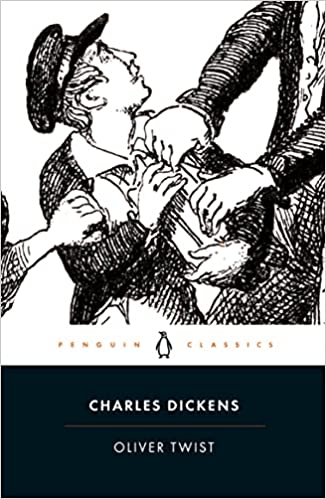
Oliver Twist by Charles Dickens, 1843

This year’s Dickens was an easy choice. Oliver Twist is the last of the major Dickens novel I had to (re)read, and it is such a familiar cultural artefact! The musical Oliver! is an important part of that feeling of course, and a comparison between the plot choices in the novel and the musical is illuminating. The characters Dickens created in this novel – Fagin, Sikes, the Artful Dodger and Oliver himself – are remarkably vivid and enduring.

I’ve written before about Dickens’s consistency as a novelist. It’s hard to believe that Oliver Twist was arguably his first ‘proper’ novel. The Pickwick Papers is now seen and published as a novel but at the time it was

written it was conceived and constructed as a very loose series of stories with no serious intention of publishing it as a single book. Oliver may have had a similar origin – it was published in instalments, as all Dickens’ s novels were, and there is every reason to believe that Dickens constructed all but the broadest elements of the plot as he went along, rather than having a master plan – but the final product is far more cohesive and carefully structured. It has a beginning a middle and an end, and a plot running through it joining all the parts, even if the plot is the weakest part of the whole. The publication history of Oliver is actually even more complex than I have suggested, because about two-thirds of the way of it being published in instalments Dickens fell out with the publisher and had it published in novel form as well. So the text was available as a novel before the instalments were all published.

Anyway, to the novel itself. Critics have long argued (see Orwell’s wonderful essay on Dickens for example) that Dickens’s experience of being taken out of school and sent to work in a factory at an early age was so traumatic an experience that it threw a shadow over most of his writing. Certainly there are echoes here of this experience – Oliver is left an orphan from birth and suffers at the hands of an uncaring welfare system. He survives, somehow, where many do not and is sent to work at a very early age as an undertaker’s assistant. He is bullied remorselessly in this post and to avoid having to return to the workhouse runs away to London. Here he is quickly picked up by the Artful Dodger (and the lesser remembered Charley Bates) and taken back to Fagin’s hideout, where he is trained to be a pickpocket. It is important to note that as soon as he realises what is happening – and it takes quite some time, because he is very naïve – Oliver refuses to consider any criminality at all. This is important for Dickens – he wants to keep Oliver’s conscience clear, and avoid any suggestion that criminality is an inevitable consequence of poverty. Oliver is nevertheless arrested on suspicion of picking the pocket of an elderly gentleman who is buying some books. This it turns out is Mr Brownlow, a kindly gentleman who takes Oliver in from the street and nurses him back to good health. The kindly old gentleman who helps out unfortunate children is one of those literary stereotypes that seems to have been around forever, but I am not sure there are many examples before Dickens.

Of course there are good archetypes and bad, and Fagin, consistently referred to as ‘the Jew’ in most editions (although some are sanitised) is a chilling portrait of the racist, anti-Semitic image that was largely accepted in Victorian England. When we first meet Fagin he is described as a “very old shrivelled Jew, whose villainous-looking and repulsive face was obscured by a quantity of matted red hair”. There’s no escaping the poisonous nature of this caricature, and the only thing that can be said in Dickens’s defence is that when subsequently challenged on the portrait he made attempts to apologies by writing more positive Jewish characters in his later novels. While Fagin’s Jewishness is portrayed as the source of all his character flaws, he remains a fascinating portrait of evil. The gang of child thieves shown in the stage and film musical and still consistently referred to in reference works, don’t appear in the novel – it’s just Charley Bates and the Artful Dodger, which hints at various other associates currently spending time at His Majesty’s pleasure, or even having previously paid the ultimate price. Dickens is very clear that criminality is a highly dangerous, unattractive, and not very well rewarded career choice.

Nancy is another fascinating character. Dickens never uses the word prostitute to describe her, nor any other of a thousand synonyms, but he may as well because there is no doubt whatsoever of her profession. Her’s is a sympathetic, almost affectionate portrait, and her murder is one of the most dramatic and traumatic scenes Dickens ever wrote, terrible in its domesticity and mundaneness, tragic in Nancy’s refusal to take the escape offered her time and again, and chilling in its description first by an omniscient narrator:

“It was a ghastly figure to look upon. The murderer staggering backward to the wall, and shutting out the sight with his hand, seized a heavy club and struck her down.”

then once the murder is committed, the perspective switches to Bill’s:

Once he threw a rug over it; but it was worse to fancy the eyes, and imagine them moving towards him, than to see them glaring upward, as if watching the reflection of the pool of gore that quivered and danced in the sunlight on the ceiling. He had plucked it off again. And there was the body—mere flesh and blood, no more—but such flesh, and so much blood! He struck a light, kindled a fire, and thrust the club into it. There was hair upon the end, which blazed and shrunk into a light cinder, and, caught by the air, whirled up the chimney. Even that frightened him, sturdy as he was; 

Notice that Nancy’s body becomes ‘it’, not ‘her’.

The only criminal character who Dickens seems unconcerned to paint as having a bad character and to be destined for the gallows or worse is the Artful Dodger. While his associate Charley Bates is so appalled by Nancy’s murder that he ‘shops’ Sikes and eventually gives up crime entirely, we last see Jack Dawkins controlling the courtroom where he is being committed (some have claimed Dodger is sentenced to transcription to Australia, but this was not at all clear in the Penguin Classics edition I read – possibly Dickens tidied things up in later editions. Dodger’s refusal to be cowed by the criminal justice system is quite magnificent:

‘No,’ replied the Dodger, ‘not here, for this ain’t the shop for justice: besides which, my attorney is a-breakfasting this morning with the Wice President of the House of Commons; but I shall have something to say elsewhere, and so will he, and so will a wery numerous and ‘spectable circle of acquaintance as’ll make them beaks wish they’d never been born, or that they’d got their footmen to hang ‘em up to their own hat-pegs, afore they let ‘em come out this morning to try it on upon me. I’ll—’

‘There! He’s fully committed!’ interposed the clerk. ‘Take him away.’ ‘Come on,’ said the jailer.

‘Oh ah! I’ll come on,’ replied the Dodger, brushing his hat with the palm of his hand. ‘Ah! (to the Bench) it’s no use your looking frightened; I won’t show you no mercy, not a ha’porth of it. You’ll pay for this, my fine fellers. I wouldn’t be you for something! I wouldn’t go free, now, if you was to fall down on your knees and ask me. Here, carry me off to prison! Take me away!’ With these last words, the Dodger suffered himself to be led off by the collar; threatening, till he got into the yard, to make a parliamentary business of it; and then grinning in the officer’s face, with great glee and self-approval.

(I think this is clear – Dodger is ‘fully committed’ i.e. sent for trial, not sentenced (the clerk couldn’t sentence him anyway), and after this point we do not hear from Dodger again – he is conspicuously absent from the author’s final ‘what happened next to everyone’ chapter.

It has to be said that the novel’s plot is repetitive and dull. Oliver is first kidnapped by Fagin, innocently involved in an attempted crime by two of Fagin’s associates (Charley Bates and the Artful Dodger, who both run away) rescued by kind Mr Brownlow and nursed back to health. Then the whole cycle starts again. He is (re)kidnapped by Bill and Nancy, innocently involved in the attempted burglary and rescued again by the intended victims, Mrs Maylie and her ward, Rose while his erstwhile criminal associates, Bill Sikes and Toby Crackit, run away. Each rescue is followed by a long period of recuperation and lots of Victorian charity and kindliness. Each intended victim is remarkably closely connected to Oliver’s and at the time totally unknown real family. And each time Oliver is suspected of involvement in the crime but protected by his kindly saviours. All the while ‘Monks’ lurks in the background of the plot with obvious sinister intent, although I suspect almost all readers will not care in the slightest what he is up to. All but the broadest detail of the secret inheritances, half brothers, lockets and nonsense used to tie things up and rescue Oliver from poverty and worse the curse of being working class is eminently forgettable, and it is hardly surprising that this was all excised from the musical adaptation without any impact of the story’s impact. But none of that really matters, because we still have a host of vivid characters and wonderful, haunting writing in chapters such as ‘Fagin’s Last Night‘ to savour and remember.

Oliver Twist by Charles Dickens, 1843

Aside
Book review

I make no claims to being an expert on the life and works of George Orwell, even though at one time or another I have read almost everything he wrote. And that’s saying something – he wrote a lot, earning his living from his journalism for much of his working life while at the same time writing novels, other books and endless letters to friends and relatives. But in reflecting on Orwell’s life and work it occurred to me that there was one distinctive feature across many periods of his life, and that was his tendency to remove himself from his social sphere and go into exile of one form or another.

The most obvious example of this was his decision to join the Burmese Imperial Police when he left Eton, instead of following the more traditional path of university. The conventional wisdom behind this choice is that it was a combination of academic failure – his tutors simply thought he was not clever enough to go to Oxford or Cambridge, and it is implied that any other university would be beyond the pale – and parental pressure. Orwell father had worked as a Sub-Deputy Opium Agent in the Opium Department of the Indian Civil Service, overseeing the production and storage of opium for sale to China. There were other family connections to the far East – his mother had grown up in Burma and there were still relatives living out there. So the traditional of working in the service of the Empire was strong in Orwell’s family, and he succumbed to this pressure in the face of limited other options. A memoir by a childhood girlfriend, Jacintha Buddicom, (Eric and Us) suggests that a failed romance may have also played a part in this decision. However it came about, Orwell spent several years in Burma, years memorably recorded in fictional form in Burmese Days and in non-fictions essays such as A Hanging and Shooting an Elephant.

His return to the UK at the end of his service didn’t last long. Unable to settle he moved to Paris where he lived and made his early attempts to make a living out of being a writer, the main result being Down and Out in Paris and London. A blizzard of casual and temporary jobs followed for several years, as Orwell lived a fairly itinerant lifestyle, always having his parents home in Suffolk to fall back on when necessary.

His journey to the north of the UK to investigate the poverty that formed the core of The Road to Wigan Pier could be seen as another form of internal exile. Certainly his decision in 1936 to move to Wallington, a small village in Hertfordshire, and open a shop can only be seen as an attempt to escape the pressures of living and working in London, but must also have left Orwell and his wife isolated from friends and family. On a map Wallington may not look that far from London, but it is still a fairly remote village with a population of less than 200, and must have been all the more remote in the 1930s. I can’t be sure how much Orwell lived in Wallington and how much he used it as a base, but I think it was a sanctuary.

Jura, where Orwell wrote 1984 and spent the final years of his life following his first wife’s death in 1945, is as remote a place as you can find in the United Kingdom, and was clearly yet another attempt to remove himself from everyday associations and allow him time to write. In terms of his health it was of course a disastrous choice, but you could not ask for anywhere more remote.

What does this mean for our understanding of Orwell’s work. Was he just someone who was socially awkward and seeking isolation? Perhaps but I don’t think that’s the whole story. He spent so long trying to escape from his class, which marked him clearly by his accent, his dress, his manners, and never wholly succeeded. To be honest I am not sure whether this urge for isolation is reflected in his work at all. His main characters are often socially isolated – look for example at Winston Smith, trapped in his own private hell, having to maintain a façade of party loyalty to his neighbours and co-workers – but is that enough? Perhaps it was more a reflection of Orwell’s personality that wasn’t translated onto the page at all. But I don’t think other readers have highlighted this feature of his life before (I appreciate that is almost certainly wrong – what I should say more accurately that a short internet search hasn’t produced any likely looking results for ‘Orwell in Exile’) and it might be an interesting lens through which to look at his work.

Orwell in Exile

Aside
Book review

Otherlands: A World in the Making, by Thomas Halliday, 2022

Thomas Halliday is a palaeobiologist and evolutionary biologist. And no, until I read Otherlands I didn’t know what those things were either and while I am being frank I ought to also accept that my understanding of them remains fuzzy. Why? Because while ‘Otherlands’ is in many ways brilliant, it is also remarkably dense. Every paragraph contains a huge amount of detail – to such an extent that I found myself only able to read a few pages at a time. I suspect this very heavily promoted book will take its place alongside A Brief History of Time (for example) as one of those books that is bought by many, started by few, and finished by almost no-one. To be clear I did finish it, because I can be very stubborn at times, but I can’t deny it was a struggle.

Otherlands is structurally a straightforward book. For each period of geological time Halliday describes what the flora and fauna on earth would have been like. As a purely academic analysis this would have been very dry, but Halliday creatively imagines what the landscape and life on earth at each point in time would have been like. We see through his eyes and words the mountains rise, the earth surrounded in ice and glaciers waxing and waning. This is not however just a ‘big picture’ account of geological eras. Speeded up like the view from the Time Machine, the earth is convulsed by huge changes that rewrite the shape and form of life each time. Mass extinctions lead to opportunities for new life forms, and eventually for the advanced apes that were our ancestors.

The scholarship behind almost every sentence is breath-taking. The biology of a micro-organism, that Halliday describes in a few lines, probably represents half a life-time of research. He takes us to times when the Antarctic was tropical, when the Mediterranean flooded, and when we said goodbye to the dinosaurs.

There are some weaknesses in the author’s decision to imaginatively recreated geological ages rather than taking a purely scientific approach. Here’s an example from chapter one on the Pleistocene:

“Dawn is near breaking in the Alaskan night, where a small herd of horses, four adults and three foals, huddle against the frigid north-easterly wind> By this time, the sun has been gone for well over ten hours, and the air is skin-tighteningly cold. Two of the mares are taking their turn on sentinel duty, keeping their vigil against the dark while the family rests or forages.”

Is this description suggested by a fossil group or is it simply an imaginative evocation of what is believed to be a typical scene (or perhaps a combination of the two)? We aren’t told, and the pedant in me chafes against this even though phrases such as “We can imagine…” would almost certainly have chafed as well. Much of Halliday’s accounts must surely be guesswork, but how much varies constantly. No clear lines are drawn between this imaginative element of the book and the detailed science, so the reader needs to do a lot of reading between the lines and of footnotes. At some points Halliday acknowledges the limits of knowledge about the past – for example with reference to one of the early placental mammals he says ““Their anatomy is too non-committal, too similar to and yet too distinct from too many living orders to be placed with confidence. […] They are an unspecialized, Platonic placental, a lump of living clay from which all others are stretched, pinched and pulled into shape” but at many other points the landscape and the detail of living creatures is reported in incredible detail as simple observable fact rather than educated guesswork.

If I were to be overly critical, I admit I found the prose style uneven. Halliday has won prizes for his writing and I am sure he will win many more, but for every illuminating metaphor bringing an ancient long-dead species back to life there is a grinding analysis of the life-cycle of worms or crustaceans where I learnt much more than I ever wanted to know. Which I suppose is my problem, my lack of engagement with the text and the subject matter. Perhaps it’s also because Halliday seems to find all ancient life fascinating, not just the big beasts and the creatures of the recent extinctions such as mammoths and the other mega-fauna.

It’s impossible not to feel awed, even overwhelmed by the vast scale of time encapsulated by this book. Life has inhabited earth for billions of years, even if for most of that time it was single cell organisms lurking near heat sources waiting for evolution to be discovered. At times I could feel my brain expanding as I read. I learnt that you can calculate an approximation of the average rainfall in any part of the world by the number of drip-points – tips at the end of a leaf – each plant has. I learnt that our genetic code still contains in a degraded form the instructions to create the enzymes used for breaking down the hard exo-skeletons of insects, a left-over from the days where our ancient ancestors ate insects as a primary part of their diet. And I learned that red deer have an extremely high resistance to cancers as a by-product of their evolutionary ability to regrow their antlers quickly. In chapter 15, Consumers, there is vivid description of the evolution of eyesight which I would recommend to anyone struggling with the concept that eyes could evolve from species which previously did not have sight. The book is full to the brim of similar accounts of the wonders of evolution and the natural world.

If ever a book could make you feel small and insignificant, a cocktail of chemicals briefly inhabiting a minuscule amount of space and time in an infinitely variable universe, this is the one.

Postscript: As an experiment I asked ChatGPT to write a review of this book. I am pleased to say it was dross – generic nonsense that was barely relevant to the book’s subject matter and containing comments that could apply to virtually any non-fiction. So it looks like AI won’t be making book bloggers redundant any time soon!

Otherlands: A World in the Making, by Thomas Halliday, 2022

Aside
Book review

Down and Out in Paris and London, George Orwell, 1933

Down and Out in Paris and London was Orwell’s first full-length book. It is written in the form of a memoir, describing the time Orwell spent living on or near the breadline in London and Paris. I’ve not been able to ascertain whether this pairing of the two capital cities was a deliberate nod towards Dickens’s Tale of Two Cities, or whether the symmetry is a simple consequence of Orwell’s time spent in both capitals. The book is also about two cities in another sense – that of the prosperous middle and upper classes and that of the working and underclass. So the symmetry works really well, even if it was accidental!

The first part of the book is Orwell’s account of his time working in hotel and restaurant kitchens in Paris. This was the original core of the book, to which the second, London-based half was later added. It covers a period of around ten weeks. You wouldn’t know it from this account, but Orwell lived in Paris for approximately two years, from the time he quit his job in the Imperial police force in Burma. Why Paris? By this point in his life Orwell was completely committed to being a full-time writer, and Paris had the attraction of a) being a cheap place to live, compared to London, and b) the home of a thriving artistic community, including a large Russian émigré community. Basically it was a lot more exciting than London.

At present I do not feel that I have seen more than the fringe of poverty. Still, I can point to one or two things I have definitely learned by being hard up. I shall never again think that all tramps are drunken scoundrels, nor expect a beggar to be grateful when I give him a penny, nor be surprised if men out of work lack energy, nor subscribe to the Salvation Army, nor pawn my clothes, nor refuse a handbill, nor enjoy a meal at a smart restaurant. That is a beginning.

I can probably guess how Orwell spent most of his time in Paris, but in March 1929 he had most of his money stolen, forcing him into seeking a job. He had the option of reaching out to family or friends – or anyone else in the English community in Paris, (none of whom are even mentioned – taken at face value this book suggests that Orwell was the only Englishman in Paris in the 1920s!) but instead he took a job as a dishwasher in a very posh hotel and then latterly in a small bistro. His experiences in these establishments and his thoughts on the social structures that underpin them form the bulk of the first half of the book, and for some time were the only part of the book – it wasn’t until after several rejections by publishers that Orwell had the idea of welding his English down and out experiences to the text, immeasurably strengthening the overall structure.

Orwell left Paris in December 1929 and returned to his parents’ house in Suffolk. While waiting for a job as a private tutor to begin he went ‘tramping’, not for the first time (as the book implies). That is to say he put on some dirty clothes, left most if not all of his money behind, and set off on the road to live among the down and out. His experiences in ‘spikes’ are vividly recorded. Spikes were temporary hostels for the homeless, often constructed as part of the workhouses which still existed in pre-war England. In 1905 a Royal Commission had recommended that specialised institutions for different classes of the poor and homeless be established, and spikes, where you were only allowed to stay one day per month, were a result. The rules of the spikes were punitive and humiliating, and Orwell captures the misery of them perfectly.

The history of the publication of the book is quite interesting. Following rejections from several publishers Orwell effectively abandoned the typescript at the home of a family friend. Proving the adage that it’s not what you know, but who, this friend showed the text to a literary agent, who in turn offered it to Gollancz, who offered to publish it subject to the excision of some curse words and a few other changes to make them less likely to be sued. The title went through various iterations – Confessions of a Down and Outer, Confessions of a DishwasherThe Lady Poverty, In Praise of Poverty, only settling on Down and Out in Paris and London at the last. This was the first time Orwell used his pseudonym, again having toyed with various alternatives. It seems the pseudonym was used to save his respectable family any potential embarrassment given the slightly sordid subject matter.

It did not occur to me when I first read Down and Out to question how accurate it was. Perhaps I more sceptical nowadays – certainly I wonder to what extent Orwell embroidered his account? He made several differing comments on this question, leaving the issue unclear. I think the honest truth is that he omitted some detail and reordered others, but the essential truth of the memoir is unavoidable – there’s nothing here that is over the top, unbelievable or cause for any doubt. The events of the book are almost bland in their plainness. But somehow this fairly uneventful narrative has had an impact far beyond the sum of its parts. Perhaps this is because we know it is the first major work by an author who was going to go on to write in a few short years 1984, Animal Farm and so much more. You can quite easily see many of the essential principles of Orwell’s writing technique in Down and Out – the lack of over-ornamentation, use of plain English, and a willingness to say the unsayable (the f-bomb is dropped casually in a later chapter about the language of the streets.)

I’ve mentioned this in previous reviews of some of Orwell’s books, but his views on Jewish and gay people haven’t aged well. He is casually anti-Semitic in the way he writes about Jewish people, and expresses similarly dismissive attitudes towards gay people. There are worse examples elsewhere in his journalism, letters and diaries, but I wouldn’t want to dismiss the examples that appear despite this.

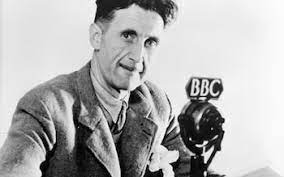
Orwell has been in the UK media a lot in recent days because of the dispute between one of the BBC’s presenters and the organisation itself on the question of freedom of speech. Lots of commentators have pointed out the irony of the BBC trying to censor Gary Lineker for his comments on Government immigration policy all the while ignoring this quote from Orwell which is on the wall of its main entrance:

Well said, as always. Apparently the quote comes from a draft preface to Animal farm which was never used. Just one more irony to go alongside the fact that at the time he worked at the BBC in the early 1940’s, Orwell was effectively a propogandist for the UK Government!

Down and Out in Paris and London, George Orwell, 1933

Aside
Book review

The Road to Wigan Pier, by George Orwell, 1937

The opening sentence to chapter eight of this book explains that ‘the road from Mandalay to Wigan is a long one and the reasons for taking it are not immediately clear. ‘

This would have been a wonderful introduction to The Road to Wigan Pier. Orwell’s decision to go to Burma for a post in the Indian Imperial Police straight from Eton (rather than taking the road more often travelled to university) was obviously a turning point in his life. The next stage of his personal odyssey, from Burma to Wigan in early 1936, would have made a fascinating story, and it is one he obviously wants to tell. He can’t completely remove himself from the narrative –

I was born into what you might describe as the lower-upper-middle class. The upper-middle class, which had its heyday in the eighties and nineties, with Kipling as its poet laureate, was a sort of mound of wreckage left behind when the tide of Victorian prosperity receded

I am a degenerate modern semi-intellectual who would die if I did not get my early morning cup of tea and my New Statesman every Friday”

and he regularly mentions how tall he is in comparison with the people of northern England. But we only get intermittent glimpses of this story. Orwell had been commissioned by the newly established Left Book Club to write about the living conditions of the unemployed in the north of England and from time to time he makes a genuine effort to stick to this brief. So there is a tension throughout the book – at points it is about the subject he was supposed to be writing about and at others autobiographical elements intrude.

I have to wonder whether Orwell delivered what he had been commissioned to write? Certainly he found what he expected to find – widespread poverty, appalling housing conditions, and little sign of organisation within the working class to improve things. A benevolent middle class intervention to help the struggling poor was Orwell’s inevitable diagnosis. But so much of the text is not on the subject Orwell was supposed to be writing about – the standards of living of the unemployed in the North. He wanders off topic for large sections of the book, and then in the second section abandons it altogether.

The opening chapter in part one describes life in a cheap boarding house. We are not told where this house is nor why Orwell is staying there (the book has no real introduction at all, other than the contentious opening by Victor Gollancz, the commissioning editor and promoter of the Left Book Club, which argues with several of Orwell’s conclusions). An un-emptied chamber pot left in the boarding house’s dining room causes Orwell to quit his shared room and get on a train to the North. This chapter includes the famous description of a view from the train:

The train bore me away, through the monstrous scenery of slag-heaps, chimneys, piled scrap-iron, foul canals, paths of cindery mud criss-crossed by the prints of clogs. This was March, but the weather had been horribly cold and everywhere there were mounds of blackened snow. As we moved slowly through the outskirts of the town we passed row after row of little grey slum houses running at right angles to the-embankment. At the back of one of the houses a young woman was kneeling on the stones, poking a stick up the leaden waste-pipe which ran from the sink inside and which I suppose was blocked. I had time to see everything about her – her sacking apron, her clumsy clogs, her arms reddened by the cold. She looked up as the train passed, and I was almost near enough to catch her eye. She had a round pale face, the usual exhausted face of the slum girl who is twenty-five and looks forty, thanks to miscarriages and drudgery; and it wore, for the second in which I saw it, the most desolate, hopeless expression I have ever-seen. It struck me then that we are mistaken when we say that’ It isn’t the same for them as it would be for us,’ and that people bred in the slums can imagine nothing but the slums. For what I saw in her face was not the ignorant suffering of an animal. She knew well enough what was happening to her – understood as well as I did how dreadful a destiny it was to be kneeling there in the bitter cold, on the slimy stones of a slum backyard, poking a stick up a foul drain-pipe.

You will note that in this paragraph Orwell talks about ‘we’ – himself and the implied reader, the Left Book Club subscriber who has someone else to unblock their drains. He does this elsewhere in the text, assuming that his reader will be middle class and Southern like himself, viewing the industrial northern working class as an alien race that needs to be introduced and explained by Orwell, the traveller into a strange land. The second chapter, later printed as a standalone essay in Inside the Whale, describes the lives of miners and their working conditions down a coal mine. This chapter vividly captures the horrors of mine working. I don’t want to over-emphasise this element of the text but it is impossible to avoid the homo-eroticism of Orwell’s descriptions of the miners:

“They really do look like iron hammered iron statues–under the smooth coat of coal dust which clings to them from head to foot. It is only when you see miners down the mine and naked that you realize what splendid men, they are. Most of them are small (big men are at a disadvantage in that job) but nearly all of them have the most noble bodies; wide shoulders tapering to slender supple waists, and small pronounced buttocks and sinewy thighs, with not an ounce of waste flesh anywhere. In the hotter mines they wear only a pair of thin drawers, clogs and knee-pads; in the hottest mines of all, only the clogs and knee-pads.”

(He later writes in similar terms about the attractiveness of Burmese men compared to Englishmen, in particular himself). The following chapters describe the housing and economic position of the average miner. Orwell agonises over the housing shortage in the north without being able to identify the obvious solution of a mass state sponsored house building programme. Eventually in chapter 5 he reaches the issue of unemployment, but this is a cold statistical analysis rather than a personal record of life without paid work. Orwell makes some good points about how hard to is to eat well or sensibly on poverty income levels – an issue that remains pertinent to this day.

The second part of the book is almost entirely comment, sometimes wandering quite some distance from the original point of the commission. He struggles to answer the question of why socialism has not been embraced by the working class in the UK, given the self evident argument that it would address all the problems outlined in the first section of the text. Orwell is honest about his social origins, his class prejudices and his efforts to overcome them. He is quite dismissive of socialists in the UK, finding them largely detached from the working classes whose lives they are planning to improve. This is largely polemic, based upon the stark contrast between his experiences as an intellectual in London and the South East and his weeks in the North. These chapters are characterised by muddled logic, prejudice and contradiction. Often you get the impression Orwell is more interested in crafting a quotable phrase than developing a line of argument. Certainly he is never afraid of hyperbole:

“Looking back upon that period (post-war) I seem to have spent half the time in denouncing the capitalist system and the other half in raging over the insolence of bus conductors”;

or

There is probably no-one capable of thinking and feeling who has not occasionally looked at a gas-pipe chair and reflected that the machine is the enemy of life.”

He argues that mechanisation is effectively synonymous with socialism, as if that is simply self-evident rather than something contentious that he has to demonstrate (“This, then, is the case against the machine. Whether is is sound or unsound case hardly matters“) then goes on to bemoan at significant length the damage machines have done to the quality of life in the UK and to his life in particular.

“As you can see by looking at any greengrocer’s shop, what the majority of English people mean by an apple is a lump of highly-coloured cotton wool from America or Australia; they will devour these things, apparently with pleasure, and let the English apples rot under the trees. It is the shiny, standardized, machine-made look of the American apple that appeals to them; the superior taste of the English apple is something they simply do not notice. Or look at the factory-made, foil-wrapped cheese and ’blended’ butter in any grocer’s; look at the hideous rows of tins which usurp more and more of the space in any food-shop, even a dairy; look at a sixpenny Swiss roll or a twopenny ice-cream; look at the filthy chemical by-product that people will pour down their throats under the name of beer. Wherever you look you will see some slick machine-made article triumphing over the old-fashioned article that still tastes of something other than sawdust.

Coming up for Air is tainted by the same pervading sense of nostalgia, a dim awareness that things were better when Orwell was a young man. It was this strand of conservatism (even when he was trying to develop an argument for socialism) that led him to being quoted approvingly by John Major. Orwell can recognise that industrialisation and mechanisation have brought benefits in terms of living standards and improvements to the world of work. But his apples have a machine-made look and it is our fault anyway for preferring American apples to the innately superior English varieties. We’ve all heard similar complaints from old people (Orwell was only in his thirties at this point, but sounds a lot older) about how things were better in the old days, and the claim rings as hollow today as it did then.

And then we come to the difficult passages where Orwell makes the argument that working class people smell. Quite why he felt the need to be so disrespectful to the people who had welcomed him into their homes, shared their food and shown him every hospitality, is beyond me. He was never afraid of being controversial, sometimes actively seeking out controversy, and I am sure he genuinely believed this to be the case, but he could have chosen to point out any number of other aspects of poverty-line daily life – badly made clothes, rotten teeth, untreated medical ailments, shoes with no soles, etc. Instead, as always it seems for Orwell, it is the ‘scent narrative’ (as John Sutherland puts it in his book on this very specific topic, Orwell’s Nose, A Pathological Biography)

The real secret of class distinctions in the West–the real reason why a European of bourgeois upbringing, even when he calls himself a Communist, cannot without a hard effort think of a working man as his equal. It is summed up in four frightful words which people nowadays are chary of uttering, but which were bandied about quite freely in my childhood. The words were: The lower classes smell. That was what we were taught–the lower classes smell. And here, obviously, you are at an impassable barrier. For no feeling of like or dislike is quite so fundamental as a physical feeling.

He tells himself that it is wrong to feel this way, but he can’t ever fully overcome this instinctual sense of repugnance at the working classes.

Class prejudice is accompanied by casual homophobia, anti-Semitism and other prejudices that shouldn’t be brushed away too casually:

It would help enormously if the smell (smell again!) of crankishness which still clings to the Socialist movement could be dispelled. If only the sandals and the pistachio-coloured shorts could be put in a pile and burnt, and every vegetarian, teetotaller and creeping Jesus sent home to Welwyn Garden City to do his yoga exercises”.

“In order that Hitler may march the goose-step, that the Pope may denounce Bolshevism, that the cricket crowds may assemble at lord’s, that the Nancy poets may scratch one another’s backs, coal has got to be forthcoming.

We have reached a stage when the very word ’Socialism’ calls up, on the one hand, a picture of aeroplanes, tractors, and huge glittering factories of glass and concrete; on the other, a picture of vegetarians with wilting beards, of Bolshevik commissars (half gangster, half gramophone), of earnest ladies in sandals, shock-headed Marxists chewing polysyllables, escaped Quakers, birth-control fanatics, and Labour Party backstairscrawlers.

While The Road to Wigan Pier doesn’t cover in any detail the subject it was commissioned to address and exposes a lot of Orwell’s prejudices, at the same time it is an important text. I originally read it over forty years ago, and while books I read last year have already started to fade from my memory, Wigan Pier still resonates, however wrong-headed and muddled it may be. This is in part because of Orwell’s legendary uncomplicated prose, in part because even when completely wrong he is always interesting, and mostly because no-one wrote about the state of pre-war Britain in the way he did. It ends with a slightly forced rallying call for class solidarity between the proletariat and the white collared middle classes and with an awful joke: “We have nothing to lose but our aitches“.

The Road to Wigan Pier, by George Orwell, 1937

Aside
Book review

Parable of the Talents is a strange combination of disparate elements that never quite come together. There’s the standard economic collapse/breakdown in social order dystopia theme, which in many ways is the core of the novel. This ground was quite well covered in the first novel in the series, Parable of the Sower. The future is bleak, particularly for the poor, for women and people of colour. More than bleak, it’s nightmarish. There’s also an extended commentary – a parable if you will – on religious extremism in the USA. Despite the violence and anarchy America is still able to hold a presidential election, which sees the arrival of the demi-Trump, President Jarret. The temptation to draw comparisons between any fictional ‘bad’ President and Trump is hard to resist – Sinclair Lewis’s It Cant Happen Here for example, or Philip Roth’s The Plot Against America, but here the similarities are overwhelming, even down to the choice of slogan, Make America Great Again. Did Trump or his followers actually read this novel and think ‘that looks great, let’s do that!’? The playbook they use is also very similar – use extremist elements as the stormtroopers of the movement, easy to disown if things go wrong, but pretty useful if some heads need smashing. And the appeal to the working man looks the same: “Even some of the less religious ones support him. They say the country needs a strong hand to bring back order, good jobs, honest cops and free schools’.

The science fiction element of the novel – Butler is best known as a sci-fi writer – is tacked on uncomfortably to the main narrative, and never really integrated, despite the author’s best efforts to bring the elements together. This is a thankless task, because when society is breaking down probably the last thing people are interested in is an attempt to colonise space.

Parable of the Talents is principally narrated by Lauren Oya Olamina, who we met in Parable of the Sower. Each chapter is prefaced by comments written much later by her daughter Larkin, which reveal much of the eventual outcome of Lauren’s story and serve to remove some of the tension from the narrative. Lauren’s husband Bankole also narrates briefly. The novel ostensibly consists of present tense diary entries written by Lauren and recovered (somehow) many years later, on which Larkin provides commentary. When the novel opens five years have passed since the founding of Acorn, the community set up to provide shelter for the group Lauren was travelling with. Acorn has become an Earthseed community, which is based on the non-theistic ideas developed in the previous novel, that God is Change and that humanity’s destiny is to live on other planets. These are dangerous ideas when Christian fundamentalist is on the rise in the form of “Christian America” led by President Andrew Steele Jarret. Slavery has been reintroduced with “shock collars” being used to control the enslaved. 

When Acorn was first established the core members of the group expressed doubt that it would survive in such harsh times. Their doubts are proven correct when the community is attacked by Jarrett’s ‘Crusaders’ and turned into a prison, and the community’s children are taken away for adoption in ‘good’ Christian families. The parallels between this society and the slavery of eighteenth and nineteenth century America is unavoidable. Read as an account of the horrors of slavery with all manner of degradation forced upon the slaves is the most difficult part of the novel, and while we know from Larkin’s comments that Lauren and her group eventually escape their enslavement, there is no conventional happy ending on the horizon.

Is the novel a parable, and if so of what? I find that difficult to answer. The parable of the talents, in which servants are given money (talents) by their master, and achieve very different things with what they are given, is an interesting companion story to the parable of the sower. The moral of the (biblical) story is I believe that we are given the same opportunities in life, and it is up to us to make the most of them. Which is palpably not what happens in this novel, where people are oppressed and suffer despite their very best efforts to carve safe spaces out for themselves. So I found the ‘message’ if there is one, confusing.

On the other hand it is obviously a lot clearer that Butler had little good to say about fundamentalist Christianity, which is a source of evil in the novel. Lauren’s continuing attempts to found her own religion, Earthseed, is ostensibly the novel’s most positive thread, but I found the verses used to introduce Earthseed theology at the opening of each chapter tedious and intrusive. Are we supposed to identify with Lauren’s ideas? Without doubt she suffers for them, but there is another way of looking at the novel, a perspective hinted at by Lauren’s brother Marc, who joins Jarret’s Christian America church. It could be argued that Lauren is as much a monster as Jarrett. She is intolerant of dissent and is entirely comfortable with killing her guards when the opportunity presents itself. All of them. One has his throat bitten out. She pursues her vision of Earthseed with the same fervour as Jarrett proselytises fundamentalist Christianity. It’s not a competition to be the more terrible, and Lauren suffers through most of the novel, but it’s also not as simple as good versus evil. Giving Marc chapters to narrate from a totally different perspective helps emphasise this point.

The novel closes on a positive note, with society returned to normal, Earthseed flourishing, and the first tentative steps being made towards fulfilling mankind’s destiny of interstellar travel. How the world went from barbarism to advanced technology in a few decades isn’t the most convincing aspect of the novel, but it does set up a sequel, which Butler was sadly never to write.

This is not a novel for the younger reader. I have a pretty strong stomach for scenes of violence etc, but even I found points where I had to remind myself that it was only a book and that the extreme violence being inflicted upon the characters wasn’t real. There’s so much suffering inflicted on women and children, relentlessly with no promise of escape or redemption. If you can get through that, and the dull poetry about Earthseed, there is still plenty to be derived from this very different novel.

Parable of the Talents by Octavia Butler, 1998

Aside
Book review

I don’t enjoy writing negative reviews, I really don’t, and sometimes it’s better to just not review a book that to take it apart. But at the same time I don’t want to self censor. So here goes: The Heart Goes Last is dreadful. It’s a hot mess. I can’t imagine if it had been written by anyone less famous than Atwood it would have been considered for a second by any publisher. That’s not to say it doesn’t have any redeeming features, but you will struggle to find them. It doesn’t make Atwood any less of a writer (well it does a bit) – The Handmaid’s Tale will always be a great book – but The Heart Goes Last is almost from a different author, it’s so casually, carelessly bad.

So what’s wrong with it? It opens promisingly enough. The setting is a very similar world to that described in Octavia Butler’s Parable of the Sower, the USA of the near future in which the economy has collapsed and social order is breaking down. (Towards the end of the novel this economic collapse is forgotten and we are back to a very recognisable consumer economy. By then the idea of disorder has done its job). Charmaine and Stan are a young under-employed couple living in their car, surviving on Charmaine’s wage and tips from her bar job. Both have been recently lost better paying jobs, and both will eventually find their way back to their previous employers in very different circumstances. They are under threat from the dangerous criminal elements that seem to roam unchecked in the streets. Stan’s brother, Conor, is a small-time criminal who helps him out from time to time. It’s clear that Stan and Charmaine’s way of life won’t last for long – they are getting desperate.

One day Charmaine sees an advertisement for Conscilience, a community in which jobs and housing are available. What’s the catch? Something very similar happens in Octavia Butler’s Parable of the Sower, where a family trades their home in their vulnerable walled community for an apartment in a company run town. Butler doesn’t follow this thread of her story through (in the original novel at least – I have yet to read the sequel) but this very similar community becomes the focus for Atwood’s story. In Conscilience (motto – “Do Time Now, Buy Time for Our Future”) everyone spends one month working in the community and alternate months in prison. Yes, I know, that makes no sense at all. Being in prison seems virtually the same as being outside it – in both cases they can’t leave the overall community – and the economic model underpinning the enterprise just doesn’t add up. Of course I understand this is not to be read literally – this is a parable about Americans trading their freedom for economic security, and at the same time a satire on the for-profit prison system in the USA – but even parables need to make some kind of sense don’t they? Inside Conscilience Charmaine and Stan have mundane jobs on their ‘freedom’ months and when they are in prison Stan looks after the chicken farm, and Charmaine dispenses lethal injections to prisoners who have proven troublesome. That’s just one of Conscilience’s dark secrets – it practices widespread murder of the difficult and economically inefficient. The management of the community, a company called Positron, is a Big-Brother-like elite using surveillance cameras across the whole community to monitor the inmates. Other sinister secrets are obviously lurking behind the fake smiles of Positron employees. As someone observes “Once you’ve got a controlled population with a wall around it and no oversight, you can do anything you want.” The wholesale murder of prisoners is not something they are particularly keen on getting out, but it is suggested that Positron has stumbled across a new social order for the USA which is better than all the other alternatives, and that a few dead prisoners here and there might be a price worth paying.

It seemed to me as if Atwood lost interest in the novel at around this point. Having established the pieces on the board she wasn’t sure what to do with them. All the major satirical points have been made. So she took the strange decision to write the rest of the novel as a ‘madcap’ sex comedy (and whose heart doesn’t drop at those words?) Charmaine begins a passionate, sordid and erotically adventurous affair with the husband of the couple who live in their apartment on alternate months. When this relationship is discovered Stan is forced to re-enact the affair – literally and physically, but for reasons that are never really made clear – with the alternate wife, sordid sex on video and all. The wife turns out to be a disaffected senior figure within Positron who is working to expose the company’s excesses and crimes, but can’t simply email the dossier of incriminating data to a journalist because – well, just because – so has to come up with an elaborate scheme to smuggle Stan out of Conscilience with a memory stick hidden in his belt. This overly elaborate scheme, which dominates the latter part of the novel, involves sex robots, Elvis and Marilyn impersonators, and a clumsy reference to the Blue Man Group. There’s also a sub-plot involving pioneering surgery which causes the recipient to fall in love with the first person they see when they come around from the anaesthetic, which I assume is a commentary on free-will but by this point I had long lost interest.

You will either read this element of the novel – the sex comedy – as either a Swiftian romp (as one extremely generous reviewer described it) or find it pretty unbearable. Whatever your thoughts on these chaotic chapters, the clash in tone with the realism of the first half of the novel is jarring. There are lots of other problems with this novel. The subject of paedophilia sex-bots is raised and quickly dropped. At one point it is hinted that Positron is planning to sell the blood of babies. Again, mentioned then quickly dropped. The casual homophobia – the Elvis impersonators all pretend to be gay to avoid having to sleep with their escorts when working in this area – was ugly. All of these elements shouldn’t have survived a careful editing of the novel, but I am not sure what would have been left.

Goodreads is normally relentlessly positive about the novels reviewed on the site – I think this is because the people who take the trouble to write reviews are usually ones who have enjoyed the books. But the Goodreads scores for The Heart Goes Last are awful – 23k three star reviews compared to a generous 8k five star.

All authors have misfires, but this one should have stayed in the draft folder.

The Heart Goes Last by Margaret Atwood, 2015

Aside
Book review

The Mysterious Case of the Alperton Angels is Hallett’s third (substantial) novel to be published in the last two years, following 2021’s The Appeal, and 2022’s The Twyford Code. A fourth novel is already in the works. She is a busy writer!

The distinctive feature of all three novels is their format – they are modern versions of epistolary novels in which the narrative is told not by a narrator but through texts, WhatsApp messages, diary notes and in the case of Alperton a host of other primary sources, including extracts from a screenplay and two novels. This can make the narrative quite fragmented – there is no guiding consciousness to explain what is going on, the reader has to do a lot more of the work – but it is refreshingly different, and allows multiple voices and perspectives to be heard, as well as telling the story in lots of different ways. Together they tell the contemporary story of the eponymous Alperton Angels, a millennial cult that ended in a bloodbath eighteen years earlier. A baby that survived the killings is due to come of age, and Amanda Bailey, a crime writer, is commissioned to write a book about the case. The book is part of a crime series re-examining previous murders, and there are lots of references to real-life cases (Fred West etc). Her editor impresses on her that the key to making the book a success is finding and interviewing the rescued baby. And so it begins.

It quickly becomes apparent that there is more to the ‘mysterious case’ than originally appears. Some basic information about the three – or is it four? – deaths is missing. What appears to be a very well known and researched case melts away on closer examination, and none of the key witnesses can be found or are willing to talk. Alarmingly people Amanda tries to interview start to die off in unexplained circumstances. A fellow crime writer, Oliver Menzies, is also working on the story, and when their investigations overlap their publishers suggest they work together, trying to find fresh perspectives on the case. The novel’s approach to narration means information is slowly eked out and there’s limited reflection by the characters. Amanda’s transcription assistant, Ellie, provides a useful sounding board for her to bounce ideas off, but her relationship with Oliver is constrained by more than professional competitiveness – they have a history dating back to when they first entered the profession.

I had some reservations about Hallett’s earlier novels – yes, they were satisfyingly easy reads in which the pages kept turning quite briskly, but the mystery elements of the stories simply weren’t strong enough. The outcome of the various puzzles often depended on people behaving irrationally and sometimes just didn’t add up. With this novel at first it looked as if using a crime where irrational behaviour was a fundamental part of the case might have resolved some of these issues – if ever a participant did something unbelievable or bizarre it could be written off as symptomatic of the power of the cult. And Amanda seems very professional in her approach to her investigation – she has a sensible and very systematic working pattern which is set out clearly for the reader. She also has extensive contacts in the crime world (police and social services in particular) and is prepared to bend a few rules in the interests of getting the story. Oliver on the other hand is less impressive and acts as a drag on the investigation.

But suspension of disbelief can only get you so far. And so will being spoiler-free. So from this point in this review expect spoilers and stop reading if you haven’t yet read The Mysterious Case and intend to do so.

Firstly, I wasn’t convinced at all that Oliver would become a believer in the arrival on earth of the antichrist on the basis of a fifteen minute interview with the charismatic cult-leader, who we are told is just a common everyday kidnapper. Amanda impersonates a friendly spiritual adviser who leads Oliver further down the path but it’s still a long way before you decide to kill a minor royal on the off-chance they are the daughter of Satan. This was just one of many comically implausible features of the plot. Amanda’s decision to rush down to try and stop him (rather than say just phoning the police) made no sense at all. And while her investigation is presented as being very thorough there are some sources she ignores – the autopsies of the bodies or the transcripts of the trial proceedings for example, where the number of victims would be easily resolved and original witness evidence would be recorded. We are also invited to believe that not only would the police beat to death a suspect who had been seen walking through the front door of the local police station that evening, but they would then opportunistically add the body to the cult suicide crime scene (which incidentally wasn’t a cult crime scene at all, but the assassination of some underworld kidnappers) as a convenient way of disposing of it. That just makes no sense whatsoever – a beaten body looks very different from someone shot and ritualistically disfigured. And if that wasn’t unbelievable enough we are invited to believe that this was all witnessed by an American crime writer, over in the UK for research, who is allowed to watch the body being dumped and arranged at the crime scene and then just waved on his way back to the USA, never to mention what he saw again, despite it being the kind of thing a crime writer might actually, you know, write about. This is all just plain nonsense. Crime novels can have some improbabilities, granted, the untraceable poisons and so on, but this was way too much to ask.

Which is so disappointing, because the central idea here – revisiting a historic crime investigation, finding a new perspective and working out what has happened to the survivors – is great. And there have been suicide cults in the recent past that were led by charismatic charlatans. So the premise could have worked, and the narrative structure could have papered over some of the cracks and improbabilities. But never to this extent, at least not for me. Such a waste.

The Mysterious Case of the Alperton Angels, Janice Hallett, 2023

Aside
Book review

(Apologies – this is not a review.)

£915,334.89. That’s how much is being asked for for a first edition of Harry Potter and the Philosopher’s Stone on the book selling website ABE at the moment. Another signed copy is being offered for £719,169.88. These are asking prices of course and the actual prices paid are likely to be less, but you take the point – early editions of Potter are worth a lot of money! There’s a really handy check list of things to look for in first editions here. I almost always casually check editions of Philosopher’s Stone in second-hand book shops on the million in one chance of finding one of the 500 first editions (300 of which went to schools) – they must be out there somewhere! The thing I always look for first is on the back cover, which on early editions features this rather curious looking fellow. There’s an interesting story about this drawing told by the original illustrator, Thomas Taylor:

“when I was commissioned to produce the cover art for a debut middle grade novel by an unknown author called J. K. Rowling — and yes, I did read it — I was asked to provide “a wizard to decorate the back cover”. So I did. The books are full of magical characters and sorcerers, so it wasn’t difficult to conjure up one of my own. It never even crossed my mind to depict Dumbledore….The publishers found themselves repeatedly called on to explain why the wizard on the back didn’t

correspond to the description of Dumbledore in the book. It was clear what readers wanted and expected, so Bloomsbury contacted me for a portrait of the famous head of Hogwarts, and the original wizard disappeared in a puff of smoke. So that’s the answer. The first wizard wasn’t anyone in particular. Except… …except he was, actually. He was based on none other than my own wonderful, magical father. Yes, my somewhat eccentric, embroidered skullcap-wearing dad is the wizard on the back of Harry Potter.

This illustration is a good sign that you have found an early edition. So when I came across a hardback edition of Philosopher’s Stone with this chap on the back at the reasonable price of £1.50 I was interested. It had an intact dust jacket as well, which sometimes helps. It was a fifth printing of the 1998 Ted Smart edition, after the novel had won the 1997 Smarties Gold Award. People are asking thousands for this edition on eBay, and a first printing is being offered for over £2000 on HarryPottercollectables.com so you never know – but there are others more realistically priced in the tens of pounds. £1.50 was a good value and I always wanted to own an edition with this pre-Dumbledore illustration, so I’m pretty happy. What true book-lover doesn’t enjoy a good second-hand bookshop find?

Collecting Harry Potter

Aside