Book review

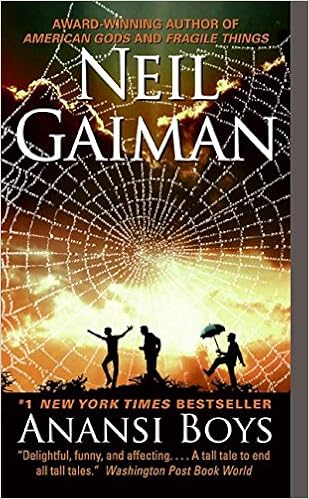
Anansi Boys, by Neil Gaiman, 2005

Anansi Boys tells the story of Charles “Fat Charlie” Nancy. Fat Charlie is an accountant, engaged half-heartedly to Rosie, whose monstrous mother is set on disrupting their engagement. Their wedding preparations are put on hold when Charlie has to travel to the Caribbean to attend his father’s funeral. There Charlie learns that not only was his father an incarnation of the West African spider god, Anansi, but also that he has a brother, and that he can be contacted by asking a spider.

Charlie takes this news relatively well, considering, and returns to his humdrum life in London. Inevitably he can’t resist summoning up his brother, Spider. Spider is everything Charlie is not – confident, charismatic, persuasive. He sets up home in Charlie’s flat, and begins to take over this life, with, as they say, disastrous consequences, losing him both his job and his fiancee.

The supernatural is invoked powerfully in Gaiman’s previous novel, American Gods, because it is taken seriously; here the whimsicality undermines the impact of the narrative. There’s never any genuine threat from the gods who resent Anansi’s status, or from the more earth-bound Grahame Coats, Charlie’s sleazy boss, who has been embezzling his clients for years. Most readers will realise very early on that Charlie is going to end up with the petite officer investigating his case, Daisy, that Charlie and Spider and going to be reconciled, and that Mr Coats is not going to get away with his crimes. This lack of threat, even from the personification of the malevolent tiger god, led to one reviewer describing the novel as “whimsical supernaturalism” which feels about right. The New Your Times review of the novel used a similar phrase, talking of “an Uncle Remus folksiness to the stories that sends the airy blitheness of the farce plummeting down to earth”.  

The other aspect of the novel that I found a little disappointing was the humour. Whimsy is always a tough one to pull off, and stripped of its context just about any joke can fall flat, but the jokes in the novel are consistently weak. Here’s some examples:

Spider: Things came up.
Fat Charlie: What kind of things?
Spider: Things. They came up. That’s what things do. They come up. I can’t be expected to keep track of them all.

More dialogue between Charlie and Spider:

“The ties of blood,” said Spider, “are stronger than water.”
“Water’s not strong,” objected Fat Charlie.
“Stronger than vodka, then. Or volcanoes. Or, or ammonia.”

This isn’t repartee. Ammonia’s not a comedic example of something unexpectedly strong is it?

The narration aims for Pratchett or Adams, but consistently misses.

“It was England in the autumn; the sun was, by definition, something that only happened when it wasn’t cloudy or raining.”

Does this mean anything? Does it say anything about the English weather, or is it just repeating a very tired cliche? Compare how Adams turns that idea completely inside out with the cursed rain god/lorry driver in (I think) Mostly Harmless. 

“There was reality and there was reality; and some things were more real than others.”

“Nothing happened. Nothing continued to happen. More Nothing. The Return of Nothing. Son of Nothing. Nothing Rides Again. Nothing and Abbott and Costello meet the Wolfman…”

Not all the jokes fall flat. Rosie’s mother is a fine portrait of a prospective mother-in-law who could put anyone off the institution of marriage. Here she is allocating guests to tables at the wedding reception, applying the fine judgments of status that matter so much on these occasions:

“I’ll put her down for table H,” said Rosie’s mother. “She’ll be more comfortable there.” She said it in the same way most people would say things like, “Do you wish to die quickly, or shall I let Mongo have his fun first?”

Later there is this fine description of an outraged dragon:

The beast made the noise of a cat being shampooed, a lonely wail of horror and outrage, of shame and defeat.

But these are isolated exceptions of otherwise disappointingly flat

This novel is really aimed at the young adult market. Adults will find it mildly engaging if a bit superficial, but younger readers will be gripped by the story and their hope that it all works out well for Charlie and his family. 

One final quibble – “nancy boy” in idiomatic English is a homosexual slur – was it really necessary to use this phrase in the book’s title?

Standard
Book review

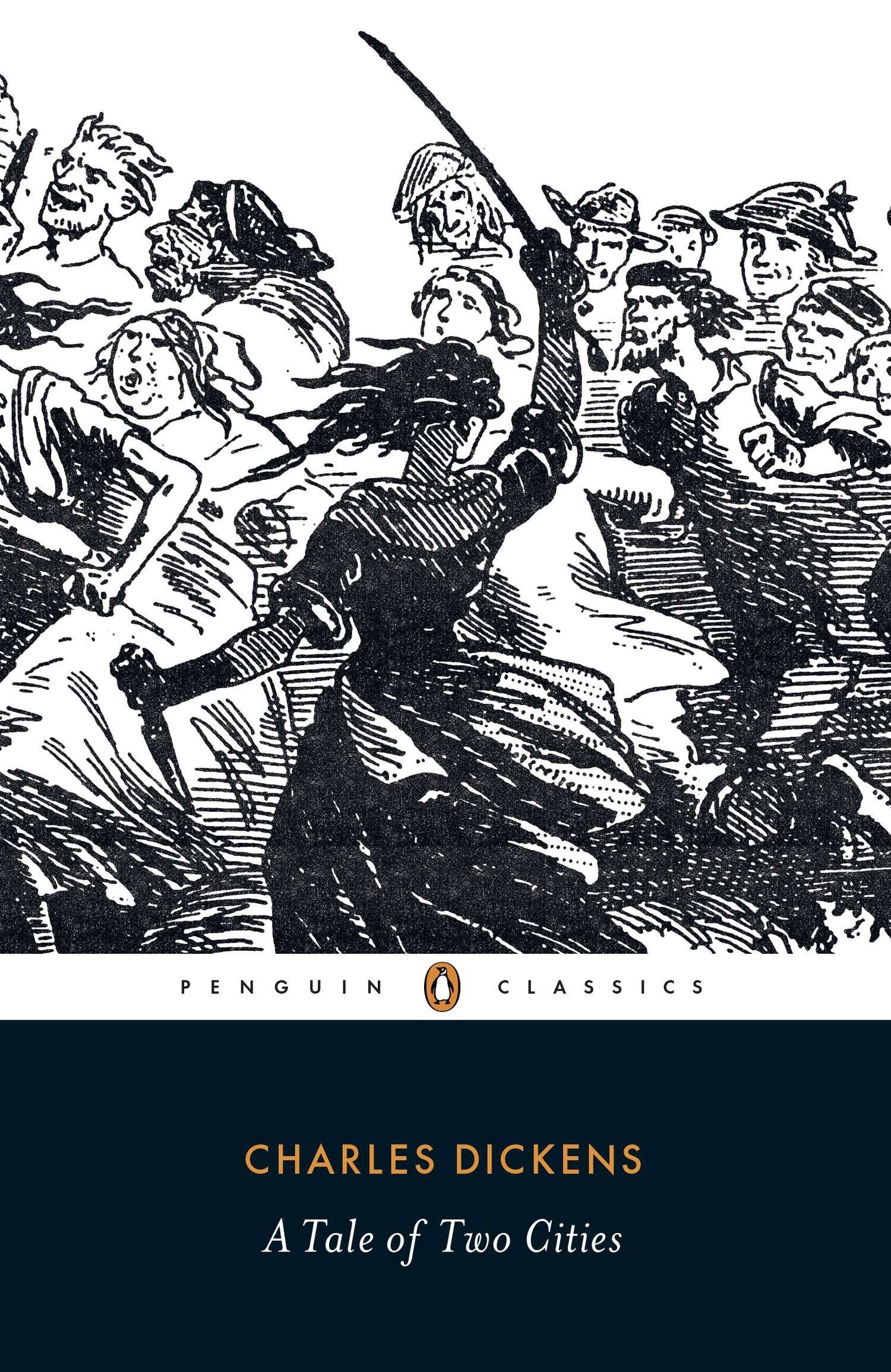
A Tale of Two Cities, by Charles Dickens, 1859

A while back I decided to copy Susan Hill‘s excellent idea of reading one Dickens novel a year. The volume of his work is such that it can be daunting knowing where to begin, (and thus never actually starting), whereas one novel a year is eminently achievable, and quickly builds up into a decent list. I read most of Dickens whilst at university, so I am making a point this time round of catching up with the ones I never got round to, of which the most prominent remaining is (or rather was) A Tale of Two Cities.Image result for tale of two cities images
It was the best of times, it was the worst of times, it was the age of wisdom, it was the age of foolishness, it was the epoch of belief, it was the epoch of incredulity, it was the season of Light, it was the season of Darkness, it was the spring of hope, it was the winter of despair, we had everything before us, we had nothing before us, we were all going direct to Heaven, we were all going direct the other way.

There are very few better openings lines to a novel than this. When I bought the copy of A Tale of Two Cities for this read, the shop assistant, (who was otherwise perfectly pleasant), took the opportunity to tell me how she ‘couldn’t stand’ Dickens. It’s not an uncommon reaction. Why do so many people feel this way? Dickens is often given to children as young as 10 or 11 to read. I can only imagine that this is done on the misguided basis that his works are considered accessible to the younger reader. But they clearly are not, on the basis of length and complexity alone. That might be one reason. The case against Dickens as a writer for adults is that his novels are slow-paced and overlong, his characters are two-dimensional, and his plots improbable. There is a lot in this. His novels are usually very long (possibly even too long, although how you could measure that I can’t imagine). The plots meander and take an age to develop. His characters are caricatures. Stupid characters are really stupid. Villains have not a single redeeming feature. Heroines are – well, you’ve got the picture. His plots, when they do finally reach a conclusion, depend massively on coincidence. His writing can be overblown and over the top. For all these reasons and more people struggle to appreciate Dickens. Which is a pity, because I think he is one of our greatest writers, and if evidence of this were required I give you the opening paragraph above. It is poetry in prose.

The case for the defence doesn’t just stand on this opening paragraph of course, but it is quoted in part as evidence of the strength of Dickens’ writing. While his characters may be two-dimensional, they are unquestionably memorable – Uriah Heep, Mr Micawber, Scrooge, the Artful Dodger and many others are known by people who would not come within a mile of one of his novels. They may be long, but reading isn’t a race. His plots wander, yes, but the wandering is the point, rather than the resolution. But all this would be as naught if he wasn’t a wonderful writer, and he is.

You will know the plot of A Tale even if you haven’t read a page of Dickens – and doesn’t that on its own tell you something about his abilities as a storyteller? Set in the time of the French Revolution, it follows the intertwined tales of an aristocrat refugee, Charles Evermonde (now known as Darnay), and the dissolute English lawyer, Sydney Carton. Dickens takes his time setting the scene, providing elements of the backstory that he will return to at the novel’s climax. In a vivid opening chapter the nightly mail-coach on route from London to Dover is flagged down by a messenger for Tellson’s Bank with the cryptic message “Recalled to Life.” We later learn that this refers to the release from the Bastille of a Dr Manette after 18 years inside. It is only at the end of the novel that we learn the reasons for his imprisonment. A reunion between the profoundly traumatised Dr Manette and his long lost daughter follows. The next chapters of the novel jump forward to 1780: Darnay is on trial for treason against the British Crown. Two spies claim that Darnay gave information about British troops in North America (where of course the American Revolutionary war was underway) to the French. Under cross-examination it is pointed out that fellow lawyer Sydney Carton bears a strong resemblance to Darnay. This coincidence is to play a key part in the novel’s resolution. Darnay is of course acquitted.

The novel’s focus then shifts to Paris, where Dickens shows the depravity of the aristocracy. The carriage of the evil Marquis St. Evrémonde runs over and kills a child. The Marquis casually tosses a coin to the parents as compensation. The Marquis is the uncle of Charles Darnay, who is also his heir, even though he has disavowed the family name. The die is thus cast – all the pieces are in place, and they fall domino-like, with the French Revolution leading swiftly to the reign of terror. At the height of the revolution Darnay suicidally travels to Paris where he is arrested as an emigrant and an aristocrat. In the novel’s least plausible development his wife, Lucie Manette, travels to try to secure his release. Bizarrely she takes an entourage with her – her father, Dr. Manette, her daughter, and two servants/travelling companions. Somehow they manage to live for over a year in the tumult of revolutionary Paris, a household of English people protected only by Dr Manette’s status as a former prisoner of the Bastille. I won’t spoil the novel’s ending for you, which you probably know anyway. I found it surprisingly moving, with that famous, resonant last line.

It is a far, far better thing that I do than I have ever done; it is a far, far better rest that I go to than I have ever known.

Dickens’ perspective on the revolution is crystal clear – the terror is a direct result of the appalling way the French working classes were treated by the aristocracy.

Along the Paris streets, the death-carts rumble, hollow and harsh. Six tumbrels carry the day’s wine to La Guillotine. All the devouring and insatiate Monsters imagined since imagination could record itself, are fused in one realization, Guillotine. And yet there is not in France, with its rich variety of soil and climate, a blade, a leaf, a root, a sprig, a peppercorn, which will grow to maturity under conditions more certain than those that have produced this horror. Crush humanity out of shape once more, under similar hammers, and it will twist itself into the same tortured forms. Sow the same seed of rapacious license and oppression over again, and it will surely yield the same fruit according to its kind.

This isn’t just a historical observation, but a pressing political point. The warning to the British ruling class is inescapable – abuse the working class and you will pay the price in blood. An academic analysis of the novel would talk at length about this being a work of opposites, a theme established clearly in that opening paragraph and indeed even in the novel’s title. I’m not going to dwell on that because it is so obvious. Instead I wonder what it would have been like reading this novel in those monthly installments in the 1850’s. In particular, would I have worked out what was going to happen, what was going to be the significance of the similarity between Darnay and Carton, and how the early promise of sacrifice by Carton was going to play out?

For you, and for any dear to you, I would do anything. If my career were of that better kind that there was any opportunity or capacity of sacrifice in it, I would embrace any sacrifice for you and for those dear to you.

The repetition of “dear to you” is in hindsight something of a clunking clue, but it comes fairly early on in the novel and would have been easy to forget. I’d like to think I would have worked it out sooner rather than later, but of course you can never be sure.

There are some weaknesses in the novel, admittedly. The heroine Lucie is a blank canvas, with nothing much in the way of personality. Not all Dickens’ female characters are so bland – Madame Defarge is a bloodthirsty monster, although even she, when her backstory is finally revealed, is not without some sympathy. The cast of secondary characters is less expansive that many Dickens novels, and they don’t play a significant role. The revolutionaries are all labelled Jacques One, Two etc – no need to differentiate the huddled masses there. Jerry Cruncher the part-time resurrection man, and Mrs Pross, Lucie’s maid, are wheeled on and off the stage at the plot’s convenience and left in storage off-stage when not required. Dickens may have hoped that the improbability of their extended stay in revolutionary Paris would not have been noticed given the focus on the main characters, but it seemed an unnecessary lack of realism to me.

These are minor quibbles. This is Dickens near his best, and is thoroughly recommended.

Standard
Book review

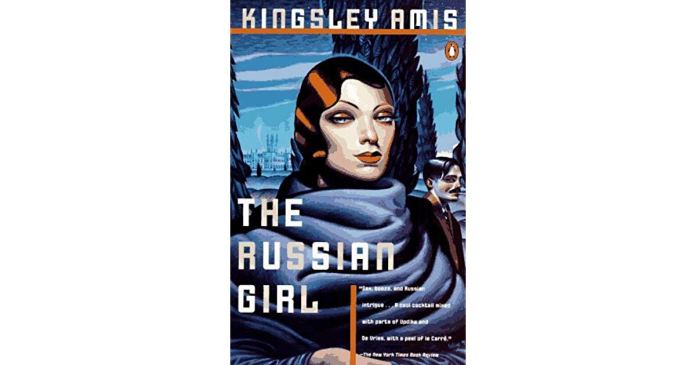
The Russian Girl, by Kingsley Amis, 1992

366437._UY630_SR1200,630_This is late Amis: The Russian Girl was published in 1992, just three years before his death. Amis is one of those novelists who essentially wrote the same novel over and over again, with slight changes of character and the setting thinly disguised. But this novel was an exception to that rule – instead of the older cast of characters bickering, having tired affairs and drinking themselves to death, The Russian Girl’s central character, Dr Richard Vaisey, is in his forties, and vaguely behaves like it. His inevitable love interest, Anna Danilova, the titular Russian girl, is in her twenties. An older academic having an affair with an exotic Russian girl (note girl, not woman; Amis was never going be that up to date) – what an original plot? But the scenario isn’t what redeems this novel.  Continue reading →
Standard
Book review

Put Out More Flags, by Evelyn Waugh, 1942

I re-read Scoop, Black Mischief, and Vile Bodies almost annually, yet somehow I had never got round to reading Waugh’s Put Out More Flags, which features many of the characters established in these earlier novels and could be seen as a sequel. Why that is I have no idea, but I have now rectified the omission.

Image result for Put Out More Flags, by Evelyn Waugh, 1942

Waugh’s sixth novel was written and published in 1942 and as we shall see that date is significant. The plot looks back at the first year of the war and contemplates the strange period in which at first little changed for many people followed quickly by the major upheavals thereafter.

Waugh’s characters are as usual wealthy and upper-class, and the war impacts them in (for them) unexpected ways. Country estates lose their servants. Billeting officers have to find accommodation for evacuees. Basil Seal, the louche ne-er do well of earlier novels struggles to find an army commission or any other constructive role in the war. Ambrose Silk, a gay Jewish intellectual looks elsewhere for a role, ideally in the Ministry of Information. Peter Pastmaster, about to go abroad into combat, decides to marry and father an heir in case he is killed in action.

In my eyes, the novel is less than the sum of its parts. There are admittedly some fascinating character portraits. Ambrose Silk for example is an openly gay character who Waugh treats surprisingly sympathetically. In previous novels he would have been an object of ridicule, but here he is treated as the unhappy victim of his sexual desires:

A pansy. An old queen. A habit of dress, a tone of voice, an elegant, humorous deportment that had been admired and imitated, a swift, epicene felicity of wit, the art of dazzling and confusing those he despised – these had been his; and now they were the current exchange of comedians; there were only a few restaurants, now, which he frequent without fear of ridicule, and there he was surrounded, as though by distorting mirrors, with gross reflections and caricatures of himself.

While Waugh may be tolerant of Silk’s sexuality, society is not. He writes a novel about a former lover, a Brownshirt who is now in a Nazi extermination camp. Basil spitefully engineers a situation where this work is interpreted as pro-German and Silk is forced to flee to Ireland, disguised as a priest. Waugh’s writing directly about a gay character without hiding behind euphemism or suggestion was quite transgressive for its time, showing a progression in his treatment of character.

Put Out More Flags captures a very precise moment in time, starting with the weeks before the war (“days of surmise and apprehension which cannot, without irony, be called the last days of “peace”) followed by the phoney war in which nothing seems to change very much, (“Well, we’re at war now. I expect there’ll be a lot to put up with”) and the final grim realisation that the war is starting in earnest, people are dying, and there’s no going back: “There’s only one serious occupation for a chap now, that’s killing Germans. I have an idea I shall rather enjoy it.”

Waugh’s commentary on these phases of the war is, as you would expect, scathing. His characters speculate that the decadence of the 20’s and 30’s, portrayed in his earlier novels and exemplified by his characters, are what lead Germany to believe we would not put up much resistance:

“You can’t blame Ribbentrop for thinking us decadent when he saw people like Basil about. I don’t suppose they’ll have much use for him in the Army.”

The comic elements of the novel are the outstanding chapters, for example when Basil abuses his sister’s position as local billeting officer, finding homes for evacuee children sent to the country to escape the air raids. He uses three horrible working class children to extort money from country folk who pay him to rehouse them. Incidentally there’s a disturbing hint of incest in these scenes. Doris, precocious oldest sister of the profitable evacuees, notices the incipient attraction between Basil and his sister Barbara:

“He’s your boy, isn’t he?” she said, turning to Barbara.

“He’s my brother, Doris”

“Ah” she said, her pig eyes dark with the wisdom of the slums, “but you fancy him don’t you? I saw”.

Waugh makes no attempt to disguise his class hatred – Doris has ‘pig’ eyes, not ‘pig-like’ eyes. He suggests that her ‘wisdom of the slums’ gives her an insight into the attraction between siblings that has previously always been hinted at but never openly acknowledged. Waugh never returns to this topic, but even to open this door the smallest of cracks must have been shocking to contemporary readers.

Put Out More Flags is in many ways just a series of sketches with the barest of plots. I think it is best seen as a portrait of the period, and as a transition novel between the lightly comic, absurbist novels of the pre-war period and the later, more serious Brideshead Revisited and the Sword of Honour trilogy.

Standard
Book review

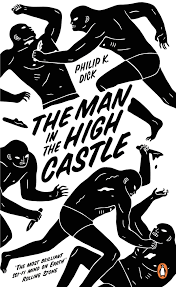
The Man in the High Castle, by Philip K Dick, 1962

The Man in the High Castle is an alternate history novel. Although the author Philip K. Dick is best known as a writer of science fiction, and despite the setting, the novel isDick 2 realistic in tone, and contains very few sci-fi elements. The scenario of the novel is chilling if not wholly original – the Nazis and their Japanese allies have won the Second World War. They rule over the former United States, where the novel is mostly set, as well as the rest of the world. In the novel’s alternate history, President Franklin D. Roosevelt was assassinated (as he very nearly was) leading to the continuation of the Great Depression and US isolationism during World War II. Without American involvement the Nazis conquer Europe and Africa, and then join with the Japanese to defeat America.

Life under the Nazis is as barbaric as one might expect, although by the time of the events of the novel America is slowly coming to terms with being a defeated and occupied country. Japan has occupied most the Western side of the US and Germany the east, with a buffer zone of the “Pacific States of America” between them and a small Nazi puppet regime to the south. 


While victory was shared by the Japanese and the Nazis, the peace is clearly being won by the technologically superior Germans, who are already (the novel is set in the 1960s) sending men to Mars. This disparity of technology is to prove dangerous. The narrative is told through the eyes of several citizens of occupied America. An antique shop owner sells romanticized and often fake American cultural artifacts to Japanese trade officials and tourists. A high-ranking official visits the shop looking for a gift to impress a visiting Swedish industrialist. Meanwhile Frank Frink (formerly Fink), a secretly Jewish-American veteran, has lost his job and sets up a handcrafted jewelry business with a former colleague. His ex-wife meanwhile now lives in the neutral buffer zone and begins a relationship with a truck driver. Slowly Dick draws these story lines together to reveal the Nazis’ sinister intentions towards their former allies. 

A popular novel, The Grasshopper Lies Heavy, depicting an alternative history in which the Allies won World War II. plays a key role in the narrative – a novel within a novel in which the central conceit is reversed. This inner novel haunts its readers with the suggestion that it in some strange way is actually a true representation of events, and the characters’s lives are themselves the fiction. In some ill-defined way the ‘truth’ is trying to impose itself on the fictional events portrayed. Dick leaves this idea unresolved at the end of the novel. 

It’s an intriguing if not particularly original central concept in the long tradition of invasion/alternate history novels. Not many works in this genre go so far as to imagining the US losing the war – even though Dick makes this plausible enough given the Nazis adapting nuclear technology before the Allies. Having set his scene, Dick seems a little lost where to go with it. This isn’t going to be a patriotic tale of valiant resistance fighters defeating the brutal invaders – in fact the Japanese seem perfectly civil, and there is no suggestion of their being an underground movement of any kind. The tensions between the remaining superpowers is well handled and convincing, and the descriptions of how Europe and Africa have suffered at the hands of the Nazis are chilling even if all-shown in passing references by the American characters. The eponymous Man in the High Castle is a bit of a disappointment – he is the author of the novel within the novel, but the High Castle ends up being just a suburban house, and the author only appears right at the end of the novel. He is not the omniscient, influential figure the title would suggest. 

I found the constant references to the prophetic powers of the I Ching quite irritating. Dick seems to take this nonsense seriously – certainly his characters do and there is nothing to suggest they are wrong to do so. The Japanese characters are all stereotypically inscrutable even when narrating the novel. All in all I couldn’t resist the feeling that there was a compelling story here trying but never quite succeeding to get out here, only appearing in flashes such as when the truck-driver is revealed as a German agent and is stopped by the plucky American judo-instructor. The television adaptation has wisely ignored almost all of the text, just using the central concept as a starting point, and as a result making a much richer, more interesting narrative.

Standard
Book review

The Five – the untold lives of Jack the Ripper’s victims, by Hallie Rubenhold, 2019

The FiveThe central concept of this popular history book (by popular in this context I mean some of the claims are not as strictly evidenced as I would normally expect) is to tell the stories of the five “canonical” victims of the Ripper, the women generally accepted to be the victims of a single murderer operating in Whitechapel in 1888.

Inevitably the author cannot avoid drifting into speculation on how they came to their deaths, and it is here where the book has caused some controversy. Rubenhold disputes the widely held view that all of the victims were prostitutes. Her case seems strong here, although I haven’t read the counter-evidence which I am sure exists. She also argues powerfully that several of the women were killed while rough-sleeping; again this seems to make a lot of sense – they certainly were living a lifestyle where rough-sleeping would have been a necessity on occasion, even if the precise locations of their murders suggest unlikely places in which to bed down. 

But these issues are not the focus of the book. What the author aims to do is to tell these women’s stories – from their births to how they came to be on the street on those nights in 1888. What decisions and events led them there. If you knew nothing about these women and were to guess you would expect drink to play a part, and of course it does. Abusive relationships and personal tragedy are also involved. More widely the author is extremely strong on the social, political and economic context of the mid nineteenth century, including of course the housing and public health crises that were at the heart of these women’s tragic stories. Things were not all consistently bleak for these women – for example some of them were reasonably well educated for their class and generation. All had been in stable relationships (so far as we can tell) and had families from whom they had slowly been alienated. They were given support from employers, charities and housing associations. There was nothing inevitable about their deaths. 

In books of this kind one is always left wondering how much of the author’s reconstruction is speculation or educated guessing. A good example is the claim that Catherine Eddowes, the fourth victim, whilst selling pamphlets and so-called ‘gallows ballads’ was present at the execution of her cousin, Christopher Robinson, at Strafford in January 1866. The evidence that Catherine was present at the execution is flimsy to say the least, but here it is presented as unquestionable fact. (This is one issue were I took a quick look at some alternative sources). The other thing that is is hard to be clear on is how much of the text is the result of independent research, and how much is simply a reheating of existing knowledge about the victims. Because despite the widespread claim that this book is the first attempt to tell these women’s stories, there have been several previous such narratives, and there is arguably not much more to be found out.

Was this a genuine attempt to give a voice to these women, or yet another cynical exploitation of the frisson of excitement caused by the monstrous nature of the murders? I am happy to give the author the benefit of the doubt here. The narratives are all well-constructed, and the decision to end them at the point of the murders removes any hint of titillation. It was nice to see photographs of the victims others than on the mortuary slab. These photographs are remarkable, and if Rubenhold is the first historian to track them down (and I have no way of knowing if that is the case or not) then this in itself was a remarkable piece of historical detective work.

I think there was another way to give some value to these women’s lives, and that would have been to show how – if at all – their murders changed society. Did the way police investigate murders change? Did the way they treated vagrants and prostitutes change? Were the Whitechapel slums cleared? What, in other words, were the political and social impacts of the Ripper murders? But that’s obviously another book entirely.

Standard
Book review

Feet of Clay (Discworld 19) by Terry Pratchett, 1996

This is Pratchett at the peak of his powers. Feet of Clay, often overlooked in any discussion of the best of Discworld, is sublime. it is a well constructed crime novel, but also a profound meditation on identity. It is also one of the City Watch series of the novels, and thus one of my favourites.

One of the less understood races of Ankh-Morpork are the golems. Usually treated as animate machines, they are awakened from their slumber and set off in search of the meaning of their existence. With the help of a priest and a baker they create a king golem, placing in his head instructions that go far beyond the simple mechanical phrases normally used. This experiment with creation goes badly wrong, which is how the Watch becomes involved. In a parallel plot sinister figures arrange for Lord Vetenari to be poisoned and replaced by a more malleable figure. Fortunately the Watch has a newly appointed forensics expert on the case, Constable Cheery Littlebottom.

Pratchett is often cited as a serious commentator on social issues (the Vimes Boots theory for instance) but in Feet of Clay he reaches Dickensian heights of commentary and analysis. On social housing for example he states:

“While it was regarded as pretty good evidence of criminality to be living in a slum, for some reason owning a whole street of them merely got you invited to the very best social occasions.”

Sam Vimes is usually the calm centre of common sense in Discworld. Here he articulates openly republican ideas, and I can’t help but believe that this reflects Pratchett’s thinking as well:

“Royalty was like dandelions. No matter how many heads you chopped off, the roots were still there underground, waiting to spring up again. It seemed to be a chronic disease. It was as if even the most intelligent person had this little blank spot in their heads where someone had written: “Kings. What a good idea”. Whoever had created humanity had left in a major design flaw. It was its tendency to bend at the knees.”

I also like the sound of Vimes’s ancestor, kingkiller Stoneface Vimes, who tells us through the pages of his journal:

“In the Fyres of Struggle let us bake New Men, who will Notte heed the Old Lies”. 

We could do now with some New Men who can see through the old lies.

You would not expect to read a thoughtful discussion of what makes us human in the pages of a comic fantasy novel almost 20 books into a series, but that’s precisely what Pratchett offers here. There are no easy or glib answers, but some serious questions. The golems do the heavy lifting both literally and metaphorically, bearing the weight of these questions. They are treated as machines, but they can think and reason, and when they start to take their own lives in response to the wave of murders across the city we gain an insight into their developing sense of self-awareness. They are unable to live with the guilt of their shared responsibility for the deaths.

Sexuality is another area where Pratchett bravely is unafraid to tread. The sexual relationship between a human and a werewolf has already been accepted by the Watch, but an openly female dwarf seems at first a step too far. Cheery Littlebottom ground-breakingly confronts the sexual mores of her race and her profession but embracing her sexuality. Wearing lipstick and a skirt is a revolutionary step in dwarven culture. Is Pratchett here signalling support for the LGBTQ+ community, or is he having just a bit of fun with bearded ladies? Discworld preaches acceptance of difference and diversity, nowhere more so than in the Watch. Vimes even accepts a golem onto the payroll in a final and bold statement of understanding.

It would be a mistake if I gave the impression that this novel takes itself in any way seriously. It doesn’t, even while discussing serious issues with the respect they deserve. Like all great works of literature Feet of Clay works on many different levels – the discussion about identity and sexuality is there if you look for it, but so are the dad jokes about Nobby and Colon, the well-constructed murder mystery, the police procedural, and the character study. I would never choose a favourite Pratchett, but if I did, this would undoubtedly be on the shortlist. I suspect I have said that about most of the other 18 or more Pratchett novels I have reviewed thus far, and will say again more than once before The Shepherd’s Crown comes round again.

Standard
Book review

One Hundred Years of Solitude, by Gabriel Garcia Marquez, 1967

“Many years later, as he faced the firing squad, Colonel Aureliano Buendía was to remember that distant afternoon when his father took him to discover ice.”

Great first line. Always going to be a tough act to follow.

There are good ways and bad ways of reading a novel. Carefully, taking one’s time, out loud, all fall in the former category. Ten minutes at a time here and there spread over a month or so is definitely the wrong way to read any book, especially one as dense and complex as Gabriel Garcia Marquez’s One Hundred Years of Solitude. This was more from force of circumstance than a conscious decision, but I wouldn’t recommend it. One practical consequence was a serious problem with following the narrative, even down to the simple task of understanding the differences between the characters. Marquez didn’t make this easy (I say this not by way of complaint – it is not the author’s job to make their novels easy to read!) by having only a handful of recurring names for the novel’s many different characters.

One Hundred Years of Solitude tells the story of seven generations of the Buendía Family in the town of Macondo in Columbia. The story opens with the family patriarch, Arcadio Buendía, facing the firing squad for crimes against the Government. The narrative then takes the reader back to the founding of Macondo by the Buendía family. Initially Macondo is isolated from the outside world, apart from an annual visit by a band of gypsies, who show the townspeople technology such as magnets, telescopes, and ice. Melquíades, the gypsy king, becomes a recurring figure in the novel and the key to its final resolution. When Macondo becomes involved in the affairs of the wider world its troubles begin. A rigged election inspires Aureliano Buendía to join the rebellion against the Conservative government. I know how he feels.

The Buendia family saga feels longer that it is. The large cast of characters grow up, fall in love, or not, then die, to be succeeded steadily by the next generation with their own challenges and successes. It could have been the disjointed way I read this novel, but I found the steady march of the years made it difficult to engage with the characters who never made it off the page and became real for me.

100 years made a huge impact when it was first published, and remains highly thought of. The magical realism motif (I think I did well to get this far without using that term) was almost revolutionary at the time – it would be wrong to say it has become passe, but it certainly doesn’t have the same impact more than fifty years on. I enjoyed the light-hearted aspects of this novel the most, the way science and magic are blended together to prove that Arthur C Clarke saying that “any sufficiently advanced technology is indistinguishable from magic”.  The people of Macondo react in alarm and wonder to things such as films where an actor who dies in one film “reappears alive” in another, but take magic carpets in their stride.

There’s lots to enjoy in this novel. Some characters will appeal, and if they don’t another (probably with the same name) will appear soon enough. The prose is poetic and usually stays the right side of over the top. Some scenes are comic, others more disturbing, but I don’t think it takes itself too seriously despite the serious themes.

Finally I leave you with this review from a reader who took the trouble to post a review online, but didn’t take a lot of trouble with the reading of the novel itself:

“(It) didn’t do much for me; just a load of people sitting on a mat, munching.”

Standard
Book review

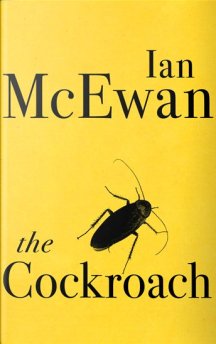
The Cockroach, by Ian McEwan, 2019

The Cockroach runs to less than 100 pages, and was obviously written quickly, in a state of intense anger. It takes as a starting point Franz Kafka’s Metamorphosis and cleverly turns it on its head – a cockroach is turned into a human being. At first he finds the cockroachclumsy nature of the body he has acquired, with its floppy limbs and internal skeleton hard to cope with. In his mouth “a slab of slippery meat lay squat and wet”. Because he no longer has compound eyes, everything appears “oppressively colourful”. His head is large, and his eyes can move. His skeleton is covered in flesh. Slowly it is revealed that this isn’t any random human that he has been turned into, but the Prime Minister, Jim Sams, who bears a profoundly close similarity to the man who is at the time of writing, but hopefully not much longer, the Prime Minister of the United Kingdom.

Kafka is fairly quickly left behind, as the new Prime Minister launches a plan to implement an economic policy so insane that only a thinly disguised President Trump can support it. The UK is driven through the looking glass into a world in which up is down, lies are truth, Parliament is the enemy of democracy, and the constitution is there to be ignored. McEwan’s solution to how Brexit could be forced through Parliament even though the Government doesn’t have a majority was inspired. For months we were told that Johnson and Cummings had a cunning plan which only four or five people had been told about, but that would see Brexit delivered on 31st October. That was all horseshit, but McEwan could have worked it for them it he had been so inclined. I bet they are kicking themselves! Job done, the cockroaches return to their previous form, but not before one is trodden on, thereby providing a tasty snack for his partners in crime.

Reviewers have consistently compared this novella to the work of Jonathan Swift, which is extraordinarily high praise indeed. Swift’s work often seems driven by anger, and here McEwan rages at the stupidity of Brexit (without mentioning it) as a massive act of national self harm which can only be rationally explained by metaphor. There are of course many economic and political explanations for the forces that led to the Brexit vote (and Trump’s election) but you won’t find any analysis of those forces here. Instead this is a cathartic rage against the forces of darkness threatening our country, forces that don’t read novels and don’t really care for reading anything else much either.

McEwan’s website helpfully summarises his motivations in The Cockroach, although we could probably have worked these out for ourselves – nevertheless the clarity is useful:

‘As the nation tears itself apart, constitutional norms are set aside, parliament is closed down so that the government cannot be challenged at a crucial time and ministers lie about it shamelessly in the old Soviet style, and when many Brexiters in high places seem to crave the economic catastrophe of a no deal, and English national extremists are attacking the police in Parliament Square, a writer is bound to ask what he or she can do. There’s only one answer: write. The Cockroach is a political satire in an old tradition. Mockery might be a therapeutic response, though it’s hardly a solution. But a reckless, self-harming, ugly and alien spirit has entered the minds of certain politicians and newspaper proprietors. They lie to their supporters. They express contempt for judges and the rule and norms of law. They seem to want to achieve their ends by means of chaos. What’s got into them? A cockroach or two, I suspect.’

Reviewers struggled to appreciate this novel, despite it being a very simple parable and despite McEwan’s even simpler translation above. The New Statesman’s judgment was that:

“If the book cannot be considered any kind of addition to the oeuvre, it is at the very least a coda to more substantive ventures, and another clue in the ongoing quest to understand what really matters to McEwan”

This misses the point spectacularly. Literature is not a guessing game where the novelist,  slowly reveals text by text clues to “what matters” to him or her. If you manage to read The Cockroach without working out within a few pages that McEwan is angry as hell with the state of the United Kingdom in 2019 then all the clues in the world aren’t going to help you divine what matters to him. 

The Guardian had reservations about McEwan’s use of cockroaches as an image for the Cabinet:

“Comparing one’s political opponents to cockroaches is a toxic metaphor with a nasty political history and it is hard to read McEwan’s novella without a degree of discomfort.”

The Spectator, formerly edited by the Cockroach in chief himself, had similar reservations:

“For many of us, it will never be at all OK to describe democratically elected politicians as ‘cockroaches’. It was the word by which the génocidaires in Rwanda called their adherents to action”

This is the same Spectator that ran an article in 2015 headed “She’s wrong but Katie Hopkins has a right to call migrants cockroaches”. Satire may be on the critical list, but irony is not dead!

Standard
Book review

Mostly Harmless, by Douglas Adams, 1992

There’s an obvious, I might even say lazy, reading of Mostly Harmless that goes something like this:

It is well known that Adams struggled with writing these novels. His lack of interest in the process is apparent in the steady decline in quality across the series, ending with this novel in which the plot is confused, the multiverse theory is wheeled out several times to explain away any inconvenient plot holes, and the ending is the author slamming the door on any further possible sequels. (In fact this novel was published posthumously, so that wasn’t really an issue as it turned out!) The dark and frankly depressing tone of the novel is largely a feature of Adams’s melancholy mood during the time he wrote it.

And of course much of that is true. The question is not whether this is a fair summary of the novel but whether there is something more interesting to be said about it?

Mostly Harmless, the fifth book in the “increasingly inaccurately named Hitchhikers’ Trilogy” derives its title from a joke earlier in the series, when Arthur Dent discovers that the entry for Earth in The Hitchhiker’s Guide to the Galaxy representing 15 years’ worth of research by Ford Prefect, consists of the word “Harmless”, which is later updated to“Mostly harmless”.

Arthur Dent, the one constant throughout the series, loses the love of his life, his girlfriend Fenchurch, when she disappears into an alternative time stream during a hyperspace jump. An understandably depressed Arthur wanders the galaxy, eventually ending up stranded in yet another lonely planet, where he decides to become a sandwich maker, as one does. In a parallel storyline, Ford steals a new and as yet-unpublished version of the Hitchhiker’s Guide as an act of rebellion against the guide’s new owners. In a third strand Tricia MacMillan is tortured by the thought of what her life might have turned out to be if she had left with the alien she once met at a party who invited her to travel the galaxy with him. Finally a Trillian from a separate timeline conceives a child, Random Dent, using donated sperm from Arthur.

Now if you step back a minute there’s no doubt that this as a plot outline shows some promise. Admittedly there is a considerable amount of repetition from previous novels – being stranded on a lonely planet is pretty much where we started after all (with Ford on earth). The satire is a bit heavy-handed, and the multiverse idea isn’t exactly original. But it’s a good start nonetheless. Tricia/Trillian finally gets some serious page time being more than just arm-candy for Zaphod, and the idea of the unintended consequences of over-enthusiastic sperm-donation coming back to haunt the donor is worth pursuing. So I think what I am trying to argue is that there is a good novel here struggling to get out, but not quite making it. The re-imagining of the guide as a sinister force that can navigate through time and space, inhabiting all possible universes at the same time, takes the quite benign original concept of the guide – not much more than a book after all – and turns it into a destroyer of worlds. The ending, with Ford laughing wildly at the absurdity of the universe, and Arthur finally experiencing a “tremendous feeling of peace”, feels like an entirely fitting way of Adams’s saying goodbye to his characters. 


Mostly harmless is undeniably bleak at times. Its plotlines are often left dangling – I would really like to know what happened to Fenchurch, Zaphod and Trillian for example. But (and I am very conscious I have written this many times before, of other writers and possibly of Adams as well) a badly constructed, bleak, and confused novel by Douglas Adams is still a thing of great joy. With more time this might have been a fitting finale to the series.


Standard