I think I am going to try and read, and review, more plays this year, even though I remain steadfast in my view that plays are for watching not reading. Sure you can read them, but in doing so you could easily miss much of the nuance and subtlety of a play that would be brought out in performance.
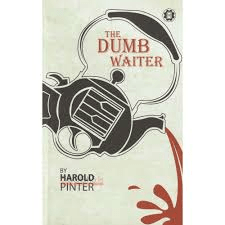
Just to explain the dates above, the internet tells me that The Dumb Waiter was written in 1957 but not performed until 1960. Either way that makes it one of Pinter’s earliest works. It is a short one-act play in which two men, Ben and Gus, wait in a basement. Ben, apparently the senior member of the two, reads a newspaper, while Gus fusses around nervously. Tea is mentioned but never quite made. As their conversation progresses it emerges that they are hit-men, waiting for an assignment and instructions on who to kill. Their conversation is dominated by mundane, everyday nonsense such as the difference between the phrase ‘light the kettle’ and ‘put on the kettle’. There is almost a vaudeville, back and forth element to their conversation, but at the same time there is a sinister undertone.
Pinter’s stage directions are very detailed and one of the reasons for this emerges when the men realise that at the back of the room is a dumbwaiter, a small lift for carrying food between floors. The waiter starts to deliver a series of food orders, as if to a restaurant kitchen – at first for plain café food – soup of the day, liver and onions, jam tart – and then for more complex orders – macaroni pastistsio, ormitha macaroundada, and scampi. Ben and Gus are dumbfounded by this turn of events, but are so used to doing what they are told that they send up what food they have – milk, biscuits, crisps and chocolate – in a pathetic attempt to comply. . In production I can imagine that this part of the play would be essentially comic, but on the page the tragic element also comes across – they are unable to understand what is happening to them, but still try to do their best. Next to the dumb waiter is a speaking tube which they try to use to communicate with whoever is sending down the orders, but to no avail.
In a break from the dumb waiter’s interruptions, the men start to rehearse the impending assassination, which complies with a strict sequences of events. In doing so they casually but shockingly reveal that their last ‘job’ was to kill a girl.
The impact of Beckett’s Waiting for Godot on this early work by Pinter is immediately obvious – two anonymous characters waiting in a remote location for something to happen, passing time with inane chat that reveals their concerns about their purpose in life. There is no conventional narrative or storyline (although in Pinter’s play there is a dramatic denouement) and absurd and unexplained events challenge the characters’ ideas. Long periods of silence allow space for the claustrophobic tension of the setting to develop. The Dumb Waiter is often produced alongside another of his one-act plays, but I can’t help wonder whether a contrasting text – something by Joe Orton for example – might work as effectively? If you want to read more British post-war plays then The Dumb Waiter is an excellent starting point. Pinter was a key figure in post-war British drama and went on to be awarded the Nobel Prize for literature in 2005, being cited for work that “”uncovers the precipice under everyday prattle and forces entry into oppression’s closed rooms”.
I have a theory: I suspect that early drafts of The Long Shoe were planned as a sequel to The Satsuma Complex (2022) and The Hotel Avocado (2024) – in all probability with a fruit-based title. But this plan had to be abandoned, because The Long Shoe‘s plot needed the central female character, Harriet (Emily in the first two novels) to have a job that runs the risk of her being kidnapped, and Mortimer just couldn’t make the plot work within the constraints of her ‘legacy’ occupation.
So a new context and setting was required. Apart from the change of occupation the novels are strikingly similar, with the protagonist Matt (Gary) a rather feckless character drifting through life (he is a recently unemployed bathroom salesman) living in a London suburb, taking walks in the park, drinking coffee, talking to his pet cat/pigeon/quirky animal of choice, and enjoying a casual relationship with his girlfriend while taking her commitment for granted. The novels’ themes are also similar – mysteries involving organised crime, a violent villain who is physically menacing and a bit disturbed, and a climax in which Gary confronts the bad guys in a clumsy, endearing manner.
This theory would also explain the irrelevance of the novel’s title. The long shoe referred to here is a comically long wooden model of a shoe, purchased from a market stall specialising in quirky conversation pieces. It could have easily been swapped into the novel on a find and replace basis for a whimsical fruit-based object of a similar scale.
Having said all that, it really doesn’t matter if this theory is right or not. The Long Shoe works well enough as a standalone novel, just one that will feel very familiar if you have read the author’s previous two. The premise is simple, if familiar: Matt’s relationship with Harriet is in trouble, as she questions whether they have a long-term future together. She leaves him for a short break to consider her feelings. While she is away Matt is offered out of the blue a caretaking job. which comes with the benefit of a heavily discounted flat in Satsuma Heights, (a little nod to novel one, of course). The new job and flat are all the more welcome as they were having to leave their existing flat in a few weeks. Harriet’s farewell note is ambiguous and Matt is not sure if she has left him for good, or is just taking some time out. Improbably she has also neglected to tell her employer, the Crown Prosecution Service, that she is taking leave, and she stops answering her phone. Instead of reporting her absence to the police, Matt tries to track her down.
The novel’s minor characters include Carol, a deeply unpleasant neighbour who has designs on Matt, Hot Dog, one of Matt’s new neighbours in Satsuma Heights, and a very underwritten waitress who never really emerges as a distinctive character at all (in my alternative version of this novel this character has a more fleshed out role but with all the old plot elements stripped from her she is left hollowed out(.
Around halfway through the novel we discover that Harriet has been kidnapped and over the course of the rest of the novel her predicament is revealed and her rescue effected. The mystery – who has kidnapped her, and why – is well-managed, and the novel’s rather violent climax is genuinely exciting. The novel’s humour is more whimsical than laugh out loud – with Bob I think much of the charm of his humour is in the performance, so on the page the jokes are wryly amusing rather than belly laughs. So overall this novel is amusing and a pleasant enough read, but will not linger long in the mind.
Love in the Time of Cholera by Gabriel Garcia Marquez, 1985
Love in the Time of Cholera is a dense and complex meditation on love and the process of aging. It also contains some very troubling content, of which more later. It is not an easy read and I am still unsure whether it merits the adulation it receives in many quarters.
Set at the end of the nineteenth century in an unnamed but volatile country in the Caribbean, the novel tells the decades long love story of Fermina Daza and Florentino Ariza. As a young man Florentino falls in love with a young woman who lives with her possessive and suspicious father. So far so Romeo and Juliet. After secretly wooing Fermina for months Florentino finally secures her promise to marry him.
But the ‘affair’ is discovered. Fermina’s father refuses to consider the marriage, considering Florentino unsuitable for his daughter and takes her on a years’ long trip through the country’s interior, hoping that this will make her forget him. During the journey scenes of the long-running civil war and the ravages of cholera simply form a background to everyday life and are considered normal. When they finally returns to the city, Florentino attempts to resume the relationship, having continued to write to her using his contacts in the telegraph service. But Fermina suddenly realises that their relationship was just a childish infatuation. Shortly afterwards she marries a local doctor, Juvenal Urbino, and lives a long and moderately happy life with him, raising a family and surviving the normal traumas of married life, until his tragically comic death in old age, a death with which the novel opens.
At the funeral, Florentino, now in his seventies, renews his affection claiming he has never stopped loving her. At first she is not interested – more than fifty years has passed – but gradually he wears her down. Much of the body of the novel consists of the story of how Florentino has spent his time while waiting for Fermina to be free. His career with a riverboat company is the background to his all-consuming passion, seduction. Florentino is a prodigious and undiscriminating lover of women of all backgrounds, ages and class. He has no problem in squaring this lifestyle with waiting for his true love.
Although Florentino is the novel’s central character and sees himself as man of principles, a tragic lover waiting all his life for his one true love, in reality he is simply depraved. He sleeps with over 600 women, many of them vulnerable. One is killed by her husband after he discovers her affair. Later, he conducts an abusive relationship with a 14-year-old girl who is his ward. The author’s portrait of this abuse is as disturbing as anything written by Nabokov:
“She was still a child in every sense of the word, with braces on her teeth and the scrapes of elementary school on her knees, but he saw right away the kind of woman she was soon going to be, and he cultivated her during a slow year of Saturdays at the circus, Sundays in the park with ice cream, childish late afternoons, and he won her confidence, he won her affection, he led her by the hand, with the gentle astuteness of a kind grandfather, toward his secret slaughterhouse.”
He has no insight into how wrong this relationship is – she is a child, he is more than fifty years older than her and in a position of parental responsibility – and when he ends the abusive relationship she commits suicide. In short, he is a scumbag. The novel ends with a reconciliation between the two ‘lovers’. A boat trip into the interior of the country, ravaged by industrialisation, war and disease, provides the novel’s ending and a metaphor for aging and loss.
The novel’s title suggests this is a book about love, but it is not (any more than Lolitais a love story). Two people spend their lives apart and eventually come together in a facsimile of elderly, incontinent married love. Florentino thinks of himself as one of the courtly knights of old who would love his lady from afar, sacrificing all for just one smile. In reality he is a disturbingly lascivious paedophile, a dirty old man whose idea of love is distorted in the extreme. I finished Love in the Time of Cholera with a sense of disquiet that has only worsened the more I think about what actually happens in the book. I accept I am probably missing something, but I am keen to move on as quickly as possible to something that isn’t full of bodily functions slowly breaking down, of sexual abuse, and death.
The Impossible Fortune – The Thursday Murder Club 5, by Richard Osman, 2025
The Impossible Fortune was the best selling novel in the UK in 2025. It is therefore proof from any criticism I can level at it. More to the point if you have read the previous four novels in the series you will have long ago decided if this is your cup of tea – if it is then again any criticism will be moot and if it isn’t then you will almost certainly be skipping this review. Nonetheless, I shall press on, because surely the novel deserves more than the unthinking adulation it seems to have received thus far? Equally the ‘read it, review it’ rule will continue to apply in 2026!
Osman has reached the point in the series where recaps of the cast and setting are not required – it is assumed that the reader will be familiar with the context. Also, very few readers will start the series on book 5 and were they to do so (it could happen – I started the Harry Potter series on book 4, Goblet of Fire) there are enough summaries available elsewhere to help them find their feet. We are back at Coopers Chase, the retirement home for active and prosperous pensioners, with Joyce, Elizabeth, Ibrahim and Ron, the founder members of the Thursday Murder Club, and a large and growing cast of secondary characters. A new investigation presents itself on cue, although it is not clear whether it actually is a case of murder or not. The gang don’t worry about this of course – the mystery is what matters. Some valuable crypto-currency is missing – or rather the codes to access it are – and the challenge is to find them before some of the other potential claimants do so.
Still grieving former spy Elizabeth is not at the top of her game and doesn’t provide the insights that usually comes to her so easily. Former trade unionist Ron is worried about his family but finds a way of combining his role in the investigation into the missing crypto with a means of protecting them all, including his precocious grandson, Kendrick. Joyce is a continuing delight and the main source of humour in the novel, especially her relationship with her daughter Joanna, who as the novel opens has just married new character lecturer Paul. Paul has two friends Holly Lewis and Nick Silver (Osman not over-exerting his name giving skills here) who together run a high security ‘cold storage’ business. This is presented as something innovative and shadowy, slightly mysterious, but to me it seemed remarkably similar to the safe deposit box services offered by many banks. Several years ago Holly and Nick were paid for their services in Bitcoin; this has increased in value exponentially over the years and they have now decided to cash it out. But as soon as they have decided to do this Nick finds a bomb attached to his car and very shortly thereafter Holly’s car is blown up, with her in it. Nick cannot be traced and mysterious text messages exchanges with Paul suggest he might have been killed.
This is a problem because to access the crypto-currency a 12 character code is required, half of which is held by Holly and half by Nick. So multiple puzzles present themselves – who tried to kill Nick, who actually killed Holly, where is Nick and how can the crypto-currency be saved?
In the event either of them dies, Holly and Nick have left their access codes with a solicitor, so the final problem in this list is fairly straightforward. Nevertheless the murder club devote most of their efforts to finding the codes which Holly and Nick have also hidden in plain sight. This is where the mystery element of the novel begins to break down somewhat – it is not clear why they have done this. Please note spoilers follow at this point. Just before she is killed by the car bomb, Holly dials a phone number, which eventually turns out to be a disguised form of her code. (Hiding personal number codes, PIN’s etc, in a fake phone number is quite common – so if I wanted to write down my PIN number 1234 in case I forgot it I would create a fake contact Bill’s Pizza and write it down as 07770 001234.) But there is no plausible reason why Holly would dial this number just before she dies; worse still there’s no reason why she would write it down at all as she has memorised it for so long, and no reason why she would dial the number rather than save it as a contact. In other words this is a very poorly constructed attempt to mislead the reader looking to ‘solve’ the mystery. Nick’s code is disclosed in an even clumsier manner, hiding it in text messages to Paul (so for example “I have written a hidden number in this sentences” disguises the number ten) that depend entirely on Paul sending the right replies in the thread. It also depends on Paul showing the messages to Elizabeth and her being able to decipher the code. Again it is totally unclear why he does this, other of course than to provide a simple puzzle for the reader looking to ‘solve’ the novel.
All of which it to miss the point – the mystery element of this series has always been secondary to Osman’s celebration of the liberation of old age. Unencumbered by jobs or responsibility, the Thursday Murder Club members are able to enjoy the later stages of their life by doing pretty much whatever they want. Rules are for other people. Osman also recognises they are so much more than just old people – they all have a lifetime of skills and experience to draw upon. This is a combination that is highly effective when deployed in the solving of murder. Recognising the value and worth of older people rather than seeing them as in god’s waiting room, decrepit or infirm (there’s even a reference to Coopers Chase residents getting frisky in the community hot tub) is at the heart of this series, and it is to be celebrated for that fact.
The Impossible Fortune has a number of sub-plots that are arguably more interesting than the central mystery. Ron’s daughter finally escapes an abusive relationship and in doing so exposes her whole family to a dangerous revenge plot. Connie, the drug dealer imprisoned earlier in the series has been released from prison but continues her unlikely relationship with former therapist Ibrahim, which in this novel finally solidifies into a friendship and even, potentially, a partnership. Joyce enjoys finally being a mother-in-law and her relationship with her daughter is drawn with skill and sensitivity. The novel has lots of good jokes – Joyce coming to terms with technology is a sub-section in its own right:
Joanna has recently introduced Joyce to Rightmove. It’s a website where you can see houses for sale. You click on them and they let you look inside! Thousands of strangers’ houses! Twenty, thirty, sometimes forty pictures. You can see their sofas, their kitchen cabinets, where they’ve put their wooden LIVE, LAUGH, LOVE signs, what they’ve done with their gardens and so on. And this site is free! Joyce doesn’t believe in all progress, self-service checkouts, for example, but she is certainly happy that somebody invented Rightmove.”
A visit from Prince Edward is mined for all it is worth; references to David Tennant and Pierce Brosnan jokingly call back to the 2025 film adaptation of The Thursday Murder Club (and its controversial casting decisions).
Osman knows his audience. The Impossible Fortune is printed double spaced with very large font – the largest I can ever recall seeing. Chapters are a few pages long at most. Nothing is too demanding or difficult. At times it seems he is falling into the trap the books warn against – under-estimating the old. The cosiness factor is kept in check, and the moments of genuine peril, particularly when Jason (Ron’s son) and Kendrick are being shot at are uncomfortably worrying. But we are quickly back to jigsaw puzzles, bourbons and sherry before you know it. The author continues to stubbornly refuse to kill off any of his main characters in defiance of my prediction that he would do so in book 2, but I refuse to back down and have faith that one day this prediction will come true. Osman is the king of cosy crime and you can’t help but feel happy for him. Let’s just hope that if they film the later books that they get the casting right this time round!
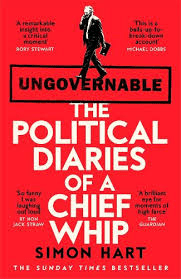
Ungovernable: The Political Diaries of a Chief Whip by Simon Hart, 2025
Simon Hart was a relatively minor figure in the appalling melodrama that was the 2019-2024 Conservative Government – he was Secretary of State for Wales for a couple of years, a post of minimal significance since devolution, but came with a place at the Cabinet table, and then Chief Whip for the duration of the Sunak Government (2022-24). He now sits in the House of Lords, despite having consistently poured scorn on the aspirations of his fellow MPs for the same privilege. Nevertheless, he undoubtedly had an insider’s perspective (the proverbial ‘front row seat’) on the chaos that engulfed the Tories during the 2019-24 Parliament and his heavily redacted diaries of that period give enough juicy details to keep the pages turning, even if the ‘real’ story remains elusive.
A feature of most political diaries is the temptation to remove references that make the author look like he or she had no idea what was going on, but at the same time to also leave sufficient minor ‘gaffes’ to make the account convincing. What do I mean by that? Well, if these diaries were to include glowing predictions of how wonderful Liz Truss’s premiership was going to be, Hart would lose any credibility as an observer of the political scene. On the other hand if every prediction proves unerringly accurate then the reader would be sceptical as to their authenticity. So when Hart says of Rishi Sunak in June 2022, “He is compelling and will be a contender for PM one day“, his editor would have been keen to keep this prediction in the final edit despite the fact that Sunak was to become Prime Minister only four months later – ‘one day’ being a stark understatement. In other words Hart was wrong, but in a mildly entertaining way rather than totally misjudging the situation. It was for the purposes of this category of memoir the ‘right’ kind of mistake. Most of his political predictions that survive the edit are reasonably accurate – for example as the process to replace Johnson as Prime Minister gets underway Hart pondered “I dread to think what a Truss Government would look like, or if it will even last”.
Looking back now over the 2019-2024 Government it really is quite breath-taking how bad it was. The rot started at the top of course and Hart is a frank observer of Johnson’s flaws as well as his abilities. Knowing how things ended we can see how entirely unsuited he was to senior office, even if that wasn’t glaringly obvious much earlier, but Hart, like the rest of the Conservative Party, was swept away by his Etonian bluster. He finds his performances in Parliament ‘brilliant’ and is charmed by his Woosterish schtick. Hart’s decision to join the eventual flood of Ministerial resignations which swept Johnson from office comes late and is done with much regret rather than in recognition of the Prime Minister’s arrogance and incompetence. His subsequent appointment as Sunak’s Chief Whip was intended to introduce some stability to the political process, but on every other page there is scandal, from the infamous ‘tractor porn‘ incident to a succession of entries about serious sex offences (allegedly and in some cases actually) committed by MPs, special advisors (SpAds) and others.
Hart himself emerges as an affable, hard-drinking One Nation Tory, a remainer who was often out of his depth, like so many of his colleagues. If you want to know why the Tories went from a comfortable 80+ majority in the December 2019 General Election to an ignominious wipe-out five years later, there is plenty here both between the lines and directly from Hart himself. A good example of his lack of understanding as to just how existentially serious the crisis the party was facing comes in his entry for Friday 17 December 2021
“The North Shropshire by election goes against us and in favour of the Lib Dems with a 5000 majority. It’s the first time this seat has ever been held by a non-Conservative. This is manageable but serious and should probably be reversed at a General Election, but it has opened up the whole question of whether the BoJo electoral ‘magic’ has lost some of its potency.”
Is some ways it this is the most egregious of all Hart’s political miscalculations. In the 2019 General Election Owen Paterson won this seat for the Conservatives with a majority of over 20,000 (the chaos over Paterson’s breach of Parliamentary standards and the Government’s blatant attempt to subvert Parliamentary processes to avoid him having to face the consequences of his actions is a whole other story – readers of Hart’s account will need to turn to Wikipedia for the detail). The Lib Dems had come third in this seat in 2019 with fewer than half the votes of the Labour candidate, then leapfrogging Labour to beat the Tories comfortably at the by-election. At the 2024 General Election the Lib Dem incumbent increased her majority to over 15,0000, making North Shropshire a relatively safe LD seat. The arrogant assumption that the by-election result was simply a protest vote rather than part of a generational movement away from life-long Conservative hegemony reveals how little Hart understood what was really going on as the Johnson administration slowly but inevitably imploded.
Although the 2019-24 government was obviously deeply flawed and chaotic, it would be wrong to overlook the two significant external events that would have been challenging for the most competent of administrations – the Covid pandemic and the war in Ukraine. Both had dramatic impacts on the economy which we will be paying for for years to come. Boris Johnson was totally unsuited to running the serious type of Government required to manage the UK’s response to the pandemic (for example his early demonstration of his incompetence and bravado by ignoring medical advice and continuing to shake people’s hands) but it would have been difficult for any government. None of which justifies the casual indifference to economic stability demonstrated by Liz Truss and Kwasi Kwarteng of course.
Does Ungovernable tell us anything we didn’t already know? The detail of the collapse of the various administrations is already in the public domain. Central characters including Johnson have already published their memoirs and accounts of the period. Frustratingly, the really juicy gossip that Hart was privy to – the drunken calls from MPs in the middle of the night, one claiming to be stuck in a Bayswater brothel with a woman he thought was a KGB agent, or the reports of orgies and someone going to a party in a Jimmy Savile costume and having sex with a blow-up doll – is all sadly but inevitably anonymised. Anyone who starts this book with a positive opinion of politicians, as hard working and basically decent, will find themselves closing the pages at the end wondering just how wrong one can be!
I have read approximately 30 books this year. That’s poor by most definitions, although par for me in recent years (I read a post recently from someone saying they ‘had only’ read 250 books this year, having chosen to prioritise quality over quantity!) My most popular post of those published this year was The Last Devil to Die, the 4th in Richard Osman’s cosy crime series, The ThursdayMurder Club. Puzzlingly the short supplementary post I wrote on Clothing in Jane Eyre remains my most popular post of all time.
2026
I still enjoy writing about books and find the discipline of ordering my thoughts about what I have read a useful one, so for now I plan to continue this blog, going into what I think will be year 14. One of my annual traditions at this time is the choice of Dickens novel for the coming year. I have only five left to read: Barnaby Rudge, Pickwick Papers, Martin Chuzzlewit, Little Dorrit and Our Mutual Friend (or six if you include the incomplete Mystery of Edwin Drood). This year the choice is an easy one, as I recently read Peter Ackroyd’s The Great Fire Of London which is based on, or inspired by, Little Dorrit. Other than this year’s Dickens and working my way through the extensive pile of Christmas and birthday presents, both of which I look forward to very much, my reading plans for 2026 are vague. I have shelved, for now, my attempt to read all the Booker Prize winners, despite there being only seven novels, including this year’s winner, Flesh, to go. I say every year I might go back to that challenge but realistically I am not sure I have the appetite for The Bone People or Sacred Hunger. To read more, to read more systematically and to include more women and international authors in my selections are all resolutions I could have made any of the last fourteen years but will continue to be aspirations. If you have read any of my posts, thank you. Comments are always welcome and an important part of the whole process. Guest posts are also very welcome – if you have read something interesting and would like somewhere to publish your thoughts on it let me know.
While doing some background reading for my review of Graham Swift’s short story collection, Learning to Swim, it occurred to me (and I accept this might be a banal statement of the obvious) that the short story form of writing is by far the most neglected when compared to others such as the novel, poetry, and drama.
It will come as no surprise that the Wikipedia entry for ‘short story’ defines the form primarily by its length, saying that it “can typically be read in a single sitting”. Can you imagine defining any other form of writing in this way? (of course I know sonnets have 14 lines and haiku have 17 syllables, but these are very specific forms within the much wider genre of ‘poetry’.) In terms of content, the entry goes on to say that a short story usually “focuses on a self-contained incident or series of linked incidents, with the intent of evoking a single effect or mood. The short story is one of the oldest types of literature and has existed in the form of legends, mythic tales, folk tales, fairy tales, tall tales, fables, and anecdotes in various ancient communities around the world.” This definition is flawed in several respects – Norse sagas were very long compared to other forms of prose, for example – but is probably as good a definition as we are going to get.
Are short stories neglected? Staying with statements of the obvious, the form doesn’t have a special word or term to describe it. Novels, poetry and plays are not ‘long stories’, ‘short stories that often rhyme’, and ‘stories told on stage by actors’. Well, they are, but the point is we have special words for them, whereas with short stories, that’s it. With the possible exception of Katherine Mansfield and Alice Munro there are very few writers who are best known for their short stories. By comparison I guess most people could name half a dozen novelists, poets and playwrights. Few writers specialise in the short story format. Many will have at one point or another written a short story, but there are few for whom it is their preferred format. And yet perversely the short story is probably the most common form of creative writing. The cliché that we all have a novel in us may or may not be true, but if creative writing groups are anything to go by we all have a couple of dozen short stories in us as well!
So why is this? When short stories are the form we are most familiar with from childhood, when many of the greatest stories ever told are short, why is this form of writing considered ‘less’ in so many ways? Is the issue one of length, that longer is better? Certainly with plays and poems that is not the case – Ode to a Nightingale is a better poem that Endymion (a 4000 line epic poem also by Keats and if you have not heard of it that makes my point); Daffodils is better than The Prelude. While plays have a ‘Cinderella’ length – too short and the audience can feel cheated, too long and we get bored and restless, novels can be too long – I would certainly put the nine volumes of Samuel Richardson’s Clarissa into that category. So no, longer is not better, and we therefore need to look elsewhere for an explanation for the neglect of this form of story-telling.
It’s possible that short stories are read more often than we think, simply that they are not read in book or collected form. Many short stories are published in magazines and will not feature in any charts or tables of book sales. The role of agents, editors and critics in pressuring writers to move away from the short story format and into novels may play a part in the marginalisation of this format. Lots of authors start out with short stories, finding it easier to have them published in magazines than getting a novel published, subsequently moving on to writing novels and abandoning the short story format.
All literary forms have periods of supremacy. In Shakespeare’s day poetry was consumed by the upper classes and plays were watched by the unwashed. The novel started its long march to ascendancy in the Eighteenth century, and became dominant when Dickens was publishing his works a chapter at a time (there might be a case for arguing that these were all short stories linked by a common set of characters and themes, and certainly the Pickwick Papers would fit that characterisation, but that can’t really be sustained as Dickens’s preferred form of publication was the exception rather than the rule). There was some speculation that the decreasing attention span brought about by social media and the advent of doom-scrolling might see a revival in popularity (and status) of the short story, but this hasn’t materialised. Perhaps short stories of a few thousand words are just too long for the tik-tok generation?
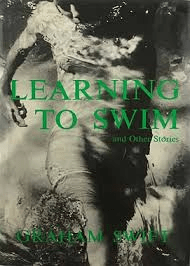
Learning to Swim and other stories by Graham Swift, 1982
I think it is more common than not for a modern short story to conclude without a formal ending. The reader is not told what ‘happens’ to the characters nor how any issues identified have been resolved. When did that start to be the case? Don’t Victorian short stories almost always have a formal ending in which murders are solved, mysteries unravelled and the problems or issues explored in the course of the story resolved? In the early decades of the twentieth century Modernist novelists rejected the idea that novels were just stories, but nonetheless formal endings remained the norm. There are of course always going to be exceptions to generalisations of this kind (there are a few modern novels that simply end, leaving everyone frozen in time and with their story lines unresolved, such as Penelope Fitzgerald’s Offshore or The Gate of Angels) but these are very much the exception), Look at it this way: would Ulysses have been the same novel if Leopold Bloom’s day ended before he returned home and without Molly’s dreams? The ending of Heart of Darkness may be ambiguous, but there’s no doubting that it is an ending rather than just an end. Nick Carraway leaves West Egg not really understanding the experience he has been through, but Gatsby’s story has ended. And so on.
Whereas with many modern short stories, the opposite is the case. The stories are sketches of a time and place, portraits of characters and situations, but there is no instinct for completion, no need to tell the reader what happens to the people who have been introduced. In many cases the stories simply stop. This is more challenging for the reader more familiar with novels that have formal endings. They may be left with a sense of frustration, wanting to know what happens next.
Which brings me to Graham Swift’s short story collection, Learning to Swim and other stories. These stories were published in various magazines from 1977 to the early 1980’s and predate Swift’s primary career as a novelist. His first novel The Sweet Shop Owner was published in 1980, and while today he is best known as a novelist, not least because his Last Orders won the Booker prize in 1996, he still writes short stories, and had the collection Twelve Post-War Tales published as recently as 2025.
Learning to Swim, named after the final story in the collection, is made up of eleven very varied tales. Some of the stand out stories include:
Seraglio is a portrait of an unhappy, childless marriage. A husband and wife are on holiday in Istanbul. Childless, they have frequent and expensive holidays as some form of compensation. The husband who narrates the story cannot understand his wife’s behaviour and when she tells him she has been assaulted by a hotel employee and wants to go home, he shows a lack of empathy in response. Swift almost taunts the reader wanting to know whether the couple remain together, or to know more about the assault in the hotel, saying “All stories are told, like this one, looking back at painful places which have become silhouettes, or looking forward, before you arrive, at scintillating facades which have yet to reveal their dagger thrusts, their hands in hotel bedrooms… One wants the moment of the story to go on for ever, the poise of parting or arriving to be everlasting. So one doesn’t have to cross to the other continent, doesn’t have to know what really happened, doesn’t have to meet the waiting blade.” The absence of a resolution in other words is the point of the story, rather than an omission.
In The Tunnel a narrator watches some youths digging a tunnel from the playground of a closed school out to wasteland. The tunnel acts a metaphor for pointless employment, the progress of children from school to the wider world, as well as invoking scenes from the first and second World Wars. This is a closely observed story in which every word counts. I wanted to know more about what happened to the narrator, his relationship with his runaway girlfriend, her mysterious uncle who may or may not be leaving her some money, and many other unresolved plot lines.
Hotel is a strange tale. A man recovers from a stay in a psychiatric hospital following his mother’s death. He then decides to run a hotel, which he eventually achieves. But when two guests who may be father and daughter, but the precise nature of their relationship is unclear, arrive, the foundation of his business begins to crumble. The narrator hints at the possibility of abuse or incest, but the story ends without an explanation of the couple’s situation.
The Watch is not really a science fiction story, but it does rest upon an element of the fantastic. A Polish watchmaker creates a pocket-watch which never needs winding and appears to grant eternal life to the owner. As it is passed down the generations to the current owner, the story’s narrator, it appears more of a curse than anything, as its owners all meet grisly fates. This is an almost Victorian horror story reminiscent of something by Edgar Allen Poe. It sits uncomfortably among the other modern sketches in the collection. Chemistry is a very similar, old-fashioned horror story in which the narrator accidentally causes the death of his grandfather. The story also features the ghost of the narrator’s father with other strong echoes of Hamlet (shipwreck, accidental poisoning, resentment of a step-father) thrown in for good measure.
The collection’s title story, Learning to Swim features another unhappy couple on holiday, thereby forming an effective bookend with the opening story, Holiday. While on vacation in Cornwall Mr Singleton is trying to teach his son Paul to swim, watched as he does so with judgment and contempt by his sunbathing wife. This felt as if it may have been an autobiographical story in which learning to swim becomes as symbol of a difficult childhood, in which the narrator finally decides to strike out on his own. The collection therefore ends on a positive note despite all the gloom and darkness that has come before.
Is it possible, just about, to make some generalisations about this collection and identify some overall themes. They all, to a greater or lesser extent, leave the reader with questions. Most of the stories are dark, featuring unhappy people. Infidelity and sexual trauma is hinted at in several of them and while never directly confronted, other stories feature the possibility of incest, bestiality and murder. Despite these topics this is not in any way a lurid collection – this is a sideways, oblique look at these issues.
Learning to Swim is still in print, more I suspect as an early work by someone who went on to write better things rather than in its own right. The 24 reviews of the collection on Goodreads, a tiny number by any measure, barely do it justice. I am not sure whether I am ever going to completely escape the need for a resolution and ending in the stories I read, and until I do I am always going to work hard to find positive things to say about this form. I appreciate that is my problem, not the authors, but I don’t think I am alone in that regard. The weaknesses of the short story format is something I will look at more closely on another day. For now I think I am going to return to the novel for my next read, albeit with a slight sense of guilt.
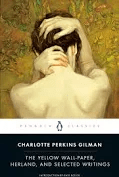
The Yellow Wallpaper and other selected writings by Charlotte Perkins Gilman
Even though you could read The Yellow Wallpaper in not much more time than it takes to drink a cup of coffee, it is widely perceived as both the author’s most significant work and a classic of its genre. The Penguin Classics edition of this story, published with Herland and other selected writings, has The Yellow Wallpaper as the lead text in its title.
The story is written as a collection of journal entries narrated by an unnamed woman whose physician husband has rented a mansion for the summer, to provide her with somewhere to recuperate. He forbids the narrator from working or writing and encourages her to rest. She is suffering from what he calls a “temporary nervous depression – a slight hysterical tendency”, a vague but common diagnosis in women at the time. As the journal entries continue the narrator slowly becomes obsessed with the yellow wallpaper in her room, convinced that it moves and that something is hiding behind it.
An important part of the context of the women’s physical and mental decline is that she has just given birth. We know little about her pregnancy other than it appears to have been the cause of her decline. Although she believes she is treated with care and consideration, the reader can infer that there is more to her confinement. She describes her room with its torn wallpaper, barred windows, metal rings in the walls, a floor “scratched and gouged and splintered”, a bed bolted to the floor – this is a cell in all but name. It will occur to most readers to wonder whether her husband has used his status and authority as a doctor to have her legally sectioned? I haven’t researched this issue thoroughly but it does appear as if women could be declared mentally ill and a danger to themselves and others simply on the word of their husband. If he happened to be a doctor as well then the chances of anyone questioning his decision were slim to non-existent. This is an interesting article on this topic from Time magazine https://time.com/6074783/psychiatry-history-women-mental-health/
The narrator’s morbid obsession with the wallpaper in the room comes to dominate the text and her thoughts. The wallpaper has a “sickly” color, a “yellow” smell, and a pattern like “an interminable string of toadstools, budding and sprouting in endless convolutions”. It leaves yellow smears on the skin and clothing of anyone who touches it. Her mental health rapidly declining, the narrator comes to believe that a woman is trapped behind the pattern in the wallpaper. To free the trapped woman she begins to strip the remaining paper off the wall. When her husband comes home, he finds the narrator rubbing herself against the wallpaper, saying “I’ve got out at last… in spite of you.”
The story is undoubtedly inspired in part by Gilman’s personal experience. When her daughter was born she suffered from postnatal depression. A doctor, considered the leading expert on women’s mental health, prescribed bed rest and forbade her from any form of work including reading, writing, or painting. She found this treatment made her condition worsen. The Yellow Wallpaper is a straightforward autobiographical account of this treatment with the addition of a supernatural component to the story, to provide a dramatic critique of these methods of male control of women’s bodies and lives.
TheYellow Wallpaper has become an important feminist text. The narrator’s attempts to control her environment, her health, and eventually her life by her interpretation of the wallpaper that surrounds her, act as a metaphor for the domestic environment, her body, her mind, and the many other lenses through which the story can be read. At the same time a simple interpretation of the text is elusive – the author scatters hints through the text, but a straightforward key – X = Y – is never provided.
Because of the significance of The Yellow Wallpaper in the canon of feminist literature, the rest of Gilman’s writing is often overlooked, or simply seen as ‘things that might be like, or provide additional information about,’ the primary text. Which is if course both wrong and a pity. Many of the short stories published in the Penguin Classics edition, together with a number available online, are intelligent thought-provoking pieces written from a progressive, feminist perspective. When I was a Witch is a fascinating account of someone being given the power to make wishes that come true, but being unable to use this power for the general improvement of the lives of women. If I were a Man must be the earliest ‘body swap’ story, in which a young woman wishes she were a man and finds herself in her husband’s body. She is fascinated by the different physical experience, and the different, secret attitudes men have towards women – some protective and loving, others base and sexual:
“In the minds of each (man) and all there seemed to be a two-story department, quite apart from the rest of their ideas, a separate place where they kept their thoughts and feelings about women. In the upper half were the tenderest emotions, the most exquisite ideals, the sweetest memories, all lovely sentiments as to ‘home’ and ‘mother,’ all delicate admiring adjectives, a sort of sanctuary, where a veiled statue, blindly adored, shared place with beloved yet commonplace experiences. In the lower half–here that buried consciousness woke to keen distress–they kept quite another assortment of ideas. Here, even in this clean-minded husband of hers, was the memory of stories told at men’s dinners, of worse ones overheard in street or car, of base traditions, coarse epithets, gross experiences–known, though not shared.”
The Giant Wistaria and The Rocking Chair are both conventional, sub-Jamesian ghost stories. While containing traditional gothic elements they are fairly predictable, although The Giant Wistaria still manages to include a feminist portrait of an early American settler woman choosing to commit suicide instead of submitting to an enforced marriage with a cousin. Bee Wise is an early working out of some of the ideas to find expression in Herland, describing a utopian and largely female community established on strongly egalitarian grounds. His Mother and The Vintage are fascinating treatments of social evils affecting the lives of women – the white slave trade and syphilis respectively. His Mother tells the story of a woman tracking down and handing over to the police her son, who has been a key figure in a gang procuring vulnerable young women for prostitution. The Vintage describes in distressing terms the impact untreated syphilis can have down the generations. These were topics that were not widely discussed in ‘polite society’ nor written about outside the pages of medical journals. I find it hard to imagine how brave it would have been for Gilman to have published these stories with their clear and unambiguous treatment of these issues.
Gilman’s personal story is in many ways as fascinating as her writings, and this https://www.neh.gov/article/charlotte-perkins-gilman-did-more-write-one-classic-short-story is a good starting point if you are interested. I agree with the article’s conclusion – Gilman is definitely worth reading beyond The Yellow Wallpaper, although that in itself is a great starting point.
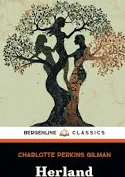
Herland is one of those novels that has been on the edges of my consciousness for a long time. I’ve known about it, known broadly what is is about, and always intended at some point to get round to it. Unlike a lot of people who take reading seriously I don’t have a literal ‘to be read’ list, but I do have a vague collection of tests that one day I intend to get round to. And for as long as I have been aware of it, Herland has been on that list. Published in 1915, when the Great War was well underway but America had yet to get involved, Herland begins as a traditional exploration/lost world novel: while on a journey of exploration in an unnamed continent, three American adventurers – Vandyck “Van” Jennings, Terry Nicholson and Jeff Margrave – hear of an isolated community that is peopled by women only, Eventually Van gets round to naming this community the rather reductive name of ‘Herland’ (we later hear that this community has been completely isolated for two thousand years, so how the tribes in the area would have heard of it is left unexplained). The explorers’ curiosity is piqued and they eventually return on a subsequent trip determined to track down this lost world. Authors such as Ryder Haggard or Conan Doyle would have lingered over the details of the
preparation for the trip, the extensive list of equipment needed, the hiring of guides, the journey inland and so on. Perkins Gilman has no interest in this element of the story, and within a few short paragraphs they are approaching Herland. Using a plane (that they have someone managed to bring with them), they surmount the impenetrable mountainous barriers around the country. We are not told where Herland is – the implication is that it is somewhere largely unexplored, and the surrounding countryside is populated by ‘savages’ but the ambiguity as to the country’s location is obviously intended to emphasise its universality. In any event, Van’s narration makes it clear that he has subsequently left Herland and returned to America, having committed to not reveal the location of the lost world.
Of course the arrival of a plane in a society isolated from the rest of the world for centuries is hardly likely to be unnoticed, and the explorers are quickly found by, initially by three young women who watch them from the treetops. Treating the women almost as prey, the men try to catch them, but they are easily outrun and then captured by a large group of women. They try to escape but are overpowered, drugged to stop them struggling, and taken to a nearby community.
From this point the body of the novel is comprised of the men’s captivity and education in the ways of Herland, which the author uses to outline the detail of the all-women society. Each man is assigned a tutor who teaches them their language while at the same time learning English. Van is a careful observer of all aspects of this new society, from the well-designed clothing they use to their agriculture and technology. But his real interest (and clearly, the main interest of the author) is in understanding how a women-only society has evolved and in what ways it is different from his own. In short, Herland is a feminist utopia. Everything is better. Conflict, inequality and criminality are things of the past, to the extent that the very concepts are no longer understood. Society has been finely tuned to allow all women to study and be creative. There are no masters and servants, bosses or slaves. No-one is overburdened with childcare or work. The traditional subservient roles of women in modern society have been forgotten – there is no-one to be subservient to. All of society’s practical problems have been mastered. By contrast the men’s accounts of their own world makes many of the practices of the outside world seem barbaric. Particular horror is shown at the very idea of abortion – a view which some modern critics have used to undermine Herland’s claim to be a feminist text, although surely the point is here about women’s loss of control of their fertility?
What is it about a women-only society that makes it so perfect? Or to put it another way, what is it about men that makes the outside world so damaged? The author suggests some answers to these questions but is surprisingly undidactic – the reader is left to join the dots themselves, even if the exercise isn’t that challenging. Free from the oppression of men and traditional female roles, women have evolved a near-perfect society. Women are respected and valued in this society, free from domestic servitude and male oppression. A key factor is their control over their fertility – the women can reproduce by parthenogenesis but choose to control their community’s population by having only one child each. Motherhood is a form of religion in this society, and children are cared for communally. No-one is worn out by having too many children or burdened by the cost of providing for large families. (This is surprisingly accurate – once women have control of their fertility, combined with lower infant mortality rates, birth rates drop dramatically.) But can this utopia survive the reintroduction of men? The author implies that this might be possible and that only some rather than all men are the problem. Of the three explorers, only one, Terry, finds the changes he faces in this society unbearable.
Over the course of the novel Van gradually finds out more information about the women’s society. He is told that a volcanic eruption 2000 years ago sealed off the only pass out of Herland, the only way of travelling to the outside world. The remaining men, mostly slaves, tried to take over but were killed by the women. Facing the end of their race a miracle occurs – one woman became pregnant without the intervention of a male partner, and went on to have five daughters, who in turn grew up to bear five daughters each. This women only society rapidly evolved strategies to survive their isolation and grew to prosper and flourish. Freed from the myriad the problems of society caused by women’s oppression the society find that many of the most deep-rooted problems such as criminality simply wither away and are forgotten.
Having had no contact with men for 2,000 years, the women have no experience or cultural memory of romantic love or sexual intercourse other than for the purposes of animal reproduction. They understand the mechanical process of mating, but the idea of sex for pleasure is unknown to them. This does not appear to be a society in which lesbian couples have formed – there is no mention or suggestion of this – and while it is never said so explicitly is is strongly suggested that all sexual urges have withered away. Therefore the men’s enthusiasm for marriage and sex (the author is not radical enough to suggest that one could happen without the other) is baffling to them. Although the men eventually form affectionate partnerships with three of the Herland ‘girls’, society appears to see this as an experiment in identifying any benefits from fatherhood rather than romances or expressions of love.
To be fair to the author, she doesn’t turn away from the question of sex, even though her freedom for discussing them directly was obviously limited. It would have been tempting I am sure to just have ignored the whole issue. She uses a wide range of creative euphemisms to discuss sex. Marriage is described by the women as “permanent mated love“. In an attempt to persuade the women to have sex with them, the men describe marital sex thus: “Why, to touch you, to be near you, to come closer and closer, to lose myself in you” and talk about “the sweet intense joy of married lovers“.
The women are puzzled by the concept of sex for pleasure rather than for procreation:
“Do you mean, she asked quite calmly, as if I was not holding her cool form hands in my hot and rather quivering ones “that with you, when people marry, they go on doing this in season and out of season, with no thought of children at all?”
Married love as an experiment in Herland is unsuccessful. After a short honeymoon period, Van’s wife Ellador withdraws from ‘married life’ and declines to have sex with him, explaining “If I thought it was really right and necessary I could perhaps bring myself to it, for your sake dear, but I do not want to, not at all. You would not have a mere submission, would you?”
Van and Jeff try to work these issues out with their wives, with Jeff seemingly accepting long-term celibacy as an option, but the more aggressive, impatient of the three, Terry, is uncompromising in his view of the submissive role of women in the bedroom and the rest of the relationship. When his partner Alima rejects his ‘advances’ he hides in her bedroom and “put into practice his pet conviction that a women loves to be mastered, and by sheer brute force, in all the pride and passion of is intense masculinity, he tried to master this woman“. In other words he tries to rape her. Van’s reaction is chilling: “In our country he would have been with quite within his rights of course….”[Crime]’s a pretty hard word for it. After all, Alima was his wife, you know.” Terry stands trial for his crime and is ordered to leave Herland. Van decides to accompany Terry but they are only allowed to leave Herland once they promise not to reveal its location. The novel ends abruptly at that point, with the subsequent adventures of Van, Terry and Ellador in the outside world told in the novel’s sequel With Her in Outland.
Following its publication Herland was almost completely forgotten and it was not until the re-printing of the author’s short-story, The Yellow Wallpaper in 1973, that readers began to rediscover Herland. For its time, Herland was extremely radical, daring to suggest that many of society’s problems originate with the subjugation of women, and even possibly that the problems originate with men alone. That may have been a step too far in a time when women still did not have the vote in the USA or the UK, but these were to happen very soon and formed part of significant changes to the role of women in society. There’s no reason to believe Herland contributed to these changes, but it is nonetheless one of the clearest descriptions of what a society without men might look like (even if it is told from the perspective of a male narrator rather than one of the society’s citizens). It is a treatise dressed up in novel form, where the story element of the text is minimal – very little happens once the men are captured, apart from a desultory escape attempt. But it has important things to say about the role of women in society and many of these messages remain starkly relevant today.