Book review

The Harpole Report, by J L Carr, 1972

I am a great admirer of J L Carr, particularly his 1980 novella A Month in the Country, and therefore my expectations for The Harpole Report were high. While it doesn’t reach the heights of A Month, on its own terms this was an enjoyable little novel. It is told in the form of report by an unknown author, commissioned by Harpole himself into his last term as a teacher. This ends up being simply a framing device rather than the more ominous introduction to a report into a serious incident – it never really becomes clear why the report is required, but by the time that becomes apparent the reader cares little for that minor anachronism. The report’s author uses and quotes from a wide variety of sources, including the school logbook – a kind of official record or diary – as well as correspondence, diaries, and other official and less than official sources.
Stories set in schools are usually written for children, be it the slapstick comedy of St Trinian’s and St Custards, or adventures in the manner of Enid Blyton and her successors. I can’t recall reading another novel told from the perspective of the long-suffering teaching staff. This novel is grounded in personal experience – Carr was a primary school teacher for almost 40 years, including 15 years as a Head. It opens with his avatar, Harpole, being temporarily given the headship of the Church of England primary school of Tampling St. Nicholas. The setting is the early 1970’s, at a point where much of education was still dominated by attitudes from the pre-war era (Tampling is described as being “run along the lines which were the height of fashion when Chadband (the former head) was trained in the 1920s by men who learnt their educational practices in the early years of the century”) and progressive attitudes towards education were hard to find. Corporal punishment, even for younger children, was commonplace, the curriculum unchanged for decades, and schools still maintained a ‘backward class’ taught by an untrained teaching assistant.

Harpole makes some tentative attempts to modernise the school, moves that are fiercely resisted by the Education board, his teaching staff, his recalcitrant janitor, and the parents. Some of the minor battles, such as whether to fly a flag at the start of each school day, are lost, but slowly through stubbornness and dedication Harpole begins to get his way. The ferocity with which Harpole’s attempts to drag the school into the modern era are resisted prove the source for much of the novel’s comedy.

In addition to completing the school log, Harpole keeps a personal journal revealing more detailed information which he often wants to keep out of the official record. Although many of his innovations are modest at times he shows signs of what could almost be described as radicalism. He proposes that caning be abolished – which provokes a response accusing him of encouraging “acts of the utmost depravity” – and that students stop referring to teachers as ‘Sir’ and ‘Miss’. Each proposed step forward is met with fierce resistance, not least from the education authorities that see him as a trouble-maker. Even a simple request for a new blackboard is met with astonishment at his effrontery. Despite this resistance he slowly begins to reform his school, encouraging outside visits for each class, (which inevitably go disastrously), securing support for some of his children who are being mistreated at home, and winning the confidence of his staff.

Two sets of correspondence are threaded through the narrative. Harpole’s letters to his fiancé, Edith Wardle, unanswered apart from her ‘Dear John’ telling him she has found love elsewhere, are dominated by details of his missing spanner – it’s not hard to see why she moved on. His place as teacher of the Scholarship class, a group of students identified as having the potential to pass the 11+ and go on to grammar school, has been taken by a supply teacher and recent Cambridge graduate, Miss Foxberrow. her letters to her sister are full of her lively independence of thought. References to Harpole are initially mocking, but her admiration for him slowly grows, particularly when he confronts a parental bully, Mr Bullitt. beating him with a cricket bat. Immediately after the fight she describes her reaction:

“a great hush had descended on the building and it was evident that all lessons had ceased and everyone was listening in petrified rapture. GH then turns towards me his eyes positively glittering, and hackles rampant (with me quite limp with adoration and the joyous expectation of being dragged off to his cave and debauched).”

There is a hint of the origins of A Month in the Country in the scene when Harpole and Miss Foxberrow are out in the country on a date of sorts, visiting a remote church in Ferry Farthingale in the sea-marshes.

“She then pointed out an area of decomposed painting above the nave arcade. This showed three ancient lords in fine raiment parading in a field of lilies and the three same, naked (with even the hair around their parts scorched off) in a fiery furnace.”

This medieval wall painting is precisely the type of relic that Birkin is employed to restore. The fruition of George and Emma’s relationship in such unlikely circumstances is one of the many delights of the book. If you haven’t discovered J L Carr yet, this might not be my recommended starting point, but on its own terms it is a witty and enjoyable novella.
The Harpole Report, by J L Carr, 1972

Aside
Book review

Heatwave, by Penelope Lively, 2009

Penelope Lively’s Heatwave is set during the course of a long hot summer in rural Oxfordshire. The narrator, Pauline rents one of a pair of cottages; the other is the home of her daughter Teresa, Teresa’s husband Maurice and their young son Luke. The pair of cottages are somewhat ominously called World’s End, not a reference to the Edgar Wright film but portentous nonetheless. Pauline is a proof-reader; Maurice an author, while Teresa cares for Luke. Maurice is writing what sounds like a very pretentious history of English tourism and as part of his working routine he regularly goes back to London for meetings. He is also visited from time to time by his publisher, James and James’s girlfriend, Carol. The other inhabitants of World’s End also travel up to London from time to time – while secluded it is obviously not that remote, and these are urban, middle class people comfortable with popping off to Paris for the weekend or Venice for a month.

It is obvious from early on that Maurice is a ‘bad un’. Think Martin, the sleazy brother-in-law from Fleabag. He (44) is quite a bit older than Teresa (29) who hero-worships him. Teresa’s archetype, the long suffering wife who accepts her lot without protest, is established early – on the very first page Pauline compares her to a Hardy heroine “betrayed no doubt”. Pauline, long divorced from her philandering husband Harry, recognises the signs of Maurice’s likely adultery well before Teresa does, although the reader is given even earlier clues of his wandering. Pauline is reluctant to tell her daughter of her suspicions, waiting for some concrete evidence. She recalls the details of her own marriage to a serially unfaithful husband, who now writes to her occasionally from America where he is a college professor. Other than the slow passage of the summer and occasional trips out to cheesy tourist attractions as ‘research’ for Maurice’s awful book, the action is slow. Pauline remains watchful towards Maurice but never confronts him, and time is marked by the changing agricultural landscape and the steadily warming weather. Slowly Teresa begins to develop her own suspicions, but is also reluctant to face the issue or even discuss it with her mother. We are offered other relationships for comparison – Pauline’s bookseller friend and his agoraphobic wife, and the author of the book Pauline is proof-reading, stranded in remote Wales. Happy relationships in Heatwave are rare.

The novel opens on a warm May day, with everyone apparently “poised for this agreeable summer of industry and companionship“. Or so they believed, the narrator silently suggests. As summer passes the stresses within Maurice and Teresa’s relationship are exposed and his infidelity becomes all the more obvious. Pauline spends much of her time reminiscing. Some reviewers – in fact most, I think – claim that the damage caused by Harry’s infidelity is inter-generational and is in some obscure way the cause of Maurice’s unfaithfulness, as if Teresa has sought out a father figure for a husband who will repeat his behaviour. I am not convinced we are fated to repeat our parents’ mistakes, but Heatwave certainly seems to suggest it is unavoidable unless a dramatic break with the past is made.

Heatwave reminded me of Howards End in its portrait of a rural idyll threatened by modernisation, the way the characters live halfway between town and country and the novels’ sudden melodramatic ending in which a brutal and arbitrary form of justice is meted out. Another novel I was reminded of was J L Carr’s A Month in the Country which follows a similar structure, but is much more gentle and perhaps even kind in its treatment of its equally flawed characters.

Often, finding a way to end these reviews can be the hardest part of writing them. You can’t just stop (as some novelists do, irritatingly) – you are always on the lookout for a way of summing things up neatly with an appropriate sign-off. Many bloggers end with an invitation to readers to comment and provide their own thoughts. But one option that is not open to us it the deus ex machina out of the blue approach to ending that Lively uses in Heatwave. It was such an abrupt conclusion that it left me feeling a little cheated if I am honest.

Heatwave, by Penelope Lively, 2009

Aside
Book review

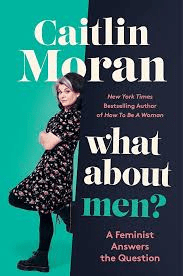
What about Men? Caitlin Moran, 2023

What indeed? Caitlin Moran is an excellent columnist. I enjoy her writing; it is usually insightful and broadly progressive. But does her style of writing – pithy, with a punchline every few hundred words – convert well into a book that grapples with the serious question of the crisis of modern masculinity?

There are multiple issues with this book that undermine its overall impact and effectiveness. Stuart Jefferies, reviewing the book in the Guardian, does an extremely good job of identifying these issues and I am not going to try and duplicate his points, almost all of which I support (although re-reading the review at a later date he does give Moran both barrels and doesn’t take much time looking for any redeeming features). While reading the text I constantly found myself disputing Moran’s observations and not in a good way. They were not thought-provoking so much as smugly wrong. To offer one example, when the author uses the term ‘men’ she appears to refer to a very specific sub-set of men, largely defined as ‘blokes I know’. They are almost all in her age group, heterosexual, and British. A chapter about porn-addiction, based on an interview with a twenty-something young man, stands out because it gives a voice to a different group. Claims such as “your T-shirt collection is, to you, as your wife’s lovingly collated wardrobe of second-hand Chanel, designer jeans and Zara brogues is to her” just aren’t funny because they don’t derive from any observable reality. Isn’t that observation only true of Moran’s husband and their mates? Not many women I know have a collection of second-hand Chanel designer jeans and I am reasonably close to Moran’s demographic. I appreciate this is intended as tongue in cheek humour, but it falls at the first hurdle because it is neither funny nor relatable.

Which is a huge pity, because the subjects Moran writes about – the crisis of toxic masculinity in this country – is profoundly serious. It is literally killing men, through suicide, differential life expectancy, and poor health care. Moran addresses all these subjects, but rarely gets to grips with them before a punchline is required.

Perhaps the fault is mine, in reading this book as a text rather than a series of chapters grouped around the same topic. A fine distinction perhaps but what I mean is What About Men might work better if read one chapter a week rather than straight through like a novel. Some of the more

There is, unquestionably, a dialling it in aspect to this book. Her habit of twitter-sourcing content doesn’t inspire confidence that the book has been carefully researched for example. Most of the conclusions she draws about men are simply stating the obvious – the amount of original insight is minuscule. As a quick gallop through the main issues of modern masculinity, a starter text if you like, this would be fine for someone who hadn’t read a newspaper or spoken to a man in the last few years. Perhaps that’s the real audience – teenagers? But the problem with that idea is that in my experience teenagers are profoundly better informed on issues of sexuality and gender that 99.9% of people of Moran’s generation. I think, in fact I am pretty sure, that most teenagers would be appalled if they read her generalisations on sex, gender and masculinity. Her real audience is obviously the people who buy books and give them to one another for birthdays and Christmas without really expecting them to be read. Why would you bother properly researching a book if you know most people are going to skip to the chapters about sex?

What about Men? Caitlin Moran, 2023

Aside
Book review

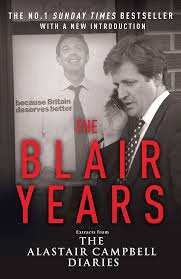
The Blair Years, by Alastair Campbell, 2007

I don’t think there is any question that Alastair Campbell’s obituary when it comes to be written will focus on the events of the last few weeks of this diary. For any readers for whom this is history rather than current affairs, a short summary: Alastair Campbell was Tony Blair’s press spokesman from shortly after Blair became leader of the Labour Party through the first two New Labour governments. He developed a fearsome reputation as a defender of the Government. The verb ‘to spin’ might have existed before Campbell and New Labour, but it came into common currency during those years. To give you some idea of Campbell’s reputation, all you need to know is that the character Malcolm Tucker from The Thick of It was based upon him.

After 9/11 America, led by George W Bush, was determined to depose Saddam Hussein. The premise for this attack was that Iraq possessed weapons of mass destruction (WMDs), or the capability to develop such weapons. Tony Blair was unshakeable in his support for Bush and the issue became a deep dividing line within British politics. To support the case for war a file of intelligence briefings (a dossier) was produced, purporting to demonstrate that Hussein had WMDs. A BBC report claimed that Campbell had interfered with the drafting of the report and ‘sexed’ it up, over-stating the strength of the evidence. Dr David Kelly, a government scientist who had allegedly leaked information on the dossier to the BBC ended up taking his own life. A judicial inquiry into these events, the Hutton inquiry exonerated Campbell but the accusation has stuck, primarily because it seems the sort of thing that Campbell would have done.

Campbell has spent more than twenty years trying to rebuild his reputation, but I suspect he will always be haunted by this accusation. The Blair Years is the first of what is by now a series of eight volumes of his extremely detailed diaries – over 750 pages covering 1994-2003, around a sixth of the total words written contemporaneously. The obvious question is to what extent these diaries have been edited or selected to present a positive view of Campbell and his role in New Labour, and specifically to exonerate him from the WMD accusations? It would be astonishing if not almost impossible to edit down that volume of writing without any element of spin. Choices must have been made, inevitably with the intention of presenting Campbell and Blair in the most positive light. Even if Campbell wasn’t such a notorious exponent of the art of spin, some recasting of events must have happened. I am possibly being naïve but I choose to think that this is a reasonably honest version of events. Campbell saw himself as a leading figure in the Blair administrations, more a chief of staff than a press officer. He was at the heart of the New Labour project, even if on some issues he found his personal views to the left of Blair. An early instance of this is when he tries and fails to persuade Blair not to send his children to a grant-maintained school, which went on to be a bit of a PR disaster for him.

Most of the time there is little effort made to provide context to the events being described – footnotes are few and far between – so the reader either needs to be familiar with the events or spend a fair amount of time flicking back and forth to Wikipedia. The overall effect is of a real-time account of several significant moments in recent British history, such as the death of Princess Diana, the foot and mouth crisis, and the British reaction to 9/11 leading through to the Gulf War. Throughout, Campbell’s portrait of Blair is consistent: he was a reforming Prime Minister often out of step with his party but driven by faith in the rightness of his own views, determined to reform institutions (such as the House of Lords) and with a broad interest in social justice. Campbell himself is by contrast more a traditional party man. The cast of supporting characters is large. John Prescott comes across as a surprisingly likeable ally, while Campbell makes little attempt to disguise his contempt for others such as Clare Short. The effect of some parts of the diaries is to confirm public perception of Labour figures – Peter Mandelson is undoubtedly Machiavellian, Gordon Brown is prone to outbursts of anger, and so on – there aren’t many revelations about politicians secret lives. Perhaps this is because so many other memoirs have been published. What was at the time an insight into what really happened – such as the story of Robin Cook breaking up with his wife on the way to the airport because a tabloid was about to expose his affair (a story sometimes presented as Campbell instructing Cook to divorce his wife) are now well known and all these diaries do is confirm them.

Campbell isn’t over-burdened by humility. Early on he becomes excruciatingly convinced Princess Diana is attracted to him. The Secretary General of NATO is quoted as saying in the context of the conflict in Kosovo “If you can, send me your man Campbell, that would be best“. He becomes good friends with Bill Clinton and George W Bush. I suppose everyone is the hero of their own stories.

While some of the narrative feels like ancient history, other sections bear strikingly similarities to the political situation today – a reforming Labour Government with a large majority after a long period of Conservative rule; a hostile media; cynical anti-politics agenda being pursued by the right-wing; Europe as always a divisive issue. Even electoral reform and changes to the House of Lords are back on the agenda. So these diaries should probably be studied by the new Labour Government. If they were to do so what lessons would they derive?

First, the Conservatives must not be under-estimated. They will be back, and the time to cement Labour’s position as the party of Government is now, not in five years time. The next Conservative Prime Minister may not yet be an MP (Cameron was not an MP when Blair was elected; Starmer was not an MP when Cameron was elected) but they aren’t one of Europe’s oldest political parties for nothing.

Second the media will be unrelentingly hostile and the Government needs to decide what it is going to do about that. What we mean by the media has obviously changed since 1997 with the advent of Facebook etc, but the right-wing tabloids are still stubbornly there and will not miss a chance to undermine the Government.

Thirdly major crises seem almost unavoidable. Whether it is the death of Princess Di, foot and mouth disease, the oil delivery drivers strike (first term) or 9/11 and the Gulf War (second term) and the global economic crisis (third term) there are going to be testing times ahead.

Is the portrait of Campbell that emerges from these diaries accurate? For example is his reputation for quite aggressive ferocity justified? I wanted to quote at length a description Campbell gives of a shouting match between himself and Gordon Brown, Chancellor of the Exchequer (page 528) during the 2001 general election campaign. Brown had long been concerned about the negative impact of briefings by Peter Mandelson, who had been sacked twice from Cabinet positions:

“I went over to see GB in his office….and he was banging away at his computer. He had a pile of papers to the right and on the top had written 75 pence and below it, in large black letters, ‘who will silence Mandelson?’ ….

I tried to make a joke of it, but he was having none of it, went on a great tirade, said we were letting him destroy the campaign, undermine him, be ill-disciplined, on and on he went and eventually I lost it, said PM was nothing to do with me and I did not like the implications that I could be held responsible one way or the other for what he was or was not up to. “Well it has to stop” he said. “Telling me it has to stop suggests that in some way I might be responsible, and I fucking resent that….(continues at some length) I was suddenly conscious that I was jabbing my finger at him, and thought it better to leave.”

This is extraordinarily unprofessional conduct, but it seems there were no consequences for Campbell for swearing and shouting at the second most senior member of the Government. The word suddenly is revealing here – if the description can be taken at face value, he seems genuinely not to have realised he was shouting and being aggressive towards Brown for most of the exchange. If he treated the Chancellor of the Exchequer like this, what was he like with junior members of staff and journalists? Of course we don’t need to ask because there are multiple accounts of his behaviour. So yes, he was aggressive and either didn’t know or care that people were often genuinely scared of him.

Just one other thing I noticed: the back cover of the paperback edition includes the following quote from Matthew Parris, the Times columnist and former Conservative MP

“A brilliant, absorbing account….These diaries….will be gasped at, and relied upon, for decades to come. Buy them; they will suck you in”.

I was surprised to read this endorsement when Mr Parris himself appears only once in these diaries (page 308) as “The little shit Parris“.

One wonders what qualifications were hidden by the ellipses?

The Blair Years, by Alastair Campbell, 2007

Aside
Book review

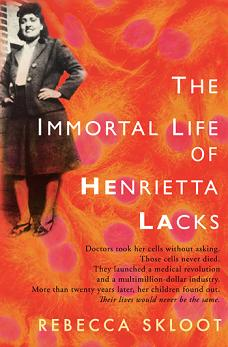
The Immortal Life of Henrietta Lacks by Rebecca Skloot, 2010

The premise of this book is that the extraordinary story of Henrietta Lacks – and more specifically, her cells which (for reasons I am still not clear about) continued to multiply after they were removed from her body, shortly before her death from cancer in 1951 – needs to be told. In other words, that this is the most

comprehensive account of Henrietta’s life, death, and subsequent ‘life’. But you don’t have to read very far into “The Immortal Life” to establish clearly that is an overstatement – in fact one of the complaints of Henrietta’s surviving family is that they are constantly being badgered for interviews by journalists and scientists. Skloot’s account may well be the most comprehensive but it is not a revelation of a lost story. Since 1996 the main School of Medicine in Atlanta has held an annual Women’s Health Conference in recognition of Henrietta and “the valuable contribution made by African Americans to medical research and clinical practice”. In 1996 the mayor of Atlanta declared a ‘Henrietta Lacks Day’. In 1997 U.S. Congressman Robert Ehrlich presented a congressional resolution recognizing Lacks and her contributions to medical science and research. Also in 1996 the BBC made a documentary about Henrietta’s story, ‘The Way of all Flesh’. Skloot writes that the documentary team “covered the Lacks family story in more detail than anyone ever had, filling dozens of hours of interviews”. In other words, hers is a very well known and comprehensively researched story and the suggestion that this account is anything other than a detailed retelling – albeit with some new elements relating to Henrietta’s family – is misleading. Which is a pity because this is a perfectly worthwhile retelling, as far as it goes, just not anything revolutionarily new. To be fair I have to accept that I can’t pin down a quote where this claim is made explicitly, but it is strongly implied throughout the text, as well as the presentation and marketing of the book.

Henrietta’s story is definitely worth retelling. She came from a literally dirt-poor African American family only two generations away from slavery. Brought up by her grandmother and married at 14 to a cousin, she grew up in an America where African Americans had few civil rights. She was only 31 years when she died in 1951 in a “coloured ward” in hospital in Baltimore. She left behind a husband and five children – and a slice of her tissue, cut from the cancer that went on to kill her. These cells duplicated and kept on duplicating despite being outside a host living organism. Scientists had known this was technically possible, and I am not sure if Henrietta’s cells were the first ever kept alive in this way, but they were undoubtedly the most prolific. The cells went on to be used across the world in numerous different laboratories and environments, including being sent into space. Their origins were largely forgotten. An industry developed around the production of these cells and it seems as if the question of compensating Henrietta’s family and heirs for her extraordinary, if entirely accidental contribution to medical research simply didn’t occur to anyone.

Henrietta’s family are as much a part of this story as her own short life. Her deaf daughter, Elsie, was committed to an institution despite there being any evidence of mental illness. The hospital she was committed to sounds an incredibly grim place. Henrietta’s other children grew up without much in the way of parenting and suffered horrible abuse from family members. Skloot invites us to pity this resilient family, suggesting that they struggled to understand the difference between their mother’s death and the survival of her cells – “Nobody round here ever understood how she dead and that thing still living. That’s where the mystery’s at” – which feels… improbable. Henrietta’s youngest son Joe served time for homicide and remains a menacing presence in this narrative, but the central role is taken by Deborah, Henrietta’s daughter, whose obsession with her mother’s legacy comes to dominate the final chapters of the book. Whether that would have been the case without Skloot’s intervention is unclear, but it’s no surprise that in the television film adaptation of this book it was this role that was taken by Oprah Winfrey rather than Henrietta herself. Skloot even goes so far as to suggest that Deborah believed her mother had been cloned and that she was suffering the pains of all the diseases that her cells had helped to cure, and links these delusions to the more understandable suspicions of African Americans of the medical establishment. Central to this belief was growing awareness of the brutal Tuskegee project in which black men were allowed to die from syphilis so that the progress of the disease could be studied. While the extent to which the medical establishment could abuse African American people is hard to over-state, the idea that Henrietta’s family thought she might still be suffering through her surviving cells feels far-fetched.

There are three main components to this book – Henrietta’s story, the discussion of the various medical ethics issues suggested by what was done to her, and the account of the writing of the book itself. The ethical issues chapters are some of the weaker elements of the book. At points Skloot conflates serious ethical scandals (such as the Tuskagee experiments mentioned earlier) with the taking of tissue samples without informed consent. It is hardly surprising that the paper trail for Henrietta’s consent (if any) to the procedures she underwent is impossible to trace and I struggle the idea that it is a scandal that someone didn’t obtain her informed consent to the tests that were done on her tissue samples and their eventual commercial exploration. She was in intense pain and dying of cancer – the last thing she would have needed is someone trying to explain what they were planning to do with her tissue after its removal. Such consent is not required even to this day, and the case for it being so is very weak.

It is the third element of the narrative, the diary-like description of the creation of the book itself, that comes to dominate the narrative, providing an element of drama, specifically whether Deborah will withdraw her support for the project. Henrietta’s story ends chapters earlier. The space Skloot devotes to her travels and time with Deborah feels self-indulgently ‘meta’ – a book about the writing of a book – and doesn’t contain anything of substance. I felt that at over 350 pages the book could easily have been 100 pages shorter without losing any of its impact. Arguably in the end the author eventually becomes the story herself, which is rarely a good thing, not least in a popular science book. Despite all these reservations, Henrietta’s story is worth retelling and stands on its own as a fascinating combination of science and ethics set against a backdrop of racism and the experience of black people in the period immediately before the civil rights movement.

The Immortal Life of Henrietta Lacks by Rebecca Skloot, 2010

Aside
Book review

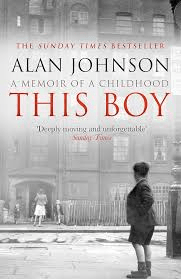
This Boy, by Alan Johnson, 2013

It’s traditional for politicians to write their memoirs after the end of their Parliamentary career. Alan Johnson was a senior figure in the Blair administration, but nonetheless This Boy had to be something special to stand out from the host of other post-Blair/Brown government autobiographies, diaries and memoirs. And it is. What makes this narrative so exceptional is its unsentimental portrait of a childhood of quite profound poverty and deprivation. That fact that the scenes Johnson describe date from the late 1950’s and early 1960’s, not some Dickensian nightmare, make them all the more extraordinary.

How bad was it; just how poor was his family? He regularly went without meals; his social housing in North Kensington, now considered part of trendy Notting Hill, was condemned; he didn’t have an indoor toilet or bathroom until he was in his teens. He faced the daily humiliation of free school meals (when everyone knew who received the free meals and who didn’t) and having to ask shop owners for ‘tick’ (credit). Coal was bought one day at a time because it couldn’t be afforded any other way and the Johnson household was usually bitterly cold, especially during the harsh winters of the early 1960’s.

But despite all that, this is not a misery memoir. These facts are recorded honestly but Johnson doesn’t dwell on them unnecessarily, and rarely seems to feel sorry for himself. (I think his older self feels sad for his younger self, but recognises that at the time he was often happy, especially when his father wasn’t around). Growing up in the 60’s Johnson sees and feels a small part of the immense social change that swept the country as it emerged from a post-war period and the 1964-70 Labour Governments introduced a host of progressive legislation.

Racism disfigured society of the period and Johnson also witnessed more than his fair share of that, as North Kensington saw terrible scenes of abuse of the Windrush generation. It’s not hard to trace the roots of the Labour politician Johnson became in the childhood of this boy.

You often see debates in the media and online about the definition of poverty. Lots of families live in households where the family income is below 60% of the median national income, the most widely used statistical definition, without suffering anything like the deprivation Johnson faced. Some of these families, it is sometimes claimed, are relatively affluent – they don’t go without daily necessities, can afford holidays and things that the middle class might consider luxuries such as mobile phones, cigarettes and flat screen televisions. So what we mean by poverty changes over time, it is relative, and the situation Johnson faced as he grew up was perhaps not as dire as that of the previous generation. The threat of eviction never seems present, social housing however poorly constructed is almost always available (including on several occasions the offer of new housing in the suburbs, most often declined) and jobs seemed to be extremely easy to walk into. If Johnson’s father had contributed to the family finances then a reasonable standard of living was within reach – certainly Johnson describes other family members and friends living in relative comfort. The safety net of the welfare state may not have protected everyone, but it did a pretty good job compared to the absolute poverty of fifty years or so earlier. That aspect of the narrative – that Johnson’s story is one of exceptional hardship, rather than a typical West London boyhood – was often lost in many of the reviews of the book at the time it was originally published. Johnson has corrected this narrative to some extent with his subsequent memoirs covering his early years as a postman, when life was comfortable by comparison.

Johnson’s sister Linda and mother Lily emerge as the heroines of this memoir. Lily worked numerous part-time jobs to keep the family afloat both before and after her husband Steve left, despite her serious health issues which took her life in her early forties. Linda, just three years older than Alan, kept the family together after Lily’s death and showed a remarkable maturity in dealing with the challenges of being orphaned and looking after her younger brother.

This book is written with a refreshing honesty and simplicity. It is obvious from the first page that it is not ghost-written, and the clumsiness of the text is easy to excuse when set beside the rawness of the content. It’s a hard read at times, although knowing that things turn out well for Johnson and his sister helps at lot.

This Boy, by Alan Johnson, 2013

Aside
Book review

Recommended – great fun – five stars *****

Burnt Coffee’s production of Kenneth Grahame’s Wind in the Willows sees an ensemble of eight performers play over thirty characters in this hugely enjoyable, up to date version of the much-loved classic.

The inventiveness of the physical comedy in this performance was outstanding. Props are used in unexpected ways and the scenes on the riverbank, the wild wood and on the river itself are brought to life with the use of simple but effective techniques. The whole thing has a playfulness and sometimes even silliness that works brilliantly with the text.

This is not a traditional performance of Grahame’s story – new characters are introduced (I particularly enjoyed the performance of the actor who played the slightly sinister Newt, Lady Toad’s butler/factotum) and some tweaks are made to the plot, particularly the ending which I have to say worked magnificently. At first I thought that the script might have wandered too far from the Edwardian pastoral comedy of the original story, captured so well in AA Milne’s stage version, Toad of Toad Hall, but I should not have worried – the spirit of the source material is treated with respect and all the changes work really well.

It’s unfair to call out any particular performances in such a strong ensemble cast, but I am going to anyway. Vanessa McAuley’s Lady Toad was magnificently amphibious and brought the mischievous and obsessive character to life every time she appeared.

There are two more chances to catch this production – Tuesday 27th and Wednesday 28th August 2024 at Norwich’s Maddermarket theatre. I saw this production at Colchester’s intimate Headgate theatre – it will be interesting to see what the cast do with the larger performance space at the Maddermarket. Parents should note that with a run time of around two hours (with an interval) this might not be suitable for pre-school children, but anyone of reception age and above will be enchanted by this energetic and inventive production.

Wind in the Willows (2024 theatre production)

Aside
Book review

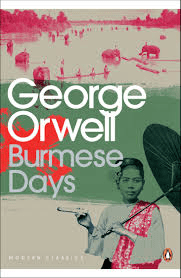
Burmese Days, by George Orwell, 1934

Yes, Burmese Days is flawed. But I would argue it is overdue a re-evaluation. As a portrait of colonialism it is not quite as devastating as, say, Heart of Darkness, one of the more obvious influences on an inexperienced writer. But it is powerful and effective, and tells us a lot about the early formation of Orwell the author.

Orwell was in his late twenties when Burmese Days was published, first in the US in 1934 and the following year in a a slightly redacted form in the UK, redacted because his publisher was worried about potential libel suits. It was his first novel. Early drafts date back to 1928, shortly after he had resigned his commission in the Burmese Military Police and decided to become a writer.

His first four novels, (Burmese Days, 1934, Coming Up for Air, 1939, Keep the Aspidistra Flying, 1936, and A Clergyman’s Daughter, 1935) form a coherent group. They are naturalistic novels of ideas, with a central character loosely based on Orwell himself, each with significant autobiographical components. They are a world apart from Animal Farm, which itself is utterly distinct in form and style from 1984. At some point in the 1940’s Orwell developed from being a moderately successful jobbing writer/journalist to one of our finest novelists. What caused that transformation (some speculate it was the influence of his first wife) is unclear. But there’s little trace of the later author in the earlier novels. I am not sure it helps to see them through that lens – i.e. as just early Orwell novels. They are more than that.

Burmese Days is a passionate anti-colonialism novel, written by someone with a detailed knowledge of the Raj and a love of Burmese people and culture. Set in 1920s British Burma (which at the time was part of India), it follows long-term ex-patriate John Flory, a timber merchant, part of a small group of hard-drinking, embittered English settlers. There are some Burmese characters, but they principally serve as plot devices rather than being fully-fleshed real people. In particular U Po Kyin, a corrupt Burmese magistrate, is a one-dimensional monstrous figure without any redeeming features, evilly plotting to destroy the reputation of his nemesis, Dr Veraswami, an archetype of the ‘good’ Indian. The British characters are not much more rounded – they are

Flory has been in Burma for fifteen years, and has become incredibly jaded. He has a Burmese concubine Ma Hla May (“He had bought her from her parents two years ago“) which is an open secret amongst his British compatriots. Flory has a birthmark on his face which dominates his perception of himself – he thinks women find him ugly and unattractive. He finds it hard to form relationships with the British people and feels increasingly isolated. The arrival of Elizabeth Lackersteen, the orphaned niece of the manager of the local timber firm, fleetingly promises the possibility of a conventional relationship. They grow close as he shows her some of the sights of the Burmese countryside, but she is appallingly shallow and vapid, and is at best confused by his appreciation of Burmese culture. Initially it appears Elizabeth might be prepared to marry Flory given her very limited options and to escape the advances of her drunken uncle. But her affections are quickly transferred to Verrall, a handsome military police lieutenant new to the area. To spoil any chance of Flory’s relationship with Elizabeth surviving, her aunt tells her that Flory has a Burmese mistress, which is of course true. Verrall leaves without saying goodbye to Elizabeth and she quickly pivots back towards her original romance with Flory.

A sub-plot sees U Po Kyin’s attempt to prevent Dr Veraswami joining the local European Club (“In any town in India the European Club is the spiritual citadel, the real seat of the British power, the Nirvana for which native officials and millionaires pine in vain.”). U Po Kyin foils the plan for Dr Veraswami to be elected by fomenting a small-scale rebellion of the locals against British rule.

So what’s wrong with Burmese Days, and why is it worth reading anyway? The characters are entirely one-dimensional, with the exception of Flory who is a thinly disguised self-portrait (as to a greater or lesser extent are all Orwell’s main characters, even the eponymous Clergyman’s Daughter.) (I thought I would illustrate this point – that Flory is a self-portrait – with an example; towards the end of the novel Flory pays a social visit to his neighbours and is shown into the house and asked to wait while the person he is visiting – Elizabeth – is fetched. Orwell describes this situation thus: “Mrs Lackersteen left him standing up in the drawing-room, feeling lumpish and abnormally large as one does at such times”. Not everyone feels this way but one can easily imagine the very tall and slightly socially awkward Orwell would.)

The obese and sexually predatory U Po Kyin is an archetypal, comic book villain; Elizabeth is little more than a plot device; the thinly sketched other ex-patriates are angry, entitled racists. The plot is clumsy and predictable, and the novel’s ending is probably its worst feature, showing every sign of simply being a rushed way of ending the book. Flory’s sudden decision at the end of the novel (trying to avoid spoilers here) makes no narrative sense and appears a way of bringing matters to a close, the novelist perhaps working to a publisher’s deadline or just being bored with the whole thing!

What of the novel’s redeeming features? For a start we get a really clear, unambiguous picture of the source of Orwell’s anti-imperialism. There is a strong argument to be made that this in turn is the source of his socialism, and explains why he always kept coming back to his time in Burma. I’ve written before why it is wrong to see Orwell’s time here as a short intermission after Eton and before the interesting bits of his biography. He spent longer in the Burmese Military Police than he did in any other job he held for the rest of his life and obviously tried hard to make a success of the job. Orwell the writer was formed in the heat of Burma. He writes with passion about the corrosive impact of being part of an imperialistic occupation:

“In the end the secrecy of your revolt poisons you like a secret disease. Your whole life is a life of lies. Year after year you sit in Kipling-haunted little Clubs, whisky to right of you, Pink’un to left of you, listening and eagerly agreeing while Colonel Bodger develops his theory that these bloody Nationalists should be boiled in oil. You hear your Oriental friends called ‘greasy Little babus’, and you admit, dutifully, that they are greasy little babus. You see louts fresh from school kicking grey-haired servants. The time comes when you burn with hatred of your own countrymen, when you long for a native rising to drown their Empire in blood.

This is as fine as anything in A Hanging or Shooting an Elephant.

The other feature of the novel that I enjoyed was the quality of the descriptive writing, not something Orwell is particularly well known for. His prose style may have been still developing, and here is more florid than it would eventually become, but the evocation of the Burmese countryside and especially the stifling heat is very well done:

“North of Mandalay the train, fuelled with wood, crawled at twelve miles an hour across a vast, parched plain, bounded at its remote edges by blue rings of hills. White egrets stood poised, motionless, like herons, and piles of drying chilis gleamed crimson in the sun. Sometimes a white pagoda rose from the plains like the breast of a supine giantess. The early tropic night settled down, and the train jolted on, slowly, stopping at little stations where barbaric yells sounded from the darkness”.

Finally, I thought I would share with you this gem. Goodreads one star reviews are often worth a laugh, but this one was special:

“This was my first George Orwell novel read as an adult, having somehow managed to avoid reading 1989 in high school like everyone else.”

Burmese Days, by George Orwell, 1934

Aside
Book review

Tomorrow and Tomorrow and Tomorrow by Gabrielle Zevin, 2022

Don’t be misled by the Shakespearean reference in this novel’s title – any Macbeth-related themes such as ambition are introduced late in the day and add little to the narrative overall. Which is a pity, because without the attempt to be more academic than it otherwise is, Tomorrow (etc) is a perfectly readable portrait of the durable friendship between two millennial gamers.

The novel opens with Sam Masur and Sadie Green meeting on the underground in Boston (at least I think it was Boston, my knowledge of New England geography is a little shaky). We find out that they are old friends who have drifted apart. The novel then jumps back in time to show us when they first met. Sadie is visiting her sister who is being treated for leukaemia. In the same hospital Sam is having reconstructive surgery on his foot, crushed in the crash that killed his mother. They bond over a shared love of video games and Sadie’s visits to Sam become an important part of his extended recovery. Visiting Sam in hospital counts as community service for Sadie, something she doesn’t tell him about as she is slightly embarrassed about it. Eventually he finds out, and is upset and understandably angry, and their friendship is ruptured.

Once reunited, older and wiser, the pair begin working on a computer game, inspired by their mutual love of gaming and supported by their friend Marx. Sadie starts a relationship with her married lecturer, Dov, the nearest thing the novel has to a villain. Their game – Ichigo – about a child lost at sea, is a huge success. A seed of resentment is sown when journalists assume that Sam is the inspiration for the character of Ichigo and give him more credit than Sadie feels is due. This festers and eventually cases a rift between the two, although not for several years, during which time the company they found, Unfair Games, (with Marx as their manager) moves to the West Coast and becomes commercially very successful.

Unfair Games diversifies into world-building and non-combat games, and Sadie begins work on a solo project, a Shakespearean-themed game. I’m going to leave the plot summary there (about halfway through the novel) to avoid spoilers, but I don’t think I am giving too much away when I say that Sadie and Sam’s friendship dominates the rest of the novel. I am sure there are plenty of novels about the early days of gaming, but this was the first I have come across/read. The notorious misogyny of this environment is a secondary theme in the novel, but most people are fairly nice – with one dramatic exception there is little of the toxicity exposed in, for example, gamergate. Even Dov, an exploitative and arrogant philanderer, is not condemned by the other characters and shows some development when he returns to the novel near the close.

I know this is going to sound strange but this felt like a young adult novel for grown-ups. What do I mean by that? Well, it has a lot of young adult themes; it follows the characters through their teenage years and into adulthood, coming to terms with the world as technological change accelerates around them. Friendship is as important as love, and casual relationships are unproblematic. I wasn’t at all surprised that the author also writes YA novels – you can tell. At the same time the novel is strangely old-fashioned – because it is set in the 1990’s (at first) in the early days of computer gaming, the author gives the period setting authenticity by numerous references to things such as Magic Eye books (where you stare at a pattern and an image emerges, or not) and Donkey Kong. The novel concludes with a chapter written from the perspective of a character in one of Sadie and Sam’s games. I am sure this was conceived as a neat way of breaking the fourth wall and bringing the plot to a conclusion, but I would have put a big red line through had I been Zevin’s editor – it was ill-conceived and distracting.

I can easily see Tomorrow being adapted for television or film, where the medium would allow time to explore the world-building and the development of the relationships. The narrative structure would work well with a series of one hour episodes, which is another way of saying that the story-line was a little episodic – something happens, a few years pass, something else happens, etc. A stronger author would have crafted the storyline so the seams weren’t quite so obvious. Sam and Sadie, and actually Marx as well, secondary character though he is, are very well developed and believable people, and it was easy to become invested in their outcomes, even if a happy ever after ending was never really on the cards. Would I read more by this author? Possibly – I definitely will keep an eye out for their next book.

Tomorrow and Tomorrow and Tomorrow by Gabrielle Zevin, 2022

Aside
Book review

The Bachelors, by Muriel Spark, 1960

Muriel Spark’s The Bachelors revolves around a group of single young(ish) men in 1950’s London. The plot centres on a case of fraud against a bogus spiritualist Patrick Seton. Seton, a leading member of spiritualist group, The Wider Infinity, is accused (and is clearly guilty of) forging a letter from his landlady, to explain his embezzlement of £2,000. Barrister Martin Bowles is prosecuting Seton, and friend Ronald Bridges, a handwriting expert, is going to be an expert witness in the trial. Other minor characters have bit-arts including an art-critic, a journalist and a teacher.

While the story is ostensibly about the men in the novel, the women play an equally central role – the novel could easily have been called ‘The Bachelors and the Spinsters’. I suspect the choice of title reflects the women’s apparent lack of agency – they are usually subservient to and manipulated by the men, in particular Alice, Patrick’s pregnant and vulnerable girlfriend. The novel takes a sinister turn from the mildly comic when it becomes apparent that he is planning to kill her by depriving her of the insulin she needs to stay alive.

And I will release her from this gross body. He looks with justification at the syringe by her bedside, and is perfectly convinced about how things will go in Austria (all being well), since a man has to protect his bread and butter, and Alice has agreed to die, though not in so many words.

Worse, one of his fellow bachelors suspects his plot but does little to prevent it. Patrick is something of a psychopath – his murderous intentions are not really financial but sadistic, possibly triggered by Alice’s refusal to abort the baby she is carrying. She gullibly believes Patrick’s assurances that they will marry as soon as his divorce is made final. Elsie, her friend, distrusts Patrick, and seeks to secure his conviction in the forgery/fraud case to help Alice escape his malign influence.

Modern (that is to say, 1950’s) spiritualism is a central theme of the novel, and it doesn’t come particularly well out of it, as you can probably imagine. It is a means to manipulate and defraud the simple-minded. Seton, an obvious villain, is protected his supporters within the Society, who are convinced he is a genuine medium, and his trial is the satisfying climax of the novel, where just desserts are granted.

The Bachelors is a quite dark novel, despite the overall jaunty tone. Ronald’s epilepsy is presented as a parallel to the spiritualists’ attempts to contact the ‘other side’ (they use the same drugs for example) in a way I couldn’t quite understand. I appreciate epilepsy as a condition was looked at very differently in the 1950’s compared to the way it is now – it was still under the shadow of the idea of possession, more part of the middle ages than a twentieth century attitude.

This wasn’t one of Spark’s stronger novels. The characters, especially the minor ones, are not clearly defined, and I think most readers will share my experience of struggling at times to work out who is speaking and what there relationships are to the other characters present. The reader has to do a lot of the work, and while sometimes that is justified, here is simply felt frustrating. The humour doesn’t always land and the portrait of living with epilepsy as if it were a curse was depressingly out of date.

I remain convinced that Spark is an under-appreciated writer who is always worth the short time it takes to read her very condensed novels, but overall this was a miss for me.

The Bachelors, by Muriel Spark, 1960

Aside