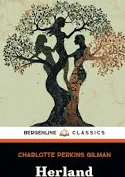
Herland by Charlotte Perkins Gilman, 1915
Herland is one of those novels that has been on the edges of my consciousness for a long time. I’ve known about it, known broadly what is is about, and always intended at some point to get round to it. Unlike a lot of people who take reading seriously I don’t have a literal ‘to be read’ list, but I do have a vague collection of tests that one day I intend to get round to. And for as long as I have been aware of it, Herland has been on that list. Published in 1915, when the Great War was well underway but America had yet to get involved, Herland begins as a traditional exploration/lost world novel: while on a journey of exploration in an unnamed continent, three American adventurers – Vandyck “Van” Jennings, Terry Nicholson and Jeff Margrave – hear of an isolated community that is peopled by women only, Eventually Van gets round to naming this community the rather reductive name of ‘Herland’ (we later hear that this community has been completely isolated for two thousand years, so how the tribes in the area would have heard of it is left unexplained). The explorers’ curiosity is piqued and they eventually return on a subsequent trip determined to track down this lost world. Authors such as Ryder Haggard or Conan Doyle would have lingered over the details of the
preparation for the trip, the extensive list of equipment needed, the hiring of guides, the journey inland and so on. Perkins Gilman has no interest in this element of the story, and within a few short paragraphs they are approaching Herland. Using a plane (that they have someone managed to bring with them), they surmount the impenetrable mountainous barriers around the country. We are not told where Herland is – the implication is that it is somewhere largely unexplored, and the surrounding countryside is populated by ‘savages’ but the ambiguity as to the country’s location is obviously intended to emphasise its universality. In any event, Van’s narration makes it clear that he has subsequently left Herland and returned to America, having committed to not reveal the location of the lost world.
Of course the arrival of a plane in a society isolated from the rest of the world for centuries is hardly likely to be unnoticed, and the explorers are quickly found by, initially by three young women who watch them from the treetops. Treating the women almost as prey, the men try to catch them, but they are easily outrun and then captured by a large group of women. They try to escape but are overpowered, drugged to stop them struggling, and taken to a nearby community.
From this point the body of the novel is comprised of the men’s captivity and education in the ways of Herland, which the author uses to outline the detail of the all-women society. Each man is assigned a tutor who teaches them their language while at the same time learning English. Van is a careful observer of all aspects of this new society, from the well-designed clothing they use to their agriculture and technology. But his real interest (and clearly, the main interest of the author) is in understanding how a women-only society has evolved and in what ways it is different from his own. In short, Herland is a feminist utopia. Everything is better. Conflict, inequality and criminality are things of the past, to the extent that the very concepts are no longer understood. Society has been finely tuned to allow all women to study and be creative. There are no masters and servants, bosses or slaves. No-one is overburdened with childcare or work. The traditional subservient roles of women in modern society have been forgotten – there is no-one to be subservient to. All of society’s practical problems have been mastered. By contrast the men’s accounts of their own world makes many of the practices of the outside world seem barbaric. Particular horror is shown at the very idea of abortion – a view which some modern critics have used to undermine Herland’s claim to be a feminist text, although surely the point is here about women’s loss of control of their fertility?
What is it about a women-only society that makes it so perfect? Or to put it another way, what is it about men that makes the outside world so damaged? The author suggests some answers to these questions but is surprisingly undidactic – the reader is left to join the dots themselves, even if the exercise isn’t that challenging. Free from the oppression of men and traditional female roles, women have evolved a near-perfect society. Women are respected and valued in this society, free from domestic servitude and male oppression. A key factor is their control over their fertility – the women can reproduce by parthenogenesis but choose to control their community’s population by having only one child each. Motherhood is a form of religion in this society, and children are cared for communally. No-one is worn out by having too many children or burdened by the cost of providing for large families. (This is surprisingly accurate – once women have control of their fertility, combined with lower infant mortality rates, birth rates drop dramatically.) But can this utopia survive the reintroduction of men? The author implies that this might be possible and that only some rather than all men are the problem. Of the three explorers, only one, Terry, finds the changes he faces in this society unbearable.
Over the course of the novel Van gradually finds out more information about the women’s society. He is told that a volcanic eruption 2000 years ago sealed off the only pass out of Herland, the only way of travelling to the outside world. The remaining men, mostly slaves, tried to take over but were killed by the women. Facing the end of their race a miracle occurs – one woman became pregnant without the intervention of a male partner, and went on to have five daughters, who in turn grew up to bear five daughters each. This women only society rapidly evolved strategies to survive their isolation and grew to prosper and flourish. Freed from the myriad the problems of society caused by women’s oppression the society find that many of the most deep-rooted problems such as criminality simply wither away and are forgotten.
Having had no contact with men for 2,000 years, the women have no experience or cultural memory of romantic love or sexual intercourse other than for the purposes of animal reproduction. They understand the mechanical process of mating, but the idea of sex for pleasure is unknown to them. This does not appear to be a society in which lesbian couples have formed – there is no mention or suggestion of this – and while it is never said so explicitly is is strongly suggested that all sexual urges have withered away. Therefore the men’s enthusiasm for marriage and sex (the author is not radical enough to suggest that one could happen without the other) is baffling to them. Although the men eventually form affectionate partnerships with three of the Herland ‘girls’, society appears to see this as an experiment in identifying any benefits from fatherhood rather than romances or expressions of love.
To be fair to the author, she doesn’t turn away from the question of sex, even though her freedom for discussing them directly was obviously limited. It would have been tempting I am sure to just have ignored the whole issue. She uses a wide range of creative euphemisms to discuss sex. Marriage is described by the women as “permanent mated love“. In an attempt to persuade the women to have sex with them, the men describe marital sex thus: “Why, to touch you, to be near you, to come closer and closer, to lose myself in you” and talk about “the sweet intense joy of married lovers“.
The women are puzzled by the concept of sex for pleasure rather than for procreation:
“Do you mean, she asked quite calmly, as if I was not holding her cool form hands in my hot and rather quivering ones “that with you, when people marry, they go on doing this in season and out of season, with no thought of children at all?”
Married love as an experiment in Herland is unsuccessful. After a short honeymoon period, Van’s wife Ellador withdraws from ‘married life’ and declines to have sex with him, explaining “If I thought it was really right and necessary I could perhaps bring myself to it, for your sake dear, but I do not want to, not at all. You would not have a mere submission, would you?”
Van and Jeff try to work these issues out with their wives, with Jeff seemingly accepting long-term celibacy as an option, but the more aggressive, impatient of the three, Terry, is uncompromising in his view of the submissive role of women in the bedroom and the rest of the relationship. When his partner Alima rejects his ‘advances’ he hides in her bedroom and “put into practice his pet conviction that a women loves to be mastered, and by sheer brute force, in all the pride and passion of is intense masculinity, he tried to master this woman“. In other words he tries to rape her. Van’s reaction is chilling: “In our country he would have been with quite within his rights of course….”[Crime]’s a pretty hard word for it. After all, Alima was his wife, you know.” Terry stands trial for his crime and is ordered to leave Herland. Van decides to accompany Terry but they are only allowed to leave Herland once they promise not to reveal its location. The novel ends abruptly at that point, with the subsequent adventures of Van, Terry and Ellador in the outside world told in the novel’s sequel With Her in Outland.
Following its publication Herland was almost completely forgotten and it was not until the re-printing of the author’s short-story, The Yellow Wallpaper in 1973, that readers began to rediscover Herland. For its time, Herland was extremely radical, daring to suggest that many of society’s problems originate with the subjugation of women, and even possibly that the problems originate with men alone. That may have been a step too far in a time when women still did not have the vote in the USA or the UK, but these were to happen very soon and formed part of significant changes to the role of women in society. There’s no reason to believe Herland contributed to these changes, but it is nonetheless one of the clearest descriptions of what a society without men might look like (even if it is told from the perspective of a male narrator rather than one of the society’s citizens). It is a treatise dressed up in novel form, where the story element of the text is minimal – very little happens once the men are captured, apart from a desultory escape attempt. But it has important things to say about the role of women in society and many of these messages remain starkly relevant today.