Book review

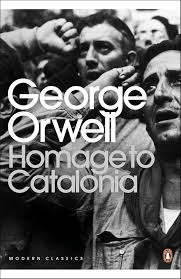
Homage to Catalonia, by George Orwell, 1938

Homage to Catalonia is Orwell’s memoir of his time fighting in the Spanish Civil War. Covering the period between December 1936 and June 1937, he tells how he stumbled into the war having originally intended to observe the conflict and ‘write newspaper articles’, but then quickly got caught up in the revolutionary atmosphere in Barcelona and signed up to fight. After some rudimentary training he describes his uneventful but miserable time on the front lines in Aragon and then his involvement in the May Days conflict in Barcelona. Although he returned to the front line after this short break, his time in Spain was brought to a sudden end when he was shot through the throat. A further close shave followed quickly when the political group he was serving in, the POUM, was declared an illegal organisation causing Orwell and his wife to flee for their lives, following closely by the police. The memoir elements of the book are interspersed with Orwell’s commentary on the war and the May Days conflict, in which he is heavily critical of the actions of the Government forces.

This analysis of the May Days conflict is central to this narrative and all subsequent commentary on the book. Orwell saw the May Days as a microcosm of the struggle between revolutionary socialism and communism. This isn’t some obscure metaphorical parallel but a real time playing out of the conflict between Trotskyism and Stalinism , fatally undermining the ability of countries such as Spain to resist fascism. Orwell comes down firmly and unambiguously on the side of revolutionary socialism and against Communism as represented by the Soviet Union and its counterparts in Spain and elsewhere. You could argue that as an almost accidental member of the POUM militia (he joined because it was aligned with the Independent Labour Party) it would have been impossible to imagine him taking any other position – who cheers on the people who are trying to arrest you and who are killing your friends and comrades. all the while telling the world that you are a fascist collaborator?

A common accusation levelled against Orwell’s non-fiction is that it is to a greater or lesser extent made up. He didn’t shoot an elephant, witness a hanging, etc. This accusation is almost never expressed as simple dishonesty – instead critics talk about things being ’embroidered’ and of ‘journalistic licence’ – but that’s what they mean. Homage to Catalonia was attacked on this basis from the moment it was published – instead of being an honest eye-witness account of the six-month period Orwell was in Spain, it is alleged that it is a carefully edited and at times simply untrue portrait of the war, most contentiously the street fighting in Barcelona. One critic who takes this position on HtC is Paul Preston, an academic at the London School of Economics. His Light and Shadows in George Orwell’s Homage to Catalonia dissects HtC in meticulous detail and gives credit for the book’s vivid descriptions of the conflict, but is assiduous in picking up on contentious issues in the account. To take one fairly minor example, early on in the book Orwell contrasts the food shortages being experienced by the ordinary citizens of Barcelona with the food being wasted in the barracks. Preston observes

If Orwell’s POUM unit could really afford to waste food, it must have been a rarity among the Republican forces.

To support this rather snide comment (it is implied that Orwell is lying, but not directly stated), Preston refers an extremely hostile essay on HtC by Bill Alexander called George Orwell and Spain. This essay was part of a collection of critical attacks on Orwell published in 1984 called Inside the Myth (see what they did there?) Why Alexander’s account is considered reliable and Orwell’s dishonest is not explained. But if Orwell was lying about the food shortage situation, Preston implies, his other observations might also be untrue or unreliable.

There’s fundamental category error in many of Preston’s cricitisms of HtC. For example he claims

Orwell’s eye-witness testimony guarantees the inclusion of Homage to Catalonia in any list of important books on the war. However, it would certainly not be there as a reliable analysis of the broader politics of the war and particularly of its international determinants.

Whereas of course it never claims to be a reliable analysis of the broader politics of the war, as a few minutes spent reading it will clearly demonstrate. Orwell goes out of his way to stress the partisan and incomplete nature of his account:

In case I have not said this somewhere earlier in the book I will say it now: beware of my partisanship, my mistakes of fact, and the distortion inevitably caused by my having seen only one corner of events. And beware of exactly the same things when you read any other book on this period of the Spanish war. (HtC)

Another accusation repeated by both Preston and Alexander is that Orwell was some kind of literary tourist, travelling to Spain simply to collect content and material for future books and articles and was not really interested in the Spanish or their struggles.

“Orwell had no understanding of the world wide significance of the struggle in Spain, he knew little of the national efforts of the Popular Front government to achieve a united front against fascism, he had never seen the Republican flag, he did not agree with the actions of the POUM – he took the rifle in the role of an outsider, a journalist looking for different experiences to figure in a future book.” (George Orwell and Spain, Bill Alexander, 1984).

Again Orwell anticipated this criticism. Initially it was the case that he had gone to Spain to write, but the sincerity of his subsequent conviction – he returned to the fighting despite the betrayal (as he saw it) of the May Days, was shot in the throat and came very close to death – is hard to doubt. In fact Orwell wrote very little about his time in Spain outside of HtC, and the book struggled to find a publisher and was famously a commercial and literary failure. You can question the accuracy of some of his writing, but surely the authenticity of his convictions cannot be questioned.

Some of the other claims made against Orwell, crafted solely to undermine his analysis of the war, are petty in the extreme. For example Preston casts doubt on the record of events at the end of the book when he is at risk of being arrested for his association with the POUM, claiming he (Orwell) couldn’t speak Spanish. There is however unambiguous eye-witness evidence that contradicts this allegation. It is also not disputed that Orwell commanded a group of young Spanish volunteers who presumably had little English. Orwell was a bright man and a quick learner and surrounded by Spanish speakers I can easily imagine he learnt the basics of the language quickly. The alternative – that he did not learn any significant amounts of Spanish during his months there and subsequently invented conversations to fit in with his anti-Government narrative – is surely far less likely?

I don’t want to spend to much time on the case for the defence, because frankly Homage to Catalonia doesn’t need it. It is superbly written and an important snapshot of pre-war European politics. It explains very clearly why Orwell become a convinced socialist and I would argue that it adds significantly to any reading of 1984 in its portrait of Stalinism. I challenge anyone to read his description of revolutionary Barcelona and not be moved, even if you accept that in doing so Orwell was overlooking the bloodshed of the early days of the conflict:

It was the first time that I had ever been in a town where the working class was in the saddle. Practically every building of any size had been seized by the workers and was draped with red flags or with the red and black flag of the Anarchists; every wall was scrawled with the hammer and sickle and with the initials of the revolutionary parties; almost every church had been gutted and its images burnt. Churches here and there were being systematically demolished by gangs of workmen. Every shop and café had an inscription saying that it had been collectivized; even the bootblacks had been collectivized and their boxes painted red and black. […] And it was the aspect of the crowds that was the queerest thing of all. In outward appearance it was a town in which the wealthy classes had practically ceased to exist. Except for a small number of women and foreigners there were no ‘well-dressed’ people at all. Practically everyone wore rough working-class clothes, or blue overalls, or some variant of the militia uniform. All this was queer and moving. There was much in it that
I did not understand, in some ways I did not even like it, but I recognized it immediately as a state of affairs worth fighting for.

The book ends with this wonderful and profoundly prophetic description of returning to England, an experience any English tourist will recognise:

“And then England—southern England, probably the sleekest landscape in the world. It is difficult when you pass that way, especially when you are peacefully recovering from seasickness with the plush cushions of a boat-train carriage underneath you, to believe that anything is really happening anywhere. Earthquakes in Japan, famines in China, revolutions in Mexico? Don’t worry, the milk will be on the doorstep tomorrow morning, the New Statesman will come out on Friday. The industrial towns were far away, a smudge of smoke and misery hidden by the curve of the earth’s surface. Down here it was still the England I had known in my childhood: the railway-cuttings smothered in wild flowers, the deep meadows where the great shining horses browse and meditate, the slow-moving streams bordered by willows, the green bosoms of the elms, the larkspurs in the cottage gardens; and then the huge peaceful wilderness of outer London, the barges on the miry river, the familiar streets, the posters telling of cricket matches and Royal weddings, the men in bowler hats, the pigeons in Trafalgar Square, the red buses, the blue policemen—all sleeping the deep, deep sleep of England, from which I sometimes fear that we shall never wake till we are jerked out of it by the roar of bombs.”

Homage to Catalonia, by George Orwell, 1938

Aside
Book review

When It Was Dark, by Guy Thorne, 1903

Christopher Hitchens called When it Was Dark a “piece of trash novel which makes ‘The Da Vinci Code’ or the ‘Left Behind’ series seem like Proust or Balzac or George Eliot.” He was being generous, but with that ‘recommendation’ I felt compelled to check this out. Sadly, other than it being a historical curiosity it has no redeeming features whatsoever. Worse, it is deeply anti-Semitic and racist. As always, I read these things so you don’t have to!

The central concept of the novel is actually a potentially compelling idea. Archaeological discoveries in the Middle East at the end of the nineteenth century were causing scholars to rethink earlier ideas about the bible, more specifically about the life of Christ. Some religious people found those discoveries and the interpretations put upon them threatening to their beliefs. Christian faith had at that time already faced significant challenges from  the scientific advancements of the nineteenth century, chief of which was of course Darwin’s theory of evolution, which had led many to question the literalist interpretations of the bible, reinterpreting many of the stories as fables. If Christ could tell stories that we intended to help people understand morale issues without being taken literally – whether or not there was a real ‘Good Samaritan for instance simply isn’t important – then why could that principle not be extended to the whole text?

Thorne’s starting point is that Christianity, specifically the form of Christianity practiced in the United Kingdom, rests solely on a belief in the literal truth of the resurrection. Anything that challenges that faith is in turn a challenge to morality and social order. Without a belief in the resurrection there is no reason why people should not behave lawlessly, following their baser instincts rather than the teachings of Christ. Anyone wanting to undermine the social order, anyone with malevolent intent against Christian society, would simply have to demonstrate beyond reasonable doubt that the resurrection did not happen.

Take a minute to think about that. Thorne is arguing – and his novel was hugely popular and very widely supported from pulpits throughout the land – that the reason we don’t rape and murder one another is not because we belief in the importance of social order, not because we believe in God, not because Jesus told us how to relate to one another, not because of the centuries of Christian teaching, but because the resurrection literally happened. As soon as that one building block of faith is removed, everything comes crashing down.

So that’s what happens. A malevolent character forges the ‘discovery’ of the tomb of Christ and blackmails a senior archaeologist from the British Museum to confirm the discovery is authentic. The forgery is of such a high standard that the many other independent experts from around the world also confirm its authenticity – apparently only British experts need to be bribed, everyone else just goes along with the Brit. Once news of the discovery spreads, society quickly begins to crumble.

Even the author himself finds this thesis implausible. He quickly recognises that for most people the resurrection isn’t the lynch-pin of their faith. Millions of people around the world are not Christians, and they manage to sustain a civil society reasonably well. The response of the Roman Catholic church is quite hilarious. The Pope issues an instruction to all Catholics that they must ignore the archaeological finds, and forbids them from even talking about it. Civil society in Catholic countries, even in areas of the United Kingdom with a significant Catholic population such as Liverpool, resists the breakdown in order experienced elsewhere. Muslim countries are also largely unaffected and many Christians are able to adapt by accepting that the resurrection was a fable in the same way many already thought of other bible stories. But Protestant England suffers:

There was the curate at Wigan, who had shot himself and left a heart-breaking letter of mad mockery behind him; there were other cases of suicide. There was the surging tide of crime, rising ever higher and higher as the clergy lost all their influence in the slums of London and the great towns…. “the evil was growing and spreading each day, each hour.” True as it was that the myriad lamps of the Faithful only burned the brighter for the surrounding gloom, yet that gloom was growing and rolling up, even as the clouds on which her unseeing eyes were fixed as she walked along the shore. Men were becoming reckless; the hosts of evil triumphed on every side.

Moral law will be abrogated for a time. The whole moral fabric of Society will fall into ruin at once until it can adjust itself to the new state of things. There will be war all over the world; crime will cover England like a cloud——”

The novel’s villain is industrialist and MP Constantine Schuabe. The ‘foreign’ sounding name given to the character is not a coincidence, of course – throughout the novel anything evil or negative is given foreign connotations. Schuabe’s Jewish ethnicity is emphasised every time he appears. This is how he is introduced:

The man was tall, above the middle height, and the heavy coat of fur which he was wearing increased the impression of proportioned size, of massiveness, which was part of his personality. His hair was a very dark red, smooth and abundant, of that peculiar colour which is the last to show the greyness of advancing age. His features were Semitic, but without a trace of that fulness, and sometimes coarseness, which often marks the Jew who has come to the middle period of life. The eyes were large and black, but without animation, in ordinary use and wont. They did not light up as he spoke, but yet the expression was not veiled or obscured. They were coldly, terribly aware, with something of the sinister and untroubled regard one sees in a reptile’s eyes.

The jaw, which dominated the face and completed its remarkable ensemble, was very massive, reminding people of steel covered with olive-coloured parchment. Handsome was hardly the word which fitted him. He was a strikingly handsome man; but that, like “distinction,” was only one of the qualities which made up his personality. Force, power—the relentless and conscious power suggested by some great marine engine—surrounded him in an almost indescribable way. They were like exhalations. Most people, with the casual view, called him merely indomitable, but there were others who thought they read deeper and saw something evil and monstrous about the man; powerless to give an exact and definite reason for the impression, and dubious of voicing it.”

It’s worth spending a moment on this description. The author tells us Schuabe gives an impression of massiveness – and he also has ‘very massive’ jaw. Can things be ‘very massive’? Its not the usual way of describing something very big. Schuabe is both not handsome (“Handsome was hardly the word which fitted him“) and in the very next line “a strikingly handsome man“. This is not a stereotypical portrait of a Jewish villain from Victorian literature – there is no suggestion he is motivated by avarice or greed and there is no mention of his nose which is often used as a marker of Jewish identity in such texts. But he is something possibly much worse – he intends to destroy Christian society.

Later in the novel Schuabe is described from the perspective of another character, Father Ripon:

“His hair, which could be seen beneath his ordinary hard felt hat, was dark red and somewhat abundant. His features were Semitic, but without a trace of that fulness, and often coarseness, which sometimes marks the Jew who has come to the period of middle life. The large black eyes were neither dull nor lifeless, but simply cold, irresponsive, and alert. A massive jaw completed an impression which was remarkable in its fineness and almost sinister beauty.

It’s good to see that he hasn’t changed and that the author hasn’t taken the trouble to find anything new to say about him. This account is given before Ripon has been introduced to Schuabe, so the reader is working out with him at the same time who this mysterious stranger might be. But Thorne assumes the reader is probably a bit stupid, so provides heavy hints about his identity by using identical descriptors. In other words it is horribly clumsy writing.

I confess I got one thing wrong about this novel. About half way a new character is introduced, Sir Michael Manichoe. Manichoe is described as

the stay and pillar of “Anglicanism” in the English Church… a man of great natural gifts. The owner of one of those colossal Jewish fortunes which, few as they are, have such far-reaching influence upon English life, he employed it in a way which, for a man in his position, was unique.….in his public life Sir Michael was diplomatic enough. He worked steadily for one thing, it is true, but he was far too able to allow people to call him narrow-minded. The Oriental strain of cunning in his blood had sweetened to a wise diplomacy

I thought this character would eventually be exposed as part of the conspiracy, and it is possible the author was going to go this way at first and then changed his mind – certainly the reference to an Oriental strain of cunning is a hint that there is more to Manichoe than meets the eye. But in fact no, he’s just a well-meaning rich man who helps the small group of people working to expose Schuabe’s conspiracy. This is done remarkably easily – Schuabe has left clues and the means to reveal his forgery all over the place and the crime quickly crumbles. A bitter end comes to him and his collaborators, one which Thorne takes great pleasure in describing in a postscript.

This is a piece of Edwardian trash that really should have never been reprinted if it weren’t for Hitchens’ passing reference to it. According to the internet Thorne wrote over 120 novels, which tells you a lot about the care he put into his work. It’s a glimpse into a mindset of an embattled faith struggling to come to terms with a changing world. I was reminded of some of the invasion literature I have written about here previously which took a similar approach to challenging readers’ ideas about the UK’s place in the world. Edwardians had lost the certainty of the nineteenth century and were worried about what was to come – turns out they were quite right to feel that way!

When It Was Dark, by Guy Thorne, 1903

Aside
Book review

The Blair Years (2) by Alastair Campbell, 2007

There were a few additional observations I wanted to add to my earlier review of Campbell’s fascinating diaries of the years he spent as Tony Blair’s press secretary, from 1994-2003.

One of the contentious policies the Starmer Government has been pursuing since the 2024 General Election is the levying VAT on the fees paid for private education. Campbell always was to the left of Blair on educational issues, advising him against sending his kids to the grant-maintained Oratory school, and he is a strong supporter of the current Government’s plans. This policy idea was originally floated in the early years of Blair’s leadership prior to him becoming Prime Minister – and when it came up he killed the idea stone dead without any debate. He considered it a tax on education and could not understand why any Government would even consider the idea. To him it was unthinkable. I mention this point simply to underline the fact that while the Starmer Government is obviously very far to the right of the policy positions taken during the Corbyn years, there remains some important differences between its policies and those of New Labour. Blair would never have countenanced something as radical as VAT on school fees – Starmer is pushing ahead with the idea despite a lot of well-resourced opposition and limited evidence that the policy is causing the party some electoral damage. In other words he is probably doing it because he believes it is the right thing to do, not simply because it is politically expedient.

The second point that I originally overlooked is an exchange Campbell shares (page 101) between himself and Mo Mowlam, at the time a shadow minister for Northern Ireland, who was to go on to play a key role in the Good Friday Agreement. At the time the Labour Party, still in opposition, was rocked by Harriet Harman’s controversial decision to send her children to grammar school. Campbell’s role as always was to ensure all Labour MPs stayed on-message and defended the party line, whatever their personal feelings on the issue. He recounts his version of events:

“We were still struggling to get anyone to defend her (Harman) on TV, but eventually I persuaded Mo to do it, only half jokingly saying that if she didn’t I’d reveal her stepchildren were at a public school.”

This is horrendous. A Shadow Minister is forced to go on television to defend a position she doesn’t agree with because otherwise a party official will expose damaging information about her family to the media. This isn’t a half-joke, it’s blackmail. The fact that Campbell thought it acceptable to include in this book – presumably to show how far he was prepared to go to support Blair – is appalling, and makes one wonder what dark arts and deviousness were left out.

Finally, during the 2024 general election campaign it was hard to find a single commentator not referring to Labour’s ‘ming vase’ campaign strategy. The phrase was used so relentlessly that it almost lost all meaning, so I was struck by the fact that the phrase is first recorded in these diaries. It isn’t just an echo of the New Labour strategy, it is the New Labour strategy.

“TB told me about his last dinner with Roy Jenkins at Derry’s….” I see you Tony, as someone carrying an exquisite, beautiful. hand-painted vase over a slippery floor and as you proceed across the floor, vase in hand, you can see your destination and you can see the likes of Harriet Harman and Clare Short lunging towards you, and you don’t know whether to run or tiptoe”.

In this original version of the strategy, it’s not the leadership who are going to drop the vase – instead they might have it struck from their hand by outspoken or clumsy Shadow Ministers or party spokespersons. So the strategy is not simply one of taking no risks, but also of shackling any Shadow Ministers seen as likely to say something out of turn. Roy Jenkins was a progressive Labour Cabinet Minister in the sixties and seventies, but had done his best to destroy the party in the eighties by setting up the SDP (which was to eventually merge with the Liberal Party to form the Liberal Democrats). You can interpret the fact that Blair adopted him as one of his senior (albeit unofficial) advisors as either evidence of Blair’s willingness to think outside the box and break rules, or of his innate conservatism.

The diaries were a mine of interesting insights such as this into both the Blair years themselves and their reflection in what might one day be called the Starmer years. Or maybe not.

The Blair Years (2) by Alastair Campbell, 2007

Aside
Book review

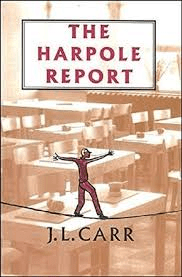
The Harpole Report, by J L Carr, 1972

I am a great admirer of J L Carr, particularly his 1980 novella A Month in the Country, and therefore my expectations for The Harpole Report were high. While it doesn’t reach the heights of A Month, on its own terms this was an enjoyable little novel. It is told in the form of report by an unknown author, commissioned by Harpole himself into his last term as a teacher. This ends up being simply a framing device rather than the more ominous introduction to a report into a serious incident – it never really becomes clear why the report is required, but by the time that becomes apparent the reader cares little for that minor anachronism. The report’s author uses and quotes from a wide variety of sources, including the school logbook – a kind of official record or diary – as well as correspondence, diaries, and other official and less than official sources.

Stories set in schools are usually written for children, be it the slapstick comedy of St Trinian’s and St Custards, or adventures in the manner of Enid Blyton and her successors. I can’t recall reading another novel told from the perspective of the long-suffering teaching staff. This novel is grounded in personal experience – Carr was a primary school teacher for almost 40 years, including 15 years as a Head. It opens with his avatar, Harpole, being temporarily given the headship of the Church of England primary school of Tampling St. Nicholas. The setting is the early 1970’s, at a point where much of education was still dominated by attitudes from the pre-war era (Tampling is described as being “run along the lines which were the height of fashion when Chadband (the former head) was trained in the 1920s by men who learnt their educational practices in the early years of the century”) and progressive attitudes towards education were hard to find. Corporal punishment, even for younger children, was commonplace, the curriculum unchanged for decades, and schools still maintained a ‘backward class’ taught by an untrained teaching assistant.

Harpole makes some tentative attempts to modernise the school, moves that are fiercely resisted by the Education board, his teaching staff, his recalcitrant janitor, and the parents. Some of the minor battles, such as whether to fly a flag at the start of each school day, are lost, but slowly through stubbornness and dedication Harpole begins to get his way. The ferocity with which Harpole’s attempts to drag the school into the modern era are resisted prove the source for much of the novel’s comedy.

In addition to completing the school log, Harpole keeps a personal journal revealing more detailed information which he often wants to keep out of the official record. Although many of his innovations are modest at times he shows signs of what could almost be described as radicalism. He proposes that caning be abolished – which provokes a response accusing him of encouraging “acts of the utmost depravity” – and that students stop referring to teachers as ‘Sir’ and ‘Miss’. Each proposed step forward is met with fierce resistance, not least from the education authorities that see him as a trouble-maker. Even a simple request for a new blackboard is met with astonishment at his effrontery. Despite this resistance he slowly begins to reform his school, encouraging outside visits for each class, (which inevitably go disastrously), securing support for some of his children who are being mistreated at home, and winning the confidence of his staff.

Two sets of correspondence are threaded through the narrative. Harpole’s letters to his fiancé, Edith Wardle, unanswered apart from her ‘Dear John’ telling him she has found love elsewhere, are dominated by details of his missing spanner – it’s not hard to see why she moved on. His place as teacher of the Scholarship class, a group of students identified as having the potential to pass the 11+ and go on to grammar school, has been taken by a supply teacher and recent Cambridge graduate, Miss Foxberrow. her letters to her sister are full of her lively independence of thought. References to Harpole are initially mocking, but her admiration for him slowly grows, particularly when he confronts a parental bully, Mr Bullitt. beating him with a cricket bat. Immediately after the fight she describes her reaction:

“a great hush had descended on the building and it was evident that all lessons had ceased and everyone was listening in petrified rapture. GH then turns towards me his eyes positively glittering, and hackles rampant (with me quite limp with adoration and the joyous expectation of being dragged off to his cave and debauched).”

There is a hint of the origins of A Month in the Country in the scene when Harpole and Miss Foxberrow are out in the country on a date of sorts, visiting a remote church in Ferry Farthingale in the sea-marshes.

“She then pointed out an area of decomposed painting above the nave arcade. This showed three ancient lords in fine raiment parading in a field of lilies and the three same, naked (with even the hair around their parts scorched off) in a fiery furnace.

This medieval wall painting is precisely the type of relic that Birkin is employed to restore. The fruition of George and Emma’s relationship in such unlikely circumstances is one of the many delights of the book. If you haven’t discovered J L Carr yet, this might not be my recommended starting point, but on its own terms it is a witty and enjoyable novella.

The Harpole Report, by J L Carr, 1972

Aside
Book review

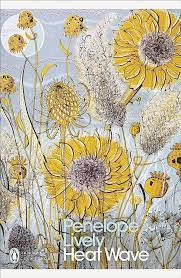
Heatwave, by Penelope Lively, 2009

Penelope Lively’s Heatwave is set during the course of a long hot summer in rural Oxfordshire. The narrator, Pauline rents one of a pair of cottages; the other is the home of her daughter Teresa, Teresa’s husband Maurice and their young son Luke. The pair of cottages are somewhat ominously called World’s End, not a reference to the Edgar Wright film but portentous nonetheless. Pauline is a proof-reader; Maurice an author, while Teresa cares for Luke. Maurice is writing what sounds like a very pretentious history of English tourism and as part of his working routine he regularly goes back to London for meetings. He is also visited from time to time by his publisher, James and James’s girlfriend, Carol. The other inhabitants of World’s End also travel up to London from time to time – while secluded it is obviously not that remote, and these are urban, middle class people comfortable with popping off to Paris for the weekend or Venice for a month.

It is obvious from early on that Maurice is a ‘bad un’. Think Martin, the sleazy brother-in-law from Fleabag. He (44) is quite a bit older than Teresa (29) who hero-worships him. Teresa’s archetype, the long suffering wife who accepts her lot without protest, is established early – on the very first page Pauline compares her to a Hardy heroine “betrayed no doubt”. Pauline, long divorced from her philandering husband Harry, recognises the signs of Maurice’s likely adultery well before Teresa does, although the reader is given even earlier clues of his wandering. Pauline is reluctant to tell her daughter of her suspicions, waiting for some concrete evidence. She recalls the details of her own marriage to a serially unfaithful husband, who now writes to her occasionally from America where he is a college professor. Other than the slow passage of the summer and occasional trips out to cheesy tourist attractions as ‘research’ for Maurice’s awful book, the action is slow. Pauline remains watchful towards Maurice but never confronts him, and time is marked by the changing agricultural landscape and the steadily warming weather. Slowly Teresa begins to develop her own suspicions, but is also reluctant to face the issue or even discuss it with her mother. We are offered other relationships for comparison – Pauline’s bookseller friend and his agoraphobic wife, and the author of the book Pauline is proof-reading, stranded in remote Wales. Happy relationships in Heatwave are rare.

The novel opens on a warm May day, with everyone apparently “poised for this agreeable summer of industry and companionship“. Or so they believed, the narrator silently suggests. As summer passes the stresses within Maurice and Teresa’s relationship are exposed and his infidelity becomes all the more obvious. Pauline spends much of her time reminiscing. Some reviewers – in fact most, I think – claim that the damage caused by Harry’s infidelity is inter-generational and is in some obscure way the cause of Maurice’s unfaithfulness, as if Teresa has sought out a father figure for a husband who will repeat his behaviour. I am not convinced we are fated to repeat our parents’ mistakes, but Heatwave certainly seems to suggest it is unavoidable unless a dramatic break with the past is made.

Heatwave reminded me of Howards End in its portrait of a rural idyll threatened by modernisation, the way the characters live halfway between town and country and the novels’ sudden melodramatic ending in which a brutal and arbitrary form of justice is meted out. Another novel I was reminded of was J L Carr’s A Month in the Country which follows a similar structure, but is much more gentle and perhaps even kind in its treatment of its equally flawed characters.

Often, finding a way to end these reviews can be the hardest part of writing them. You can’t just stop (as some novelists do, irritatingly) – you are always on the lookout for a way of summing things up neatly with an appropriate sign-off. Many bloggers end with an invitation to readers to comment and provide their own thoughts. But one option that is not open to us it the deus ex machina out of the blue approach to ending that Lively uses in Heatwave. It was such an abrupt conclusion that it left me feeling a little cheated if I am honest.

Heatwave, by Penelope Lively, 2009

Aside
Book review

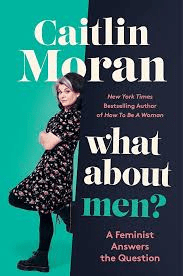
What about Men? Caitlin Moran, 2023

What indeed? Caitlin Moran is an excellent columnist. I enjoy her writing; it is usually insightful and broadly progressive. But does her style of writing – pithy, with a punchline every few hundred words – convert well into a book that grapples with the serious question of the crisis of modern masculinity?

There are multiple issues with this book that undermine its overall impact and effectiveness. Stuart Jefferies, reviewing the book in the Guardian, does an extremely good job of identifying these issues and I am not going to try and duplicate his points, almost all of which I support (although re-reading the review at a later date he does give Moran both barrels and doesn’t take much time looking for any redeeming features). While reading the text I constantly found myself disputing Moran’s observations and not in a good way. They were not thought-provoking so much as smugly wrong. To offer one example, when the author uses the term ‘men’ she appears to refer to a very specific sub-set of men, largely defined as ‘blokes I know’. They are almost all in her age group, heterosexual, and British. A chapter about porn-addiction, based on an interview with a twenty-something young man, stands out because it gives a voice to a different group. Claims such as “your T-shirt collection is, to you, as your wife’s lovingly collated wardrobe of second-hand Chanel, designer jeans and Zara brogues is to her” just aren’t funny because they don’t derive from any observable reality. Isn’t that observation only true of Moran’s husband and their mates? Not many women I know have a collection of second-hand Chanel designer jeans and I am reasonably close to Moran’s demographic. I appreciate this is intended as tongue in cheek humour, but it falls at the first hurdle because it is neither funny nor relatable.

Which is a huge pity, because the subjects Moran writes about – the crisis of toxic masculinity in this country – is profoundly serious. It is literally killing men, through suicide, differential life expectancy, and poor health care. Moran addresses all these subjects, but rarely gets to grips with them before a punchline is required.

Perhaps the fault is mine, in reading this book as a text rather than a series of chapters grouped around the same topic. A fine distinction perhaps but what I mean is What About Men might work better if read one chapter a week rather than straight through like a novel. Some of the more

There is, unquestionably, a dialling it in aspect to this book. Her habit of twitter-sourcing content doesn’t inspire confidence that the book has been carefully researched for example. Most of the conclusions she draws about men are simply stating the obvious – the amount of original insight is minuscule. As a quick gallop through the main issues of modern masculinity, a starter text if you like, this would be fine for someone who hadn’t read a newspaper or spoken to a man in the last few years. Perhaps that’s the real audience – teenagers? But the problem with that idea is that in my experience teenagers are profoundly better informed on issues of sexuality and gender that 99.9% of people of Moran’s generation. I think, in fact I am pretty sure, that most teenagers would be appalled if they read her generalisations on sex, gender and masculinity. Her real audience is obviously the people who buy books and give them to one another for birthdays and Christmas without really expecting them to be read. Why would you bother properly researching a book if you know most people are going to skip to the chapters about sex?

What about Men? Caitlin Moran, 2023

Aside
Book review

The Blair Years, by Alastair Campbell, 2007

I don’t think there is any question that Alastair Campbell’s obituary when it comes to be written will focus on the events of the last few weeks of this diary. For any readers for whom this is history rather than current affairs, a short summary: Alastair Campbell was Tony Blair’s press spokesman from shortly after Blair became leader of the Labour Party through the first two New Labour governments. He developed a fearsome reputation as a defender of the Government. The verb ‘to spin’ might have existed before Campbell and New Labour, but it came into common currency during those years. To give you some idea of Campbell’s reputation, all you need to know is that the character Malcolm Tucker from The Thick of It was based upon him.

After 9/11 America, led by George W Bush, was determined to depose Saddam Hussein. The premise for this attack was that Iraq possessed weapons of mass destruction (WMDs), or the capability to develop such weapons. Tony Blair was unshakeable in his support for Bush and the issue became a deep dividing line within British politics. To support the case for war a file of intelligence briefings (a dossier) was produced, purporting to demonstrate that Hussein had WMDs. A BBC report claimed that Campbell had interfered with the drafting of the report and ‘sexed’ it up, over-stating the strength of the evidence. Dr David Kelly, a government scientist who had allegedly leaked information on the dossier to the BBC ended up taking his own life. A judicial inquiry into these events, the Hutton inquiry exonerated Campbell but the accusation has stuck, primarily because it seems the sort of thing that Campbell would have done.

Campbell has spent more than twenty years trying to rebuild his reputation, but I suspect he will always be haunted by this accusation. The Blair Years is the first of what is by now a series of eight volumes of his extremely detailed diaries – over 750 pages covering 1994-2003, around a sixth of the total words written contemporaneously. The obvious question is to what extent these diaries have been edited or selected to present a positive view of Campbell and his role in New Labour, and specifically to exonerate him from the WMD accusations? It would be astonishing if not almost impossible to edit down that volume of writing without any element of spin. Choices must have been made, inevitably with the intention of presenting Campbell and Blair in the most positive light. Even if Campbell wasn’t such a notorious exponent of the art of spin, some recasting of events must have happened. I am possibly being naïve but I choose to think that this is a reasonably honest version of events. Campbell saw himself as a leading figure in the Blair administrations, more a chief of staff than a press officer. He was at the heart of the New Labour project, even if on some issues he found his personal views to the left of Blair. An early instance of this is when he tries and fails to persuade Blair not to send his children to a grant-maintained school, which went on to be a bit of a PR disaster for him.

Most of the time there is little effort made to provide context to the events being described – footnotes are few and far between – so the reader either needs to be familiar with the events or spend a fair amount of time flicking back and forth to Wikipedia. The overall effect is of a real-time account of several significant moments in recent British history, such as the death of Princess Diana, the foot and mouth crisis, and the British reaction to 9/11 leading through to the Gulf War. Throughout, Campbell’s portrait of Blair is consistent: he was a reforming Prime Minister often out of step with his party but driven by faith in the rightness of his own views, determined to reform institutions (such as the House of Lords) and with a broad interest in social justice. Campbell himself is by contrast more a traditional party man. The cast of supporting characters is large. John Prescott comes across as a surprisingly likeable ally, while Campbell makes little attempt to disguise his contempt for others such as Clare Short. The effect of some parts of the diaries is to confirm public perception of Labour figures – Peter Mandelson is undoubtedly Machiavellian, Gordon Brown is prone to outbursts of anger, and so on – there aren’t many revelations about politicians secret lives. Perhaps this is because so many other memoirs have been published. What was at the time an insight into what really happened – such as the story of Robin Cook breaking up with his wife on the way to the airport because a tabloid was about to expose his affair (a story sometimes presented as Campbell instructing Cook to divorce his wife) are now well known and all these diaries do is confirm them.

Campbell isn’t over-burdened by humility. Early on he becomes excruciatingly convinced Princess Diana is attracted to him. The Secretary General of NATO is quoted as saying in the context of the conflict in Kosovo “If you can, send me your man Campbell, that would be best“. He becomes good friends with Bill Clinton and George W Bush. I suppose everyone is the hero of their own stories.

While some of the narrative feels like ancient history, other sections bear strikingly similarities to the political situation today – a reforming Labour Government with a large majority after a long period of Conservative rule; a hostile media; cynical anti-politics agenda being pursued by the right-wing; Europe as always a divisive issue. Even electoral reform and changes to the House of Lords are back on the agenda. So these diaries should probably be studied by the new Labour Government. If they were to do so what lessons would they derive?

First, the Conservatives must not be under-estimated. They will be back, and the time to cement Labour’s position as the party of Government is now, not in five years time. The next Conservative Prime Minister may not yet be an MP (Cameron was not an MP when Blair was elected; Starmer was not an MP when Cameron was elected) but they aren’t one of Europe’s oldest political parties for nothing.

Second the media will be unrelentingly hostile and the Government needs to decide what it is going to do about that. What we mean by the media has obviously changed since 1997 with the advent of Facebook etc, but the right-wing tabloids are still stubbornly there and will not miss a chance to undermine the Government.

Thirdly major crises seem almost unavoidable. Whether it is the death of Princess Di, foot and mouth disease, the oil delivery drivers strike (first term) or 9/11 and the Gulf War (second term) and the global economic crisis (third term) there are going to be testing times ahead.

Is the portrait of Campbell that emerges from these diaries accurate? For example is his reputation for quite aggressive ferocity justified? I wanted to quote at length a description Campbell gives of a shouting match between himself and Gordon Brown, Chancellor of the Exchequer (page 528) during the 2001 general election campaign. Brown had long been concerned about the negative impact of briefings by Peter Mandelson, who had been sacked twice from Cabinet positions:

“I went over to see GB in his office….and he was banging away at his computer. He had a pile of papers to the right and on the top had written 75 pence and below it, in large black letters, ‘who will silence Mandelson?’ ….

I tried to make a joke of it, but he was having none of it, went on a great tirade, said we were letting him destroy the campaign, undermine him, be ill-disciplined, on and on he went and eventually I lost it, said PM was nothing to do with me and I did not like the implications that I could be held responsible one way or the other for what he was or was not up to. “Well it has to stop” he said. “Telling me it has to stop suggests that in some way I might be responsible, and I fucking resent that….(continues at some length) I was suddenly conscious that I was jabbing my finger at him, and thought it better to leave.”

This is extraordinarily unprofessional conduct, but it seems there were no consequences for Campbell for swearing and shouting at the second most senior member of the Government. The word suddenly is revealing here – if the description can be taken at face value, he seems genuinely not to have realised he was shouting and being aggressive towards Brown for most of the exchange. If he treated the Chancellor of the Exchequer like this, what was he like with junior members of staff and journalists? Of course we don’t need to ask because there are multiple accounts of his behaviour. So yes, he was aggressive and either didn’t know or care that people were often genuinely scared of him.

Just one other thing I noticed: the back cover of the paperback edition includes the following quote from Matthew Parris, the Times columnist and former Conservative MP

“A brilliant, absorbing account….These diaries….will be gasped at, and relied upon, for decades to come. Buy them; they will suck you in”.

I was surprised to read this endorsement when Mr Parris himself appears only once in these diaries (page 308) as “The little shit Parris“.

One wonders what qualifications were hidden by the ellipses?

The Blair Years, by Alastair Campbell, 2007

Aside
Book review

The Immortal Life of Henrietta Lacks by Rebecca Skloot, 2010

The premise of this book is that the extraordinary story of Henrietta Lacks – and more specifically, her cells which (for reasons I am still not clear about) continued to multiply after they were removed from her body, shortly before her death from cancer in 1951 – needs to be told. In other words, that this is the most

comprehensive account of Henrietta’s life, death, and subsequent ‘life’. But you don’t have to read very far into “The Immortal Life” to establish clearly that is an overstatement – in fact one of the complaints of Henrietta’s surviving family is that they are constantly being badgered for interviews by journalists and scientists. Skloot’s account may well be the most comprehensive but it is not a revelation of a lost story. Since 1996 the main School of Medicine in Atlanta has held an annual Women’s Health Conference in recognition of Henrietta and “the valuable contribution made by African Americans to medical research and clinical practice”. In 1996 the mayor of Atlanta declared a ‘Henrietta Lacks Day’. In 1997 U.S. Congressman Robert Ehrlich presented a congressional resolution recognizing Lacks and her contributions to medical science and research. Also in 1996 the BBC made a documentary about Henrietta’s story, ‘The Way of all Flesh’. Skloot writes that the documentary team “covered the Lacks family story in more detail than anyone ever had, filling dozens of hours of interviews”. In other words, hers is a very well known and comprehensively researched story and the suggestion that this account is anything other than a detailed retelling – albeit with some new elements relating to Henrietta’s family – is misleading. Which is a pity because this is a perfectly worthwhile retelling, as far as it goes, just not anything revolutionarily new. To be fair I have to accept that I can’t pin down a quote where this claim is made explicitly, but it is strongly implied throughout the text, as well as the presentation and marketing of the book.

Henrietta’s story is definitely worth retelling. She came from a literally dirt-poor African American family only two generations away from slavery. Brought up by her grandmother and married at 14 to a cousin, she grew up in an America where African Americans had few civil rights. She was only 31 years when she died in 1951 in a “coloured ward” in hospital in Baltimore. She left behind a husband and five children – and a slice of her tissue, cut from the cancer that went on to kill her. These cells duplicated and kept on duplicating despite being outside a host living organism. Scientists had known this was technically possible, and I am not sure if Henrietta’s cells were the first ever kept alive in this way, but they were undoubtedly the most prolific. The cells went on to be used across the world in numerous different laboratories and environments, including being sent into space. Their origins were largely forgotten. An industry developed around the production of these cells and it seems as if the question of compensating Henrietta’s family and heirs for her extraordinary, if entirely accidental contribution to medical research simply didn’t occur to anyone.

Henrietta’s family are as much a part of this story as her own short life. Her deaf daughter, Elsie, was committed to an institution despite there being any evidence of mental illness. The hospital she was committed to sounds an incredibly grim place. Henrietta’s other children grew up without much in the way of parenting and suffered horrible abuse from family members. Skloot invites us to pity this resilient family, suggesting that they struggled to understand the difference between their mother’s death and the survival of her cells – “Nobody round here ever understood how she dead and that thing still living. That’s where the mystery’s at” – which feels… improbable. Henrietta’s youngest son Joe served time for homicide and remains a menacing presence in this narrative, but the central role is taken by Deborah, Henrietta’s daughter, whose obsession with her mother’s legacy comes to dominate the final chapters of the book. Whether that would have been the case without Skloot’s intervention is unclear, but it’s no surprise that in the television film adaptation of this book it was this role that was taken by Oprah Winfrey rather than Henrietta herself. Skloot even goes so far as to suggest that Deborah believed her mother had been cloned and that she was suffering the pains of all the diseases that her cells had helped to cure, and links these delusions to the more understandable suspicions of African Americans of the medical establishment. Central to this belief was growing awareness of the brutal Tuskegee project in which black men were allowed to die from syphilis so that the progress of the disease could be studied. While the extent to which the medical establishment could abuse African American people is hard to over-state, the idea that Henrietta’s family thought she might still be suffering through her surviving cells feels far-fetched.

There are three main components to this book – Henrietta’s story, the discussion of the various medical ethics issues suggested by what was done to her, and the account of the writing of the book itself. The ethical issues chapters are some of the weaker elements of the book. At points Skloot conflates serious ethical scandals (such as the Tuskagee experiments mentioned earlier) with the taking of tissue samples without informed consent. It is hardly surprising that the paper trail for Henrietta’s consent (if any) to the procedures she underwent is impossible to trace and I struggle the idea that it is a scandal that someone didn’t obtain her informed consent to the tests that were done on her tissue samples and their eventual commercial exploration. She was in intense pain and dying of cancer – the last thing she would have needed is someone trying to explain what they were planning to do with her tissue after its removal. Such consent is not required even to this day, and the case for it being so is very weak.

It is the third element of the narrative, the diary-like description of the creation of the book itself, that comes to dominate the narrative, providing an element of drama, specifically whether Deborah will withdraw her support for the project. Henrietta’s story ends chapters earlier. The space Skloot devotes to her travels and time with Deborah feels self-indulgently ‘meta’ – a book about the writing of a book – and doesn’t contain anything of substance. I felt that at over 350 pages the book could easily have been 100 pages shorter without losing any of its impact. Arguably in the end the author eventually becomes the story herself, which is rarely a good thing, not least in a popular science book. Despite all these reservations, Henrietta’s story is worth retelling and stands on its own as a fascinating combination of science and ethics set against a backdrop of racism and the experience of black people in the period immediately before the civil rights movement.

The Immortal Life of Henrietta Lacks by Rebecca Skloot, 2010

Aside
Book review

This Boy, by Alan Johnson, 2013

It’s traditional for politicians to write their memoirs after the end of their Parliamentary career. Alan Johnson was a senior figure in the Blair administration, but nonetheless This Boy had to be something special to stand out from the host of other post-Blair/Brown government autobiographies, diaries and memoirs. And it is. What makes this narrative so exceptional is its unsentimental portrait of a childhood of quite profound poverty and deprivation. That fact that the scenes Johnson describe date from the late 1950’s and early 1960’s, not some Dickensian nightmare, make them all the more extraordinary.

How bad was it; just how poor was his family? He regularly went without meals; his social housing in North Kensington, now considered part of trendy Notting Hill, was condemned; he didn’t have an indoor toilet or bathroom until he was in his teens. He faced the daily humiliation of free school meals (when everyone knew who received the free meals and who didn’t) and having to ask shop owners for ‘tick’ (credit). Coal was bought one day at a time because it couldn’t be afforded any other way and the Johnson household was usually bitterly cold, especially during the harsh winters of the early 1960’s.

But despite all that, this is not a misery memoir. These facts are recorded honestly but Johnson doesn’t dwell on them unnecessarily, and rarely seems to feel sorry for himself. (I think his older self feels sad for his younger self, but recognises that at the time he was often happy, especially when his father wasn’t around). Growing up in the 60’s Johnson sees and feels a small part of the immense social change that swept the country as it emerged from a post-war period and the 1964-70 Labour Governments introduced a host of progressive legislation.

Racism disfigured society of the period and Johnson also witnessed more than his fair share of that, as North Kensington saw terrible scenes of abuse of the Windrush generation. It’s not hard to trace the roots of the Labour politician Johnson became in the childhood of this boy.

You often see debates in the media and online about the definition of poverty. Lots of families live in households where the family income is below 60% of the median national income, the most widely used statistical definition, without suffering anything like the deprivation Johnson faced. Some of these families, it is sometimes claimed, are relatively affluent – they don’t go without daily necessities, can afford holidays and things that the middle class might consider luxuries such as mobile phones, cigarettes and flat screen televisions. So what we mean by poverty changes over time, it is relative, and the situation Johnson faced as he grew up was perhaps not as dire as that of the previous generation. The threat of eviction never seems present, social housing however poorly constructed is almost always available (including on several occasions the offer of new housing in the suburbs, most often declined) and jobs seemed to be extremely easy to walk into. If Johnson’s father had contributed to the family finances then a reasonable standard of living was within reach – certainly Johnson describes other family members and friends living in relative comfort. The safety net of the welfare state may not have protected everyone, but it did a pretty good job compared to the absolute poverty of fifty years or so earlier. That aspect of the narrative – that Johnson’s story is one of exceptional hardship, rather than a typical West London boyhood – was often lost in many of the reviews of the book at the time it was originally published. Johnson has corrected this narrative to some extent with his subsequent memoirs covering his early years as a postman, when life was comfortable by comparison.

Johnson’s sister Linda and mother Lily emerge as the heroines of this memoir. Lily worked numerous part-time jobs to keep the family afloat both before and after her husband Steve left, despite her serious health issues which took her life in her early forties. Linda, just three years older than Alan, kept the family together after Lily’s death and showed a remarkable maturity in dealing with the challenges of being orphaned and looking after her younger brother.

This book is written with a refreshing honesty and simplicity. It is obvious from the first page that it is not ghost-written, and the clumsiness of the text is easy to excuse when set beside the rawness of the content. It’s a hard read at times, although knowing that things turn out well for Johnson and his sister helps at lot.

This Boy, by Alan Johnson, 2013

Aside
Book review

Recommended – great fun – five stars *****

Burnt Coffee’s production of Kenneth Grahame’s Wind in the Willows sees an ensemble of eight performers play over thirty characters in this hugely enjoyable, up to date version of the much-loved classic.

The inventiveness of the physical comedy in this performance was outstanding. Props are used in unexpected ways and the scenes on the riverbank, the wild wood and on the river itself are brought to life with the use of simple but effective techniques. The whole thing has a playfulness and sometimes even silliness that works brilliantly with the text.

This is not a traditional performance of Grahame’s story – new characters are introduced (I particularly enjoyed the performance of the actor who played the slightly sinister Newt, Lady Toad’s butler/factotum) and some tweaks are made to the plot, particularly the ending which I have to say worked magnificently. At first I thought that the script might have wandered too far from the Edwardian pastoral comedy of the original story, captured so well in AA Milne’s stage version, Toad of Toad Hall, but I should not have worried – the spirit of the source material is treated with respect and all the changes work really well.

It’s unfair to call out any particular performances in such a strong ensemble cast, but I am going to anyway. Vanessa McAuley’s Lady Toad was magnificently amphibious and brought the mischievous and obsessive character to life every time she appeared.

There are two more chances to catch this production – Tuesday 27th and Wednesday 28th August 2024 at Norwich’s Maddermarket theatre. I saw this production at Colchester’s intimate Headgate theatre – it will be interesting to see what the cast do with the larger performance space at the Maddermarket. Parents should note that with a run time of around two hours (with an interval) this might not be suitable for pre-school children, but anyone of reception age and above will be enchanted by this energetic and inventive production.

Wind in the Willows (2024 theatre production)

Aside