Book review

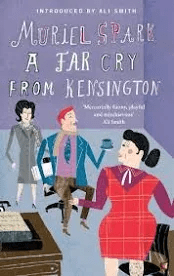
A Far Cry from Kensington by Muriel Spark, 1988

Muriel Spark is on my auto-buy list. When browsing in second hand bookshops I have a few authors I always buy if I can find them. As long as the book is reasonably priced, in decent condition, and I don’t already have it, I will always buy novels by, among a small number of other authors, Muriel Spark. Her novels are always interesting and worth reading, and A Far Cry from Kensington was no exception.

Set in 1955, A Far Cry is narrated by the no-nonsense Mrs Hawkins, a thinly disguised semi-autobiographical portrait of the author. It centres on a “rooming house” in (you guessed it) Kensington – a large house divided into separate one room apartments – where a diverse set residents live under the care and supervision of the landlady, Milly. It is a comfortable community of people in transit, typical of post-war London, settled by individuals and couples looking to establish themselves in London and in life.

Mrs Hawkins works in publishing. Some of her reminiscences (the narrative is told in flashback, some thirty years later) are based on Spark’s own time working in this field. Initially she works for the Ullswater and York Press, a chaotic publishing house that is heading for bankruptcy. I haven’t researched the novel sufficiently to say this for certain but I would put good money on the fact that Ullswater Press has a real-life equivalent that went bust in the mid-1950s, causing something of a scandal at the time as the proprietor was subsequently jailed for fraud.

The novel’s villain is Hector Bartlett, a bad writer who has influential friends who try to secure publication of his writing. Hector takes to accidentally-on-purpose bumping into Mrs Hawkins on her daily walks in the park near her office, attempting to leverage this casual relationship into an introduction to her boss. Hector the writer is described thus

“Hector Bartlett, it seemed to me, vomited literary matter, he vomited and sweated, he excreted it…His writings writhed and ached with twists and turns and tergiversations, inept words, fanciful repetitions, far-fetched verbosity and long, Latin-based words.”

Hector the man is if anything even more harshly described:

Red hair en brosse, brown corduroy trousers, tweed coat with leather patches on the sleeves, a yellow tie, and a green check shirt….with a pronounced stoop of the shoulders which made him seem older than he was… His face was round with a second fat chin”.

Mrs Hawkins describes him to his face as a ‘pisseur de copie” a urinator of journalistic prose, and never backs down from this undeniably confrontational phrase. Spark denied that Bartlett was a portrait of anyone specific in post-war literary London, which I suppose must be right given how libellous it would otherwise have been!

Bartlett uses his influence with Emma Loy, a successful novelist, to have Mrs Hawkins sacked from Ullswater Press and subsequently from another job in publishing when she continues to use this description of him and also refuses to rewrite his copy to make it acceptable for publication. This doesn’t have a significant impact on her career and even if it would have done she is not the kind of character to back down, even in the face of a direct plea from Ms Loy. She can’t stand him, and her instincts prove spot on when there are further revelations about his damaging behaviour towards other women in the novel.

A Far Cry isn’t just a series of anecdotes about the publishing world. While the residents of the boarding house all have their brief moments centre stage, Wanda, the Polish emigre seamstress, has a defining role when she receives a threatening letter, which leads to a downward spiral that, we eventually find out, was caused by the vengeful pisseur de copie.

Central to the novel is the bizarre practice of ‘radionics’.  Radionics is a form of quack therapy that survives to this day (There is a Radionics Association that awards three-year diplomas and sells crystal pendulums). It claims that diseases and other medical conditions can be diagnosed and treated by applying electromagnetic radiation such as radio waves to the body from an electrically powered device. It ‘works’ only through the placebo effect. Mrs Hawkins has no time for it and it is no surprise that Hector Bartlett is an enthusiast proponent of the concept, using it to manipulate other characters in the novel. People undoubtedly do fall prey to this sort of scam, and while radionics may have faded out somewhat, certainly in the UK, other forms of manipulation have of course taken its place. Initially I found this all a bit clumsy, but on reflection the fact that there are many modern forms of the same pseudo-science that people fall prey to every day made me reconsider and feel more charitable towards the idea as a plot device.

This is a complex and rewarding novel in which Mrs Hawkins’ narration, even with the benefit of thirty years of hindsight, reveals only glimpses of what is ‘really’ going on – for example the identity of the anonymous threatening letters to Wanda is only revealed in passing at the end of the novel, the revelation pivoting on the spelling of the word “organisers”. The reader sees the events of the novel through the eyes of 1955 Mrs Hawkins as she experiences them in real time, with only occasional reassuring interjections by the 1980’s narrator. I have enjoyed other Spark novels more, but I could admire the artistry of A Far Cry without being blown away by its sophistication.

A Far Cry from Kensington by Muriel Spark, 1988

Aside
Book review

Uproar!: Satire, Scandal and Printmakers in Georgian London by Alice Loxton, 2024

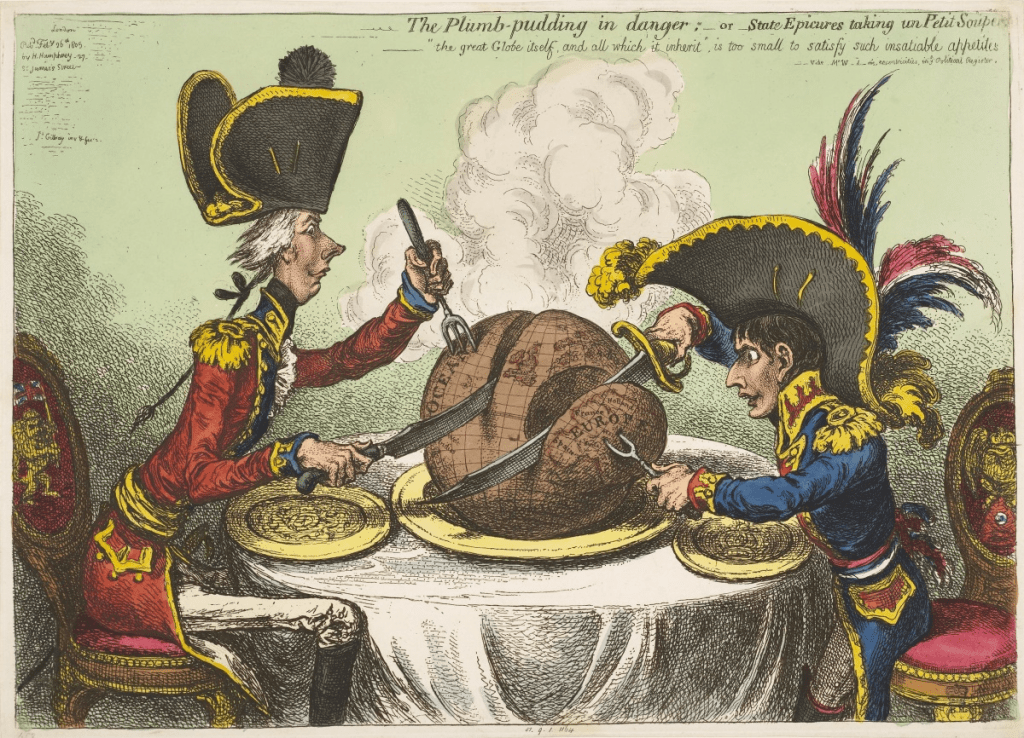
Uproar! is a jaunty look at the work of the golden era of satirical printmakers in Georgian Britain. These are names you will have heard of – Cruickshank, Rowlandson and Gillray, you will definitely have seen some of their work, such as the famous and much copied sketch of Pitt and Napoleon carving up the world like a plum(b) pudding (below).

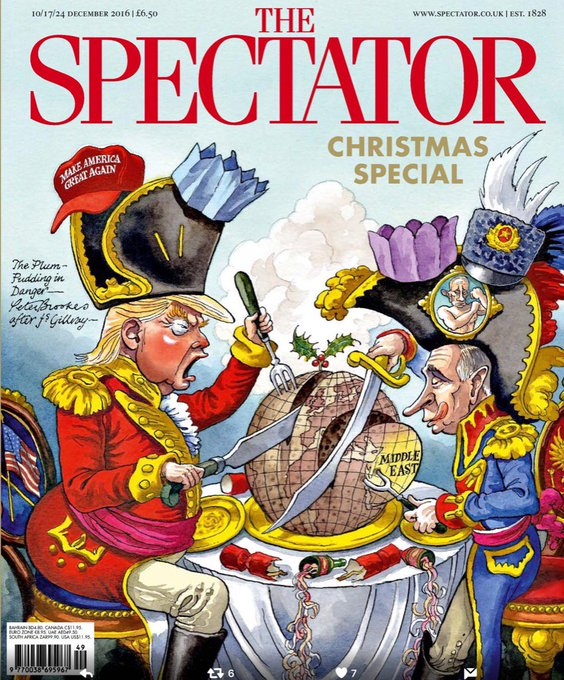
While writing the previous sentence I wondered whether this sketch would work if the characters were replaced with more contemporary figures such as Trump and Putin – and viola:

Previously I knew very little about these caricaturists, although many of their sketches were very familiar. Loxton charts their rise as important influencers of public opinion in the context of the technological changes (which allowed the prints they produced to be published quickly and cost effectively) and the political upheaval occurring at the same time – the loss of the American colonies, the French revolution, and the rise of Napoleon. It’s a compelling story briskly told alongside brief biographies of the main characters.

Being picky, I found the author’s attempts to make the account relevant by a liberal sprinkling of contemporary culture reference a bit annoying. The X Factor, Carry On films and The One Show are all referenced. (“If joining the Royal Academy under Sir Joshua Reynolds was the chance to get a five-minute interview on The One Show, studying with Pigalle in Paris was the equivalent of being sent to Hollywood” and later “Much like the X-Factor starlets staying at Simon Cowell’s LA Mansion”). Do these images really add to the point being made, or do they feel like an author slightly desperate to make boring old history relevant? I could have done without them, particularly because most of the references are so out-of-date – would the average Millennial even know what the Carry On films were?

However, with this qualification, the author makes a compelling case regarding the importance of printmakers to Georgian politics and society. The comparison to Spitting Image is equally strangely old-fashioned, but for readers of my generation it works – Spitting Image definitely had a impact on late-twentieth-century politics. Arguably that impact was zero – politicians used to love being in the limelight by being portrayed in grotesque latex – but that’s the nature of satire; you can never be certain whether it influences political events. Certainly the image of a stone-grey John Major eating his peas has stayed with me!

The final chapter, in which the author attempts to summarise the impact and importance of the Georgian caricaturists, felt a bit confused. Their significance at the time did not outlast the Georgian period. Once Gillray, (Isaac) Cruickshanks and Rowlandson had died, all around the same time as George 3rd and the end of the Regency, society was ready to move on to a new era of Victorian conservatism, in which the extravagance of the caricatures was considered indecent and disrespectful. But to say they were ‘cancelled’ is to misuse a phrase from the era of social media. Reputations rise and fall but the work of these printmakers and satirists has definitely survived and remains relevant, as the Trump/Putin examples above demonstrate. Loxton I think fairly describes their influence as ” undeniably one of the most powerful forces in Georgian Britain; their prints not only reacted to world events, but propelled political change, they shaped public opinion; they built up careers; they shredded reputations.” She even goes so far as to claim that these printmakers were the reason Britain didn’t see its own version of the French Revolution, which seems quite a stretch, and argue they had a direct influence on artists as varied as Blake, Lewis Carroll, and even Salvador Dali.

One false note was the author’s claim that ‘Victorian commentators’ were responsible for inflating the reputation of William Blake above those of his contemporary illustrators. This is bizarre. Blake’s reputation rests largely on his poetry, which isn’t mentioned, and his art is as far from the satirical cartoons of Gillray etc as can be imagined. But that aside this is a really useful summary of the politics and history of this I think unfairly neglected art form and its impact on social change in Georgian Britain.

Uproar!: Satire, Scandal and Printmakers in Georgian London by Alice Loxton, 2024

Aside
Book review

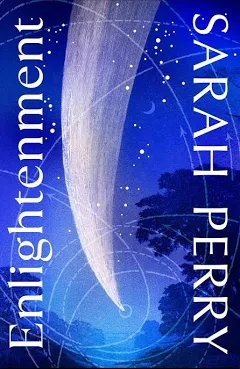
Enlightenment by Sarah Perry, 2024

Enlightenment is very recognisably a Sarah Perry novel. It contains many of the same elements and themes of her earlier novels, The Essex Serpent and Melmoth* although it is probably her most autobiographical novel to date.

It opens in the winter of 1997 in the Essex town of Aldleigh, a thinly disguised version of Chelmsford where Perry grew up. Thomas Hart writes a column for the local newspaper and attends Bethesda, a strict Calvinist church of the kind that somehow survives into the present day in small pockets of Essex. Hart is gay but keeps his private life private, knowing it would be frowned upon by the unforgiving people of Bethesda. When his sexuality is eventually ‘exposed’ he is told that he is “an affront to God” and effectively expelled from the congregation.

The chapel is next to Lowlands House, a crumbling stately home and park, slowly being restored by the local museum. Potters Field, an area of scrub and wasteland is also adjacent to the chapel and provides a metaphorical counterpoint to its order and structure.

One day James Bower, curator of the local museum, writes to Thomas about some correspondence that has been found during the renovations of Lowlands House. James thinks the letters might be a clue to the local legend of the Ghost of Lowlands, who he identifies as Maria Vaduva, an elusive nineteenth-century resident of Lowlands. The pursuit for the mysterious Maria and the truth about what she discovered in the night’s sky forms the central narrative of the novel.

Thomas is also an amateur astronomer and the link he shares with Maria drives him to discover her story, scattered as it is through the novel in the form of long-lost letters, some hidden in the fabric of Lowlands, others in private papers in the museum. The other main character in the novel is Grace Macauley, the pastor’s daughter, who when the novel opens is about to turn 18. Thomas feels paternal towards Grace and one thing keeping him in Bethesda and Aldleigh is his determination to watch over her. Grace starts a romantic relationship with Nathan, a local lad not associated with the church, but Thomas sabotages their friendship, an act for which he is never fully forgiven.

Enlightenment is slow-paced and luxurious and at times almost Dickensian. The sense of place is vivid, no doubt in part due to the autobiographical elements of the story.

“Monday: late winter, bad weather. The River Alder, fattened by continuous rain, went in spate through Aldleigh and beyond it, taking carp and pike and pages torn from pornographic magazines past war memor­ials and pubs and new industrial estates, down to the mouth of the Blackwater and on in due course to the sea. Toppled shopping trolleys glistened on the riverbank; so also did unwanted wedding rings, and beer cans, and coins struck by empires in the years of their decline. Herons paced like white­coated orderlies in the muddy reeds; and at half past four a fisherman caught a cup untouched since the ink was wet on The Battle of Maldon, spat twice, and threw it back. 

Late winter, bad weather: the town oppressed by cloud as low as a coffin lid. A place spoken of in passing, if at all: nei­ther Boudicca nor Wat Tyler had given it a second glance when they took their vengeances to London; and war had reached it only as an afterthought, when a solitary Junkers discharged the last of its ordnance and extinguished four souls without notice.” 

The novel clearly owes a significant debt to A S Byatt’s Possession, but I didn’t find that at all problematic. Some novels are like other novels, and draw inspiration from one another, but that doesn’t mean they are derivative.

Many book bloggers structure their posts around categories such as publication data, information about the author, a plot summary and so on. I’ve never been organised enough to do this, but if I were ever to do so one category I would include would be “How easy was the novel/text to read?” Authors can make their texts easier to read in lots of ways: very short chapters and a large font is the approach adopted by writers such as Richard Osman for example. But of course the reader can make things difficult for themselves – reading late at night, leaving large gaps between each reading session so remembering what is happening gets tricky, and so on. I found Enlightenment a little hard to read. The narrative progression is slow and the events that do happen are often predictable. Some plot devices, such as the finding of very old letters in the fabric of Lowlands House, are a bit too convenient. We were never not going to find out what happens to Maria. Thomas is not a compelling character – he is very introspective and reserved – and while Grace is a more interesting character her life proves aimless until she is able to be reunited, temporarily, with Nathan.

I enjoyed Enlightenment but I can’t resist the feeling that the author’s best novel is still to come.

*Perry also wrote After Me Comes the Flood (2014) which I have yet to read.

Enlightenment by Sarah Perry, 2024

Aside
Book review

We Solve Murders, by Richard Osman, 2024

I think it would have been a reasonable assumption that in moving away from The Thursday Murder Club, Richard Osman was going to try something a bit different. He strongly implies as much in the acknowledgements to the fourth book in the series. Yet while We Solve Murders superficially inhabits a totally different world from the TMC series, if you scratch the surface we are right back in Coopers Chase.

We Solve Murders introduces the reader to Amy Wheeler, a bodyguard to the rich and famous. Amy is seriously hard-core, totally unafraid of the dangerous life and death situations she regularly finds herself in. She has a long-distance relationship with her husband, who plays only a very minor role in the book, but seems much closer to her father-in-law, retired copper and widower Steve. Steve loves his quiet life – pub, crossword, and chatting to his late wife – and is very reluctant to be pulled away from this retirement when Amy calls for his help. Amy’s client, Rosie D’Antonio, the world’s second most successful novelist forms the unlikely third wheel of this team as they career around the world trying to do what the novel’s title promises they will – solve murders.

Because someone has been killing influencers – young naïve people with small social media followings who travel to exotic locations to promote brands that mysteriously don’t seem to actually exist. This isn’t really one of the novel’s puzzles – we are told by the novel’s criminal mastermind who narrates occasional chapters that these killings are a retaliation for when his money smuggling operation is called into question. While the use of gullible and well-meaning influencers to unwittingly move money around the world is an innovative idea, I am not sure that’s how money smuggling really works anymore, is it? Surely it’s moved around online nowadays? Not that I claim any expertise in this issue I hasten to add. Amy is set up as the fall guy for the murders, which is a really silly choice as she is not going to allow this to happen without putting up a ferocious fight.

While the novel is set in several exotic locations – a private island off the coast of South Carolina, St Lucia, Dubai, and Dublin (!) – there’s no real sense of place in any of them. They could have been anywhere. I had to wonder whether these locations were chosen more for the inevitable film adaptation than the narrative? There’s also no really sense of peril – Amy, Steve and Rosie are held at gun-point and shot at more than once, but I didn’t for a second think they were going to die. Neither did they if the way they respond is to be believed – plot armour is one thing, but characters behaving as if they know they have plot armour is another!

Rosie is a source of much of the novel’s slapstick comedy – she is an archetypical randy pensioner, and being incredibly rich she can conveniently summon up private jets and helicopters at a moment’s notice. She has a sense of adventure which means she can be extremely reckless, in counterpoint to Steve’s deeply conservative instincts. He always yearns to be back home with his cat, Trouble. The novel’s ending is both predictable and to be honest not that interesting – the exposure of the bad guy’s identity is very much a ‘so what?’ moment. But that’s missing the point, because this is cosy crime after all, however badly disguised as a thriller, and it’s the gentle humour that keeps the pages turning, not any sense of adventure. One of the novel’s climactic scenes happens at a pub quiz, which tells you all you really need to know.

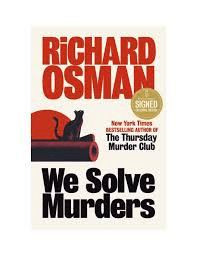
The hard-back edition of this novel has a strangely neutral design – it’s definitely moved away from the distinctive Thursday Murder Club ‘branding’ – but to where? The author’s name dominates the front cover, and the portrait of Trouble is the only real ornamentation on an otherwise stark black and red design. I think it reflects some uncertainty on the part of the publishers – whether to market the novel as ‘more of the same’ (the text “Best selling author of the Thursday Murder Club” appears above the title) or a new direction for the author. I can’t blame Osman for staying close to what has been a hugely successful and rewarding formula for him. It may not seem like it but I did enjoy reading We Solve Murders despite my reservations, but I wasn’t challenged by it in any way. Osman is by now such an accomplished novelist that as a reader you can leave yourself in his hands knowing he is going to safely guide you to the conclusion with everyone you care about in one piece, all ends neatly tucked away and the opening lines to the sequel already inked in. (In fact I fully expected the opening chapter of the sequel to appear at the end of this edition – it’s that kind of book – but it didn’t; instead we are neatly guided back towards TTMC).

In conclusion, you won’t be at all surprised to read that if you enjoy TTMC you will enjoy We Solve Murders. I do and I did.

We Solve Murders, by Richard Osman, 2024

Aside
Book review

Julia, by Sandra Newman, 2023

My first review of 2025 is of Sandra Newman’s compelling Julia, a retelling of the events of George Orwell’s 1984 from the perspective of Winston Smith’s young lover, whom he betrays in the novel’s bitter climax in Room 101 “‘Do it to Julia! Do it to Julia! Not me! Julia! I don’t care what you do to her. Tear her face off, strip her to the bones. Not me! Julia! Not me!'”

Which poses the very simple question as to whether 1984 needs to be retold from Julia’s perspective. The source novel is told from Winston’s point of view. Through Winston (and bearing in mind his relationship with her is quite short and comprises a few snatched moments and afternoons) we learn a little about her background and childhood, her life as a mechanic in the Fiction Department of the Ministry of Truth, and her living arrangements, sharing a hostel room with thirty other young women.

Julia sent me back to 1984 to try and ascertain how much was the author’s creation, filling in the gaps left by Orwell’s account, and how much was based on the source material. I was surprised at how much the original novel does actually tell us about Julia – she certainly isn’t the two dimensional character some critics would have you believe, and I don’t think she necessarily needed to be re-imagined by this novel to be made more believeable or rounded. Of course the original novel doesn’t contain her full life story or her internal monologue – Winston’s point of view narration precludes this. More honestly, Winston isn’t that interested in Julia’s background or history. Their relationship is not simply one of an older man being sexually attracted to a younger, more independent woman – Winston is genuinely interested in Julia’s ideas and is guided by her in acts of rebellion other than ‘sex-crime’ – “In some ways she was far more acute than Winston, and far less susceptible to Party propaganda. Once when he happened in some connexion to mention the war against Eurasia, she startled him by saying casually that in her opinion the war was not happening. The rocket bombs which fell daily on London were probably fired by the Government of Oceania itself, ‘just to keep people frightened’. This was an idea that had literally never occurred to him. She also stirred a sort of envy in him by telling him that during the Two Minutes Hate her great difficulty was to avoid bursting out laughing.”

A lot of the critical commentary on Julia is based on the assumption or claim that the original novel is in some way unfair to her. The Guardian put it this way: “This ambitious retelling from Julia’s point of view gives Winston Smith’s lover the agency she lacked. ” Is this fair? Did Orwell have a ‘women problem’? And does 1984 underplay Julia’s role, reducing her to a sexual partner and victim, requiring this attempt to rehabilitate her? Certainly women play only minor roles in most of his earlier novels, and the one exception, Dorothy in A Clergyman’s Daughter, is a largely unconvincing portrait used principally as an avatar for Orwell to recycle some of his journalism. But I think there is a case to made for Julia being one of his most fully-rounded female characters. She is independent, brave, forthright, and kind. The Julia we are introduced to in Newman’s novel is very closely modelled on Orwell’s original – Newman has been very respectful to the source material, and only made one significant change. Fairly early in in the novel Julia is recruited into the Thought Police, and in addition to her relationship with Winston she is instructed to seduce a number of other Outer Party members and encourage them to commit thought- and sex-crimes.

The idea that Orwell’s version of Julia lacks agency is unfair and wrong – it is Julia who initiates the affair with Winston, finds them somewhere to go to have sex, and has previously had many other lovers. She is a strong woman who knows what she wants and is perfectly willing to take calculated risks. Newman’s Julia is not significantly more independent than Orwell’s – arguably her early recruitment into the Thought Police actually reduces her agency. From that point she is compelled to follow their instructions and cannot freely pursue her own choices.

Day to day life in Airstrip One is vividly described in 1984. These descriptions would have been painfully familiar to Orwell’s original audience in a Britain only slowly emerging from the hardships of the Second World War. Newman builds upon this portrait, giving more detail on the petty humiliations that young women have to face. She describes the Party’s ArtSem (artificial insemination) programme which is used as cover when women fall pregnant outside of marriage and other aspects of women’s lives which the original novel did not describe or consider. Overall the Airstrip One she describes is vividly recognisable and very faithful to Orwell’s portrait.

As long as Julia remains safely within the guide rails of the source material, the novel remains on track, but the text fails to convince as soon as it goes beyond the undeniably bleak ending of 1984. Newman understandably chooses to omit Orwell’s suggestion that Julia has been lobotomised during her torture and goes on to suggest that the end of Big Brother’s rein of terror is imminent. This is nowhere suggested in the source text – quite the opposite, Orwell suggests that Big Brother is unbeatable (although the appendix on Newspeak implies that one day IngSoc’s rule comes to an end).

Orwell’s handling of Winston’s torture, and in particular the climax of this process in Room 101, is a very hard read. Newman takes this several steps further – the descriptions of Julia’s abuse is really hard to stomach. Orwell would not have been allowed by his publishers to be this explicit, but sometimes less is more. Newman doesn’t blink and follows through with the implication that the ultimate torture conceived for Winston is applied instead to Julia. The horror of this is undermined by the deus ex machina resolution Newman applies, which is that Julia survives the torture because the time each victim has in Room 101 is limited to fifteen minutes, because of the sheer volume of torture candidates. This is a serious misstep – I understand why Newman wanted to show the horrific consequences of Winston’s betrayal and at the same time keep Julia alive, but this resolution is deeply improbable in a world of bitterly realistic situations.

Novels based on and inspired by well-known original texts need to overcome some high hurdles to avoid being dismissed as mere fan-fiction. They need to be respectful to the source material – in most respects Newman does this, with some important exceptions. They need to have a clear reason for returning to the source material, and I think Newman ticks that box as well, giving a clear and recognisable voice to a character who often appears enigmatic in the source text, and exploring what life on Airstrip One would be like for women, a subject Orwell is largely silent on. The tightrope between simply being an attempted impersonation of Orwell’s voice and being faithful to his creation is an awfully difficult line to tread and I think for the most part, with one or two significant exceptions, Newman achieves this. It often felt like I was reading an authentic description of life under Big Brother, chapters that Orwell would have not disowned. For these good reasons alone Julia is definitely worth reading. I did have just one minor complaint – the cover design is awfully drab. It tries to suggest the relationship between the novel and the source text but I am sure there must be better ways of doing it.

Julia, by Sandra Newman, 2023

Aside
Book review

Summing Up 2024, and looking forward to 2025

I reviewed 35 books in 2024, which is about average for me in a typical year, but a little disappointing nonetheless. One book every ten days, read and reviewed, doesn’t sound too bad, and that does include Dombey and Son – but almost all the other books were either average length or shorter. Definitely a ‘must try harder’ year. Likes and views were slightly down on 2023, but still better than any other year. My five most popular posts were my reviews of Bob Mortimer’s underwhelming The Satsuma Complex, Richard Osman’s The Last Devil to Die, fourth in the Thursday Murder Club series, Ben Okri’s The Famished Road, and Graham Greene’s The Third Man. The other post in my top five is one in which I discuss Clothing in Jane Eyre, which was posted back in 2016 and which is by some considerable distance my most visited post of all time. I can just about understand why the Mortimer and Osman reviews are popular – these were both huge sellers from the end of 2023 – but the persistent popularity of the other posts are baffling. Not that I am complaining!

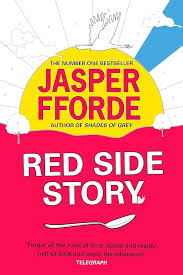
My reading in the first quarter of the year is as always going to be focussed on the outstanding selection of books received as presents, including new novels by the aforementioned Mortimer and Osman, as well as a book I am very much looking forward to, the latest Jasper Fforde novel. My 2025 Dickens is going to be his last completed novel, Our Mutual Friend. Beyond that I do not have any specific reading targets, but I would like to improve on this year’s total if possible. While I have abandoned my attempt to read all the Booker Prize winning novels – I was left with a small residue which I simply didn’t like the look of – I will be catching up on one or two of the more recent winners this year. Above all I will be trying to recapture the reading bug, that love of reading that is such a blessing and which gives this blog its corny name.

Summing up 2024, and looking forward to 2025

Aside
Book review

The Wager: a Tale of Shipwreck, Mutiny, and Murder by David Grann, 2023

The Wager is everywhere at the moment. After President Obama listed it as one of his books of the year in 2023 it topped The New York Times best-seller list and stayed in the top ten for six months. The film rights were snapped up by Martin Scorsese and Leonardo di Caprio. It featured in many best books of 2023 lists: as usual I am coming very late to the party. Accordingly my expectations were sky-high and predictably I was a little disappointed – if it hadn’t had this much hype I would have been able to read and appreciate the book on its own terms. Oh well.

The book’s blurb and description on Amazon give this summary (I’ve tried to edit it because it is quite long, but in the end I decided to keep it full-length because the detail actually matters):

On January 28, 1742, a ramshackle vessel of patched-together wood and cloth washed up on the coast of Brazil. Inside were thirty emaciated men, barely alive, and they had an extraordinary tale to tell. They were survivors of His Majesty’s Ship the Wager, a British vessel that had left England in 1740 on a secret mission during an imperial war with Spain. While the Wager had been chasing a Spanish treasure-filled galleon known as “the prize of all the oceans,” it had wrecked on a desolate island off the coast of Patagonia. The men, after being marooned for months and facing starvation, built the flimsy craft and sailed for more than a hundred days, traversing nearly 3,000 miles of storm-wracked seas. They were greeted as heroes.

But then … six months later, another, even more decrepit craft landed on the coast of Chile. This boat contained just three castaways, and they told a very different story. The thirty sailors who landed in Brazil were not heroes – they were mutineers. The first group responded with countercharges of their own, of a tyrannical and murderous senior officer and his henchmen. It became clear that while stranded on the island the crew had fallen into anarchy, with warring factions fighting for dominion over the barren wilderness. As accusations of treachery and murder flew, the Admiralty convened a court martial to determine who was telling the truth. The stakes were life-and-death–for whomever the court found guilty could hang.

To be fair, this is not just the publisher’s summary – in the book’s opening chapter this version of what it to come is largely the same: this is a story of a shipwreck that leads to mutiny, murder, and finally a form of retribution for the survivors. Except it is not.

For a start there was no real mutiny – no-one was tried for this incredibly serious charge. If the Admiralty had thought there was any risk of this offence being condoned they would have seen to it that people hanged, just in case anyone thought mutiny was acceptable in any circumstances. They took law and order extremely seriously. There was no question a dispute amongst the survivors about how to reach civilisation once the Wager had been shipwrecked on an isolated (but not completely deserted) island. The bulk of the survivors ignored the captain’s wishes to sail north to Chile and instead headed off in the opposite direction – but the Admiralty did not think this constituted mutiny. If the breakaway group had really thought they were committing mutiny they would almost certainly have destroyed the many paper records that they carried with them back to England and for that matter they would have avoided handing themselves in to the authorities by travelling back to England in the first place.

For an event that happened on the other side of the world almost three hundred years ago, there is a remarkable amount of documentary evidence about the wreck of the Wager and the subsequent ordeal of its crew. Many of the survivors wrote extensively about their adventures – the account by the leader of the expedition of which the Wager was a part, George Anson, is still in print – and in addition many of the contemporaneous records including log books and diaries survived and are available to historians (to be completely fair to Grann whether he is an academic historian or not (not) I nevertheless include him in this category; his account is very well researched and evidenced. It’s just not a new or untold story).

There was no trial, no-one was found innocent or guilty, and no-one was hanged. There was an investigation with a very limited scope, but that quickly found that no further action was required. This is all a bit of a damp squib after the long build-up in which the reader is explicitly lead to believe that a trial would decide who was telling the truth about the shipwreck. In fact the introduction suggests this is the whole point of the narrative. Surprisingly there were no significant differences between the survivors as to what happened; broadly speaking their accounts agreed, not least because of the extent of the written record. Whether the actions of the protagonists were justified was disputed, but what they actually did or did not do was not disputed.

So this is not the book we are led to believe it is going to be. It is instead a dramatic but as far as possible accurate retelling the story of the Wager. Much of the book is dedicated to the preparation for setting sail and then the journey to South America and beyond, the challenges of assembling a crew and then the privations once on board and under sail. The Wager was part of a wider expedition which in turn was part of the English campaign against the Spanish that in this period. usually described as the War of Jenkins’ Ear. The shipwreck and the appalling conditions on the island that the survivors experienced (although ironically the diet of scavenged seaweed and sea celery help cure the ravages of scurvy all the men had faced) are brought to life and it is from this point, almost three-quarters of the way through the book, that the ‘slow-motion mutiny’ (as Wikipedia describes it) unfurls.

The Wager has some striking similarities with Batavia’s Graveyard, Mike Dash’s 2002 account of a shipwreck some 100 years earlier, in which the survivors faced a life and death struggle for survival, order quickly broke down and brutality engulfed the survivors. The crew of the Wager behaved in a relatively civilised fashion compared to their East Indian counterparts from the Batavia. To be fair their island was better equipped – they even had friendly natives on hand to bring them food (although the quickly scared them off with their behaviour). If you are looking for books with a similar theme and structure to The Wager, Batavia’s Graveyard is highly recommended.

When a book doesn’t live up to the hype it can be disappointing, but judged on its own merits The Wager was an enthralling read. The book’s epilogue, telling the story of the rest of the fleet which was slowly destroyed, leaving just one surviving ship, which in a ferocious sea battle captured a Spanish treasure ship and made its way home from halfway around the world , is told almost as an afterthought, but it is hard to resist the thought that this was the more compelling adventure.

The Wager: a Tale of Shipwreck, Mutiny, and Murder by David Grann, 2023

Aside
Book review

Invisible Man, by Ralph Ellison, 1952

Invisible Man appears on many lists of the best novels of the twentieth century. It is a powerful and often disturbing account which challenges many of the conventional ideas of the form and structure of the novel.

It opens with the narrator, an unnamed black man, living in an underground room lit by hundreds of electric lights powered by electricity stolen from the city’s grid. He tells his story in flashback, attempting to explain why he feels socially and sometimes literally invisible.

“I am an invisible man. No, I am not a spook like those who haunted Edgar Allan Poe; nor am I one of your Hollywood-movie ectoplasms. I am a man of substance, of flesh and bone, fiber and liquids — and I might even be said to possess a mind. I am invisible, understand, simply because people refuse to see me. Like the bodiless heads you see sometimes in circus sideshows, it is as though I have been surrounded by mirrors of hard, distorting glass. When they approach me they see only my surroundings, themselves, or figments of their imagination — indeed, everything and anything except me.”

Born in the American South, he lives in a highly segregated society, in which black people live in fear and subjugation. He intends to escape the poverty which defines black lives in this community and wins a scholarship to an all-black college. Integrated education in the South at this time was unheard of. He works to support himself by taking a chauffeuring job. One day, while chauffeuring Mr. Norton, a trustee of the college, he makes a series of disastrous decisions. Norton, a white man, is curious about the lives of local black people. The narrator takes him to the old slave-quarters near the college campus. The fact that there even are old slave quarters still standing shows that slavery is still part of people’s lives, despite it formally ending almost a century beforehand. Here Mr Norton meets Jim Trueblood, a notorious local figure who has got both his wife and his daughter pregnant ‘in his sleep’. This is an uncomfortable portrait of black poverty in which people live little better than slaves and ignore social conventions regarding incest. Norton is appalled and asks to be taken somewhere for a stiff drink. Inexplicably the narrator takes him to a local brothel, where a riot breaks out caused by a surreal day-outing of patients from a nearby mental hospital. (There is an echo of this scene in One Flew Over the Cuckoos Nest, where the patients are taken out for the day, with similarly disastrous consequences).

The narrator is summarily expelled from college. He sees it as an unfair punishment but his principal is appalled that he has exposed the dark side of black people’s lives behind the civilised facade of the campus. The narrator travels to New York and finds work in a paint factory. More chaos ensues – he is a magnet for trouble and has no control over his life. He unwittingly causes an explosion at the factory, is hospitalised and given electric shock treatment. He escapes the hospital and stumbles into the next, decisive phase of his life. Happening across the eviction of an elderly black couple he makes an impassioned speech in their support, accidentally inciting the crowd to attack the bailiffs and triggering yet another riot. His oratorical skills are recognised by a group known as “the Brotherhood” which appears to be a black nationalist movement. He signs up and quickly becomes one of the group’s keynote speakers. Internal politics eventually turns this sour, and he becomes disillusioned with the group. Its message of gradual change and co-operation with whites is challenged from the left by more radical voices, led by a figure known as Ras the Exhorter. The novel reaches its climax with the narrator getting caught up in a race riot in Harlem. He narrowly escapes being lynched by supporters of Ras the Exhorter who perceive him as a traitor to his race.

Invisible Man is vivid, impressionistic, and unconventional. Superficially it follows a traditional narrative structure but the narrator’s adventures and mishaps are chaotic and often appear random. It charts a very specific time in Black American history at the birth of the Civil Rights movement, when many of the debates about how best to combat segregation and oppression were at their fiercest. It’s not a comfortable read but it is an important, unique book.

Invisible Man, by Ralph Ellison, 1952

Aside
Book review

The Lost World by Sir Arthur Conan Doyle, 1912

The Lost World is an unashamedly escapist adventure story. Although published shortly before the outbreak of the First World War, there is barely a hint of the looming conflict. There is one brief glimpse of the real world – when celebrating the success of the stories of Malone, the plucky young reporter for the Daily Gazette, his editor tells him “What a three column article for the paper! What a foundation for a career! A correspondentship in the next great war might be within my reach.” As with so many other texts of this period, the inevitability of a future ‘great war’ is accepted as a matter of fact. I also find it interesting that it was referred to as ‘the great war’ even before it had started! – great here is simply a reference to scale rather than the later suggestion that it was glorious in any way.

You will be familiar with what happens in The Lost World because it is the source of many of the tropes of the genre to which it gives its name. Malone, the reporter mentioned above, asks his editor for an assignment to somewhere exotic and challenging in order to impress Gladys, the woman he loves. In rejecting his marriage proposal she tells him that she will only marry a man of action and achievement:

“He must be a man who could do, who could act, who could look Death in the face and have no fear of him, a man of great deeds and strange experiences. It is never a man that I should love, but always the glories he had won; for they would be reflected upon me. Think of Richard Burton! When I read his wife’s life of him I could so understand her love! And Lady Stanley! Did you ever read the wonderful last chapter of that book about her husband? These are the sort of men that a woman could worship with all her soul,”

Malone takes this rejection at face value, and decides to find a way of meeting her expectations. His editor is sceptical as to whether such great deeds and strange experiences can be found any more:

Dear me, Mr. Malone, this is very—very exalted. I’m afraid the day for this sort of thing is rather past. The expense of the ‘special meesion’ business hardly justifies the result, and, of course, in any case it would only be an experienced man with a name that would command public confidence who would get such an order. The big blank spaces in the map are all being filled in, and there’s no room for romance anywhere.

The mention of an ‘experienced man with a name to command public confidence’ gives him an idea. He suggests that Malone approaches Professor Challenger for a place on his next expedition. Challenger is a blimpish, cartoon-like figure who challenges to a fist-fight anyone who cast doubt on his account of his recent expedition to the Amazon, where he claims to have discovered a lost world where dinosaurs still roam.

At a rowdy public meeting Challenger announces he is going back to the Amazon, and Malone volunteers to join him, along with Professor Summerlee, a zoologist who has publicly questioned Challenger’s claims and Lord John Roxton, a professional adventurer. It is not long before the Atlantic has been crossed and the party of explorers sets off up the Amazon in search of the Lost World. Their party, along with the ubiquitous native guides, quickly reaches the isolated plateau, cut off from the surrounding countryside, where the prehistoric wildlife is to be found. There’s an economy to the narrative – not much time is wasted with exposition, speculation or character development. The cliffs to the plateau cannot be climbed, but the party is able to scale a nearby spire of rock. Using a tree as a bridge they cross over to the plateau.

A treacherous guide, seeking revenge on Roxton for a grudge held from a previous adventure, pushes the tree-bridge off the pinnacle, stranding the party of four, who have no choice but to set off and explore this lost world. They encounter dinosaurs and other animals, insects and plants previously thought extinct, many of which are highly dangerous. It’s not just the wildlife they have to be cautious about, because while Malone is off one night exploring the plateau’s central lake, his companions are taken prisoner by some ape-men, referred to by Malone (acting as the novel’s narrator) as the missing link. Roxton escapes and with Malone’s help rescues the others, together with some indigenous cave people who are at war with the ape-men. A battle royale ensues in which the white men’s guns tip the bitter long-running struggle in the favour of the cave men, wiping out the ape-men and enslaving their women and children.

Eventually the explorers find a tunnel leading off the plateau and on to civilisation. The novel ends with a rerun of the public meeting in which Challenger’s claims about the lost world are repeated and once again challenged, the difference being when he produces a young pterodactyl as proof, triggering a small riot. The novel doesn’t quite end there. Two final scenes close the show. First, Malone returns to Gladys, who had married a banker in his absence, the very opposite of the man of action she described. I think the reader is meant to conclude women are fickle from this scene, but my reaction was that she was letting Malone down gently. At a private celebratory dinner Roxton then reveals that he has brought back £200,000 worth of diamonds from the expedition, making them all rich. With nothing to keep him in London Malone he decides to accompany Roxton back to the lost world. If this was the cinema the ending would be a great set-up for Return to the Lost World, but Conan Doyle obviously thought better of the idea (Hollywood disagreed, and Return to the Lost World is actually a real film!)

You may be wondering why I am reading Edwardian adventure novels? I think the simple answer is that they give an insight into how people – not everyone of course, but in particular the educated novel-reading and -writing classes – were thinking about the Empire and Britain’s place in the world at the close of the Victorian era. There was a nervousness about a decline in military strength relative to countries like Germany, France and Austro-Hungary. The Boer War had exposed serious weaknesses in the strength of the British army, particularly if conscription were ever to be needed. The trade unions were flexing their muscles and had set up the Labour Party. The world was changing and the extent to which these changes were reflected in the books people wrote and read at the time, and how their feelings about these changes are worked through in the stories, fascinates me. The Lost World is mainly an exercise in escaping the chaos that was about the erupt across Europe – but it doesn’t always succeed. When Malone and companions are fighting for their lives in the decisive battle between ape-men and cave-men, the struggle is a visceral matter of life and death:

For an hour or more after we entered the wood, there was a desperate struggle in which for a time we hardly held our own. Springing out from among the scrub the ape-men with huge clubs broke in upon the Indians and often felled three or four of them before they could be speared. Their frightful blows shattered everything upon which they fell. One of them knocked Summerlee’s rifle to matchwood and the next would have crushed his skull had an Indian not stabbed the beast to the heart….Once our allies broke under the pressure, and had it not been for the execution done by our rifles they would certainly have taken to their heels. But they were gallantly rallied by their old chief and came on with such a rush that the ape-men began in turn to give way… I was emptying my magazine as quick as I could fire, and on the further flank we heard the continuous cracking of our companion’s rifles.

War is brutal and lethal, as Europe (and Conan Doyle) were about to fight out.

The Lost World by Sir Arthur Conan Doyle, 1912

Aside
Book review

Lost Horizons, by James Hilton, 1933

Hilton’s 1933 novel, Lost Horizons, is in many ways an unconventional adventure story. It is almost completely devoid of action scenes – there’s no fighting with ghastly foreigners; situations in which primitive natives are impressed by the explorers’ gadgets are conspicuous by their absence; there are no encounters with wildlife, traditional or Jurassic. It does admittedly share some DNA with the classic Victorian Lost World adventure story. It opens conventionally for example, with a complex framing device in which a story is told by one traveller to another about a tale they once heard:

“Cigars had burned low, and we were beginning to sample the disillusionment that usually afflicts old school friends who have met again as men and found themselves with less in common than they had believed they had.”

It takes some time before we penetrate these layers and get to the central story, in which four Western travellers, escaping from violent civil unrest in China, are taken by airplane to a secret valley in the Himalayas. Here they discover Shangri-La, a hidden and mysterious community governed by a monastery populated by enigmatic monks. Shangri-La has a secret – there is something about the valley that gives its inhabitants extremely long lives (we never discover what causes this effect, but it only applies to people who come to live in the valley, not the indigenous residents who barely feature).

The novel’s central character and narrator is Conway, an Allan Quartermain-type figure. Conway is a diplomat who is still haunted by his experiences in the First World War:

Twelve years earlier he had grown to hate the perils of trench warfare in France, and had several times avoided death by declining to attempt valorous impossibilities. Even his D.S.O. had been won, not so much by physical courage, as by a certain hardly developed technique of endurance.

Conway is accompanied by his junior envoy, Mallinson, Barnard, an American businessman, and Miss Brinklow, a missionary. Mallinson is keen to return to the outside world, but eventually learns that there is a price to Shangri-La’s gift of long life – once you go there you are never allowed to leave. While the others gradually come to terms with their life sentences, albeit in a very comfortable cage, Mallinson plots his escape, and finally persuades Conway to help him. While we are left to guess at Mallinson’s eventual fate, the last we hear of Conway is that he is trying to return to the remote and inaccessible valley.

Lost Horizons looks back nostalgically to the great adventure novels of the turn of the century when there were believed to be still undiscovered parts of the world. In those novels the focus was Africa or South America, but Hilton sets his story in an even more remote area, the unexplored zone between Nepal, Tibet and China.  

“there came over him, too, as he stared at that superb mountain, a glow of satisfaction that there were such places still left on earth, distant, inaccessible, as yet unhumanized. The icy rampart of the Karakorams was now more striking than ever against the northern sky, which had become mouse-coloured and sinister; the peaks had a chill gleam; utterly majestic and remote, their very namelessness had dignity.

While British explorers and adventurers from Victorian novels would often treat the ‘foreigners’ they meet with contempt, Conway is a much more mature, might I even say liberal, traveller:

Conway had no race or colour prejudice, and it was an affectation for him to pretend, as he sometimes did in clubs and first-class railway carriages, that he set any particular store on the “whiteness” of a lobster-red face under a topee.

A persistent theme in the novel is the idea that Shangri-La will provide a safe haven for the coming global war. The idea that Europe was going to erupt into a war zone was common place at the turn of the century, but Hilton is prescient in his prediction that the same thing was going to happen again, this time on a global scale. Barnard, one of the kidnapped travellers who we eventually find out is a Wall Street financier on the run from the police, wanted for an unspecified financial crime, presumably embezzlement, is happy to stay in hiding because he believes the global economy is close to collapse. The head monk, Perrault, who established the monastery in the late eighteenth century, sees the speed of technological change happening in the world as likely to lead to war on an industrial scale:

“he saw the nations strengthening, not in wisdom, but in vulgar passions and the will to destroy; he saw their machine power multiplying until a single-weaponed man might have matched a whole army of the Grand Monarque. And he perceived that when they had filled the land and sea with ruin, they would take to the air… “But that was not all. He foresaw a time when men, exultant in the technique of homicide, would rage so hotly over the world that every precious thing would be in danger, every book and picture and harmony, every treasure garnered through two millenniums, the small, the delicate, the defenseless —all would be lost”

Perrault describes the coming war as a storm, and is clear that it will be an apocalypse of unprecedented scale and ferocity:

“The storm… this storm you talked of…”

“It will be such a one, my son, as the world has not seen before. There will be no safety by arms, no help from authority, no answer in science. It will rage till every flower of culture is trampled, and all human things are levelled in a vast chaos. Such was my vision when Napoleon was still a name unknown; and I see it now, more clearly with each hour. Do you say I am mistaken?”

Conway answered: “No, I think you may be right. A similar crash came once before, and then there were the Dark Ages lasting five hundred years.”

“The parallel is not quite exact. For those Dark Ages were not really so very dark—they were full of flickering lanterns, and even if the light had gone out of Europe altogether, there were other rays, literally from China to Peru, at which it could have been rekindled. But the Dark Ages that are to come will cover the whole world in a single pall; there will be neither escape nor sanctuary, save such as are too secret to be found or too humble to be noticed. And Shangri-La may hope to be both of these. The airman bearing loads of death to the great cities will not pass our way, and if by chance he should, he may not consider us worth a bomb.”

One inconsistency in the novel troubled me perhaps more than it should. The four travellers were kidnapped and taken to Shangri-La. Why? If people there don’t die for centuries, why the need for an infusion of fresh blood? The population of the valley may have been dwindling but we are told it is regularly topped up by explorers accidentally wandering into or near the valley. Conway and friends don’t bring any much-needed skills or experience and there’s every chance that Mallinson in particular will react violently to his kidnapping and life imprisonment, never to see family and friends again. He certainly doesn’t see Shangri-La as any kind of paradise:

There’s something dark and evil about it. The whole business has been like that, from the beginning—the way we were brought here, without reason at all, by some madman—and the way we’ve been detained since, on one excuse or another. But the most frightful thing of all—to me—is the effect it’s had on you.”

I appreciate I am over-thinking this. This is really a comic-book story in novel form that shouldn’t be taken too seriously. Hilton’s characterisation rest on stereotypes and the central conceit is more than a bit silly. The idea of a lost civilisation hidden from the outside world and containing secret treasures is a key feature of many late Victorian novels as the British empire began to approach the full extent of its reach and people came to realise there probably weren’t many more lost horizons in front of them.

Attitudes to sex in Lost Horizons

There are surprisingly frequent and explicit references to sex in Lost Horizons. Hilton has an interesting approach to this topic. References to sex in the novel are usually tangential and tentative but nevertheless surprisingly frequent and ultimately unambiguous. Traditionally adventure stories would skirt around the issue of sex, usually not mentioning it at all. But in Lost Horizons it is a part of people’s lives, just not one that can be talked about using everyday language. Instead euphemism is the order of the day. Take this example in which the missionary, Miss Brinklow, is discussed. Conway tells us that

“it was to Miss Brinklow that he spoke first. He realized that she was neither young nor pretty —negative virtues, but immensely helpful ones in such difficulties as those in which they might soon find themselves.”

Indirectly phrased this may be, but Conway is clearly saying that Miss Brinklow’s age and lack of attractiveness is going to helpful in the circumstances that they may soon find themselves – in other words that she is less likely to be raped because of her age and looks.

Later there is this exchange between Chang, their mysterious host at the monastery, and Conway, about sexual desire, and whether it can be a source of conflict in Shangri-La:

“Quite often,” replied Chang with a broad smile. “The lamas, of course, are immune, and so are most of us when we reach the riper years, but until then we are as other men, except that I think we can claim to behave more reasonably. And this gives me the opportunity, Mr. Conway, of assuring you that the hospitality of Shangri-La is of a comprehensive kind. Your friend Mr. Barnard has already availed himself of it.”

Conway returned the smile. “Thanks,” he answered dryly. “I’ve no doubt he has, but my own inclinations are not—at the moment—so assertive

How wonderfully euphemistic. ‘The hospitality of Shangri-La is of a comprehensive kind” – which translates as ‘the women in the village are available for sex if your urges become uncontrollable’. Barnard has already been down there getting some; Conway is for the time being under control.

There is more than a hint of homo-eroticism in the relationship between Conway and the much younger and more inexperienced Mallinson:

Conway reached his hand towards Mallinson’s, and the answering grip was hot and eagerly affectionate. Mallinson went on: “I don’t suppose you realize it, but I’ve been terribly alone these last few weeks. Nobody seemed to be caring a damn about the only thing that was really important—Barnard and Miss Brinklow had reasons of a kind, but it was pretty awful when I found YOU against me.”

However, they get a grip on themselves and later on both men compete for the affections of the silent, doll-like Lo-Tsen. Lo-Tsen is a Manchu princess who entered Shangri-la in 1884 as a girl of 18. Although she is now 70 she still looks 18. She is used by Chang and the monks as a way of persuading arrivals to accept their new lives in Shangri-La and we are told she is content in this role, although she is only ever seen through the eyes of other, male characters. Mallinson drops heavy hints that his relationship with her has become physical. When asked by Conway how he knows she will help him escape, he replies:

Mallinson half-turned away, his face lit with a grave shyness. “Because I DO know… Perhaps you’ll think less of me for it… but I DO know. I’m afraid you never properly understood her, Conway. She was cold on the surface, but that was the result of living here—it had frozen all the warmth. But the warmth was there.”

“To be unfrozen?”

“Yes… that would be one way of putting it.”

“And she’s YOUNG, Mallinson—you are so SURE of that?”

Mallinson answered softly: “God, yes—she’s just a girl. I was terribly sorry for her, and we were both attracted, I suppose. I don’t see that it’s anything to be ashamed of.

Again it is not particularly hard to de-code Hilton’s euphemisms – these are really single entendres, in which unfreezing her warmth is unquestionably Mallinson’s way of telling Conway that he has had sex with her, and he follows this certainty up with an assurance that her body is that of a young woman.

Novels of this kind would often be read by children, so to find such frankness about sex and sexuality is unusual. You normally find more carefully coded language to allow room for ambiguity about the nature of characters’ relationships. Here instead hot-blooded Englishmen are expected to have sex with native women and are largely unapologetic about it.

Lost Horizons, by James Hilton, 1933

Aside