Book review

The Inheritors by William Golding, 1955

The Inheritors is a fascinating, challenging novel by the author of Lord of the Flies, with which it shares some points of similarity. It is set in prehistoric times and follows a community of stone-age people moving from their winter quarters to their summer base. The novel is prefaced by a quote from H G Wells’s Outline of History explaining how little is known about Neandethal man. Although this is presented as a key to interpreting the text that follows, it is somewhat misleading, as the reader comes to learn.

The Inheritors is told largely from the perspective of Lok, one of ‘the people’, a term they use to describe their small group. It is not clear if the people have had contact with other communities before. It is quickly clear however that they are a very primitive tribe. One way Golding illustrates this is that they struggle with most kinds of abstract or conceptual thought. We see this early in the novel, when Lok finds that the log the group has habitually used to cross a river has been removed:

“He shut his eyes and frowned at the picture of the log. It had lain in the water from this side to that, grey and rotting. When you trod the centre you could feel the water that washed beneath you, horrible water, as deep in places as a man’s shoulder. The water was not awake like the river or the fall but asleep, spreading there to the river and waking up, stretching on the right into wilderness of impassable swamp and thicket and bog. So sure was he of this log the people always used that e opened his eyes again, beginning to smile as if he were waking out a a dream; but the log was gone. “

You will note that the author uses the phrase ‘as deep in places as a man’s shoulder’. Elsewhere the term ‘old woman’ is used. So we are subtlety led to understand that these people are men and women, or consider themselves as such. But they have virtually no tools, no clothing, a very limited understanding of the world around them, and are almost completely unable to use abstract ideas (although they are able to control fire). Which prompts the reader to ask – just how primitive are they? – and critically, are they homo-sapiens, the species that went on to inherit the earth (in the terms of the novel’s title), or are they another species entirely? We are initially encouraged – by the novel’s title, the focus on the group, the first person narration and the use of the terms man and woman – to think they are the inheritors, our ancestors, but we come to realise that assumption might not be right. That doubt accelerates or is confirmed when the group comes into contact with the Others. This new group wear clothes, use tools including weapons and boats, and kill the people casually immediately on contact. The people are quickly reduced to two adults – Lok, Fa, a female, and two children, Liku and an unnamed baby. The newcomers kidnap the children and shoot arrows across the river at Lok, who doesn’t understand what is happening:

Suddenly Lok understood that the man was holding the stick out to him but neither he nor Lok could reach across the river. He would have laughed if it were not for the echo of the screaming in his head. The stick began to grow shorter at both ends. Then it shot out to full length again. The dead tree by Lok’s ear acquired a voice. “Clop!” His ears twitched and he turned to the tree. By his face there had grown a twig: a twig that smelt of other, and of goose, and of the bitter berries that Lok’s stomach told him he must not eat. This twig had a white bone at the end. There were hooks in the bone and sticky brown stuff hung in the crooks. His nose examined this stuff and did not like it.

Despite his understanding that the sticky brown stuff at the end of the arrow is unpleasant, (he has a highly advanced sense of smell) Lok is simply unable to conceive of the fact that he is being attacked. Later he again has arrows fired at him and crucially he has learnt nothing from his original encounters with the Others and reacts in a bemused way. The people are so isolated that they are unable to comprehend the danger that the Others represent – without this instinct for self-preservation they are doomed. Although wary of the Others once they have killed four of his group, Lok is also fascinated by them – running away doesn’t occur to him. Fa, more perceptive than Lok, tries to persuade him to flee, but he is focussed on rescuing the children. When Liku, the older child, is apparently killed and possibly eaten by the Others, Fa sensitively protects Lok from this fact. As we see the events of the novel from Lok’s perspective it is some time before we (and he) realise what has happened to Liku. More generally, his limited vocabulary and understanding of the world at times makes the novel hard to follow. The reader has to decode everything – the example given above of the arrow being fired at Lok is straightforward enough, but much of the time things are confused and unclear. This means that The Inheritors is a novel that demands to be read carefully.  Ben Okri’s introduction to the Faber and Faber edition puts it this way:

“It is the kind of novel in which the real reading starts with the second reading. Then the work becomes clearer with every sentence and yet not so clear. In the second half, much has to be pieced together in the highly suggestive writing. Readers have to discover for themselves what is meticulously described. This makes us inhabit the restricted comprehension of ‘the people’, sometimes understanding and sometimes not.”

The novel is redolent with symbolism and particularly Biblical imagery. The group are described as the people of the Fall. In one sense this is literal, as their summer camp is next to a waterfall, but the analogy with the Adam and Eve story, with the people embodying an innocence that has no concept of sin or violence, and the Others representing the violence of Cain. It is relevant that the people have a cultural taboo against killing animals, although they will eat the abandoned or stolen prey of wild animals. The Others have developed an alcoholic drink and the scene where Lok and Fa accidentally get drunk and are completely disorientated by the experience is analogous to Adam and Eve being tempted to eat the fruit of the tree of knowledge of good and evil. If this sounds a somewhat heavy-handed use of symbolism that is more down to my summary than Golding’s writing which is done with much more sensitivity and lightness of touch.

The novel ends, famously, with two sudden changes of perspective. From the moment Fa is swept away over the waterfall, the narrator steps back, and instead of showing us the world and its events from Lok’s perspective, looks at him dispassionately. He suddenly – mid-chapter – becomes “it” and “the red creature”. We have seen this description used once before, when in Chapter 11 we see Fa from Lok’s eyes and she is described as “red as a squirrel, running mostly on all fours“, but this is the first detailed description of the people’s appearance:

“It was a strange creature, smallish and bowed. The legs and thighs were bent and there was a whole thatch of curls on the outside of the legs and arms. The back was high and covered over the shoulders with curly hair. Its feet and hands were broad, and flat, the great toe projecting inwards to grip. The square hands swung down to the knee. “

The novel’s final chapter sees another switch in perspective, almost as shocking. It is written from the viewpoint of Tuami, one of the homo sapiens group that has brought such destruction into the simple lives of the people. This group are scared – terrified – of the people and are running away from them. Tuami is plotting to kill the group’s leader and replace him. But for now they are fleeing from the strange and dangerous people who they think of as devils. They have with them the Neanderthal baby, adopted as a pet. The Others have been scarred and damaged by their encounter with the people and will carry traces of this meeting for a long time, choosing to avoid the forest where they think they live. These are the real inheritors – and they are us. As he does in Lord of the Flies, Golding exposes man’s true nature. I wouldn’t want to reduce this complex narrative to a simple parable – ‘we are the real monsters’ – but there’s no doubt that is a significant part of the overall theme of the novel.

As Golding’s second novel this is a powerful follow up to Lord of the Flies and a novel that is perhaps not read as widely as it should be. That might in part be because of its perceived difficulty and partly because (slightly surprisingly) it has never been filmed. It is thoughtful and thought-provoking. Highly recommended.

The Inheritors by William Golding, 1955

Aside
Book review

Dr Fischer of Geneva, or The Bomb Party, by Graham Greene, 1980

Graham Greene was arguably the senior British novelist of the post-war period. He was nominated for the Nobel Prize for Literature and probably would have won it if not for the objections of a couple of key Swedish judges. But since his death in April 1991 his reputation has faded and faded quite quickly. According to an essay in Prospect magazine this is because ” the world has moved on to another century and other fashions”. Adaptations of his work, such as Neil Jordan’s film of The End of the Affair (1999) and Phillip Noyce’s The Quiet American (2002) only served to emphasis the outdated nature and period settings of his novels rather than keep him in the public eye. I’d struggle to find any concrete evidence for this fading popularity, but my feeling is that his work is read very little nowadays. He certainly is conspicuously missing from many of the ‘100 best novels written in the 20th Century’ lists that pop up from time to time.

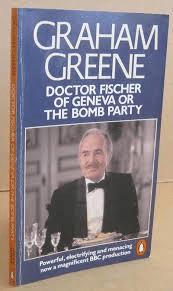
So, as always, the question has to be asked, why did I read Dr Fischer of Geneva? The BBC made a television movie of the book in 1984, with Alan Bates, James Mason (in his final screen performance) and Greta Scacchi in the leading roles and with Barry Humphries rather hilariously miscast as the alcoholic womanising film star Richard Deane. The edition I read had a still from this adaptation on the front cover and the impression was inescapably that I was looking at a late version of one of Roald Dahl’s corny ‘Tales of the Unexpected’. (For people of my generation that reference will immediately summon up a lot of memories and meaning – for others please refer to the internet!) Perhaps it was that association, combined with the promising brevity of the novella, that encouraged me to read this text to while away the time on a short journey.

The novella is narrated by Alfred Jones, a translator for a Swiss chocolate company. A note of inauthenticity is immediately introduced – did even the largest chocolate companies have their own in-house translators? It does seem something of a luxury. Jones lost his left hand while working as a fireman during the Blitz and is a widower in his fifties. In Geneva Jones meets the much younger Anna-Luise Fischer, the estranged daughter of the eponymous Dr Fischer and quickly experiences a mutual if unlikely attraction. Her father, Dr Fischer, has become rich after inventing a perfumed toothpaste. He is now known for his notorious dinner parties which attract the rich and famous. Alfred and Anna-Luise are married after a very short courtship and the problem of how to tell her father is one they eventually have to confront.

Jones finally plucks up the courage to go and see Fischer to tell him about the marriage, but Fischer is indifferent to the news. However, he later invites Jones to one of his slightly sinister and infamous dinner parties. Anna-Luise begs him not to go – the suggestion is that the parties will in some way corrupt him – but she relents, and out of curiosity Jones goes to one of the parties. At the party, Fischer sets out the ‘rules’: if a dinner guest does as she or he is instructed they will receives a valuable present at the end of the meal. This is simply a way for Fischer to humiliate his guests. Desperate for their reward they go only with the rules, pretending to find the experience amusing. Jones of course refuses to take part.

This would have been the last of their relationship with Dr Fischer and his ludicrous parties, but Anna-Luise is tragically killed in a skiing accident. Jones is devastated and considers suicide. He tells Fischer about his daughter’s death, but he needs unconcerned. When unexpectedly another party invitation arrives from Dr Fischer he decides to attend to vent his anger at his father-in-law’s indifference to his wife’s death by attending the dinner party and telling him precisely what he thinks of him and his ‘friends’.

This is of course the “Bomb Party” of the novel’s alternative title. Dr. Fischer explains the rules – he has hidden cheques for two million francs apiece within five crackers. Inside the sixth is a small bomb likely to kill whoever opens it. The guests are expected to chose a cracker and open it. A form of Russian roulette in other words. Most of the guests accept the challenge, partly suspecting that Dr Fischer would not really kill one of his guests. Jones, still feeling suicidally reckless, opens several of the crackers. I won’t spoil the ending for you but it was neither surprising nor satisfying.

Greene is quite clumsily discoursing on wealth and morality, but I am not convinced he had anything particularly interesting to say. Fischer is a monster who uses his wealth to abuse his ‘friends’, and they are sufficiently avaricious to allow him to treat them like that. Rich people aren’t very kind to one another. Who would have known? By contrast the romance at the heart of the novel is sweet albeit brief. Jones’s first person narration warns the reader early on that it is not going to last, so Anna-Luise’s death does not come as a shock. But we lose the more interesting character – Jones never really emerges as a convincing persona: having lost his hand in the war he has no expectation of a romance in later life, let alone with someone as exuberant as Anna-Luise. After her death he reverts to existing rather than living.

This was a late Greene novella, not much more than an extended short story. It passed away a short journey, but I doubt it will linger long in the memory, nor encourage me to continue trying with Greene.

Dr Fischer of Geneva, or The Bomb Party, by Graham Greene, 1980

Aside
Book review

Jack Maggs, by Peter Carey, 1997

I can’t tell you precisely how long Peter Carey’s Jack Maggs has sat on my bookshelves waiting to be read, but it is a long time – I was seriously considering abandoning any intent of reading it and regifting it to the charity shop from whence it came. I am so glad that I did not and instead on a whim started this original and entertaining novel.

When I first started it I wasn’t aware that Jacks Maggs was based on Dickens’ Great Expectations and was feeling rather smug when I identified the character Tobias Oates as being a portrait of the young Dickens. Oates is 24 and has had one successful novel published (Captain Crumley, a version of the Pickwick Papers). Oates is married but is already getting bored with his wife and is having a passionate affair with his eighteen-year old sister-in-law. There are close parallels with Dickens’ life here and he doesn’t come out of the novel well at all. Dickens did eventually separate from his wife after she had borne his many children and his relationships with his sisters-in-law don’t stand up to too much scrutiny. This speculative portrait of the early years of his marriage suggest that his affections for his wife were waning even at this stage.

The novel opens with the titular character returning from a life-sentence of transportation to Australia. Whilst imprisoned as a convict his life in Australia was brutally hard, but eventually he was freed and went on to earn a comfortable living and a place in respectable society by becoming a brickmaker. He uses some of this money to trace his young son, abandoned back in England, and provide him with a good education. This of course is essentially the storyline of Great Expectations, but seen from Magwitch/Maggs’s point of view. On returning to England to find his son, leaving a young family back in Australia, Maggs risks the death penalty which faced all those who left Australia after a life sentence. He finds his son’s house empty – he has fled to his club after being forewarned of his father’s intention to come calling – and takes a job as a footman in the household of Mr Percy Buckle, the next door neighbour. His predecessor in the role has recently died by suicide and one of the novel’s mysteries and sub-plots is the background to this death. Maggs is a brutal man, vividly realised by the author, and quite unsuited to the subservient role of footman. In this role he encounters Oates, a dinner guest in the Buckle household, who is intrigued by the rough character who is attending table. Oates offers to hypnotise Maggs to help him with a painful tic that has developed in his face, a result of his being brutally whipped. Oates real intention is to discover Maggs’ backstory, which he quickly does, much to Maggs’s anger when he finds out his identity has been revealed. Maggs only agrees to be hypnotised if Oates will tell him how to find a notorious thief-taker who he believes will help him track down his son.

The novel slightly stalls at this point. The Great Expectations storyline has been left some way behind, and the characters and events repeat themselves while waiting for the deadline by which Oates has agreed to reveal the identity of the thief taker to come around. Maggs discovers his identity has been revealed, and reacts with anger, effectively taking Buckle’s household and Oates along with it hostage. Maggs doesn’t follow a plan or behave in any way strategically – he just uses cunning and the threat of violence to get his way. A trip to Gloucester to find the thief-taker is a wild-goose-chase which doesn’t seem to serve any particular purpose in the narrative (unless it was following a story-line in GE that I have managed to forget!) and puts off the climax in which all the characters come together in a dangerous and potentially violent end to the novel. Dickens was always careful to give his villains an ending that Victorian civic society would approve of, however charismatic they might be, but Carey is less anxious to comply with Victorian morality and (spoiler alert) allows Maggs a happy ending that for much of the novel appears deeply unlikely. Oates on the other hand suffers a painful loss that runs parallel with a similar loss in Dickens’ life, showing that not all immoral behaviour escapes judgment, even if the judgment is delivered on a young woman rather than Dickens/Oates himself.

I thought it would be an interesting to compare this novel with a more recent reimagining of Dickens, Barbara Kingsolver’s Demon Copperhead. Google’s AI tells me that the latter novel is the more radical reinterpretation of the two, set as it is in the Appalachians in modern times, and focussing on the opoid epidemic. But it was also in other ways a traditional and fairly close retelling of the Dickens novel, albeit updated, whereas I thought Carey’s novel, while retaining the original setting, was a more imaginative narrative. It uses the Dickens text as a jumping off point but also blends the events of Great Expectations with episodes from Dickens’ life itself. It also uses what I think of as the ‘Rosencrantz and Guildenstern’ technique of showing the events of the novel from an entirely new perspective, revealing depths to the original that were previously unexplored. I think on balance I found the Carey text the more impressive of the two (compared that is with the Kingsolver novel, not the Dickens!) although in terms of critical and popular reaction Demon Copperhead has been far more successful. It is interesting that two very well established authors chose to turn to Dickens for inspiration (of course there are many others doing the same thing) rather than crafting entirely new narratives.

Jack Maggs, by Peter Carey, 1997

Aside
Book review

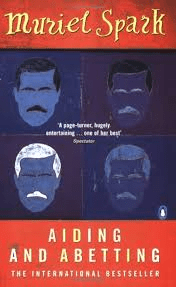
Aiding and Abetting, by Muriel Spark, 2000

Aiding and Abetting was Muriel Spark’s penultimate novel. It is a retelling of the notorious case of ‘Lucky’ Lucan, a British aristocrat who in the 1970’s murdered his children’s nanny, battered his wife almost to death (she having been his original target) and then went on the run, never to face justice. He is the recurring subject of tabloid stories, being ‘discovered’ living in the Australian outback or South Africa every few years.

Spark tells this story through the unusual lens of Dr Hildegard Wolf, a fake-psychiatrist ‘practising’ in Paris, who is consulted by two men, both of whom claim to be Lucan. They have discovered that she, like them, has a secret – in a previous incarnation she was Beate Pappenheim, a ‘fake stigmatic’ – someone who claimed to experience the wounds Christ suffered on the cross, wounds which mysteriously heal and reappear periodically. Using this story Beate/Hildegard took charitable donations from the faithful and the gullible, and when her fraud (she used period blood to simulate her wounds) was uncovered, fled the country. assuming a new identity.

It’s never clear whether the Lucan claimants are intending to blackmail Wolf – they need the money, their supporters who have kept them secure from the law for decades finally beginning to run out – or whether they enjoy the experience of being able to tell their story free from any risk of exposure. Wolf quickly works out that the men are working together, one being the real Lucan and the other a decoy, helping collect donations of support while leading the police and others astray. But this is all largely a framework within to tell or retell the notorious story of Lucan’s murder of Sandra Rivett, the Lucans’ nanny, and attempted murder of his wife. Lucan sees this as a Shakespearean tragedy instigated by his wife’s legal battle for custody of their children (they were divorcing), made worse by his constant gambling losses. He is the victim in his version of the story. The protection he is offered by friends in escaping justice is his god-given right.

When reading Aiding and Abetting I was left with the impression that it was poorly written, with a lot of repetition and sub-plots that peter out. Poorly written by Spark’s standards that is – she is normally a very intelligent writer with intricate plots, well developed characters and deft control of her material, none of which could be found here. I went back to the text several times to try and find evidence for this impression, but came up empty-handed. Perhaps I was looking for something that wasn’t there? As a reader you have to both trust and challenge your instincts – trust them as first impressions, but nevertheless check them just in case they are prejudices bobbing to the surface. Always give the author the benefit of the doubt (OK- not always; there are some authors who just don’t deserve the benefit of the doubt. E L James comes to mind, as do Jeffrey Archer and Dan Brown. But that’s just about it). If you are left with an impression, try and work out why. Well, for a start in Aiding and Abetting Spark doesn’t really have anything new or interesting to say about the Lucan case. She uses it as the structure for her story, but ends up leaning against it lazily. Spark claimed the novel’s theme was ‘blood’ and while there is plenty of blood in the novel, multiple references don’t add up to a theme. None of the novel’s characters are engaging – some are pretty forgettable – and the story doesn’t do justice to the real victim, the children’s nanny, who remains a largely one-dimensional and voiceless figure. (As part of my background reading for this review I was pleased to note that more recently, in 2019, Jill Dawson wrote The Language of Birds which tells the events of the Lucan murder from the point of view of the victim). If I felt ambivalent about the novel, the appallingly predictable and unfunny ending, a tribute of sorts to Evelyn Waugh but with none of the wit and about seventy years too late, left me in no doubt that this was a bit of a dud.

I really hesitate to suggest that Spark, in her early 80’s when this was written, was running out of steam, but I can’t find any other reason why an author usually so careful in her construction and characterisation would not live up to those standards. Perhaps I should read her final novel, The Finishing School, to see if that hypothesis stands up?

Aiding and Abetting, by Muriel Spark, 2000

Aside
Book review

Orwell’s Roses, by Rebecca Solnit, 2021

There is a scene is Stella Gibbons’s near-perfect Cold Comfort Farm where the heroine, Flora, meets the appalling Mr Mybug in a tea shop. She tries to avoid him but he is unshakeable and tries to impress her by talking about his latest project. He is convinced Branwell Bronte wrote Wuthering Heights and in his research has found three letters from him to an aunt in Ireland. These letters are “little masterpieces of repressed passion.  They are full of tender little questions… he asks her how is her rheumatism…has her cat, Toby, ‘recovered from the fever?’ … what is the weather like at Derrydownderry…?’” This portrait, of a pseudo-intellectual taking an obscure fact from the life of an author and blowing it up into a profound insight into their life and work, cannot be bettered, but in Orwell’s Roses, Rebecca Solnit gives it a good go.

In the mid-1930’s Orwell rented a small cottage in Wallington, Hertfordshire. He ran the local shop from the front room of the cottage and tended the small garden, planting fruit trees, vegetables, and roses. Those roses may or may not be still flowering in the cottage garden, although this seems both improbable and unimportant. In the course of the many thousands of articles, reviews, essays and letters he wrote he inevitably also referenced roses from time to time. But the idea that this scant piece of information can tell us anything significant about Orwell, either as a man or as a writer, is ludicrous. Although sceptical I was genuinely prepared to be persuaded I was wrong. I expected Solnit to have dug up some long-forgotten essay or letter in which Orwell wrote about the significance of roses to his world view, perhaps using their connection to England’s heritage as a metaphor for, well, anything. But of course he didn’t write any such thing and this left the author struggling mightily to make any kind of case. Chapters are devoted to the commercial rose growing industry in Columbia for example, in which unsurprisingly workers rights are undermined and working conditions are tough (although it is hardly a dark satanic mill situation). The author draws clumsy parallels between these hot greenhouses full of roses with Orwell’s exploration of the British mining industry in the 1930’s, but almost any third-world factory or sweatshop would have delivered the same set of comparisons.

A few years ago, shortly after lockdown, I was browsing in my local bookshop with one of my sons. Knowing my admiration for all things Orwell, he pointed this book out. My initial reaction probably seemed a little churlish (I do hope not, but fear it might have been) – that this felt like the scraping of a barrel. All of Orwell’s primary influences – Empire, class, the BBC, literature, politics etc – have been documented and investigated at length, so here was someone writing about his love of gardening. Gardening might have made it into the top ten of a list of Orwell’s interests, perhaps, but did it tell us anything we didn’t already know about the author, his works and his politics? I hazarded that the answer was no, and decided not to invest the £20 or so that the hardback would have cost me. A second-hand bookshop bargain made the decision a lot easier more recently, but my initial judgment – that this was a really tenuous thesis that it would be hard to sustain – was vindicated. There’s no questioning that the author makes a strong effort in arguing that there was some significant connection between Orwell and floristry, but effort doesn’t equal success in this case. See here for example:

“He (Orwell) went on to classify flowers among hobbies, and hobbies among the characteristics of people who valued liberty and private life, but he had opened a door for a room he hadn’t gone into, or perhaps a door onto something much larger than a room. If you do go through this door marked aesthetics and Orwell, you wander toward the very center of his life’s pursuits. (188).

No you don’t. And even if you do, roses are entirely peripheral to that room/area of interest.

Solnit writes at length about the significance of flowers to our lives. There are times where she seems to forget that the book is supposed to be about Orwell, only dragging him back into the text unconvincingly in chapter-ending summaries. But when she does write about Orwell, particularly in the book’s final chapters looking at the extraordinary productivity at the end of his life, she writes well. It is rewarding to spend time revisiting this period of his life, when he took the bizarre decision to move to Jura with his very young son, shortly after his wife Eileen had died, but carried on writing ferociously. The text ends with a chapter on Orwell’s significance today and she rightly points out that the word Orwellian has a resonance in these times that even words like Shakespearean or Dickensian do not. I was expecting the text’s final peroration to see roses drawn back into the discussion, but I was really pleased to see that in the end this didn’t (and probably couldn’t) happen. Solnit writes so much more interestingly about Orwell when she isn’t struggling to tie his work to her poorly-conceived theme.

Orwell’s Roses, by Rebecca Solnit, 2021

Aside
Book review

My Friends, by Hisham Matar, 2024

My Friends is a very personal narrative about the experiences of the narrator, Khaled, a Libyan student who in 1983 goes to study at the University of Edinburgh. There he meets fellow Libyan Mustafa, who becomes a life-long friend. Despite being aware of the risk to both themselves and their families they attend an anti-Gaddafi protest outside the Libyan embassy in London in 1984. This was the infamous occasion when Libyan secret police opened fire on the protest from within the embassy, killing Yvonne Fletcher, a Metropolitan police officer.

Khaled and Mustafa are wounded in the attack and spend weeks recovering in hospital under police guard. They realise that as soon as the Libyan authorities discover they were present at the demonstration that not only will they be at risk but so will their families. While the Gaddafi regime survives they can never go back to Libya. Their involvement in the demonstration is kept strictly secret, revealed only to the most trusted, closest friends. Their close-knit friendship is later joined by another Libyan ex-patriate, Hosam, a writer, one of whose anti-Gaddafi poems is read on the BBC Arabic World Service, thus putting a target on his back. This small group of friends share their longing to return to Libya and their families and a life-long fear of retribution by the Gaddafi regime.

For almost thirty years the friends keep in touch, on and off, while Khaled tries to settle in London, teaching and occasionally starting relationships, but never seriously committing to either a job or a partner. Finally, during the 2011 Arab Spring, the friends feel compelled to choose between staying in London or returning to Libya to fight. Mustafa chooses to return to fight – Hossam and Khaled stay in London.

As with all plot summaries, I have evened out the chronology – in the novel itself the chapters jump between time periods as Khaled looks back over his friendships with Hosam and Mustafa. It opens in the present with Khaled saying farewell to Hosam at St Pancras Station. Hosam is leaving for California, and Khaled recognises he is unlikely to see him again. As Khaled wanders through the London streets he reminisces about his friendships, and this walk forms the framework for the novel.

Exile is the central theme of the novel and this is the closest I am likely to ever get to experiencing this sense of loss, of one’s life being almost permanently on hold, never being able to commit to a relationship or a career. But equally the novel is about friendship, particularly the type of friendship forged in crisis and a shared experience of trauma than can endure for decades and through long periods of separation and distance.

Although My Friends won the Orwell Prize for Political Fiction in 2024, it is not an overtly political novel. Opposition to the Gaddafi regime forms a backdrop to the exiles’ lives, but it is taken as read, without the need for any overt criticism of the dictatorship. While the Arab Spring saw the end of that generation of political figureheads, a new generation has emerged. Political opposition and protests is as unsafe as it ever was, now in the West as much as elsewhere. This gives My Friends a renewed political relevance, urgency and resonance.

It’s great to see the Orwell Foundation expanding its scope and awarding prizes for a wider variety of writing. The results of this year’s prizes are announced later this month (June 2025) – well worth watching out for.


My Friends, by Hisham Matar, 2024

Aside
Book review

The British Museum is Falling Down by David Lodge 

This novella is a comic pastiche of James Joyce’s Ulysses. That makes it sound more substantial than it actually is. Lodge was flexing his literary muscles as a professor of English literature here, and he did so by inserting throughout the novel a series of literary references. Ten distinct sections of the novel are written in the style of a range of authors including Conrad, Woolf and Kafka. I would argue that these actually add little to the novel overall. In other words there’s an element of showing off here, where the reader might be vaguely aware that the novel’s style has shifted and that they should be getting the joke, (the Kafka and the Joyce sections are unmissable; the others less so) but uncomfortably aware that they are failing the test being set by the much cleverer than them author.

Strip away the contrived literary references and this is simply a straightforward mid-sixties comic novel on that most sixties of themes, sex. Adam Appleby, a father of three and a student of English literature spends a single day failing to do any work at the British Museum (not) researching his thesis “The Structure of Long Sentences in Three Modern English Novels”. Instead he gets into a series of what it is hard to avoid calling ‘scrapes’ familiar to anyone who watched British sitcoms (especially those, ironically, from the 1970s) – he accidentally calls the fire brigade out to a non-existent fire at the museum, he is the subject of an attempted seduction by a frustrated seventeen year-old virgin (a common experience for the male subjects of English post-war comic novels), he gets drunk at a cocktail party, and his scooter bursts into flames. The scene where he tries to buy some condoms but can’t do so because his priest enters the medical appliances shop at precisely the wrong moment is appallingly cliched. Throughout the novel Appleby, a thinly disguised avatar for the author, is haunted by the fear that his wife is pregnant with their fourth child, because being Roman Catholics and this being before the widespread availability of the pill, they are forbidden from using any but the most unreliable methods of contraception. This leaves Appleby permanently frustrated and at the same time petrified that their personal complicated game of Vatican Roulette has been lost once again.

As well as the explicit references to other authors, there are some strong echoes of Kingsley Amis here. The ‘seduction’ scenes is an obvious example. Appleby’s persistent worries about money and the way these are resolved by the intervention of a wealthy American at the end of the novel was strongly reminiscent of the way Amis concludes Lucky Jim. The getting inappropriately drunk at a party scene, the ‘seduction’ scene, and the many petty minor frustrations of academic life, all echo the earlier Amis novel. So yes, in a nutshell, this is heavily derivative, so much so that by the end their is no attempt to disguise Lodge’s borrowing, and it is simply chalked up as pastiche.

In many ways this is a very typical mid-Sixties comic novel, but what sets it apart are Lodge’s literary pretentions. And in case you were wondering, no, the title doesn’t make sense – Lodge explains in an afterword written for a 1980 reprinting that he had originally wanted to call the novel “The British Museum Had Lost Its Charm” but as this is a quote from a Gershwin song and he couldn’t get permission to use it, the alternative title had to be used. There is a clearly late addition to the text to explain the alternative title he ended up using, with its reference to London Bridge, which Lodge may have got away with if he hadn’t written about the original title in the afterword.

The British Museum is Falling Down, by David Lodge, 1965

Aside
Book review

Birnam Wood by Eleanor Catton, 2023

I really enjoyed reading Birnam Wood, until the end, when I didn’t, which retrospectively spoiled the whole novel for me. Don’t you hate it when that happens?

First. just to get one thing out of the way, this novel has nothing to do with Macbeth. You could work hard at trying to find some parallels, but they won’t work. Which is just one of those minor disappointments that could have easily have been overlooked if the novel’s ending worked, which it didn’t, as I may have mentioned.

The author invites us to believe that a New Zealand community gardening project, with the mildly amusing name of Birnam Wood, is covertly a much more subversive, radical project threatening the status quo – or so some of its members believe (others just like gardening). For wildly complex and improbably reasons, this group gets involved with Robert Lemoine, an American billionaire, who decides to sponsor and support the group. He’s a psychopath, so the reasons he gives for sponsoring BW are nonsensical, but we are invited to accept them anyway because billionaires spend their money on whimsical projects as the fancy takes them. don’t they.

“I know how easy it was,’ said Lemoine. Mira didn’t follow. How easy what was?’ All of it,’ he said, shrugging. Getting rich. Staying rich. Winning. It was all so easy. I just took what I wanted, and it was mine. I said what I wanted, and people got it for me. I did what I wanted, and nobody stopped me. So simple. And if it was easy for me, then it could be easy for anybody, and that’s a very frightening thought. Apart from anything else, it would be untenable, Everyone can’t be on top, or it wouldn’t be the top any more, would it? That’s just a fact. And I’ve been in the citadels of power,’ he added. I’ve eaten at the high tables; I’ve seen behind the doors that never open. Everyone’s the same. You reach a certain level and it’s all exactly the same: it’s all just luck and loopholes and being in the right place at the right time, and compound growth taking care of the rest. That’s why we’re all building barricades. It’s in case the rest of you ever figure out how incredibly easy it was for us to get to where we are. 

Lemoine invites the group to start gardening in the grounds of an estate he is considering buying and of course they accept, the whole deal sweetened by the promise of much more money to come once the garden is established and he gets to know them better. No, that doesn’t make any sense, does it? Obviously I have summarised the ‘logic’ behind his investment unfairly, because I am irritated by the fact that a central plot point in the novel makes no sense, but it gets worse. Because secretly this one-dimensional evil genius is drilling for rare earth minerals in the national park around the home he is about to buy and having a group of hippies on site is just what any illegal covert mining operation needs.

Despite all of the above, I enjoyed at least three quarters of the novel. It was well-paced, the non-billionaire characters were well-sketched, and I was interested to find out what happened to everyone. As the remaining pages dwindled and the multitude of plot lines remained stubbornly unresolved, I wondered how the author was going to bring everything together. At one point I genuinely thought we were going to be set up for a sequel, there was so much left incomplete. Instead, Catton totally blows the ending. She uses a crude device to bring to a sudden halt some of the plot lines, and leaves a few dangling uncertainly. One central character, Shelley, seems to be forgotten entirely. The climax is rushed, unconvincing, and the reader is left to sketch in most of what happens themselves, with little to go on. Most of the dramatic events happen off-screen (as it were) with the reader left to join the dots from scattered clues. Imagine Hamlet from Fortinbras’s perspective and you get a rough idea of how the potential drama of the climax is thrown away.

Birnam Wood aspires to being a thoughtful novel of ideas, and there are prolonged sections in which characters discuss the decline of late stage capitalism, mostly in a millennial argot in which the word ‘like’ is sprinkled through the speeches every other sentence, in a redundant attempt at authenticity.

“Shelley said “I was just thinking about it. Like, no one ever actually knows that the right thing to do is. I mean, you can think that you know what’s right, and you can tell yourself that you know, but at the point that you make your choice, like, in the moment, you’re never really certain. Yu just hope. You just act and you hope for the best…But, like, the wrong thing to do, that’s often much clearer. Wrong is, like, easier to se than right, a lot of the time. It’s more definite – like, this is the line I know I will not cross. “

I get it that some people do speak like that and I understand that it is just the twenty-first century equivalent of um’s and er’s, but on the page it is wearisome. The ideas being discussed never really come into focus and are quickly forgotten when the action sequences in the novel kick in.

In a promotional interview the author said that she aspired to write a twenty-first century equivalent of Jane Austen’s Emma. I don’t think I have ever read a more absurd comparison in a very long time. It’s like Dan Brown comparing the Da Vinci Code to Middlemarch. Austen is the most precise, careful writer – Birnam Wood is ultimately a soggy mess. Which proves one thing – that thrillers are not as easy to write as you might think.

Birnam Wood by Eleanor Catton, 2023

Aside
Book review

Red Side Story by Jasper Fforde, 2024

Red Side Story is the sequel to the wonderfully imaginative Shades of Grey (2009), which I should stress straightaway has absolutely no connection with the book with ’50’ in its name. Fifteen years is a long time to wait for a sequel (unless you are George R R Martin) and I was worried that the author had lost interest in the fascinating world of chromatacians (bear with me) that he had created, or couldn’t work out where to take the story. But all our patience has definitely been rewarded.

As we know from Shades of Grey, the story is set in a version of the UK (more specifically, Wales) where every aspect of your position in society depends on your ability to perceive parts of the colour spectrum. Colour vision is extremely limited in this society. Some people – ‘Greys’ – have no colour vision at all and are the equivalent of untouchables; others are divided into the colours they can see with more senior roles given to those with the better colour sensitivity. Society is governed by an extremely rigid set of rules set out in Munsell’s ‘Book of Harmony’. Technology is largely forbidden, with a few exceptions. It is a bizarre, but at the same time recognisable world. It is also quite brutal – people are killed (by being shown a shade of green which acts like a deadly poison) for any small infraction of the rules. There are signs of the civilisation that came before the Something that Happened’ five hundred years earlier, but very little understanding of that society.

The novel picks up where Shades of Grey left off. IN East Carmine on the fringes of Red Sector West, Eddie Russett and Jane Grey, having discovered that there is something profoundly wrong with their society, have determined to do something about it. But first they have to escape the trumped-up murder charges they are due to imminently face. Eddie has also recently found out that his perception of the colour red is very high, meaning he is highly valued in the marriage market. But once his seed has been sown any protection he derives from his colour perception will be gone. Slowly Eddie and Jane piece together clues that show them their society could possibly be a vast social engineering experiment, monitored by drones that they have been taught to think as swans. Everyone carries a bar code imprinted on their fingers, allowing the ‘swans’ to locate them at any time – hence the reason wearing gloves is not allowed.

The novel’s parables aren’t hard to unlock – they aren’t meant to be. Treating people as unequal simply because of their physical characteristics is bad. Dogmatic adherence to out of date rules of dubious authority is stupid. We should be able to love who we want to love, not have to trade our fertility like cattle. And so on. But the novel is at no point preachy – this is just Eddie and Jane’s world, and they are heroic in their struggles to find the truth, risking their lives over and over again. I don’t think there’s ever any doubt they will succeed.

Red Side Story can be read as a standalone novel, but I would recommend reading Shades of Grey first. Not because you really need it to work out what is going on in the later novel, but because it is a great story. Fforde is a unique author – comparisons to Pratchett (in the Independent’s review below) for example are wide of the mark. Possibly the nearest in terms of imaginativeness would be the wonderful Douglas Adams and there really is no higher praise. The inventiveness of Fforde’s stories is just the start – what is really impressive is the way he manages to sustain an idea and populate a believable universe without drawing on folk tales or mythologies as most fantasy authors do. This makes him instantly recognisable as an author. Add to this mix his consistently progressive narratives and some great jokes (and there I will accept a comparison with Pratchett, because some of the puns are a bit painful – for example the menacing Undertoad) and you have an author in superb control of his material and a wonderful, whimsical and at the same time brutal story.

The internet seems to think there will be a third novel in the series – I do hope so, and that we don’t have to wait 15 years!

What other reviews have said: a selection

‘Fforde is one of literature’s most enjoyable visionaries, and his long-awaited Shades of Grey sequel will be eagerly seized upon by his admirers… The jokes are excellent, the pacing breathless and the last line a classic’ Observer

‘Fforde’s books are more than an ingenious idea. They are written with buoyant zest and are tautly plotted . . . and are embellished with the rich details of a Dickens or Pratchett’ Independent

‘No summaries can do justice to the sheer inventiveness, wit, complexity, erudition, unexpectedness and originality’ ​The Times

Red Side Story by Jasper Fforde, 2024

Aside
Book review

Changing Places, by David Lodge, 1975

Although Changing Places was written in 1975, it is set in 1969, and those six years are significant. The events of the novel take place in parallel on campuses in England and America, and the spirit of the sixties is abroad in both. Protest and counter-culture are in the air. By 1975 Nixon was out of the White House, the Vietnam War was coming to an ignominious end, the Beatles had split up and flower power was a distant memory.

To an extent this made Changing Places anachronistic even when it was published. It was looking back nostalgically at a period in time which was very close but also gone for good. That anachronism has inevitably widened over time. Professors sleeping with their students and one another’s wives may have been the height of liberation in the sixties – today it just looks creepy.

The novel is a classic trading places situation comedy. Two English professors, mild-mannered Philip Swallow, and charismatic American Morris Zapp, swap roles in their respective universities, thinly disguised versions of Birmingham, UK and Berkeley, California. They find themselves in very unfamiliar territory both academically and socially and much of the novel’s humour derives from their struggles in their new environments in traditional fish out of water manner. Both men almost inevitably have affairs while on their academic sabbaticals; more surprising is their involvement in the student protests that sweep their campuses. While Swallow finds himself accidentally involved in the demonstrations, Zapp is well-suited to his role as mediator between students and faculty.

Lodge has fun with the format of the novel, at one point continuing the narrative through news headlines and stories and later using a screenplay format. This serves to keep the story fresh and moves it along at pace. A significant time jump two thirds of the way through, moving quickly past some of the events that had been sign-posted and are now seen in hindsight, adds to the sense of pace. The novel ends with the two couples convened in a New York hotel room trying to decide their fates. The author has fun with the idea first articulated in Northanger Abbey that the reader knows the novel is coming to a close (and therefore a resolution of any outstanding plot points) by the “tell-tale compression of the pages” but chooses instead to leave issued unresolved – until the sequel of course.

The acid test for any comic novel has to be ‘is it funny?’. The quote on the front cover of the edition I read (shown above) has a comparison to Lucky Jim, a novel that I think has largely fallen out of fashion in recent years and is now equally anachronistic. There was a time when the Kingsley Amis novel would have been in my top ten novels list, but it hasn’t aged well. I think a more interesting comparison would be with Malcolm Bradbury’s The History Man which was published in the same year as Changing Places and which takes a much more unblinking, less affectionate look at British academic life. Is Changing Places funny? It’s mildly amusing, nothing more; the satire is so gentle as to be hardly noticeable. I now need to decide whether to read the sequel, with a nagging suspicion that it might simply be more of the same. Only one way to find out I suppose.

Changing Places, by David Lodge, 1975

Aside