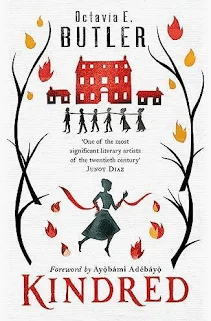
The trouble began long before June 9, 1976, when I became aware of it, but June 9 is the day I remember. It was my twenty-sixth birthday. It was also the day I met Rufus – the day he called me to him for the first time.
Dana and Kevin have just moved into their new apartment in Los Angeles, California. Out of nowhere, Dana starts to feel dizzy and faint, and before she knows it…
“The house, the books, everything vanished. Suddenly I was outdoors kneeling on the ground beneath trees. I was in a green place. I was at the edge of a woods. Before me a was a wide tranquil river, and near the middle of that river was a child, splashing, screaming….Drowning!”
Dana has been transported to somewhere where she is needed, where she can save the life of the drowning child, whose name we later find out is Rufus. But the boy’s parents are not grateful – far from it, they seem to think Dana is responsible for his accident – the father aims a shotgun at her and angrily confronts her. She fears for her life, and in that moment she is transported back to her apartment, where a puzzled Kevin tells her that only moments have passed.
At first the reader thinks they are in a simple time travel novel, where the principal character is summoned into another time and place to intervene in the life of someone with whom they have some kind of connection. Yes and no, because in a moment of dreadful realisation Dana finds out something terrible about the challenge fate has presented her with – the time she is travelling back to is the 1820’s, in the South of the United States of America, and Dana is black. The young boy whose life she is fated to save – she is summoned from the present every time his life is at risk – is the son of a slave-owner. He lives on a plantation. Worse, Dana has no control over when she is summoned nor when she is returned. She works out that she will return to her own time – where time passes at a completely different rate from that in the 1820’s, so several months can pass in the past but only hours in the present – when her own life is threatened. She cannot choose when to return, and putting her own life deliberately at risk seems far too dangerous.
The only positive side to this appalling situation is that, unlike the form of time travel in the Time Traveller’s Wife (for example) she is able to take objects with her into the past, anything she happens to be touching at the time she is summoned, including her partner Kevin. She quickly assembles a small bag of useful items, including a knife and some painkillers, knowing she could be whisked back to the nineteenth century at any time. I would have been tempted to take a gun, preferably a rifle, but I am probably taking the time travel conventions a little too literally! On her subsequent journey to the 1820’s Kevin goes or is taken with her, and after she saves the young man’s life once again, the plantation owner assumes Dana is Kevin’s slave. Dana, recognising names from the family tree in her bible, quickly works out that Rufus is one of her distant relatives, and that she needs to keep him alive long enough for him to father one of her ancestors. But Rufus is white, and she is not, horrifyingly suggesting that the ancestor she is waiting to arrive is the product of an abusive relationship between slave-owner and enslaved.
Novels that attempt to portray the horrors of slavery are faced with an immediate challenge – how to convey the many terrible things that happened – the brutality of every day life, the appalling treatment of the enslaved, the families torn apart by slave-owners simply for monetary gain – without looking away or in any way softening the edges of the realities of the form of chattel slavery of this period, but at the same time not making the novel impossible to read, capturing the reality of what living through this period must really have been like. To take someone from the 1970’s and transplant them into this environment is a brilliant way of making the reader imagine what being in this time must have been like – these are no longer long-dead people who it is easy to think of as statistics, but real, living family members and friends.
Butler takes one step further than just presenting afresh the trauma of slavery, by asking the question – how does one accommodate oneself to living in that situation, living as an enslaved person? Dana is trapped in the nineteenth century for long periods, too far away from the Northern states where slavery was no longer practised or widespread (slavery in the Northern states of the USA ended gradually over several decades; Vermont banned slavery in 1777 and Massachusetts in 1783; other Northern states passed gradual emancipation laws that freed existing slaves slowly, meaning complete freedom for all enslaved people in the North took until the early-to-mid 1800s – and even then ‘runaways’ were subject to the punitive conditions of the Fugitive Slaves Act). Dana is forced to come to terms with the conditions and compromises of her enslavement. Her partner Kevin is trapped in this time period for several years when she is returned to the twentieth century unexpectedly and this experience changes him as well (Dana perceives) even though he commits himself to helping runaway and escaped slaves.
Quite early on Rufus learns of Dana’s origins – he can hardly find a natural explanation for her appearing out of thin air every time his life is at risk – and has to accept the undeniable supernatural element of her existence. Dana slowly comes to an understanding with Rufus – he depends on her to save his life, therefore he must treat her with respect and care for her, protecting her from the unstable temper of his father. But time and again Rufus’s contempt for black people resurfaces – he never gets out of the habit of using the n-word for example, even though he knows he needs Dana to save his regularly threatened life (Rufus is very accident-prone!).
Kindred has an incredibly strong narrative structure. The reader (or this one at least) cares for and wants to find out what happens to Dana, Kevin and even Rufus. I understand why the author included a prologue which effectively spoils the ending of the novel for the reader – we know some important details about the outcome of the novel through this short opening chapter – but personally I don’t think it added anything and removed much of the suspense from the novel’s ending and I would have not used it had I been the author. But even though this is a very strong story, that’s not the primary reason for this being such a ‘must read’ – that derives from its unblinking portrait of the horrors of American chattel slavery.
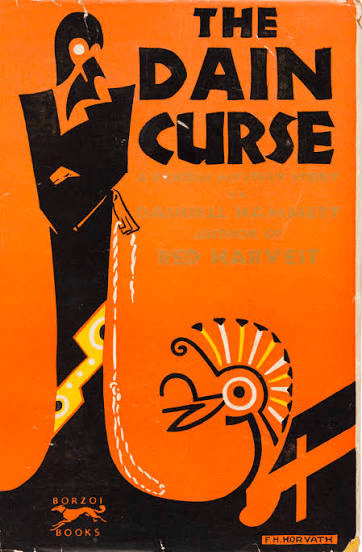
“It was a diamond all right, shining in the grass half a dozen feet from the blue brick wall. It was small, not more than a quarter of a carat in weight, and unmounted. I put it in my pocket and began searching the lawn as closely as I could without going at it on all fours. I had covered a couple of square yards of sod when the Leggetts’ front door opened. “
Oh dear. Having really enjoyed The Maltese Falcon and The Thin Man a lot, I decided to read some lesser known novels by Hammett, in the hope that I might, like the Continental Op in the quote above, find some diamonds in the rough. Unfortunately all I found was ‘rough’, no diamonds!
The Dain Curse is divided into three, loosely linked stories, which equate to the instalments in which the novel was first published in The Black Mask magazine. The first story opens with the Continental Op investigating a diamond robbery from Doctor Edgar Leggett. Dr Leggatt was using the diamonds to test a process of colourisation. The Op is commissioned by an insurance company to see whether the reported theft is legitimate and if possible to recover the diamonds. Dr Leggett’s wife maiden name was Dain and in the course of the investigation it emerges that their daughter Gabrielle believes there is a curse on the whole Dain family which follows them through the generations. This belief appears justified when several murders complicate what at first appears a straightforward investigation. I have to confess that even though I have only just finished reading the novel I can’t recall the precise detail of who murders who, and why, but I suspect that level of detail is not that important – this is an adventure story rather than a mystery. We know the Op is going to find out who committed the murders, all we have to do is enjoy the ride.
Diamonds recovered, the Op thinks his time with the unfortunate Gabrielle is over, but he is soon recalled to investigate a mysterious religious cult to which she has succumbed. The cult’s headquarters double as a clinic, a place of worship, and a retreat for the more vulnerable of the membership. The Op infiltrates the clinic/hostel/church none too subtly, and after the inevitable drugging, murdering and shoot-outs, manages to rescue Gabrielle. Her fiancé takes her away to marry her as quickly as possible before anything else can happen to her, but of course the curse cannot be escaped as easily as that….
The novel ends with at least ten pages of exposition, ten pages of the Op explaining what really happened. This becomes absurdly complex and convoluted and I can’t imagine many readers by this stage (or even earlier) really caring who did what to whom. The solution, including the extremely unlikely evil mastermind behind it all, is of course nonsense. If the novel itself was worth reading then the silly ending would be excusable, but sadly the characters are weak and unconvincing and the prose is flat. If you were considering reading anything by Hammett, a) despite all of the above, don’t let this put you off, and b) don’t choose this. Better still, read anything by Raymond Chandler!
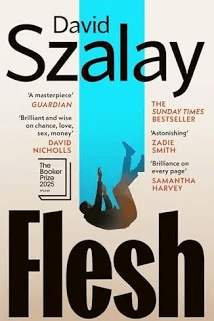
“When he’s fifteen, he and his mother move to a new town and he starts at a new school. It’s not an easy age to do that – the social order of the school is already well established and he has some difficulty making friends.”
In eight discontinuous chapters, David Szalay tells the story of Istvan, whose surname is never mentioned to preserve his ‘everyman’ status. The novel opens with 15-year-old István living with his single mother (his father is also never mentioned, but his absence from Istvan’s life casts a long shadow. This is a novel about fatherhood among other more prominent themes.) Isolated at school, he begins a sexual relationship with an older, married neighbour. Told from Istvan’s perspective this affair is not perceived as abusive, but he is clearly groomed and the reader can infer how damaging it is. He repeatedly describes the neighbour as ‘old’ and ‘ugly’ and focuses on the flaws in her less-than perfect body. Eventually a violent confrontation with her husband results in his accidental death; István is held responsible (rightly so) and is sent to juvenile detention. As with many critical episodes in his life, this period of detention is skipped over in the narrative, and the next chapter opens with István about to be discharged from five years’ service in the army. He has served in Kuwait and the Iraq War, but we only learn this after the event as we are told about his discharge and attempt to return to civilian society. Another end of chapter time jump sees him moving to London to work as a bouncer at a nightclub. From there he is hired as a chauffeur and bodyguard for a wealthy businessman and he soon begins an affair with the businessman’s wife, Helen.
Helen’s husband has a recurrence of cancer and despite the best treatment money can buy, he dies. Another time jumps sees Istvan and Helen married, Helen pregnant, and her teenage son Thomas bitterly resenting Istvan’s very existence. All of the businessman’s estate has been left to Thomas, held in trust until he turns 25. Helen and Istvan dip into this money (with the connivance of a dodgy lawyer) to fund property development schemes. I am going to stop this plot summary at this point because there some significant spoilers ahead, if I haven’t given too many already. Suffice to say there are some significant challenges ahead for Istvan.
It’s quite some time since I read a book where I was so conscious of the author, sitting behind a screen, tapping out scenes and challenging the reader to find them banal, improbable or unconvincing. His central character – virtually every scene is recounted through Istvan’s eyes, to the extent that the small number of scenes not told from his perspective stand out starkly – finds it very difficult to access or articulate his feelings. To demonstrate this Szalay gives us literally dozens of scenes where Istvan replies in monosyllables to anyone attempting to get him to communicate on anything other than the most basic level. In conversation he either replies any time he is addressed with “I don’t know”, “Yeah” or by repeating the question:
“It’s Istvan right?”
“Yeah”
“Where are you from?”
“Hungary”
“What’s that like?
Istvan isn’t sure what to say. He says what he tends to say when people ask that question.
“It’s okay”
“You go back much?”
“Sometimes”
“Visit family?”
“Yeah”
“You must miss it”
“Yeah, sometimes”
And so on, relentlessly, daring the reader to find this banal. Even scenes of conflict, danger or excitement are described in the same, monosyllabic unengaged tone, demonstrating no awareness of the questioner’s interest in what is being discussed. Szalay has made a brave, radical choice – to take an exciting life and focus on the moments in-between the incident and drama, so all we see are the moments of reflection; and then to create a character almost completely unable to reflect on what has happened to him with any degree of insight or coherence. Istvan’s inability to talk about the events of his life quickly becomes a burden to the reader. We get it, he is inarticulate, the point is really flogged to death. I could have done with fewer of these extended conversations where nothing is said – I doubt if I was the only reader who was tempted to let their eyes slide over a chunk of dull, phatic dialogue to the next paragraph.
Reflecting on this choice while announcing the novel’s Booker Prize 2025 award, the chair of judges, Roddy Doyle explained:
“At the end of the novel, we don’t know what the protagonist, István, looks like but this never feels like a lack; quite the opposite. Somehow, it’s the absence of words – or the absence of István’s words – that allow us to know István. Early in the book, we know that he cries because the person he’s with tells him not to; later in life, we know he’s balding because he envies another man’s hair; we know he grieves because, for several pages, there are no words at all.I don’t think I’ve read a novel that uses the white space on the page so well. It’s as if the author is inviting the reader to fill the space, to observe – almost to create – the character with him. The writing is spare and that is its great strength. Every word matters; the spaces between the words matter.
If Szalay had chosen to write the scenes between the chapters, telling us directly about the moments that shape Istvan’s life, rather than letting most of it happen ‘off screen’, this would have been a very different novel, far more conventional, less challenging, but I suspect more enjoyable. But while interesting things happen to Istvan, I am not sure he is an interesting character. It will be clear by now that I am ambivalent about Flesh: you have got to admire the author’s audacity and technical skill, and I found the novel an extremely easy, two-day read, but the nagging doubt remains that at the heart of the novel there is a vacancy, a gap. Istvan drifts through life without forming any serious relationships – he is almost surprised when he realises at one point very late in the day that he actually likes his wife – and has nothing of interest to say. Perhaps Szalay was telling us that we are all, like Istvan, just flesh?
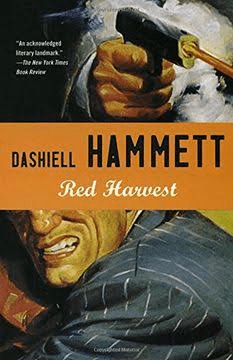
“I first heard Personville called Poisonville by a red-haired mucker named Hickey Dewey in the Big Ship in Butte. He also called his shirt a shoit. I didn’t think anything of what he had done to the city’s name. Later I heard men who could manage their r’s give it the same pronunciation. I still didn’t see anything in it but the meaningless sort of humor that used to make richardsnary the thieves’ word for dictionary. A few years later I went to Personville and learned better.”
The first person narrator of Dashiell Hammett‘s Red Harvest, known only as ‘the Continental Op’ is called to Personville (known as “Poisonville” by the locals) a Californian mining town, by newspaper publisher Donald Willsson to help fight corruption in the town. Willsson is gunned down before The Op has a chance to meet him, establishing an early pattern of violence and murder that continues throughout the novel. The ‘red harvest’ of the novel’s title refers simply to the carnage which ensues, a vicious cycle of revenge murders, which even The Op loses track of eventually.
Personville/Poisonville is run by a number of violent gangs. The police and the civic authorities – the Mayor, City Councillors, etc – are all implicated in the various criminal enterprises the gangs run, not least of which is bootlegging (prohibition was a gift to the criminal fraternity). The Op has to decide early on his investigation whether he is going to abandon things – his client is dead, after all – and head back to San Francisco, or get his hands dirty and try to break up the gangs. He chooses option two, and realises that the only way he is going to achieve this is if he plays the gangs off against one another. This is a dangerous, high stakes game, with the prospect of little reward at the end of it other than a bullet. But The Op is stubborn and not scared of a gunfight or two.
He starts by meeting the dead man’s father, Elihu Willsson, an industrialist who originally ran the whole town, but has now lost control to the gangs he brought in to help run the city. The Op identifies Donald’s murderer as someone who is not a gang member at all, but a bank clerk. This establishes another pattern – each murder is committed by someone other than the obvious suspect. But by now the war has started and the bloodshed is not going to stop. The large cast of characters passes by with blistering speed and it can be hard for the reader to keep up with who is blackmailing who, who is double-crossing who, and so on. The gangsters are particularly bloodythirsty and vengeful – after The Op organises a ‘peace conference’, ostensibly to halt the slide into all out war, if anything the pace of the killings accelerates.
The Op manipulates all of the warring parties, feeding them information, sometimes false, sometimes not, to keep the antagonism at fever pitch. The outcome is, inevitably, a blood bath, from which The Op manages somehow to escape with his life despite being in the middle of several shootouts. Soon everyone who has played a part in the criminality of the town is dead. Poisonville might revert back to illegality and war in a few years, but for now the poison has been flushed out.
Reading Red Harvest I kept being struck, time after time, how similar the novel was to those of Raymond Chandler. Chandler took the template developed by Hammett and improved it significantly, to the extent that Red Harvest at times reads like a rough draft of a Chandler novel. Individual scenes such as a trip out of town to a shack used as a safe house by one of the gangs, a drunken dream ended by waking up to find a corpse spread-eagled on the floor, the client who wants to back out of the deal but can’t – every scene and every plot device has its later parallel in Chandler. Hammett’s sparse prose style, his plot structures, stock characters and just about every other element of the novel is echoed time and again. At times the slang tips over the edge into being unintelligible. See if you can work out what this means:
“somebody dynamited the floor out of the can. I dropped through the hole with the rest of them. There was some mugs standing off the bulls. I made the back-trotters with one bunch. Then we split, and I was figuring on cutting over and making the hills.”
There is no doubt that Chandler improved on his source material – Red Harvest is repetitive, and all problems are resolved in the same violent way. The secondary characters are two-dimensional and one could be forgiven for confusing Gangster A with Gangster B, C or D. The OP has some good lines – “The chief winked at me, an athletic wink in which all his facial muscles took part” – but he’s no Philip Marlowe. To be fair, Red Harvest was Hammett’s first novel, originally published in four instalments in a pulp magazine, Black Mask, so I shouldn’t expect too much in the way of literary flair, but enough of the bones are there to show that Hammett was to go on to become a great writer.
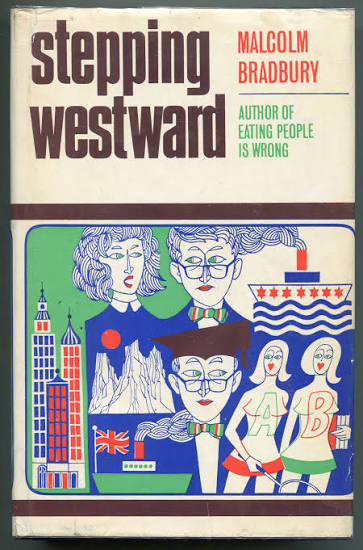
Stepping Westward is an early example of the campus novel, although for some reason Wikipedia does not include it in its list of examples of the genre. Bradbury is still a well-known author, largely on the basis of the television adaptation of The History Man but this, his second novel, has been almost forgotten – it doesn’t have its own entry in Wikipedia, has only one review on Amazon, nine other fairly desultory reviews on Goodreads and is out of print. And yet it is head and shoulders above many other examples of the genre including the novel it obviously had a significant influence on, David Lodge’s Changing Places (1975).
Bradbury took his novel’s title from the Wordsworth poem of the same name, which opens thus:
‘T would be a wildish destiny, If we, who thus together roam In a strange land, and far from home, Were in this place the guests of Chance
And it is this spirit of exploration, even wanderlust, that inspires and infuses the novel. On the Malcolm Bradbury website the author wrote (in an unpublished afterword):
Stepping Westward is my second novel. I wrote it, mostly in the United States, at the beginning of the Sixties, when I and the world were both visibly changing… It was a time when Americanization was passing through Europe like what many of the young in those days still had to take – a dose of salts. Britain was losing an Empire and gaining a washing machine, and America was where, it seemed, everything that was best came from – the best jazz, the best novels, the best ice-cream, the best cars, the best films. In fact America, the America of Arthur Miller and Marilyn Monroe, J.D. Salinger and Dave Brubeck, Jack Kerouac and Allen Ginsberg, Elvis and the Kelvinator, haunted the imaginations of the Fifties young. The old myth of European liberation in the New World never seemed stronger, and adventurous journeys to the new frontier were very much in order. So one day, when my thesis was finished, I put down my Leavis, put on my Levis, and sailed for the United States.
This is the mood that fills this novel, and I hope it seems like a joyous one.
I think it does.
James Walker lives a drab life in Nottingham with three modestly successful novels to his name. Unhappily married and with a young daughter, he takes little joy in life. He doesn’t think much of himself as a husband, father, writer or man. Largely because of lazy reviewers his work has been lumped into the category of ‘angry young man’ novels, even though he had no conception of this when writing them. Out of the blue he is offered and accepts a one-year Creative Writing Fellowship at Benedict Arnold University in the town of Party, located in the undefined West but in the shadow of the Rockies. We see this offer being made from the American perspective and know that he is part of a wider game of campus politics being played by the cynical Bernard Froelich.
Walker sails to America instead of flying, which feels anachronistic even for the 1960s. The journey drags somewhat (for the reader – Walker enjoys himself). We soon learn that Walker has no intention of remaining faithful to his wife – these are the sixties after all – as he pursues one of the American students sharing his journey, a member of an unlikely bagpipe band that has been touring Europe. Once arrived in Party he struggles to navigate the complexities of American campus life and politics. The bumbling Englishman abroad material is hardly original and much of the content here is laboured. Most of the humour derives from cliches about American hostility to the English, American food, and campus politics (including elements of lingering McCarthyism). The crunch comes when his stubborn Britishness leads him to resist signing the university’s mandatory loyalty oath. His speech to the whole university explaining his reasons for this (in a scene very reminiscent of the climax of Kingsley Amis’s Lucky Jim) makes him something of a civil rights celebrity, but also paints a target on his back.
Tempted by the improbably named Julie Snowflake, the young woman he met on the boat over, Walker travels further west during the Christmas break. At first their journey is exciting – he contemplates leaving his wife and marrying Ms Snowflake – but when he fails to act decisively during a mechanical breakdown in Mexico, he realises he is not cut out for this life. He quits his job and sails back home to England and his family.
The novel unquestionably has its issues. The portrayal of campus politics has long lost any interest and seems as dated as the ocean crossing by liner. The sexism in the novel is problematic. Walker seems obsessed with the tight fitting nature of the clothing of every single female student and whenever any woman is introduced he always notices and comments on their ‘sunburnt skin’ or their ‘finely cantilevered bosoms’. Watching students becomes a hobby:
“From their offices the members of the faculty could see the co-eds flouncing past the windows,,,On fine days they wore neat blouses and skirts, tight at the rump, or else cut-off jeans with the Greek letters of their sororities painted in white across their behinds; on wet ones they wore slickers in red and blue and yellow, or, if it was cold, quilted or fur-lined jackets with hoods. ,,, Walker spent a good deal of time peering through the fly-screens on his windows at this campus display.”
In part this is a reflection of the time – the depiction of women and casual sexism reflects the mid-1960s academic and societal landscape. Bradbury’s satirical aspirations, aimed at exposing the hypocrisies of British and American cultures, may have been laudable, but his treatment of female characters often falls into the trap he aims to critique. His fictional academia is a profoundly male-centred world – there are very few female professors or tutors. Women are marginalised as either wives, hostesses, or romantic targets. Julie Snowflake is a modern American young woman, but she serves mainly to act as Walker’s romantic interest. At times she seems his intellectual equal, challenging him, but he never treats her as such. Most other women in the novel are the faculty wives, relegated to supporting roles and judged by how well they “pour tea, manage the donors, and keep their opinions to themselves“. Bradbury is of course critiquing this treatment of women but he does nothing other than portray it – positive female role models that challenge this status quo are hard to find.
The novel ends with a whimper. It fizzles out with most of the plot lines forgotten or abandoned. Walker feels disenchanted with America and when his relationship with Julie stalls he runs away back home. The last time we see him he is climbing onto the liner back to Southampton. In a postscript the university decides to discontinue its Creative Writing fellowship and spend the money more wisely.
Despite all this, I would still encourage anyone interested in the campus novel genre to read Stepping Westward. It is a confident, thoughtful work, a product of its time, no doubt, but it has interesting things to say about the awkward relationship between the UK and America. While Walker is a frustratingly limited anti-hero, the novel deserves a wider audience and to be recognised as an important contribution to the genre.
PS. In preparing this review I looked up some information about Bradbury’s first novel, Eating People is Wrong. Lazily I did not include the words ‘Bradbury’ or ‘novel’ in my search, and the engine’s AI thought I was asking whether cannibalism was legal!
“Autumn 1930. From my window, the deep solemn massive street. Cellar-shops where the lamps burn all day, under the shadow of top-heavy balconied facades, dirty plaster frontages embossed with scroll-work and heraldic devices. The whole district is like this: street leading into street of houses like shabby monumental safes crammed with the tarnished valuables and second-hand furniture of a bankrupt middle class.”
Isherwood’s narrator of these stories of early 1930’s Berlin, a city in transition from the ‘decadence’ of the Weimar Republic to the repression of the Nazis, claims to be a passive observer, famously claiming “I am a camera with its shutter open, quite passive, recording not thinking”. To what extent that claim was sustained is debateable – it is surely not possible to simply observe events without having some impact upon them. But perhaps what Isherwood was intending to suggest is that his narrator was not being judgmental about what he observed, neither condemning nor approving. Which makes me wonder – why? Why would you witness at first-hand momentous political change, change which you would have a unique insight into having been a part of, and which would have a profound impact on the whole world, and have nothing to say about it? Is Isherwood genuinely intending to be a passive observer, or is something else going on here?
Taking a step back, for context, Goodbye to Berlin features six stories all narrated by ‘Christopher Isherwood’, a persona we can assume is as close as it is possible to be to the author himself. The novel opens in autumn 1930 with Christopher, an English writer, living in Berlin. We are not told why he finds himself there. He lives in a boarding house run by Fraulein Schroeder and meets her other guests including Bobby, a bartender, “a pale, worried-looking, smartly dressed young man with thin sleek black hair”, Fraulein Kost, a prostitute, (“a blonde florid girl with large silly blue eyes“) and Fraulein Mayr, (who has a “bull-dog jaw, enormous arms, and string-coloured hair”) a professional yodeller and “an ardent Nazi“. Despite their differences this is a relatively harmonious household, in which being a Nazi was not really something worth mentioning, and certainly not a reason to ostracise someone.
At around this time, Christopher meets Sally Bowles, a 19-year-old English actress. The first time he meets Sally she is “dressed in black silk, with a small cape over her shoulders and a little cap like a page-boy’s stuck jauntily on one side of her head” with emerald green fingernails, and her face “powdered dead white“. Sally is totally open about her sexual adventurousness – “That’s the man I slept with last night…He makes love marvellously”….”I didn’t sleep a wink last night. I’ve got a marvellous new lover”. Some of this frankness is intended to shock (“Do I shock you when I talk like that Christopher?”) but is largely just an expression of her lack of inhibition. Sally sings at a bar, the Lady Windermere, and has a series of wealthy gentlemen lovers who take care of her financially. She moves into Fraulein Schroeder’s boarding house as her friendship with Christopher becomes closer. At one point they meet a wealthy businessman, Clive, who showers them with money and gifts. Sally has hopes that he will help fund her acting career, but as quickly as he arrives, Clive disappears.
Unfortunately it is just at this point that Sally finds out that she is pregnant. She uses money left by Clive prior to his disappearance to pay for an abortion, telling the ‘nursing home’ staff that Christopher is the father. Although they don’t realise it at the time, this incident marks the turning point of their friendship. Christopher’s source of income is never mentioned, but he can afford a break from Berlin in the form of holiday by the Baltic, where he meets teenager Otto Nowak and Englishman Peter Wilkinson. These non-Berlin scenes are very different from the earlier chapters. Peter pays Otto to spend time with him and gets jealous when he wants to stay out late and go dancing with girls. The text avoids any direct implication that theirs is a homosexual relationship, but it can certainly be read that way. This is the case with almost all of the novel’s treatment of gay relationships, including Christopher’s own – they all exist between the lines but are not expressly referred to. Back in Berlin Christopher moves in with Otto’s family, sharing their small attic apartment.
In the background, the novel’s references to the Nazi Party steadily increase as the years pass and as the appointment of Hitler as Chancellor approaches. While on his holiday, Christopher reports this conversation with two Hitler Youth members:
“Two of them come into the restaurant sometimes and engage us in good-humoured political arguments. They tell us about their field-exercises and military games.
“You’re preparing for war” says Peter indignantly. On these occasions – although he has really not the slightest interest in politics – he gets really heated.
“Excuse me” one of the boys contradicts, “that’s quite wrong. The Fuhrer does not want war. Our programme stands for peace, with honour. All the same…” he adds wistfully, his face lighting up. “War can be fine you know! Think of the Ancient Greeks!”
Later he witnesses this exchange:
“Overheard in a café: a young Nazi is sitting with his girl; they are discussing the future of the Party. The Nazi is drunk. ‘Oh, I know we shall win, all right’ he exclaims impatiently, ‘But that’s not enough!’ He thumps the table with his fist. ‘Blood must flow!’ The girl strokes his arm reassuringly. She is trying to get him to come home. ‘But of course it’s going to flow, darling’ she coos, soothingly. ‘The Leader’s promised that in our programme'”.
The penultimate sketch in the novel is entitled The Landauers, and tells of Christopher’s friendship with the wealthy Jewish family. He writes to Frau Landauer, a family friend, after witnessing a Nazi demonstration shortly after his arrival in Berlin in 1930.
“Gangs of Nazi roughs turned out to demonstrate against the Jews. They manhandled some dark-haired, large-nosed pedestrians, and smashed the windows of all the Jewish shops. The incident was not, in itself, very remarkable….I remember it only because it was my first introduction to Berlin politics.”
After getting to know the family he makes the disastrous decision to introduce the daughter, 18-year-old Natalia, to Sally, with whom he remains in contact despite the cooling of their friendship. Sally immediately makes an anti-semitic comment and shocks Natalia with her open discussion of her sexual exploits. At the end of this chapter Christopher notes a postscript to the story of his friendship with the Landauer family. overhears two men in a restaurant talking about the fate of Bernard, who had become a close friend.
“He’s dead”. “You don’t say”. “Heart failure…. There’s a lot of heart failure in Germany these days….If you ask me anyone’s heart’s liable to fail if it gets a bullet inside it.”
The Austrian looked very uncomfortable. “Those Nazis….” he began. “They mean business.” The fat man seemed rather to enjoy making his friend’s flesh creep. ‘You mark my words, they’re going to clear the Jews right out of Germany, Right out….Concentration camps….They get them in there, make them sign things…then their hearts fail.”
Isherwood’s portrait of any opposition to the Nazis is dismissive. In the Berlin Diary (Winter 1932-3) chapter which ends the novel, he describes attending a Communist ‘dive’ near the zoo. “The cafe was full of students, dressed mostly with aggressive political untidiness – the men in sailor’s sweaters and stained baggy trousers, the girls in ill-fitting jumpers, skirts held visibly together with safety-pins and carelessly knotted gaudy gipsy scarves.” As a force to oppose the Nazis they are comically unqualified.
So why does Isherwood simply record what he sees, despite the rising and unavoidable tide of bloody violence towards Jews, Communists, and (although it is not mentioned here) gay people and others? A charitable interpretation is that the author is letting the events tell their own story and leaving the reader to draw their own conclusions. The portrait of Berlin is not a simple Nazis = Bad, ordinary Berliners = Good narrative. In showing the decadent side of Berlin he risks feeding Nazi propaganda about the need for a moral renewal of the country. As George Orwell wrote in his review of the novel ” Reading such tales as this, the thing that surprises one is not that Hitler came to power, but that he did not do so several years earlier.“
Isherwood is at pains to avoid directly condemning the Nazis even when his friends are at risk and are eventually being murdered. This is taking neutrality too far surely? A more critical interpretation would be that Isherwood genuinely had no interest in the politics of early 1930’s Berlin, and simply recorded what he saw, only later adding the violence of the Nazis when it had become unavoidable. There is some biographical detail that suggests this is the explanation that is closest to the truth, but it is unsatisfactory, because taking the narrative entirely on its own – disregarding what we know about Isherwood the author, the book can still be read as a chilling record of the seemingly inevitable rise of the Nazis. One can choose to accept that Goodbye to Berlin is an honest, authentic account of Isherwood’s time in Germany – or not. It is of course fiction rather than autobiography, (although there are obvious autobiographical elements), so Isherwood was not under the obligations for accuracy that would apply to a journalist or a historian. As an account of life in Berlin in the early 1930’s, albeit for a small sub-section of society, the novel gives an insight into what those years must have been like – dangerous, frightening, but also exciting. By the end of the novel all that promise has evaporated, and the spectre of the war looms over everything. An alternative reading is that the text is only superficially neutral, but nevertheless clearly shows how the Nazis came to power and how the German people acquiesced in that assumption. For me this is a more compelling reading of the novel. I am a camera – well maybe. But the choices made in what to show the reader and what to omit was not a neutral act but an editing of events that help the reader understand the politics of |Germany.
“Most of us have only one story to tell. I don’t mean that only one thing happens to us in our lives: there are countless events, which we turn into countless stories. But there’s only one that matters, only one finally worth telling.”
The Only Story is that of the doomed romance between 19-year-old Sussex University undergraduate Paul Roberts and Susan McLeod, a 48-year-old married woman with two grown-up daughters. Paul meets Susan at the local tennis club, where they are partnered in a doubles tournament. From that moment on they quickly become close friends, and then much more. Paul narrates their story from the vantage of decades later, a lifetime really, looking back with the wisdom of years which of course is denied a 19-year old. Susan is trapped in a loveless (and sexless) marriage to a bully of a husband with whom she has very little in common. Despite the inevitable scandal this causes at the tennis club and elsewhere, Paul and Susan become lovers. They conduct their affair largely in the open, hoping that its improbability will protect them.
Generation gap love stories follow a predictable pattern. If the woman is the older partner then the romance is bitter-sweet, educational, and doomed. If the man is the older partner then the romance is abusive, predatory and well, yes, also obviously doomed. Paul and Susan’s relationship follows these familiar tram-lines. There is always a maternal aspect to the way Susan speaks to and behaves towards Paul, an attitude that he apparently does not find problematic – he seems to like having someone tell him what to do. The older Paul narrating the story tells the reader early on that this is not going to be a happy-ever-after story, which frankly we would probably have worked out ourselves. What was not predictable was the nature of the unhappy ending. Because their relationship survives much longer than one would expect, in large part because Susan has the financial resources to support them both once she leaves her husband. She is able to buy a house for them in London, (the setting is the 1960’s, when this would not have been quite so absurdly improbable) while Paul embarks on the long process of qualifying as a solicitor. If this level of financial independence is hard to credit then Barnes ignores the issue. Financial difficulties are simply not part of this story.
Their relationship remains happy, even as Susan slips into a new version of the bored domesticity that characterised her life with her husband. As she sees Paul embark on his adult life she turns to drink, and slowly becomes an alcoholic. For years Paul struggles to cope and to find her help, but eventually he cannot manage any more and he moves out. Susan, now hollowed-out by her addiction, is cared for by one of her daughters and when years later Paul visits her in a nursing home she does not recognise him.
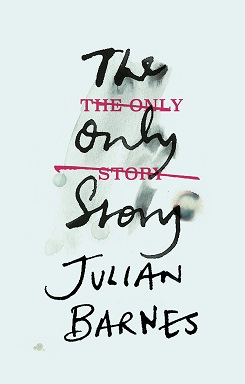
It has to be said this novel has an appallingly dull front cover (right). The deliberate smudging – presumably to represent the narrator’s tears? – is so cliché. But it is somehow fitting for a banal novel that has very little to say. Age has not given Paul any important insights into his relationship with Susan (there is never any hint that it might have been abusive or inappropriate, or even that it could have worked out differently) and he looks back on it with no real regrets and no understanding of the impact of the affair on the other people involved, their families. The simplistic way he thought about the relationship at 19 basically remains the way he sees it in later life. For him it is the only story worth telling in his life and it sours all future possible relationships (which in itself should have been a sign of something wrong). What passes for insights into love and relationships are really little more than a dreary collection of hallmark inscriptions:
Would you rather love the more and suffer the more, or love the less and suffer the less?
“You’re still in it. You’ll always be in it. No, not literally. But in your heart. Nothing ever ends, not if it’s gone that deep. You’ll always be walking wounded.”
“first love always happens in the overwhelming first person. How can it not? Also, in the overwhelming present tense.” #
“I do believe now that when two lovers meet, there is already so much pre-history that only certain outcomes are possible.”
A more interesting telling of the story would have been to give voices to the other participants. Would Gordon, Susan’s abusive and violent husband, have had a different perspective? I suspect he tolerated Paul’s presence in his family home through gritted teeth and was well aware of the threat he posed. Susan’s daughters, or Paul’s parents, would have seen things differently, not the grand romance that all 19-year olds think their first love affair is, but something far more sordid and unattractive. Instead we have to accept Paul’s banal unfiltered version of events. I haven’t read much else by Barnes, only his Booker winning The Sense of an Ending (2011), and the even earlier Arthur and George (2005). Neither novel lodged itself firmly in my memory, but looking back it seems that The Sense of an Ending has some distinct similarities with The Only Story, principally the narrative structure of looking back over decades to an important event in the past. Perhaps, for Barnes, this really is the only story?
“On 20 May 2119 I took the overnight ferry from Port Marlborough and arrived in the late afternoon at the small quay near Maentwrog-under-Sea that serves the Bodleian Snowdonia Library.“
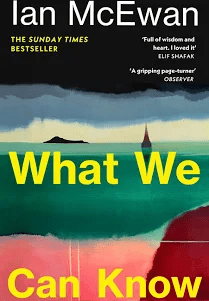
Thus opens Ian McEwan’s latest novel, What We Can Know. It is a gripping, fascinating, thoughtful narrative. Immediately we know we are not just in the future, but in a reshaped world where there are overnight ferries to the Bodleian Library, which is now in Snowdonia. We quickly find out that a deadly combination of nuclear war and climate change have transformed the world. The Atlantic Ocean has flooded much of the British countryside and reshaped the geography of Europe and other parts of the earth. Britain is a now a scattered collection of small islands, hard to navigate around, but somehow still surviving as a nation. A new normal has emerged (or been imposed), which in some ways is strangely similar to our own. Instead of a brutal dystopia, Britain seems well run, with universities (in which the study of Liberal Arts is still pursued), libraries and archives. Our tour of this new world is narrated by Thomas Metcalfe, a researcher from the University of the South Downs. Thomas is researching a largely forgotten 21st century poet, Francis Blundy and specifically his lost poem, “A Corona for Vivien,” which he read at a dinner party thrown to celebrate his wife’s birthday, known in academia as ‘the Second Immortal Dinner’. The end of the world has not prevented people being obsessed with obscure literary detail it seems. Thomas is confronted with the question posed in the novel’s title – what can be known about the lives of these long-dead people?
Thomas is able to recreate many of the events leading up to the reading of the poem in part because the archives of the principal characters have survived and also in part because the digital footprints of the participants has been unlocked due to advances in de-encryption technology. So he has access to everyone’s emails, bank statements and social media. Using this data and the surviving paper records he pieces together what he believes happened on the night the poem was read, together with the lives and back stories of the participants, focussing primarily on the poet Francis and his wife, Vivien. As Thomas believes Vivien was the person most likely to know what happened to the manuscript, (she outlived Francis, and the poem was ‘hers’ in that it was dedicated to her and given to her as a birthday present) he works principally on her timeline. We are given his reconstructed account of her life. Originally an Oxford don she married to Percy, a violin maker, who after a few brief years of happy marriage was diagnosed with Alzheimer’s. This cruel illness slowly robbed him of his independence and his personality and Vivien’s life became overwhelmed by the daily demands of having to care for him. In one of her brief moments of escape she met and formed a relationship with the distinguished poet, Francis Blundy. Eventually Percy died, thereby freeing his wife to pursue her relationship with Francis, and they married and moved to the English countryside.
Thomas’s visit to the Snowdonian Bodleian proves unproductive. The archivist there, Donald Drummond, tries to interest him in a theory about a note in Vivien’s diary which is believed to be a phone number, but he is dismissive. In the new academic pecking order researchers outrank archivists it seems, or more likely Thomas is just intolerant of anyone who shows an interest in his specialist subject. He returns to the South Downs, and eventually resumes a romantic relationship with fellow academic Rose Church. For some time the project remains stalled as Thomas and Rose get on with their lives. Thomas continues to read the papers of the dinner party attendees, but in a largely desultory fashion. A return visit to the Bodleian proves disastrous, because when he returns home a day early, feeling defeated by the brick wall he is facing, he discovers Rose in bed with a student, which even in 2119 is out of order. He buries himself in yet more detail of Vivien and Francis’s life, until one day he discovers a note from Drummond, passed to him during his last visit to the Library but left unopened until now, in which Drummond explains the mystery of the phone number – it is in fact a set of map coordinates. This is a clue that has been left in plain sight for almost the whole novel. Rose is (partially) forgiven and recruited into an expedition to the site of the former Blundy home where they believe the poem is hidden. The cottage is now on an abandoned and remote, hard to find, island, and the journey there is complex. There is an element of ‘Five Go Camping’ about this part of the narrative with lots of detail about the equipment they purchase and the navigation processes they follow, but eventually the coordinates are located and after some frantic digging an airtight box is unearthed. Will it contain the missing poem?
At this point the first half of the novel ends. We never return to 2119 and have to fill in the gaps ourselves as to what happens to Thomas and Rose, although there is one brief clue, which I will come back to.
The second part of the novel is a transcription of the buried manuscript, which takes the form of a confession by Vivien. She tells the real stories of her marriages to Percy and Francis. She reveals that during her first marriage, even when it was happy and before his diagnosis, she was having an affair with Harry Kitchener, Francis Blundy’s brother-in-law and literary agent, one of the attendees at the fabled dinner party. Harry gives her something that Percy cannot, which she claims is ‘intellectual stimulation’. Percy is an artisan, with no interest in books and poetry. In a moment of crisis, Vivien reveals a dark secret to Percy – but shortly thereafter he can remember nothing of what she has told him, which is the first point his illness begins to show itself. His slow degeneration takes its toll on her mental health, which is worsened when Harry casually breaks off their affair. In revenge she pursues an affair with Francis, largely to hurt Harry, but finds in this new relationship some solace from her role as Percy’s carer. I can’t go much further in this ‘what happens’ narrative without spoilers, but is quickly becomes apparent that most of what Thomas has worked out about Vivien’s life is incorrect. Her papers and her digital footprint kept secret much of what was really important in her life. A lot of the assumptions that Thomas has made about the dinner party are shown to be mistaken. (One that stood out for me is his careful reconstruction of what the guests would have eaten at the party, and how Vivien would have lovingly prepared the meal, whereas in her version of events (which we are invited to read as the ‘real’ version) she employs caterers! The novel ends with brief return to 2119 and an announcement that the Confessions of Vivien Blundy, edited by Thomas Metcalfe, with an introduction by Rose Church and a preface by Donald Drummond, was published in 2125, giving them a happy ending of sorts.
It is in the difference between the two narratives – Thomas’s findings from the papers and memoirs of the dinner guests and his background research, and the ‘real’ explanation of what happened recorded in Vivien’s confessional – that McEwan poses the question ‘What Can We Know?’ His short answer seems ‘not a lot’. People are adept at keeping their secrets, even in the digital age. The things we are confident about often turn out to be wrong. Thomas’s warning – “I’d like to shout down through a hole in the ceiling of time and advise the people of a hundred years ago: If you want your secrets kept, whisper them into the ear of your dearest, most trusted friend. Do not trust the keyboard and screen. If you do, we’ll know everything.” is only part of the story. Time quickly destroys the present and much of the knowledge we take for granted as unimportant is lost. (I am reminded of the fact that we have only a couple of pictures of the Bronte sisters for example, and even fewer of Jane Austen, and that there is no known recording of George Orwell’s voice let alone film of him as an adult, even though he lived well into the modern era and worked for several years at the BBC (which I may have already mentioned!). The point is we lose the past so quickly, and what can be known changes fast, to the extent that after one hundred years (let alone the end of the world) the past is largely lost to us.)
In part we are back in Atonement territory, where the revelation of a second, more authentic version of ‘what happened’ at Dunkirk reveals a devastating truth. What We Can Know also obviously owes a significant debt to A S Byatt’s Booker prize winning novel Possession featuring as it does academics conducting a literary investigation across a gap of a hundred years, with the climax of the novel involving the lost text being disinterred.
What We Can Know was hugely enjoyable. There’s never much doubt that Thomas will find out what happens to the lost poem – the paperback blurb gives some of this away (“When he stumbles across a clue that may lead to the lost poem….”) – but the detective element of the story is fun. As a portrait of a dystopian future (I have seen the novel described as a climate change novel which is misleading) the future is a bit depressing but it is hardly The Road. People are still employed studying medieval poetry, and AI is more of a benevolent agony aunt than an existential threat. ‘Try to reduce global warming because otherwise it might be more difficult to investigate literary mysteries’ is not the stark warning of an unbearable future that it might have been.
Which is where we come to what I think of as the case for the prosecution, very well summarised in this review of the novel in the Guardian:
“The sheer Englishness of Ian McEwan’s fiction may not be fully visible to his English readers. But it is clearly, and amusingly, visible to at least this Irish reader. It isn’t just McEwan’s elegiac, indeed patriotic, attentiveness to English landscapes – to the wildflowers and hedgerows and crags, to the “infinite shingle” of Chesil Beach, to the Chilterns turkey oak in the first paragraph of Enduring Love. Nor is it merely the ferocious home counties middle-classness of his later novels, in which every significant character is at the very least a neurosurgeon or a high court judge, everyone is conversant with Proust, Bach and Wordsworth, and members of the lower orders tend to appear as worrying upstarts from a world in which nobody plonks out the Goldberg Variations on the family baby grand. No, McEwan’s Englishness has most to do with his scrupulously rational, but occasionally and endearingly purblind, liberal morality: England’s most admirable, and most irritating, gift to politics and art.”
That’s the sort of critique that can’t be unread and I have to admit that it has tainted a little my appreciation of the novel. Because he is right – all of McEwan’s main characters are profoundly middle-class, and his settings are resolutely English, infused with a nostalgia for a countryside about to be lost. There are exceptions of course – the token named working class character in this novel, Chris, is a handyman, who when visiting Francis and Vivien’s home (a converted barn, with a dairy as an annexe, of course) for drinks has his use of language rudely corrected by Francis
“Hopefully is not a word. You’re murdering the language. Don’t say it.”
It is of course good that McEwan has noticed that middle class people police the language use of the working class, telling them when they have ‘got it wrong’ rather than recognising the obvious, that right and wrong in language use is imposed by the powerful on the less so. But everyone else in the novel is busy writing sonnets, hand-crafting violins, editing books and teaching literature.
The profoundly middle class nature of the characters is best summed up on one brief incident at the dinner party. One of the guests, Mary, accidentally breaks a salad bowl that another of the guests gave Francis and Vivien as a wedding gift. A broken hand-crafted salad bowl represents the kind of drama that can engulf a middle class dinner party. The jokes in the novel are about academia (“The reading break began and those who liked books stopped reading”) and the things people worry about include the standing of the arts in the pecking order of university courses. These are middle-class people with middle-class mindsets, assumptions and interests, including a largely feigned interest in poetry. The Corona is eventually exposed as a lie, recreating the times Percy spent with Vivien rather than anything genuine about her marriage to Francis. None of this really spoiled the novel for me but it did introduce an element of doubt or middle-class guilt – shouldn’t novels be about struggle, and dystopias about cannibalism and starvation? Before reading the Guardian review I was genuinely thinking about the chances of McEwan being nominated for a Nobel Prize for Literature. He is approaching the end of his career (he is in his late seventies) and has a considerable body of work to look back on. Among the many awards and prizes he has received he been nominated for the Booker six times (winning only once). But I suspect he would be thought too similar to the recent British winner of the award, Kazuo Ishiguro for that to happen. His novels are always interesting and worth reading, which can’t be said of all modern novels.
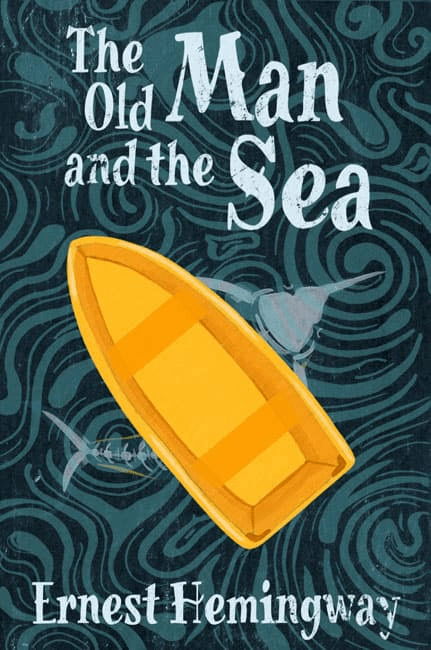
The Old Man and the Sea is the story of an epic struggle between an old fisherman and a huge marlin. Thus starts every review ever written of The Old Man and the Sea and who am I to break with tradition. The novella is short and because it has been seen as a representative sample of Hemingway’s prose, the text is commonly taught in schools and is therefore arguably his best known work. Partly for this reason, and partly because of Hemingway’s status as one of America’s most important novelists, the book comes weighted down with a burden of analysis long before the reader opens the pages. Every detail and nuance is overloaded with interpretation to the extent that the merits of the story itself can be lost.
Which would be a pity because at its heart this is the simplest of stories. Santiago, a Cuban fisherman, is suffering a run of bad luck and is not catching any fish. Things are so bad that the parents of his apprentice Manolin have made him leave the old man and go to work in another boat. The relationship between the old man and the boy is touching and gentle, with Manolin caring for the old man while at the same time allowing him to retain his self-respect. He admires his wisdom and his indefatigability. They share an interest in American baseball which allows them to bond outside the daily struggle for subsistence.
The heart of the story focusses on the day Santiago’s luck turns, when he catches a massive fish. The detail of the catch consumes more than half of the narrative, with the struggle to land the fish being described in intimate and totally believable, immersive detail. The reader shares the old man’s fight with the marlin, confident that his wisdom and experience will help him win. And eventually he does, killing the marlin with a harpoon after a three day battle. But this is where his problems come into focus, because the fish is so huge that he cannot bring it aboard his small fishing boat. He is three days away from the shore, with very few resources, and very little chance of bringing his catch home. It would be worth a lot of money were he to be able to get it into harbour, but the boost to his reputation as a fisherman is just as important. He ties the fish to the side of his boat and heads for home.
Inevitably the blood trail in the water attracts sharks. A series of attacks follow and while Santiago does his best to fight them off, the end result is unavoidable, and the fish is all but lost, with only the skeleton, head, and tail remaining. Santiago finally makes it back to the shore and stumbles back to his shack. His catch, or what remains of it, causes amazement among the fishermen when they arrive for work in the morning. The scale of the fish is obvious and Santiago’s reputation is restored. The novel ends with the old man being cared for by his young, newly-returned apprentice.
This is a simple and engrossing story which assumes the symbolic weight of its narrative effortlessly. Hemingway doesn’t have to point out that this is a tale about the struggles we face in life and how to overcome them, nor the pointlessness of it all at the end of the day, but it is the struggle itself which is worthwhile. His admiration for the fishermen of this community is self-evident, the way they work together, respect one another and value the experience that comes with old age. The story played a significant part in Hemingway being awarded the 1954 Nobel prize for Literature, and rightly so. The citation said he was being given the award “for his mastery of the art of narrative, most recently demonstrated in The Old Man and the Sea, and for the influence that he has exerted on contemporary style”. This is a reference to that fact that Hemingway was feted for his bare, stripped down narrative style. While this is certainly a feature of this novella, it does not dominate the text – one doesn’t read the story looking for all the missing adverbs and descriptions, marvelling at the economy of the prose. The novella’s ending is never really in any doubt – we know Santiago’s luck will change, but also that it will not be as simple as ‘old man catches fish’. I read quite a bit of Hemingway in years gone past (prior to the blog) and I am not sure this was enough to take me back to the longer works, given how many unread novels there are out there – but this novella fully deserves its reputation as one of the great American short stories.
“At the beginning of August a band in scarlet uniforms began to play in the municipal gardens. To Boris, watching them through binoculars from the top of a tree, they appeared like bloodstained weevils that we shortly to bring about the collapse of summer.”
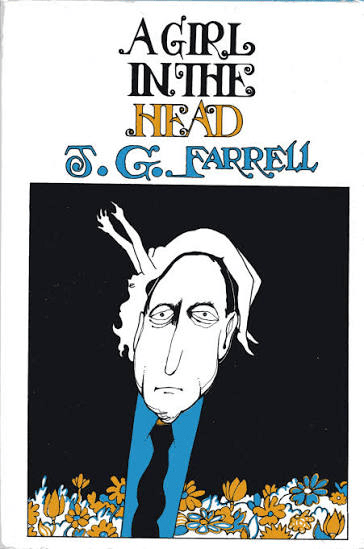
A Girl in the Head is out of print and has been since the 1980’s, which is surprising given that Farrell is a Booker Prize winner (for The Siege of Krishnapur) and that at least one of his other works – The Singapore Grip – was televised. It has only eight reviews on Goodreads and even fewer on Amazon – it is fair to say it has sunk with barely a trace. I think it is due a reappraisal.
Occasionally you will read a novel that keeps setting off little ‘pings’ in your head, memories and reminders of the work of other writers. A Girl in the Head is one such book – I was constantly being reminded of other works from the period. The novel is told by Boris Slattery, an impoverished Polish aristocrat (or so he tells us, but he is a fantasist and there are lots of reasons for doubting his version of events) living in the decaying English seaside town of Maidenhair Bay. Boris is vain, self-deluding, often ridiculous, and morally compromised. He drifts through a collapsing marriage while fantasising about younger women, particularly the Swedish schoolgirl Inez who gives the novel its title. The events of the novel span one summer and follow Boris as he bumbles his way through life. He is a traditional anti-hero – achieving little, thinking highly of himself, and getting into ‘scrapes’ such as being trapped in the tree-top mentioned above. Most of all he is driven by sexual fantasies that never quite come to fruition.
The novel has two alternating narrators – Boris himself, and an omniscient narrator writing in the third person. It soon becomes apparent that in fact this omniscient narrator is simply Boris writing about himself, narrating his actions as if he were observing them. This serves to distance him from his actions and their consequences. His internal monologue reveals him to be delusional and vain – he thinks all women are sexually attracted to him. In one disturbing scene he has reluctant, clumsy and unenjoyable sex with an under-age girl in a boat-house on the sea-front, hurrying to completion before they are disturbed. While this scene is presented as consensual and comedic, it is troubling – Boris is much older than this girl but sees himself almost as the victim of the encounter rather than its perpetrator.
Other scenes reminded me of Anthony Burgess’s anti-hero, the poet Enderby, in the sense that Boris is often confronted with his own incompetence and frustrations. Here, for example, he tries to get rid of a dog that has attached itself to him:
“Since the first (and only) time I had tickled his year he had become utterly devoted to me. Though I detest dogs it was virtually impossible to get rid of him. I made one or two vain attempts, it is true. I made him sit down and ran away from from him. Without success. I even tried making him sit still in the middle of the road whenever I heard a car coming. On one occasion, huddled nervously on the crown of the road and under strict orders not to move, he even vanished beneath the thundering wheels of a passing lorry.
Boris thinks this anecdote is amusing, not that he shares it with anyone but the reader, but a moment’s consideration reveals it to be quite horrific. Other scenes reminded me of the absurdism of Beckett. One member of Boris’s household is a cantankerous grandmother, who enjoys being read the headlines from the local newspaper, the more lurid and graphic the better:
“‘Here’s one for you Granny’ declared Maurice in ringing tones. ‘Shropshire bride disembowelled by gypsy’,
‘Serves him right’ muttered Granny Dongeon, ‘the little fool’.
‘Police having been using dogs and helicopters to help them with their enquiries’.
‘They didn’t have helicopters when you were a girl did they Granny?’
‘People knew how to behave when I was a girl’ Granny Dongeon said crossly. ‘Disembowelling a gypsy. I never heard of such a thing’.
The narrative follows Boris as he wanders around Maidenhair Bay, lusting after young women, Inez in particular. Inez is far more interested in Alessandro, another house-guest for the summer. When Uncle Cecil comes to stay for an extended visit, Boris’s wife absurdly decides that the solution to the shortage of beds is to have the two teenagers share a bed! Peeping through the hole in his floor Boris watches as Inez clumsily tries to seduce Alessandro, who is more interested in riding horses than girls, it seems.
Farrell’s debt to Nabokov and Lolita is obvious. While there are some differences – Boris’s fantasies are largely unacted upon – both Boris and Humbert Humbert are predators and delusional about their behaviour. Arguably Humbert is a monster while Boris is just a fool, but I can’t help wondering whether perhaps the real difference between them is one of opportunity.
For me the strongest echo throughout the novel was with the writing of Kingsley Amis. A standard Amis plot line from this period sees an older male protagonist lust after younger women. In the course of his attempted seduction the protagonist gets into various ‘scrapes’ and somehow manages to bumble and bluster his way out of them. (I appreciate I am using slang here but these terms – bumble, scrapes, etc – sum up the attitudes of the time). In the 1960’s these attitudes were seen as more comical than problematic, but thankfully times have changed and Boris (and his peers) now stand exposed as dirty old men.
A Girl in the Head occupies an awkward place in Farrell’s bibliography. Published three years before Troubles, it has generally been treated as an interesting experiment, overshadowed by the later, more successful novels that established his reputation. I said in opening it deserves a reappraisal. It is uneven and flawed, but I have to confess I would like to know how things turned eventually out for Boris.