Book review, Discworld, humour, Terry Pratchett, The Colour of Magic

The Colour of Magic (Discworld 1) by Terry Pratchett, 1983

Colour of magic

So this is where it all began. I returned to the original Discworld novel as a change of pace from Dickens and with one question at the front of my mind – would it stand the test of time? How well would it have aged, and how fully formed was Pratchett’s early vision of Discworld? Would the detail and complexity all be there, or would, as I assumed, the detail have developed and accrued over time, book by book? Which is a lot more than one question of course.

Remarkably the Discworld universe is almost completely fully developed in this first portrait. The cosmology or Astrozoology – with the Great A’tuin and his accompanying elephants – is all there, and Pratchett had obviously given a lot of thought to the practicalities of a flat world with its hub and the Rim. Ankh-Morpork is complete in virtually every detail (quote) with the pre-Sam Vimes Watch, the Patrician (not yet identified as Vetenari) and the Thieves and Assassins’ Guilds. The Unseen University with its complex hierarchy of wizards and ArchWizards is there, as is magic as a practical working concept. I really enjoyed the way Pratchett plays with the idea of science being a modern equivalent of magic – not a new idea of course, but one he has fun with, for example when Rincewind is trying to work out how Twoflower’s camera works.

“This is all wrong. When Twoflower said they’d got a better kind of magic in the Empire I thought – I thought…

The imp looked at him expectantly. Rincewind cursed to himself. “Well if you must know, I thought he didn’t mean magic. Not as such”

“What else is there, then?”

Rincewind began to feel really wretched. “I don’t know” he said. “A better way of doing things, I suppose. Something with a bit of sense in it. Harnessing – harnessing the lightening, or something”.

‘The Colour of Magic’ also features two of Pratchett’s most-loved ‘characters’ – Twoflower’s sapient pearwood Luggage, and Death. The Luggage is an indefatigable multi-legged terminator, while Death already speaks in his distinctive capitalised tone, and already has his habit of appearing when least expected, such as here when the landlord of the Broken Drum is trying to set fire to his cellar to claim on his recently agreed inn-sewer-ants polly sea:

“At the top of the cellar steps Broadman knelt down and fumbled in his tinderbox. It turned out to be damp.
‘I’ll kill that bloody cat,’ he muttered, and groped for the spare box that was normally on the ledge by the door. It was missing. Broadman said a bad word. A lighted taper appeared in mid-air, right beside him.
HERE, TAKE THIS.
‘Thanks,’ said Broadman.
DON’T MENTION IT.”

The other thing that struck me, and which may be controversial, is that over time Pratchett became a much better and funnier writer. That’s not to say ‘The Colour of Magic’ isn’t funny – it is – but I think his comic style matured and improved. His love of groanworthy puns is already evident here, but some of the jokes go beyond being bad dad jokes, and are just plain bad, for example:

“My name is immaterial,’ she said.
That’s a pretty name,’ said Rincewind”

There is a thin dividing line between using clever references to other writers and genres, and just being derivative. Pratchett tiptoes close to the line sometimes in this novel, and in particular I have always thought that his debt to Fritz Lieber, author of the Fafhrd and the Gray Mouser series has been acknowledged but never fully appreciated. In later novels there is a lot more Pratchett and far fewer borrowings – references of course, but done in a way in which the original source is acknowledged without being simply reproduced.

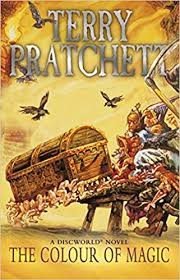
Almost lastly, a bit of a moan about this edition. It is the Corgi edition shown above, with the original Josh Kirby illustration (which I always felt were a bit over the top tbh), published this year with a mention of Pratchett’s death in the frontispiece. The blurb includes a quote from the independent calling Pratchett “one of the funniest English authors alive”. Was this just a case of laziness by the publishers not bothering to update their copy, or just a bad joke?

Finally, a quiz question for you, which should be easy given the subject of this blog entry – who are Berilia, Tubul, Great T’Phon and Jerakeen?

Standard
19th Century literature, Book review, Charles Dickens

Comment: Gammon

Just a quick follow up to yesterday’s post about ‘Nicholas Nickleby’.

Earlier this year there was a very slight fuss in the UK media about the use of the term “gammon” as a pejorative description of older white men who get red in the face when upset. The Urban Dictionary defines it disrespectfully as:

“A term used to describe a particular type of Brexit-voting, middle-aged white male, whose meat-faced complexion suggests they are perilously close to a stroke. The term ‘gammon’ is linked to the unhealthy pink skin tone of such stout yeomen, probably because of high blood pressure caused by decades of ‘PC gone mad’, being defeated in arguments about the non-existent merits of Brexit and women getting the vote. Gammon often make their appearance on BBC’s Question Time jabbing their porcine fingers at the camera while demanding immediate nuclear strikes against Remain-voting areas, people who eat vegetables and/or cyclists.
When gammon appears en masse it is often referred to as a “wall of gammon“.

The origin of the term is interesting. In ‘Moranthology’ Caitlin Moran claimed that David Cameron resembled “a slightly camp gammon robot” and “a C3PO made of ham”. However, the term appears in a very similar context some 150 years earlier in (you guessed it) ‘Nicholas Nickleby’.

In a scene shoe-horned clumsily into the narrative for what I assume was intended but now lost satirical purposes, an angry political deputation (indeed, a mob) confront their humbugging MP, Mr Gregsbury. In the course of the argument

download (1)


“one gentleman in the rear did not scruple to remark aloud, that, for his purpose, it savoured rather too much of a ‘gammon’ tendency.”

“The meaning of that term—gammon,’ said Mr. Gregsbury, ‘is unknown to me. If it means that I grow a little too fervid, or perhaps even hyperbolical, in extolling my native land, I admit the full justice of the remark. I am proud of this free and happy country. My form dilates, my eye glistens, my breast heaves, my heart swells, my bosom burns, when I call to mind her greatness and her glory.”

Gregsbury is ‘Gammon and proud’ in other words.

Inevitably people have found earlier uses of the term, for example in the 1603 John Marston play ‘The Malcontent’ where someone gloriously is called a “sallow-Westphalian gammon-faced zaza”. So gammon has a proud old English heritage, ironically,

I think the term is a glorious addition (or rediscovery) to our lexicon. It calls to mind the physical response to distress or emotion in a certain group of individuals and as such is the perfect metaphor. It’s not just a term of abuse, although granted it isn’t a compliment, because as well as the physical similarity there is a shared intellectual mindset between the commentator and the cooked meat. As for the preposterous argument that it is in any way racist, phooey! Some people get red in the face when agitated – that has nothing to do with their ethnicity.

Words, like brexiteers, are fiercely independent, and can’t be bullied into or out of our language. The new definition of gammon might make it to the next edition of the OED, or it might not, but if it does I think Dickens would approve, and should certainly get some of the credit.


Standard
Book review, Charles Dickens, Nicholas Nickleby

Nicholas Nickleby, by Charles Dickens, 1838-9

In her reading diary ‘Jacob’s Room is full of books’ Susan Hill describes her habit of reading one Dickens novel a year. This struck me as an eminently sensible habit – if you tried to read them all in one you would go a bit mad, and I suspect the novels would start to bleed into one another. One a year on the other hand allows plenty of time for other reading and would leave most readers with a realistic prospect of working their way through the whole canon. So I thought I would give this practice a go, starting with one of the more accessible novels, ‘Nicholas Nickleby’.nn
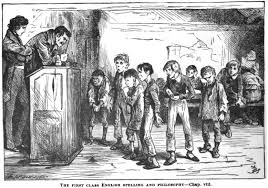
‘Nicholas Nickleby’ was Dickens’s third novel, published in monthly instalments over 18 months in 1838 and 1839. In many ways it is quintessential Dickens. Almost all of the features of a typical Dickens novel appear – the episodic switching between narrative threads, the mysterious stranger who reveals a long buried secret, fortunes lost and re-won, child-like romances, and the long drawn out death of consumptive innocents. Probably the one other most distinctive feature of all Dickens’ work is his concern with social justice. This aspect of his work is already fully formed in this novel, as for example here in this extraordinary meditation by Nicholas:

But now, when he thought how regularly things went on, from day to day, in the same unvarying round; how youth and beauty died, and ugly griping age lived tottering on; how crafty avarice grew rich, and manly honest hearts were poor and sad; how few they were who tenanted the stately houses, and how many of those who lay in noisome pens, or rose each day and laid them down each night, and lived and died, father and son, mother and child, race upon race, and generation upon generation, without a home to shelter them or the energies of one single man directed to their aid; how, in seeking, not a luxurious and splendid life, but the bare means of a most wretched and inadequate subsistence, there were women and children in that one town, divided into classes, numbered and estimated as regularly as the noble families and folks of great degree, and reared from infancy to drive most criminal and dreadful trades; how ignorance was punished and never taught; how jail-doors gaped, and gallows loomed, for thousands urged towards them by circumstances darkly curtaining their very cradles’ heads, and but for which they might have earned their honest bread and lived in peace; how many died in soul, and had no chance of life; how many who could scarcely go astray, be they vicious as they would, turned haughtily from the crushed and stricken wretch who could scarce do otherwise, and who would have been a greater wonder had he or she done well, than even they had they done ill; how much injustice, misery, and wrong, there was, and yet how the world rolled on, from year to year, alike careless and indifferent, and no man seeking to remedy or redress it; when he thought of all this, and selected from the mass the one slight case on which his thoughts were bent, he felt, indeed, that there was little ground for hope, and little reason why it should not form an atom in the huge aggregate of distress and sorrow, and add one small and unimportant unit to swell the great amount.

This is classic Dickens, with its clinical and yet at the same time passionate dissection of the social ills of Victorian Britain, but sadly also without offering any hope or constructive solutions. Yes the bad guys always come to a messy end in his novels, either the gallows, deportation or similar, and the central characters find happiness and prosperity through the bequests of long lost relatives, but the poverty disease and degradation are still all there.

The other source of enjoyment I find in Dickens is his wonderfully perceptive portraits of the fallibility of human nature. In this he probably has no peer other than Jane Austen. Mrs Nickleby is a particular favourite, bringing to mind her obvious predecessors Mr Woodhouse and Mrs Bennett, where the author’s use of reported speech conveys the full impact of her rambling complaints, without us having to work our way through them all:

To this, Mrs. Nickleby only replied that she durst say she was very stupid, indeed she had no doubt she was, for her own children almost as much as told her so, every day of her life; to be sure she was a little older than they, and perhaps some foolish people might think she ought reasonably to know best. However, no doubt she was wrong; of course she was; she always was, she couldn’t be right, she couldn’t be expected to be; so she had better not expose herself any more; and to all Kate’s conciliations and concessions for an hour ensuing, the good lady gave no other replies than Oh, certainly, why did they ask her?, her opinion was of no consequence, it didn’t matter what she said, with many other rejoinders of the same class.

There’s no denying the fact that Dickens’s villains are two dimensional, with very few shades of grey in their character, but what wonderfully wicked villains they are. Even if you have not read any Dickens, you will be able to get a good idea of the character of the schoolmaster Wackford Squeers simply through his name alone.

So why isn’t ‘Nicholas Nickleby’ considered in the top rank of Dickens’ work? That assessment is open to debate of course, but I think it reflects a consensus. Dickens had five novels in the BBC Big Read list of the 100 most loved novels (‘Bleak House’, ‘A Tale of Two Cities’, ‘David Copperfield’, ‘Great Expectations’ and ‘A Christmas Carol’) but Nickleby was omitted. My theory is that this is because the scenes of peril in the novel are rarely sustained. The dangers characters face at different points is never very serious, and is usually resolved quickly. (This is reminiscent of the ‘fake’ deaths at the end of many Disney films: the scene in which a character appears to die, only to revive moments later is a feature of many children’s films, and it is a very reliable rule that the quicker they revive (think of Baloo surviving the fight with Shere Khan in ‘Jungle Book’, or the brief moment in ‘Robin Hood’ when we think he has been shot with an arrow and drowned) the younger the target audience.

From this perspective Nicholas lives a charmed life. When his father dies unexpectedly, rather than ending up in the workhouse, his family has a rich uncle Frank to turn to. He easily gets a job as a teacher despite his lack of qualifications. While Dotheboys Hall is a nightmarish place for the boys, for Nicholas it is far less uncomfortable, and when his patience is pushed too far he can simply beat Wackford and walk away, something of which the boys can only dream.

His sister Kate and their mother are given lodgings free of charge by the villainous uncle, and Kate is found a perfectly respectable job as a milliner’s assistant. When this does not work out another equally respectable job, as a lady’s companion, appears quickly enough. The trauma of the subsequent assault on Kate by Sir Mulberry Hawk is obviously serious, but is quickly stopped by Ralph.

Nick’s good fortune however continues. He finds a job on the stage in Portsmouth and debuts almost immediately as Romeo. Later, compelled to return to London, he again finds well-paid work straight away with the lovable merchants, the Cheeryble the brothers. Nicholas has been accompanied on his adventures by Smike, an orphan runaway from Dotheboys. Smike has the misfortune to run into Squeers, who kidnaps him, but is rescued within hours. A subsequent attempt to reclaim Smike by the use of forged documents to the effect that he is the long-lost son of a man named Snawley is avoided by the simple expedient of ignoring it.

Inevitably, romantic interest intervenes. Nicholas nobly tries to avoid making Madeline Bray, the penniless daughter of a debtor, fall in love with him, but it comes as no surprise when this plan fails. There is a far-fetched plan to marry Madeline off to Arthur Gride, an early iteration of Fagin, in return for the promise of paying off her father’s debts to be foiled. This scheme falls apart on the day of the wedding when her father drops conveniently dead. The happily-ever-after then comes in a rush as all the plots against Nicholas fall away as so much background noise.

There is much more sustained threat in Dickens’ later novels. Imagine how more scary being a pupil at Dotheboys would have been compared to being a master? Indeed, Dickens gives us this comparative experience himself with David Copperfield’s experiences at Salem House, and those of Oliver Twist in the workhouse. Ultimately, this lack of genuine peril is what makes this novel considered suitable for children. if you are looking for an introduction to Dickens for a younger reader this is an excellent place to start.



Standard
21st century literature, American literature, Book review, Jonathan Safran Foer

Here I Am, by Jonathan Safran Foer, 2017

As I may have mentioned once or twice, I keep this blog as a record of what I read. If I don’t blog it’s probably because I haven’t been reading, but occasionally there are novels that really challenge my ability to say something interesting. ‘Here I Am’, Jonathan Safran Foer’s third novel, is a case in point. I read it a couple of months ago, but found it so underwhelming that when I finally found the time to write this review I had to look the title up. What is more remarkable is that it seems to have taken the author 10 years or more to write it!

‘Here I Am‘ is the story of the Blochs, a very familiar dysfunctional American family. Julia, an architect, and husband Jacob, a TV screenwriter, live in Washington DC with their three sons, Sam, Max and Benjy. Their marriage is falling apart for all the usual reasons – boredom, disrespect, mid-life crises, infidelity. An extended family provides supporting cast members including Jacob’s grandfather Isaac, planning to defer death until after Sam’s bar mitzvah; Jacob’s parents, Irv and Deborah, and others.

The Guardian’s review described “Here I Am” as

“a novel of diaspora, of the elasticity of its numerous possible meanings, and of the pain caused by both the presence and the absence of the homeland it invokes. It moves from the intimate dissection of a family that has ceased to become a home for its members to the question of what Israel means to American Jews, and what they might consider to be their duty in the face of its imperilment.”

Which is a useful thematic summary, but will also give you a strong flavour of the worthiness of the novel. Worthiness can be fatal to any attempt at comedy. Because despite the big themes, this is undoubtedly intended to be an albeit dark comic novel. Divided between writing a serious novel about the experience of being a Jewish American family (already very well-explored novelistic territory) and the more comic aspects of that experience (ditto) Safran delivers neither very well.

Part of the problem is that very little happens, and it takes a long time to not happen. Minor incidents become central plot elements. Sam leaves a list of “rude” words on his desk at school then denies doing so – it is not until near the end of the novel that we find out he did write the list, as a profoundly unrealistic exercise in intellectual curiosity. Jacob “loses” the secret mobile phone on which he and a producer have exchanged explicitly sexual texts, in a pretty pathetic attempt to make himself more interesting to his wife. As mid-life crises go this is mundane stuff.

The bulk of the narrative is conveyed through the family’s conversations. The repetitive dialogues and monologues may be realistic representations of the way families talk to one another, but it felt a bit like being harangued for 500 and more pages. Realising the novel needed something by way of incident or drama, Safran Foer goes “all-in”. An apocalyptic earthquake in the Middle East strikes Israel, gifting the surrounding states an opportunity to recover lost territories/invade, depending on your perspective. A domestic chronicle suddenly becomes a diary of this catastrophe, which ends with the Israeli prime minister’s absurdly unlikely call to the men of the Jewish diaspora to return “home”. As if a country struck by an earthquake needs an influx of untrained volunteers to defend it. Jacob’s half-hearted attempt to volunteer falls flat, being turned away at the airport due to him having nothing worthwhile to contribute. As a metaphor for the turbulence in the Bloch family the earthquake and ensuing crisis is clumsy in the extreme, and as a statement on the position in the Middle East it is at best irrelevant and worst tasteless.

And if you have found the preceding paragraphs an unsatisfactory account of this novel, well you can’t say I didn’t warn you!

Standard
Book review

The Templars: The Rise and Spectacular Fall of God’s Holy Warriors by Dan Jones, 2017

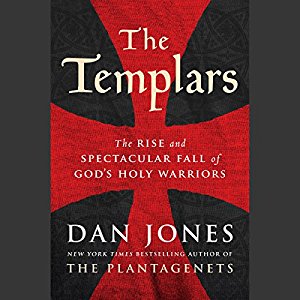
tamplarsIt would be hard to write a boring history of the Knight’s Templars. They were a Christian military order originally founded during the early years of the Crusades to protect pilgrims travelling to Jerusalem and other holy sites in the very dangerous lands of the Middle East. The Order’s story is inextricably linked with that of the Crusades, and you accidentally learn a lot about the latter just by reading this account of the former. It is hardly surprising then that the Templars have had a strong grip on popular imagination, from the Da Vinci Code to Indiana Jones. They also had a flair for iconography and symbolism, such as the big red cross they wore on their cloaks.
Dan Jones’s “Templars” a fairly conventional chronological narrative, and after a while the procession of battles, slaughter, castles and cities captured and lost, becomes a bit of a blur. Masters of the Order come and go, opponent warlords do the same, victories and losses take their turn. This is a very Western oriented history – the infidel hordes are differentiated only by their leaders, and there is no attempt to understand why they had such apparently inexhaustible resources (clue – because this was/is their homeland) or why they were able to repeatedly defeat supposedly superior Western European armies. Jones resists the temptation to draw parallels with modern conflicts in the Middle East,  although these suggest themselves at times irresistibly.

 Authors of histories need to address the “Why am I writing this book?” question in a way fiction writers do not. Normally answers range from “I have uncovered new material” – no such claim is made here – “I have a different interpretation from previous authors” – ditto – or “this topic has not been written about recently” – another ditto. So why was this book written? Jones may have hoped for a TV adaptation from this book – the settings are very photogenic – and this may be behind his tendency to leave chapters hanging on a cliff-hanger in phrases such as “William was not quite ready to act on the evidence he was compiling. But he could and he would”; “He would never see Cyprus again”; or “This was the moment when darkness began to fall on the Templars”.

I make no claims of expertise in this field, but I got the impression that Jones has based his work primarily on the chronicles of the Templars and their opponents. I would have thought an archaeological approach might have been worth considering – what do the ruins of the temples, castles, houses and farms of the Order  tell us about their histories that the chronicles gloss over?

During my read of this text I came up with a theory about this category of book – serious but non-academic history. There’s a limit to how much information the brain can retain. This is a complex narrative spanning around two hundred years. The bibliography, glossary and appendices run to almost 100 pages. This condensation of such a vast amount of information in a non-academic work of history (I don’t mean Jones’s approach is non-academic, simply that the book is aimed at the general albeit studious reader, rather than historians or student) inevitably leads to the overwhelming weight of facts passing the reader by. It’s just not possible to retain all that information, unless you read the book as if you were going to be examined on it afterwards. So in the end you probably learn little more than if you were to read a few thousand words about the Templars on Wikipedia. I am not sure that is a problem or not – you can enjoy the book but use the internet if time is more pressing or you want to cover more ground.

Standard
Book review

Jacob’s Room is full of books – Susan Hill, 2017

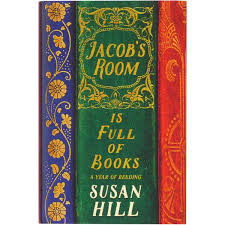
‘Jacob’s Room is full of books‘ is Susan Hill’s very readable if (I have to say) unsubstantial  follow up to ‘Howard’s End is on the Landing’. Simply, it is a reading diary, a year of reading as the subtitle puts it.  Each month Hill mentions the books she has been reading, and these booHIllks then go on to trigger what often seem quite random but nevertheless entirely natural thoughts – her personal acquaintance with the author, her impressions and judgments on their other works, what it is like to be a writer on GCSE reading lists, attending literature festivals, and so on. Interspersed with this well-informed stream of consciousness are many observations about nature, particularly birds, which if I was being cynical I would think of as padding to get the book over the 200 pages mark…

There is a structure of sorts to the book – it is divided into the twelve months of the year – but you could easily dip into it at any point and it wouldn’t make much difference. You certainly don’t end the book knowing much more about Hill or books or reading or writing than you do, say, half way, or indeed after having read ‘Howards End is on the Landing’. Which makes me wonder – is this anything other than a rather cynical cash-in, a stocking filler, something to appeal to Christmas shoppers with a reader in their lives to keep happy? I feel a bit ridiculous mentioning this, but the fact that Jacob’s Room isn’t mentioned at all in the book, other than to provide the mildly amusing title, niggled at me slightly. Because Hill’s struggles with her out-of-control personal collection of books, which she culls ruthlessly and often, but still can’t keep on top of, (“As fast as I get one out of the back door, two new ones come in through the front anyway”) was one of the more relate-able aspects of the book which I would have liked to have known more about.

The book shows signs of being a transcribed notebook – there is an immediacy to many of Hill’s observations and comments, such as those on wildlife spotted (that is seen, not spotted wildlife) or emails received – and the repetition at many points, such as her slightly contradictory accounts of being on the 2011 Booker prize jury, could have done with some friendly editing. There’s little artifice here – there must have been a temptation to edit or self censor to make the author appear a more careful and considered reader – but that doesn’t seem to have happened. I suspect I won’t be the only reader who snapped the book shut at her more outrageous criticisms of writers we have loved – Keats, for goodness sake, gets dismissed with a few words, and Jane Eyre goes proudly unread – but then cheered when she praises our favourites. I can forgive her almost everything for her comments on the brilliance of Raymond Chandler.

If I wanted to I could construct a narrative about this book being (underneath all the daily noise) about ageing. Hill is in her mid-70’s, and while full of life she still has some/much of the grumpiness of many of that age. She knows that her overstocked shelves are becoming a bit of a burden, and in trying to divest herself of them she is making tentative steps towards preparing for the later stages of her life. Whether I can convince even myself on this one is another matter.

This was the first and probably easiest/shortest of an extraordinary haul of books I accumulated over the recent festivities, which will dominate my reading across much of 2018. I’ll keep you posted.


Standard
Book review

Goods Omen by Terry Pratchett and Neil Gaiman 1990

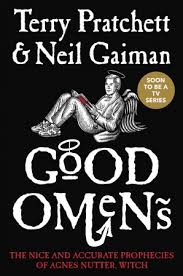
Why haven’t I read “Good Omens” before now? That’s not a rhetorical question – tell me why no-one has thrust this book into my hands and said “You love Terry Pratchett and you think Neil Gaiman is pretty good as well, so read this, now”? As you can tell I feel slightly narked at the fact that this wonderful book has not made it onto my reading list until now. Good omens

One reason might be that collaborations, especially on novels, have at best a patchy record. Name me a novel written by two people that is as good as any of the novels written by either of the co-authors? That one is a rhetorical question btw. “Good Omens” is the only co-authored novel on the BBC Big Read list of 100 best novels, if you needed any evidence on that point. But something about the way these two worked together, across different continents and time zones, just worked, producing something as good as if not better than their best solo work. It could easily have been written by Douglas Adams, and if you have been paying any attention to anything I have written in the last 5 years or so you will know that there is no higher compliment.

“Good Omens” started life as a Just William parody, and if I were to find a fault with the novel, the extended sections of the prepubescent schoolboys and schoolgirl getting up to no good in an essentially well behaved way are some of the weaker parts of the novel. But that doesn’t really matter, because the cornucopia of ideas and characters that fizz from every page of the rest of the novel more than compensate. Quite how a schoolboy story became a parable about the end of the world I am not sure, but it tells you something about Pratchett and Gaiman’s imaginations. There so much to enjoy here – utterly believable eccentric characters, such as the angel and demon working together to avoid Armageddon, Witchfinder General Shadwell and his assistant Newton Pulsifer, the witch Anathema Device (was/is there any author better at producing fantastic names for his characters than Terry Pratchett was – I give you Cut My Own Throat Dibbler in evidence), a breathless plotline that genuinely leaves it open to doubt whether the world is going to end or not, and on every page some of the best and at the same time wisest jokes you will find in any modern novel.

“It may help to understand human affairs to be clear that most of the great triumphs and tragedies of history are caused, not by people being fundamentally good or fundamentally bad, but by people being fundamentally people.”

“An Angel who did not so much Fall as Saunter Vaguely Downwards.”
“She was beautiful, but she was beautiful in the way a forest fire was beautiful: something to be admired from a distance, not up close.”
This is Pratchett at his very best, and whatever Neil Gaiman contributed to the process and outcome – the appendix at the end of this edition contains interviews with the authors that are frustratingly vague on this point, including the possibility that some of the text was written by neither of them – the combination just worked. I suspect it made Terry a better author in the long run, although I don’t think he ever wrote anything better.
Finally some good news – the novel is being adapted for television by the BBC, with two of Britain’s best actors, Michael Sheen and David Tennant, in the lead roles, and with a wonderful supporting cast. Should be (the light) fantastic.
Standard
Book review

Citizen Clem – John Bew

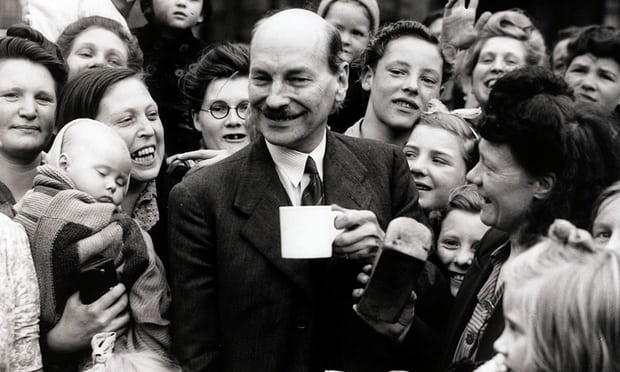
This is a good time to return to the extraordinary story of Clement Attlee’s rise to the leadership of the Labour Party, his twenty-year long period as leader (1935-1955), Deputy Prime Minister (1940-1945) and Prime Minister (1945-1951).  Attlee won two General Elections, saved the Party from the electoral wipe-out of 1931, and governed during Labour’s almost mythical post-war period in office when the Welfare State was brought to fruition.

Attlee

It is timely because the legacy and spirit of the Labour Party is once again the focus for political debate in the UK. It is possible that the party’s much better than expected performance at the 2017 General Election will have quietened that debate for the time being, but few imagine that this will not break out time and again while Jeremy Corbyn remains leader.

Rigidly chronological in structure, this biography charts Attlee’s rise to senior positions within the Labour Party, without his ever really expressing much interest in doing so – he seems to have had an amazing knack of being in the right place at the right time, never more so when he became Deputy Leader after the whitewash of 1931, when the party was reduced to fewer than 50 MPs. After a careful narrative charting Attlee’s childhood, early military career, and his discovery of his social conscience, Bew focuses on the post-war Government which delivered such an amazing legacy of legislation and reform. while at the same time falling short of many of the aspirations generated by such a resounding win.

Despite having made my way through over 500 pages of this biography, Attlee remains something of any enigma. I can’t honestly say I know the man.  You could fill a short book alone with the collected insults offered to him. Nye Bevan is said to have called him ‘a desiccated calculating machine.’ Others compared him to ‘a little mouse’, ‘a poor little rabbit’, or as George Orwell put it, “a recently dead fish, before it has had time to stiffen’. American press said he was `the dullest man in English politics’. Churchill famously said that Attlee was not only a modest man with plenty to be modest about, but ‘a sheep in sheep’s clothing’. Even when people tried to say something supportive or positive about him, they almost always prefaced their comments with another veiled insult about his reserved nature, his modest talents, his poor grasp of economics, and so on.

Bew gives us little of Attlee’s personal life, leaving the reader to conclude that it was as dull as outer appearances suggest. He draws heavily on Attlee’s letters to his brother Tom which are referenced every few pages – as if they provide some unique and previously unknown insights into Attlee’s inner thoughts, when almost always they tell us what we already know and indeed have already been told.

This book won the Orwell Prize for political writing in 2017. I have a sneaking suspicion that the author had half an eye on the prize when writing – the number of shoe-horned in references to Orwell’s work pile up, for example when comparing Attlee to Boxer, the shire horse eventually sent to the knackers’ yard. Boxer represents the ordinary Russian worker who continues to recite party slogans long after they lose all meaning, his faith in the Party unaffected by reality – in other words not at all like Attlee, who was a party faithful all his life but can hardly be described as a mindless functionary. The comparison just doesn’t work, and should have been cut – but the author obviously needed to keep every possible Orwell name-check to keep the book in the prize judges’ eyeline.

I can’t comment on whether this is the definitive Attlee biography, but I am glad I read it – I knew shockingly little about his background as a Major at Gallipoli and in France in World War one, for example, or the collapse of the second Labour Government 1929-1931, although his role in the second World War and the post war Government were naturally more familiar. I did have a couple of quibbles with the book that I can’t let slide.

First, it could have done with a closer edit. Over 500 pages there are always going to be mistakes, but this is not the first edition, and allowing sentences such as (page 144)

“For the moment, he shared the view that the obstacles to self government in India were, for the moment, insurmountable”

is unforgivable. Second, there are some moment of lazy writing. Can you spot what’s wrong with the following paragraph, for example?

(page 147) “The biggest challenge facing the second Labour Government was unemployment. Their task became extremely difficult because of events outside its control. In the last week of October (1929) the bottom fell out of the international economy, beginning with a monumental panic on the New York Stock Exchange that saw traders leap from windows in despair.“

Yes, it’s the cliched way of describing the Wall Street crash featuring those leaping traders. Five minutes on Google will tell you that it didn’t happen – suicides rates actually went down during the period of the crash. But even if they didn’t, and they did, why describe the crash in this way? Is the reader supposed to think “Oh that Wall Street crash in October 1929, the one which led directly to the rise of fascism and the resurgence of the National Socialist Party in Germany , I wasn’t sure which one you meant”. If the author can’t be relied on to get simple facts like this right, how reliable is the rest of his narrative?

Standard
Book review

Comments – sticks and stones

I got my first nasty comment yesterday. Having been blogging for several years now I Trollhave previously always welcomed comments. The vast majority have been positive, but even when people have disagreed with my view, they have done so politely. I have tried to adopt the same approach when commenting on other people’s blogs, because, you know, I am a human being not a troll. But my 2013 review of Patrick Suskind’s ‘Perfume‘ really upset one person, because they decided to leave a comment calling me an “miserable trout”!
Anyone not familiar with idiomatic British English may not recognise this phrase. It’s a remarkably mild insult, meaning roughly an unattractive and bad-tempered old woman. I’ll leave it for others to decide on the attractiveness or otherwise of my appearance, although what that has to do with Patrick Suskind’s novel escapes me for the moment. Bad-tempered I will accept in the context of the review – ‘Perfume’ is an appalling novel, and I stand by that judgment of several years ago when I first reviewed the novel – and yes, it put me in a bad mood. More, it upset me. If the descriptions of young women being murdered for sadistic pleasure which form the heart of the novel don’t upset you, perhaps it’s not me with the problem. But it’s the casual assumption that I am a woman that niggled at me – as if only women can call out misogyny when they see it. I thought we as a society or civilisation had outgrown that lazy idea?

For the avoidance of any doubt, I still love getting comments. It’s really one of the things that keeps me blogging and reading blogs, getting to share my ideas about books with other people and discuss them. Of course we will have disagreements. I would love to know in what way this commenter disagreed with me – what is it about Suskind’s portrayal of the mass murder of young women and the commoditisation of their bodies that appealed to him/her? But (s)he chose not to share that information, which was a pity.

Standard
Book review, John Green, Turtles all the way down, Young adult

Turtles All the Way Down – John Green, 2017

Should one use the same criteria when judging young adult novels as one does when assessing full-grown adult fiction? I ask because if one were to do so, ‘Turtles’ would probably suffer by comparison, when judged on its own merits as a thoughtful novel for young adults, it is a success.

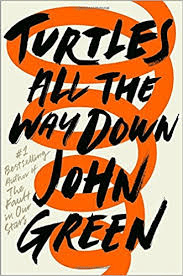
Turtles

The central character of John Green’s ‘Turtles All The Way Down’ (loving that title), Aza Holmes (‘Holmesy’) suffers from Obsessive Compulsive Disorder (OCD). This makes her extremely anxious, and she self harms as part of her control rituals, opening a wound on her hand, then being terrified it will become infected. As her condition deteriorates she takes to drinking hand sanitizer, in a deluded attempt to purge her body of infection. (NB Do not do this!). She is also haunted by thoughts that she is a fictional creation (which of course she is, although Green does nothing with this paradox). Most of the time she remains in control of her obsessive behaviour, although her internal monologue tells us that she is tortured by harmful thoughts. Despite her condition Aza is in many ways a typical, relatable American teenager – she drives to school in her beloved truck Harold, eats pizza with friends, and watches television with her mum. Green doesn’t spell it out in so many words, but we are invited to conclude that Aza’s OCD was triggered following the sudden death of her father from a heart attack when she was seven.

A fledgling romance with a neighbour whose incredibly rich father has gone missing triggers a more serious episode, and she is eventually hospitalised. The parallels with the loss of her own father are quietly underlined, and form the basis of her relapse. She eventually recovers sufficiently to overcome her anxiety and in a strange conclusion to the novel attends an art exhibition in a sewer, where she comes close to solving the mystery of the missing billionaire. I probably shouldn’t focus on this detail, but I doubt whether many OCD suffers would be prepared to go into a sewer for any price, let alone wander around in the dark in one. This ending to the novel was for me its weakest part, and fails on any level, providing an unsatisfactory ending to the ‘mystery’ element of the novel, which had a lot of potential but which Green seemed to lose interest in.

What elements do you look for in an adult novel that we can forgive being missing from a YA novel? Characterisation? Obviously not, we need the characters to be fully fledged and believable. Green does reasonably well here – some of his characters are generic, off-the shelf quirky teenagers distinguishing themselves from one another by their choice of hair style or interest in music. I quite liked Daisy, the inevitable reliable best friend, but Davis, the missing billionaire’s son, who provides the only significant romantic interest in the novel, isn’t well developed – in fact his brother Noah, who is mourning the loss of his father, but hides his grief and distress in video games, was more believable. There’s a whole missing novel there in fact – the two brothers waiting for their father to return, unable to draw any solace from their preposterous riches.

Plot? The story line in ‘Turtles’ goes missing quite early on, and never resurfaces until the hurried and unconvincing conclusion. Green starts out writing a conventional if slightly Scooby Dooish mystery, but this element fizzles out early on, and the focus shifts instead to Aza’s illness and its impact on her life.

Quality of writing. Green does a good job, so far as I can tell, in representing the voice and thoughts of a teenage OCD sufferer. His writing is straightforward and extremely easy to read – this is the kind of novel that you can polish off in a few hours easily. There are no rhetorical flourishes or difficult passages.

Originality. It would be being harsh to say Green was on auto-pilot here, but there is a very familiar clichéd feel to this novel. Angsty teenagers have mild romantic entanglements to the backdrop of a high-school experience, something easy for US teenagers to identify with from real-life, (and other readers from anyone who has watched US television) the kind of high school where you pull up in front of the school and there is always a parking space waiting; where lessons take a few minutes and time is mainly spent being cool in the cafeteria, and pupils quote Shakespeare to one another in their texts. It was as believable as Buffy the Vampire Slayer, but a bit less glamorous.

Ultimately, the answer to my opening question is a clear no. This isn’t a book that adults will be able to take much from, but younger readers (I really wouldn’t get hung up on the YA label; I would have thought pre-teens could enjoy this as well. There are some adult themes such as references to dick pics, but that is about as strong as it gets) will find it an interesting and comforting read – or in the words of the Guardian’s reviewer “It will resonate with, and comfort, anxious young minds everywhere” , which I think is spot on.

P.S. What a disappointing book cover by the way – we get it that depression is like a spiral (not that that image is in any way helpful or clear) but the missed opportunity for pictures of some turtles will hopefully be rectified in the paperback!!

Standard