Book review

Titus Groan, by Mervyn Peake, 1946

God I loved this book and its sequels. They enchanted me in a way that very few other books have done in my lifetime – possibly only teenagers can really feel this way about novels. Decades on I can look at them a bit more dispassionately and see their (very minor) flaws, but they remain high on my top ten list, and will always do so. It’s not going to be easy explaining this obsession. You either love these books (or at least the first two, the third is more complicated as I will explain in a bit) or you don’t – indifference is rare.

Peake was a writer of extraordinary flair and confidence. This is how he opens Titus Groan:

Gormenghast, that is, the main massing of the original stone, taken by itself would have displayed a certain ponderous architectural quality were it possible to have ignored the circumfusion of those mean dwellings that swarmed like an epidemic around its outer walls. They sprawled over the sloping arch, each one half way over its neighbour until, held back by the castle ramparts, the innermost of these hovels laid hold on the great walls, clamping themselves thereto like limpets to a rock. These dwellings, by ancient law, were granted this chill intimacy with the stronghold that loomed above them. Over their irregular roofs would fall throughout the seasons, the shadows of time-eaten buttresses, of broken and lofty turrets, and, most enormous of all, the shadow of the Tower of Flints. This tower, patched unevenly with black ivy, arose like a mutilated finger from among the fists of knuckled masonry and pointed blasphemously at heaven. At night the owls made of it an echoing throat; by day it stood voiceless and cast its long shadow.

I wonder at the assurance and skill of an author who can open with a parenthesis like that. This is our introduction to the huge castle of Gormenghast, a “vast landscape of crumbling towers and ivy-filled quadrangles” that has for centuries been the hereditary residence of the Groan family. I have only limited evidence for this but I am personally convinced that as Peake wrote the novels the castle grew in his imagination, starting from a modest, realistic setting and with it finally ending larger than a city. Titus Groan, the first of the series (not strictly a trilogy as it was not conceived as such, more a 3 book series) opens in an extraordinarily cinematic way – taking the reader from the outside of the castle where the Bright Carvers reside to the Hall of Bright Carvings, through corridors and passageways into the heart of the castle, focussing down to a small eye-hole in a painting through which we see the novel’s newly born hero, Titus, heir to the crumbling towers of Gormenghast.

Slowly Peake introduces the cast of his drama. Lord Sepulchrave, seventy-sixth Earl of Groan, a melancholy man, a prisoner of the rituals that govern life in the castle.

Sepulchrave, 76th Earl to the house of Gormenghast and lord of those tracts of country that stretch on every hand, in the North to the wastelands, in the south to the grey salt marshes, in the East to the quicksands and the tideless sea, and in the West to knuckles of endless rock.

His wife Countess Gertrude shuts herself away with her birds and her multitude of white cats. Their daughter is 15-year-old Fuchsia.

a girl of about fifteen with long, rather wild black hair. She was gauche in movement and in a sense, ugly of face, but with how small a twist might she not suddenly have become beautiful. Her sullen mouth was full and rich – her eyes smouldered.”

Fuchsia is a typical teenager, moody, self-absorbed and selfish. Sequestered in the south wing of the castle are Sepulchrave’s identical twin sisters Cora and Clarice:

dressed in purple, with gold buckles at their throats by way of brooches, and another gold buckle each at the end of hatpins which they wore through their grey hair in order apparently to match their brooches. Their faces, identical to the point of indecency, were quite expressionless, as though they were the preliminary lay-outs for faces and were waiting for sentience to be injected.

Both suffered from ill-defined fits in their youth which left them with limited mobility and even less intelligence. They crave power and blame Gertrude for robbing them of their rightful place in the castle’s heirarchy.

This is the ruling Groan family. Their lives are supported by numerous servants. These include Mr Flay, Lord Sepulchrave’s personal assistant, who is obsessively dedicated to his master. Swelter, the castle’s enormously fat chef, is Flay’s arch-nemesis:

Swelter, as soon as he saw who it was, stopped dead, and across his face little billows of flesh ran swiftly here and there until, as though they had determined to adhere to the same impulse, they swept up into both oceans of soft cheek, leaving between them a vacuum, a gaping segment like a slice cut from a melon. It was horrible. It was as though nature had lost control. As though the smile, as a concept, as a manifestation of pleasure, had been a mistake, for here on the face of Swelter the idea had been abused.”

Nanny Slagg is the down-trodden Groan family carer, looking after Fuchsia and now Titus. Doctor Prunesquallor is the castle’s physician. Rottcodd cares for the Bright Carvings. Sourdust is the Master of Ritual.

Into this arcane, decaying, isolated world, comes Steerpike, a young kitchen boy who could give Machiavelli a run for his money, Rescued by Flay from the kitchen, mainly to irritate Swelter, Steerpike immediately starts scheming his rise to power. This is as much his story as Titus’s. Steerpike is the worm in the apple of Gormenghast, who slowly comes to corrupt the whole body-politic of the castle.

In some ways the castle itself is almost a character in the novel. Peake is endlessly fascinated by its eccentric architectural detail:

Most of these buildings had about them the rough-hewn and oppressive weight of masonry that characterized the main volume of Gormenghast, although they varied considerably in every other way, one having at its summit an enormous stone carving of a lion’s head which held between its jaws the limp corpse of a man on whose body was chiseled the words: “he was an enemy of Groan’; alongside this structure was a rectangular area of some length entirely filled with pillars set so closely together that it was difficult for a man to squeeze between them.

Some readers have struggled to allocate Titus Groan and its sequel to a particular genre. While often described as fantasy, there are no witches, dragons or magical spells here, nothing supernatural or other-worldly at all. We perhaps cannot tell where or when Gormenghast is, but the people who live there obey strictly the internal rules of the narrative. It is best read as a gothic adventure story, a romance. Yes it is peopled by grotesques who you are unlikely to meet in everyday – but you might. There are stranger people out there. Not that long ago the Guardian carried an article comparing the novel to its near contemporary The Lord of the Rings, trying to understand why it was not as well known or loved as Tolkien’s trilogy. This was surely a category error – one work is a quest trilogy peopled by dragons, dwarves, wizards and elves; in Titus we remain rooted in Gormenghast, and the only menacing creatures hiding in the shadows are the men and women of the castle.

Readers may struggle with Peake’s florid language. Without question some passages are over-written. The novel also has probably the slowest start of any classic – it takes an age to reach Titus’s birth and Steerpike’s escape from the kitchen. All I can say is that once you get past this point the pace picks up and the narrative is gripping across the two main novels. Steerpike is a compelling character – while he is clearly monstrous, we cannot help but sympathise with him for at least some of his journey.

Titus Groan and its sequels are wonderful, life-changing, superb novels. Peake creates memorable characters you come to genuinely care about, and who will stay with you. There is a Shakespearean quality to the tragedy that unfolds in this novel and its sequel, a tragedy compounded in a remarkable way by the turn of events in Peake’s own life that are reflected in the third and final novel in the series. They may not be universally popular – some readers may find it hard to find a hero to identify with, and the language over-indulgent – but I love them.
Standard
Book review

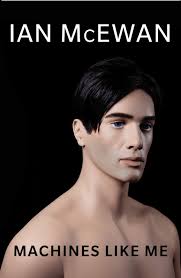
Machines Like Me, by Ian McEwan, 2019

Let’s start with that clever title.  The ambiguity lies between machines that are similar to ‘me’ and machines that feel a form of affection towards ‘me’. In Ian McEwan’s interesting latest novel it’s not clear in what sense if any the machines in question, robots, like the narrator.McEwan1

The narrative is relatively straightforward. Charlie Friend, the narrator, buys one of the earliest personal robots introduced onto the market. These robots are all called either Adam or Eve. His Adam is a very near simulacrum of a human being, although it costs more than the price of an average house (and Charlie still lives in a flat in London). Charlie is attracted to Miranda, his upstairs neighbour , and they soon begin a relationship. This quickly becomes a menage a trois, as Adam first has sex with, then falls in love with, Miranda. Yes, they are that kind of fully-functioning robot.

Charlie, Miranda and Adam are living in an alternate version of the 1980s, one where Alan Turing didn’t take the course of chemical castration ordered by the courts following his conviction for being gay. Turing is the key in this parallel universe to unlocking an extraordinary leap forward in technology in which self-driving cars are commonplace and robot technology has been perfected.

During my reading of Machines Like Me I kept experiencing a nagging sensation that something wasn’t quite right. Unquestionably the novel’s narrator wasn’t telling us the whole story, and I wondered whether there might be a hidden reason for this, in a similar fashion to McEwan’s earlier Sweet Tooth. In Sweet Tooth there are similar moments where things don’t quite add up, where the narrator is clearly getting things wrong or asking us to make intuitive leaps without sufficient reason. There is the same feel to the narrative here – the narrator presents us with a series of events which successively feel ‘wrong’, and asks us to take them at face value.

The sense that Charlie’s account is either misleading or disguising another, perhaps more serious or disturbing narrative, recurs throughout the novel. Things don’t quite add up. Early on Adam tells Charlie that Miranda, at that point only his potential girlfriend, is likely to hurt him. Charlie doesn’t follow this up – surely he would take the earliest possible opportunity to grill Adam on what he means, but he lets it slide, and apparently forgets about the warning, such is the strength of his attraction. The much later explanation of this warning is insufficient. Shortly after this incident Adam breaks Charlie’s wrist when he attempts to turn him off, a clear violation of Asimov’s first law which had been specifically referenced a little earlier in the novel. (1. A robot may not injure a human being or, through inaction, allow a human being to come to harm. Adam also ignores rule 2. (a robot must obey orders given it by human beings except where such orders would conflict with the First Law) freely throughout the novel – he is almost completely autonomous. After the attack, Adam threatens Charlie with the removal of his arm, which Charlie assumes is a joke, although he has little reason for doing – at any time this comment would be unfunny, but coming as it does just after he has broken his wrist, it is clearly a serious threat.

Charlie earns money speculating on the stock exchange. It takes him forever to work out that Adam, with his far superior if not god-like intelligence, might be a little bit better at this than he is. Once he sets him to work he quickly amasses thousands of pounds. While Adam’s intelligence is special, it isn’t unique. If he is able to manipulate the stock and commodities exchanges to swiftly earn thousands, is there any reason to think that others with access to this technology would not have had the same idea, and be using computers to make their trades? Of course they had that idea a long time ago, so the narrative as presented by Charlie loses another element of its credibility.

I thought we were edging towards a revelation during the scene when Charlie is taken for the robot and Adam for the human by Miranda’s father, during a much-delayed visit. Adam easily passes this version of the Turing test, but the mistake is unconvincing – while Charlie is dull, and his small talk is similar to that of an android, it would have been funnier if the mistake had been a deliberate put down by the prospective father-in-law. Was this scene hinting that Charlie is actually the android with implanted memories and Adam the human owner? Or that androids have now assumed their rightful place in ascendancy over man, and this is the method of control, fooling humans that they are the owners, while being in control all along (and therefore able to override the Asimov rules?

But sadly nothing ever come of this line of thought, and it turns out that Charlie isn’t a seriously flawed narrator after all. All the inconsistencies and “off” moments were just lapses in the construction of the narrative, nothing else. Which was a major disappointment.

Some of McEwan’s recent novels, I am thinking of Solar and The Children Act in particular, were weighted down by the extensive research behind them. There was a sense that McEwan had gone to a considerable effort to learn about the topic in question, and was reluctant to let it go to waste, so incorporated large chunks of his notes into the text. Sometimes it felt like I was being lectured and that a test was likely at some point. Machines Like Me has a similar feel – the life of Alan Turing is definitely fascinating but if I wanted to read a biography of the man I would have done so.

McEwan has some fun with the setting and the alternative history in which Britain loses the Falklands War and Tony Benn becomes Prime Minister, but it is hard to see the relevance other than providing a context for and explanation of the advances in technology. There is no real effort to flesh out this world in any detail – apart from the life-like robots and the self driving cars, everything else is familiar, down to the poll-tax riots and the Brighton bomb. It’s just the 1980’s with robots.

I’ve been quite harsh on Machines Like Me thus far, but I did enjoy reading it. I wanted to know what happened to the characters, and while Miranda never really came into focus, I was pleased she earned her happy ending. As a mediation on human consciousness and identity, I didn’t feel the novel had anything new to say – Never Let Me Go is an incomparably more interesting and engaging exploration of many of the same issues.

Standard
Book review

The Handmaid’s Tale, by Margaret Atwood, 1985

The popularity of the television adaptation of The Handmaid’s Tale may have been what inspired Margaret Atwood to return to Gilead and the story of the eponymous handmaid Offred. (In the TV adaptation this character is called June, but so far as I can tell this name is not used in the book). It was certainly a factor in my decision to finally getting round to picking up this much-admired classic.

The Handmaid’s Tale is set the near future. A radical religious group, the “Sons of Jacob”, has captured power in the United States. The president has been assassinated, congress murdered, the constitution suspended, and the possession of jobs and separate bank accounts is forbidden to women. This is only the beginning of a dramatic overhaul of society in which all other religious groups are banned and a Talibanesque Old Testament-inspired model of society is imposed.

Declining birth rates caused by pollution and radiation mean that now only a few women are able to have children. These women are taken into slavery and forced to produce children for the ruling class of men, the “Commanders”. They are known as handmaids, a title derived from the story in Genesis of Rachel and her slave Bilhah. Women (and their children) are commonly treated as possessions in the Old Testament, and this inspires many of the new social structures and traditions in Gilead. All women have rigidly defined roles and and must follow a strict dress code: Commanders’ wives wear blue, handmaids red, and Marthas (servants) green.

The story is narrated by Offred, a 33 year old woman who records several months of her life as handmaid to a Commander and his embittered wife. As well as telling the reader about her imprisonment and the daily tortures she faces, she includes memories of her life before and during the revolution, which she describes as “The other time, the time before”. Life is brutal for almost everyone in Gilead, but the enslavement of women and the ritualised assaults for the purpose of breeding is particularly horrifying, even if Offred has slow begun to come to terms with her captivity. Her fond memories of times past provide some slight relief from the brutality of her new life.

Things improves marginally when the Commander begins to meet her secretly at night, not for sex, but to play Scrabble. This surprising development lightens the mood slightly and allows them to develop a less formal relationship. This is rule-breaking that could easily end badly for Offred, but she welcomes the hint of freedom it offers. She also agrees when the Commander’s wife, Serena, proposes that she tries to get pregnant by Nick, the family chauffeur, the implication being that the Commander may be sterile. At the same time Offred learns from her shopping partner, Ofglen, that there may be an underground resistance working to overthrow Gilead.

Offred’s narrative ends abruptly, leaving it unclear whether she has been taken into custody for her small acts of resistance, or whether she escapes Gilead. A mis-judged epilogue set in 2195 explains the events of the novel were recorded onto cassette tapes and are now considered an historic document charting the early years of the Republic of Gilead. While it appears a more equal society has now been restored, the lecturer is insensitive, treating the victims of the regime as a source for clumsy jokes. 

There are several disturbing aspects to this novel. It is utterly convincing in its demonstration how the injustices towards women in today’s society came to be the first step towards their enslavement in Gilead. Offred describes her life before the collapse of society as largely happy, but

“I never ran at night, and in the daytime only beside well-frequented roads. Women were not protected then. I remember the rules, rules that were never spelled out, but that every woman knew: don’t open your door to a stranger, even if he says he is the police. Make him slide his ID under the door. Don’t stop on the road to help a motorist pretending to be in trouble. Keep the locks on and keep going. If anyone whistles don’t turn to look. Don’t go into a laundromat, by yourself, or at night.”

In other words the seeds of Gilead and its oppression of women are inherent in today’s society. Another incident recounted in the novel emphasised this point. Offred describes a book-burning scene. But these are not nazis burning books about Marxism, but women burning hard core porn.

“You see what things used to be like? That’s what they thought of women then!”

I think the author may be suggesting here that freedom of speech extends to even content we find offensive, and that once we start burning books or magazines because they are upsetting, we are on the path that lead to censorship. Atwood in other words is out to challenge the reader rather than present a scary story which we can walk away from knowing we are lucky not to live there.

There are some obvious parallels between The Handmaid’s Tale and George Orwell’s 1984. Both are set in a relatively near future in which people can remember and contrast life under the previous regime. Both envisage totalitarian control of society in which thought crime can be punished by death. Sex is strictly controlled by society and is used as an act of rebellion by the protagonists. War dominates daily life in both Gilead and Eurasia. The state spies on and tortures its opponents and punishes any deviation from the rules, and uses collective gathering, such as the daily hate or the Salvagings to keep the people in check. The novels even share the same feature of an epilogue or postscript looking back at the society from a more liberal future. The other characteristic the novels share is their approach to language. In 1984 language is under attack through the introduction of Newspeak, constantly being diminished to reduce the risk of thoughtcrime. In Gilead they take this further, so all writing and reading is forbidden to women (which is why seemingly mundane invitation to play Scrabble is so dangerous thrilling to Offred).

Doing a small amount of background reading I came across the shocking fact that this novel was short-listed but did not win the 1986 Booker prize, which was instead awarded to Kingsley Amis’s The Old Devils. Time has not been kind to that decision. I know hindsight is a wonderful thing but the judges of that award must look back with some shame. Instead of the Booker the Handmaid’s Tale won the inaugural Arthur C Clarke award in 1987, even though the novel is clearly not science fiction. My other brief attempt at research also threw up (choice of words intentional) this classic example of missing the point. Writing in the Spectator, the writer Allison Pearson claimed

“I only wish that Atwood would tell her fans that she is not writing, primarily at least, about the way that Trump’s America could go in the future, but about how things are right now for females in repressive Islamic societies. We are so blessed compared to them. To don a red dress and white bonnet, to pretend their suffering is ours, to talk of tyranny, is the most appalling moral vanity.”

Yes and no. Surely Atwood is writing about how women are treated in patriarchal society, not just one country or set of social conditions. She is unlikely to have been writing about Trump’s presidency in 1985 anyway! It’s easy to scan round the world, find a society you don’t like (the Spectator isn’t a fan of Islam) and identify ways in which women in that society are treated similar to those in Gilead. You can if you wish do the same for women in America denied the right to have an abortion. It’s not a competition – which society is the most repressive towards women – the problem is that they all are. And they all use the same reasons – that women are not safe when they are free. I think this slowly dawns on Pearson, because she ends on this peroration

“Imagine a country where women have no jobs, no rights and are valued only for their reproductive success. Imagine a country where girls aren’t taught to read in case they get ideas. Imagine a country where boys eat lunch while girls have to wait. Imagine women having to cover themselves head to toe in case men get ideas. Sadly, we don’t have to imagine. There are millions of handmaids. The nightmare of Gilead is right here.

Her dislike of Islam overrides her need for consistency, because women wear head to toe clothing in many societies including the UK, women earn less than men, women face everyday sexism in the workplace, and the example of boys eating their lunch first is drawn for a reference earlier in the article to a school in the UK.

I am glad Atwood has returned to Gilead in The Testaments, which I look forward to reading. The Chaucerian echo in this novel’s title always suggested there were more tales to be told.


Standard
Book review

Interesting Times, (Discworld 17) by Terry Pratchett, 1994

Interesting Times, as well as being 17th in the Discworld series, is also the fifth novel to feature the world’s worst wizard, (or should that be wizzard?), Rincewind. So, cards on the table time – despite the enormous respect I have for all things Discworld, Rincewind is one of my least favourite characters. My heart sank a little when I read that this was another Rincewind novel (the fifth). I think there’s a good reason why after making several valiant attempts to resurrect him, Pratchett eventually allowed Rincewind to quietly fade into the background of Discworld.

‘May you live in interesting times’ is commonly thought to be an old curse (don’t we live in them right now?) usually attributed to the Chinese, although wrongly so according to my extensive research (Wikipedia). The phrase provides the inspiration for this adventure in which Rincewind travels to the Agatean Empire, the mysterious continent from which Twoflower, the naive but very rich tourist in The Colour of Magic and The Light Fantastic, came. 

After Pratchett’s traditional framing introduction, the novel opens with the Patrician of Ankh-Morpork receiving a demand from the Agatean Empire to send them a great wizzard. The spelling mistake triggers the idea of sending them Rincewind. Of course this immediately leads to a series of disasters and mishaps from which he always emerges through sheer dumb luck.

The villain of Interesting Times is Lord Hong, a Machiavellian character who has read Twoflower’s book, What I did on my holiday which has inspired vague ambitions to conquer distant Ankh-Morpork. Pratchett’s record on villains is patchy, and Lord Hong doesn’t linger long in the memory – he is a bit of a cardboard-cutout psychopath. Cohen the Barbarian also makes a reappearance, accompanied by a Silver Horde of aging barbarian berserkers. Together with a new “Red Army” of young idealists and Rincewind’s trademark failures at magic, they capture the imperial palace, and with it the Empire. Lord Hong rallies the Empire’s armies, and the scene is set for an epic battle – six aging barbarians and an ex-teacher against 70,000 trained soldiers. What could possibly go wrong?

There are several fairly serious issues with Interesting Times. First, the jokes aren’t that funny. There’s always a high groan quotient in the Discworld novels, but the problem here is repetition. The Silver Horde are old, but really good at fighting. People who under-estimate them usually don’t live to regret it. If that joke is repeated once it is repeated a dozen or more times. Rincewind is a rubbish wizard and a coward, who will run away from danger at any opportunity, but is also a great survivor. Again, point made and repeated over and over again. The word intercourse is funny. Maybe once, but that’s enough.

And then there’s the rape ‘jokes’. The Silver Horde are barbarians, and rape women. Now they are old this is probably not going to happen, but it won’t stop them trying. I know the 1990’s were different times, but it was not funny then, and is certainly not funny now. Terry Pratchett was usually fairly progressive in his values (take for instance the ideas about religion in Small Gods), but this is a horrible mis-step. Am I being pious to find the opening scene – in which castaway Rincewind encounters several buxom Amazons who beg him to help them repopulate their race after a strange and highly specific plague has mysteriously wiped out all their menfolk – both boringly unoriginal and offensive? While I am being offended I may as well throw in the fact that much of the novel is culturally insensitive to the point of racism – Chinese/Asian people are portrayed as inherently funny – they speak strangely, eat weird food, misunderstand things, and are generally different to the citizens of old Ankh-Morpork.

About three quarters of the way through Interesting Times I was thoroughly fed-up – disappointed and un-entertained. And then something strange happened – I started to be engaged. I think I can pinpoint precisely the moment this happened – when it dawns on the Silver Horde that they may not win their battle (even though they quickly recover and offer surrender terms to the army) and begin to come to terms with their mortality – sooner or later all heroes die. There is a poignant scene where Cohen lists all his barbarian horde friends, and is told disbelievingly one by one that they have died, or worse retired into respectability. Old men don’t fear death, but they don’t welcome it either, especially not old heroes who have spent their life avoiding it. Pratchett doubles-down at this point by revealing the tragic back story to Twoflower’s loss of his wife, which is handled with dignity. Pratchett always was at his best when writing about Death.

So Interesting Times isn’t bad, but it hasn’t aged well, and could probably have been about half as long and not suffered. Rincewind fans will enjoy it, but there are few of the great quotable quotes that you can trip over elsewhere in the series. It’s not as thought-provoking or as funny as most other novels in the series, and Rincewind is as un-engaging as ever. Thank goodness the next novel in the series, Maskerade, sees the return of the wonderful witches!

Standard
Book review

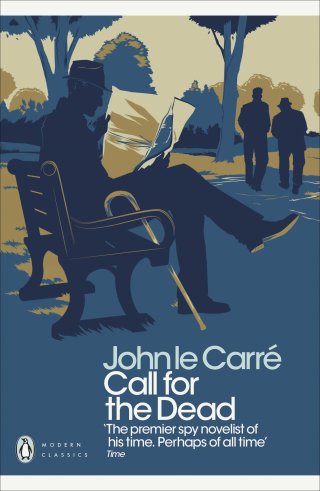
Call for the Dead by John le Carre, 1961

Call for the Dead is the first novel in which George Smiley appears, which of course is the right order in which to read a novel series, not jumping straight in with the last one as I carelessly did recently. Carre

The novel opens with the suicide of civil servant Samuel Fennan following a routine security check, which in turn had been prompted by an anonymous accusation that Fennan had been leaking secrets to/working for the Russians. This is the novel’s central puzzle – why would Fennan kill himself when the review was going to clear him? But kill himself he has, and it begins to look as if the investigating officer, one George Smiley, is going to be blamed for his death.

This is the first of the novel’s many improbabilities – despite it being obvious that there is at least a chance that Smiley is going to be implicated in the suicide, he is asked to investigate it. He interviews Fennan’s wife Elsa in her home. While there he answers the telephone, expecting the call to be for him, (oh for the days before mobiles!) but it is an alarm call from the telephone exchange which Fennan had booked the night before. Why would someone book a call and then kill themselves? Could it possibly be that this is not a suicide, but a murder staged to look like one? It could.

A local policeman Inspector Mendel, the classic copper only days from retirement, conducting the investigation into the Fennan case, begins to work with Smiley. Smiley’s boss (rather late in the day) orders him to drop the case, but a letter posted by Fennan the night before arrives, requesting an urgent meeting that day, confirming his suspicion this is murder! Smiley hands in his badge to pursue the case. Of course these may not have been such tired police procedural cliches in the 1960’s, but that is of limited consolation to a modern reader.

Can you guess what happens next? I suspect you can. Yes, before he can make much progress with the case, Smiley is hit on the back of the head in an alley by a mysterious assailant, and goes out like a light. He has just had time to find the lead that will crack the case, and expose the sinister East German agent who is behind it all.

Yes, there’s a twist, of sorts, but by now you will have got there already. So why does this novel seem so tired and predictable when Le Carre is widely seen as a master of his craft, writer of novels of byzantine complexity where you only find out what really happened on the last page? The Guardian ran an excellent parody of the novel a while back which does a good job of pointing out its combination of cliche, predictability, and improbability. As soon as the long holidays to Austria the Fennan’s took every year (in an era when even everyday civil servants were prohibited from travelling to Eastern Europe) it is obvious they are guilty as hell. There is no way Smiley or anyone would have cleared Fennan on the basis of the cursory chat that passes for an investigation into the allegations against him. As well as being the first Smiley novel this was also Le Carre’s first novel of any kind, and it went on to generate a series that is widely loved and respected, so I shouldn’t be too harsh. Smiley himself is an anti-hero, fat, balding, aging, but becomes over time a formidable spymaster, not that you would necessarily know that from this work alone. I may have ruined my enjoyment of the later books in the series by reading the last one first, but at least I can say I have given Le Carre a run for his (my) money!

Standard
Book review

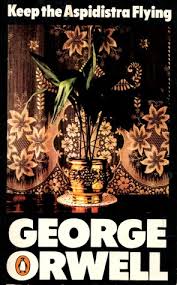
Keep the Aspidistra Flying, by George Orwell, 1936

Orwell

Gordon Comstock, anti-hero of Keep the Aspidistra Flying, is a failed poet, struggling with a premature mid-life crisis and what we would now characterise as depression. He expresses his feelings as resentment at the demands placed upon him by family and friends and rages against the need to work for a living. Rejecting a well-paid job in advertising, which he feels is beneath him, he instead works in a bookshop, spending long sad weeks struggling to make sure he can afford the next cigarette or pint of beer. He obsesses over the cost of everything. At first this is slightly comic, but the intensity of this obsession soon becomes wearisome. He is a misanthropic, grumpy figure who doesn’t deserve the friendship and love of those around him who care for him and look out for him, even though he goes out of his way to reject their help.

He lives a mean life in a dingy bedsit in Hampstead. In his spare time he picks away at his magnum opus ‘London Pleasures’. His fantasy of himself as a poet is fed by the earlier publication of a slim volume of poetry – ‘Mice’ – which sold only 153 copies despite positive reviews. His obsession with money poisons his relationship with his girlfriend Rosemary. They have nowhere to go to be together and Gordon’s pride means he won’t allow her to pay for even a cup of coffee. Rosemary suggest a day in the countryside, with a hint that this might be the long awaited opportunity to finally consummate their relationship (Orwell was to return to this idea – of a couple travelling out into the countryside to find somewhere private to have sex – in 1984). But the day doesn’t go well – in an attempt to impress Rosemary, he wastes most of his money on lunch at a fancy hotel. Later when they are about to have sex en plein air it doesn’t happen because Gordon has forgotten to bring any contraception. Like a spoilt child he is angry with her:

“Money again, you see! … You say you ‘can’t’ have a baby. … You mean you daren’t; because you’d lose your job and I’ve got no money and all of us would starve.”

When some money does finally come his way, in the form of payment for a poem sent speculatively to an American magazine, Gordon wastes it on another fancy dinner and ostentatious tips. He gets completely out-of-control drunk, leading to a night in the cells and the sack from his job the next morning. I am not sure if Orwell intended this episode to be comic, but it is quite the opposite, not least in the assault on Rosemary.

After “sponging” for a while off Ravelston, a more prosperous literary friend, Gordon secures a post in another book shop/lending library. Determined to sink to the lowest level of society but afraid of sleeping on the street, Gordon takes an even seedier bed-sit in Lambeth, (to have fallen so low!) and isolates himself from family and friends. There is no question at this point that Gordon is clinically depressed and he is hugely lucky to be loved by some of the most patient people on the planet. In desperation (at the state of his mental health) Rosemary has sex with him and while this doesn’t jolt him from his depression, the result of this episode (and thereby the conclusion to the novel) is predictable.

Keep the Aspidistra Flying has a strong, semi-autobiographical flavour. It was written in 1934 and 1935 when Orwell was living in London and clearly draws on his experiences in this period. There are numerous points of comparison between the life of the novel’s protagonist and his own. Orwell had written for The Adelphi, a left-wing literary journal edited by Sir Richard Rees, an obvious model for Ravelston, Comstock’s upper-class publisher and friend. Orwell had also worked in a second-hand bookshop in Hampstead, lived in squalid bedsits and struggled to find female companionship while attempting to write.

The novel has not aged well. Many of the social attitudes here will be uncomfortable to a modern reader. Comstock is homophobic, referring to a customer as a “nancy”. Orwell gives this character an affected lisp, and used similar language in correspondence and articles, so it is a reasonable assumption that he is here reflecting the everyday prejudice against homosexuality that was common in the 1930’s. Comstock also has disrespectful attitudes towards women, seeming only interested in them for sex:

This woman business! What a bore it is! What a pity we can’t cut it right out, or at least be like the animals—minutes of ferocious lust and months of icy chastity. Take a cock pheasant, for example. He jumps up on the hen’s backs without so much as a with your leave or by your leave. And no sooner is it over than the whole subject is out of his mind. He hardly even notices his hens any longer; he ignores them, or simply pecks them if they come too near his food.

Equally there is a horrible disdain for the working class here that only someone born into the middle-classes (and having been to Eton) could display. Of course one needs to be careful to not ascribe the character’s views to the author too easily, but the disgust with which the working classes – not least their terrible smelliness – is described seems authentic and is on a par with some of Orwell’s other work. Take this description of a pub for example:

“A foul yet coldish air enveloped them. It was a filthy, smoky room, low-ceilinged, with a sawdusted floor and plain deal tables ringed by generations of beer pots. In the corner were four monstrous women with breasts the size of melons.” 

Comstock explores the underworld of the very poor, as Orwell himself did when Down and Out in Paris and London, but is always an outsider looking in, with the safety net of the £4 a week job waiting for him whenever he wants it. There’s a cursory discussion of socialist ideas which could help Comstock escape the money he feels trapped by, but Orwell’s heart doesn’t seem in it. Gordon’s conversations with Ravelston never progress beyond the level of point facile scoring:

Every intelligent boy of sixteen is a Socialist. At that age one does not see the hook sticking out of the rather stodgy bait.

Whatever its aspirations this isn’t a novel of ideas. The portrait of the profoundly grumpy, sexist poet with a flair for getting extremely drunk may have been a partial inspiration for Kingsley Amis’s Lucky Jim, although there equally are some clear signs of borrowing from Sinclair Lewis’s 1922 novel Babbitt about a another individual’s struggle against the pressures of capitalism. “Keep the aspidistra flying!” is also the final line of Henry Miller’s novel Nexus (1959), and it also provided the title (if little else by way of inspiration) for Nancy Mitford’s 1949 “Love in a Cold Climate“.

Orwell wrote Keep the Aspidistra as a source of relatively easy income, and it shows. In a 1946 letter to a friend he wrote that this novel was one of the two or three books of which he was ashamed, saying that it was “written simply as an exercise; I oughtn’t to have published it, but I was desperate for money [-] At that time I simply hadn’t a book in me, but I was half starved and had to turn out something to bring in £100 or so.” It wasn’t until towards the end of his life, after the second world war, that he was to find his authentic voice as a novelist. Much of his best writing is to be found elsewhere, in his journalism, his essays and book reviews.

Standard
Book review

Collected Short Stories, by E. M. Forster, 1947

Having recently broken my short story review duck, I decided to read another collection, this time by the Edwardian modernist E. M. Forster. This edition, available as a Penguin 20th Century classic, is a good introduction to Forster, because it so clearly demonstrates what is wrong with his work, avoiding the need (if you are lucky enough to start here) to go on and read the novels.

The problem is essentially one of perspective. All of these stories, and I think this comment also applies to many if not all of the novels, are written from the narrow upper-middle class point of view from which Forster is never able to move away, no matter how he tries. All his point of view characters are to a greater or lesser extent prosperous, never seem to have to work, have servants or paid companions, and can afford long, indulgent if apparently unenjoyable journeys across southern Europe. Working class people and foreigners do appear in Forster, but the world is never seen from their perspective, and to be blunt they always seem two-dimensional participants.

Forster does, to be fair, consistently side with the people who are polite and condescending to these “others”. In novels such as Howards End and Where Angels Fear to Tread this extends as far as being able to contemplate relationships across class and national divides, but these relationships almost always end in tragedy or violence. Howard Bast is murdered, (Howards End) Gino loses his wife and baby (Where Angels) and Dr Aziz (Passage to India) has his life ruined by the false accusations made against him. Here the Greek family who are kind to Mr Lucas in The Road from Colonus are wiped out in a freak accident the day he moves on.

I don’t know whether Forster was unable to see the world through the eyes of the people who obviously fascinated and attracted him, or simply chose to write about what he knew. The relentlessness of yet another group of fussy English people settling into yet another picturesque Southern European town, with its hotels, its funny foreigners, the stereotypical alpha-male trying to assert himself by speaking English loudly, the older women, often in pairs, fussy about their luggage, eventually becomes wearisome.

Forster kept his sexuality a well-guarded secret in his lifetime, refusing to publish Maurice until after his death, but the homo-erotic gaze is also apparent here, not least in The Story of the Siren where a young Italian diver entrances the narrator:

“With a jerk he became alive, seizing my arm and saying “…I will show you something beautiful”….He drew me away from the light till I was standing on the tiny beach of sand…there he left me with his clothes…for a moment he stood naked in the brilliant sun…the man is past all description. His effect was that of a silver statue.”

(I’ve edited some text here to emphasis the point. Quite why he needs to be naked to go diving to recover a book, which surely would have floated anyway (thus avoiding the need for the naked diving) is unclear.)

These stories differ from the novels in one important way, and that is in their handling of the supernatural. In the introduction to the 1947 edition Forster describes them as “fantasies”. An element of the other-worldly is introduced in most tales. In some it is creatures such as Pan, fauns or sirens; in others it is the afterlife – one character goes to heaven, finds it boring, and leaves. Another character escapes from a boorish fiance by becoming a tree. At some points these injections of fantasy seem largely whimsical, and to this reader at least a little nauseatingly so. Elsewhere the allegorical nature of the tale is more obvious. In The Other Side of the Hedge for example, life is described in Bunyanesque terms as a walk beside a hedge, on one side of which is a hard-paced race with no obvious end in sight, and on the other an Elysian paradise of fields and recreation.

The Story of a Panic, the first story in the collection, demonstrate many of the inherent problem in Forster’s use of the fantasy genre. It is a silly melodramatic story about a sulky teenage boy, Eustace, (possibly the inspiration for Eustace Scrubb?) who one day, while on a walk in the ubiquitous Italian countryside, is possessed by the spirit of Pan. Instead of narrating the story in a way that is at least marginally sympathetic to the child, giving us some insight into what happens to him, Forster narrates the tale through the eyes of an older English tourist, who insists on being addressed formally, and looks sneeringly down on the Italians working in the hotel.  This strange little mis-firing tale establishes the template for many of the other stories in the collection, where essentially the same mystical experience is predictably repeated using the same set of characters and features. The tiresome and repetitive nature of these motifs almost became too much for me by the end of the collection, to the point where I didn’t want to read on because a) I knew what was coming, and b) I felt patronised by it. The most interesting story in the collection, The Machine Stops, which I reviewed earlier this year, is an exception to the fantasy genre, and is all the more refreshing for it.


Standard
Book review

Tarzan of the Apes, by Edgar Rice Burroughs, 1912

Tarzan of the Apes is unquestionably pulp fiction, but it is also great fun, if you can stomach the appalling colonialist attitudes. Tarzan has become one of those archetypal characters from fiction – Dracula, Frankenstein, Sherlock Holmes – with a life far beyond the confines of their original story. Rice Burroughs went on to really milk the most possible value from the original success of his story of the ape-man, with around 25 sequels including Tarzan and the Foreign Legion and Tarzan at the Earth’s Core to name just a couple.

I am sure you know the bones of the Tarzan story. Newly-wed Lord Greystoke, an English aristocrat and his young wife are marooned on a deserted African shoreline following a mutiny by the crew. Here they create a mini-Eden, building a thatched hut with all-mod cons. Lady Greystoke gives birth to an heir, only to succumb to a fit of the vapours following a lion attack. Lord Greystoke quickly follows his wife, leaving young Tarzan to be adopted and brought up by the apes of the jungle. Interestingly these are not gorillas – Rice Burroughs is very specific on that point. This (invented) species of ape bears many similarities to the gorilla, but can speak a primitive language. Tarzan grows up among them, acquiring his physical prowess. He also discovers his parents’ hut and his father’s knife, which allows him to win a series of battles with the alpha-males in his troupe, as well as other beasts, finally becoming king of the jungle.

In parallel Tarzan teaches himself (improbably) to read and write and discovers more about his ancestry and the world beyond his jungle. Rice Burroughs was obviously taken with the idea of white people being marooned on the coast of Africa by mutinous sailors, because he re-uses this plot-device to introduce Jane Porter, lovely young American heiress, her eccentric father Professor Porter, and her suitor Clayton, Lord Greystoke. Yes, another Lord Greystoke, Tarzan’s cousin, has pitched up on the same shore in the same manner, twenty years on. This sums up the laziness of Rice Burroughs writing. Why bother inventing a new plot device when there’s a perfectly good one available that is only 15 chapters old?     

You won’t be surprised to hear that this novel is profoundly racist. The African natives Tarzan encounters are uncivilised, superstitious cannibals and they are wiped out by the French sailors towards the end of the novel without compunction.  Jane’s maid, Esmerelda, is a cliched American  lawks-a mercy caricature, always using clumsy malapropisms in a very unfunny manner and fainting every few minutes. The novel appears to accept an evolutionary link between man and beast, but the natural order in which white men are superior to dark-skinned men and beasts, and aristocratic white men are superior to all, is insisted on throughout.

Only in the novel’s portrayal of sex is there any hint of transgression. When Jane is first kidnapped by one of the apes, it is made explicitly clear that he intends to rape her.

“The tribe had kept his women. He must find others to replace them. This hairless white ape would be the first of his new household, and so he threw her roughly across his broad, hairy shoulders and leapt back into the trees” (Chapter 19)

Jane’s response to Tarzan when he rescues her is intensely sexual.

Jane—her lithe, young form flattened against the trunk of a great tree, her hands tight pressed against her rising and falling bosom, and her eyes wide with mingled horror, fascination, fear, and admiration—watched the primordial ape battle with the primeval man for possession of a woman—for her.

As the great muscles of the man’s back and shoulders knotted beneath the tension of his efforts, and the huge biceps and forearm held at bay those mighty tusks, the veil of centuries of civilization and culture was swept from the blurred vision of the Baltimore girl.

When the long knife drank deep a dozen times of Terkoz’ heart’s blood, and the great carcass rolled lifeless upon the ground, it was a primeval woman who sprang forward with outstretched arms toward the primeval man who had fought for her and won her.

And Tarzan? He did what no red-blooded man needs lessons in doing. He took his woman in his arms and smothered her upturned, panting lips with kisses. For a moment Jane lay there with half-closed eyes. For a moment—the first in her young life—she knew the meaning of love.

Note Jane’s response is in part to Tarzan’s muscles, but also to his violence, and she goes to him – indeed springs towards him. This would have been titillating to Rice Burrough’s Edwardian audience. This is not a novel for nice young women, but an adventure story for frustrated young men. The erotic emphasis on Tarzan’s musculature is relentless.

A feeling of dreamy peacefulness stole over Jane as she sank down upon the grass where Tarzan had placed her, and as she looked up at his great figure towering above her, there was added a strange sense of perfect security. As she watched him from beneath half-closed lids, Tarzan crossed the little circular clearing toward the trees upon the further side. She noted the graceful majesty of his carriage, the perfect symmetry of his magnificent figure and the poise of his well-shaped head upon his broad shoulders.

What a perfect creature! There could be naught of cruelty or baseness beneath that godlike exterior. Never, she thought had such a man strode the earth since God created the first in his own image.

However I am not sure how transgressive this actually is – while sexual activity between a young woman and a jungle man would have been taboo, we are never allowed to forget Tarzan’s aristocratic origins.

If you enjoy reading origin stories out of a sense of curiosity (in what way does the popular culture version of the character differ from the original?) Tarzan will keep you diverted for a couple of hours, but I doubt few if any readers will feel compelled to read any further in Tarzan’s adventures, which I suspect are simply reiterations of this template.

Standard
Book review

The Buried Giant, by Kazuo Ishiguro, 2015

The Buried Giant is an enigmatic, allegorical novel. Do those two features work well together – can an allegory actually be enigmatic, because if it is then is it really an allegory (and if so of what?). These are the questions that I am grappling with in shaping this review, whereas I suspect they may actually be a distraction, because The Buried Giant is first and foremost an enjoyable story.

Set in Britain in what became known as the Dark Ages, the period in history roughly between the departure of the Roman occupation and the Norman Conquest, this novel tells the story of two Britons, Axl and Beatrice, as they journey from their village to visit their son. Journeys of this nature were at the best of times dangerous and challenging, here all the more so because Axl and Beatrice are old. Although peace has descended on the countryside following years of conflict between Britons and Anglo-Saxons, this is still a world full of danger and menace, so of it very practical – a fall or an infection could easily prove fatal – and some of it fantastical, such as the unspoken threat that lurks on the Great Plains, or the ogres that steal children away from villages.

The fantasy element of the novel sits a little uncomfortably alongside the highly realistic portrait of Dark Ages life, in all its primitive, brutish and short nastiness. It becomes slowly apparent that the people are being affected by a form of collective amnesia – Axl and Beatrice refer to it as ‘the mist’ meaning that they quickly forget even recent events, and lives their lives in a fog of the very recent past. Axl sometimes wonders if this is a blessing, allowing them to forget upsetting incidents in their past, whether it be the conflicts that have swept across the land between Britons and Anglo-Saxons, or the personal problems the couple have faced, despite appearing the model of old-age devotion.

An adventure element to the novel is introduced with the character of Wistan, an Anglo-Saxon warrior sent by his king in the fens to travel west on an unspecified quest. Wistan rescues a boy from some ogres and agrees to share Axl and Beatrice’s journey for some of the way. They meet an aging Sir Gawain, knight of the Round Table, who is also on a quest. Slowly the truth about the amnesia causing fog and the characters’ back story emerges, and while I don’t think I would be spoiling the plot for you if I said more, I won’t in case it might. The adventure element of the novel keeps the pages turning, even if the allegorical nature of the plot (nothing is ever just itself – it always represents or stands for something, and after a while this gets a little distracting) is really what we are here for, with the sword fights and escapes through mysterious tunnels just a bit of a distraction.

This is very much an aside, but I would have liked it if Ishiguro had avoided some of the cliches about the Dark Ages. Of course they were difficult dangerous times, but the savagery and lawlessness that is suggested is probably wrong. There is evidence, principally archaeological, that travel and trading between Britain and the continent continued after the Romans left, and that society continued in many ways unchanged, with cooperation and inter-marriage between Britons and Anglo-Saxons. But of course it suits the narrative here to have these as savage times.

So what’s the novel an allegory of? It’s a meditation on relationship, naturally, but however touching the relationship of Axl and Beatrice is this is not more than a portrait of a couple growing old together and coming to terms with the challenges their marriage has faced over the years. In the end Axl faces the loss of his wife with stoicism. Their journey through the country can be seen as Bunyanesque, with the challenges they face as metaphorical manifestations – ogres, dragons, dog-beasts – of child-rearing, infidelity and old-age. You have to work hard at these allegorical associations – Ishiguro doesn’t join any dots for the reader – and I am not convinced that they really work. Everyone will have their own personal interpretation of these symbols. The Buried Giant itself only appears in passing, and is a slightly easier puzzle – conflict in the land has been buried by the collective amnesia caused by Merlin’s spell, and when it awakes there will be a heavy price to pay.

I’ve read a few negative reviews of this novel, both when it was published and subsequently in preparing for this post. Some of the objections are relatively trivial – if the identity of the narrator in some chapters is unclear, does it really matter? (I did notice, and it niggled slightly, but I got over it). The concerns about Ishiguro appropriating the tropes of fantasy fiction – which when it boils down to it that just  means dragons – seem a bit ridiculous in hindsight. Of course you can put dragons into your novels if you want to, who says you can’t? That doesn’t mean you are showing disrespect to the authors who were writing about dragons before you came along with your Nobel prize and your realism. I think this is one of those novels that unsettle readers and reviewers when it first comes out, but over time comes to be appreciated for what it is.

Despite my minor reservations, this was a genuinely enjoyable read. The characters are interesting, and you come to care about them as more than just cyphers for the values they represent. Post-Roman England is realistically portrayed. What I really like about Ishiguro’s work is that he refuses to be pigeon-holed by genre – novels as varied as this work, Never Let Me Go and The Remains of the Day are all worth reading. Although it was published in 2015 this is his most recent novel – let’s hope the fuss about the use of fantasy tropes when it come out haven’t put Ishiguro off taking risks in his fiction.


Standard
Book review

The Lottery, and other stories, by Shirley Jackson, 1949

I haven’t checked but I think this may well be the first collection of short stories I have reviewed in over 400 posts. That must at least be in part because I focused on the Guardian’s top 100 novels for a long time, but it is probably also a comment on the limitations of the short story as a literary form. Most publishers, even in this case, feel compelled to gather them together in a quasi-novel format of approximate novel length.

Having said that, this collection works well as a whole, and the use of The Lottery as a conclusion gives the whole text a strong collective punch. The Lottery is by far Jackson’s best known short story, and rightly so – it is an extraordinary, bleak portrait of rural America descended into a controlled, ritualistic form of Taliban-style barbarism. The citizens of a small, unnamed farming community gather on 27th June for a traditional ceremony involving the drawing of lots, the purpose of which is only fully revealed in the story’s closing lines. The ceremony is a harvest sacrifice – “Lottery in June, corn be heavy soon” – of the kind practised by primitive societies. Whilst the story is chillingly bleak, there is some hope offered in the asides that confirm that some communities are abandoning what is obviously a long-established tradition of human sacrifice by stoning to death.

Originally published in 1948 The Lottery revealed the potential for savagery lurking under the veneer of civilisation in America. I understand it is read widely in American schools, although in the UK it is not, by comparison, well known. If I was teaching English teenagers I would definitely use this powerful exploration of how we in the West think of ourselves as so advanced but how we are just one step away from the jungle. The tiny details in The Lottery are what give it its power – the calm, bucolic portrait of the villagers gathering in good cheer, chatting quietly to one another about this and that, the officials fussing about getting things underway, and then slowly the panic builds as the lottery starts.

I am sure this point has been made many times before, but there are strong echoes between The Lottery and The Hunger Games. Instead of a simple sacrifice the later novel uses the concept of a lottery as the starting point for a to-the-death gladiatorial contest, but the random selection of an ordinary person chosen for the sacrifice is such a powerful concept that I can understand why Collins would have been inspired by it.

None of the other short stories in this collection feature such a gruesome turn of events as that in The Lottery. They are mainly set in domestic, suburban settings, in which housewives, often newly wed or with small children, struggle to settle into new homes. Usually there is a sinister undertone to the stories, a sense of repressed threat which finally explodes in the Lottery, thus justifying its place at the climax of the collection. Sometimes the stories are simply sketches of brief if unsettling incidents, such as The Witches, in which an old man on a train disturbs a family with inappropriately gruesome reference to witchcraft. Other longer stories feature women past their prime living lives of quiet desperation, with the minutiae of everyday life becoming oppressive.

Jackson links these 25 stories thematically and in terms of their setting – they all seem to take place at roughly the same period of time, and in the same middle-American setting. They are linked further by the use of the same name for several characters across the different stories – indeed the original title of the collection was going to be ‘The Lottery and the Adventures of James Harris’. This unsettles the reader – are we following different events in the lives of the characters, or unrelated stories featuring people who just happen to share a common name? Is there any continuity between the stories? This is a world in which the supernatural still lurks beneath the surface of everyday life, a world where the memory of Salem Witch trials still troubles, and where people believe in daemons.

Jackson is a fine stylist. Not a word is wasted. If you want to dip into her work The Lottery is a great if atypical starting point, but I would recommend this collection as a more representative selection of her writing.

Standard