Six years after Trafalgar, while the Peninsular War rages on the continent and social discontent stirs at home, Jane Austen turned her attention to the challenges facing a very specific class of young women in Georgian England.
A complex will, and the early death of the family’s father, see the widowed Mrs Dashwood, and daughters, Elinor, Marianne and Margaret, left with a small income and no residence. John, half brother to the sisters and heir to the family home, undertakes to care for his half-siblings, but quickly reneges on the promise in one of those acts of self-persuasion in which Austen’s characters specialise. Treated as unwelcome guests in what has been until recently their family home, the Dashwoods relocate to to Barton Cottage in Devon , near the home of their relative, Sir John Middleton, although not before oldest daughter Elinor has ‘formed an attachment’ with Edward Ferrars, brother of their half-brother’s wife. I hope you are following this because there will be a quiz. (In following the narrative it helps to understand the convention that if there are two or more unmarried sisters, the eldest will be Miss Dashwood, and the younger Miss Marianne Dashwood, etc. A pen and paper help as well).
Settling into their modest new home in Devon, the Dashwood ladies also settle into what constitutes Devon society, assisted by Sir John, his wife, Lady Middleton, his mother-in-law, the rather common Mrs Jennings, and family friend, Colonel Brandon. The Colonel is attracted to Marianne, although she finds the almost twenty-year age gap off-putting. To be fair she is only sixteen, so you can understand her concerns.
While out walking one day, Marianne sprains her ankle, and is carried home by a charming young rescuer, John Willoughby. Willoughby and Marianne quickly become very close, and their intimate behaviour soon suggests to Mrs Dashwood and Elinor that they are engaged. Willoughby takes Marianne to see the home he expects to inherit one day, and cuts off a lock of her hair. Taking a lock of hair is a traditionally symbolic and intimate act. But the long awaited engagement fails to materialise. Then out of the blue Willoughby informs the family that has to go to London on business,and is unlikely to return within the year. Marianne is devastated.
One beau is replaced by another. Edward Ferrars comes to visit. Remember him? Mysteriously, his earlier intimacy with Elinor is missing. He is restrained and diffident. Shortly after his puzzling visit, the Misses Steele, Anne and Lucy, cousins of Mrs. Jennings, come visiting, and in the first of many plot twists Lucy secretly tells Elinor she is engaged to Edward. Unable to see any wrong in a man who had apparently wooed her just a few months earlier, Elinor speculates that this is a loveless engagement which Edward’s sense of honour will not allow him to end.
At this point the speed of events accelerates. The Dashwood sisters (apart from the near invisible Margaret) travel with Mrs Jennings to London, to join the parties and dances that are a way of passing the time for the idle rich. Knowing him to be in town, Marianne writes to Willoughby, trying to arrange an assignation, but her letters go unanswered. Several days later, as Marianne’s distress at his silence escalates, they meet by chance at a dance, and Willoughby, with another woman, brushes Marianne off coldly. A blunt letter follows which claims that there was never any substance to their relationship, and telling her than he is now engaged to another woman. Young heiresses are a stock figure in these novels, along with cads, bluff uncles, giddy younger sisters and indulgent fathers. Marianne is once again devastated, and falls into a decline in which her health suffers. In a self-interested attempt to help, Colonel Brandon reveals to Elinor that Willoughby is a scoundrel who has previously seduced, impregnated, then abandoned Brandon’s young ward, Miss Eliza Williams.
Meanwhile, the Steele sisters have come to London as guests of Mrs Jennings. Unable to keep a secret, talkative Anne Steele betrays Lucy’s engagement to Edward. Chaos ensues. The Misses Steele are turned out of the house, and Edward is ordered by his wealthy mother to break off the engagement. He refuses and is promptly disinherited in favour of his brother, Robert.
So where does that leave the Dashwood ladies. Elinor’s love Edward is marrying someone beneath him, and who she suspects he does not love. Marianne’s love Willoughby is by now married to his heiress, and forever out of reach. And the novel is in its concluding chapters, so the author needs to hurry up and sort this out!
Marianne, moping over Willoughby, catches a cold and becomes dangerously ill. Colonel Brandon goes to fetch Marianne’s mother to her bedside. Unexpectedly, in a moment of what I suspect is intended to be high drama, Willoughby arrives. He confesses all to Elinor – his love for Marianne was genuine and having married for money he is now miserable. This is all well and fine but doesn’t really explain away his seduction of Colonel Brandon’s niece does it? Elinor softens somewhat but there’s not much she can say to him by way of comfort – he has made his choices.
Happily, Marianne recovers from her illness, and is told of Willoughby’s visit. Marianne, showing a maturity sadly missing only weeks earlier, tells her family that she could never have been happy with Willoughby, and dedicates herself to a monastic life of study and good work. Here the sound of ends being tied up becomes deafening. Edward arrives and reveals that Lucy has implausibly married his now wealthy younger brother, Robert. Edward and Elinor marry, and finally Marianne comes to terms with his advanced old age and marries Colonel Brandon.
Nobody reads Austen for the car chases and the suspense. We know what is going to happen, and little gets in the way of the long-awaited happy ever after. So the entertainment value of the novel, and in many ways in all of Austen’s work, resides not in incident but in the portraits of human nature she sketches. She is particularly good at catching the stifling nature of the lives of middle class women, unable to join the men in hunting, so condemned to sketching, music, reading (Marianne claims to have read everything in her family library, and anticipates reading six hours a day) and so bored. All they have to do is gossip, size up the value of people’s estates and income, and plan romances between the younger people.
Austen’s portraits of her minor characters is a particular strength of this novel. For example, Mrs Palmer, second daughter of Mrs Jennings, (Chapter 19)
“was several years younger than Lady Middleton, and totally unlike her in every respect. She was short and plump, had a very pretty face, and the finest expression of good humour in it that could possibly be. Her manners were by no means so elegant as her sister’s, but they were much more prepossessing. She came in with a smile, smiled all the time of her visit, except when she laughed, and smiled when she went away.”
Her wonderfully grumpy husband clearly has little or no respect for his kind wife; he:
“was a grave looking young man of five or six and twenty, with an air of more fashion and sense than his wife, but of less willingness to please or be pleased. He entered the room with a look of self-consequence, slightly bowed to the ladies, without speaking a word, and, after briefly surveying them and their apartments, took up a newspaper from the table, and continued to read it as long as he staid.
The interaction between Mr Palmer and his wife is comedy gold:
“Well! what a delightful room this is! I never saw anything so charming! Only think, Mama, how it is improved since I was here last! I always thought it such a sweet place, ma’am! (turning to Mrs. Dashwood) but you have made it so charming! Only look, sister, how delightful every thing is! How I should like such a house for myself! Should not you, Mr. Palmer?”
Mr. Palmer made her no answer, and did not even raise his eyes from the newspaper.
“Mr. Palmer does not hear me,” said she, laughing; “he never does sometimes. It is so ridiculous!”
When it is revealed that Mrs Palmer is pregnant (“in her situation“), Lady Middleton is shocked that such matters are openly discussed, and
“could no longer endure such a conversation, and therefore exerted herself to ask Mr. Palmer if there was any news in the paper.
“No, none at all,” he replied, and read on.”
Austen can at times be harsh with her characters. She creates some wonderful monsters that are never just caricatures. Lady Middleton is described as having “a kind of cold hearted selfishness” and Mrs. Ferrars was “a little, thin woman, upright, even to formality, in her figure, and serious, even to sourness, in her aspect. Her complexion was sallow; and her features small, without beauty, and naturally without expression; …She was not a woman of many words; for, unlike people in general, she proportioned them to the number of her ideas”.
The other obsession everyone seems to have is with money. One’s worth is weighed in savings and income to the nearest penny, and futures are decided on the basis of who has how much. Willoughby does not seriously consider marrying Marianne because of her relative poverty, but his wife has:
“Fifty thousand pounds, my dear. Did you ever see her? a smart, stylish girl they say, but not handsome. I remember her aunt very well, Biddy Henshawe; she married a very wealthy man. But the family are all rich together. Fifty thousand pounds! and by all accounts, it won’t come before it’s wanted; for they say he is all to pieces. No wonder! dashing about with his curricle and hunters! Well, it don’t signify talking; but when a young man, be who he will, comes and makes love to a pretty girl, and promises marriage, he has no business to fly off from his word only because he grows poor, and a richer girl is ready to have him.” (Chapter 30)
Writing about boredom without being boring is difficult. Austen uses her observations of how ridiculously people behave in these situations, drawing humour from the absurdity. Here for example the women are discussing the heights of their children,
“Harry Dashwood, and Lady Middleton’s second son William, who were nearly of the same age. Had both the children been there, the affair might have been determined too easily by measuring them at once; but as Harry only was present, it was all conjectural assertion on both sides; and every body had a right to be equally positive in their opinion, and to repeat it over and over again ……The two mothers, though each really convinced that her own son was the tallest, politely decided in favour of the other.
The two grandmothers, with not less partiality, but more sincerity, were equally earnest in support of their own descendant.
Lucy, who was hardly less anxious to please one parent than the other, thought the boys were both remarkably tall for their age, and could not conceive that there could be the smallest difference in the world between them; and Miss Steele, with yet greater address gave it, as fast as she could, in favour of each.
Elinor, having once delivered her opinion on William’s side, by which she offended Mrs. Ferrars and Fanny still more, did not see the necessity of enforcing it by any farther assertion; and Marianne, when called on for hers, offended them all, by declaring that she had no opinion to give, as she had never thought about it.”
Austen is also one of the greatest users of narrative point of view. Most of the novel’s events are shown through Elinor’s eyes – we know what she is thinking and feeling, but events elsewhere are effectively “off-screen”. When this perspective shifts, as it does occasionally, the reader knows to sit up and pay attention, such as in this scene where the point of view switches to that of Mrs Jennings, observing Elinor and the Colonel having a private conversation (Marianne is playing the piano making it hard to overhear:
“on Elinor’s moving to the window …he followed her to it with a look of particular meaning, and conversed with her there for several minutes. The effect of his discourse on the lady too, could not escape her observation, for though she was too honourable to listen, and had even changed her seat, on purpose that she might NOT hear, to one close by the piano forte on which Marianne was playing, she could not keep herself from seeing that Elinor changed colour, attended with agitation, and was too intent on what he said to pursue her employment.”
She assumes there has been a proposal. Austen gives us a “what really happened” explanation very shortly thereafter. There is a similar and even more dramatic shift of perspective in the novel’s concluding chapters when Edward comes to tell Elinor he is a free man, and to propose to her.
“His errand at Barton, in fact, was a simple one. It was only to ask Elinor to marry him;—and considering that he was not altogether inexperienced in such a question, it might be strange that he should feel so uncomfortable in the present case as he really did, so much in need of encouragement and fresh air. How soon he had walked himself into the proper resolution, however, how soon an opportunity of exercising it occurred, in what manner he expressed himself, and how he was received, need not be particularly told. This only need be said;—that when they all sat down to table at four o’clock, about three hours after his arrival, he had secured his lady” (Chapter 49).
“need not be particularly told”! I beg to differ. There is another example of this turning aside at the last minute and leaving the fictional lovers a moment of intimate privacy at the point of engagement in Northanger Abbey. Perhaps this was a literary convention of the time, although if it was Austen ignores it in Pride and Prejudice for example.
The novel concludes with a wrapping up of events that the reader has expected from the start, albeit with a touch of regret for the loss of innocence in Marianne
“Instead of falling a sacrifice to an irresistible passion, as once she had fondly flattered herself with expecting,—instead of remaining even for ever with her mother, and finding her only pleasures in retirement and study, as afterwards in her more calm and sober judgment she had determined on,—she found herself at nineteen, submitting to new attachments, entering on new duties, placed in a new home, a wife, the mistress of a family, and the patroness of a village.”
Notice how almost all the verbs used to describe Marianne’s future are passive – she falls. remains, submits, and is placed in a new home. You have to wonder what element of choice she genuinely exercises, even though the answer is of course none, because she is fictional!
Two final thoughts on what is already an overly long review:
- I can’t help but wonder what happens to poor forgotten younger sister Margaret?
- You may have noticed that I have not illustrated this review with a copy of the novel’s book cover – this is because they were all universally awful!

 several times before, this causes them less concern that you would expect, and another last minute rescue leads to the party (Arthur Dent, earthling, Trillian, hitchhiker, Ford Prefect, researcher for the Hitchhiker’s Guide to the galaxy, Zaphod Beeblebrox, President of the Galaxy, and Marvin, the paranoid android) being separated once again.
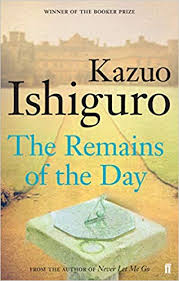 ails of the story emerge in the gaps between what the narrator tells us, and what we can perceive is actually happening. Here Ishiguro pushes the flawed narrator concept even further – Stevens’s memories are carefully layered to reveal a portrait of a man profoundly reserved and out of touch with his feelings, who comes to fear that he has wasted his life, and worse still will waste what remains to him. Several memories are revisited more than once in the course of the novel, with Stevens’s revisions and corrections revealing each time further insights into his decisions and thought processes.
 restaurant at the end of the universe, and life the universe and everything, now have their own existences far beyond the confines of this novel.